NASA Scientists Take to the Seas to Study Air Quality

NASA Scientists Take to the Seas to Study Air Quality

4 min read

Preparations for Next Moonwalk Simulations Underway (and Underwater)

Satellites continuously peer down from orbit to take measurements of Earth, and this week a group of scientists set sail to verify some of those data points.

On June 2, the SCOAPE (Satellite Coastal and Oceanic Atmospheric Pollution Experiment) research team, in partnership with the U.S. Interior Department’s Bureau of Ocean Energy Management, took to the seas in the Gulf of Mexico for its second campaign to make surface-based measurements of air pollutants.

In the foreground of the image in the bottom right corner of the image is a portion of a boat. The deck of the boat is a gray color and has several large pieces of equipment on it including pully systems. There are four people standing on the deck of the boat. In the background is the deep blue ocean, which looks flat, and meets up with the light blue sky at the horizon. In the top left corner of the image is a large white balloon, which has just been released from the boat.
The NASA/GSFC SCOAPE team launches an ozonesonde weather balloon from the stern of the research vessel Point Sur during the May 2019 cruise.
Ryan Stauffer (NASA/GSFC)

The primary pollutant scientists are measuring is nitrogen dioxide (NO2), the compound that reacts with sunlight to make ground-level ozone, said Anne Thompson, senior scientist emeritus for atmospheric chemistry at NASA’s Goddard Space Flight Center in Greenbelt, Maryland, and senior researcher at the University of Maryland, Baltimore County.

The Gulf of Mexico is highly concentrated with oil and natural gas drilling platforms, which are sources of NO2. By taking measurements of these emissions from the sea surface nearby, scientists can help validate measurements taken from a much different vantage point. The research vessel the scientists are using, Point Sur, is owned by the University of Southern Mississippi and operated by the Louisiana Universities Marine Consortium.

The deep blue of the ocean meets the light blue of the sky in a straight horizontal line at the bottom of the image. Emerging from the ocean are four large red pillars which hold up the oil platform. The platform is covered in large machinery including several cranes. At the top of a structure on the left side of the platform, a fire flares. A small helicopter is seen above the top right of the platform.
The Petronius deepwater oil platform flaring during the May 2019 SCOAPE cruise. The helicopter in the foreground is used as a means of transporting personnel to and from the platform.
Ryan Stauffer (NASA/GSFC)

“We’re the eyes on the surface to understand how well the eyes in the sky are working,” said Ryan Stauffer, research scientist for the atmospheric chemistry and dynamics laboratory at Goddard. Stauffer is also the principal investigator for the SCOAPE II project.

For the first iteration of the project in 2019, ship-based measurements were compared to data gathered by the Ozone Monitoring Instrument aboard NASA’s Aura satellite and the Tropospheric Monitoring Instrument aboard ESA’s (European Space Agency) Sentinel-5 Precursor satellite. Both instruments fly on polar orbiting satellites, which pass over every part of the globe once per day. They capture snapshots at the same time each day, but cannot capture the short-lived NO2 emissions that come and go at different times.

In 2024, the research team is working to validate the measurements taken by TEMPO (the Tropospheric Emissions: Monitoring of Pollution instrument), which was launched on a commercial satellite in April 2023. The TEMPO instrument provides a different perspective to the NO2 measurements due to its geostationary orbit — it focuses solely on North America and has a constant view of the Gulf of Mexico region. This allows scientists to better quantify emissions and make comparisons across all daylight hours.

From space, satellites collect measurements of the “total column” of air, which means they measure the concentrations of NO2 from the land or ocean surface all the way up to the top of the atmosphere. With SCOAPE, scientists are taking measurements from the ship, about 33 feet above sea level, to focus measurements on the air that people breathe.

In the foreground of the image is a scientific instrument, which is shadowed due to the sunset behind it. In the background of the image, the ocean meets the sky at the horizon, and the sun is placed directly on the horizon emitting a yellow orange sunset that fades as it rises into the sky.
The SCOAPE Pandora spectrometer instrument, which were used to gather the air quality near the operation sites, during sunset with a shallow water gas platform on the horizon.
Ryan Stauffer (NASA/GSFC)

Learning more about how those surface measurements compare to what satellites see in the total column can help scientists figure out how to use satellite data most effectively. Measuring NO2 from space over the past two decades has helped scientists understand how the compound affects air quality, and has helped to inform policies to reduce emissions of the pollutant.

During SCOAPE’s 2019 campaign, researchers detected concentrations of methane – a significant greenhouse gas – near the Gulf Coast. This time around, the scientists are  looking to accurately measure these concentrations from the surface as well. They will mount the NASA Airborne Visible and InfraRed Imaging Spectrometer–3 imaging spectrometer instrument on a Dynamic Aviation B-200 plane to collect methane measurements above the Gulf, which will add an extra layer to understanding emissions of this potent greenhouse gas from Gulf of Mexico oil and gas operations.

It has historically been difficult to measure methane from space, but scientists are working to build those capabilities. As with NO2, taking surface measurements helps scientists better understand the measurements taken from space.

By Erica McNamee

NASA’s Goddard Space Flight Center, Greenbelt, Md.

Share

Details

Last Updated

Jun 06, 2024

Editor
Kate D. Ramsayer
Contact
Erica McNamee
Location
Goddard Space Flight Center

Powered by WPeMatico

Get The Details…
Erica McNamee
Boeing’s Starliner Approaching Station Live on NASA TV

Boeing’s Starliner Approaching Station Live on NASA TV

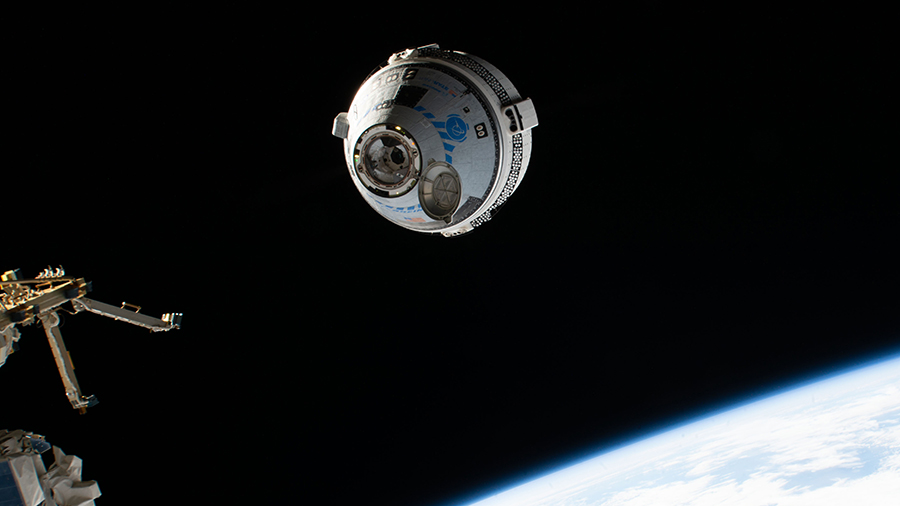
Boeing's Starliner crew ship approaches the space station during the company's uncrewed Orbital Flight Test-2 mission on May 20, 2022.
Boeing’s Starliner crew ship approaches the space station during the company’s uncrewed Orbital Flight Test-2 mission on May 20, 2022.

NASA’s arrival coverage of Boeing’s Starliner spacecraft to the International Space Station is now underway on NASA+, NASA Television, the NASA app, YouTube, and the agency’s website. Docking is scheduled at approximately 12:15 p.m. EDT Thursday, June 6.

NASA astronauts Butch Wilmore and Suni Williams launched safely on the Starliner spacecraft on a United Launch Alliance Atlas V rocket at 10:52 a.m. June 5 from Space Launch Complex-41 at Cape Canaveral Space Force Station in Florida.

The Starliner crew continues to make their way to the space station. During flight, Wilmore and Williams successfully performed manual piloting demonstrations of Starliner and completed a sleep period. Prior to crew sleep, mission teams identified three helium leaks in the spacecraft. One of these was previously discussed before flight along with a management plan, and the other two are new since the spacecraft arrived in orbit. To monitor and manage these leaks, the three helium manifolds were isolated. Those manifolds have all been reopened prior to a Starliner height adjust burn, called NHPC. All affected manifolds will remain open for rendezvous and docking operations.

Following in-flight reviews of the mission and helium leaks, the Starliner and International Space Station mission management teams are “go” to proceed with space station arrival. The flight control team will continue to monitor the leak rates in Starliner’s propulsion system. After docking, all of Starliner manifolds will be closed per normal plans. All other Starliner systems are functioning normally.

NASA’s arrival and in-flight event coverage is as follows (all times Eastern and subject to change based on real-time operations):

12:15 p.m. – Targeted docking

2 p.m. – Hatch opening

2:20 p.m. – Welcome remarks

3:30 p.m. – Post-docking news conference at NASA Johnson with the following participants:

  • NASA Associate Administrator Jim Free
  • Steve Stich, manager, NASA’s Commercial Crew Program
  • Jeff Arend, manager for systems engineering and integration, NASA’s International Space Station Office
  • Mark Nappi, vice president and program manager, Commercial Crew Program, Boeing

Coverage of the post-docking news conference will air live on NASA+, NASA Television, the NASA app, YouTube, and the agency’s website.

To attend the post-docking briefing, U.S. media must contact the NASA Johnson newsroom at: jsccommu@mail.nasa.gov or 281-483-5111 by 1 p.m. June 6. To join by phone, media must contact the NASA Johnson newsroom by 3 p.m. June 6.

5:50 p.m. – NASA Administrator Bill Nelson, Deputy Administrator Pam Melroy, Associate Administrator Jim Free, Associate Administrator for Space Operations Ken Bowersox, and Johnson Space Center Director Vanessa Wyche will speak with Wilmore and Williams about their launch aboard the Starliner spacecraft.

Coverage of the Earth to space call will air live on NASA+, NASA Television, the NASA app, YouTube, and the agency’s website.


Learn more about station activities by following the space station blog, @space_station and @ISS_Research on X, as well as the ISS Facebook and ISS Instagram accounts.

Get weekly updates from NASA Johnson Space Center at: https://roundupreads.jsc.nasa.gov/

Get the latest from NASA delivered every week. Subscribe here: www.nasa.gov/subscribe

Powered by WPeMatico

Get The Details…

Mark Garcia

NASA, Global Astronomers Await Rare Nova Explosion

NASA, Global Astronomers Await Rare Nova Explosion

6 min read

Preparations for Next Moonwalk Simulations Underway (and Underwater)

A red giant star and white dwarf orbit each other in this animation of a nova similar to T Coronae Borealis. The red giant is a large sphere in shades of red, orange, and white, with the side facing the white dwarf the lightest shades. The white dwarf is hidden in a bright glow of white and yellows, which represent an accretion disk around the star. A stream of material, shown as a diffuse cloud of red, flows from the red giant to the white dwarf. When the red giant moves behind the white dwarf, a nova explosion on the white dwarf ignites, creating a ball of ejected nova material shown in pale orange. After the fog of material clears, a small white spot remains, indicating that the white dwarf has survived the explosion.
NASA/Goddard Space Flight Center

Around the world this summer, professional and amateur astronomers alike will be fixed on one small constellation deep in the night sky. But it’s not the seven stars of Corona Borealis, the “Northern Crown,” that have sparked such fascination.

It’s a dark spot among them where an impending nova event – so bright it will be visible on Earth with the naked eye – is poised to occur.

“It’s a once-in-a-lifetime event that will create a lot of new astronomers out there, giving young people a cosmic event they can observe for themselves, ask their own questions, and collect their own data,” said Dr. Rebekah Hounsell, an assistant research scientist specializing in nova events at NASA’s Goddard Space Flight Center in Greenbelt, Maryland. “It’ll fuel the next generation of scientists.”

T Coronae Borealis, dubbed the “Blaze Star” and known to astronomers simply as “T CrB,” is a binary system nestled in the Northern Crown some 3,000 light-years from Earth. The system is comprised of a white dwarf – an Earth-sized remnant of a dead star with a mass comparable to that of our Sun – and an ancient red giant slowly being stripped of hydrogen by the relentless gravitational pull of its hungry neighbor.

The hydrogen from the red giant accretes on the surface of the white dwarf, causing a buildup of pressure and heat. Eventually, it triggers a thermonuclear explosion big enough to blast away that accreted material. For T CrB, that event appears to reoccur, on average, every 80 years.

Don’t confuse a nova with a supernova, a final, titanic explosion that destroys some dying stars, Hounsell said. In a nova event, the dwarf star remains intact, sending the accumulated material hurtling into space in a blinding flash. The cycle typically repeats itself over time, a process which can carry on for tens or hundreds of thousands of years.

“There are a few recurrent novae with very short cycles, but typically, we don’t often see a repeated outburst in a human lifetime, and rarely one so relatively close to our own system,” Hounsell said. “It’s incredibly exciting to have this front-row seat.”

Finding T Coronae Borealis

A map that uses constellations to find the Northern Crown. It shows Hercules,
A conceptual image of how to find Hercules and the “Northern Crown” in the night sky, created using planetarium software. Look up after sunset during summer months to find Hercules, then scan between Vega and Arcturus, where the distinct pattern of Corona Borealis may be identified.
NASA

The first recorded sighting of the T CrB nova was more than 800 years ago, in autumn 1217, when a man named Burchard, abbot of Ursberg, Germany, noted his observance of “a faint star that for a time shone with great light.”

The T CrB nova was last seen from Earth in 1946. Its behavior over the past decade appears strikingly similar to observed behavior in a similar timeframe leading up to the 1946 eruption. If the pattern continues, some researchers say, the nova event could occur by September 2024.

What should stargazers look for? The Northern Crown is a horseshoe-shaped curve of stars west of the Hercules constellation, ideally spotted on clear nights. It can be identified by locating the two brightest stars in the Northern Hemisphere – Arcturus and Vega – and tracking a straight line from one to the other, which will lead skywatchers to Hercules and the Corona Borealis.

The outburst will be brief. Once it erupts, it will be visible to the naked eye for a little less than a week – but Hounsell is confident it will be quite a sight to see.

A coordinated scientific approach

Watch V407 Cyg go nova! In this animation, gamma rays (magenta) arise when accelerated particles in the explosion’s shock wave crash into the red giant’s stellar wind.
NASA/Conceptual Image Lab/Goddard Space Flight Center

Dr. Elizabeth Hays, chief of the Astroparticle Physics Laboratory at NASA Goddard, agreed. She said part of the fun in preparing to observe the event is seeing the enthusiasm among amateur stargazers, whose passion for extreme space phenomena has helped sustain a long and mutually rewarding partnership with NASA.

Citizen scientists and space enthusiasts are always looking for those strong, bright signals that identify nova events and other phenomena,” Hays said. “Using social media and email, they’ll send out instant alerts, and the flag goes up. We’re counting on that global community interaction again with T CrB.”

Hays is the project scientist for NASA’s Fermi Gamma-ray Space Telescope, which has made gamma-ray observations from low Earth orbit since 2008. Fermi is poised to observe T CrB when the nova eruption is detected, along with other space-based missions including NASA’s James Webb Space Telescope, Neil Gehrels Swift Observatory, IXPE (Imaging X-ray Polarimetry Explorer), NuSTAR (Nuclear Spectroscopic Telescope Array), NICER (Neutron star Interior Composition Explorer), and the European Space Agency’s INTEGRAL (Extreme Universe Surveyor). Numerous ground-based radio telescopes and optical imagers, including the National Radio Astronomy Observatory’s Very Large Array in Mexico, also will take part. Collectively, the various telescopes and instruments will capture data across the visible and non-visible light spectrum.

“We’ll observe the nova event at its peak and through its decline, as the visible energy of the outburst fades,” Hounsell said. “But it’s equally critical to obtain data during the early rise to eruption – so the data collected by those avid citizen scientists on the lookout now for the nova will contribute dramatically to our findings.”

For astrophysics researchers, that promises a rare opportunity to shed new light on the structure and dynamics of recurring stellar explosions like this one.

“Typically, nova events are so faint and far away that it’s hard to clearly identify where the erupting energy is concentrated,” Hays said. “This one will be really close, with a lot of eyes on it, studying the various wavelengths and hopefully giving us data to start unlocking the structure and specific processes involved. We can’t wait to get the full picture of what’s going on.”

Some of those eyes will be very new. Gamma-ray imagers didn’t exist the last time T CrB erupted in 1946, and IXPE’s polarization capability – which identifies the organization and alignment of electromagnetic waves to determine the structure and internal processes of high-energy phenomena – is also a brand-new tool in X-ray astronomy. Combining their data could offer unprecedented insight into the lifecycles of binary systems and the waning but powerful stellar processes that fuel them.

Is there a chance September will come and go without the anticipated nova outburst from T CrB? Experts agree there are no guarantees – but hope abides.

“Recurrent novae are unpredictable and contrarian,” said Dr. Koji Mukai, a fellow astrophysics researcher at NASA Goddard. “When you think there can’t possibly be a reason they follow a certain set pattern, they do – and as soon as you start to rely on them repeating the same pattern, they deviate from it completely. We’ll see how T CrB behaves.”

Learn more about NASA astrophysics at:

https://science.nasa.gov/astrophysics

Jonathan Deal
Marshall Space Flight Center, Huntsville, Ala.
256-544-0034
jonathan.e.deal@nasa.gov

Share

Details

Last Updated

Jun 06, 2024

Powered by WPeMatico

Get The Details…
Beth Ridgeway

The First Responder UAS Wireless Data Gatherer Challenge

The First Responder UAS Wireless Data Gatherer Challenge

The First Responder UAS Wireless Data Gatherer Challenge (UAS 6.0) seeks innovators with applicable expertise across and beyond the UAS ecosystem. For public safety and the greater good, contribute invaluable knowledge and ingenuity in artificial intelligence (AI), radio communications and mapping, Internet of Things (IoT), cybersecurity, and more. Challenge results will support the public safety community and its partners to improve real-time situational awareness and save lives while operating in potentially dangerous radio-complex outdoor environments without fixed communications infrastructure or  satellite communications. You can make a difference!

Government Agency: National Institute of Standards and Technology

Open Date: May 2024

Close Date: July 2024

For more information, visit: https://firstresponderuas.org/

Powered by WPeMatico

Get The Details…
Sarah Douglas

The 2024 FAA Data Challenge

The 2024 FAA Data Challenge

Artist rendering of person standing at the end of a runway looking up at a commercial airliner taking off above him. The sky is actually a computer screen depicting code and data fields.

The 2024 Federal Aviation Administration (FAA) Data Challenge ushers in a groundbreaking opportunity for university students to identify challenges and present solutions toward the evolution of the National Airspace System (NAS) into a more information-centric entity. By harnessing the power of artificial intelligence and advanced analytics, participants are invited to tackle pressing challenges within aviation safety, operational efficiency, sustainable aviation, and the exploration of novel NAS applications. This challenge not only highlights the FAA’s commitment to innovation and safety but also opens the door for the next generation of data scientists and engineers to contribute meaningful solutions that could shape the future of aviation.

Government Agency: Federal Aviation Administration

Award: $100,000 in total prizes

Open Date: Phase 1: February 2024; Phase 2: September 2024

Close Date: Phase 1: August 2024; Phase 2: March 2025

For more information, visit: https://www.herox.com/FAADataChallenge2024

Powered by WPeMatico

Get The Details…
Sarah Douglas