Hubble Examines a Barred Spiral’s Light

Hubble Examines a Barred Spiral’s Light

2 min read

Hubble Examines a Barred Spiral’s Light
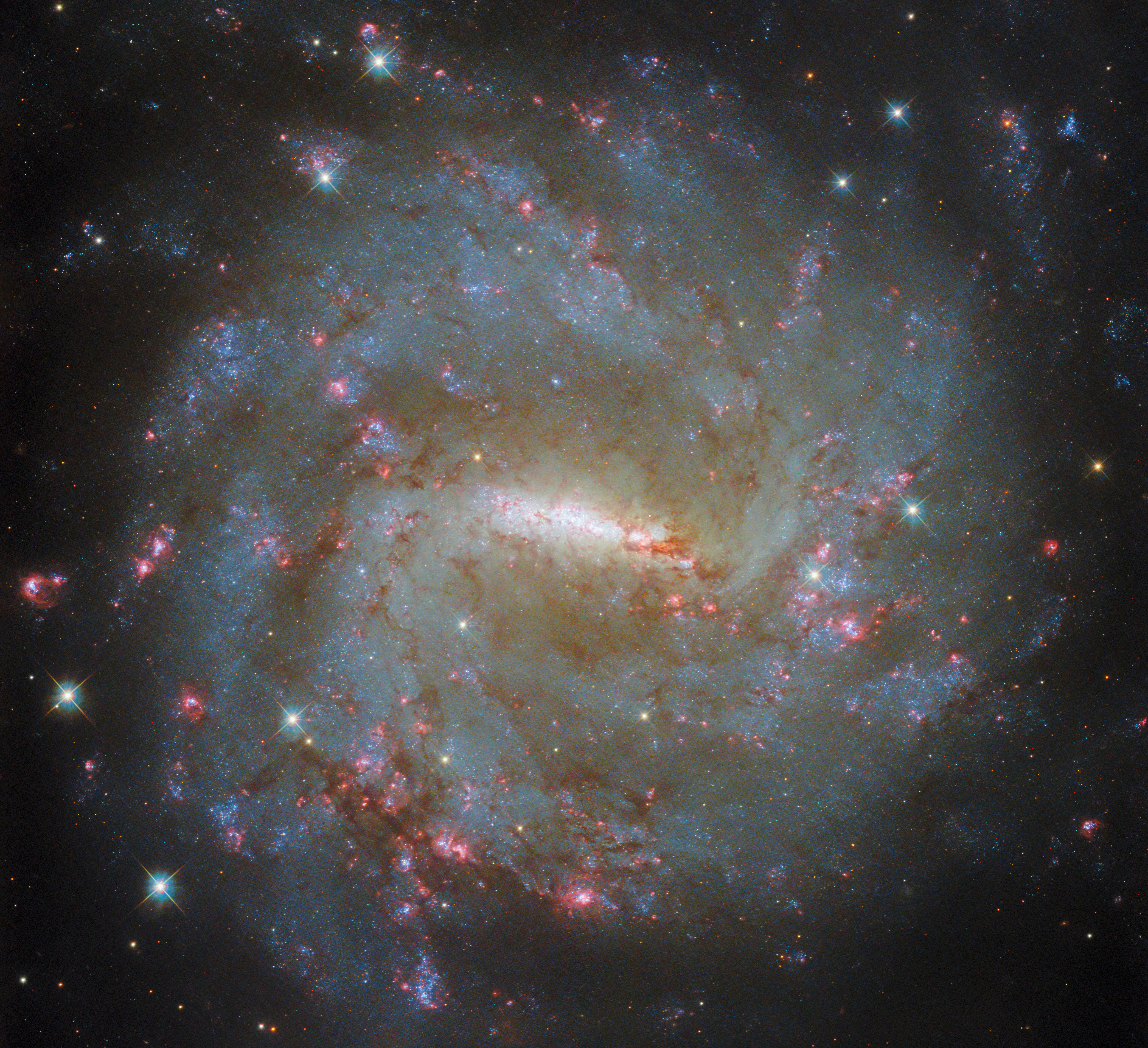
A barred spiral galaxy seen face-on. Its many arms and distinct, glowing, bar-shaped core are easily visible. The galaxy’s arms hold bluish patches of older stars, pink patches where new stars are forming, and dark threads of dust. A few bright stars with cross-shaped diffraction spikes lie between us and the galaxy and are visible in the foreground.
This NASA/ESA Hubble Space Telescope image features the barred spiral galaxy NGC 3059.
ESA/Hubble & NASA, D. Thilker

This NASA/ESA Hubble Space Telescope image features the barred spiral galaxy NGC 3059, which lies about 57 million light-years from Earth. Hubble’s Wide Field Camera 3 collected the data in May 2024 as part of an observing program that studied a number of galaxies. All of the observations used the same range of filters: partially transparent materials that allow only very specific wavelengths of light to pass through.

Astronomers use filters extensively in their observations. These filters may allow either extremely narrow or somewhat broader ranges of light through to the telescope’s instruments. Narrow-band filters are invaluable from a scientific perspective because they filter specific wavelengths of light that are associated with specific physical and chemical processes. For example, under certain conditions, hydrogen atoms emit red light with a wavelength value of 656.46 nanometers called H-alpha emission, or the ‘H-alpha line’. It is very useful to astronomers because its presence indicates certain physical processes and conditions and is often a tell-tale sign of newly forming stars.

The data in this image used a narrow-band filter that allowed H-alpha emission through to the telescope’s detectors. The particular filter, called F657N (F for filter, N for narrow, and 657 for the wavelength in nanometers) or the H-alpha filter, lets through light very close to the 656.46 nanometer H-alpha line’s wavelength. It reveals pinkish star-forming regions in the galaxy.

Data from five other wide-band filters also contributed to this image. As their name implies, wide-band filters allow a wider range of wavelengths through to Hubble’s instruments. They isolate sections of the electromagnetic spectrum allowing astronomers to explore different aspects of the object Hubble is looking at.

In the case of this image, wide-band filters revealed the bluish patches that hold older stars. In addition, information from multiple filters provides image processors with the data to make beautiful and informative images such as this one.

Text Credit: European Space Agency (ESA)

Explore More

Media Contact:

Claire Andreoli
NASA’s Goddard Space Flight CenterGreenbelt, MD
claire.andreoli@nasa.gov
Powered by WPeMatico

Get The Details…

Artemis II Astronauts Participate in Moon Tree Dedication Ceremony

Artemis II Astronauts Participate in Moon Tree Dedication Ceremony

The Artemis II crew, NASA astronauts Victor Glover, Reid Wiseman, and Christina Koch, and Canadian Space Agency (CSA) astronaut Jeremy Hansen, pose for a photo after a Moon tree dedication ceremony, Tuesday, June 4, 2024, at the United States Capitol in Washington. The American Sweetgum tree planted on the southwestern side of the Capitol, was grown from a seed that was flown around the Moon during the Artemis I mission.

Powered by WPeMatico

Get The Details…

NASA’s Boeing Starliner Astronauts Enter Space Station

NASA’s Boeing Starliner Astronauts Enter Space Station

The seven Expedition 71 crew members gather with the two Crew Flight Test members for a team portrait aboard the space station. In the front from left are, Suni Williams, Oleg Kononenko, and Butch Wilmore. Second row from left are, Alexander Grebenkin, Tracy C. Dyson, and Mike Barratt. In the back are, Nikolai Chub, Jeanette Epps, and Matthew Dominick. Credit: NASA TV

NASA astronauts Butch Wilmore and Suni Williams entered the International Space Station at 3:45 p.m. EDT.

The Boeing Starliner spacecraft, successfully docked to the International Space Station at 1:34 p.m. The spacecraft launched on a United Launch Alliance Atlas V rocket at 10:52 a.m. June 5 from Space Launch Complex-41 at Cape Canaveral Space Force Station in Florida.

NASA will provide coverage of the post-docking news conference at 5 p.m. on NASA+, NASA Television, the NASA app, YouTube, and the agency’s website.

As part of the agency’s Commercial Crew Program, the mission is the first crewed flight for the Starliner spacecraft. Learn more about the mission by following the commercial crew blog, @commercial_crew on X, and commercial crew on Facebook.


Learn more about station activities by following the space station blog, @space_station and @ISS_Research on X, as well as the ISS Facebook and ISS Instagram accounts.

Get weekly updates from NASA Johnson Space Center at: https://roundupreads.jsc.nasa.gov/

Get the latest from NASA delivered every week. Subscribe here: www.nasa.gov/subscribe

Powered by WPeMatico

Get The Details…

Mark Garcia

Boeing’s Crew Flight Test on Starliner Docks to Station

Boeing’s Crew Flight Test on Starliner Docks to Station

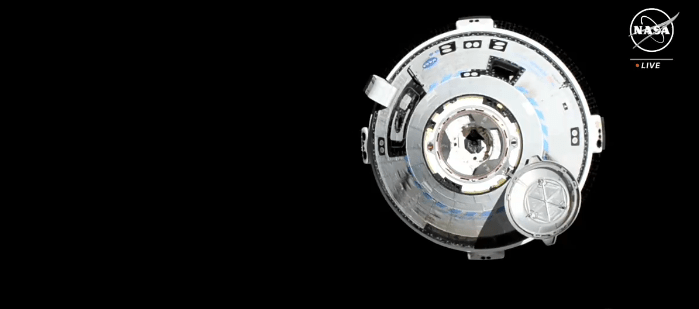
Boeing's Starliner spacecraft with two NASA astronauts aboard approaches the space station for an autonomous docking as it orbited 257 miles above the South Pacific Ocean.
Boeing’s Starliner spacecraft with two NASA astronauts aboard approaches the space station for an autonomous docking as it orbited 257 miles above the South Pacific Ocean.

NASA astronauts Butch Wilmore and Suni Williams, aboard Boeing’s Starliner spacecraft, successfully docked to the International Space Station at 1:34 p.m. EDT. Starliner launched on a United Launch Alliance Atlas V rocket at 10:52 a.m., June 5 from Space Launch Complex-41 at Cape Canaveral Space Force Station in Florida.

During flight, Wilmore and Williams successfully performed manual piloting demonstrations of Starliner and completed a sleep period. Prior to crew sleep, mission teams identified three helium leaks in the spacecraft. One of these was previously discussed before flight along with a management plan, and the other two occured when the spacecraft arrived in orbit. To monitor and manage these leaks, the three helium manifolds were closed in flight during the crew’s sleep period and were all reopened ahead of rendezvous and docking operations. After docking, all Starliner manifolds are closed per normal plans.

As Starliner began its approach to the space station, five reaction control system thrusters failed off during flight. Mission teams performed a series of hot-fire tests which re-enabled four of the thrusters while the crew manually piloted the spacecraft at the station’s 200-meter hold point. After re-selecting four of the thrusters, Starliner had the fault tolerance required to approach the space station for docking. At the 10-meter hold point, the mission team completed system readiness evaluations and proceeded with docking.

Starliner’s hatch opening will begin about 3:20 p.m., with welcome remarks to follow.

NASA will continue coverage on NASA+, NASA Television, the NASA app, YouTube, and the agency’s website. Learn how to stream NASA TV through a variety of platforms including social media.

NASA will host a post-docking media conference at approximately 5 p.m. with the following participants:

  • NASA Associate Administrator Jim Free
  • Steve Stich, manager, NASA’s Commercial Crew Program
  • Jeff Arend, manager for systems engineering and integration, NASA’s International Space Station Office
  • Mark Nappi, vice president and program manager, Commercial Crew Program, Boeing

Learn more about station activities by following the space station blog, @space_station and @ISS_Research on X, as well as the ISS Facebook and ISS Instagram accounts.

Get weekly updates from NASA Johnson Space Center at: https://roundupreads.jsc.nasa.gov/

Get the latest from NASA delivered every week. Subscribe here: www.nasa.gov/subscribe

Powered by WPeMatico

Get The Details…

Mark Garcia

Starliner Approaches Station as Live Coverage Continues

Starliner Approaches Station as Live Coverage Continues

Boeing's Starliner spacecraft approaches the International Space Station for docking on June 6, 2024. Credit: NASA TV
Boeing’s Starliner spacecraft approaches the International Space Station for docking on June 6, 2024. Credit: NASA TV

NASA’s coverage of the Boeing Starliner spacecraft flight to the International Space Station continues on NASA+, NASA Television, the NASA app, YouTube, and the agency’s website. The Starliner spacecraft is performing its careful approach to the space station with NASA astronauts Butch Wilmore and Suni Williams. After conducting a series of reaction control system thruster tests, four thrusters were recovered from five that had gone out. The spacecraft will conduct a planned hold at 10 meters from its station docking port to assess readiness. The second docking window opens at 1:33 p.m. ET.


Learn more about station activities by following the space station blog, @space_station and @ISS_Research on X, as well as the ISS Facebook and ISS Instagram accounts.

Get weekly updates from NASA Johnson Space Center at: https://roundupreads.jsc.nasa.gov/

Get the latest from NASA delivered every week. Subscribe here: www.nasa.gov/subscribe

Powered by WPeMatico

Get The Details…

Abby Graf