NASA’s SpaceX Crew-11 Wraps Up Space Station Science

NASA’s SpaceX Crew-11 Wraps Up Space Station Science
4 Min Read

NASA’s SpaceX Crew-11 Wraps Up Space Station Science

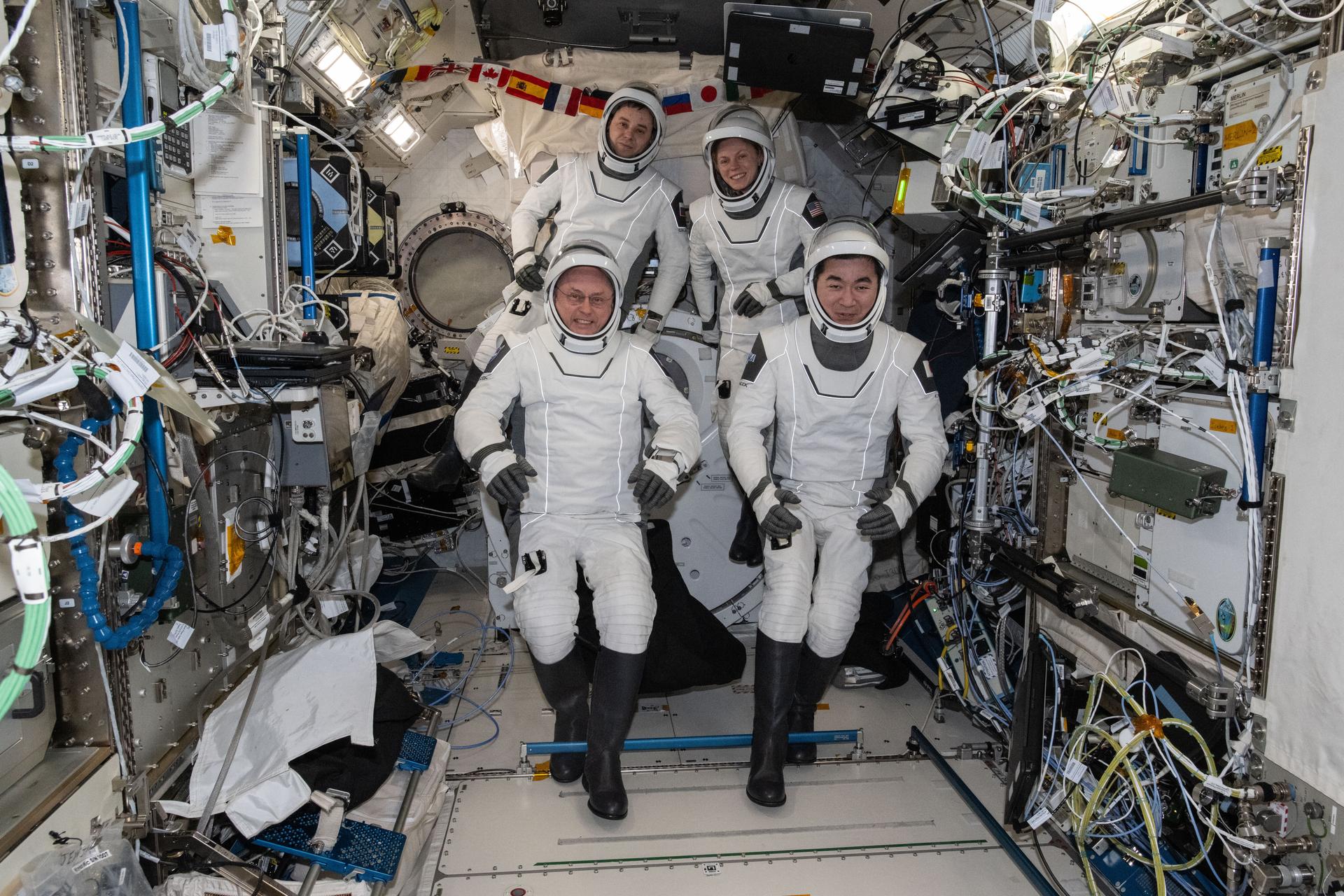
Four SpaceX Crew-11 members gather together for a crew portrait wearing their Dragon pressure suits during a suit verification check inside the International Space Station's Kibo laboratory module. Clockwise from bottom left are, NASA astronaut Mike Fincke, Roscosmos cosmonaut Oleg Platonov, NASA astronaut Zena Cardman, and JAXA (Japan Aerospace Exploration Agency) astronaut Kimiya Yui.

NASA’s SpaceX Crew-11 mission with agency astronauts Zena Cardman and Mike Fincke, JAXA (Japan Aerospace Exploration Agency) astronaut Kimiya Yui, and Roscosmos cosmonaut Oleg Platonov returned to Earth after a long-duration mission aboard the International Space Station.

During their stay, Cardman, Fincke, and Yui contributed more than 850 hours of research to help prepare humanity for the return to the Moon and future missions to Mars, while improving life back on Earth.

Here’s a glimpse into the science completed during the Crew-11 mission:

Bolstering bone resilience
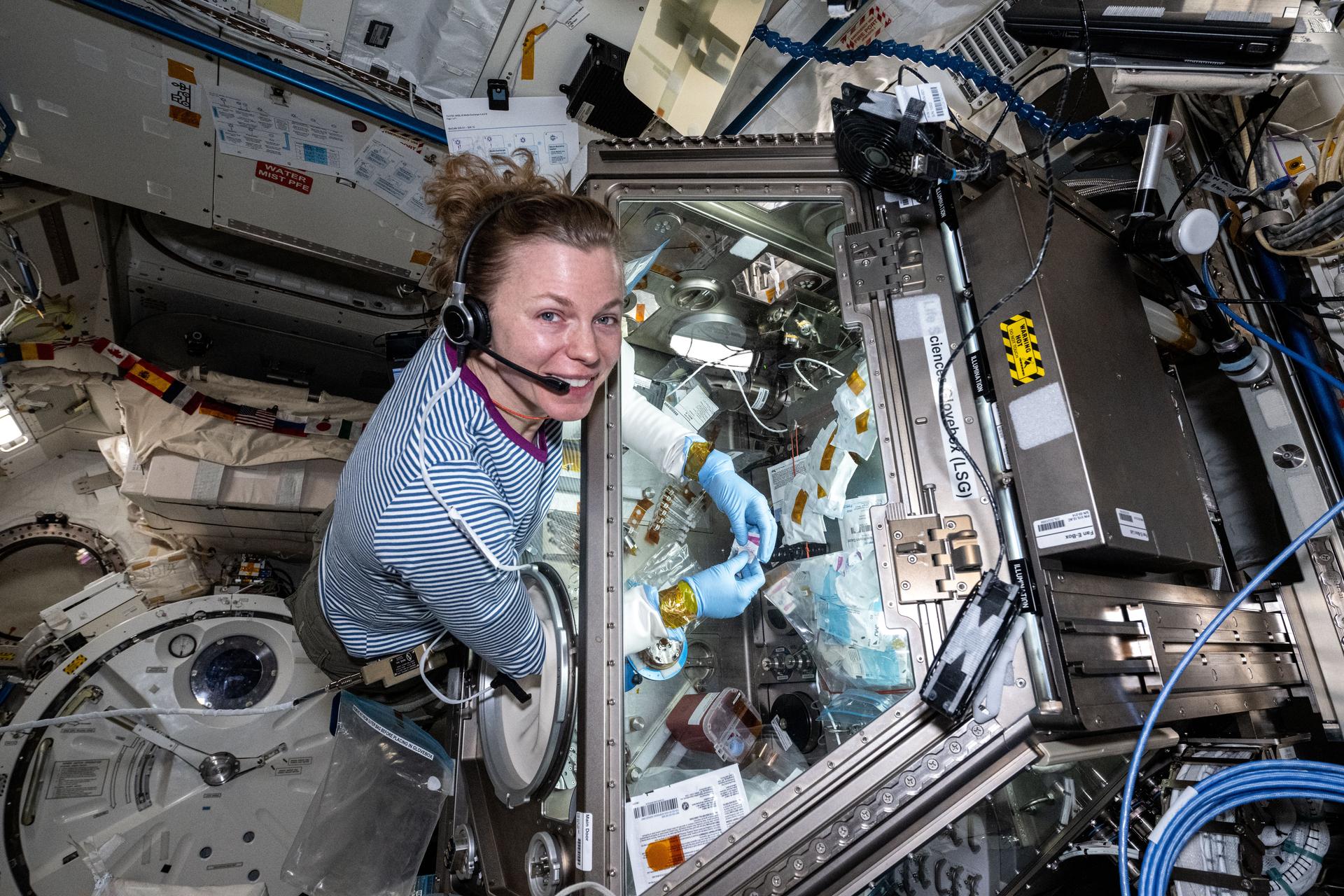
NASA astronaut Zena Cardman reaches into the clear, sealed Life Science Glovebox and holds a small packet. The inside of the rectangular workspace is illuminated by white light and is full of small containers and bags.

NASA astronaut Zena Cardman works with bone stem cells aboard the International Space Station to improve our understanding of how bone loss occurs during spaceflight. Studying bone cell activity in microgravity could help researchers learn how to control bone loss to protect astronauts’ bone density during future long-duration space missions and inform treatments for diseases like osteoporosis on Earth. 

Learn more about MABL-B.

Observing Earth and beyond
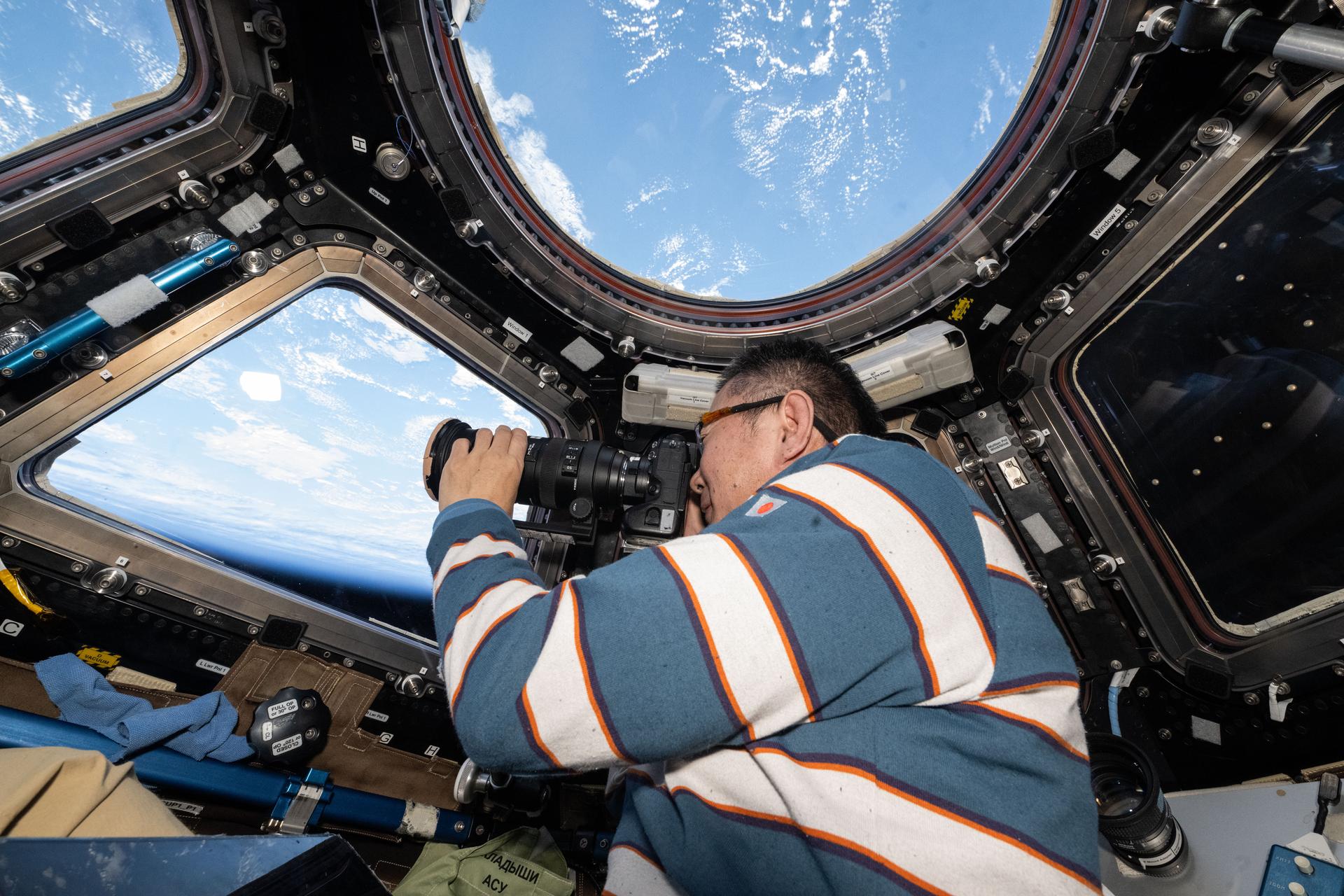
JAXA (Japan Aerospace Exploration Agency) astronaut Kimiya Yui, wearing a blue-and-white striped shirt, looksthrough a camera inside of the space station’s cupola. The blue Earth, speckled with clouds, can be seen through a circular window above and trapezoid-shaped windows in front of him.

JAXA (Japan Aerospace Exploration Agency) astronaut Kimiya Yui photographs the Earth from the International Space Station’s cupola. For more than 40 years, astronauts have used hand-held cameras to capture millions of images documenting Earth’s geographic features, weather patterns, urban growth, changes to its surface, and the impacts of natural disasters such as hurricanes and floods.
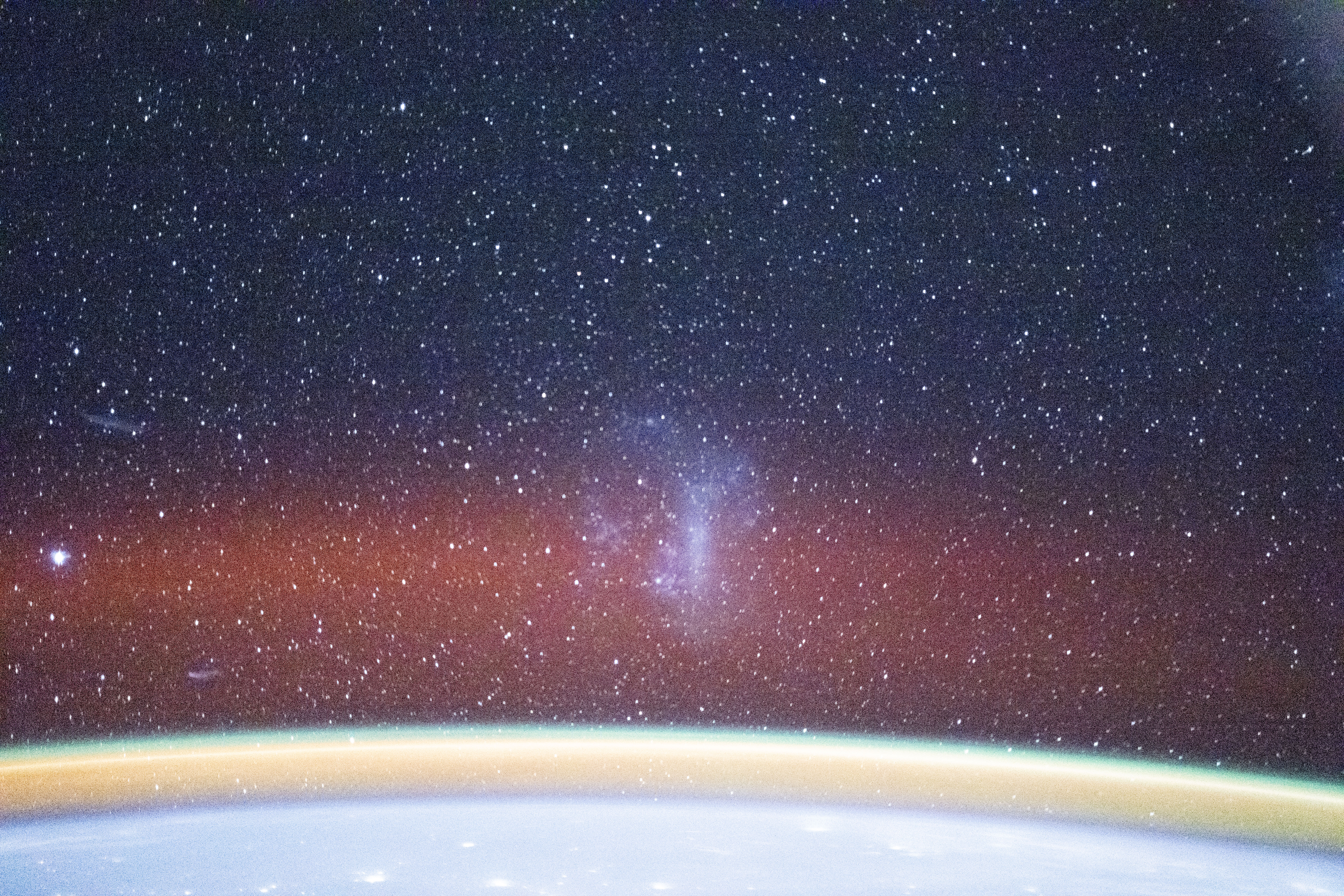
The blue curvature of the Earth’s atmosphere is visible with yellow, green, and red layers of airglow above it. In the center, just above Earth and peeking through the red haze, a blue collection of stars is visible.

Astronauts also use the cupola and other viewports aboard the space station to gaze into the cosmos without Earth’s atmospheric interference. Just as viewing Earth from 250 miles above provides a new perspective on our home planet, looking out into the stars from the orbiting laboratory offers a clearer view of our universe.

Space catch

NASA astronaut Mike Fincke floats in a cylindrical airlock. He wears blue latex gloves and gestures toward a silver box with a black, hexagonal shape in the center. He is surrounded by wires and various panels along the space station’s walls.

NASA astronaut Mike Fincke poses aboard the International Space Station with a new device designed to test an inflatable capture bag’s ability to open, close, and stay airtight in microgravity. This technology could be used to remove space debris from orbit, protecting future spacecraft and crew members. It also may enable trapping samples during exploration missions and support the capture and mining of small asteroids.

Learn more about Capture Bag Demo.

Tracking internal temperature
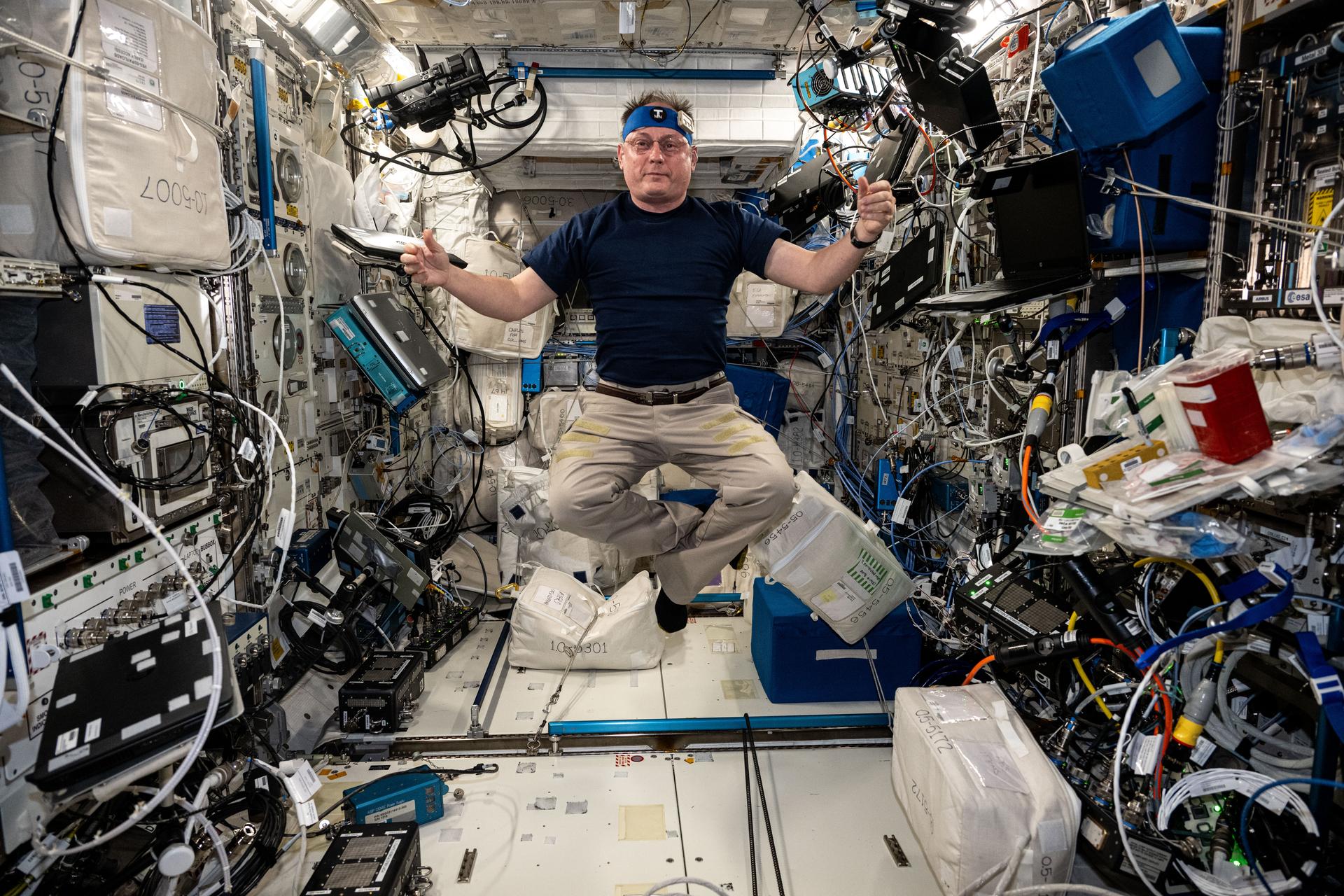
NASA astronaut Mike Fincke, wearing a black shirt and khaki pants, floats in the space station with his arms up and legs crossed. He wears the blue T-Mini headband. The surrounding walls of the space station are lined with equipment and wires.

NASA astronaut Mike Fincke wears a temperature-monitoring headband that tracks how the human body regulates its core temperature during spaceflight. Adjusting to living and working aboard the International Space Station can influence human temperature regulation. This headband provides an easy, non-invasive way to collect temperature data while astronauts conduct their daily activities. The sensor is also being tested on Earth and may help prevent hyperthermia in people working in high-temperature environments.

Learn more about T-Mini.

A new cargo vehicle
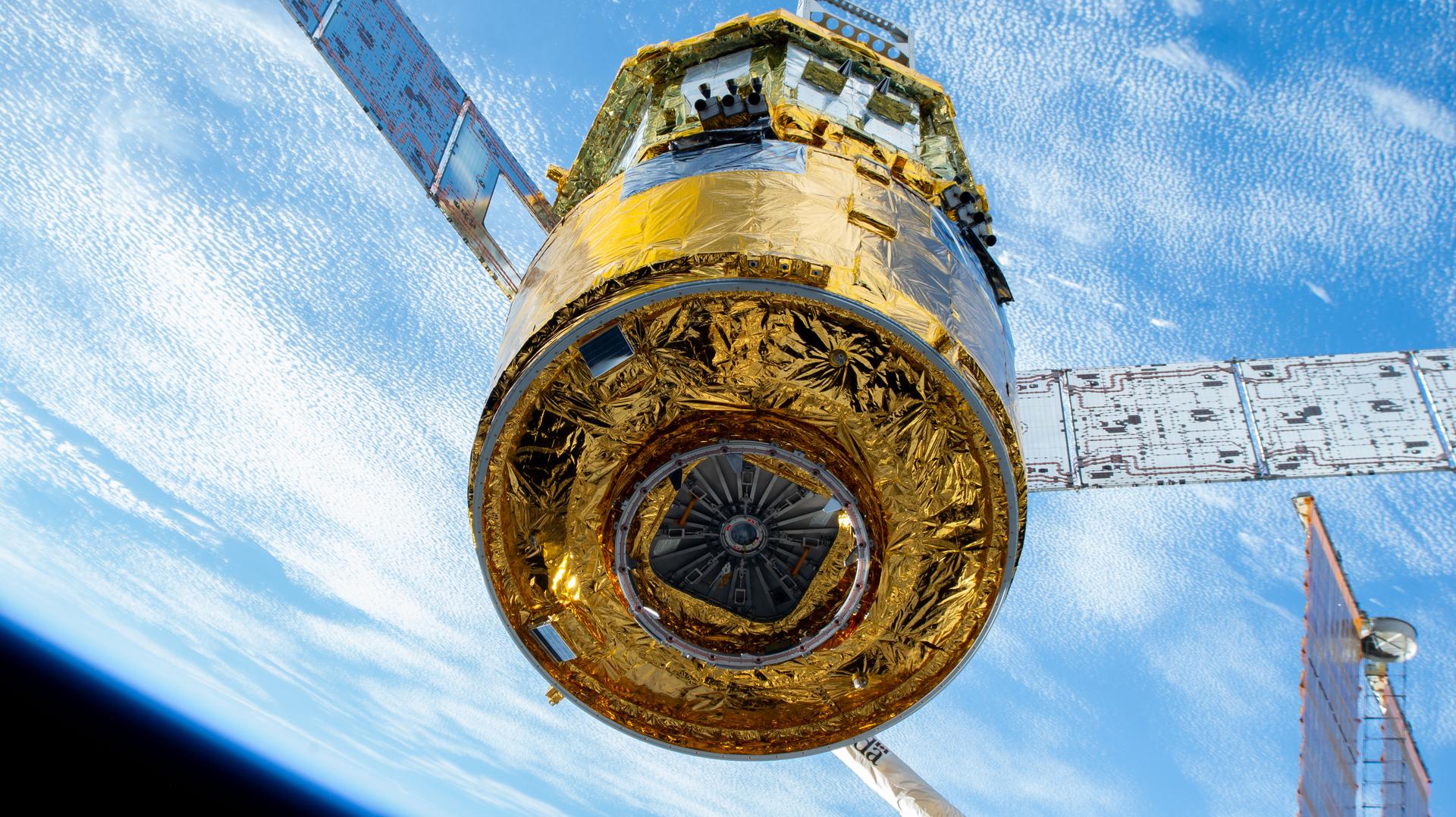
The cylinder-shaped HTV-X1 spacecraft is shown gripped by the Canadarm2. The surface of the vehicle is reflective gold, and a silver-colored solar array panel juts from either side. The Earth fills the background, with white streaky clouds covering much of the blue ocean.

JAXA’s (Japan Aerospace Exploration Agency) new cargo resupply spacecraft, HTV-X1, is shown after being captured by the International Space Station’s Canadarm2 robotic arm during the Crew-11 mission. The spacecraft launched from Tanegashima Space Center on Oct. 26, 2025, delivering approximately 12,800 pounds of science, supplies, and hardware to the orbital complex. New cargo spacecraft expand the station’s capability to support more research and receive critical supplies.

Making nutrients on demand
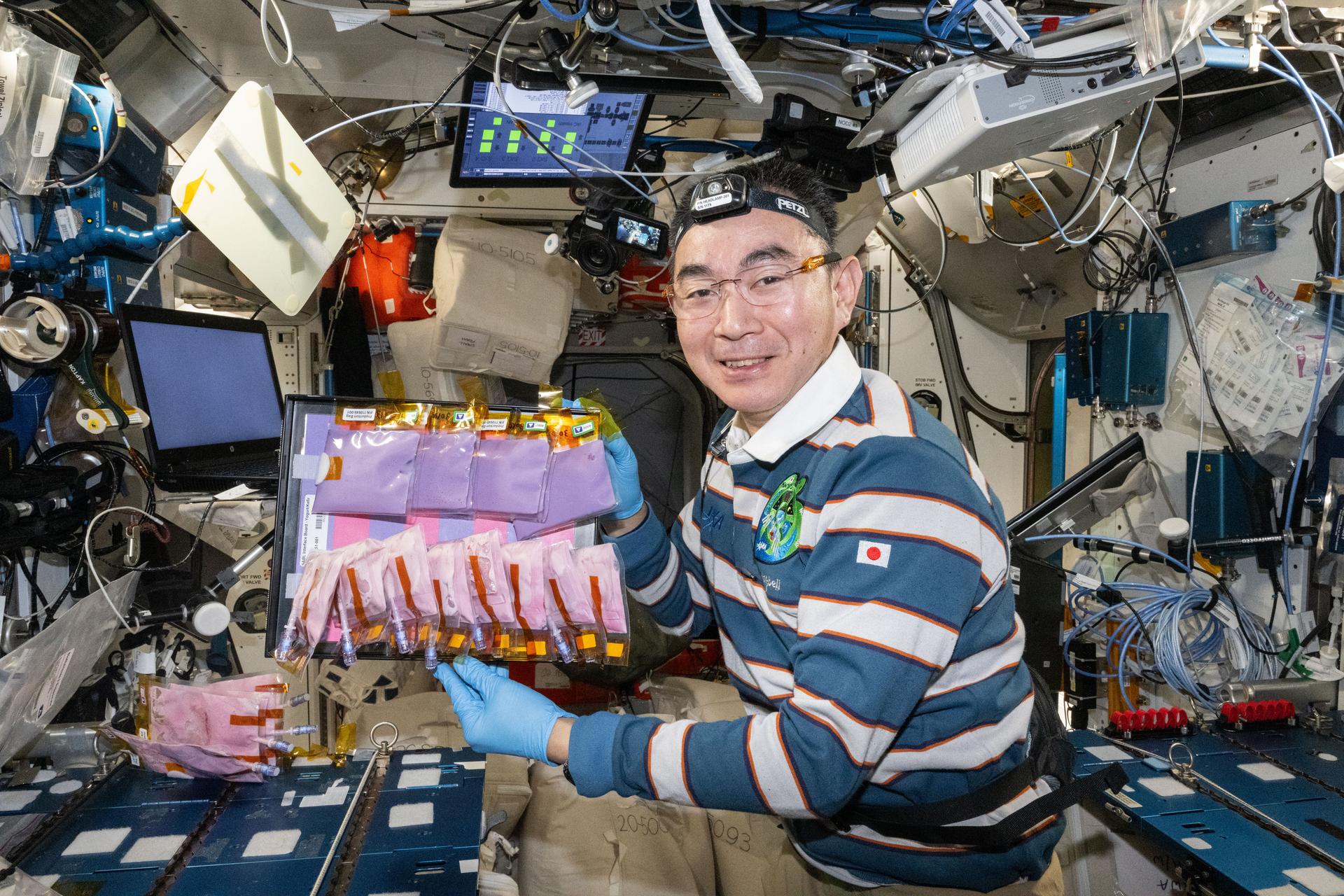
JAXA (Japan Aerospace Exploration Agency) astronaut Kimiya Yui, wearing a blue-and-white striped shirt, holds a tray with two rows of plastic bags. The top row has four bags filled with purple fluid, and the bottom row has eight bags filled with pale pink fluid.

JAXA (Japan Aerospace Exploration Agency) astronaut Kimiya Yui holds yogurt bags produced aboard the International Space Station that could provide important nutrients during missions far from Earth. Certain nutrients degrade when stored for long periods of time, and deficiency in even one can lead to illness. Researchers are building on previous experiments to develop a method for producing on-demand vitamins and nutrients in space using microorganisms.

Learn more about BioNutrients-3.

Celebrating a historic milestone
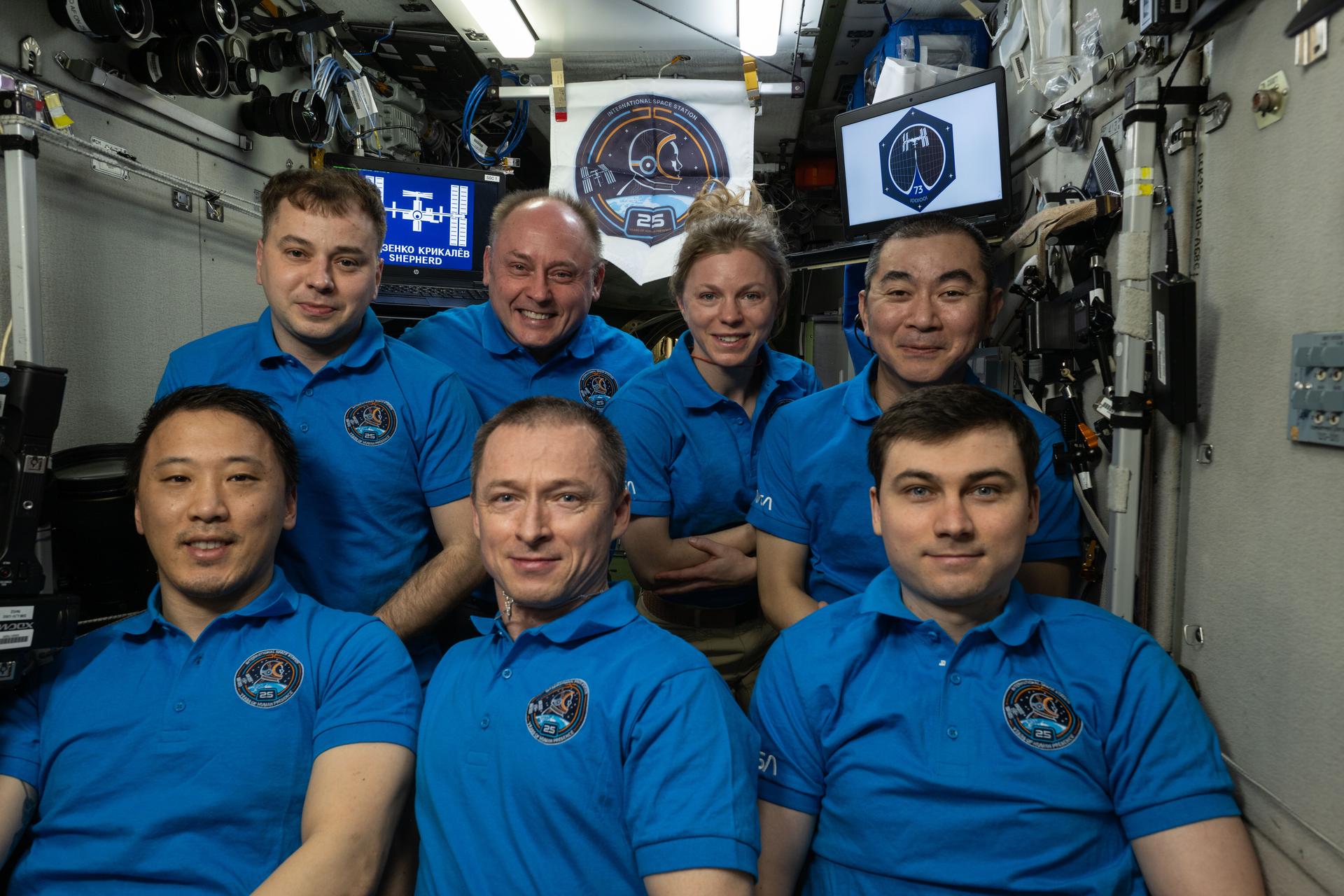
The seven-member Expedition 73 crew poses for a portrait, each of them in a light blue polo. In the front row from left are, NASA astronaut Jonny Kim, Roscosmos cosmonaut Sergey Ryzhikov, and Roscosmos cosmonaut Alexey Zubritsky. In the back row are, Roscosmos cosmonaut Oleg Platonov, NASA astronauts Mike Fincke and Zena Cardman, and JAXA (Japan Aerospace Exploration Agency) astronaut Kimiya Yui.

The Expedition 73 crew poses for a portrait to commemorate 25 years of continuous human presence aboard the International Space Station. In the front row from left, NASA astronaut Jonny Kim, Roscosmos cosmonaut Sergey Ryzhikov, and Roscosmos cosmonaut Alexey Zubritsky. In the back row, Roscosmos cosmonaut Oleg Platonov, NASA astronauts Mike Fincke and Zena Cardman, and JAXA (Japan Aerospace Exploration Agency) astronaut Kimiya Yui.

A truly global endeavor, the space station has been visited by more than 290 people from 26 countries, along with a variety of international and commercial spacecraft. Since the first crew arrived, NASA and its partners have conducted thousands of research investigations and technology demonstrations to advance exploration of the Moon and Mars and benefit life on Earth.

Powered by WPeMatico

Get The Details…
Christian M. Getteau
NASA Data Helps Maine Oyster Farmers Choose Where to Grow

NASA Data Helps Maine Oyster Farmers Choose Where to Grow

6 Min Read

NASA Data Helps Maine Oyster Farmers Choose Where to Grow

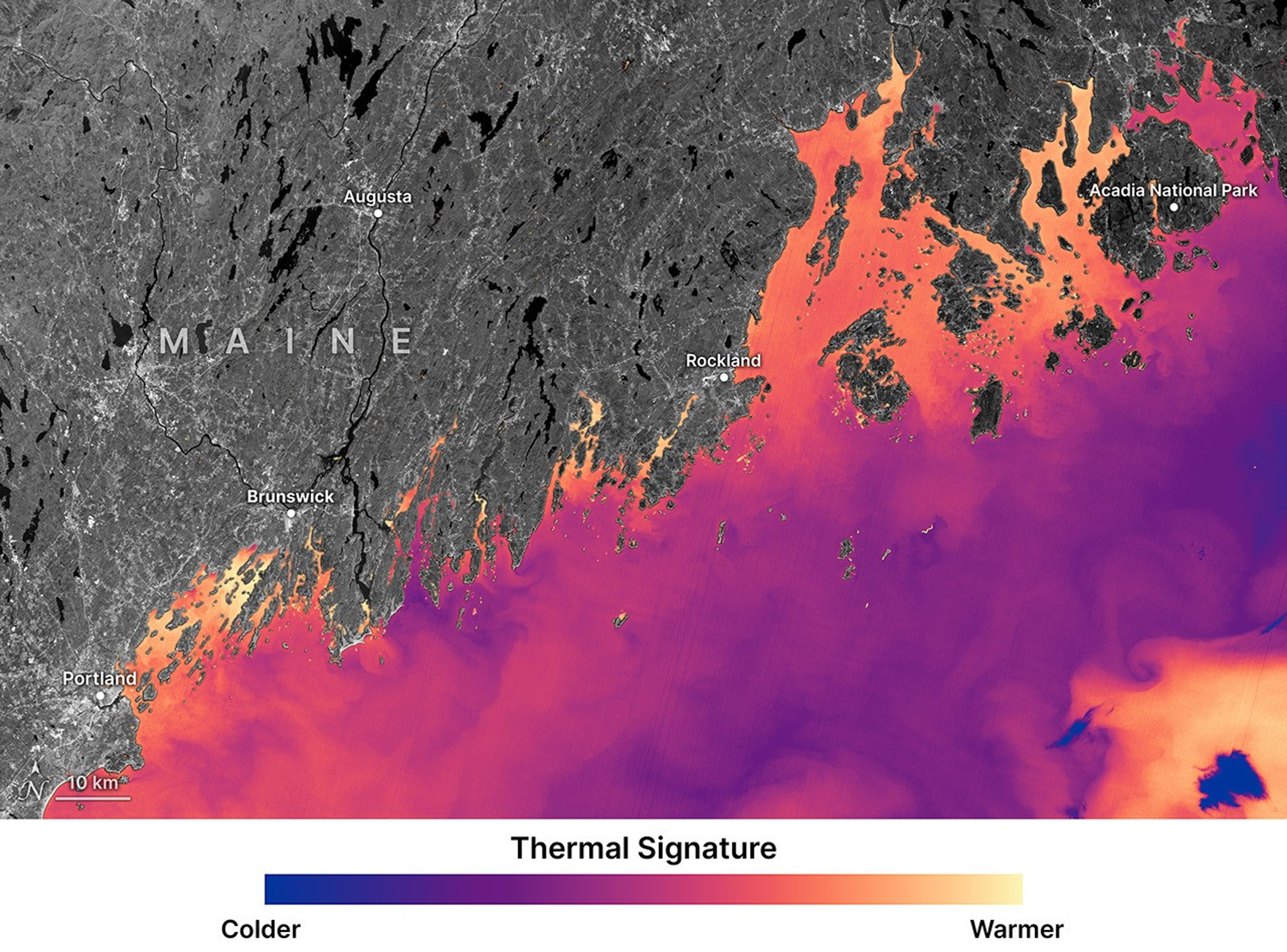
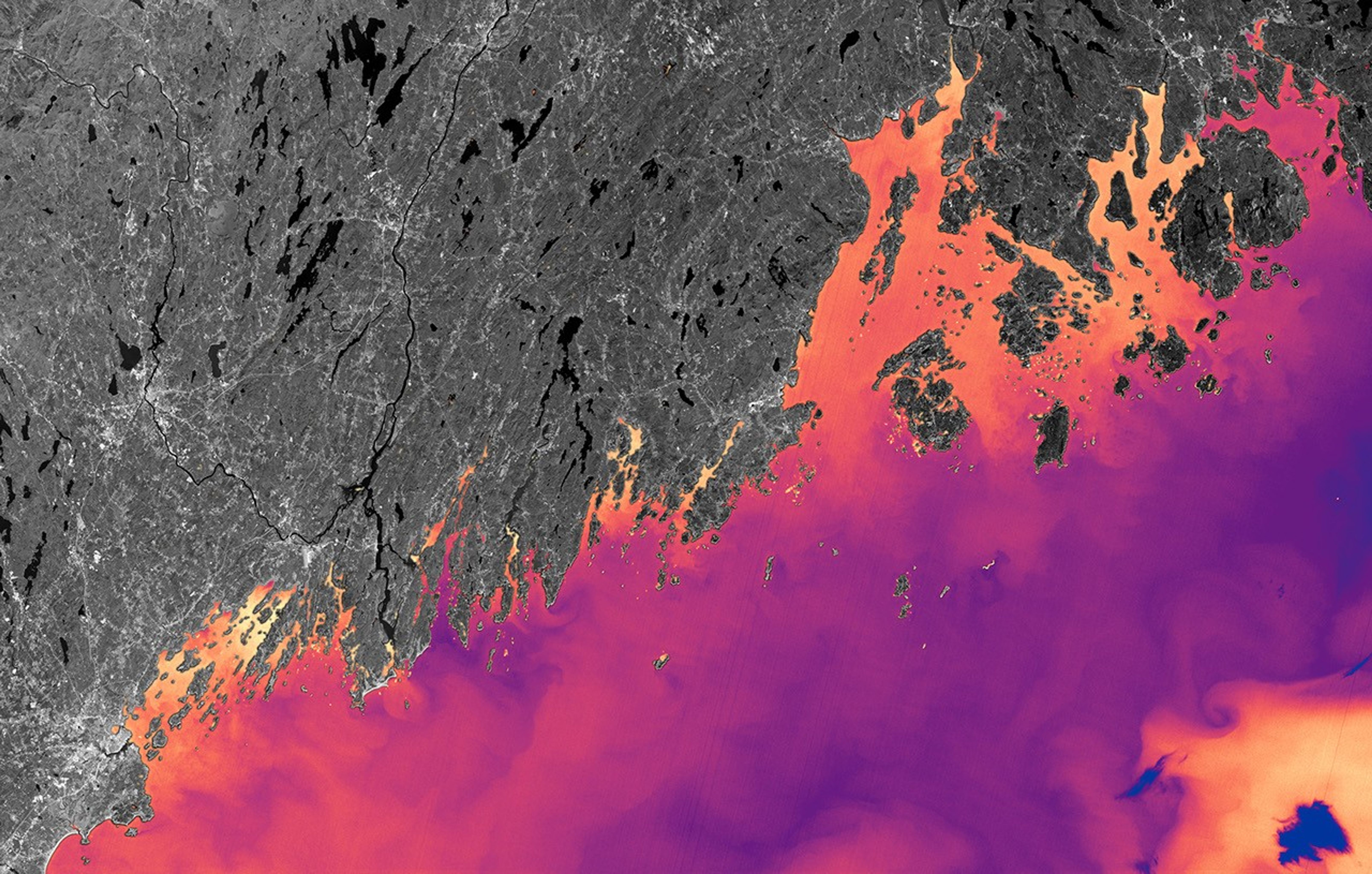
False-color Landsat 9 map shows cooler purple/blue Gulf of Maine waters and warmer orange/yellow nearshore coves.

The Landsat satellites are helping oyster farmers in Maine see which coves run warmer or cooler from space.

Credits:
NASA/Ross Walter and Allison Nussbaum

When oyster farmer Luke Saindon went looking for a place to grow shellfish in Maine, he knew that picking the wrong patch of water could sink the farm before it began. So Saindon did something oyster farmers couldn’t have done a generation ago: He used NASA satellite data to view the coastline from space.

“Starting a farm is a big venture,” said Saindon, the director for The World Is Your Oyster farm in Wiscasset, Maine. “If you choose the wrong spot, you can blow through a lot of money without ever bringing oysters to market.”

NASA satellites had been passing over these waters for years, recording temperatures and other conditions. Using a site-selection tool created by University of Maine researchers, Saindon examined satellite maps showing where water temperatures and food levels might be best for growing oysters. The maps pointed him toward a wide, shallow bay near his home. Four years later, the farm is still there — and the oysters are thriving.

Oyster farmer Luke Saindon kneels on a floating oyster farm platform, lifting a mesh cage of oysters in Wiscasset, Maine.
Luke Saindon, director of The World Is Your Oyster farm in Wiscasset, Maine, checks oyster cages on the farm’s floating platform.
© Jacqueline Clarke/The World Is Your Oyster, used with permission

Saindon believes that using the satellite data to select his oyster farm site resulted in faster-than-average growth rates.

“This is an example of how NASA’s Earth science program supports our nation,” said Chris Neigh, the Landsat 8 and 9 project scientist at NASA’s Goddard Space Flight Center in Greenbelt, Maryland. “We collect global data, but its value grows when it’s used locally to help communities work smarter and make their livelihoods more sustainable.”

From orbit to oyster

That same satellite-based approach is now the foundation of a study published Jan. 15 in the journal Aquaculture. Led by University of Maine scientists Thomas Kiffney and Damian Brady, the research demonstrates how temperature data from Landsat — the joint NASA and U.S. Geological Survey mission — combined with European Sentinel-2 satellite estimates of oyster food availability, namely plankton, can predict how quickly eastern oysters (Crassostrea virginica) reach market size.

The team built a satellite data–driven model of how oysters divide their energy among growth, survival, and reproduction. Feed the model sea surface temperature and satellite estimates of chlorophyll and particulate organic matter — signals of how much plankton and other edible particles are in the water — and it predicts how fast oysters will grow, a big step beyond just spotting good or bad sites for farms.

“By showing where oysters grow faster, the model can help farmers plan ahead,” Kiffney said. “That could mean better decisions about when to seed, when to harvest, and how much product to expect, all of which reduces financial risk.”

That kind of insight is increasingly valuable in Maine, where oyster farming has grown rapidly over the last decade. From 2011 to 2021, the industry’s value increased 78%, rising from about $2.5 million to more than $10 million. As the sector scales up, understanding the finer details of Maine’s coastal waters has become essential — and that’s where NASA satellites come in.

The stakes are considerable. “It takes two to three years of scoping in order to get your permit to grow, and then it can take two years for those oysters to reach market,” Brady said. “So if you’ve chosen the wrong site, you’re four years in the hole right off the bat.”

Sharper eyes on coast

Maine’s coastline measures about 3,400 miles (5,500 kilometers) if you follow the tide line. It is a coast of drowned valleys and glacier-scoured granite. Water depth, temperature, and circulation can shift dramatically within a few miles. This complexity makes oyster site selection notoriously difficult, and some satellites that see the coast in broad strokes miss the small, patchy places where oysters live.

“What makes Landsat so powerful for aquaculture is its ability to see finer-scale patterns along the coast,” where farmers put oyster cages in the water, Neigh said.

False-color Landsat 9 map shows cooler purple/blue Gulf of Maine waters and warmer orange/yellow nearshore coves.
This false-color image from Landsat 9’s Thermal Infrared Sensor, acquired Oct. 11, 2025, shows the thermal signature of waters off the coast of Maine — revealing finer-scale temperature differences between neighboring coves. Cooler waters appear purple and blue, while warmer water shows up in orange and yellow.
NASA/Ross Walter and Allison Nussbaum

Landsat 8 and 9’s pixels — 98 to 328 feet (30 to 100 meters) across — are able to distinguish more subtle temperature differences between neighboring coves. For a cold-blooded oyster, those distinctions can translate into months of growth. Warm water accelerates feeding and shell development. Cold water slows both.

A challenge for satellites is clouds. Maine’s sky is frequently overcast, and together Landsat 8 and 9 pass over any given point only every eight days. To work around this, the research team analyzed 10 years of Landsat data (2013–2023) and built seasonal “climatologies,” or average temperature patterns for every 98-foot (30-meter) pixel along the coast. Sentinel-2 imagery added estimates of chlorophyll and particulate organic matter, the drifting microscopic food that oysters pull from the water column with rhythmic contractions of their gills.

Field tests at multiple sites showed the technique’s accuracy. “We validated the model against seven years of field data,” Brady said. “It’s a strong indication that these remotely sensed products can inform not just where to grow, but how long it will take to harvest.”

Turning satellite science into tools for growers

The University of Maine team is now developing an online tool to put this model into practice. A grower will be able to click on a coastal location and receive an estimate for time-to-market.

The researchers also assist with workshops through Maine’s Aquaculture in Shared Waters program, teaching farmers how to interpret temperature and water clarity data and apply them to their own sites.

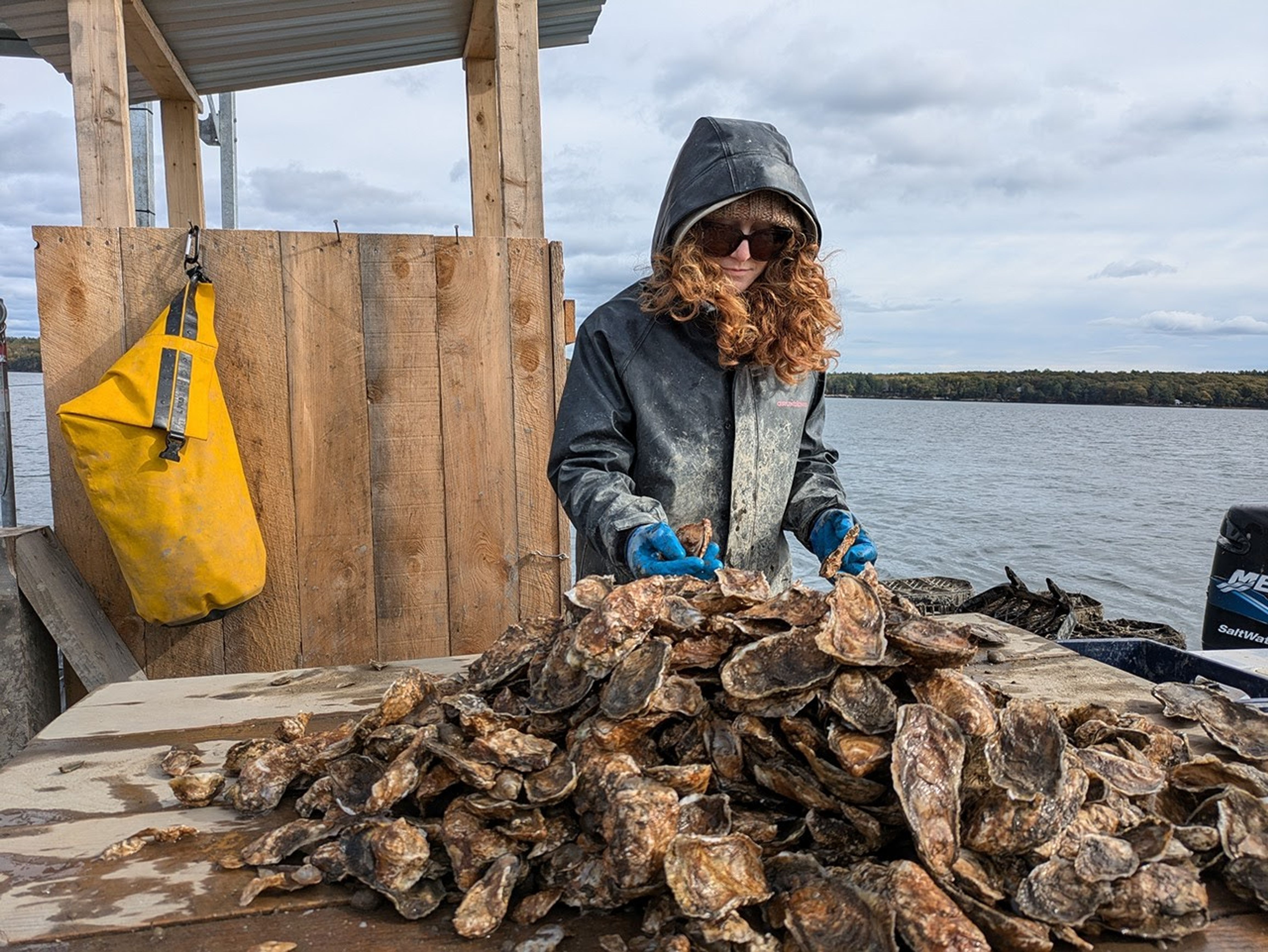
Aquaculture technician Monique Boutin sorts oysters from a large pile on a work table on a floating platform in Maine.
Monique Boutin, an aquaculture technician with The World Is Your Oyster farm, sorts oysters during harvest work on the water in Maine.
© Nina Boutin/The World Is Your Oyster, used with permission

For farmers like Saindon, that translates into something simpler: confidence and efficiency. “Having these kinds of tools lowers the barrier for new people to get into aquaculture,” he said. “It gives you peace of mind that you’re not just guessing.”

The Maine project is helping pave the way for other NASA missions. The PACE satellite (Plankton, Aerosol, Cloud, ocean Ecosystem) launched in 2024 and is now delivering hyperspectral observations of coastal waters. Where earlier sensors could estimate how much plankton was present, PACE can begin to identify the different plankton species themselves. For oysters, mussels, and other filter feeders, that specificity matters. Not all plankton are equal food: Different kinds offer different nutrition, and some plankton are harmful to oysters.

A next step will be turning that richer picture of coastal life into forecasts people working on the water can use, helping farmers trade some of the coast’s mystery for evidence they can apply to their harvest.

By Emily DeMarco

NASA’s Goddard Space Flight Center, Greenbelt, Md.

Share

Details

Last Updated

Jan 15, 2026

Editor
Christina Campen
Contact
Emily DeMarco
Location
Goddard Space Flight Center

Powered by WPeMatico

Get The Details…

NASA’s SpaceX Crew-11 Dragon Splashdown at 3:41 a.m. EST

NASA’s SpaceX Crew-11 Dragon Splashdown at 3:41 a.m. EST

Spacecraft splashes down in ocean.
NASA’s SpaceX Crew-11 Dragon spacecraft splashes down in the Pacific Ocean on Thursday, Jan. 15, 2025.
NASA+

At 3:41 a.m. EST, the SpaceX Dragon spacecraft, carrying NASA astronauts Zena Cardman and Mike Fincke, JAXA (Japan Aerospace Exploration Agency) astronaut Kimiya Yui, and Roscosmos cosmonaut Oleg Platonov splashed down off the coast of San Diego, California.  

This completes a stay in space of 167 days for the four-person crew. The mission returned to Earth earlier than originally planned as teams monitored a medical concern with a crew member living and working aboard the orbital laboratory. The crew member is stable.  

Teams aboard the recovery ship, including two fast boats, are securing the SpaceX Dragon and ensuring the spacecraft is safe for the recovery effort. As the fast boat teams complete their work, the recovery ship will move into position to hoist Dragon onto the main deck with the astronauts inside. Once on the main deck, the crew will egress the spacecraft.  

NASA previously announced all four crew members will be transported to a local hospital for additional evaluation, taking advantage of medical resources on Earth to provide the best care possible. 

Following a planned overnight hospital stay, the crew will return to NASA’s Johnson Space Center in Houston, where they will reunite with their families and undergo standard post-flight reconditioning and evaluations. Due to medical privacy, it is not appropriate for NASA to share more details about the crew member. 

NASA will host a post-splashdown media conference at 5:45 a.m. on NASA+, Amazon Prime, and the agency’s YouTube channel, with the following participants:   

  • NASA Administrator Jared Isaacman 
  • Joel Montalbano, deputy associate administrator, NASA’s Space Operations Mission Directorate 

Learn more about the mission by following the commercial crew blog, @NASASpaceOps and @space_station on X, as well as the International Space Station’s Facebook and Instagram accounts.

Get the latest from NASA delivered every week. Subscribe here.

Powered by WPeMatico

Get The Details…

Jason Costa

SpaceX Dragon Completes Deorbit Burn

SpaceX Dragon Completes Deorbit Burn

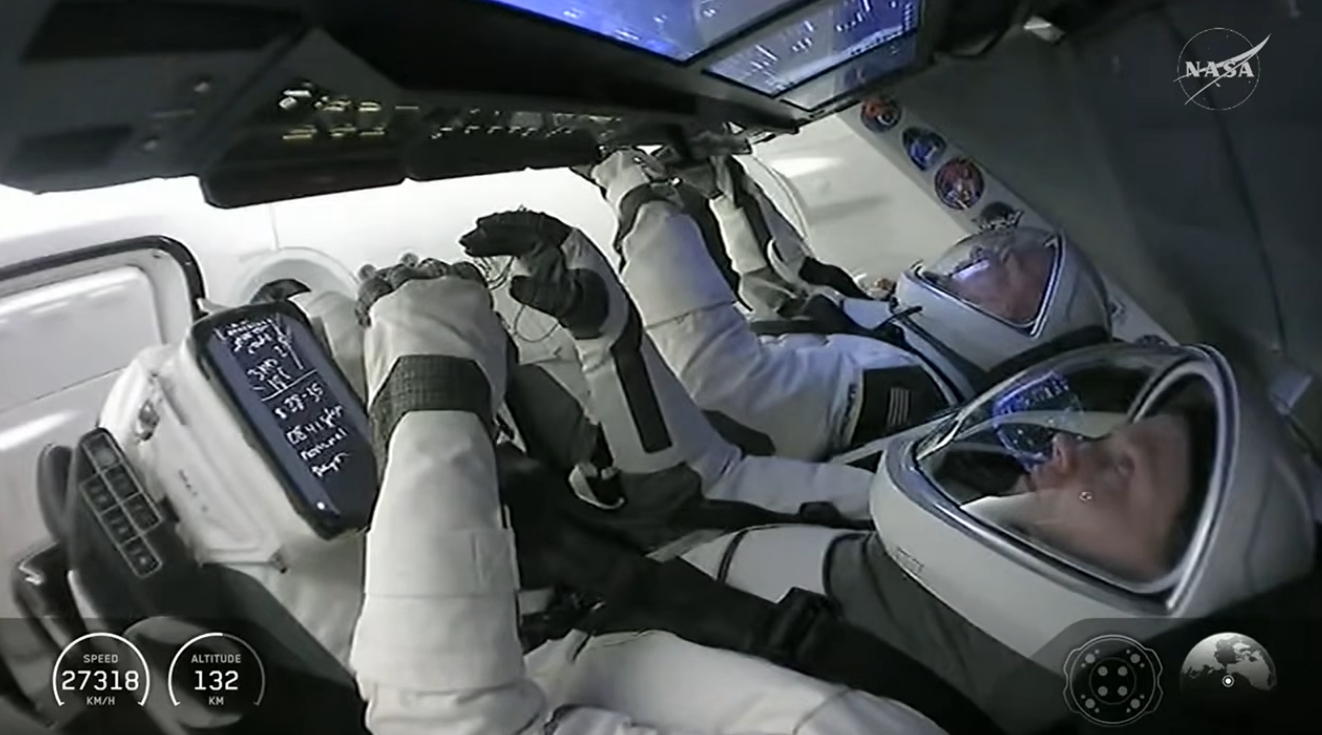
NASA's SpaceX Crew-11 crew prepares for splashdown in the Pacific Ocean on Thursday, Jan. 15, 2025.
NASA’s SpaceX Crew-11 NASA astronauts Zena Cardman (right) and Mike Fincke prepare for splashdown in the Pacific Ocean on Thursday, Jan. 15, 2025.
NASA+

The SpaceX Dragon spacecraft carrying NASA astronauts Zena Cardman and Mike Fincke, JAXA (Japan Aerospace Exploration Agency) astronaut Kimiya Yui, and Roscosmos cosmonaut Oleg Platonov has completed its deorbit burn as expected ahead of splashdown. 

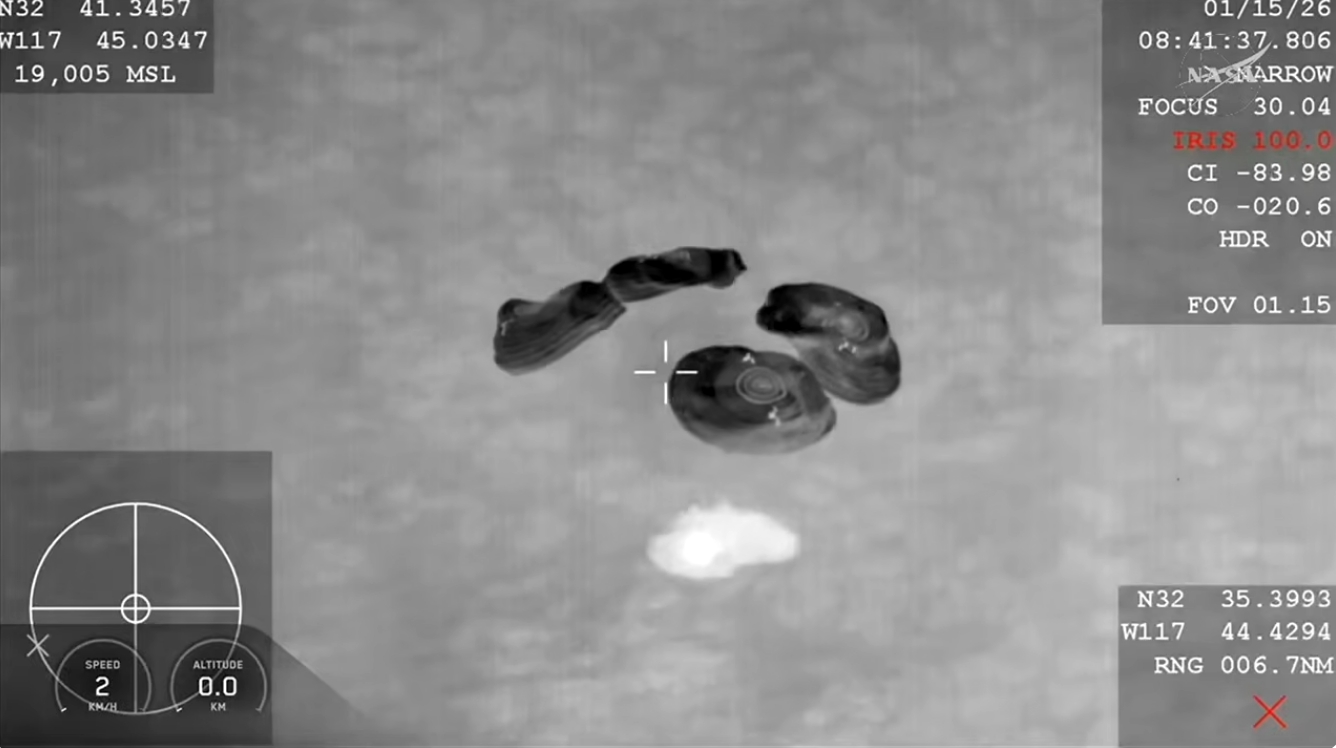
Four minutes before splashdown, the drogue parachutes will deploy at about 18,000 feet in altitude while Dragon is moving approximately 350 mph. Less than a minute later, at about 6,000 feet in altitude, the main parachutes deploy while the spacecraft is moving approximately 120 mph. 

Watch NASA’s live coverage on NASA+Amazon Prime, and the agency’s YouTube channel until crew recovery is complete. 

Learn more about the mission by following the commercial crew blog, @NASASpaceOps and @space_station on X, as well as the International Space Station’s Facebook and Instagram accounts.

Get the latest from NASA delivered every week. Subscribe here.

Powered by WPeMatico

Get The Details…

Jason Costa

NASA’s SpaceX Crew-11 Preparing for Splashdown

NASA’s SpaceX Crew-11 Preparing for Splashdown

The crew of NASA’s SpaceX Crew-11 mission train for their upcoming trip to the International Space Station at SpaceX facilities in Florida. From left: Oleg Platonov, Mike Fincke, Zena Cardman, and Kimiya Yui.
The crew of NASA’s SpaceX Crew-11 mission train for their trip to the International Space Station at SpaceX facilities in Florida. From left: Oleg Platonov, Mike Fincke, Zena Cardman, and Kimiya Yui.
SpaceX

Live coverage is underway on NASA+Amazon Prime, and the agency’s YouTube channel as NASA astronauts Zena Cardman and Mike Fincke, JAXA (Japan Aerospace Exploration Agency) astronaut Kimiya Yui, and Roscosmos cosmonaut Oleg Platonov, are about an hour away from splashing down aboard their SpaceX Dragon spacecraft.  

The deorbit burn is scheduled to begin at 2:51 a.m. EST. Splashdown remains on schedule for approximately 3:41 a.m. Weather conditions remain favorable and are “go” at the primary splashdown site off the coast of San Diego, California. 

On Jan. 8, NASA decided to return Crew-11 earlier than originally planned as teams monitored a medical concern with a crew member currently living and working aboard the International Space Station. The crew member is stable. 

Learn how to watch NASA content through a variety of online platforms, including social media. 

Learn more about the mission by following the commercial crew blog, @NASASpaceOps and @space_station on X, as well as the International Space Station’s Facebook and Instagram accounts.

Get the latest from NASA delivered every week. Subscribe here.

Powered by WPeMatico

Get The Details…

Jason Costa