NASA Additive Manufacturing Project Shapes Future for Agency, Industry Rocket Makers

NASA Additive Manufacturing Project Shapes Future for Agency, Industry Rocket Makers
5 Min Read

NASA Additive Manufacturing Project Shapes Future for Agency, Industry Rocket Makers

Additively manufactured rocket engine hardware coupled with advanced composites allows for precision features, such as multi-material coolant channels developed by the Rapid Analysis and Manufacturing Propulsion Technology team at NASA’s Marshall Space Flight Center in Huntsville, Alabama

Credits:
NASA

The widespread commercial adoption of additive manufacturing technologies, commonly known as 3D printing, is no surprise to design engineers at NASA’s Marshall Space Flight Center in Huntsville, Alabama whose research created stronger, lighter weight materials and new manufacturing processes to make rocket parts.

NASA’s RAMPT (Rapid Analysis and Manufacturing Propulsion Technology) project is on the cutting-edge of additive manufacturing – helping the agency and industry produce new alloys and additively manufactured parts, commonly referred to as 3D printing, according to Paul Gradl, the project’s co-principal investigator at NASA Marshall.

“Across NASA’s storied legacy of vehicle and hardware design, testing, and integration, our underlying strength is in our application of extremely durable and severe environment materials and innovative manufacturing for component design,” said Gradl. “We strive to fully understand the microstructure and properties of every material and how they will ultimately be used in components before we make them available to industry for flight applications.”

The same principle applies to additive manufacturing, the meticulous process of building components and hardware one layer of material at a time.

An info graphic shows the different sections of a testing article
The graphic captures additive manufacturing technology milestones led by the RAMPT project. Using 3D-printed, liquid oxygen/hydrogen thrust chamber hardware at chamber pressures of up to 1,400 pounds per square inch, Marshall engineers have completed 12 hot-fire tests totaling a combined 330 seconds. The project also has delivered composite materials demonstrating a 40% weight savings over conventional bimetallic combustion chambers. NASA and its industry partners are working to make this cutting-edge technology accessible for a host of future NASA and commercial space missions.
NASA/Pablo Garcia

“The RAMPT project’s goal is to support commercial, technical readiness, enabling our industry partners to meet the challenges inherent in building new generations of safer, more cost-effective deep space exploration propulsion systems,” said John Fikes, RAMPT project manager.

Since its inception, RAMPT has conducted 500 test-firings of 3D-printed injectors, nozzles, and chamber hardware totaling more than 16,000 seconds, using newly developed extreme-environment alloys, large-scale additive manufacturing processes, and advanced composite technology. The project has also started developing a full-scale version for the workhorse RS-25 engine – which experts say could reduce its costs by up to 70% and cut manufacturing time in half.

As printed structures are getting bigger and more complex, a major area of interest is the additive manufacturing print scale. A decade ago, most 3D-printed parts were no bigger than a shoebox. Today, additive manufacturing researchers are helping the industry produce lighter, more robust, intricately designed rocket engine components 10-feet tall and eight-feet in diameter.

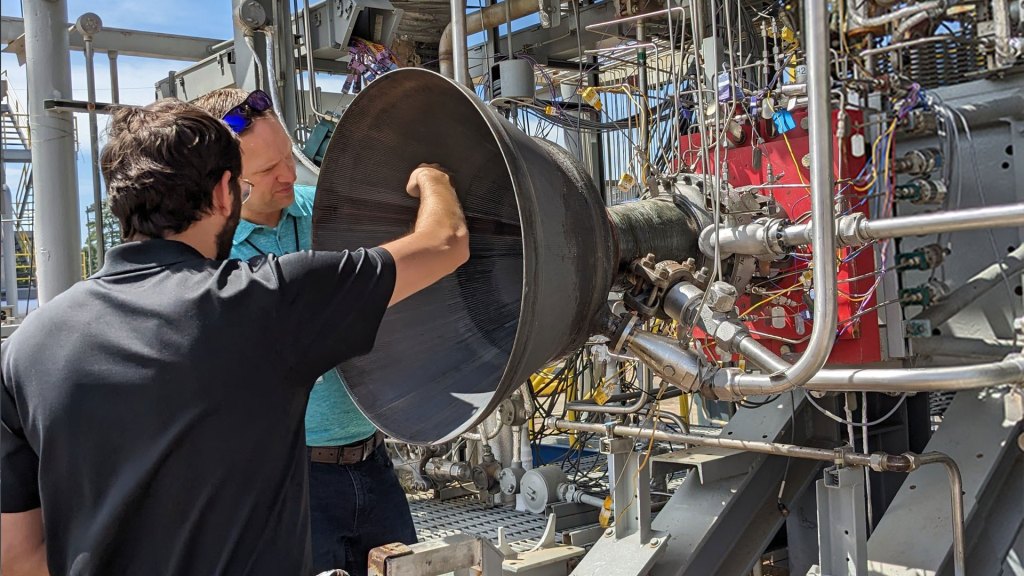
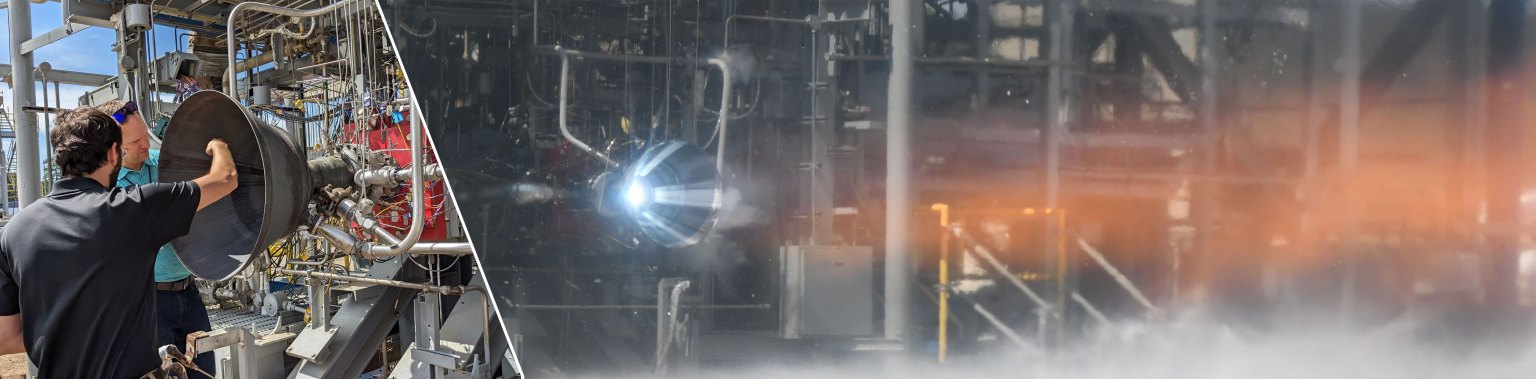
A man and women look at a piece of hardware
Tyler Gibson, left, and Allison Clark, RAMPT engineers at NASA’s Marshall Space Flight Center in Huntsville, Alabama, inspect an additively manufactured composite overwrap thrust chamber assembly. Conventional rocket hardware may require more than 1,000 or more individually joined parts. Additive manufacturing permits engineers to print these channels in novel alloys as a single piece with multiple alloys, dramatically reducing manufacturing time.
NASA/Danielle Burleson

“NASA, through public-private partnerships, is making these breakthroughs accessible to the commercial space industry to help them rapidly advance new flight technologies of their own,” Gradl said. “We’re solving technical challenges, creating new supply chains for parts and materials, and increasing the industry’s capacity to rapidly deliver reliable hardware that draws a busy commercial space infrastructure ever closer.”

The RAMPT project does not just develop the end technology but the means to fully understand that technology, whatever the application. That means advancing cutting-edge simulation tools that can identify the viability of new alloys and composites at the microstructural level – assessing how they handle the fiery rigors of liftoff, the punishing cold of space, and the dynamic stresses associated with liftoffs, landings, and the long transits between.

NASA’s strategy to encourage commercial and academic buy-in is to offer public-private partnership opportunities, wherein industry and academia contribute as much as 25% of project development costs, allowing them to reap the benefits.

For example, NASA successfully delivered a refined version of an alloy, known as GRCop42, created at NASA Glenn nearly 40 years ago which helped commercial launch provider, Relativity Space, launch the first fully 3D-printed rocket in March 2023.

“Our primary goal with these higher-performance alloys is to prove them in a rocket engine test-fire environment and then hand them off to enable commercial providers to build hardware, fly launch vehicles, and foster a thriving space infrastructure with real scientific, social, and economic rewards,” Gradl said.

A key benefit of additive manufacturing hardware development is radically reducing the “design-fail-fix” cycle – when engineers develop new hardware, ground-test it to failure to determine the hardware’s design limits under all possible conditions and then tweak accordingly. That capability is increasingly important with the creation of new alloys and designs, new processing techniques, and the introduction of composite overwraps and other innovations.
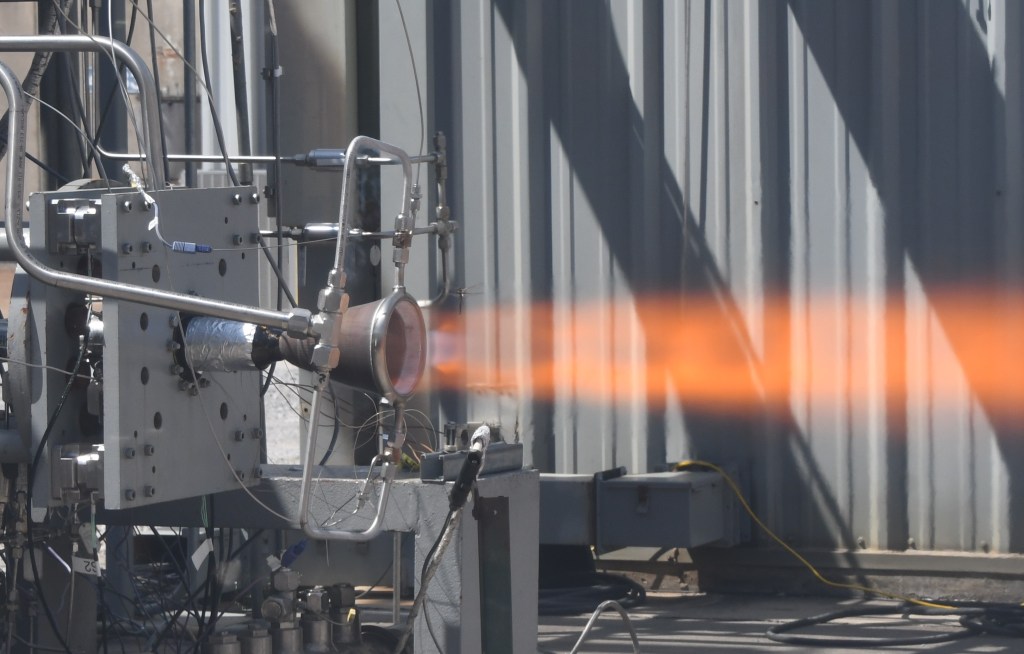
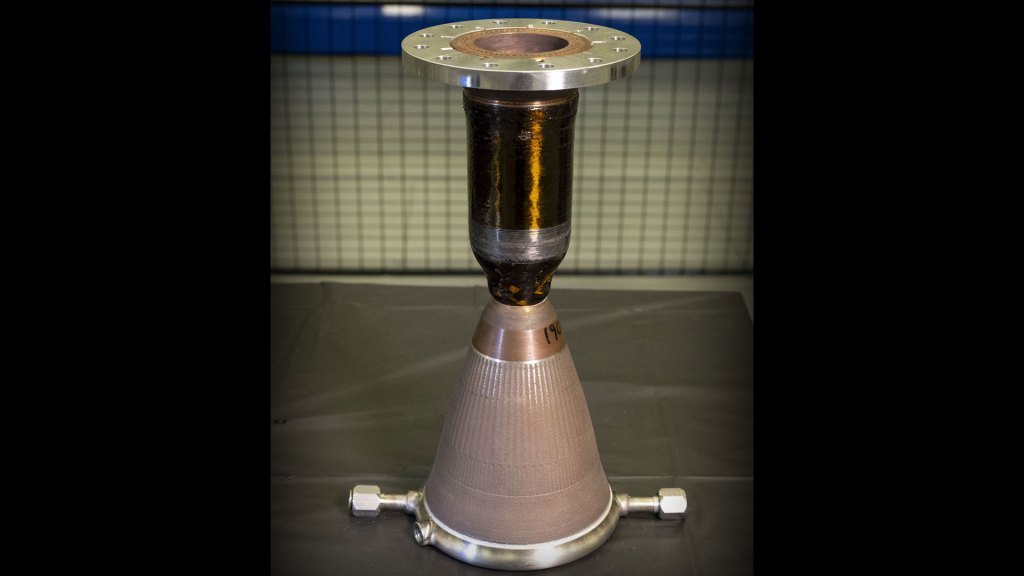
The RAMPT project did just that, successfully advancing new additive manufacturing alloys and processes, integrating them with carbon-fiber composites to reduce weight by up to 40%, developing and validating new simulation tools – and making all this data available to industry through public-private partnerships.

“We’re able to deliver prototypes in weeks instead of years, conduct dozens of scaled ground tests in a period that would feasibly permit just one or two such tests of conventionally manufactured hardware, and most importantly, deliver technology solutions that are safer, lighter, and less costly than traditional components,” Gradl said.

Fikes added, “Ten years from now, we may be building rocket engines – or rockets themselves – out of entirely new materials, employing all-new processing and fabrication techniques. NASA is central to all of that.”

The RAMPT project continues to progress and receive recognition from NASA and industry partners. On July 31, the RAMPT team was awarded NASA’s 2024 Invention of The Year award for its excellence and contributions to NASA and the commercial industry’s deep space exploration goals.

NASA’s Marshall Spaceflight Center in Huntsville, Alabama, leads RAMPT, with key support among engineers and technologists at NASA’s Glenn Research Center in Cleveland; Ames Research Center in Mountain View, California; Langley Research Center in Hampton, Virginia; and Auburn University in Auburn, Alabama, plus contributions from other academic partners and industry contractors. RAMPT is funded by NASA’s Game Changing Development Program within the agency’s Space Technology Mission Directorate.

Learn more at:

https://www.nasa.gov/rapid-analysis-and-manufacturing-propulsion-technology

Ramon J. Osorio
Marshall Space Flight Center, Huntsville, Alabama
256-544-0034
ramon.j.osorio@nasa.gov

Powered by WPeMatico

Get The Details…
Beth Ridgeway
Sols 4261-4262: Drill Sol 1…Take 2

Sols 4261-4262: Drill Sol 1…Take 2

2 min read

Sols 4261-4262: Drill Sol 1…Take 2

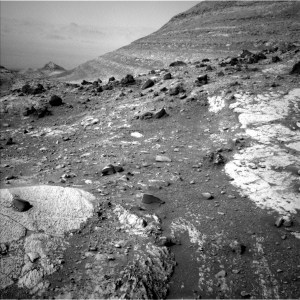
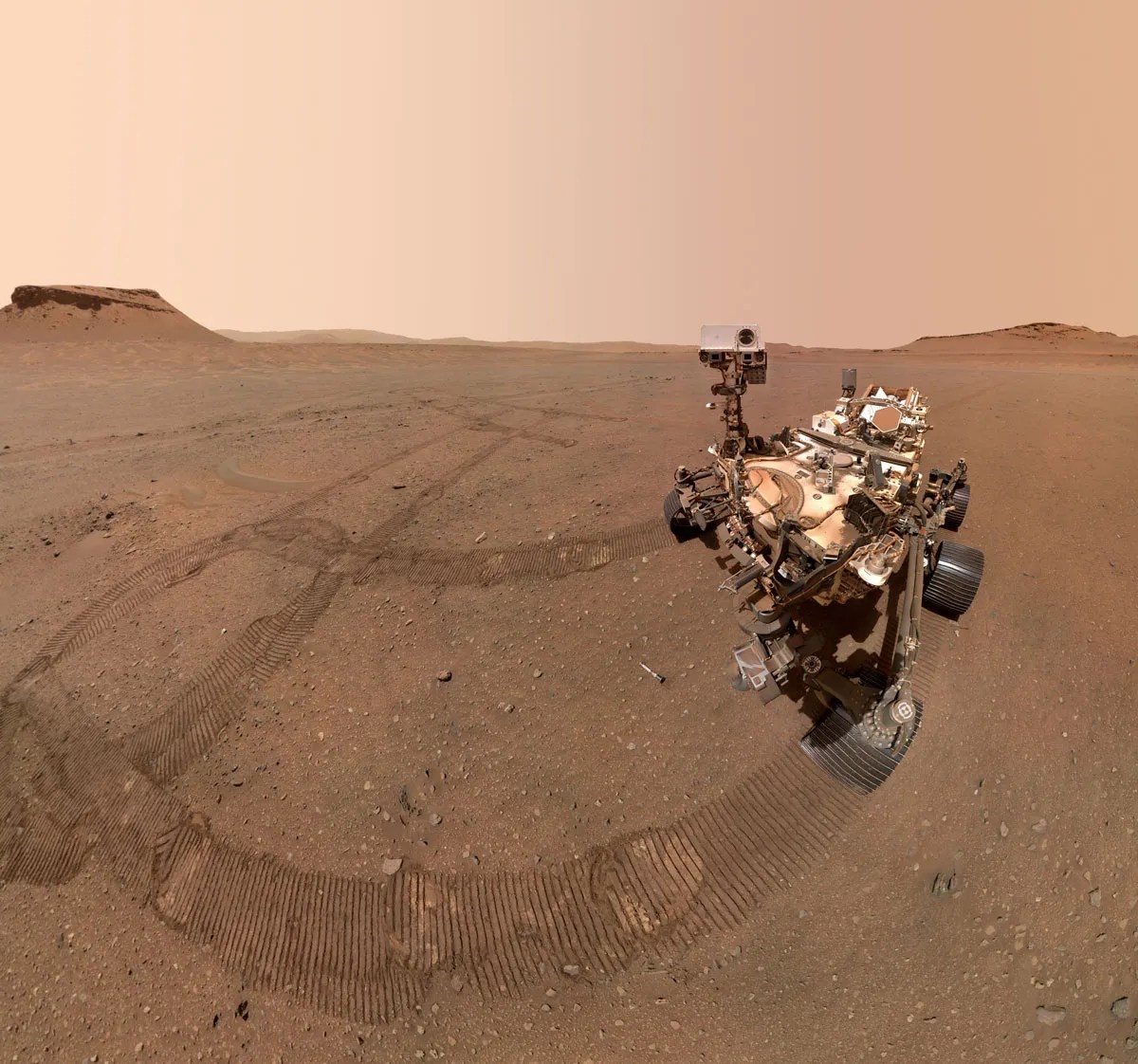
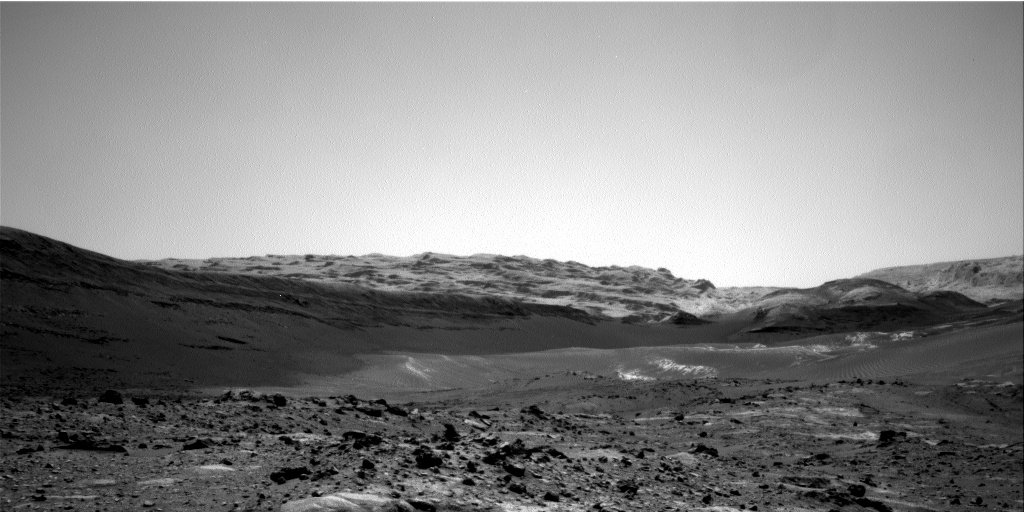
A grayscale panorama of the Martian surface showing terrain covered in many small rocks in the foreground. The middle ground consists of smooth dunes, curving from a low point in the center of the image, upward toward the left and right edges of the frame. In the background, another hill at center, with uneven ground that looks like the top of a frosted chocolate cake.
This image was taken by Right Navigation Camera onboard NASA’s Mars rover Curiosity on Sol 4258 — Martian day 4,258 of the Mars Science Laboratory mission — on July 29, 2024, at 03:26:02 UTC.

Earth planning date: Wednesday, July 31, 2024

As Cat mentioned on Monday, today’s plan is a second attempt at our Drill Sol 1 activities. We’ve shifted the target on Kings Canyon a little bit, but the activities remain the same — a preload test to ensure that we’re able to safely drill here, and contact science to get a preview of what composition we might be dealing with in this target.

Around these pre-drilling activities, we still had some time left over for more typical science activities. Power wasn’t as much of a concern as it will become as the drill campaign progresses, but we did have to do some rearranging due to timing constraints. There are some activities that need to go at particular times, whether that be for lighting, heating, or to coincide with other observations. If you put enough of these together, there can be a lot of swapping back and forth and moving things around to get the perfect position for everything. It’s a bit like choreographing a big dance — activities have to come in at just the right time so they don’t step on anyone’s toes, and all the pieces come together to make a cohesive whole.

In this metaphorical dance, our first movement is a short solo from ChemCam — just before the preload test we were able to squeeze in LIBS (laser spectroscopy) on a darker area of bedrock called “Blacksmith Peak.” The rest of the company joins ChemCam on the second sol. Mastcam comes in first to check out “Sam Mack Meadow,” an area of crushed material, followed by a quartet of environmental activities — a suprahorizon cloud movie, a tau and line-of-sight to see how dusty the atmosphere is, and a dust devil movie. It’s then back over to ChemCam, with LIBS on Kings Canyon and a long-distance observation of the yardang unit. Mastcam brings the dance to a close with their own documentation of Kings Canyon. For an encore, Mastcam makes one last appearance later that evening to do a sky survey.

Written by Alex Innanen, atmospheric scientist at York University

Share

Details

Last Updated
Aug 01, 2024

Related Terms

Powered by WPeMatico

Get The Details…

System-Wide Safety Project Description

System-Wide Safety Project Description

2 min read

Preparations for Next Moonwalk Simulations Underway (and Underwater)

Artist concept showing various projects the SWS team works on, from developing new data solutions, new technology and the safety risks associated with it, from robotics to unmanned aircraft and more.

A new era of aviation is here, and NASA’s System-Wide Safety (SWS) project is developing innovative data solutions to assure safe, rapid, and repeatable access to a transformed National Airspace System (NAS). SWS was created in 2018 and is part of NASA Aeronautics’ Airspace Operations and Safety Program. SWS evaluates how the aerospace industry and aircraft modernization impacts safety by using technology to address future operational and design risks.  

SWS Goals

  1. To explore, discover, and understand the impact on safety of growing complexity introduced by modernization aimed at improving the efficiency of flight, the access to airspace, and the expansion of services provided by air vehicles 
  1. To develop and demonstrate innovative solutions that enable this modernization and the aviation transformation envisioned for global airspace system through proactive mitigation of risks in accordance with target levels of safety 

To transform the NAS, SWS employs high-risk research and development to understand how the modernization of industry and aircraft can affect overall safety. SWS is developing and demonstrating innovative solutions within several key research areas, referred to as technical challenges. 

Current Technical Challenges (TCs)

  • TC-2: In-Flight Safety Predictions for Emerging Operations  
  • TC-4: Complex Autonomous Systems Assurance 
  • TC-5: Safety Demonstrator Series for Operational In-Time Aviation Safety Management System 
  • TC-6: In-Time Aviation Safety Management System 

SWS is developing the concept and requirements for an assured In-Time Aviation Safety Management System to achieve the goals described above. It is an integrated set of services, functions, and capabilities to address operational risks and hazards of a transformed NAS. SWS catalyzes the discovery of the unknown and paves the path forward for aviation safety in the future airspace.


Back to main System-Wide Safety project page.

Share

Details

Last Updated

Jul 31, 2024

Editor
Jim Banke
Contact

Related Terms

Powered by WPeMatico

Get The Details…
Jim Banke

System-Wide Safety Project Leadership

System-Wide Safety Project Leadership

1 min read

Preparations for Next Moonwalk Simulations Underway (and Underwater)

Artist concept showing various projects the SWS team works on, from developing new data solutions, new technology and the safety risks associated with it, from robotics to unmanned aircraft and more.

System-Wide Safety (SWS) project leaders are listed here.

Project Manager
Dr. Kyle Ellis

Deputy Project Manager
Summer Brandt

Associate Project Manager
Dr. Wendy Okolo

Associate Project Manager
Michael Vincent

Project Scientist
Dr. Paul Miner

Senior Technical Advisor for Aviation Safety
Dr. Lance Prinzel

Senior Technical Advisor for Autonomy
Dr. Joseph Coughlan

Senior Technical Advisor for Assurance
Dr. Natasha Neogi

Safety Liaison
Dr. Misty Davies

Back to main System-Wide Safety project page.

Share

Details

Last Updated

Jul 31, 2024

Editor
Jim Banke
Contact

Related Terms

Powered by WPeMatico

Get The Details…
Lillian Gipson

Spacesuit Check and Student Robotics Contest Today as Station Orbits Higher

Spacesuit Check and Student Robotics Contest Today as Station Orbits Higher

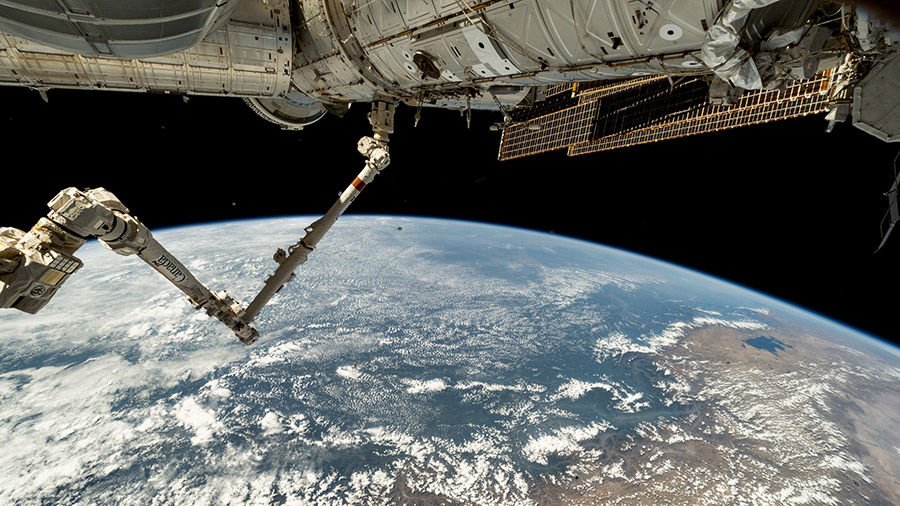
The Canadarm2 robotic arm extends from the Harmony module as the orbital outpost soared above the coast of Peru. Partially obscured in the top background, is the Boeing Starliner spacecraft.

Spacesuits, robotics, and maintenance were the main priorities for the Expedition 71 and NASA’s Boeing Crew Flight Test crews after the International Space Station raised its orbit on Wednesday. The nine orbital residents also split their day on a variety of human research activities and docked crew spaceship activities.

NASA Flight Engineer Matthew Dominick evaluated a spacesuit in the Quest airlock today with assistance from fellow NASA astronaut Mike Barratt. The duo powered up the spacesuit, configured its components, and tested the suit’s communications and life support systems during Dominick’s fit verification.

Astrobee free-flying robotic assistants, powered by fans and a vision-based navigation system, were maneuvering inside the Kibo laboratory module during the Astrobee Zero Robotics 3 finals competition on Wednesday. The Astrobees were controlled and manipulated by winning algorithms written by students on Earth and downloaded to the robotics platform by mission controllers. NASA Flight Engineer Tracy C. Dyson readied the toaster-sized, cube-shaped Astrobees then monitored the contest designed to encourage students to pursue careers in science, engineering, and space exploration.

During the morning, NASA Flight Engineer Jeanette Epps removed blood samples that were stowed overnight inside the Kubik research incubator. She spun those samples in a centrifuge before placing them inside a science freezer for preservation and later analysis to understand microgravity’s effect on humans. Afterward, Epps conducted several hours of airflow measurements inside the crew quarters located in the Harmony module’s deck compartment to maintain ventilation systems and crew health.

Starliner Commander Butch Wilmore and Suni Williams, both NASA astronauts, had their day packed primarily with lab upkeep duties aboard the orbiting outpost. Wilmore spent his morning inspecting advanced plumbing hardware then packed the life support components for return to Earth. Williams set up high-definition video gear inside the Columbus laboratory module then inspected a bar code reader and radio frequency hardware. The duo also partnered up and organized cargo packed inside the Tranquility module before calling down to Boeing mission controllers for a conference.

The space station is orbiting higher today after the docked Progress 87 cargo craft fired its thrusters for over 20 minutes early Wednesday morning. The orbital reboost places the station at the correct altitude to receive the next cargo craft from Roscosmos after it launches in mid-August.

Commander Oleg Kononenko examined the cargo space available inside the Nauka and Rassvet modules to prepare for the upcoming space delivery. The five-time station visitor also inspected the telerobotically operated rendezvous unit, or TORU, in the Zvezda service module. The TORU would be used to remotely control an approaching Roscosmos resupply ship in the unlikely event the spacecraft would be unable to complete its automated docking sequence.

Roscosmos Flight Engineers Nikolai Chub and Aleksander Grebenkin had their day full as they conducted a variety of space research and maintained orbital lab systems on Wednesday. Chub continued studying how magnetic and electrical fields affect fluid physics and serviced life support systems. Grebenkin pointed a digital video camera out a station window and videotaped the condition of the Roscosmos segment modules for analysis.


Learn more about station activities by following the space station blog@space_station and @ISS_Research on X, as well as the ISS Facebook and ISS Instagram accounts.

Get weekly video highlights at: https://roundupreads.jsc.nasa.gov/videoupdate/

Get the latest from NASA delivered every week. Subscribe here: www.nasa.gov/subscribe

Powered by WPeMatico

Get The Details…

Mark Garcia