The Marshall Star for July 31, 2024
The Marshall Star for July 31, 2024

SLS Core Stage Rolls Inside Vehicle Assembly Building at Kennedy
NASA’s SLS (Space Launch System) rocket core stage for the Artemis II mission is inside the Vehicle Assembly Building at the agency’s Kennedy Space Center.
Tugboats and towing vessels moved the barge and core stage 900-miles to the Florida spaceport from NASA’s Michoud Assembly Facility, where it was manufactured and assembled.

Team members with NASA’s Exploration Ground Systems Program safely transferred the 212-foot-tall core stage from the agency’s Pegasus barge, which arrived at NASA Kennedy’s Complex 39 turn basin wharf on July 23, onto the self-propelled module transporter, which is used to move large elements of hardware. It was then rolled to the Vehicle Assembly Building transfer aisle where teams will process it until it is ready for rocket stacking operations.
In the coming months, teams will integrate the rocket core stage atop the mobile launcher with the additional Artemis II flight hardware, including the twin solid rocket boosters, launch vehicle stage adapter, and the Orion spacecraft.
The Artemis II test flight will be NASA’s first mission with crew under the Artemis campaign, sending NASA astronauts Victor Glover, Christina Koch, and Reid Wiseman, as well as CSA (Canadian Space Agency) astronaut Jeremy Hansen, on a 10-day journey around the Moon and back.
Take 5 with Chris Calfee
By Wayne Smith
Ask Chris Calfee about his favorite memory from his 38-year career at NASA’s Marshall Space Flight Center and you’ll discover it’s a difficult question to answer.
That’s because there have been many memories.

Calfee was the integrator for the upper stage spacecraft for the Marshall-led Chandra X-Ray Observatory, which marked its 25th launch anniversary July 23. He’s worked with Demonstration of Autonomous Rendezvous Technology (DART), a technology mission aimed at demonstrating that a spacecraft could independently rendezvous with an orbiting satellite without human intervention. Calfee was the booster manager for the Ares I-X test flight, which he points to as another career highlight.
And then there’s his favorite memory – working with NASA’s SLS (Space Launch System) rocket and watching the 2022 Artemis I launch from NASA’s Kennedy Space Center.
“I’ve been fortunate in my career to have the opportunities I’ve had with NASA,” said Calfee, the SLS Spacecraft Payload Integration and Evolution (SPIE) element manager. “Seeing the Chandra mission fly and the success it has had is awesome. Being able to work DART from cradle to grave, including its flight, was unforgettable. But I’d have to say being able to represent the SLS SPIE Element Office at Kennedy’s Launch Control Center and seeing Artemis I light up the night sky is the proudest moment.”
As the SLS Spacecraft/Payload Integration and Evolution element manager, Calfee’s responsibilities include overseeing the development and delivering key adapter hardware for SLS rockets that will power the first crewed Artemis missions and first flight of SLS in its evolved Block 1B configuration. The hardware includes the launch vehicle stage adapter, interim cryogenic propulsion stage, and the Orion stage adapter – and the universal stage adapter for SLS Block 1B. The SPIE Element Office serves a key role in the successful execution of the SLS mission, both for the initial launch capability as well as the evolution of subsequent rocket configurations.
NASA moved a step closer to the Artemis II launch with the July shipment of the SLS core stage to Kennedy from the agency’s Michoud Assembly Facility. Calfee and his team have the adapters complete for Artemis II and will soon ship them to Kennedy for launch preparations. As work advances toward Artemis II, Calfee looks back on the Artemis I launch as a “surreal experience.” But he put his celebration on hold as he watched the initial moments of the flight.
“The pressure was on the SPIE hardware to finish the job for SLS as we tracked the successful booster burn and separation, and then the core stage’s excellent performance,” said Calfee, who is from Newport, Tennessee, and a graduate of the University of Tennessee. “The interim cryogenic propulsion (ICPS) stage 20-minute burn was approximately one and a half hours after launch, followed by Orion spacecraft separation from the ICPS and Orion stage adapter, the most critical event of the mission from my perspective. It was another huge relief to see the ICPS burn and the Orion separation event go flawlessly.”

Memorable indeed.
Question: Looking ahead to Artemis II and the Artemis campaign, what excites you most about the future of human space exploration and your team’s role it?
Calfee: For me personally, it is exciting just to be a part of the future of human space flight and having the opportunity to influence that future. With respect to the SPIE team, it’s a similar feeling. Having the opportunity to lead a team that has such a significant role and responsibility in our future is an awesome experience.
Question: Who or what drives/motivates you?
Calfee: The opportunity to make a difference, be a part of history, and lead and mentor our future leaders.
Question: Who or what inspired you to pursue an education/career that led you to NASA and Marshall?
Calfee: My parents were my inspiration and provided me the opportunity to pursue my education. Although I followed the space program as a kid, specifically the Apollo program and Moon landings, I never dreamed that I would actually have the opportunity to work for NASA. I found my way to NASA via an on-campus interview job fair, was invited to Marshall for a follow-up interview, and it became an easy decision when an offer was made.
Question: What advice do you have for employees early in their NASA career or those in new leadership roles?
Calfee: For those early in their career, keep an open mind and be willing to take on new challenges. Diversify the resume. For those in new leadership roles, never get complacent. The moment you think you have it all figured out, something will surprise and humble you. I love the quote, “Get comfortable being uncomfortable,” because I guarantee as a leader, you will experience many uncomfortable moments.
Question: What do you enjoy doing with your time while away from work?
Calfee: Spending time with my grandkids. I also enjoy homebrewing and wine making, and I probably spend too much time following and watching college sports.
Smith, a Media Fusion employee and the Marshall Star editor, supports the Marshall Office of Communications.
Stars, Stripes, and STEM: Q&A with Former NASA Intern, Miss America
Team members at NASA’s Marshall Space Flight Center recently sat down with reigning Miss America, Madison Marsh. In addition to her crown, Marsh is a second lieutenant in the United States Air Force and a former intern who contributed to astrophysics research at Marshall. Watch to learn more about her experience studying gamma-ray bursts and hear what advice she has for anyone interested in a STEM career. (NASA)
Thomas Brown Named Marshall’s Chief Engineer, Manager of Engineering Office
Thomas Brown has been named center chief engineer and manager of the Chief Engineering Office within the Engineering Directorate at NASA’s Marshall Space Flight Center, effective July 28.

In his role, Brown will be responsible for assuring the technical excellence and success of all Marshall-assigned spacecraft, propulsion, science payload, life support, and mission systems. He will provide expert technical leadership in planning, directing, and executing research, technology, ground and flight systems design and development, production, integration, and sustaining engineering for the Space Launch System Program, Human Landing System Program, the Human Exploration Development and Operations Office, and the Science and Technology Office.
Brown previously served as director of the Propulsion Systems Department of the Engineering Directorate, since 2020. In this role, he managed a $68 million annual budget and oversaw a workforce responsible for new and ongoing design and development activities for the propulsion components and systems at Marshall and other NASA centers.
As the capability lead for In-Space Transportation Systems from 2018-2020, Brown led the Systems Capability Leadership Team of system-specific subject matter experts from across the agency for the in-space transportation system’s disciplines, which support NASA’s robotic and human exploration missions. From 2014 to 2018, he was the NASA Technical Fellow for Propulsion and the NASA Propulsion Capability Lead, the agency’s most senior propulsion subject matter expert.
Between 2005 and 2014, Brown served as chief of two divisions within the Propulsion Systems Department, as well as technical advisor to the director of the Propulsion Systems Department at Marshall, where he assisted in internal technology investment planning and served in agency and cross-government level assignments. In 2007, he completed a one-year developmental assignment at Glenn Research Center as acting deputy manager of the Advanced Capabilities Project Office.
Brown began his NASA career at Marshall in 1999 as an aerospace engineer in the Space Transportation Directorate, performing propulsion systems analysis and integration. Initially working design, analysis, and integration of the X-34 Main Propulsion System and the Fastrac/MC-1 rocket engine, Brown’s activities quickly expanded into a broad range of propulsion technology development efforts. He served as chief engineer for several of these efforts during both the Second Generation Reusable Launch Vehicle Program and the Next Generation Launch Technology Program. Specific projects included the Main Propulsion and Auxiliary Propulsion Systems Technology Project and the ISTAR, Rocket Based Combined Cycle technology project.
Brown received a bachelor’s degree in physics from Allegheny College in Meadville, Pennsylvania, before earning his master’s and doctoral degrees in mechanical engineering from Vanderbilt University. He holds a U.S. patent and has published more than 30 refereed journal publications, book sections, and conference proceedings related to fundamental combustion, advanced measurement techniques, propulsion technology, and propulsion systems analysis and integration.
Marshall Deputy Director Rae Ann Meyer Honored During Huntsville City Football Club Space Night
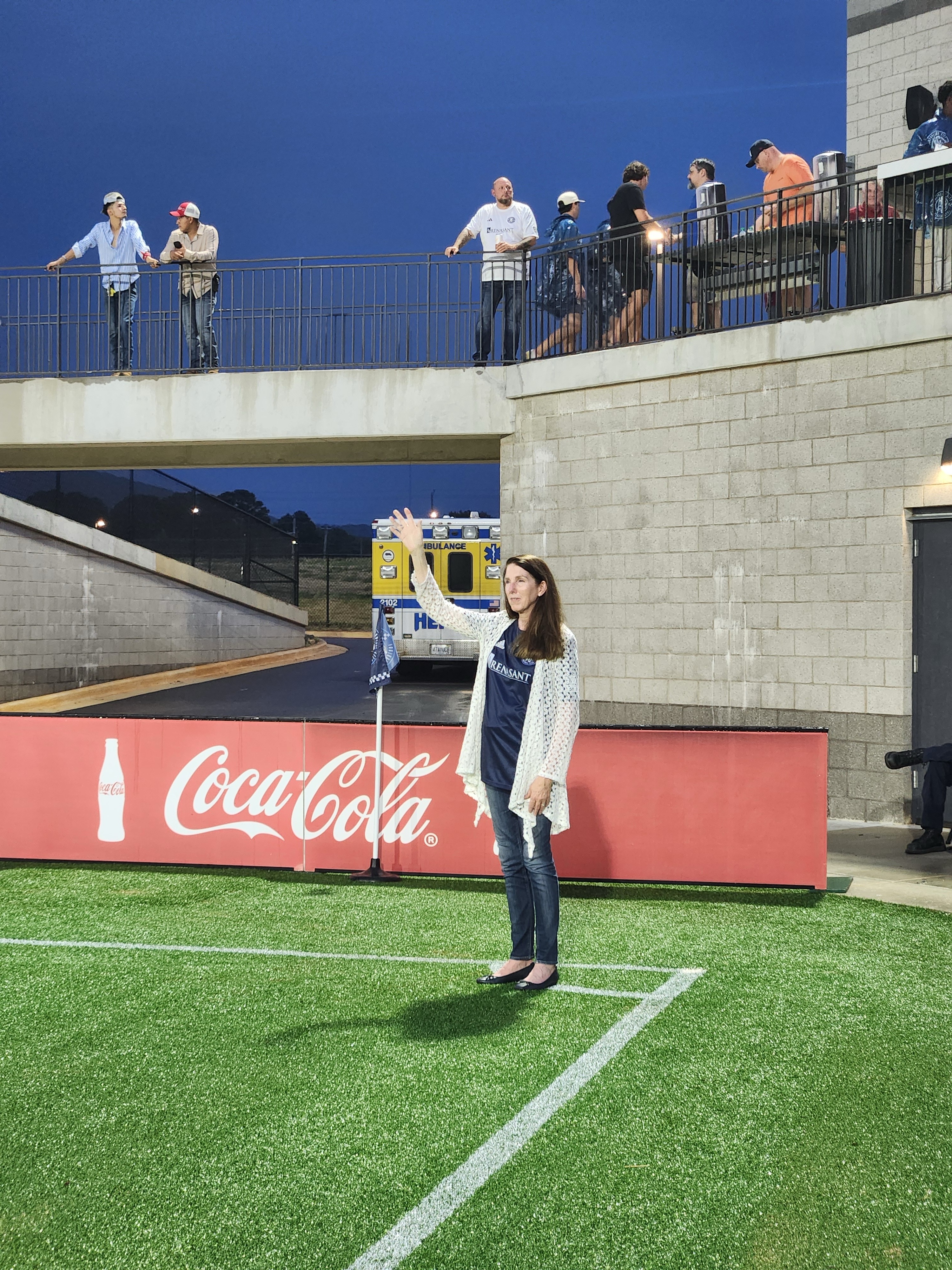
NASA Marshall Deputy Director Rae Ann Meyer waves to a crowd of more than 4,000 fans at the Wicks Family Field at Joe Davis Stadium in Huntsville on July 27 during halftime of the soccer match between Huntsville City Football Club and Atlanta United 2. Meyer was honored as the “Hero of the Match,” recognizing her leadership and accomplishments in 35 years of service to the agency. (NASA/Taylor Goodwin)

Representatives from 10 Marshall programs and projects staffed booths and exhibits at the stadium throughout the match, sharing details of their respective work to thousands of guests. (NASA/Taylor Goodwin)

Marshall’s exhibit footprint began outside of the stadium, welcoming soccer and space fans to the stadium with inflatables and educational materials. (NASA/Taylor Goodwin)
NASA Supports Burst Test for Orbital Reef Commercial Space Station
An element of a NASA-funded commercial space station, Orbital Reef, under development by Blue Origin and Sierra Space, recently completed a full-scale ultimate burst pressure test as part of the agency’s efforts for new destinations in low Earth orbit.
This milestone is part of a NASA Space Act Agreement awarded to Blue Origin in 2021. Orbital Reef includes elements provided by Sierra Space, including the LIFE (Large Integrated Flexible Environment) habitat structure.

Teams conducted the burst test on Sierra Space’s LIFE habitat structure using testing capabilities at NASA’s Marshall Space Flight Center. The inflatable habitat is fabricated from high-strength webbings and fabric that form a solid structure once pressurized. The multiple layers of soft goods materials that make up the shell are compactly stowed in a payload fairing and inflated when ready for use, enabling the habitat to launch on a single rocket.
“This is an exciting test by Sierra Space for Orbital Reef, showing industry’s commitment and capability to develop innovative technologies and solutions for future commercial destinations,” said Angela Hart, manager of NASA’s Commercial Low Earth Orbit Development Program at the agency’s Johnson Space Center. “Every successful development milestone by our partners is one more step to achieving our goal of enabling commercial low Earth orbit destinations and expanding the low Earth orbit marketplace.”
The pressurization to failure during the test demonstrated the habitat’s capabilities and provided the companies with critical data supporting NASA’s inflatable softgoods certification guidelines, which recommend a progression of tests to evaluate these materials in relevant operational environments and understand the failure modes.
Demonstrating the habitat’s ability to meet the recommended factor of safety through full-scale ultimate burst pressure testing is one of the primary structural requirements on a soft goods article, such as Sierra Space’s LIFE habitat, seeking flight certification.
Prior to this recent test, Sierra Space conducted its first full-scale ultimate burst pressure test on the LIFE habitat at Marshall in December 2023. Additionally, Sierra Space previously completed subscale tests, first at NASA’s Johnson Space Center and then at Marshall as part of ongoing development and testing of inflatable habitation architecture.
NASA supports the design and development of multiple commercial space stations, including Orbital Reef, through funded and unfunded agreements. The current design and development phase will be followed by the procurement of services from one or more companies.
NASA’s goal is to achieve a strong economy in low Earth orbit where the agency can purchase services as one of many customers to meet its science and research objectives in microgravity. NASA’s commercial strategy for low Earth orbit will provide the government with reliable and safe services at a lower cost, enabling the agency to focus on Artemis missions to the Moon in preparation for Mars while also continuing to use low Earth orbit as a training and proving ground for those deep space missions.
Learn more about NASA’s commercial space strategy.
DART Mission Sheds New Light on Target Binary Asteroid System
In studying data collected from NASA’s DART (Double Asteroid Redirection Test) mission, which in 2022 sent a spacecraft to intentionally collide with the asteroid moonlet Dimorphos, the mission’s science team has discovered new information on the origins of the target binary asteroid system and why the DART spacecraft was so effective in shifting Dimorphos’ orbit.
In five recently published papers in Nature Communications, the team explored the geology of the binary asteroid system, comprising moonlet Dimorphos and parent asteroid Didymos, to characterize its origin and evolution and constrain its physical characteristics.

“These findings give us new insights into the ways that asteroids can change over time,” said Thomas Statler, lead scientist for Solar System Small Bodies at NASA Headquarters. “This is important not just for understanding the near-Earth objects that are the focus of planetary defense, but also for our ability to read the history of our Solar System from these remnants of planet formation. This is just part of the wealth of new knowledge we’ve gained from DART.”
Olivier Barnouin and Ronald-Louis Ballouz of Johns Hopkins Applied Physics Laboratory (APL) in Laurel, Maryland, led a paper that analyzed the geology of both asteroids and drew conclusions about their surface materials and interior properties. From images captured by DART and its accompanying LICIACube cubesat – contributed by the Italian Space Agency (ASI), the team observed the smaller asteroid Dimorphos’ topography, which featured boulders of varying sizes. In comparison, the larger asteroid Didymos was smoother at lower elevations, though rocky at higher elevations, with more craters than Dimorphos. The authors inferred that Dimorphos likely spun off from Didymos in a large mass shedding event.
There are natural processes that can accelerate the spins of small asteroids, and there is growing evidence that these processes may be responsible for re-shaping these bodies or even forcing material to be spun off their surfaces.
Analysis suggested that both Didymos and Dimorphos have weak surface characteristics, which led the team to posit that Didymos has a surface age 40–130 times older than Dimorphos, with the former estimated to be 12.5 million years and the latter less than 300,000 years old. The low surface strength of Dimorphos likely contributed to DART’s significant impact on its orbit.
“The images and data that DART collected at the Didymos system provided a unique opportunity for a close-up geological look of a near-Earth asteroid binary system,” said Barnouin. “From these images alone, we were able to infer a great deal of information on geophysical properties of both Didymos and Dimorphos and expand our understanding on the formation of these two asteroids. We also better understand why DART was so effective in moving Dimorphos.”
Maurizio Pajola, of the National Institute for Astrophysics (INAF) in Rome, and co-authors led a paper comparing the shapes and sizes of the various boulders and their distribution patterns on the two asteroids’ surfaces. They determined the physical characteristics of Dimorphos indicate it formed in stages, likely of material inherited from its parent asteroid Didymos. That conclusion reinforces the prevailing theory that some binary asteroid systems arise from shed remnants of a larger primary asteroid accumulating into a new asteroid moonlet.
Alice Lucchetti, also of INAF, and colleagues found that thermal fatigue – the gradual weakening and cracking of a material caused by heat – could rapidly break up boulders on the surface of Dimorphos, generating surface lines and altering the physical characteristics of this type of asteroid more quickly than previously thought. The DART mission was likely the first observation of such a phenomenon on this type of asteroid.
Supervised by researcher Naomi Murdoch of ISAE-SUPAERO in Toulouse, France, and colleagues, a paper led by students Jeanne Bigot and Pauline Lombardo determined Didymos’ bearing capacity – the surface’s ability to support applied loads – to be at least 1,000 times lower than that of dry sand on Earth or lunar soil. This is considered an important parameter for understanding and predicting the response of a surface, including for the purposes of displacing an asteroid.
Colas Robin, also of ISAE-SUPAERO, and co-authors analyzed the surface boulders on Dimorphos, comparing them with those on other rubble pile asteroids, including Itokawa, Ryugu, and Bennu. The researchers found the boulders shared similar characteristics, suggesting all these types of asteroids formed and evolved in a similar fashion. The team also noted that the elongated nature of the boulders around the DART impact site implies that they were likely formed through impact processing.
These latest findings form a more robust overview of the origins of the Didymos system and add to the understanding of how such planetary bodies were formed. As ESA’s (European Space Agency) Hera mission prepares to revisit DART’s collision site in 2026 to further analyze the aftermath of the first-ever planetary defense test, this research provides a series of tests for what Hera will find and contributes to current and future exploration missions while bolstering planetary defense capabilities.
Johns Hopkins APL managed the DART mission for NASA’s Planetary Defense Coordination Office as a project of the agency’s Planetary Missions Program Office, which is at NASA’s Marshall Space Flight Center. NASA provided support for the mission from several centers, including the Jet Propulsion Laboratory, Goddard Space Flight Center, Johnson Space Center, Glenn Research Center, and Langley Research Center.
Fermi Finds New Feature in Brightest Gamma-Ray Burst Yet Seen
In October 2022, astronomers were stunned by what was quickly dubbed the BOAT — the brightest-of-all-time gamma-ray burst (GRB). Now an international science team reports that data from NASA’s Fermi Gamma-ray Space Telescope reveals a feature never seen before.
“A few minutes after the BOAT erupted, Fermi’s Gamma-ray Burst Monitor recorded an unusual energy peak that caught our attention,” said lead researcher Maria Edvige Ravasio at Radboud University in Nijmegen, Netherlands, and affiliated with Brera Observatory, part of INAF (the Italian National Institute of Astrophysics) in Merate, Italy. “When I first saw that signal, it gave me goosebumps. Our analysis since then shows it to be the first high-confidence emission line ever seen in 50 years of studying GRBs.”

A paper about the discovery appears in the July 26 edition of the journal Science.
When matter interacts with light, the energy can be absorbed and reemitted in characteristic ways. These interactions can brighten or dim particular colors (or energies), producing key features visible when the light is spread out, rainbow-like, in a spectrum. These features can reveal a wealth of information, such as the chemical elements involved in the interaction. At higher energies, spectral features can uncover specific particle processes, such as matter and antimatter annihilating to produce gamma rays.
“While some previous studies have reported possible evidence for absorption and emission features in other GRBs, subsequent scrutiny revealed that all of these could just be statistical fluctuations. What we see in the BOAT is different,” said coauthor Om Sharan Salafia at INAF-Brera Observatory in Milan, Italy. “We’ve determined that the odds this feature is just a noise fluctuation are less than one chance in half a billion.”
GRBs are the most powerful explosions in the cosmos and emit copious amounts of gamma rays, the highest-energy form of light. The most common type occurs when the core of a massive star exhausts its fuel, collapses, and forms a rapidly spinning black hole. Matter falling into the black hole powers oppositely directed particle jets that blast through the star’s outer layers at nearly the speed of light. We detect GRBs when one of these jets points almost directly toward Earth.
The BOAT, formally known as GRB 221009A, erupted Oct. 9, 2022, and promptly saturated most of the gamma-ray detectors in orbit, including those on Fermi. This prevented them from measuring the most intense part of the blast. Reconstructed observations, coupled with statistical arguments, suggest the BOAT, if part of the same population as previously detected GRBs, was likely the brightest burst to appear in Earth’s skies in 10,000 years.
The putative emission line appears almost 5 minutes after the burst was detected and well after it had dimmed enough to end saturation effects for Fermi. The line persisted for at least 40 seconds, and the emission reached a peak energy of about 12 MeV (million electron volts). For comparison, the energy of visible light ranges from 2 to 3 electron volts.
So what produced this spectral feature? The team thinks the most likely source is the annihilation of electrons and their antimatter counterparts, positrons.
“When an electron and a positron collide, they annihilate, producing a pair of gamma rays with an energy of 0.511 MeV,” said coauthor Gor Oganesyan at Gran Sasso Science Institute and Gran Sasso National Laboratory in L’Aquila, Italy. “Because we’re looking into the jet, where matter is moving at near light speed, this emission becomes greatly blueshifted and pushed toward much higher energies.”
If this interpretation is correct, to produce an emission line peaking at 12 MeV, the annihilating particles had to have been moving toward us at about 99.9% the speed of light.
“After decades of studying these incredible cosmic explosions, we still don’t understand the details of how these jets work,” noted Elizabeth Hays, the Fermi project scientist at NASA’s Goddard Space Flight Center. “Finding clues like this remarkable emission line will help scientists investigate this extreme environment more deeply.”
The Fermi Gamma-ray Space Telescope is an astrophysics and particle physics partnership managed by Goddard. Fermi was developed in collaboration with the U.S. Department of Energy, with important contributions from academic institutions and partners in France, Germany, Italy, Japan, Sweden, and the United States.
NASA’s Marshall Space Flight Center is responsible for one of the instruments on the Fermi Gamma-ray Space Telescope – the Gamma-ray Burst Monitor, or GBM. The GBM studies gamma-ray bursts, the most powerful explosions in the universe, as well as other flashes of gamma rays. The GBM sees these bursts across the entire sky, and scientists are using its observations to learn more about the universe.
Powered by WPeMatico
Get The Details…
Lee Mohon