NASA Ames to Host Supercomputing Resources for UC Berkeley Researchers
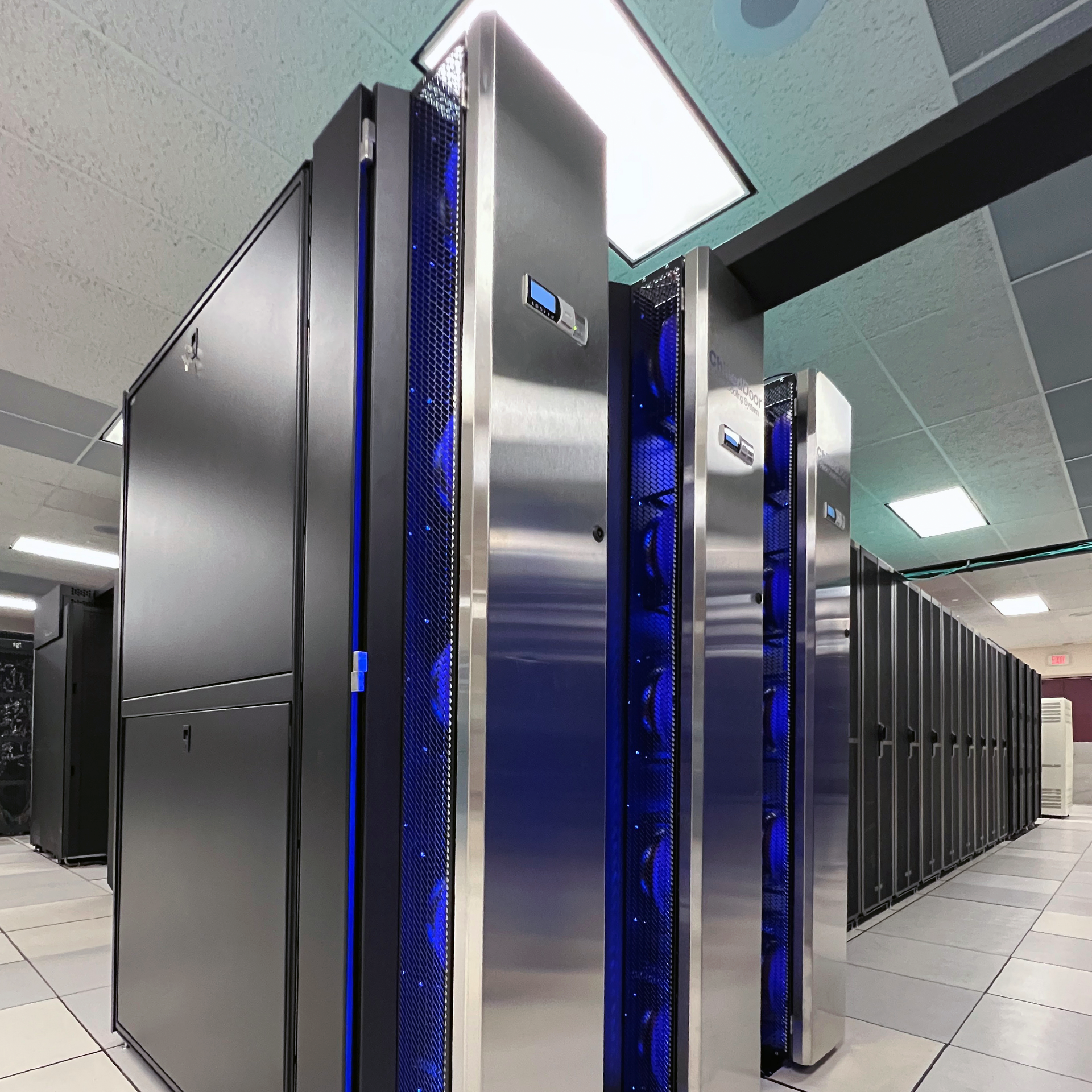
The Cabeus supercomputer at the NASA Advanced Supercomputing Facility at NASA’s Ames Research Center in California’s Silicon Valley
NASA/Michelle Moyer
Under a new agreement, NASA will host supercomputing resources for the University of California, Berkeley, at the agency’s Ames Research Center in California’s Silicon Valley. The agreement is part of an expanding partnership between Ames and UC Berkeley and will support the development of novel computing algorithms and software for a wide variety of scientific and technology areas.
Per the three-year Reimbursable Space Act Agreement, the UC Berkeley supercomputer and storage systems will be hosted at the NASA Advanced Supercomputing Facility – the agency’s premiere supercomputing center. UC Berkeley researchers will benefit from NASA’s capability in optimizing modern computing codes. NASA will gain from exchanging with the university best practices in operating and maintaining high-performance computing systems.
The newest addition to the UC Berkeley “Savio” supercomputer will be housed within a NASA data center and will consist of 192 dual Intel Ice Lake Xeon processor nodes, 32 NVIDIA graphics processor unit accelerated nodes, and 1.3 petabytes of high-performance flash storage.
The agreement complements the joint venture announced in October 2023 between UC Berkeley and developer SKS Partners to build the proposed Berkeley Space Center at NASA Research Park, located at Ames. The project is envisioned as a 36-acre discovery and innovation hub to include educational spaces, labs, offices, student housing, and a new conference center.
“Supporting UC Berkeley in various aspects of supercomputing operations adds an important component to our existing collaboration and opens up exciting possibilities for gaining new knowledge in aeronautical and space sciences, materials sciences, and information science and technologies,” said Rupak Biswas, director, Exploration Technology at NASA Ames.
For more than four decades, the NASA Advanced Supercomputing facility has provided leadership in NASA high-end computing technologies and services for agency missions and projects in aeronautics research, launch vehicle analysis, entry systems technologies, Earth and planetary science, astrophysics, and heliophysics. Learn more about Ames’ world-class supercomputing capabilities and services, here.
Author: Jill Dunbar, NASA Advanced Supercomputing Division, NASA’s Ames Research Center
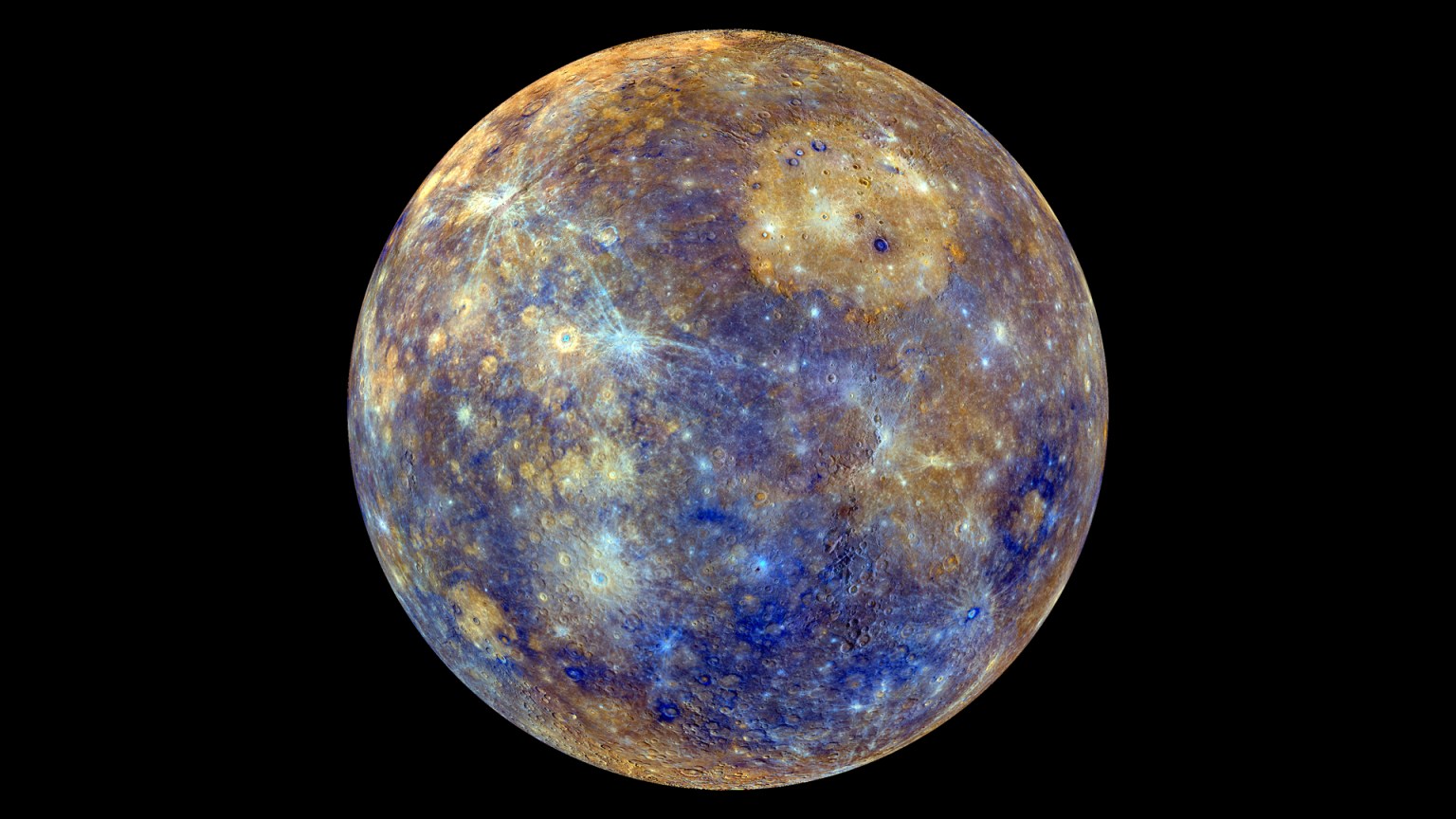
This view of Mercury was produced by using images from the color base map imaging campaign during MESSENGER’s primary mission.
Credits: NASA/Johns Hopkins University Applied Physics Laboratory/Carnegie Institution of Washington
The excerpts below are taken from Discovery Program oral history interviews conducted in 2009 by Dr. Susan Niebur and tell the story of the hurdles the MESSENGER (MErcury Surface, Space ENvironment, GEochemistry, and Ranging) mission team faced with the technical requirements of visiting Mercury, budget challenges, and schedule impacts —all while keeping their mission goals in mind on the way to launch.
The MESSENGER mission followed a long road from conception to launch with multiple detours and obstacles along the way. First conceived by the Johns Hopkins University Applied Physics Laboratory (APL) after NASA’s 1996 Discovery Program Announcement of Opportunity, the mission to Mercury proposal, if accepted, would be the first spacecraft to visit the planet since Mariner 10’s flybys in 1974.A critical step for APL was finding the right principal investigator (PI) to lead the mission.
“There’s not that many people out there, especially in the early days when the PI [principal investigator-led] mission paradigm itself was just getting set up. You didn’t want to screw up. You didn’t want to have a problem. …Scientific qualifications are necessary, but that’s not even the biggest part of it. It’s knowing something about missions and seeing how they work with engineers and also how they handle Headquarters and how they handle the program management. It’s a whole variety of things.
“Number one is the cachet to help you win the mission. And then there’s the consideration, ‘Okay, what if we win and we’re actually stuck with this guy? All right, he better be able to work with the engineers, better know how to listen, better realize that, yes, you’re in charge, but you’re not really.’ PIs don’t know everything and they have to know how to delegate. These projects are so huge…they can’t get their fingers into everything.”
“APL decided that they thought they could do a Mercury orbiter mission. They were doing NEAR [Near Earth Asteroid Rendezvous] at the time. They had ambitions to do more things in solar system exploration.
“I got a call from John Appleby, who was the head of development for the APL space department at the time. He said, ‘We are looking to put together a team of scientists for a Discovery proposal, a Mercury orbiter. Would you be interested?’
“I said sure. …This sounded like fun. I hadn’t given a great deal of thought to Mercury for almost 20 years, then. This is spring of 1996. But it was something I had wanted to do for 20 years. It was a chance. …The next thing I knew I got a call from Tom Krimigis, …and he said, “Can you come out to APL?” I had never been to APL. So I drove out there and I was late because I didn’t know how bad the beltway traffic would be. I came into this room with 10 people waiting for me, and the gist of it was, they asked me, ‘Would you like to be PI? You already said you would be on the science team for the mission, how about being PI?’…
“I was naïve in a lot of ways. I didn’t appreciate all of the aspects of the things I would have to know. For instance, when we wrote that first proposal. The first time we wrote it, it got accepted [and moved] to the second round [of competition]. I put a lot of effort into the science rationale, which was the first 25 pages of the proposal. But I had to accept that the engineering team really knew what they were doing. I wasn’t in a position to critically evaluate the confidence with which they had solutions to particular technical challenges. I didn’t know that much then about risk management. I didn’t know how to ask all of the questions that I learned how to ask about. Nor did I know how to evaluate project managers, the first time around.
“At the time of our site visit [a requirement during the second round], we had a development path for the solar arrays, which was worked out, but in the questions and answers it was clear we didn’t have a sufficient contingency plan. If any of the testing proved that our assumptions were not appropriate…we didn’t have a deep plan for what to do next. And so we were really sharply dinged on the solar arrays, which have to face the Sun. We hadn’t done enough testing to be absolutely confident to the level of being able to persuade a legitimately skeptical review panel that we had the right solution.
“The other place we got hammered was that the budget did not come together. This was the project manager’s fault. It didn’t come together in a way that could be shared with the team, including the PI, before the site visit. The budget was so late that he didn’t put all the numbers together until the night before the presentation, and some of that information that had gone out to the site review team didn’t add up. …And there was nobody there who could help him because nobody had seen it. It had been put together so last minute….I wasn’t sufficiently skeptical in the areas where I was ignorant. So I certainly bear a lot of responsibility [for not being chosen].”
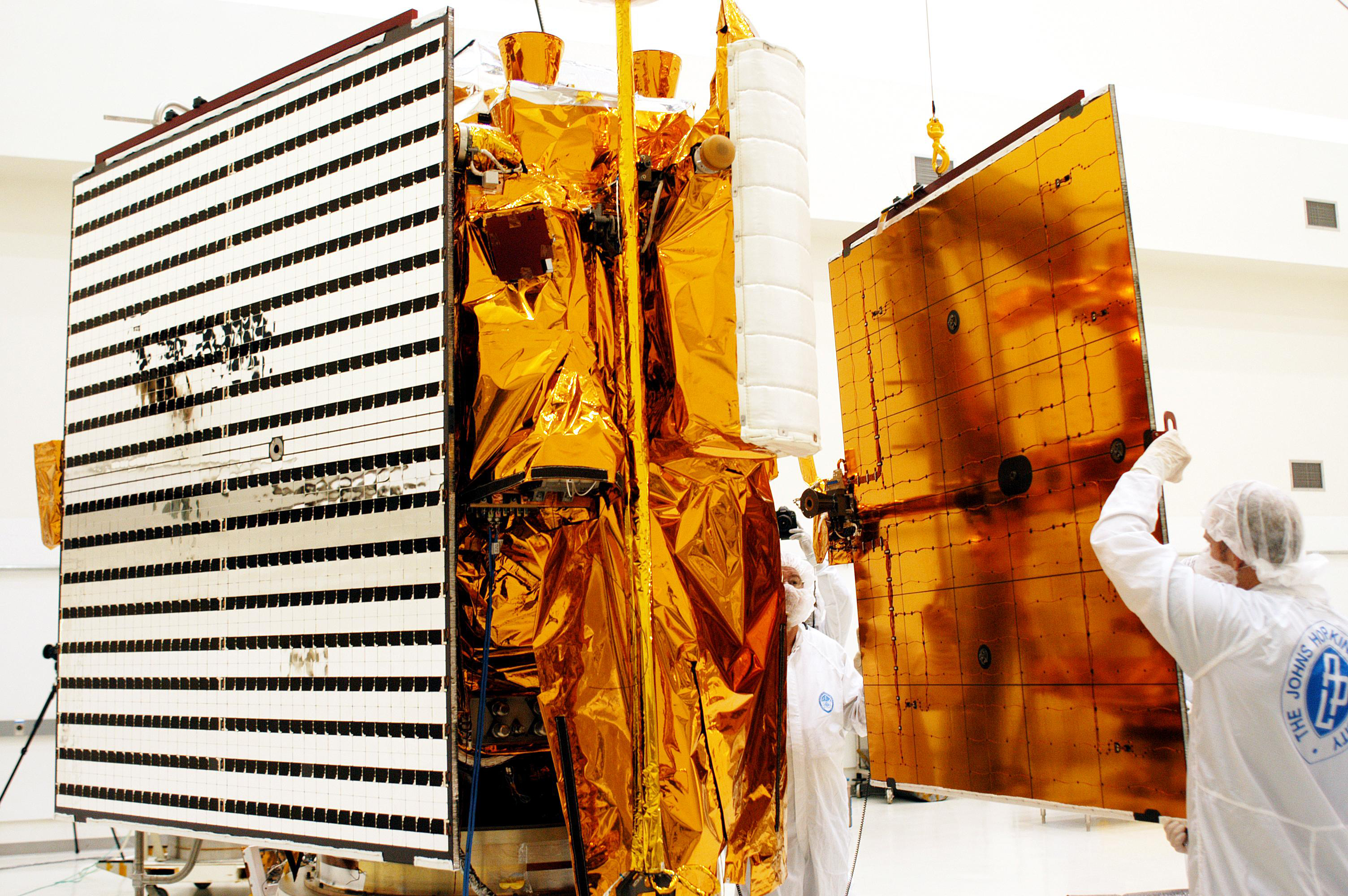
These two large solar panels gave the MESSENGER spacecraft its power.
NASA
After that first disappointment, the MESSENGER team regrouped and proposed again in 1998 after some changes to the team and after addressing significant problems that were identified in the first proposal. The second proposal was accepted for development on July 7, 1999.
“Somebody who knew about risk”
Sean Solomon, MESSENGER Principal Investigator
“We had a meeting and agreed that we would re-propose. I said I want a new project manager…we had to have a rapport, someone who could work well with his own engineers. Somebody whose budgets I believed. Somebody who knew about risk. Somebody who had had some experience. They said, ‘We think we have somebody for you. We would like you to meet Max Peterson.’ Max and I hit it off. So he became the proposal manager and the project manager for the second proposal.
“We had to solve the solar array problem. And APL did that by doing the testing. They developed a testing protocol. They put the resources in. They figured out how to do the test at NASA Glenn [Research Center, Cleveland, Ohio]. So by the time we wrote our second proposal, and particularly by the time of the second site study, we could say, ‘Not only do we have a solution for the solar arrays, here are all the tests that validate our models.’
“So, the first time we proposed we were low risk in round one and high risk after the site visit, high risk being the solar arrays and not having a good project manager. But we were low risk both times the second time through.”
Two separate Mars missions lost their spacecraft to failures in 1999 — the Mars Climate Orbiter in September and the Mars Polar Lander in December. As a result, NASA set up the NASA Integrated Action Team [NIAT] to study these failures and make recommendations going forward for all small missions, including the Discovery missions. For the newly selected MESSENGER mission, this imposed a significant effect on the planned budget and timeline because of the added mandates for risk avoidance.
“Reviews upon reviews upon reviews”
Tom Krimigis, APL Space Department head
“Well, needless to say, we felt sort of punished, even though we were innocent. Some of that also was very disappointing because we did have several of these reviews, and they pointed out certain things that needed to be done. But they were imposed on the system, and at the same time not paid for, and also not relaxing the schedule in any way, because we had a specific deadline to launch and so on. So, these were mandates. And that’s part of the problem with the reviews upon reviews upon reviews, that there is no incentive for the review teams to somehow be mindful of the schedule and the cost.
“I complained to Headquarters at one time that we had a third of the staff acting on the recommendations from the previous review; another third preparing for the next review; and the final third was actually doing work. I mean, it was really horrendous.”
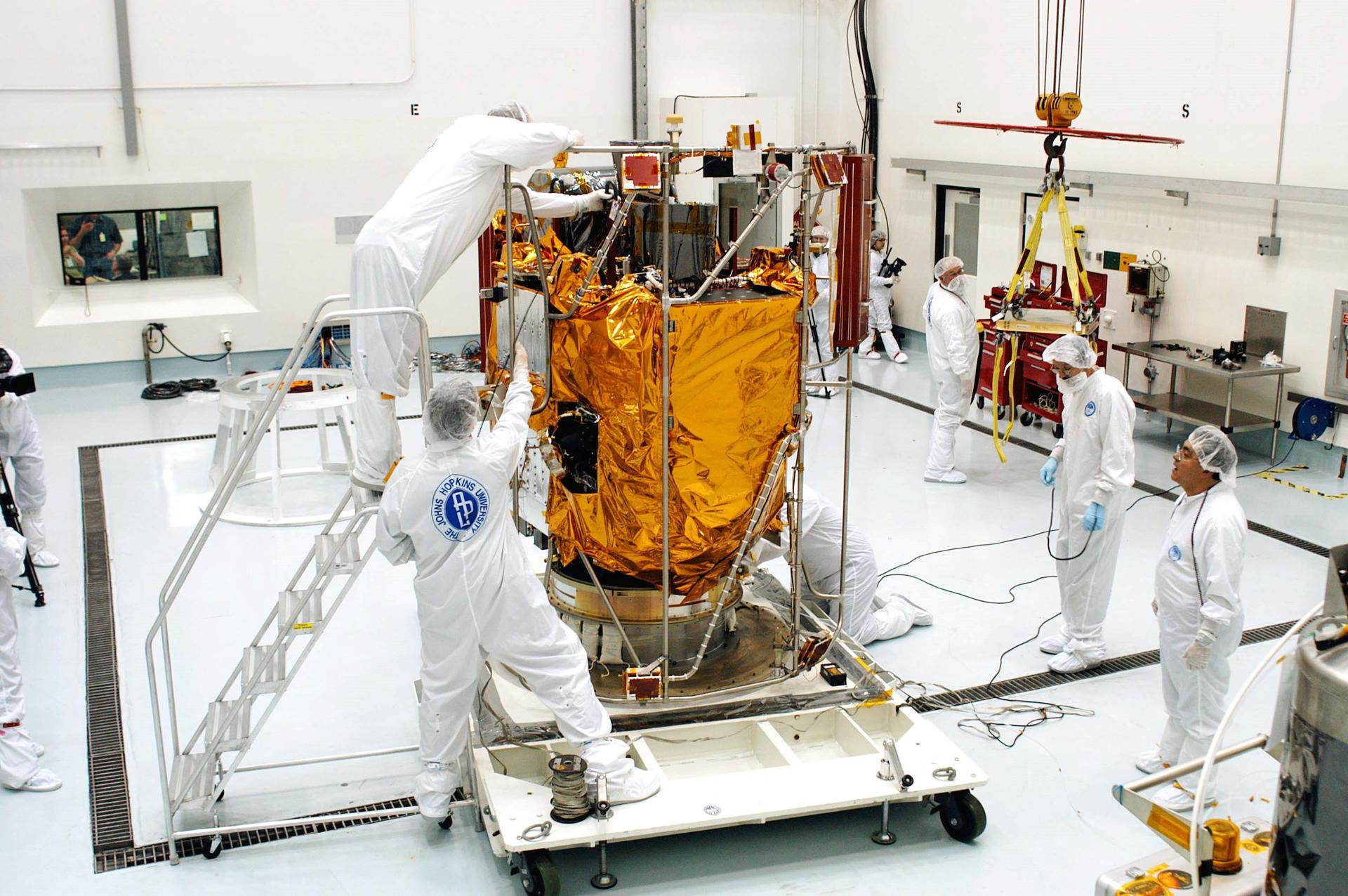
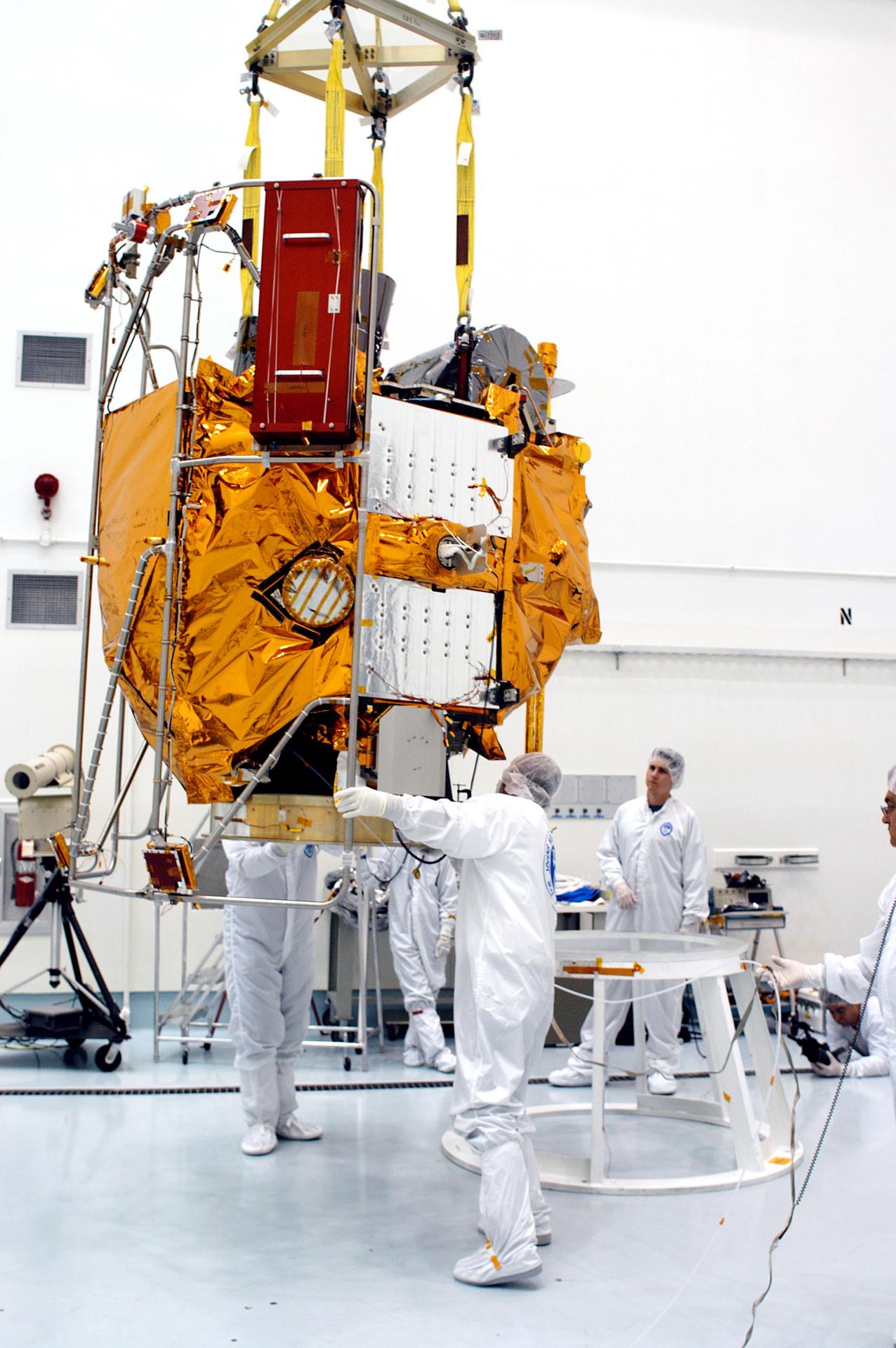
In the high bay clean room at the Astrotech Space Operations processing facilities near Kennedy Space Center, workers prepared to attach an overhead crane to NASA’s MESSENGER spacecraft. The spacecraft was moved to a work stand where employees of the Johns Hopkins University Applied Physics Laboratory, builders of the spacecraft, performed an initial state-of-health check.
NASA
“Keep marching forward”
Ralph McNutt, MESSENGER Project Scientist
“I think what did happen was then the NIAT report came out, and it was like we were told, ‘Well, things are going to happen differently.’
“And of course, we were in the middle of trying to get this thing pulled together when all of this was going on. Quite frankly, I think looking back on it, it’s not that we didn’t take it seriously, it’s just that if you’re going to keep your budget down, you’ve got a certain number of people. And unfortunately there are only 24 hours in the day and occasionally it’s probably good to sleep during some of those.
“So we had [asked for] an original amount of money, which we got, which was, looking back on it, way too small considering what was going to be coming down the pike at us. And as all of this started coming together about what the implications really were. ‘Wait a minute. We’re not going to make it.’ And we got into a bit more hardball with some of the powers that be at that point.
“We didn’t get nearly all of what we’d asked for. And we said, ‘Well, we’re not going to give up. We’re going to keep marching forward.’ And we did have to go back and ask for more money. Sean ended up giving presentations to four of the different NASA advisory subcommittees down at NASA Headquarters.
“All the committees agreed that it should go forward. There were some other people down at NASA Headquarters that weren’t very happy with that assessment. …I think everybody was frustrated. It wasn’t like we felt like we were coming up roses. …I don’t know that it was so much a feeling of vindication as the feeling that we had managed to evade the executioner’s blade.”
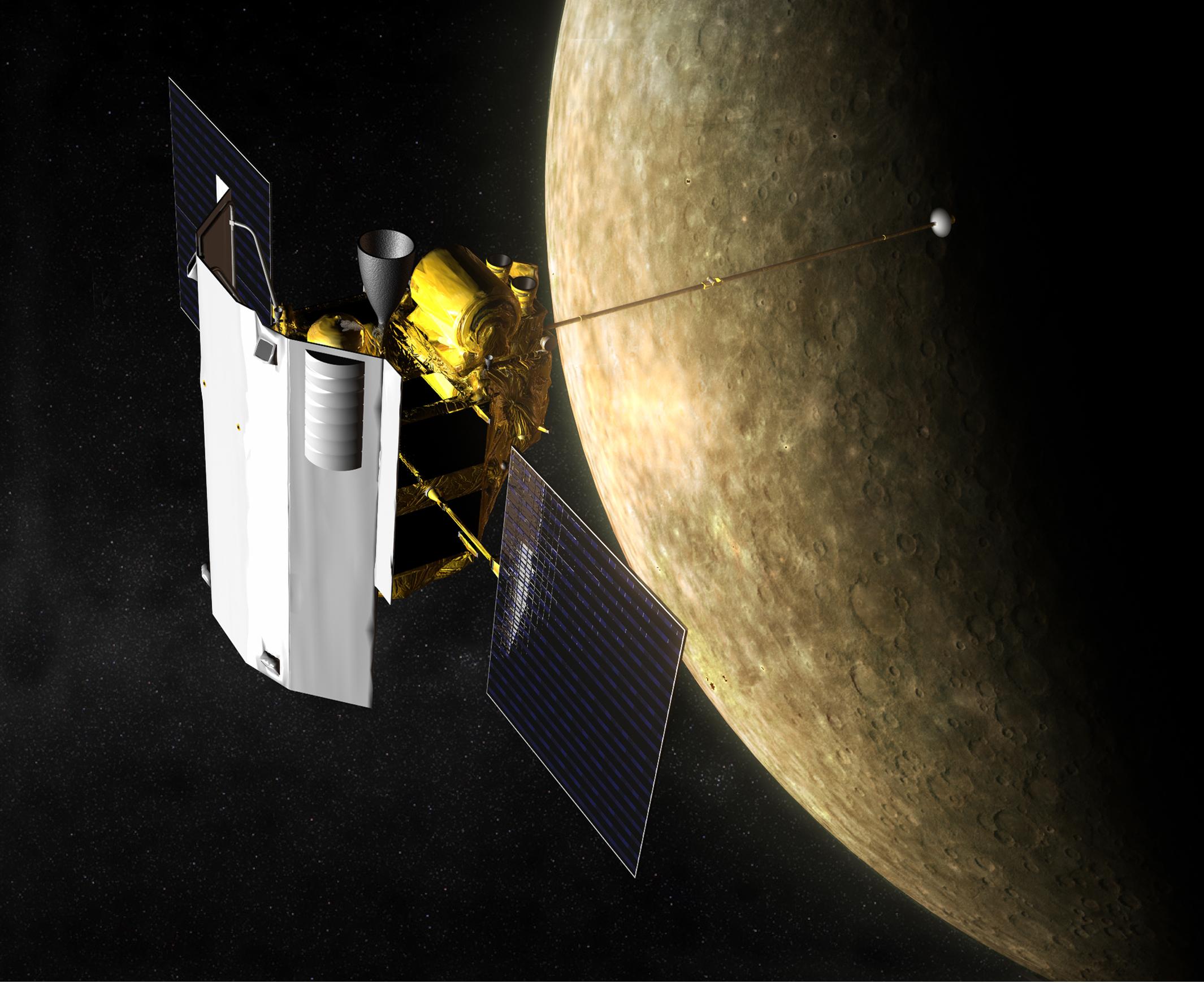
Artist impression of NASA’s MESSENGER spacecraft in orbit at Mercury.
As the mission development continued, delivery delays from subcontractors presented another schedule and cost impact. And the cost reviews at NASA Headquarters were causing more worry for the team.
“Not a standard review”
David Grant, MESSENGER Project Manager
“My first meeting was called a Risk Retirement Review. It was covered by an independent assessment team that had been following the program for some time. I went to the review and I began to sense that there were some serious problems going on in the program. The review was not a standard review. It was requested by Colleen Hartman, and I believe her title at the time was Director for the Division of Planetary Science.
“And so we get into the details and it was clear from the start that there was a very big struggle to try to keep the program cost under the [budget] cap. It was a very big concern about that.
“There were problems. We had problems with the IMU [Inertial Measurement Unit]. It was very late and Northrup Grumman was having a heck of a time with it. Also, just as I came in the door, they had announced that one of the solar array substrates had cracked in testing. What were they going to do about that $100,000 rebuild? We had an autonomy system to protect the spacecraft that was stuck. It was a very comprehensive system, trying to do everything. Everywhere I looked there were cost and schedule problems.
“Now you have to understand, MESSENGER is a very tough mission. You have to keep your eye on the spacecraft weight, on the propulsion, and on the thermal. An awful lot of technology. The guys that were working the job were very good people, but it was a very tough job. So, I really wasn’t surprised to see that there were problems. I mean this is a program with an awful lot of technology development. An awful lot. And we were having problems. So, we had the review and came out of it with some recommendations. But it was clear to me, very clear, that we had blown the cost cap. This was something that my own management did not want to hear, but there was no way that we could complete the work and stay under the program cap.”
The delays and cost mounted, but the team still worked toward their March 2004 launch date. The stress of the situation affected work schedules and team morale, and the mission leadership had to find ways to keep people motivated and moving forward.
“We wanted to get to Mercury sooner”
Sean Solomon, MESSENGER Principal Investigator
“We were projecting delays at that point in key subsystem deliveries that came to pass. One of the most painful was the spacecraft structure. That was subcontracted to an outfit called Composite Optics in California, because APL had never done a structure made out of composites. But we did it to keep the dry mass of the spacecraft down. Composite Optics is a fine company, but they’re a small company, and the mission that they had to finish before us was MER [Mars Exploration Rover]. MER was four months late on the delivery of their spacecraft, the bus that flew the MER to Mars. And there was nothing we could do.
“So that set our integration and test schedule four months in arrears from the beginning. Because the spacecraft structure had to go to the propulsion system guys, who integrated it. And then those guys delivered an integrated propulsion system and structure to APL. So that put us deeper in the hole.
“But there were other things going on at the time. We were really sweating the inertial measurement unit. There was a company that built these things outside of Santa Barbara in Goleta, California. They were bought by Northrup Grumman. And Northrup Grumman decided to close the Goleta plant, and they tried to get people who knew how to do this to move down to Woodland Hills. Well, nobody who lives in Santa Barbara wants to live in LA. So none of them moved. So they had to reproduce the expertise to build these very complicated gyros. All new people.
“They missed every deadline…. But there were other technical issues, and they were all eating away at our schedule. Still, we were working toward a schedule that would have had us go in our first launch window, which was March of 2004. There was another window in May of 2004. There was a third, less desirable window in August of 2004. So we had three windows, by good fortune, in 2004.
“We particularly didn’t want to have the August launch, because that was the energetically least favorable launch. The March and May launches involved cruise times of 5 years. The August launch, which is the one we eventually used, was a 6 ½-year cruise. And so not only would we get to the planet much later, but there would be a big Phase E cost increase. So we didn’t want to go there. We wanted to get to Mercury sooner. So, in the winter of 2003 we were still aiming for the March 2004 launch. ”
At the Astrotech Space Operations processing facilities, an overhead crane lowered NASA’s MESSENGER spacecraft onto a work stand. There employees of the Johns Hopkins University Applied Physics Laboratory, builders of the spacecraft, performed an initial state-of-health check. Then processing for launch began, including checkout of the power systems, communications systems and control systems.
NASA
“Things kept coming up”
David Grant, MESSENGER Project Manager
“You need to have the subsystems delivered in a certain order. Well, first of all, many were being delivered late. We were shooting for a March launch. So, we made the subsystems move their delivery dates in. That took more money to get that done.
“For electrical integration and test, I had an 18-person team working double shifts, sometimes triple shift, sometimes seven days a week. There’s an impact. The thing you have to be careful about is burn out…. But we get through that summer. Now we were on schedule for launch in March of 2004.
“Well, things kept coming up. …So, around that time I met with Tom Krimigis and department management and I just told them that in my view we were not going to make the March launch date. I thought that the schedule reserve that we had was insufficient for where we were in the program. Still had nine months to go, more or less, and we didn’t have enough schedule reserve. It was diminishing, and, in my view, I thought we should notify our sponsor that we were going to recommend a schedule slip.
“So, we said, move the launch out to May of ’04. Well, there was a cost associated with that. It’s a couple more months of development time. It’ll also impact down at the Cape [Canaveral, Florida]. They were getting ready for the March launch. Now it’s May. Okay, the launch day was going to be different but they have to keep the team together and that affects everything.
“We got into the final stages of development. We completed integration and test and then the environmental tests over at Goddard and we had our pre-ship review here and everybody in creation was at it. We went through the pre-ship review and we go by the numbers. I present, the system engineer presents, the subsystem people present, autonomy people got up and spoke and said we’ve completed testing. We’re very confident of where we are, we’re good to go, and ready to launch in May 2004.
Now you could have cut the tension with a knife in the room — very high tension
David G. Grant
MESSENGER Project Manager
“Now you could have cut the tension with a knife in the room – very high tension. So, the reviewers had a private room they all went into and voted. They came out and they say, ‘Okay, Dave, we’re going to ship.’ So we got the team going and they packed the whole thing up, and we shipped it all to the Cape.
“But something was wrong. Management was not at ease. We were not at ease…. Not everybody was comfortable and I could sense that.
“We shipped it and then the first weekend it was there and I got a call Sunday night from Mike Griffin [the new head of the APL Space Department] and he says that NASA was concerned about autonomy. ‘Well, there’s concern that we haven’t done enough testing of the autonomy system. They want you to do more testing in several areas.’
“I said, ‘Well if NASA wants us to do the testing, we’ll do the testing. But they have to understand the consequences.’ If we go from May to August there’s a development cost…. We have an Earth flyby, two Venus flybys and three Mercury flybys before we get into orbit. Also, five major propulsive burns. That’s a lot more difficult trajectory than the May launch was. It’s a much higher risk trajectory. Also, the cost impact could be as much as $30 million.
“In addition, the margins on the spacecraft, the power margin, the thermal margin, were much tighter with this new mission. So, I said, ‘NASA has to recognize that the risk is from launch to orbit. And you have to take everything into account. So you can keep that spacecraft here and do another few weeks of testing and go with Flight 2, or you can go with Flight 1 as approved at the pre-ship review. NASA’s got to decide if the additional testing is worth it. It’s a much higher risk mission at a much higher cost. But if NASA wants to do it, we’ll salute and we’ll do it.’ So Mike said, ‘It’s non-negotiable.’ “
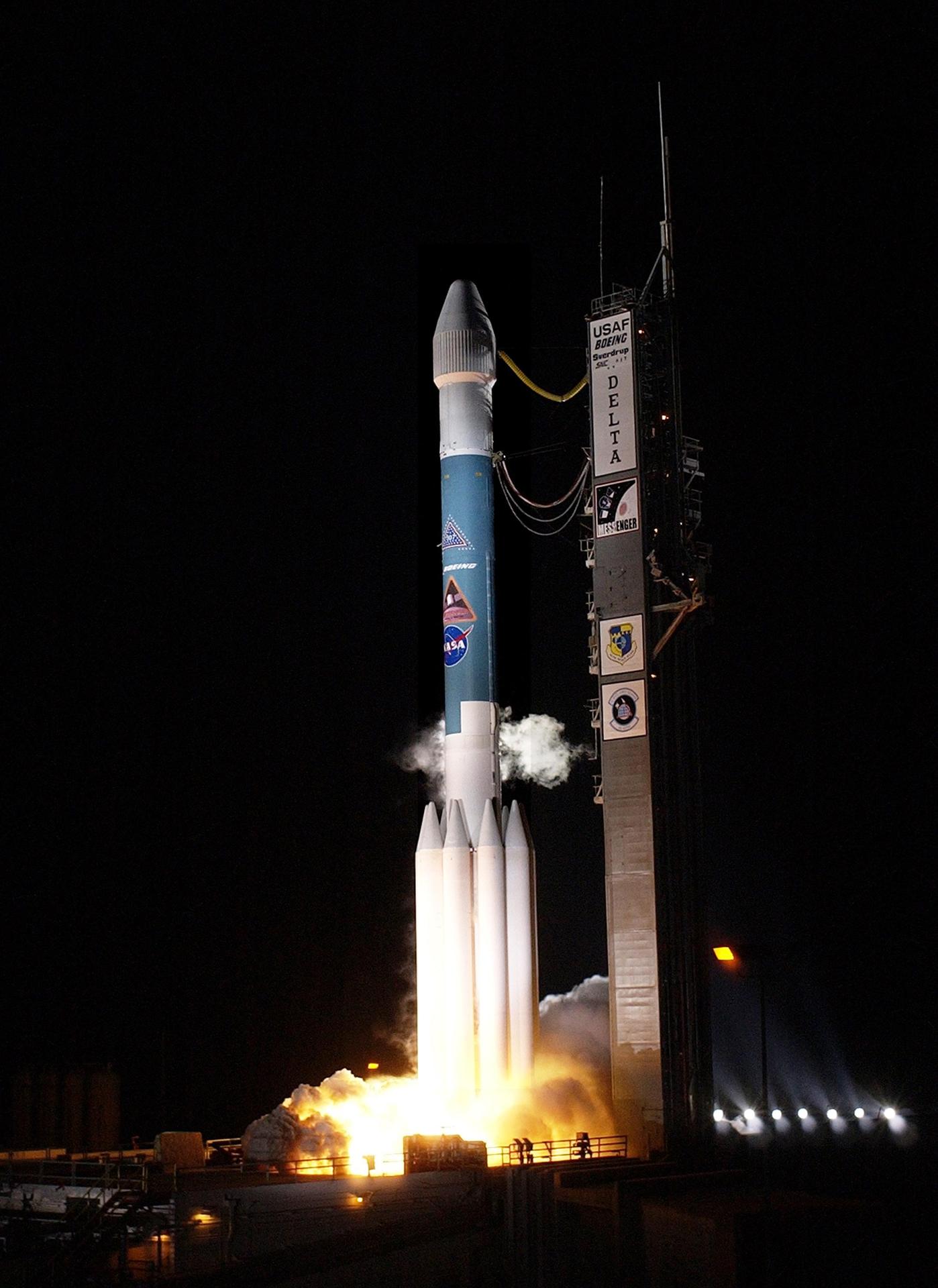
The launch window in August 2004 finally arrived, but the Florida weather made the long road a little more perilous.On the second launch attempt, August 3, 2004, MESSENGER began it’s long journey to Mercury.
“Everything was go”
Sean Solomon, MESSENGER Principal Investigator
“We launched on the second day of an almost 3-week window. Vestiges of a tropical storm had stopped us the day before. The day didn’t satisfy the constraints on clouds, but we came very close. We came within a few minutes of liftoff. We were out there at night, watching. And then the next night everything was go. Which was good, because another storm came through a day or two later that turned into a hurricane.”
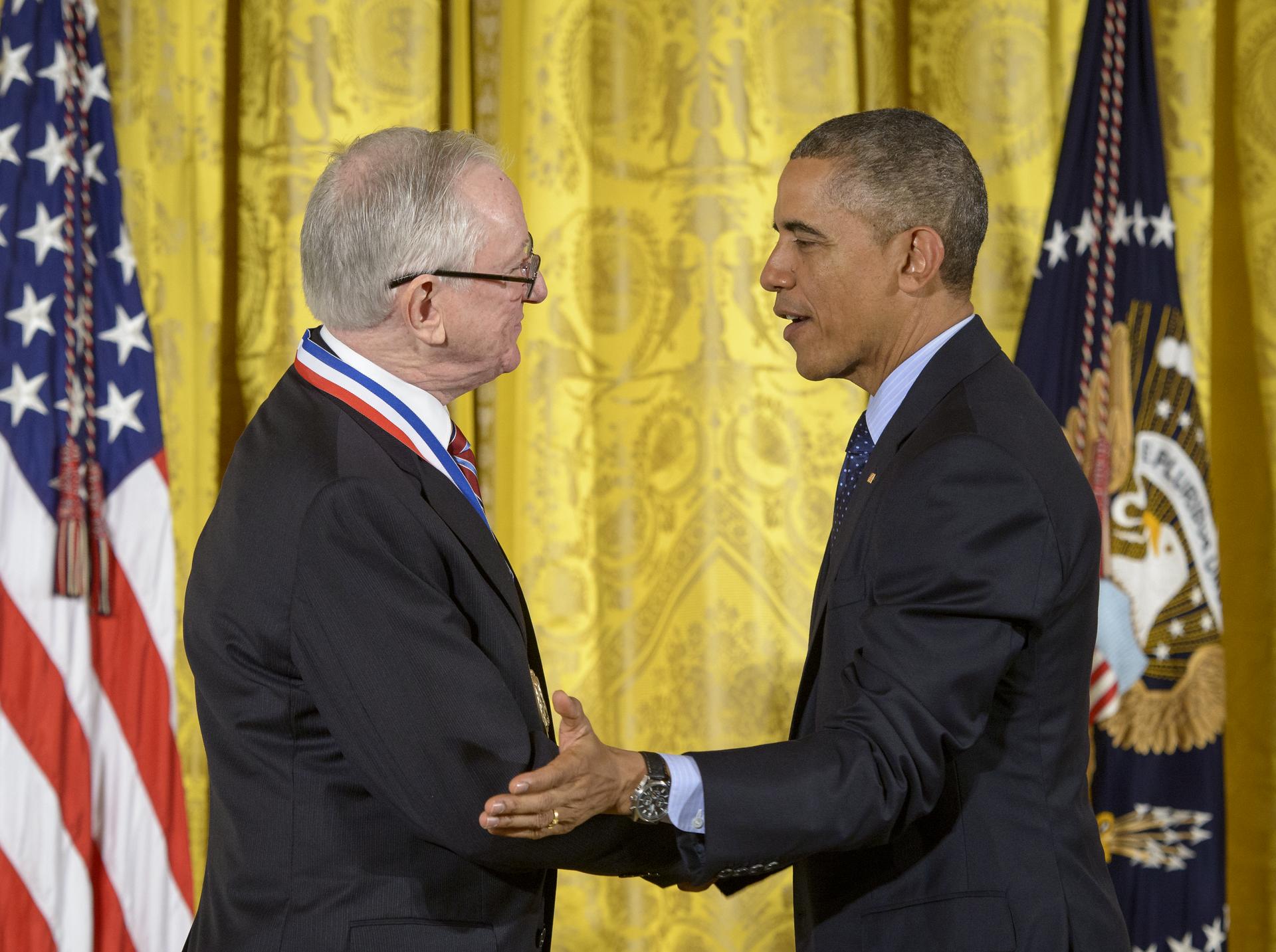
President Barack Obama congratulates MESSENGER Principal Investigator, director of Columbia University’s Lamont-Doherty Earth Observatory, Sean Solomon, after awarding him the National Medal of Science, the nation’s top scientific honor, Thursday, Nov. 20, 2014 during a ceremony in the East Room of the White House in Washington.
NASA/Bill Ingalls
After a successful launch, the team had to do come catching up on mission and science planning because of the delays in launch and the effect of those delays on the mission itself.
“An excellent spacecraft”
David Grant, MESSENGER Project Manager
“So right after we launched, we had to do the whole mission planning all over again, analysis that we had done before launch. Ordinarily you’d have it all packaged up good to go. All the science planning had to be done again. All the mission design had to be done again. And. in the meantime, we had to learn how to fly the spacecraft, which involves a level of trial and error.
“Initially, the spacecraft was difficult to operate. We didn’t know where the center of the gravity was. So when we did little thruster burns, for trajectory correction, there were errors, and they were significant enough that they had to be corrected. We had to learn how to deal with that. We had plume impingement—that wasn’t anticipated prior to launch. We had to deal with that. And in the meantime, there are literally thousands of different parameters onboard. Were they all right? No, there were a few that needed adjustment. Some were approximations.
“The first time we tried something, it didn’t work exactly the way we had hoped it would, so we had to go back and correct it. Each of these events were characterized as anomalies; they had to be corrected. And we spent a lot of time doing that. The shakedown cruise for MESSENGER was much more difficult than I thought it was going to be.
“Well, a lot of new technology, and the first time out flying. It’s like anything complex and new. But the engineering team stayed with it. They ran every problem to ground. They understood the reasons for the anomaly and fixed it. They were very thorough and diligent. And finally, one day, we all realized all the problems were pretty much fixed and that MESSENGER was an excellent spacecraft.”
The MESSENGER spacecraft atop a Boeing Delta II rocket lifts off on time at 2:15:56 a.m. EDT, from Launch Pad 17-B, Cape Canaveral Air Force Station. MESSENGER (Mercury Surface, Space Environment, Geochemistry and Ranging) was on its way for a 7-year, 4.9-billion-mile journey to the planet Mercury.
NASA Invites Media, Public to Attend Deep Space Food Challenge Finale
NASA’s Deep Space Food Challenge directly supports the agency’s Moon to Mars initiatives.
Credit: NASA
NASA invites the media and public to explore the nexus of space and food innovation at the agency’s Deep Space Food Challenge symposium and winners’ announcement at the Nationwide and Ohio Farm Bureau 4-H Center in Columbus, Ohio, on Friday, Aug. 16.
In 2019, NASA and the CSA (Canadian Space Agency) started the Deep Space Food Challenge, a multi-year international effort to develop sustainable food systems for long-duration habitation in space including the Moon and Mars. Since Phase 1 of the challenge opened in 2021, more than 300 teams from 32 countries have developed innovative food system designs. On Aug. 16, NASA will announce the final Phase 3 winners and recognize the shared global effort.
NASA will award up to $1.5 million during the awards ceremony, totaling the prize purse for this three-year competition at $3 million. International teams also will be recognized for their achievements.
“Advanced food systems also benefit life on Earth,” said Kim Krome-Sieja, acting program manager of NASA Centennial Challenges at NASA’s Marshall Space Flight Center in Huntsville, Alabama. “Solutions from this challenge could enable new avenues for food production around the world, especially in extreme environments, resource-scarce regions, and in locations where disasters disrupt critical infrastructure.”
Media also may request attendance for activities on Thursday, Aug. 15, including private tours, networking, knowledge sharing, and culinary experiences. Interested media need to RSVP by 3 p.m. EDT Monday, Aug. 12, to Lane Figueroa at lane.e.figueroa@nasa.gov.
The Methuselah Foundation, NASA’s partner in the Deep Space Food Challenge, is hosting the event in coordination with the Ohio State University College of Food, Agricultural, and Environmental Sciences and NASA Centennial Challenges.
“Our Phase 2 winners’ event in Brooklyn, New York, was an incredible display of innovation, partnership, and collaboration across NASA, industry, and academia,” said Angela Herblet, challenge manager of the Deep Space Food Challenge and program analyst of NASA Centennial Challenges at NASA Marshall. “I’m looking forward to celebrating these brilliant Phase 3 finalists and underscoring the giant leaps they’ve made toward creating sustainable, regenerative food production systems.”
The event will feature a meet and greet with the Phase 3 finalists, symposium panels, and live demonstrations of the finalists’ food production technologies. Attendees also will have the opportunity to meet the crew of Ohio State students called “Simunauts,” who managed operations of the technologies during the eight-week demonstration and testing period.
“The Prizes, Challenges, and Crowdsourcing team is excited to welcome media, stakeholders, and the public to our event in Columbus,” said Amy Kaminski, program executive for NASA’s Prizes, Challenges, and Crowdsourcing at NASA Headquarters in Washington, D.C. “These finalists have worked diligently for three years to develop their diverse, innovative food systems, and I’m excited to see how their technologies may impact NASA’s future deep space missions.”
The awards ceremony also will livestream on Marshall Space Flight Center’s YouTube channel and NASA Prize’s Facebook page.
As a NASA Centennial Challenge, the Deep Space Food Challenge is a coordinated effort between NASA and CSA for the benefit of all. Subject matter experts at NASA’s Johnson Space Center in Houston and NASA’s Kennedy Space Center in Florida support the competition. NASA’s Centennial Challenges are part of the Prizes, Challenges, and Crowdsourcing program within NASA’s Space Technology Mission Directorate and managed at NASA’s Marshall Space Flight Center in Huntsville, Alabama. The Methuselah Foundation, in partnership with NASA, oversees the competitors.
For more information about the symposium, see the symposium website. To learn more about the Deep Space Food Challenge, visit:
NASA Scientists on Why We Might Not Spot Solar Panel Technosignatures
5 min read
NASA Scientists on Why We Might Not Spot Solar Panel Technosignatures
One of NASA’s key priorities is understanding the potential for life elsewhere in the universe. NASA has not found any credible evidence of extraterrestrial life — but NASA is exploring the solar system and beyond to help us answer fundamental questions, including whether we are alone in the universe.
For those who study the potential for life beyond Earth, one of the questions has long been trying to determine the likelihood of microbial life versus complex life versus a civilization so advanced that we can spot signs of it, called technosignatures, from here at home. Studying the answers to questions like that can help guide suggestions on new telescopes or missions to emphasize the most likely places and ways to look for life.
Now a recent paper published May 24 in the Astrophysical Journal postulates that if advanced extraterrestrial civilizations exist, one reason they might be hard to detect with telescopes from our vantage point is because their energy requirements may be relatively modest. If their culture, technology, and population size do not need vast amounts of power, they would not be required to build enormous stellar-energy harvesting structures that could be detected by current or proposed telescopes. Such structures, based on our own Earthly experience, might be solar panel arrays that cover a significant portion of their planet’s surface or orbiting megastructures to harness most of their parent star’s energy—both of which we might be able to spot from our own solar system.
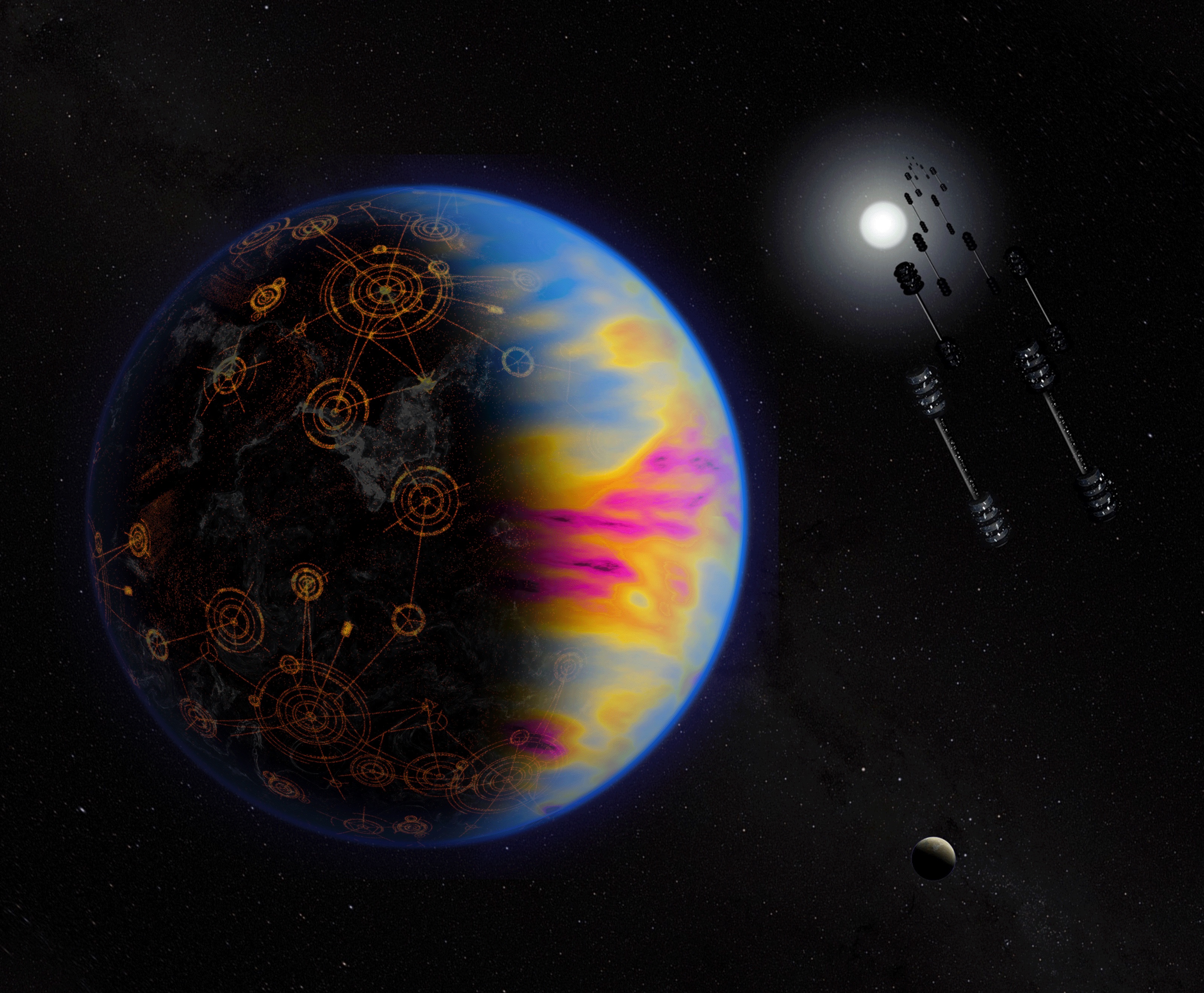
Conceptual image of an exoplanet with an advanced extraterrestrial civilization. Structures on the right are orbiting solar panel arrays that harvest light from the parent star and convert it into electricity that is then beamed to the surface via microwaves. The exoplanet on the left illustrates other potential technosignatures: city lights (glowing circular structures) on the night side and multi-colored clouds on the day side that represent various forms of pollution, such as nitrogen dioxide gas from burning fossil fuels or chlorofluorocarbons used in refrigeration.
NASA/Jay Freidlander
“We found that even if our current population of about 8 billion stabilizes at 30 billion with a high standard of living, and we only use solar energy for power, we still use way less energy than that provided by all the sunlight illuminating our planet,” said Ravi Kopparapu of NASA’s Goddard Space Flight Center in Greenbelt, Maryland, lead author of the paper.
The study has implications for the Fermi paradox, postulated by physicist Enrico Fermi, which asks the question that since our galaxy is ancient and vast, and interstellar travel is difficult but possible, why hasn’t an alien civilization spread across the galaxy by now?
“The implication is that civilizations may not feel compelled to expand all over the galaxy because they may achieve sustainable population and energy-usage levels even if they choose a very high standard of living,” said Kopparapu. “They may expand within their own stellar system, or even within nearby star systems, but a galaxy-spanning civilizations may not exist.”
Additionally, our own technological expertise may not yet be able to predict what more advanced civilizations could do.
“Large-scale stellar-energy harvesting structures may especially be obsolete when considering technological advances,” adds Vincent Kofman, a co-author of the paper at NASA Goddard and American University, Washington, D.C. “Surely a society that can place enormous structures in space would be able to access nuclear fusion or other space-efficient methods of generating power.”
The researchers used computer models and NASA satellite data to simulate an Earth-like planet with varying levels of silicon solar panel coverage. The team then modeled an advanced telescope like the proposed NASA Habitable Worlds Observatory to see if it could detect solar panels on the planet about 30 light-years away, which is relatively nearby in a galaxy that spans over 100,000 light-years. They found that it would require several hundreds of hours of observing time with that type of telescope to detect signatures from solar panels covering about 23% of the land area on an Earth-like exoplanet. However, the requirement for 30 billion humans at a high-living standard was only about 8.9% solar-panel coverage.
Extraterrestrial civilizations with advanced technology could be discovered by their technosignatures – observational manifestations of extraterrestrial technology that could be detected or inferred through astronomical searches. For decades, scientists have been using radio telescopes to look for potential extraterrestrial radio transmissions. More recently, astronomers have proposed using a telescope like the Habitable Worlds Observatory to look for other kinds of technosignatures, such as chemical “fingerprints” in exoplanet atmospheres or specific characteristics in the light reflected by an exoplanet that might announce the presence of vast silicon solar arrays.
The new study assumes that extraterrestrials would build solar panels out of silicon because it’s relatively abundant compared to other elements used in solar power, such as germanium, gallium, or arsenic. Also, silicon is good at converting the light emitted by Sun-like stars into electricity and it’s cost-effective to mine and manufacture into solar cells.
The researchers also assume that a hypothetical extraterrestrial civilization would rely exclusively on solar energy. However, if other sources of energy are used, such as nuclear fusion, it would reduce the silicon technosignature, making the civilization even harder to detect. The study further assumes that the civilization’s population stabilizes at some point. If this doesn’t happen for whatever reason, perhaps they will be driven to expand ever-father into deep space. Finally, it’s impossible to know if an advanced civilization may be using something we haven’t imagined yet that requires immense amounts of power.
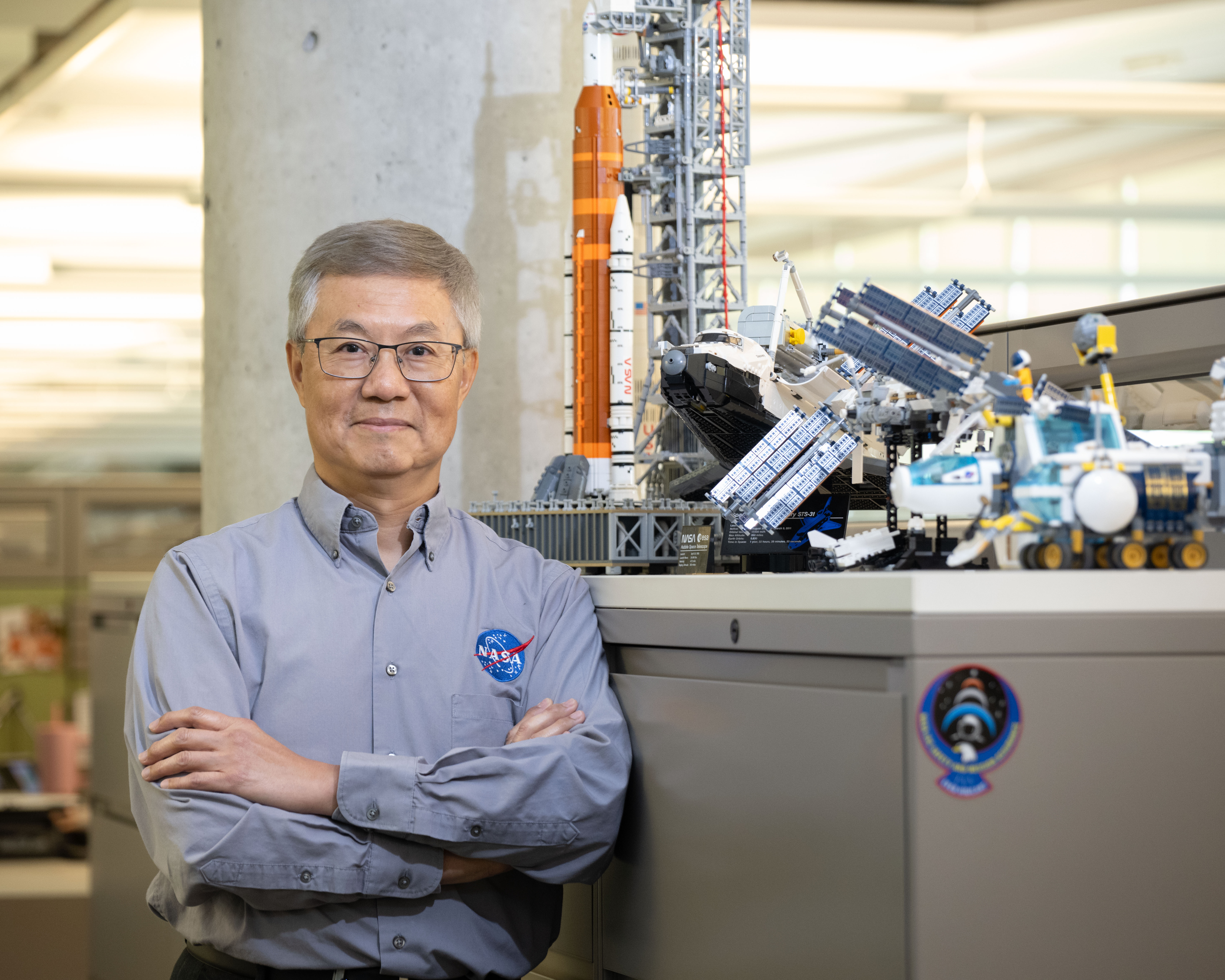
“When I was around 16 or 17, I came across this book by Arthur C. Clarke called Space Odyssey 2001. That was actually the first science fiction book that I’ve ever read. I was just so captured by what he had written because the things that he wrote about weren’t [happening] in the far-off future, but in the year 2001. In the book, he talks about a lot about space stations, and space shuttles that go up to the space station, and vehicles that go to the Moon or the Moon base, and all that. I mean, these are terms that you hear now all the time, right? And Arthur C. Clarke actually envisioned it at that time. So that was interesting to me. I hoped that someday I could work on something like that.
“In terms of my education, I was actually going to go into the space engineering, but then someone advised me that mechanical engineering would give me a broader background. So I followed the advice, and it was the right thing to do. I ended up learning a lot of things, not just mechanical engineering but also a lot about electrical engineering and systems engineering at the same time.
“…Then an opportunity came with NASA. It was at that time that they started talking about the space station. Ronald Reagan at that time was the President, and he proposed this initiative to develop the space station. At that time, he called the space station ‘Freedom.’
“I thought, ‘Wow, what an exciting concept; it would be great if I could work on that.’
“And of course, one thing led to another, and [I ended up working on the International Space Station.] So you never know what you’re going to end up doing.
“I believe in synchronicity sometimes. The things that you do, one way or another, lead to your final destination. Some invisible forces push you in that direction. When you look back, you realize that everything fits together.”
— Douglas Wong, Systems Engineer, ISS CRS Visiting Vehicle Safety & Mission Assurance Integration Focal, NASA’s Johnson Space Center