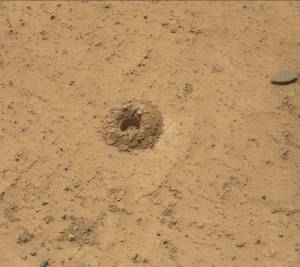
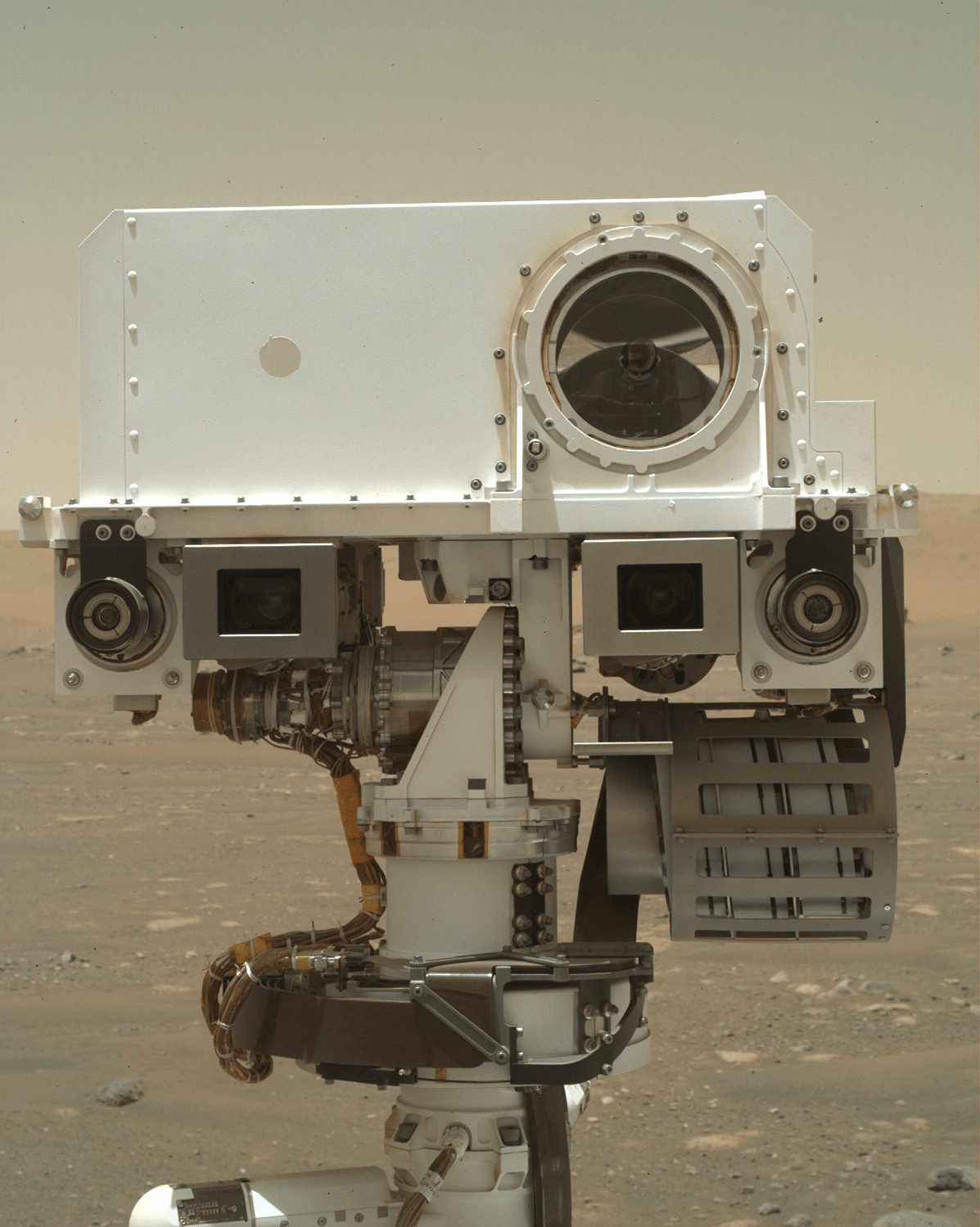
This image from NASA’s Mars rover Curiosity shows the open inlet No. 2 on the rover’s SAM (Sample Analysis at Mars) instrument suite, where Curiosity delivered a sample from the “Kings Canyon” drill hole, for study using SAM’s Evolved Gas Analysis (EGA) mode. This image was taken by Mastcam Right (Mast Camera) aboard Curiosity on sol 4270 — Martian day 4,270 of the Mars Science Laboratory mission — on Aug. 10, 2024 (at 14:16:21 UTC).
NASA/JPL-Caltech/MSSS
Earth planning date: Monday, Aug. 12, 2024
The SAM EGA over the weekend was successful, and that means we’re well on our way to planning the GCMS (Gas Chromatograph Mass Spectrometry) on our “Kings Canyon” drill sample! GCMS is an energy-intensive activity, so we’ll be using today’s two-sol plan mainly for recharging our battery and prepping SAM by cleaning its GC column with high temperatures (like you’d clean your own oven!). We can still afford about 75 minutes of remote sensing over both sols this plan and are using it for our usual ChemCam, Mastcam, and Navcam activities.
On the first sol, ChemCam is kicking things off with a LIBS (Laser Induced Breakdown Spectrometer) on “The Major General” — some crunchy light-toned bedrock about 9 feet away (about 2.8 meters) — then will capture a long-distance 10-frame RMI of the Gediz Vallis channel floor to the south. Mastcam finishes off the first sol’s 72-minute science block with an M100 image of The Major General LIBS spots and a 68-frame stereo mosaic of the midfield terrain to fill in what’s left of the midfield with M100. We’ll nap until about 15:15 local Mars time, when we’ll wake back up to take just two M100 images near the RSM hardstop at the same timing as a previous mosaic to make sure we have continuous coverage across the hardstop. SAM’s GC column clean is planned between 21:00 and 01:00; overnight between our two sols.
On the second sol, we’ll have our second remote sensing block around 11:00 for 73 minutes. ChemCam is planning a second LIBS target on “Dewey Point” — a slab of light-toned bedrock about 13 feet away (about 3.9 meters) — a passive-spectrum observation of a dark float block named “Waller Minaret,” and another long-distance four-frame RMI of southern Kukenan butte to the southeast. Mastcam has just a single M100 image of Dewey Point’s LIBS spots this sol so that Navcam can complete some environmental movies to hopefully capture some dust devils and maybe even some clouds!
Written by Natalie Moore, Mission Operations Specialist at Malin Space Science Systems
Preparations for Next Moonwalk Simulations Underway (and Underwater)
A fire burns in Fishlake National Forest, as part of the Fall 2023 FASMEE prescribed burn.
NASA/ Grace Weikert
Background
Fire is a natural occurrence in many ecosystems and can promote ecological health. However, wildfires are growing in scope and occurring more often than in the past. Among other causes this is due to human-caused climate impacts and the expansion of communities into areas with wildland vegetation. These blazes continue to significantly harm communities, public health, and natural ecosystems. NASA is leveraging cutting-edge science and technology to better understand wildland fire behavior and provide valuable tools for fire policy, response, and mitigation.
NASA’s Stake in Wildfire
NASA’s contributions to wildland fire management span decades. This includes research to better understand the role fire plays in Earth’s dynamic atmosphere, and airborne and spaceborne sensors to analyze fire lifecycles. Much of this research and technology is still used by wildfire agencies across the globe today. NASA is building on this research and technology development with the Wildland Fire Management Initiative (WMI).
WMI leverages expertise across the Agency in space technology, science, and aeronautics to improve wildfire research and response. Through this effort, NASA and its partners will continue to provide tools and technologies for improved predictive fire modeling, risk assessment, fire prevention, suppression and post-fire recovery operations. NASA’s WMI aims to equip responders with improved tools for managing these fires
How NASA is Tackling Wildfire
NASA is collaborating with other government agencies, academia, and commercial industries to build a concept of operations for the future of wildland fire management. This means identifying gaps in current wildland fire technologies and procedures and laying out clear solutions to address those challenges.
NASA will perform a demonstration of wildland fire technologies – including X – in the coming years.
To provide a well-rounded toolkit for improving wildland operations, NASA and is tackling every aspect of wildland fire response. These efforts include:
Pre-Fire
Fuel fire maps with improved accuracy
Tools that identify where and when safe, preventative burn treatments would be most effective
Airspace management and safety technologies to enable mainstream use of uncrewed aircraft systems in prescribed burns
Active Fire
Fire detection and tracking imagery
Improved fire information management systems
Models for changing fire conditions, including fire behavior, and wind and atmospheric tracking for quality forecasts
Uncrewed aircraft and high-altitude balloons for real-time communications for fighting fires in harsh environments
Uncrewed Aircraft Systems Traffic Management (UTM) to expand use of uncrewed aircraft systems in fire response, particularly in environments where traditional air traffic control technologies aren’t available
An airspace awareness and communications system to enable remotely piloted aircraft to identify, monitor, and suppress wildfires 24 hours a day
Post-Fire
Improved fire impact assessments, including fire severity, air and water quality, risks of landslides, debris flows, and burn scars
Ground-based, airborne, and spaceborne observations to develop monitoring systems for air quality and map burn severity and develop and enhance models and predictions of post-fire hazards
NASA’s Disasters Response Coordination System (DRCS) supports all three fire response aspects listed above. The DRCS, developed under the Agency’s Earth Science Division’s Disasters Program, provides decisional support to international and domestic operational response agencies. This support includes products for understanding wildfire movement and potential pathways, burn-area maps, and impacts of fire, ash, and smoke to population and critical infrastructure. DCRS tools also provide assessments of post-fire flooding and debris flow susceptibility.
NASA’s Investment in New Wildland Fire Technologies
NASA’s WMI offers grants, contracts, and prizes to small businesses, research institutions, and other wildland technology innovators. Some related technology development activities underway include:
Testing communications technologies for incident response teams in areas with no cellphone coverage via a high-altitude balloon 60,000 feet above ground level
Developing wildfire detection systems and instruments for crewed and uncrewed aircraft
Funding early-stage technology development for remote sensing instruments and sensor systems
Developing and flight testing integrated, compact systems for small spacecraft and other platforms for autonomous detection, location tracking, and data collection of transient smoke plumes, early wildfires and other events
Licensing technologies relevant to wildland fire management and hosting wildland fire webinars to promote NASA technology licensing
Partners
The NASA Wildland Fire Management Initiative team collaborates with industry, academia, philanthropic institutions, and other government agencies for a more fire-resilient future. These include:
U.S. Forest Service
The California Department of Forestry and Fire Protection
The National Oceanic and Atmospheric Administration
The Federal Aviation Administration
The Department of Homeland Security
The Department of Defense
The National Wildfire Coordinating Group
WMI Deliverables
Through these combined efforts, NASA aims to address urgent wildland fire management challenges and ensure communities are better prepared for wildland fires. NASA will continue to expand partnerships within wildland fire management agencies for technology development and adoptions.
For more information, email: Agency-WildlandFiresInitiative@mail.nasa.gov
Crew Studies Space Effects on Humans, Plants; Managers Provide Starliner Update
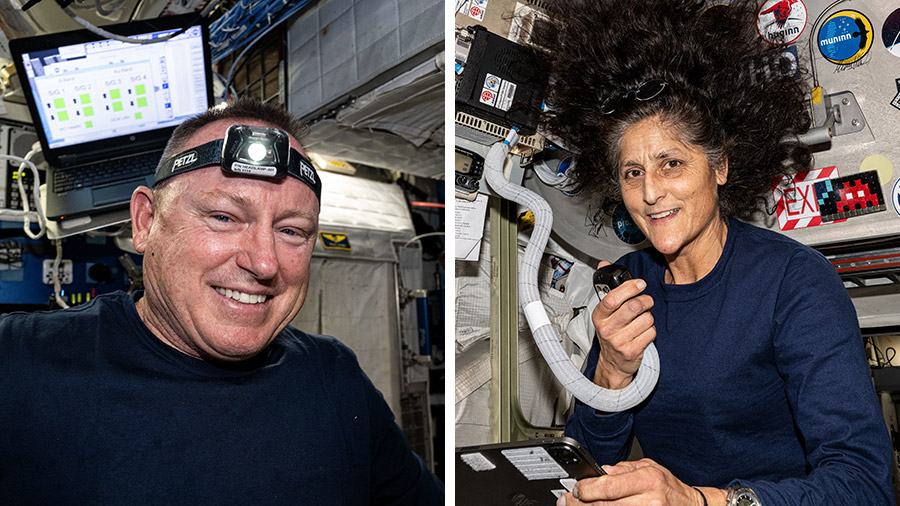
NASA astronauts Butch Wilmore and Suni Williams, Boeing Crew Flight Test Commander and Pilot respectively, conduct a variety of research and maintenance activities aboard the space station.
Vein scans and space botany topped Wednesday’s science schedule aboard the International Space Station. Earth observations and health assessments rounded out the day’s investigations as NASA managers on the ground provided an update on Boeing’s Crew Flight Test.
NASA Flight Engineer Tracy C. Dyson, who is celebrating her birthday today, spent the day on space biology participating in vein scans then cleaning up after a stem cell study. She first joined Flight Engineer Jeanette Epps who scanned Dyson’s neck, shoulder, and leg veins with the Ultrasound 2 device in the Columbus laboratory module. Doctors on the ground monitored in real-time to understand how the human body adapts to weightlessness. At the end of the day, Dyson cleaned up the Life Science Glovebox in the Kibo laboratory module after the previous day’s stem cell research to advance cellular manufacturing and improve human health.
Epps began her day handing over hardware to the cosmonauts for usage in the orbital outpost’s Roscosmos segment. Following her vein scan work, Epps moved to Kibo and watered plants growing inside the Plant Experiment Unit that is part of the Cell Biology Experiment Facility. She was caring for thale cress plants and supporting the Plant UV-B space botany study to understand how plant life responds to high ultraviolet radiation and the microgravity environment.
NASA Flight Engineers Matthew Dominick and Mike Barratt focused primarily on unpacking some of the 8,200 pounds of cargo that was stowed inside the Cygnus space freighter. Afterward, Dominick removed simulated lunar cement packs from a thermos can that he had mixed and incubated two days before. The concrete samples will spend several more weeks settling at ambient temperature before returning to Earth for analysis. Before the cargo work, Barratt called down to doctors on Earth for a medical conference.
NASA astronauts Butch Wilmore and Suni Williams, Commander and Pilot for Boeing’s Crew Flight Test, tested the use of an ultrasound device with software guidance instead of remote guidance from doctors on the ground. The duo conducted bladder and kidney ultrasound scans to demonstrate autonomous medical procedures in space and inform future crewed missions to the Moon, Mars, and beyond.
NASA managers updated the media and answered questions today about the Boeing Crew Flight Test. The agency and Boeing are still evaluating the Starliner spacecraft docked to the Harmony module’s forward port and will decide soon when Wilmore and Williams will return to Earth.
The three Roscosmos cosmonauts had their day full with a variety of science expanding knowledge obtainable only in the microgravity environment. Flight Engineer Alexander Grebenkin once again set up a digital camera and collected hyper-spectroscopy imagery of natural and man-made disasters on Earth. Flight Engineer Nikolai Chub jogged on a treadmill as sensors recorded his heart and lung activity for a space fitness evaluation. Station Commander Oleg Kononenko attached electrodes to himself for a 24-hour session monitoring his heart rate and blood pressure. Flight surgeons are constantly evaluating the health of crews to ensure successful missions and ease the adjustment when crews return to Earth’s gravity.
Nearly three tons of science, supplies, and fuel are packed inside the Progress 89 cargo craft that is counting down to a liftoff at 11:20 p.m. EDT today from the Baikonur Cosmodrome in Kazakhstan. The Progress 89 will take a day a two-day trip to the space station before its automated docking planned for 1:56 a.m. on Saturday.
Marshall Director Joseph Pelfrey Addresses Space and Missile Defense Symposium
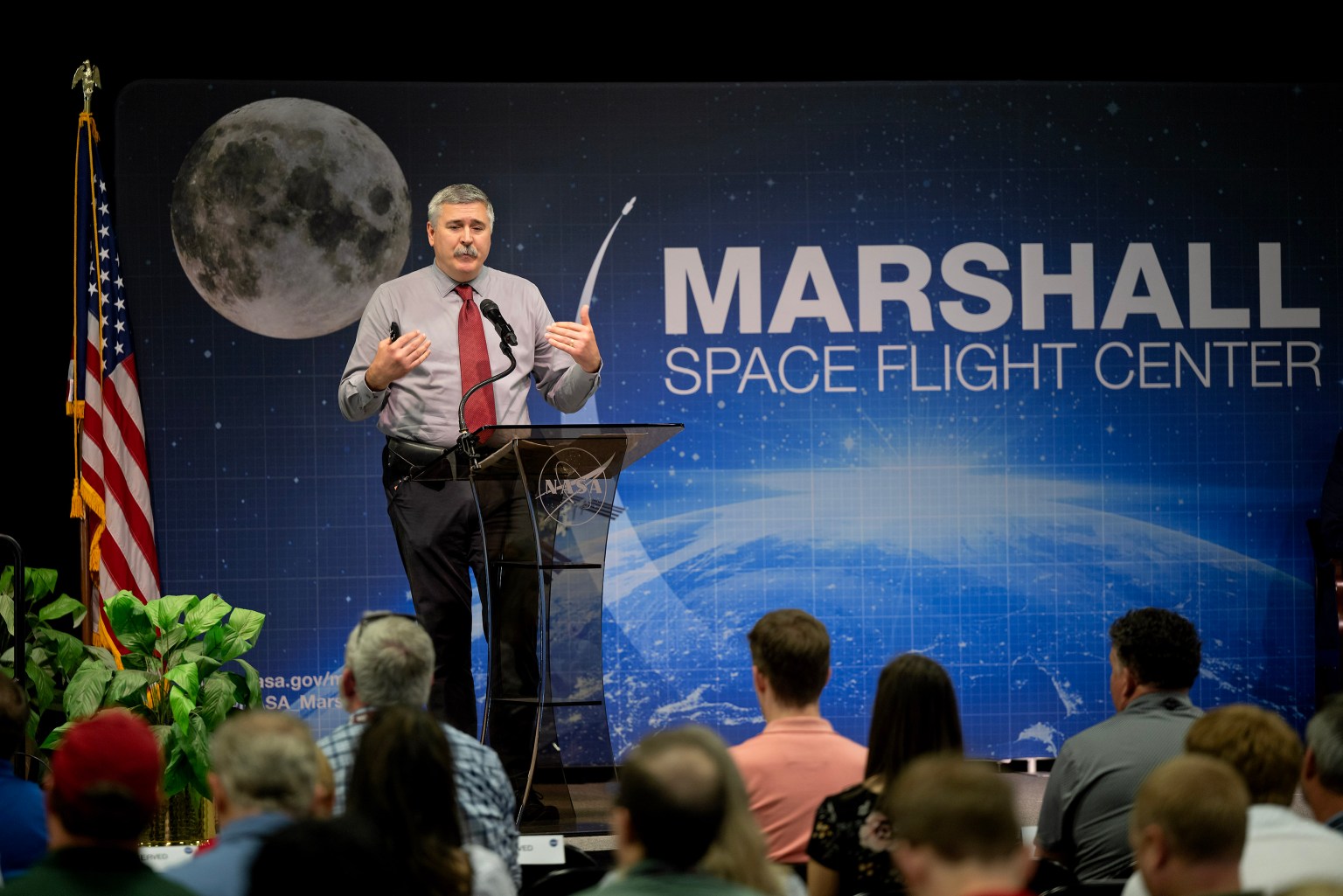
NASA Marshall Space Flight Center Director Joseph Pelfrey gives a keynote address during the 2024 Space and Missile Defense Symposium on Aug. 8 at the Von Braun Center in downtown Huntsville. Pelfrey shared updates on programs and projects that Marshall is leading for the agency, and highlighted strategic partnerships that have used Marshall’s deep technical expertise. More than 7,000 people attended this year’s symposium, including leaders and stakeholders from across the aerospace industry and Department of Defense. “Many of our partners are in this room, and I want to reiterate the importance of our current collaborations – as well as those that are to come,” Pelfrey said. “Marshall is committed to building relationships and sharing resources to further the aerospace industry and aid national security.”(NASA)
NASA’s Marshall Space Flight Center hosted Gen. Stephen Whiting, Commander, U.S. Space Command, and his team Aug. 7. The USSPACECOM team was in Huntsville for the 2024 Space and Missile Defense Symposium. Marshall Director Joseph Pelfrey, center right, talks with Gen. Whiting, left, while on a tour of Marshall’s Additive Manufacturing Lab. The group also toured the Payload Operations Integration Center and heard presentations from Marshall team members on data science/management and space nuclear propulsion. (NASA/Charles Beason)
Artemis I Lessons Learned Focus of Mission Success Forum; Charlie AdamsReceives Golden Eagle Award
By Wayne Smith
Mike Sarafin, Artemis mission manager and mission management team chair, reflected on Artemis I challenges during the Shared Experiences Forum at NASA’s Marshall Space Flight Center on Aug. 8.
The event was part of the Mission Success is in Our Hands safety initiative and held in Activities Building 4316.
Mike Sarafin, Artemis mission manager and mission management team chair, discusses Artemis I challenges during the Shared Experiences Forum at NASA’s Marshall Space Flight Center on Aug. 8. The event was part of the Mission Success is in Our Hands safety initiative and held in Activities Building 4316.
NASA/Charles Beason
Sarafin discussed lessons learned from Artemis I, highlighting the importance of communicating quickly and effectively with team members and using risk informed decision-making tools. After some initial delays that included lightning strikes, the Artemis I mission began with a successful liftoff of NASA’s SLS (Space Launch System) rocket Nov. 16, 2022, from Launch Pad 39B at NASA’s Kennedy Space Center. Over the course of 25.5 days, NASA tested the Orion spacecraft in the harsh environment of deep space before flying astronauts on Artemis II.
Sarafin said it was his first time in the “hot seat,” and stressed the importance for anyone leading a mission management team to prepare for it by talking with those who have been in the same role, naming the individuals who supported him as team chair.
“You have got to find somebody who has walked a mile in those shoes, who understands the dynamics, who understands the cultural aspects of it,” Sarafin said. “They were fantastic team members, fantastic partners to work with, and I am proud to be a part of that team. These guys walked alongside me and kept me out of trouble.”
As Artemis mission manager for the Moon to Mars Program Office at NASA Headquarters, Sarafin provides oversight and responsibility for critical decisions across all flight phases (launch, in-space, and recovery), with support from team members and advisers with technical expertise in various areas. Prior to flight, he acts as a senior technical leader integrating mission requirements, planning, operations, and flight readiness leading to mission execution.
Sarafin said lessons learned from the mission management team for Artemis I included training both a prime and alternate for each position. He also pointed out the importance of training for logistics, and daily effective communications for all team members.
Bill Hill, left, director of Safety and Mission Assurance at Marshall, presents Sarafin with a certificate of appreciation following the Shared Experiences Forum. At right is Jeff Haars, Jacobs vice president and program manager for Jacobs Space Exploration Group.
NASA/Charles Beason
“In summary, have the right team, do your party planning, (and) set clear expectations,” Sarafin said. “Take care of yourself and your team, and use good tools to make decisions.”
Mission Success is in Our Hands is a safety initiative collaboration between NASA’s Marshall Space Flight Center and Jacobs Engineering. The initiative’s goal is to help team members make meaningful connections between their jobs and the safety and success of NASA and Marshall missions.
Charlie Adams Presented with Golden Eagle Award
As part of the forum, Mission Success is in Our Hands presented the 40th Golden Eagle Award to Charlie Adams of the Jacobs Space Exploration Group. Adams was the mission manager for NASA’s Low-Earth Orbit Flight Test of an Inflatable Decelerator (LOFTID).
Charlie Adams, center, of Jacobs Space Exploration Group, displays the Golden Eagle Award presented to him during the Shared Experiences Forum. He is joined by Haars, left, and Hill, right.
NASA/Charles Beason
Bill Hill, director of Safety and Mission Assurance at Marshall, said Adams was recognized for leading the project throughout LOFTID’s life cycle, which culminated with a successful flight in 2022. Hill said LOFTID’s success as a heat shield will benefit NASA’s future missions.
The Golden Eagle Award promotes awareness and appreciation for flight safety, as demonstrated through the connections between employees’ everyday work, the success of NASA and Marshall’s missions, and the safety of NASA astronauts. Management or peers can nominate any team member for the award. Honorees are typically recognized at Shared Experiences forums.
The next Shared Experiences Forum is scheduled for Sept. 5, featuring Dave Dykhoff, former vice president and general manager of the Jacobs Missile Defense Group and the North American Aerospace Defense (NORAD) Operations Group. The forum will be held in Building 4203, Conference Room 1201 for Marshall team members, and available to the public via Teams.
Smith, a Media Fusion employee and the Marshall Star editor, supports the Marshall Office of Communications.
Marshall Team Members Participate in Space Night with Rocket City Trash Pandas
NASA’s Marshall Space Flight Center participated in Space Night at the Rocket City Trash Pandas game Aug. 10. Several team members represented the center, talking with fans about Marshall’s cutting-edge technologies and missions. The event featured special giveaways, astronaut food samples, and photo opportunities. (NASA/Corinne Beckinger)
Dave Greeson, center, an aerospace engineer with the Space Nuclear Propulsion Office at Marshall, talks with fans during Space Night with the Rocket City Trash Pandas. (NASA/Daniel Boyette)
Daniel Boyette, communications specialist for the Space Nuclear Propulsion Office at Marshall, sets up for Space Night. (NASA/Corinne Beckinger)
Dustin McMullen, lead ground systems engineer for the Human Landing System Program at Marshall, displays some astronaut food samples at Space Night. (NASA/Corinne Beckinger)
Unlike most of her friends in the 80s who covered their walls with posters of bands, Julia Khodabandeh plastered hers with posters of rockets and fighter jets.
Khodabandeh’s interest in aerospace and aeronautics developed at a young age. Her parents were avid fans of the Apollo Program and were heavily invested in her education. Khodabandeh’s father always encouraged her to tackle math and science problems without fear. She recalls him telling her that “you can take any problem and break it into smaller pieces.” It’s a philosophy she still uses in solving problems today.
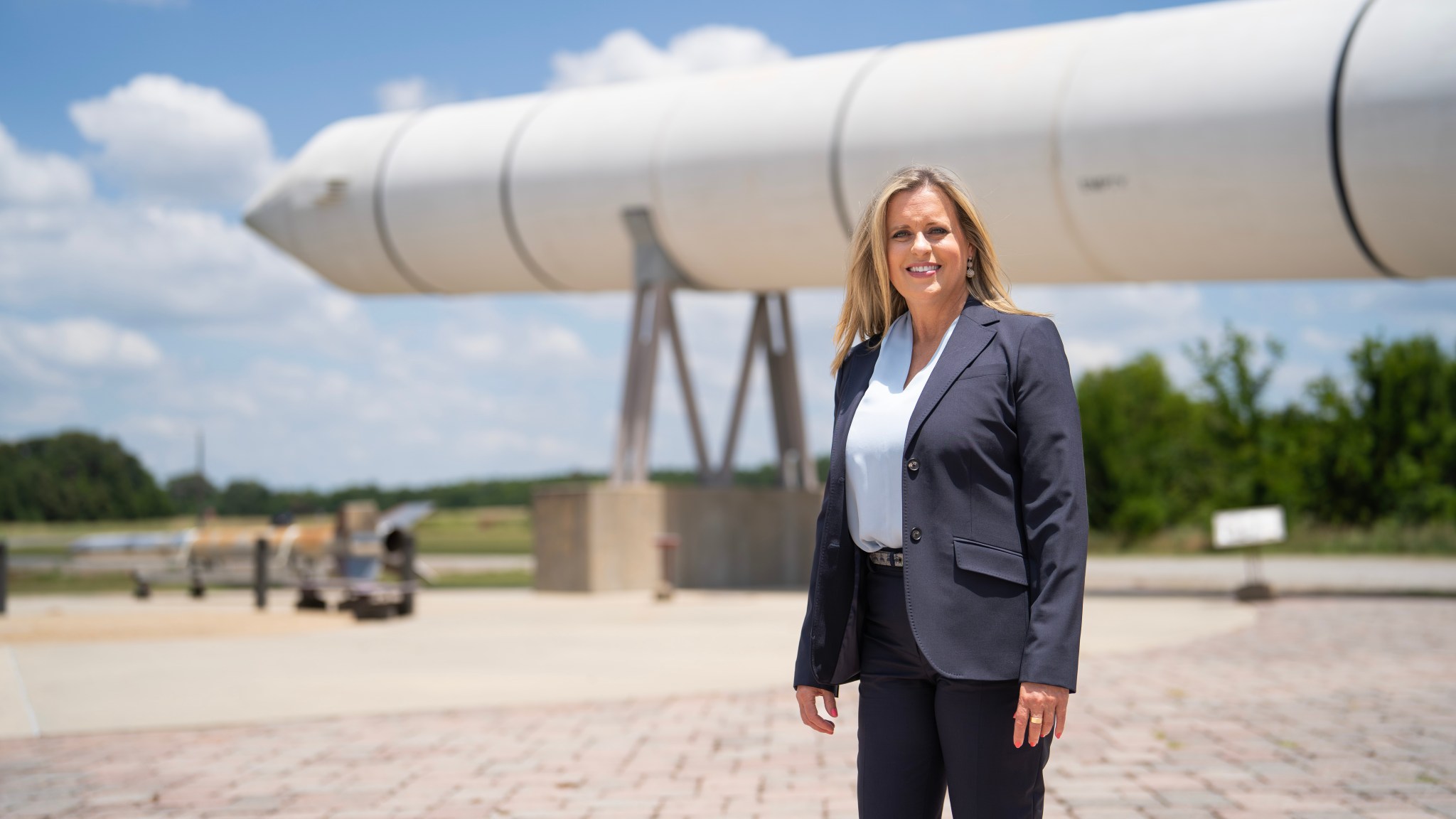
Julia Khodabandeh once adorned her walls with rockets, fighter jets, and Air Force pilots. Now, she is the solid rocket motor lead for NASA’s SLS (Space Launch System).
NASA/Sam Lott
“When I was growing up, my dad would make practice tests the night before my exams,” she said. “It helped me feel more prepared. The confidence I developed for math and science and my passion for aeronautics and aerospace, led me to a NASA career.”
The better part of her 24-year career with NASA has been dedicated to solid rocket boosters at the agency’s Marshall Space Flight Center. Over the past 10 years, she helped develop the twin solid rocket boosters for the agency’s SLS (Space Launch System) rocket, which are the largest and most powerful solid propellant boosters ever flown. They stand at 177 feet tall, and individually generate a maximum thrust of 3.6 million pounds. Together, the twin boosters provide more than 75% of the total thrust to launch SLS for NASA’s Artemis campaign to the Moon.
Khodabandeh graduated from the University of Alabama in Huntsville with a bachelor’s degree in mechanical engineering and a master’s degree in computational fluid dynamics. Early in her career, her work focused on Space Station microgravity material processing furnaces and the Space Shuttle Return-to-Flight Program. She went on to support the Ares rocket solid rocket booster team as part of the Constellation Program preceding SLS. Her work on the Ares booster helped guide her to her current position on SLS.
Khodabandeh is the motor and pyrotechnic team lead for the SLS Booster Element Office. She supports design, development, certification, production, and operation of the solid rocket motors, booster separation motors, and pyrotechnics for the twin boosters on SLS. Most days, she manages schedules and helps resolve issues with the help of her team.
“The flight hardware and test hardware are all tremendous accomplishments for the team, and behind these accomplishments are hours, weeks, and months of working together to resolve issues and deliver results,” Khodabandeh said. “It’s the people that make us successful, and teamwork is my favorite part of what we do. Someone once said, ‘You have to build a successful team before you can build successful hardware.’ I couldn’t agree more!”
In her spare time, Khodabandeh volunteers at a local rescue mission, where she provides aid to women struggling with substance abuse. She also mentors students in the Huntsville community, where she hopes to pass on the confidence her dad instilled in her, inspiring them to one day be a part of NASA and the Artemis Generation.
As the girl who grew up with posters of rockets on her walls, Khodabandeh says she is incredibly excited to be one of the many who are responsible for sending astronauts around the Moon on Artemis II.
“The incredible success of Artemis I is something that I will never forget,” she said. “We have demonstrated what we’re capable of, and I can’t wait to see what we accomplish going forward on the Artemis Program.”
NASA is working to land the first woman, first person of color, and its first international partner astronaut on the Moon under Artemis. SLS is part of NASA’s backbone for deep space exploration, along with the Orion spacecraft, supporting ground systems, advanced spacesuits and rovers, the Gateway in orbit around the Moon, and commercial human landing systems. SLS is the only rocket that can send Orion, astronauts, and supplies to the Moon in a single launch.
‘Legacy of the Invisible’ Event to Celebrate Marshall’s Contributions to Astrophysics
The public is invited to join NASA’s Marshall Space Flight Center for a special celebration of art and astronomy in downtown Huntsville on Aug. 16 from 6 to 8 p.m. The event will include a dedication of Huntsville’s newest art installation, “No Straight Lines,” by local artist Float.
The celebratory event, “Legacy of the Invisible,” will take place at the corner of Clinton Avenue and Washington Street, coinciding with the 25th anniversary of the Chandra X-ray Observatory launch on July 23, 1999. Attendees will have a chance to meet and hear from NASA experts, as well as meet Float, the artist behind “No Straight Lines,” which aims to honor Huntsville’s rich scientific legacy in astrophysics and highlight the groundbreaking discoveries made possible by Huntsville scientists and engineers.
A ‘FURST’ of its Kind: Sounding Rocket Mission to Study Sun as a Star
Editor’s Note: NASA and partners scrubbed the first launch attempt of the FURST Sounding Rocket Mission on Aug. 11 due to issues with the cooling systems. This story will be updated as soon as the next launch attempt is determined.
By Jessica Barnett
From Earth, one might be tempted to view the Sun as a unique celestial object like no other, as it’s the star our home planet orbits and the one our planet relies on most for heat and light. But if you took a step back and compared the Sun to the other stars NASA has studied over the years, how would it compare? Would it still be so unique?
The Full-sun Ultraviolet Rocket SpecTrograph (FURST) undergoes testing at White Sands Missile Range in New Mexico in preparation for launch. The instrument was designed and built at Montana State University. NASA’s Marshall Space Flight Center provided the camera, supplied avionics, and designed and built its calibration system.
Montana State University
The Full-sun Ultraviolet Rocket SpecTrograph (FURST) aims to answer those questions. when it launches aboard a Black Brant IX sounding rocket at White Sands Missile Range in New Mexico.
“When we talk about ‘Sun as a star’, we’re treating it like any other star in the night sky as opposed to the unique object we rely on for human life. It’s so exciting to study the Sun from that vantage point,” said Adam Kobelski, institutional principal investigator for FURST and a research astrophysicist at NASA’s Marshall Space Flight Center.
FURST will obtain the first high-resolution spectra of the “Sun as a star” in vacuum ultraviolet (VUV), a light wavelength that is absorbed in Earth’s atmosphere meaning it can only be observed from space. Astronomers have studied other stars in the vacuum ultraviolet with orbiting telescopes, however these instruments are too sensitive to be pointed to the Sun. The recent advancements in high-resolution VUV spectroscopy now allow for the same observations of our own star, the Sun.
“These are wavelengths that Hubble Space Telescope is really great at observing, so there is a decent amount of Hubble observations of stars in ultraviolet wavelengths, but we don’t have comparable observations of our star in this wavelength range,” said Kobelski. Marshall was the lead field center for the design, development, and construction of the Hubble Space Telescope.
Because Hubble is too sensitive to point at Earth’s Sun, new instruments were needed to get a spectrum of the entire Sun that is of a similar quality to Hubble’s observations of other stars. Marshall built the camera, supplied avionics, and designed and built a new calibration system for the FURST mission. Montana State University (MSU), which leads the FURST mission in partnership with Marshall, built the optical system, which includes seven optics that will feed into the camera that will essentially create seven exposures, covering the entire ultraviolet wavelength range.
Charles Kankelborg, a heliophysics professor at MSU and principal investigator for FURST, described the mission as a very close collaboration with wide-ranging implications.
Montana State University alumnus Jake Davis, left, Professor Charles Kankelborg, and doctoral students Catharine “Cappy” Bunn and Suman Panda, pose at White Sands Missile Range in New Mexico.
Montana State University
“Our mission will obtain the first far ultraviolent spectrum of the Sun as a star,” Kankelborg said. “This is a key piece of information that has been missing for decades. With it, we will place the Sun in context with other stars.”
Kobelski echoed the sentiment.
“How well do the observations and what we know about our Sun compare to our observations or what we know of other stars?” Kobelski said. “You’d expect that we know all this information about the Sun – it’s right there – but it turns out, we actually don’t. If we can get these same observations or same wavelengths as we’ve observed from these other sources, we can start to connect the dots and connect our Sun to other stars.”
FURST will be the third launch led by Marshall for NASA’s Sounding Rocket Program within five months, making 2024 an active year for the program. Like the Hi-C Flare mission that launched in April, the sounding rocket will launch and open during flight to allow FURST to observe the Sun for approximately five minutes before closing and falling back to Earth’s surface. Marshall team members will be able to calibrate the instruments during launch and flight, as well as retrieve data during flight and soon after landing.
Kobelski and Kankelborg each said they’re grateful for the opportunity to fill the gaps in our knowledge of Earth’s Sun.
NASA Challenge Seeks ‘Cooler’ Solutions for Deep Space Exploration
NASA’s Human Lander Challenge, or HuLC, is now open and accepting submissions for its second year. As NASA aims to return astronauts to the Moon through its Artemis campaign in preparation for future missions to Mars, the agency is seeking ideas from college and university students for evolved supercold, or cryogenic, propellant applications for human landing systems.
As part of the 2025 HuLC competition, teams will aim to develop innovative solutions and technology developments for in-space cryogenic liquid storage and transfer systems as part of future long-duration missions beyond low Earth orbit.
“The HuLC competition represents a unique opportunity for Artemis Generation engineers and scientists to contribute to groundbreaking advancements in space technology,” said Esther Lee, an aerospace engineer leading the navigation sensors technology assessment capability team at NASA’s Langley Research Center. “NASA’s Human Lander Challenge is more than just a competition – it is a collaborative effort to bridge the gap between academic innovation and practical space technology. By involving students in the early stages of technology development, NASA aims to foster a new generation of aerospace professionals and innovators.”
Through Artemis, NASA is working to send the first woman, first person of color, and first international partner astronaut to the Moon to establish long-term lunar exploration and science opportunities. Artemis astronauts will descend to the lunar surface in a commercial Human Landing System. The Human Landing System Program is managed by NASA’s Marshall Space Flight Center.
Cryogenic, or super-chilled, propellants like liquid hydrogen and liquid oxygen are integral to NASA’s future exploration and science efforts. The temperatures must stay extremely cold to maintain a liquid state. Current state-of-the-art systems can only keep these substances stable for a matter of hours, which makes long-term storage particularly problematic. For NASA’s HLS mission architecture, extending storage duration from hours to several months will help ensure mission success.
“NASA’s cryogenics work for HLS focuses on several key development areas, many of which we are asking proposing teams to address,” said Juan Valenzuela, a HuLC technical advisor and aerospace engineer specializing in cryogenic fuel management at Marshall. “By focusing research in these key areas, we can explore new avenues to mature advanced cryogenic fluid technologies and discover new approaches to understand and mitigate potential problems.”
Interested teams from U.S.-based colleges and universities should submit a non-binding Notice of Intent (NOI) by Oct. 6, and submit a proposal package by March 3, 2025. Based on proposal package evaluations, up to 12 finalist teams will be selected to receive a $9,250 stipend to further develop and present their concepts to a panel of NASA and industry judges at the 2025 HuLC Forum in Huntsville, near Marshall, in June 2025. The top three placing teams will share a prize purse of $18,000.
Teams’ potential solutions should focus on one of the following categories: On-Orbit Cryogenic Propellant Transfer, Microgravity Mass Tracking of Cryogenics, Large Surface Area Radiative Insulation, Advanced Structural Supports for Heat Reduction, Automated Cryo-Couplers for Propellant Transfer, or Low Leakage Cryogenic Components.
NASA’s James Webb Space Telescope has captured a phenomenon for the very first time. The bright red streaks at top left of this June 20 image are aligned protostar outflows – jets of gas from newborn stars that all slant in the same direction.
In this image of the Serpens Nebula from NASA’s James Webb Space Telescope, astronomers found a grouping of aligned protostellar outflows within one small region (the top left corner). Serpens is a reflection nebula, which means it’s a cloud of gas and dust that does not create its own light, but instead shines by reflecting the light from stars close to or within the nebula.
NASA, ESA, CSA, STScI, Klaus Pontoppidan (NASA-JPL), Joel Green (STScI)
This image supports astronomers’ assumption that as clouds collapse to form stars, the stars will tend to spin in the same direction. Previously, the objects appeared as blobs or were invisible in optical wavelengths. Webb’s sensitive infrared vision was able to pierce through the thick dust, resolving the stars and their outflows.
The James Webb Space Telescope is the world’s premier space science observatory. Webb is solving mysteries in our solar system, looking beyond to distant worlds around other stars, and probing the mysterious structures and origins of our universe and our place in it. Webb is an international program led by NASA with its partners, ESA (European Space Agency) and CSA (Canadian Space Agency). Several NASA centers contributed to the project, including NASA’s Marshall Space Flight Center.
NASA Invites Media to Watch Artemis II Rocket Adapter Roll Out
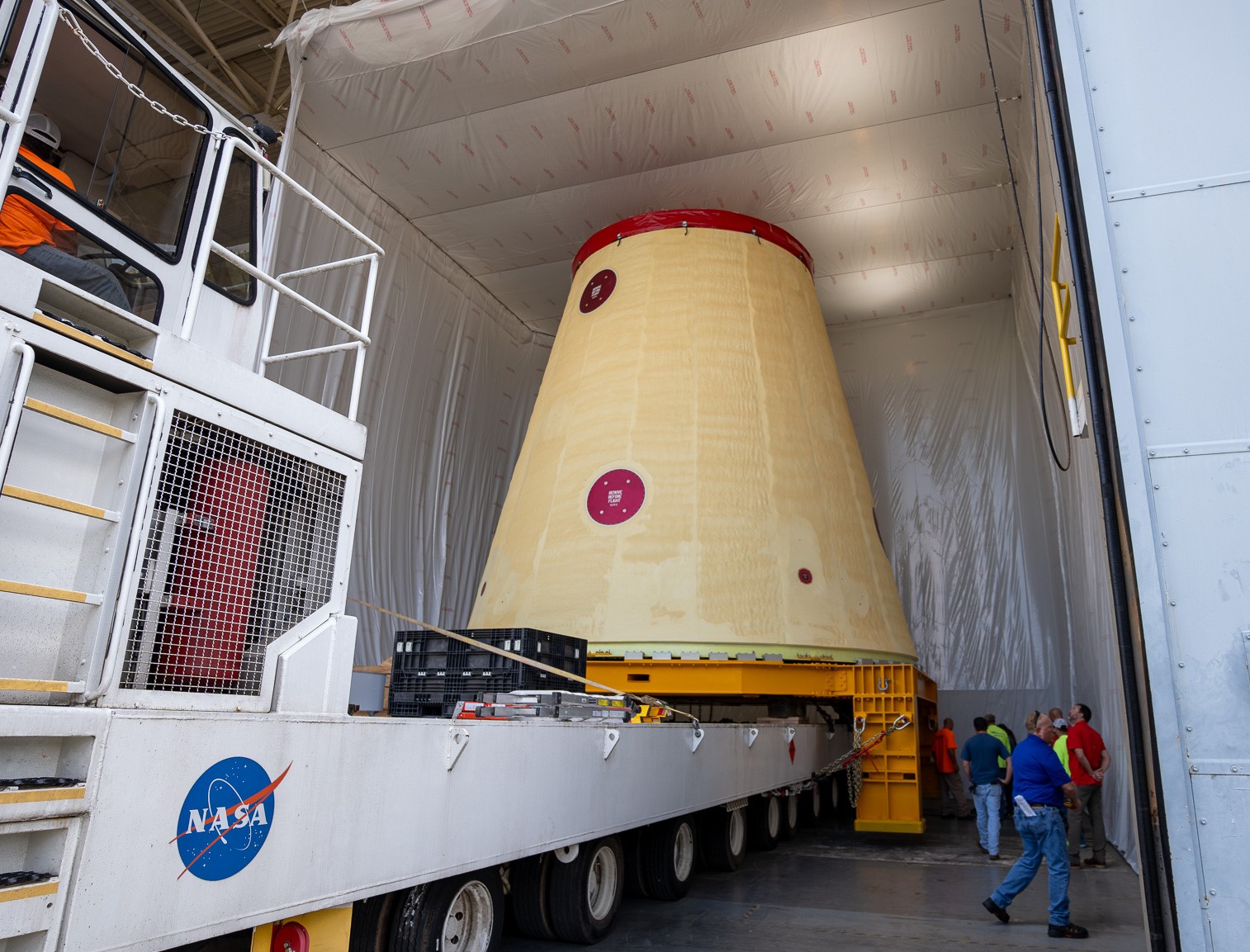
Crews are preparing to move a key adapter for NASA’s Space Launch System rocket out of Marshall Space Flight Center’s Building 4708 to the agency’s Pegasus barge. The cone-shaped launch vehicle stage adapter connects the rocket’s core stage to the upper stage and helps protect the upper stage’s engine that will help propel the Artemis II mission around the Moon.
Credits: Sam Lott/NASA
To mark progress toward the first crewed flight test around the Moon in more than 50 years for the benefit of humanity, NASA will welcome media Wednesday, Aug. 21, to see a key adapter for the agency’s SLS (Space Launch System) rocket at its Marshall Space Flight Center in Huntsville, Alabama.
The cone-shaped launch vehicle stage adapter connects the rocket’s core stage to the upper stage and helps protect the upper stage’s engine that will help propel the Artemis II mission around the Moon. The event includes seeing the adapter on the move as it prepares for shipment to NASA’s Kennedy Space Center in Florida.
Media will have the opportunity to capture images and video and speak to subject matter experts as crews move the adapter out of NASA Marshall’s Building 4708 to the agency’s Pegasus barge. The barge will ferry the adapter first to NASA’s Michoud Assembly Facility, where it will pick up additional SLS hardware for future Artemis missions, and then travel to NASA Kennedy. In Florida, teams with NASA’s Exploration Ground Systems will prepare the adapter for stacking and launch.
This event is open to U.S. media, who must RSVP by 5 p.m. CDT on Monday, Aug. 19, to Jonathan Deal at jonathan.e.deal@nasa.gov. Additional details about timing and other details for the event are forthcoming to registered media.
Manufactured by prime contractor Teledyne Brown Engineering and the Jacobs Space Exploration Group’s ESSCA contract using NASA Marshall’s self-reacting friction-stir robotic and vertical weld tools, the launch vehicle stage adapter is the largest SLS component for Artemis II that is made at the center.
Through the Artemis campaign, NASA will land the first woman, first person of color, and its first international partner astronaut on the Moon. The rocket is part of NASA’s deep space exploration plans, along with the Orion spacecraft, supporting ground systems, advanced spacesuits and rovers, Gateway in orbit around the Moon, and commercial human landing systems. NASA’s SLS is the only rocket that can send Orion, astronauts, and supplies to the Moon in a single launch.