Geospatial AI Foundation Model Team Receives NASA Marshall Group Achievement Award 

Geospatial AI Foundation Model Team Receives NASA Marshall Group Achievement Award 

2 min read

Geospatial AI Foundation Model Team Receives NASA Marshall Group Achievement Award 

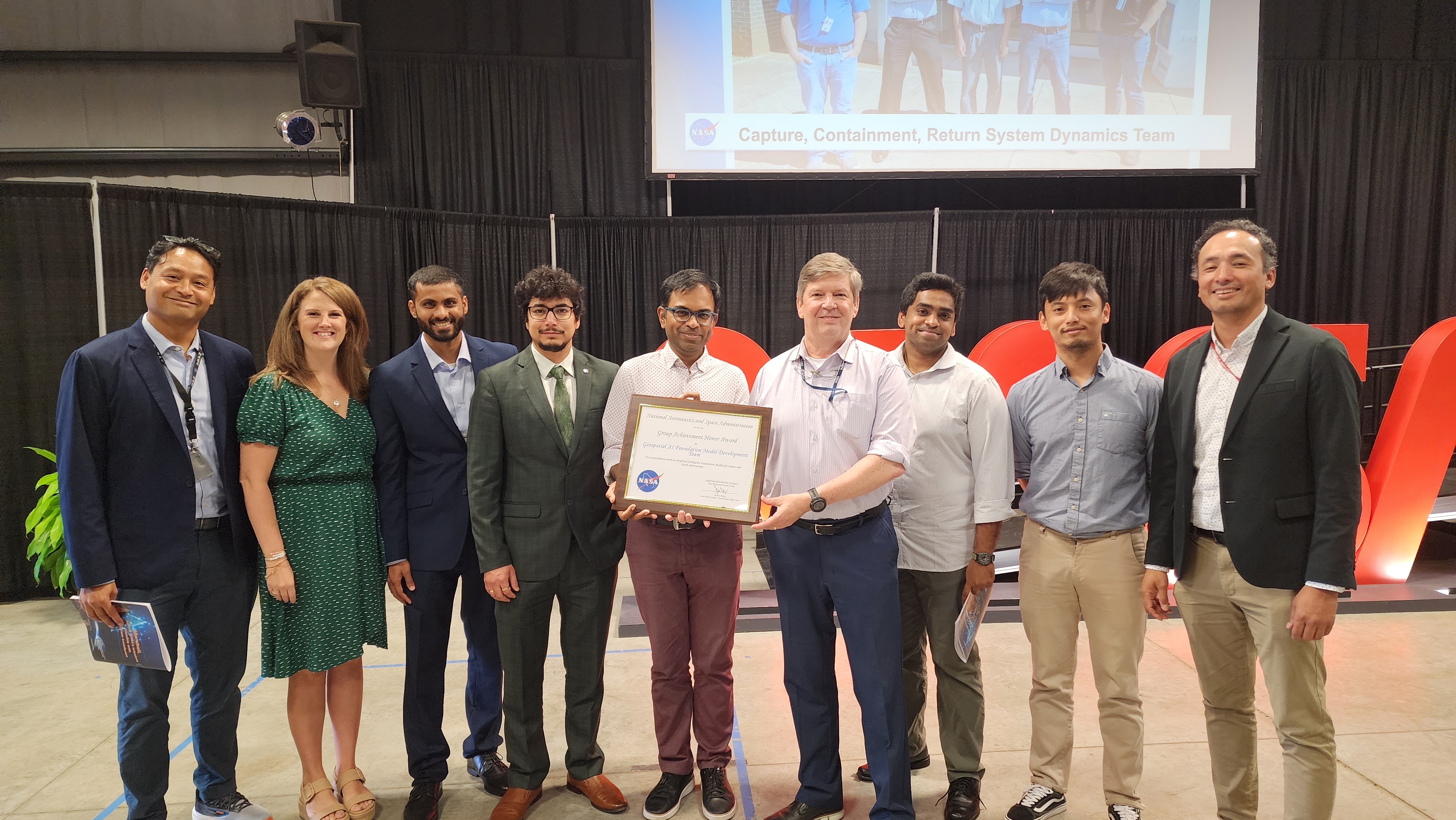
Members of the NASA Impact and IBM Research teams accept their certificate after winning the NASA Marshall Group Achievement Award.
Rahul Ramachandran of NASA IMPACT, left, Elizabeth Fancher of NASA IMPACT, Ankur Kumar of the University of Alabama in Huntsville (UAH), Sujit Roy of UAH, Raghu Ganti of IBM Research, David McKenzie of NASA, Muthukumaran Ramasubramanian of UAH, Iksha Gurung of UAH, and Manil Maskey of NASA IMPACT, right, accept the NASA Marshall Space Flight Center Group Achievement Award on Thursday, August 15, 2024 at NASA Marshall.
NASA

NASA’s science efforts aim to empower scientists with the tools to perform research into our planet and universe. To this end, a collaborative effort between NASA and IBM created an AI geospatial foundation model, which was released as an open-source application in 2024. 

Trained on vast amounts of NASA Earth science data, the foundation model can be adapted for Earth science applications such as flood, burn scar, and cropland studies. Tailoring the model for a specific task takes far less data than the original training set, providing an easy path for researchers to perform AI-powered studies. 

For their groundbreaking work on this project, the development team behind the foundation model has received the NASA Marshall Space Flight Center Group Achievement Award. Their success with the model showcases their commitment to advancing AI and scientific research and will inspire progress in this field for years to come.

The team members from NASA’s Marshall Space Fight Center /IMPACT (Interagency Implementation and Advanced Concepts Team) are:

  • Rahul Ramachandran 
  • Manil Maskey 
  • Elizabeth Fancher 

The team members from the University of Alabama in Huntsville (UAH) are: 

  • Sujit Roy 
  • Ankur Kumar 
  • Christopher Phillips 
  • Iksha Gurung 
  • Muthukumaran Ramasubramanian

The team members from IBM are: 

  • Ranjini Bangalore 
  • Juan Bernabe-Moreno 
  • Dario Augusto Borges Oliveira 
  • Linsong Chu 
  • Blair Edwards 
  • Paolo Fraccaro 
  • Carlos Gomes 
  • Raghu Ganti 
  • Adnan Hoque 
  • Johannes Jakubik 
  • Levente Klein 
  • Devyani Lambhate 
  • Gabby Nyirjesy 
  • Naomi Simumba 
  • Johannes Schmude 
  • Mudhakar Srivatsa 
  • Harini Srinivasan 
  • Daniela Szwarcman 
  • Rob Parkin 
  • Kommy Weldemariam 
  • Campbell Watson 
  • Bianca Zadrozny 

The team members from Clark University are:

  • Hamed Alemohammad 
  • Michael Cecil 
  • Steve Li 
  • Sam Khallaghi 
  • Denys Godwin 
  • Maryam Ahmadi 
  • Fatemeh Kordi

To learn more about the NASA projects improving accessible science discovery for the benefit of all, visit the Open Science at NASA page

Share

Details

Last Updated
Aug 15, 2024

Related Terms

Powered by WPeMatico

Get The Details…

Space Delivery Launches to Station; Crew Studies Stem Cells, Works Life Support

Space Delivery Launches to Station; Crew Studies Stem Cells, Works Life Support

An aurora radiates brightly above the Indian Ocean as the International Space Station soared 270 miles above the Earth's surface.
An aurora radiates brightly above the Indian Ocean as the International Space Station soared 270 miles above the Earth’s surface.

A Roscosmos cargo craft is orbiting Earth today packed with nearly three tons of cargo to resupply the International Space Station. Meanwhile, the orbital residents stayed focused on more cargo work, space biology, and lab maintenance on Thursday.

The Roscosmos Progress 89 space freighter launched at 11:20 p.m. EDT on Wednesday from the Baikonur Cosmodrome in Kazakhstan beginning a two-day space delivery to the orbital outpost. Cosmonauts Oleg Kononenko and Nikolai Chub will be on duty monitoring Progress when it completes its automated approach and docking 1:56 a.m. on Saturday. Progress will remain docked to the aft port of the Zvezda service module for six months of cargo operations.

NASA astronauts Matthew Dominick and Jeanette Epps teamed up Thursday morning continuing to unload science and supplies packed inside Northrop Grumman’s Cygnus space freighter replenishing the Expedition 71 and Boeing Crew Flight Test crews. Cygnus has been berthed to the Unity module’s Earth-facing port since Aug. 6 when it was captured and installed with the Canadarm2 robotic arm.

NASA Flight Engineer Tracy C. Dyson continued her weeklong stem cell studies treating samples inside the Kibo laboratory module’s Life Science Glovebox. She was helping doctors develop improved cell therapies for Earth and advance cellular manufacturing in space.

Life support work commanded a large portion of the day on Thursday as NASA astronauts Mike Barratt, Butch Wilmore, and Suni Williams serviced a variety of advanced atmospheric and water hardware. Barratt and Wilmore took turns working on the carbon dioxide removal assembly checking it for leaks and configuring it for reinstallation. Williams installed experimental water recovery hardware in the Microgravity Science Glovebox to explore how microgravity affects water purification, fuel cells, and heating and cooling systems to benefit both Earth and space applications.

Kononenko and Chub are relaxing today before their Friday schedule to get ready for Progress’ arrival early Saturday. However, Kononenko wrapped up a 24-hour heart and blood pressure monitoring session then handed over sensors to Chub so he could begin his health data collection session. Flight Engineer Alexander Grebenkin started his morning transferring water out of the Progress 88 cargo craft into station water tanks. He then spent the rest of his shift servicing air conditioning systems and filling an oxygen generator.


Learn more about station activities by following the space station blog@space_station and @ISS_Research on X, as well as the ISS Facebook and ISS Instagram accounts.

Get weekly video highlights at: https://roundupreads.jsc.nasa.gov/videoupdate/

Get the latest from NASA delivered every week. Subscribe here: www.nasa.gov/subscribe

Powered by WPeMatico

Get The Details…

Mark Garcia

São Francisco’s Colorful Palette

São Francisco’s Colorful Palette

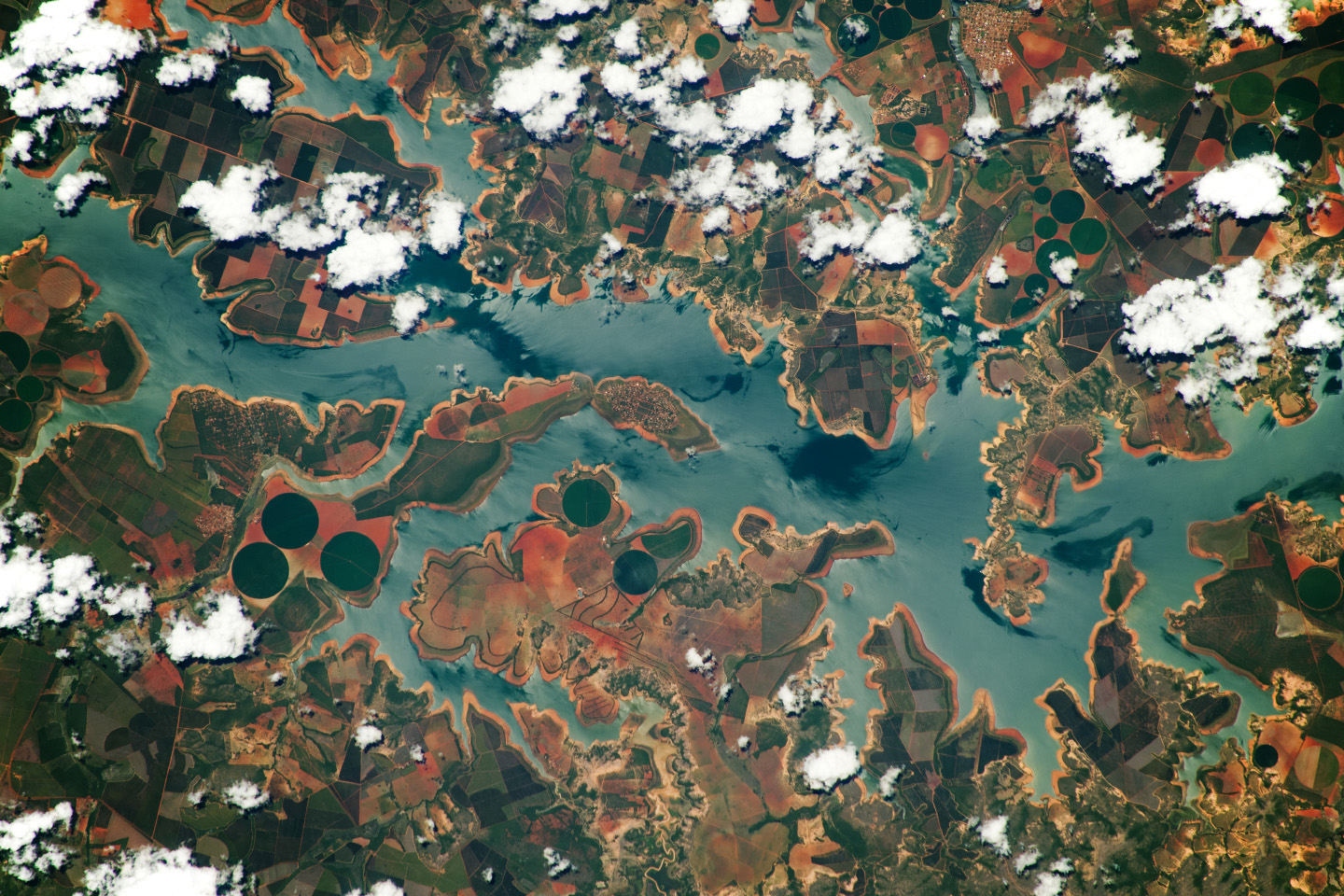
A multi-colored area of land is split horizontally by a cloudy blue river. The river cuts into the land at many points. The land is various shades of green, red, and yellow. Clumps of white clouds dot the top part and a little bit of the bottom land.
NASA

This Dec. 27, 2023 image of the São Francisco River in southeast Brazil showcases the range of vibrant colors in the area including blues, reds, greens, and yellows. Much of the unvegetated land, such as unplanted fields and unpaved roads, appears in bright shades of red and yellow. This coloration comes from the underlying clays and soils of Brazil’s state of Minas Gerais.

The photo focuses on the Três Marias Reservoir, a human-made waterbody fed by the São Francisco River. Access to freshwater for irrigation enables agriculture around the reservoir. Red- and green-toned areas can be distinguished as fields with center-pivot irrigation or straight-edged plots. An orange-tan contour line tracing the shoreline of the reservoir marks where water levels have been higher. The lighter shades of blue on the reservoir’s surface are due to sunglint, an optical effect that occurs when sunlight reflects off smooth water at the same angle a sensor views it.

Text credit: Andrea Wenzel

Image credit: NASA

Powered by WPeMatico

Get The Details…
Monika Luabeya

NASA Selects 5 New Roman Technology Fellows in Astrophysics

NASA Selects 5 New Roman Technology Fellows in Astrophysics

9 min read

NASA Selects 5 New Roman Technology Fellows in Astrophysics

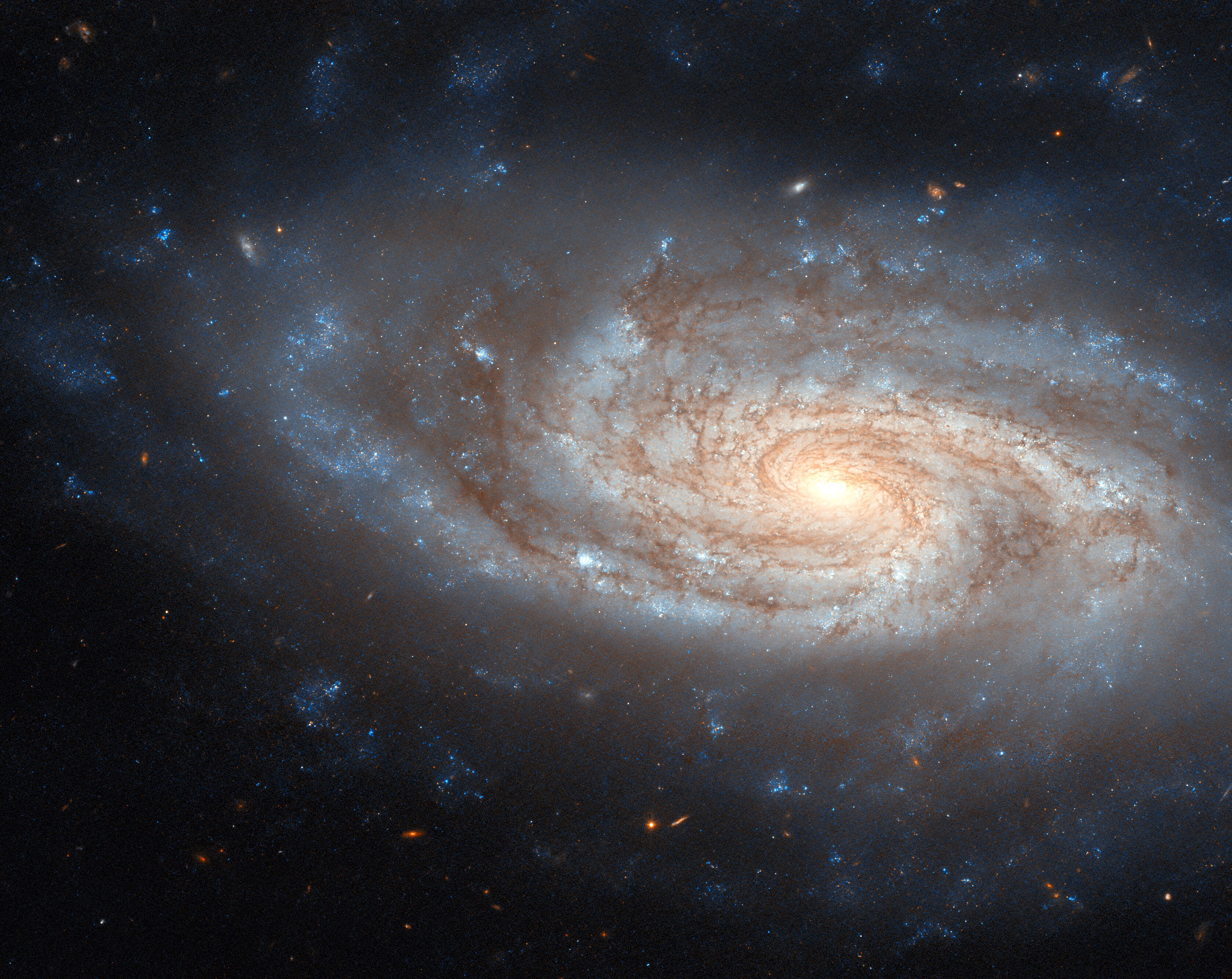
A spiral galaxy with three prominent arms wrapping around it. The galaxy holds plenty of extra gas and dark dust between the arms. There are shining blue points throughout the arms and some patches of gas out beyond the galaxy’s edge, where stars are forming. The center of the galaxy also shines brightly. It is on a dark background where some small orange dots mark distant galaxies.
This NASA/ESA Hubble Space Telescope image treats viewers to a wonderfully detailed snapshot of the spiral galaxy NGC 3430 that lies 100 million light-years from Earth in the constellation Leo Minor. Several other galaxies, located relatively nearby to this one, are just beyond the frame of this image; one is close enough that gravitational interaction is driving some star formation in NGC 3430 – visible as bright-blue patches near to but outside of the galaxy’s main spiral structure. This fine example of a galactic spiral holds a bright core from which a pinwheel array of arms appears to radiate outward. Dark dust lanes and bright star forming regions help define these spiral arms.
ESA/Hubble & NASA, C. Kilpatrick

NASA has awarded Nancy Grace Roman Technology Fellowships (RTF) to five early-career researchers in astrophysics for the class of 2023.  The program will support the advancement of their ideas for new technologies to further the exploration of the universe. 

This annual fellowship gives researchers the opportunity to develop the skills necessary to become principal investigators of future astrophysics missions, and fosters new talent by putting early-career instrument builders on track towards long-term positions. Specifically, the fellowship facilitates the development of skills necessary to lead astrophysics flight instrumentation development projects, as well as the development of innovative technologies that have the potential to enable major scientific breakthroughs.

“We saw higher numbers of strong applications for this class than in recent years, so we are especially honored to welcome this new group of five fellows,” says Mario Perez, RTF program scientist and chief technologist for NASA’s Astrophysics Division, based at the agency’s headquarters in Washington. “These new fellows advance important areas of technological interest to NASA astrophysics, and we expect them to become leaders in their fields and principal investigators of supporting technologies and space missions.”  

Since the RTF program was established in 2011, all 31 researchers who have previously been awarded the fellowship are still active in careers within the fields of astrophysics or planetary mission development. In 2024, five additional fellows were competitively selected, making the total 36 researchers who have been awarded this fellowship since the program began.

The program’s name honors Dr. Nancy Grace Roman, the first female executive at NASA who created the agency’s first astronomical program. She is known as the “Mother of Hubble” for her foundational role in planning NASA’s Hubble Space Telescope. NASA’s forthcoming Nancy Grace Roman Space Telescope is also named for her.

The five newly selected fellows are:

A man is smiling. He is researcher Nicholas Kruczek.
Nicholas Kruczek is an instrument engineer at the Laboratory for Atmospheric and Space Physics (LASP) at the University of Colorado, Boulder

Nicholas Kruczek

Position: Instrument engineer, Laboratory for Atmospheric and Space Physics (LASP) at the University of Colorado, Boulder

Hometown: Orchard Park, New York (“Go Bills!”)

Education: B.A. in Physics, Drexel University; Ph.D. in Astrophysical and Planetary Science, University of Colorado, Boulder

What is the focus of your research? Ultraviolet (UV) instrumentation and sounding rockets, with a focus on diffraction grating development.

What does this fellowship mean to you? At LASP, we’ve assembled a team that’s knowledgeable and passionate about sounding rockets and developing novel UV technologies. Having this environment provides a strong platform for mentoring undergraduate and graduate students. This fellowship provides much needed support to keep that team together and maintain our mission of the training the next generation of UV principal investigators and Roman fellows.

What inspired you to pursue your career in astrophysics? I’ve always been fascinated by the physics of light and its interaction with optics. Astrophysical instrumentation provided an outlet to channel that passion into a career. It gives me the opportunity to study optical phenomena in detail, but in the context of gaining a deeper understanding of the physical processes governing our universe.

A man with long hair and a beard is smiling. His name is Drew Miles and he is a scientist.
Drew Miles is a research assistant professor at the California Institute of Technology in Pasadena.

Drew Miles

Name: Drew Miles

Position: Research assistant professor, California Institute of Technology

Hometown: Marshalltown, Iowa

Education: B.B.A in Accounting and B.S. in Physics and Astronomy, University of Iowa; M.S. and Ph.D. in Astronomy and Astrophysics, Penn State University

What is the focus of your research? My research is focused on developing and demonstrating technologies for space-based grating spectrographs. In this work we develop the full life cycle of the technology: conceiving new spectrograph designs and applications, using nanofabrication techniques to manufacture next-generation diffraction gratings, implementing the gratings into astronomy instruments, and verifying their performance in applications representative of their applicability to large NASA missions. 

What does this fellowship mean to you? This fellowship will help allow me to further develop my research program and implement the lab support and characterization capabilities needed to advance our technologies. Further, the Nancy Grace Roman Technology Fellowship program continues to be an excellent investment in the careers of early-career researchers, and I am appreciative at being awarded a fellowship and having the opportunity to advance impactful instrumentation for the future.

What inspired you to pursue your career in astrophysics? After not having exposure to physics and astronomy prior to college, I became interested in further exploring astronomy while taking a few elective physics and astronomy courses during my business degree. The idea of working to better understand the nature and evolution of our universe is extremely compelling. Later, I was fortunate to become involved in a research lab for experimental astrophysics and was hooked by the hands-on nature of the research and the need to maintain a long-term vision for the technology while ensuring the smallest details are well understood. Throughout my time as a student and postdoctoral researcher, the positive mentorship from my dissertation advisor (and former Roman Technology Fellow), Dr. Randall McEntaffer, and other members of the field have been critical in teaching me and allowing me to grow into the field.

A woman with long hair is smiling. She is scientist Johanna Nagy.
Johanna Nagy is the Warren E. Rupp Assistant Professor of Physics at Case Western Reserve University.
Photo: Daniel Milner/Case Western Reserve University

Johanna Nagy

Position: Warren E. Rupp Assistant Professor of Physics at Case Western Reserve University

Hometown: Lompoc, California

Education: B.S. in Physics, Stanford University; Ph.D. in Physics, Case Western Reserve University

What is the focus of your research? My research group focuses on cosmology, studying the evolution and composition of the universe through increasingly precise measurements of the Cosmic Microwave Background. We build instruments to measure its polarization and analyze the resulting data. Several of our current projects use NASA’s stratospheric balloons to access signals that are difficult to see from the ground.

What does this fellowship mean to you?

This fellowship will allow me to continue to grow my research group and expand our lab’s capabilities. I am most excited about being able to work with more undergraduate and graduate students and to help them pursue their own career paths.

What inspired you to pursue your career in astrophysics?

I became deeply interested in space when I was in middle school, but in college I learned how much I enjoy experimental work. It still amazes me that instruments we build by hand in the lab can help us answer fundamental questions about the universe. I have also been fortunate to have many fantastic mentors throughout my career and hope to pay it forward.

A man with glasses is smiling. He is scientist Dustin Swarm.
Dustin Swarm is a postdoctoral research scholar in the Department of Physics & Astronomy at University of Iowa.
Kayla Laird/The University of Iowa

Dustin Swarm

Name: Dustin Swarm

Position: Postdoctoral Research Scholar in the Department of Physics & Astronomy at University of Iowa

Hometown: Greenville, Illinois

Education: B.S. in Spanish Education, B.A. in Physics and Mathematics, Greenville University; Ph.D. in Physics, University of Iowa

What is the focus of your research? My research involves the design and fabrication of focusing optics for high-energy astrophysics investigations. Constructing telescopes with focusing optics that operate in the hard X-ray to soft gamma-ray regime (100-600 keV) is unfeasible with current technologies. Developing high-performance focusing optics for this regime would enable deeper investigations of, for instance, accreting compact objects or sources of electron-positron annihilation.

What does this fellowship mean to you? The Roman Technology Fellowship is impactful for my early career in a number of ways. It is a major source of encouragement that my work is interesting and meaningful to people beyond myself. It is a validation that I have a place in the broader astrophysics community. It offers a chance of stability and a solid foundation on which to build my nascent career. I am also grateful for the opportunity it provides me to mentor and train future astrophysicists, following in the footsteps of the mentors who have poured into me along this journey. I am honored to be selected as a Roman Technology Fellow.

What inspired you to pursue your career in astrophysics? I grew up with a love of science. From my mother burying chicken bones in my sandbox to inspire my play as a paleontologist to my grandfather purchasing a telescope so we could look at the Moon in his backyard, my ambition was to become a scientist. I began college on an aerospace engineering path, but along the way I switched majors to Spanish education. I spent six years as a high school Spanish teacher, but during that time I followed the physics and astronomy world through documentaries, news articles, and books. I missed engaging with mathematics and science, and I eventually decided it was time to go back to school to become an astrophysicist. It was in this time that NASA’s Juno spacecraft was transmitting high quality photographs of Jupiter, and the ground-based LIGO, the Laser Interferometer Gravitational-wave Observatory, was detecting black hole mergers. I was wrapping up my second undergraduate degree when news broke of the simultaneous detection of gravitational waves and electromagnetic radiation from the neutron star merger GW170817. I was fascinated by the papers published on this event, and it cemented my desire to become a high-energy astrophysicist.

A man wearing a hat is smiling. His name is Kyle Van Gorkom and he is a scientist.
Kyle Van Gorkom is an assistant research professor at Steward Observatory, University of Arizona.

Kyle Van Gorkom

Name: Kyle Van Gorkom

Position: Assistant research professor at Steward Observatory, University of Arizona

Hometown: Tucson, Arizona

Education: B.S. in Physics and Philosophy, Brandeis University; Ph.D. in Optical Sciences, University of Arizona

What is the focus of your research: My research focuses on the use of high-contrast imaging techniques and wavefront control to directly image exoplanets (planets around other stars) with space- and ground-based observatories.

What does this fellowship mean to you: This fellowship will enable me to start building an independent research program, to set up a laboratory for technology development in coronagraphy, and to begin mentoring the next generation of instrument builders.

What inspired you to pursue a career in astrophysics: I first became interested in astrophysics after taking a philosophy of science course during college, which led me to realize that if I wanted to be able to think carefully about the world, I needed a deeper understanding of physics. I joined a research group doing radio astronomy and then, following graduation, worked several years at the Space Telescope Science Institute in Baltimore, which introduced me to astronomical instrumentation and motivated me to pursue a PhD in optics. Over the years, I’ve had several supportive mentors whose guidance set me on my current career trajectory.

Share

Details

Last Updated
Aug 15, 2024

Powered by WPeMatico

Get The Details…
NASA Citizen Scientists Spot Object Moving 1 Million Miles Per Hour

NASA Citizen Scientists Spot Object Moving 1 Million Miles Per Hour

4 min read

NASA Citizen Scientists Spot Object Moving 1 Million Miles Per Hour

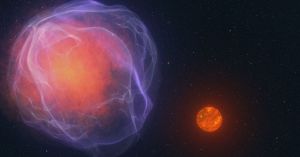
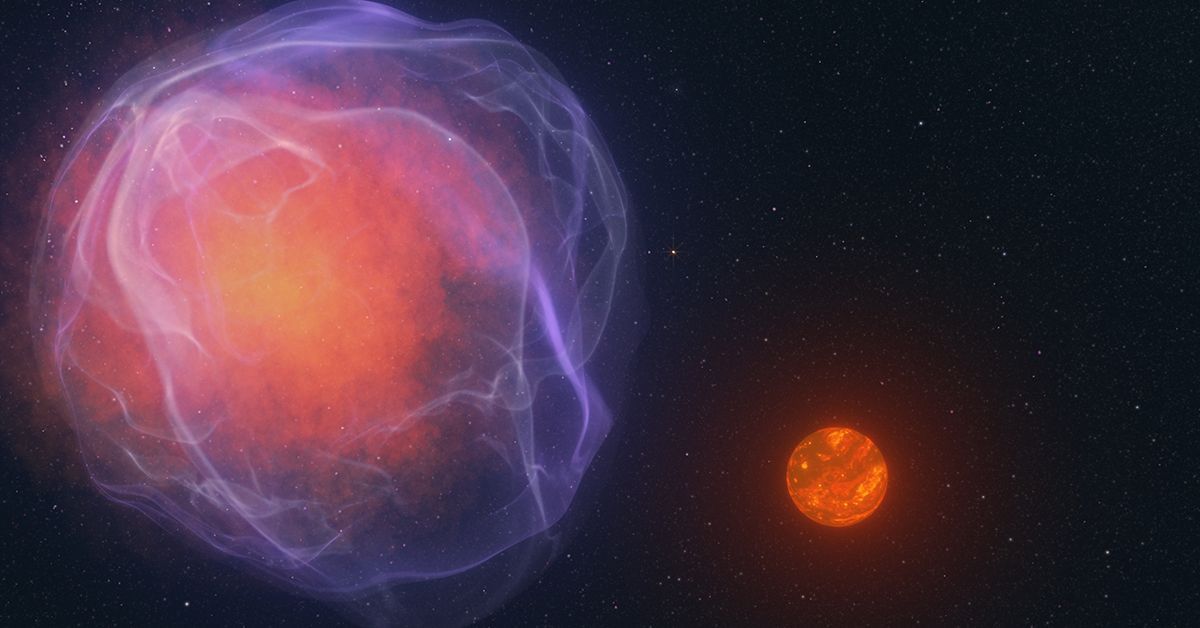
In this artist's concept, against a black background with tiny distance stars, at left is a fluffy large orange sphere is surrounded by purple translucent whisps representing an exploded white dwarf. At right is much smaller orange ball representing CWISE J1249, which is a low-mass star or brown dwarf.
This artist’s concept shows a hypothetical white dwarf, left, that has exploded as a supernova. The object at right is CWISE J1249, a star or brown dwarf ejected from this system as a result of the explosion. This scenario is one explanation for where CWISE J1249 came from.
W.M. Keck Observatory/Adam Makarenko

Most familiar stars peacefully orbit the center of the Milky Way. But citizen scientists working on NASA’s Backyard Worlds: Planet 9 project have helped discover an object moving so fast that it will escape the Milky Way’s gravity and shoot into intergalactic space. This hypervelocity object is the first such object found with the mass similar to or less than that of a small star.  

Backyard Worlds uses images from NASA’s WISE, or Wide Field Infrared Explorer, mission, which mapped the sky in infrared light from 2009 to 2011. It was re-activated as NEOWISE (Near-Earth Object Wide-field Infrared Survey Explorer) in 2013 and retired on Aug. 8, 2024.

A few years ago, longtime Backyard Worlds citizen scientists Martin Kabatnik, Thomas P. Bickle, and Dan Caselden spotted a faint, fast-moving object called CWISE J124909.08+362116.0, marching across their screens in the WISE images. Follow-up observations with several ground-based telescopes helped scientists confirm the discovery and characterize the object. These citizen scientists are now co-authors on the team’s study about this discovery published in the Astrophysical Journal Letters (a pre-print version is available here).

“I can’t describe the level of excitement,” said Kabatnik, a citizen scientist from Nuremberg, Germany. “When I first saw how fast it was moving, I was convinced it must have been reported already.” 

CWISE J1249 is zooming out of the Milky Way at about 1 million miles per hour. But it also stands out for its low mass, which makes it difficult to classify as a celestial object. It could be a low-mass star, or if it doesn’t steadily fuse hydrogen in its core, it would be considered a brown dwarf, putting it somewhere between a gas giant planet and a star.

Ordinary brown dwarfs are not that rare. Backyard Worlds: Planet 9 volunteers have discovered more than 4,000 of them! But none of the others are known to be on their way out of the galaxy.

This new object has yet another unique property. Data obtained with the W. M. Keck Observatory in Maunakea, Hawaii, show that it has much less iron and other metals than other stars and brown dwarfs. This unusual composition suggests that CWISE J1249 is quite old, likely from one of the first generations of stars in our galaxy.

Why does this object move at such high speed? One hypothesis is that CWISE J1249 originally came from a binary system with a white dwarf, which exploded as a supernova when it pulled off too much material from its companion. Another possibility is that it came from a tightly bound cluster of stars called a globular cluster, and a chance meeting with a pair of black holes sent it soaring away.

“When a star encounters a black hole binary, the complex dynamics of this three-body interaction can toss that star right out of the globular cluster,” says Kyle Kremer, incoming assistant professor in UC San Diego’s Department of Astronomy and Astrophysics.

Scientists will look more closely at the elemental composition of CWISE J1249 for clues about which of these scenarios is more likely.

This discovery has been a team effort on multiple levels—a collaboration involving volunteers, professionals, and students. Kabatnik credits other citizen scientists with helping him search, including Melina Thévenot, who “blew my mind with her personal blog about doing searches using Astronomical Data Query Language,” he said. Software written by citizen scientist Frank Kiwy was also instrumental in this finding, he said.

The study is led by Backyard Worlds: Planet 9 science team member Adam Burgasser, a professor at the University of California, San Diego, and includes co-authors Hunter Brooks and Austin Rothermich, astronomy students who both began their astronomy careers as citizen scientists.

Become a citizen scientist

Want to help discover the next extraordinary space object? Join the Backyard Worlds: Planet 9 now — participation is open to anyone in any country worldwide.

Podcast

Check out this NASA’s Curious Universe podcast episode to hear personal stories from citizen scientists engaged NASA-related projects.

Media contact

Elizabeth Landau
Headquarters, Washington
202-358-0845
elandau@nasa.gov

Powered by WPeMatico

Get The Details…