Hubble Lights the Way with New Multiwavelength Galaxy View

Hubble Lights the Way with New Multiwavelength Galaxy View

2 min read

Hubble Lights the Way with New Multiwavelength Galaxy View
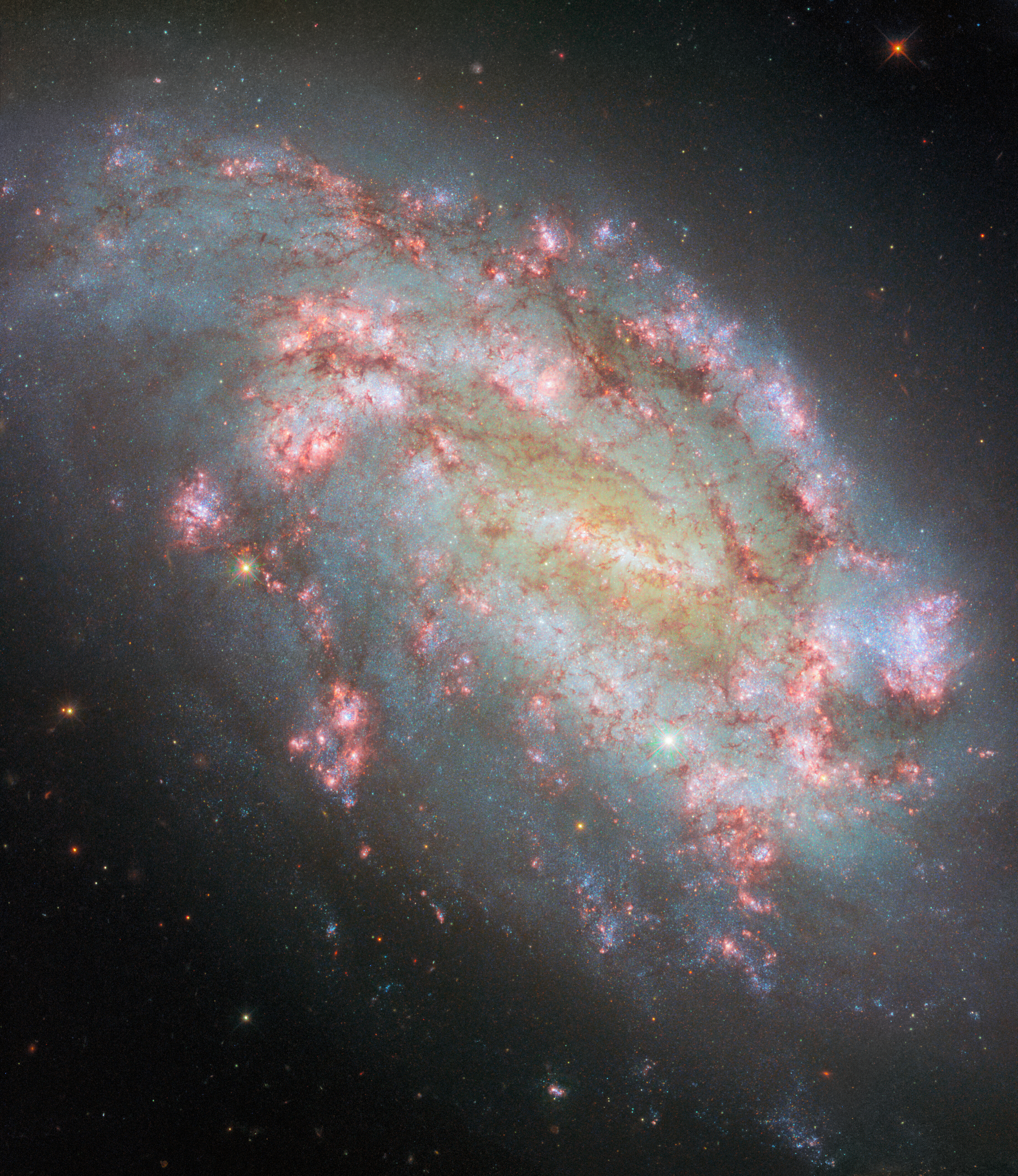
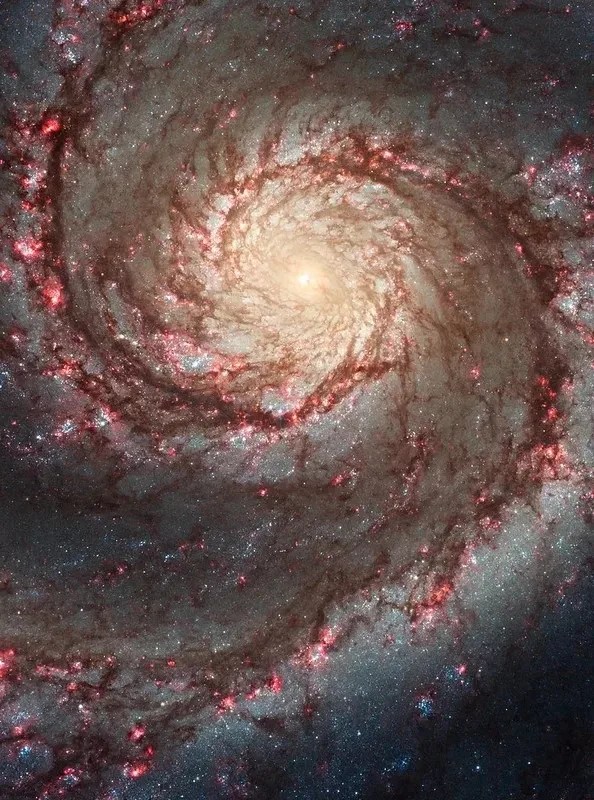
A spiral galaxy, tilted at an angle, with irregularly-shaped arms. It appears large and close-up. The center glows in a yellowish color, while the disk around it is a bluer color, due to light from older and newer stars. Dark reddish threads of dust cover the galaxy, and there are many large, shining pink spots in the disc, where stars are forming.
This image from the NASA/ESA Hubble Space Telescope features the galaxy NGC 1559.
ESA/Hubble & NASA, F. Belfiore, W. Yuan, J. Lee and the PHANGS-HST Team, A. Riess, K. Takáts, D. de Martin & M. Zamani (ESA/Hubble)

The magnificent galaxy featured in this NASA/ESA Hubble Space Telescope image is NGC 1559. It is a barred spiral galaxy located in the constellation Reticulum, approximately 35 million light-years from Earth. The brilliant light captured in the current image offers a wealth of information.

This picture is composed of a whopping ten different Hubble images, each filtered to collect light from a specific wavelength or range of wavelengths. It spans Hubble’s sensitivity to light, from ultraviolet through visible light and into the near-infrared spectrum. Capturing such a wide range of wavelengths allows astronomers to study information about many different astrophysical processes in the galaxy: one notable example is the red 656-nanometer filter used here. Ionized hydrogen atoms emit light at this particular wavelength, called H-alpha emission. New stars forming in a molecular cloud, made mostly of hydrogen gas, emit copious amounts of ultraviolet light that the cloud absorbs, ionizing the hydrogen gas causing it to glow with H-alpha light. Using Hubble’s filters to detect only H-alpha light provides a reliable way to detect areas of star formation (called H II regions). These regions are visible in this image as bright red and pink patches filling NGC 1559’s spiral arms.

These ten images come from six different Hubble observing programs, spanning from 2009 all the way up to 2024. Teams of astronomers from around the world proposed these programs with a variety of scientific goals, ranging from studying ionized gas and star formation, to following up on a supernova, to tracking variable stars as a contribution to calculating the Hubble constant. The data from all of these observations lives in the Hubble archive, available for anyone to use. This archive is regularly used to generate new science, but also to create spectacular images like this one! This new image of NGC 1559 is a reminder of the incredible opportunities that Hubble provided and continues to provide.

Along with Hubble’s observations, astronomers are using the NASA/ESA/CSA James Webb Space Telescope to continue researching this galaxy. This Webb image from February showcases the galaxy in near- and mid-infrared light.

Media Contact:

Claire Andreoli
NASA’s Goddard Space Flight CenterGreenbelt, MD
claire.andreoli@nasa.gov
Powered by WPeMatico

Get The Details…

NASA, NAACP Partner to Advance Diversity, Inclusion in STEM Fields

NASA, NAACP Partner to Advance Diversity, Inclusion in STEM Fields

3 min read

Preparations for Next Moonwalk Simulations Underway (and Underwater)

NAACP Board Chair Leon Russell, left, and NASA Administrator Bill Nelson, right, sign a Space Act Agreement between NASA and the NAACP during a 5th Annual Hidden Figures Street Naming Anniversary event Thursday, Sept. 19, 2024, at the Mary W. Jackson NASA Headquarters building in Washington.
NASA/Keegan Barber

During an event Thursday, NASA and the National Association for the Advancement of Colored People (NAACP) signed a Space Act Agreement to increase engagement and equity for underrepresented students pursuing science, technology, engineering, and mathematics (STEM) fields and to improve access to agency activities and opportunities.

“NASA and the NAACP share a longstanding commitment to attracting more diverse students to STEM education and ultimately careers,” said Shahra Lambert, senior advisor for engagement and equity, NASA headquarters. “This agreement reaffirms that commitment and solidifies a partnership that will enable us to expand opportunities for more students of color to build their STEM identity and gain real-world experience through NASA STEM education, mentorship, and career awareness. With the NAACP’s help we’ll be able to truly impact young minds who will be our future scientists, engineers, explorers and more.”

As part of the agreement, the NAACP will incorporate NASA STEM lessons, content, and themes into its Afro-Academic, Cultural, Technological and Scientific Olympics (ACT-SO) achievement program, which is a series of competitions where students compete for scholarships and other incentives in areas ranging from performing and culinary arts to business and STEM. In turn, NASA will provide guidance on programming, participate in information sharing, provide mentorship, and facilitate tours of NASA facilities when appropriate.

“Much like NASA, brave, brilliant, Black women were critical to the success of the NAACP,” said Leon W. Russell, Chairman of the NAACP Board of Directors. “For years, we’ve worked to increase the number of diverse STEM students by providing scholarships and establishing key initiatives. Through our ACT-SO program and this new partnership with NASA, both organizations will make even greater progress to help pave the way for more Katherine Johnsons and Mary Jacksons. By enacting today’s agreement, we hope to increase the number of Black and underrepresented students in the STEM fields and help them reach for the stars.”

While initial efforts will be led by NASA’s Office of STEM Engagement, the umbrella agreement also allows for further collaboration and partnership in the future. Specifically, the agency and the NAACP will look to support certain areas of NASA’s Equity Action Plan.

NASA works to explore the secrets of the universe and solve the world’s most complex problems, which requires creating space for all people to participate in and learn from its work in space. Providing access to opportunities where young minds can be curious and see themselves potentially at NASA and beyond is how the agency will continue to inspire the next generation of STEM innovators. 

For more information on how NASA inspires students to pursue STEM visit:

https://www.nasa.gov/learning-resources

Share

Details

Last Updated

Sep 19, 2024

Related Terms

Powered by WPeMatico

Get The Details…
Gerelle Q. Dodson

NASA Sets Coverage for Astronaut Tracy C. Dyson, Crewmates Return

NASA Sets Coverage for Astronaut Tracy C. Dyson, Crewmates Return

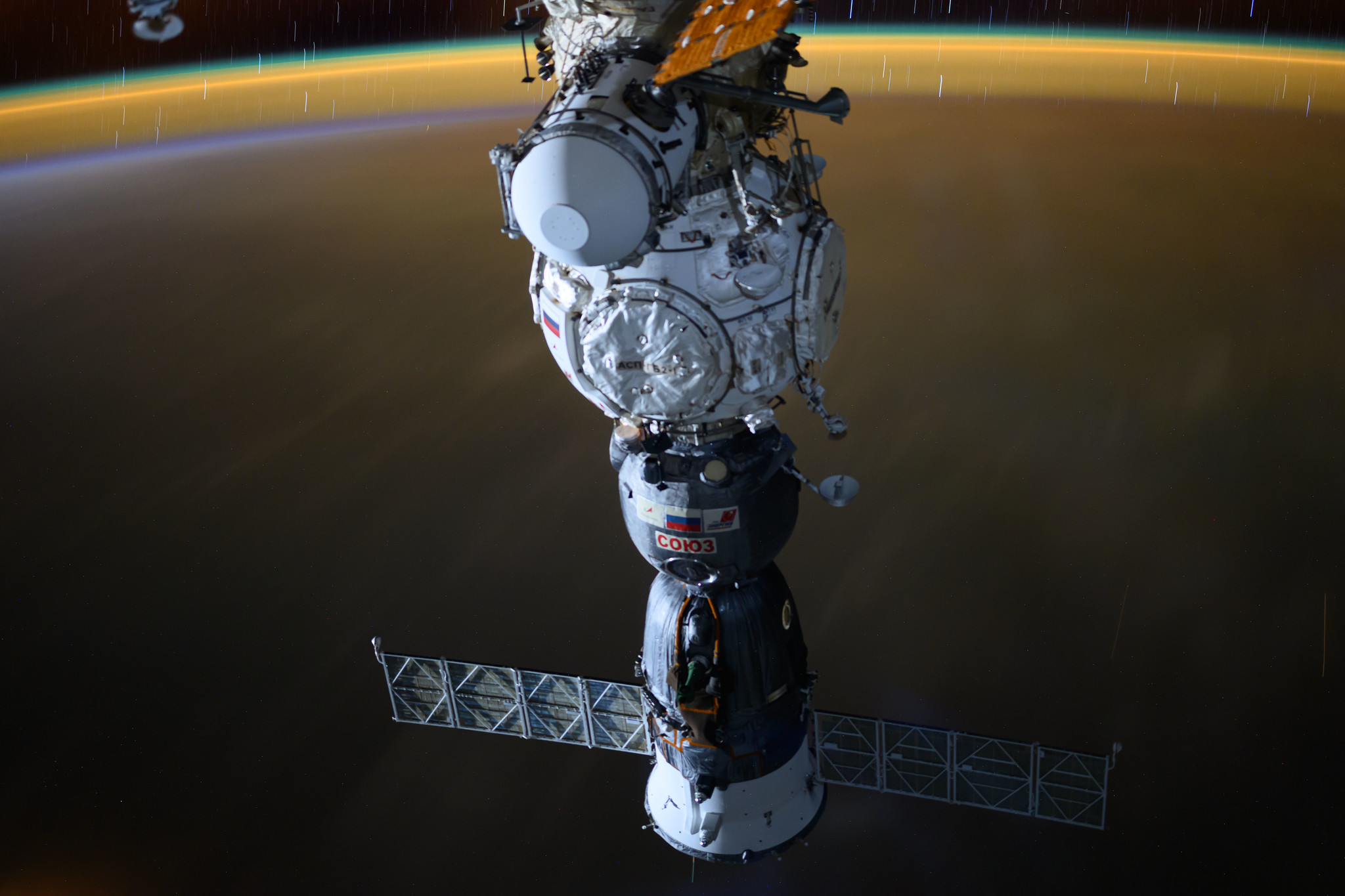
A long-duration photograph of a Roscosmos Soyuz spacecraft docked to the International Space Station’s Prichal module as the station orbits 258 miles above Nigeria.
The Roscosmos Soyuz MS-25 spacecraft is pictured docked to the International Space Station’s Prichal module in this long-duration photograph as it orbited 258 miles above Nigeria.
Credit: NASA

NASA astronaut Tracy C. Dyson, accompanied by Roscosmos cosmonauts Nikolai Chub and Oleg Kononenko, will depart from the International Space Station aboard the Soyuz MS-25 spacecraft, and return to Earth.

Dyson, Chub, and Kononenko will undock from the orbiting laboratory’s Prichal module at 4:37 a.m. EDT Monday, Sept. 23, heading for a parachute-assisted landing at 8 a.m. (5 p.m. Kazakhstan time) on the steppe of Kazakhstan, southeast of the town of Dzhezkazgan.

NASA’s live coverage of return and related activities will stream on NASA+ and the agency’s website. Learn how to stream NASA content through a variety of platforms, including social media.

A change of command ceremony also will stream on NASA platforms at 10:15 a.m. Sunday, Sept. 22. Kononenko will hand over station command to NASA astronaut Suni Williams for Expedition 72, which begins at the time of undocking.

Spanning 184 days in space, Dyson’s mission includes covering 2,944 orbits of the Earth and a journey of 78 million miles. The Soyuz MS-25 spacecraft launched March 23, and arrived at the station March 25, with Dyson, Roscosmos cosmonaut Oleg Novitskiy, and spaceflight participant Marina Vasilevskaya of Belarus. Novitskiy and Vasilevskaya were aboard the station for 12 days before returning home with NASA astronaut Loral O’Hara on April 6.

Kononenko and Chub, who launched with O’Hara to the station on the Soyuz MS-24 spacecraft last September, will return after 374 days in space and a trip of 158.6 million miles, spanning 5,984 orbits.

Dyson spent her fourth spaceflight aboard the station as an Expedition 70 and 71 flight engineer, and departs with Kononenko, completing his fifth flight into space and accruing an all-time record 1,111 days in orbit, and Chub, who completed his first spaceflight.

After returning to Earth, the three crew members will fly on a helicopter from the landing site to the recovery staging city of Karaganda, Kazakhstan. Dyson will board a NASA plane and return to Houston, while Kononenko and Chub will depart for a training base in Star City, Russia.

NASA’s coverage is as follows (all times Eastern and subject to change based on real-time operations):

Sunday, Sept. 22

10:15 a.m. – Expedition 71/72 change of command ceremony begins on NASA+ and the agency’s website.

Monday, Sept. 23

12:45 a.m. – Hatch closing coverage begins on NASA+ and the agency’s website.

1:05 a.m. – Hatch closing

4 a.m. – Undocking coverage begins on NASA+ and the agency’s website.

4:37 a.m. – Undocking

6:45 a.m. – Coverage begins for deorbit burn, entry, and landing on NASA+ and the agency’s website.

7:05 a.m. – Deorbit burn

8 a.m. – Landing

For more than two decades, people have lived and worked continuously aboard the International Space Station, advancing scientific knowledge, and making research breakthroughs that are not possible on Earth. The station is a critical testbed for NASA to understand and overcome the challenges of long-duration spaceflight and to expand commercial opportunities in low Earth orbit. As commercial companies focus on providing human space transportation services and destinations as part of a robust low Earth orbit economy, NASA is focusing more resources on deep space missions to the Moon as part of Artemis in preparation for future human missions to Mars.

Learn more about International Space Station research and operations at:

https://www.nasa.gov/station

-end-

Josh Finch / Claire O’Shea
Headquarters, Washington
202-358-1100
joshua.a.finch@nasa.gov / claire.a.o’shea@nasa.gov

Sandra Jones
Johnson Space Center, Houston
281-483-5111
sandra.p.jones@nasa.gov

Powered by WPeMatico

Get The Details…
Tiernan P. Doyle

Image shows NASA's SpaceX Crew-9 astronaut Nick Hague and Roscosmos cosmonaut Aleksandr Gorbunov
NASA astronaut Nick Hague (left) and Roscosmos cosmonaut Aleksandr Gorbunov are scheduled to launch to the International Space Station as part of NASA’s SpaceX Crew-9 mission no earlier than 2:05 p.m. EDT Thursday, Sept.. 26 Credit: SpaceX

Coverage is set for NASA astronaut Nick Hague and Roscosmos cosmonaut Aleksandr Gorbunov, who are scheduled to launch no earlier than 2:05 p.m. EDT Thursday, Sept. 26, aboard NASA’s SpaceX Crew-9 mission to the International Space Station.

Hague and Gorbunov are scheduled to arrive at approximately 1:30 p.m. EDT Saturday, Sept. 21, touching down at the Launch and Landing Facility at NASA’s Kennedy Space Center in Florida.

After landing, the crewmates will join NASA Kennedy leadership to make brief remarks and answer questions from the media. Additional participants include:

  • Kelvin Manning, deputy director, NASA Kennedy
  • Dana Hutcherson, deputy program manager, Commercial Crew Program, NASA Kennedy

Live coverage of the crew’s arrival will stream on NASA+ and the agency’s website. Learn how to stream NASA content through a variety of platforms, including social media.

The Crew-9 mission to the space station will be the first human spaceflight mission to launch from Space Launch Complex-40 at Cape Canaveral Space Force Station. This is the ninth crew rotation mission with SpaceX to the orbiting laboratory under NASA’s Commercial Crew Program. The crew will spend approximately five months at the station, conducting more than 200 science and research demonstrations before returning in February 2025.

More details about the launch will be posted on the mission blog, @commercial_crew on X, and commercial crew on Facebook.

Powered by WPeMatico

Get The Details…

Elyna Niles-Carnes

Station Crew Demonstrates AI Assistant and Ultra-High Res Camera

Station Crew Demonstrates AI Assistant and Ultra-High Res Camera

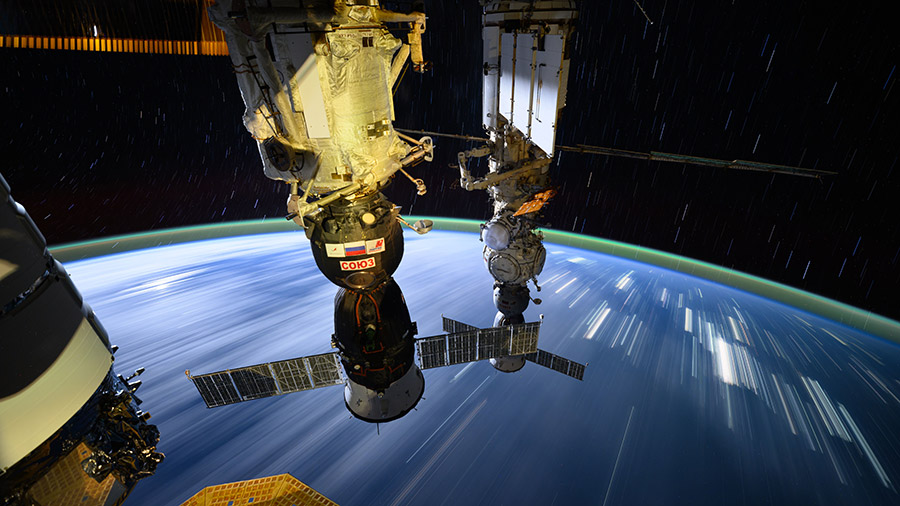
Star trails, streaks of city lights, and two Soyuz crew ships are pictured as the space station orbited above central China.

The Expedition 71 crew demonstrated advanced technologies including artificial intelligence and ultra-high-resolution photography aboard the International Space Station on Thursday. The orbital residents also performed vein scans, packed a spacecraft for departure, and maintained life support systems.

Artificial intelligence is being explored for its potential to help crews perform a variety of space tasks as missions and the technology supporting them become more complex. NASA Flight Engineers Mike Barratt and Jeanette Epps tested the free-flying CIMON AI assistant Thursday morning monitoring its scientific capabilities while using voice prompts. CIMON is being investigated for its potential to relieve a crew’s workload providing more time for relaxation on long-term space missions.

Also on Thursday’s research schedule was an advanced digital motion picture camera designed for usage in the harsh environment of microgravity. NASA Flight Engineers Tracy C. Dyson and Butch Wilmore set up the Sphere Camera-2 and filmed crew activities in the Tranquility module. Footage is collected in 12K, or ultra-high resolution, that can provide highly detailed spacecraft inspection imagery or lunar and planetary surface imagery for analysis during missions.

Dyson also joined NASA astronauts Don Pettit and Suni Williams and replaced filters on the station’s bathroom, also known as the waste and hygiene compartment located in Tranquility. Afterward, Pettit filmed commercial activities taking place inside the Kibo laboratory module for Japanese audiences. Pettit also joined NASA Flight Engineer Matthew Dominick for neck, shoulder, and leg vein scans using the Ultrasound 2 device with remote guidance from doctors on the ground.

Dominick began his shift training for the upcoming departure of the SpaceX Dragon Endeavour spacecraft that he Barrat, Epps, and Roscosmos cosmonaut Alexander Grebenkin will ride back to Earth in early October. Then he joined Wilmore and Williams for a conference with flight directors in Mission Control Center in Houston. Wilmore also swapped fuel bottles inside the Combustion Integrated Rack then joined Williams to organize cargo inside the Columbus laboratory module.

Grebenkin tried on the Roscosmos-designed lower body negative pressure suit today with assistance from cosmonaut Ivan Vagner. That suit may alleviate space-caused head and eye pressure symptoms and help crews adjust quicker to the return to Earth’s gravity. Vagner then spent the rest of the day familiarizing himself with orbital lab systems and life support maintenance.

Dyson is nearing the end of her stay in space as she and Commander Kononenko and Flight Engineer Nikolai Chub prepare for their return to Earth on Sept. 23. Kononenko packed a variety of scientific hardware and station cargo inside the Soyuz MS-25 crew ship today that he will ride home in with his two crewmates. Chub began handing over his responsibilities to fellow Roscosmos cosmonaut Alexey Ovchinin.


Learn more about station activities by following the space station blog@space_station and @ISS_Research on X, as well as the ISS Facebook and ISS Instagram accounts.

Get weekly video highlights at: https://roundupreads.jsc.nasa.gov/videoupdate/

Get the latest from NASA delivered every week. Subscribe here: www.nasa.gov/subscribe

Powered by WPeMatico

Get The Details…

Mark Garcia