Soyuz Hatch Closed, Trio Prepares to Undock From Station

Soyuz Hatch Closed, Trio Prepares to Undock From Station

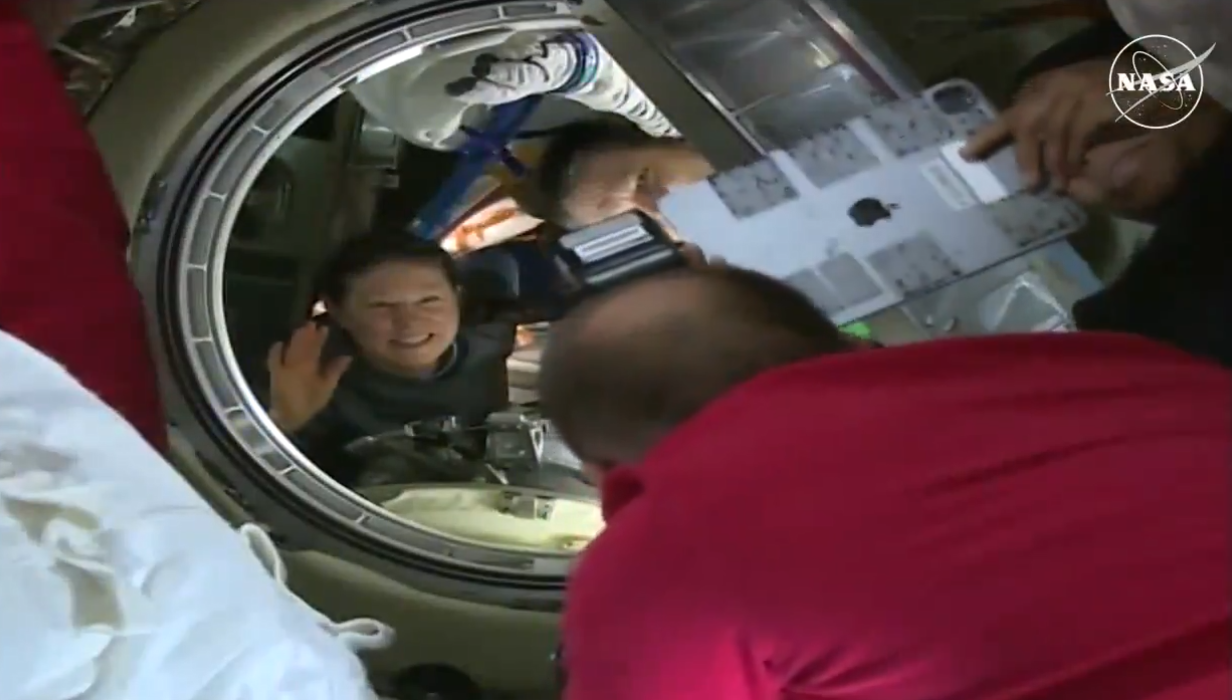
NASA astronaut Tracy C. Dyson is pictured inside the Soyuz MS-25 spacecraft ahead of hatch closure on Sept. 23. Credit: NASA

At 1:02 a.m. EDT, the hatch closed between the Soyuz MS-25 spacecraft and the International Space Station in preparation for undocking and return to Earth.

NASA will provide live undocking coverage at 4 a.m. on NASA+ and the agency’s website. Learn how to stream NASA content through a variety of platforms, including social media.

NASA astronaut Tracy C. Dyson, accompanied by Roscosmos cosmonauts Nikolai Chub and Oleg Kononenko, will undock from the orbiting laboratory’s Prichal module at 4:37 a.m., heading for a parachute-assisted landing at 8 a.m. (5 p.m. Kazakhstan time) on the steppe of Kazakhstan, southeast of the town of Dzhezkazgan.


Learn more about station activities by following the space station blog, @space_station and @ISS_Research on X, as well as the ISS Facebook and ISS Instagram accounts.

Get weekly updates from NASA Johnson Space Center at: https://roundupreads.jsc.nasa.gov/

Get the latest from NASA delivered every week. Subscribe here: www.nasa.gov/subscribe

Powered by WPeMatico

Get The Details…

Abby Graf

Live NASA Coverage Underway of Soyuz Crew Farewell and Hatch Closure

Live NASA Coverage Underway of Soyuz Crew Farewell and Hatch Closure


An aurora radiates brightly above the Indian Ocean in this photograph from the International Space Station as it soared 270 miles above the Earth's surface and about 1,280 miles southwest of Perth, Australia. In the foreground, is the Soyuz MS-25 crew ship docked to the Prichal docking module which is itself attached to the Nauka science module.
The Soyuz MS-25 crew ship is pictured docked to the Prichal docking module as an aurora radiates brightly above the Indian Ocean.

NASA’s live departure coverage is underway on NASA+ and the agency’s website. Learn how to stream NASA content through a variety of platforms, including social media.

NASA astronaut Tracy C. Dyson and Roscosmos cosmonauts Nikolai Chub and Oleg Kononenko will close the hatch between the Soyuz MS-25 spacecraft and the International Space Station at 1:05 a.m. EDT Monday, Sept. 23.

The spacecraft will undock from the orbiting laboratory’s Prichal module at 4:37 a.m. to begin the journey back to Earth, heading for a parachute-assisted landing at 8 a.m. (5 p.m. Kazakhstan time) on the steppe of Kazakhstan, southeast of the town of Dzhezkazgan.

NASA will provide live undocking coverage at 4 a.m. on NASA+ and the agency’s website.

Spanning 184 days in space, Dyson’s mission includes covering 2,944 orbits of the Earth and a journey of 78 million miles. The Soyuz MS-25 spacecraft launched March 23, and arrived at the station March 25, with Dyson, Roscosmos cosmonaut Oleg Novitskiy, and spaceflight participant Marina Vasilevskaya of Belarus. Novitskiy and Vasilevskaya were aboard the station for 12 days before returning home with NASA astronaut Loral O’Hara on April 6.

Kononenko and Chub, who launched with O’Hara to the station on the Soyuz MS-24 spacecraft last September, will return after 374 days in space and a trip of 158.6 million miles, spanning 5,984 orbits.

Dyson spent her fourth spaceflight aboard the station as an Expedition 70 and 71 flight engineer, and departs with Kononenko, completing his fifth flight into space and accruing an all-time record 1,111 days in orbit, and Chub, who completed his first spaceflight.


Learn more about station activities by following the space station blog, @space_station and @ISS_Research on X, as well as the ISS Facebook and ISS Instagram accounts.

Get weekly updates from NASA Johnson Space Center at: https://roundupreads.jsc.nasa.gov/

Get the latest from NASA delivered every week. Subscribe here: www.nasa.gov/subscribe

Powered by WPeMatico

Get The Details…

Abby Graf

Crew Wraps Week with Landing Preps and Advanced Tech Studies

Crew Wraps Week with Landing Preps and Advanced Tech Studies

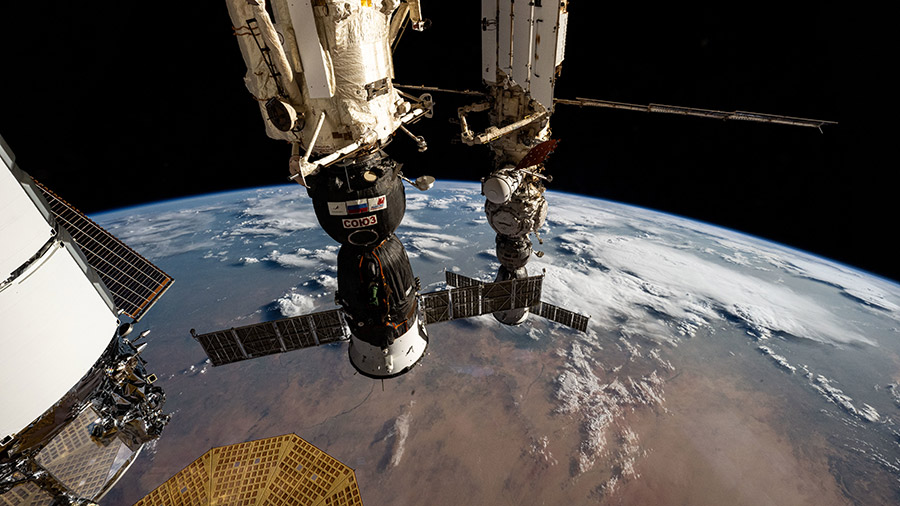
The Soyuz MS-26 (foreground) and MS-25 (background) crew ships are pictured docked to the International Space Station as it orbited above Africa.

Three Expedition 71 crewmates are in their final weekend aboard the International Space Station getting ready for a return to Earth. Meanwhile, the rest of the orbital residents were busy on Friday exploring how the human body adapts to weightlessness, manufacturing tools on demand, and running an educational robotics competition.

NASA astronaut Tracy C. Dyson is completing a six-month mission, while Roscosmos cosmonauts Oleg Kononenko and Nikolai Chub are wrapping up just over a year in low-Earth orbit.  The Earth-bound trio is scheduled to depart the orbital lab inside the Soyuz MS-25 spacecraft at 4:47 a.m. EDT on Monday. At that time, Expedition 71 will end and Expedition 72 will officially be under way. The crew inside the Soyuz will parachute to a landing just over three hours later in Kazakhstan. NASA’s live undocking and landing coverage will stream on NASA+ and the agency’s website. Learn how to stream NASA content through a variety of platforms, including social media.

Microgravity research was full speed ahead at the end of the week despite the landing preparations as the rest of the crew conducted space biology and advanced technology investigations. Scientists can remotely monitor the experiments on the station or analyze the samples after they are returned to Earth to advance human health, space industries, manufacturing, household products, and more.

NASA Flight Engineer Mike Barratt spent his day exploring how living in space affects his cognition and vision as part of the CIPHER suite of 14 human research experiments. Barratt first took a test while practicing robotic maneuvers to measure any space-caused changes in his brain structure and function. Afterward, NASA Flight Engineer Jeanette Epps peered into Barratt’s eyes using medical imaging hardware looking for alterations in his eye structure and vision.

Epps also activated the Astrobee robotic free-flyers in the Kibo laboratory module and monitored as the toaster-sized robot assistants performed pre-programmed maneuvers designed by Asian college students. Algorithms were written to solve specific problems such as guiding the Astrobee to find a lost item in this robotics competition sponsored by JAXA (Japan Aerospace Exploration Agency) to inspire the next generation of engineers, scientists, and leaders.

NASA Flight Engineer Matthew Dominick spent his day on exercise research to learn how working out in microgravity affects the bones and muscles. Dominick performed squats, deadlifts, and heel raises on the advanced resistive exercise device as specialized cameras with motion detection systems monitored his workout. Doctors already know astronauts need to increase the intensity of exercise in space to reduce the rate of body mass loss. Now they are learning ways to maximize the effectiveness of a space workout to keep crews healthier on long-term missions.

The station’s newest trio, with NASA astronaut Don Pettit and Roscosmos cosmonauts Alexey Ovchinin and Ivan Vagner, was busy on Friday maintaining orbital lab systems and studying state-of-the-art technologies. Pettit inspected safety hardware documenting the condition, locations, and ID numbers. Ovchinin and Vagner investigated futuristic planetary piloting techniques then tested printing tools on a 3D printer. Fellow cosmonaut Alexander Grebenkin also participated in the futuristic pilot study. Both experiments are preparing crews for longer missions farther away from Earth.

NASA astronauts Butch Wilmore and Suni Williams started the day reviewing updated emergency procedures as they settle into a mission set to end in February 2025. Next, Wilmore assisted Pettit with the safety gear checks while Williams organized cargo inside the Cygnus space freighter.


Learn more about station activities by following the space station blog@space_station and @ISS_Research on X, as well as the ISS Facebook and ISS Instagram accounts.

Get weekly video highlights at: https://roundupreads.jsc.nasa.gov/videoupdate/

Get the latest from NASA delivered every week. Subscribe here: www.nasa.gov/subscribe

Powered by WPeMatico

Get The Details…

Mark Garcia

NASA Awards $1.5 Million at Watts on the Moon Challenge Finale

NASA Awards $1.5 Million at Watts on the Moon Challenge Finale

At the Great Lakes Science Center in Cleveland, Ohio, Team H.E.L.P.S. (High Efficiency Long-Range Power Solution) from The University of California, Santa Barbara pose with their $1 million check and the power transmission and energy storage hardware that won them the grand prize in the four-year competition. The team is comprised of six faculty researchers at UC Santa Barbara, led by team lead Dr. Philip Lubin (far right).
Team H.E.L.P.S. (High Efficiency Long-Range Power Solution) from The University of California, Santa Barbara won the $1 million grand prize in NASA’s Watts on the Moon Challenge. Their team developed a low-mass, high efficiency cable and featured energy storage batteries on both ends of their power transmission and energy storage system.
Credit: NASA/GRC/Sara Lowthian-Hanna

NASA has awarded a total of $1.5 million to two U.S. teams for their novel technology solutions addressing energy distribution, management, and storage as part of the agency’s Watts on the Moon Challenge. The innovations from this challenge aim to support NASA’s Artemis missions, which will establish long-term human presence on the Moon.

This two-phase competition has challenged U.S. innovators to develop breakthrough power transmission and energy storage technologies that could enable long-duration Moon missions to advance the nation’s lunar exploration goals. The final phase of the challenge concluded with a technology showcase and winners’ announcement ceremony Friday at Great Lakes Science Center, home of the visitor center for NASA’s Glenn Research Center in Cleveland.

“Congratulations to the finalist teams for developing impactful power solutions in support of NASA’s goal to sustain human presence on the Moon,” said Kim Krome-Sieja, acting program manager for NASA Centennial Challenges at NASA’s Marshall Space Flight Center in Huntsville, Alabama. “These technologies seek to improve our ability to explore and make discoveries in space and could have implications for improving power systems on Earth.”

The winning teams are:

  • First prize ($1 million): H.E.L.P.S.  (High Efficiency Long-Range Power Solution) of Santa Barbara, California
  • Second prize ($500,000): Orbital Mining Corporation of Golden, Colorado

Four teams were invited to refine their hardware and deliver full system prototypes in the final stage of the competition, and three finalist teams completed their technology solutions for demonstration and assessment at NASA Glenn. The technologies were the first power transmission and energy storage prototypes to be tested by NASA in a vacuum chamber mimicking the freezing temperature and absence of pressure found at the permanently shadowed regions of the Lunar South Pole. The simulation required the teams’ power systems to demonstrate operability over six hours of solar daylight and 18 hours of darkness with the user three kilometers (nearly two miles) away from the power source.

During this competition stage, judges scored the finalists’ solutions based on a Total Effective System Mass (TESM) calculation, which measures the effectiveness of the system relative to its size and weight – or mass – and the total energy provided by the power source. The highest-performing solution was identified based on having the lowest TESM value – imitating the challenges that space missions face when attempting to reduce mass while meeting the mission’s electrical power needs.

Team H.E.L.P.S. (High Efficiency Long-Range Power Solution) from University of California, Santa Barbara, won the grand prize for their hardware solution, which had the lowest mass and highest efficiency of all competitors. The technology also featured a special cable operating at 800 volts and an innovative use of energy storage batteries on both ends of the transmission system. They also employed a variable radiation shield to switch between conserving heat during cold periods and disposing of excess heat during high power modes. The final 48-hour test proved their system design effectively met the power transmission, energy storage, and thermal challenges in the final phase of competition.

Orbital Mining Corporation, a space technology startup, received the second prize for its hardware solution that also successfully completed the 48-hour testwith high performance. They employed a high-voltage converter system coupled with a low-mass cable and a lithium-ion battery.

“The energy solutions developed by the challenge teams are poised to address NASA’s space technology priorities,” said Amy Kaminski, program executive for Prizes, Challenges, and Crowdsourcing in NASA’s Space Technology Mission Directorate at NASA Headquarters in Washington. “These solutions support NASA’s recently ranked civil space shortfalls, including in the top category of surviving and operating through the lunar night.”

During the technology showcase and winners’ announcement ceremony, NASA experts, media, and members of the public gathered to see the finalist teams’ technologies and hear perspectives from the teams’ participation in the challenge. After the winners were announced, event attendees were also welcome to meet NASA astronaut Stephen Bowen.

The Watts on the Moon Challenge is a NASA Centennial Challenge led by NASA Glenn. NASA Marshall Space Flight Center manages Centennial Challenges, which are part of the agency’s Prizes, Challenges, and Crowdsourcing program in the Space Technology Mission Directorate. NASA contracted HeroX to support the administration of this challenge.

For more information on NASA’s Watts on the Moon Challenge, visit:

https://www.nasa.gov/wattson

-end-

Jasmine Hopkins
Headquarters, Washington
321-432-4624
jasmine.s.hopkins@nasa.gov

Lane Figueroa 
Marshall Space Flight Center, Huntsville, Ala. 
256-544-0034
lane.e.figueroa@nasa.gov 

Brian Newbacher
Glenn Research Center, Cleveland
216-469-9726
Brian.t.newbacher@nasa.gov

Powered by WPeMatico

Get The Details…
Roxana Bardan

Honoring Hidden Figures

Honoring Hidden Figures

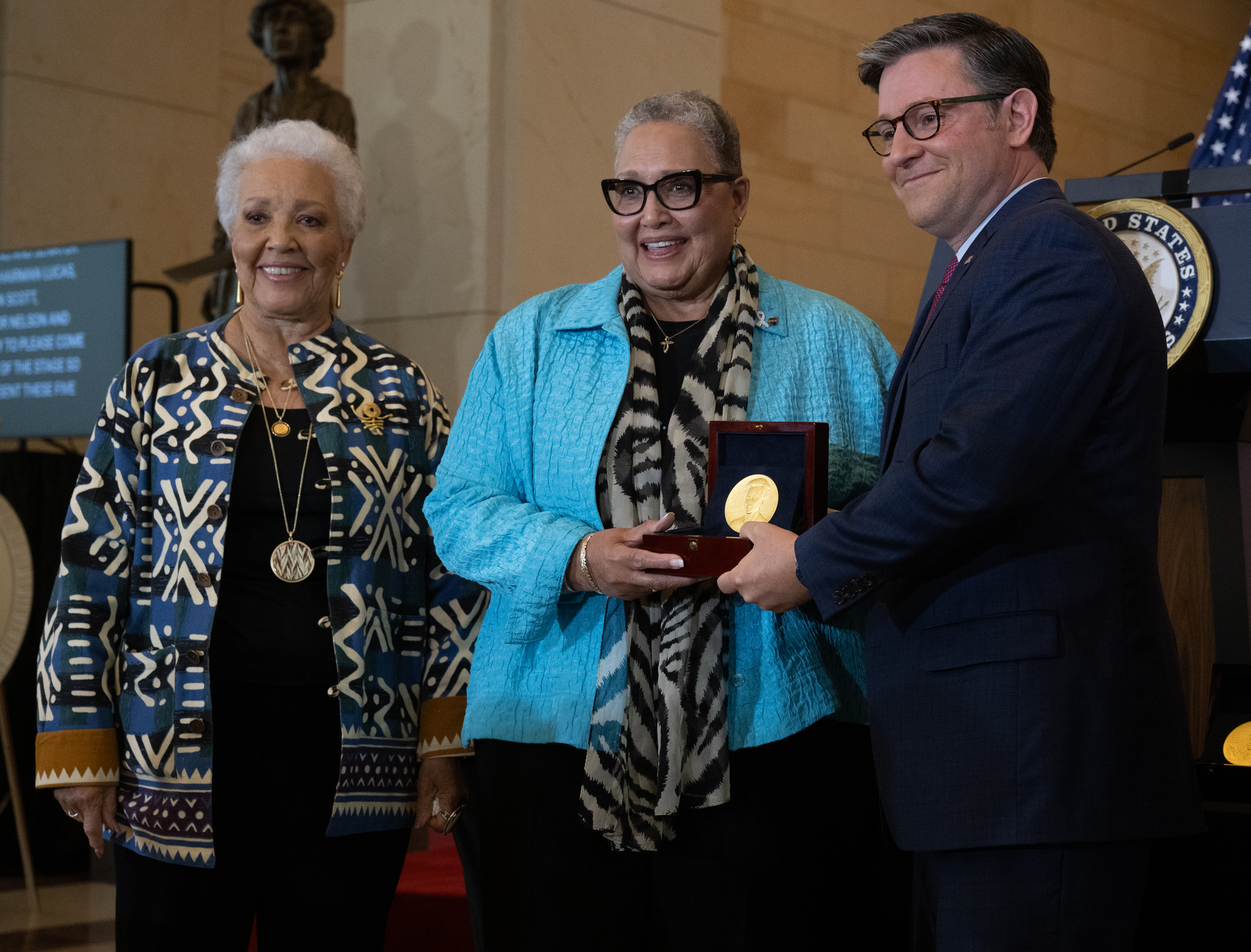
Two Black women and a white man face slightly left as they pose for a photo. The man and the woman in the middle hold a box containing a Congressional Gold Medal.
NASA/Joel Kowsky

Joylette Hylick, left, and Katherine Moore, right, accept the Congressional Gold Medal on behalf of their mother, Katherine Johnson, during a Sept. 18, 2024, ceremony recognizing NASA’s Hidden Figures.

Katherine Johnson, Dr. Christine Darden, Dorothy Vaughan, and Mary W. Jackson were awarded Congressional Gold Medals in recognition of their service to the United States. A Congressional Gold Medal was also awarded in recognition of all the women who served as computers, mathematicians, and engineers at the National Advisory Committee for Aeronautics and NASA between the 1930s and 1970s.

See more photos from the ceremony.

Image credit: NASA/Joel Kowsky

Powered by WPeMatico

Get The Details…
Monika Luabeya