NASA Ames Experts Available for Roman Space Telescope Interviews
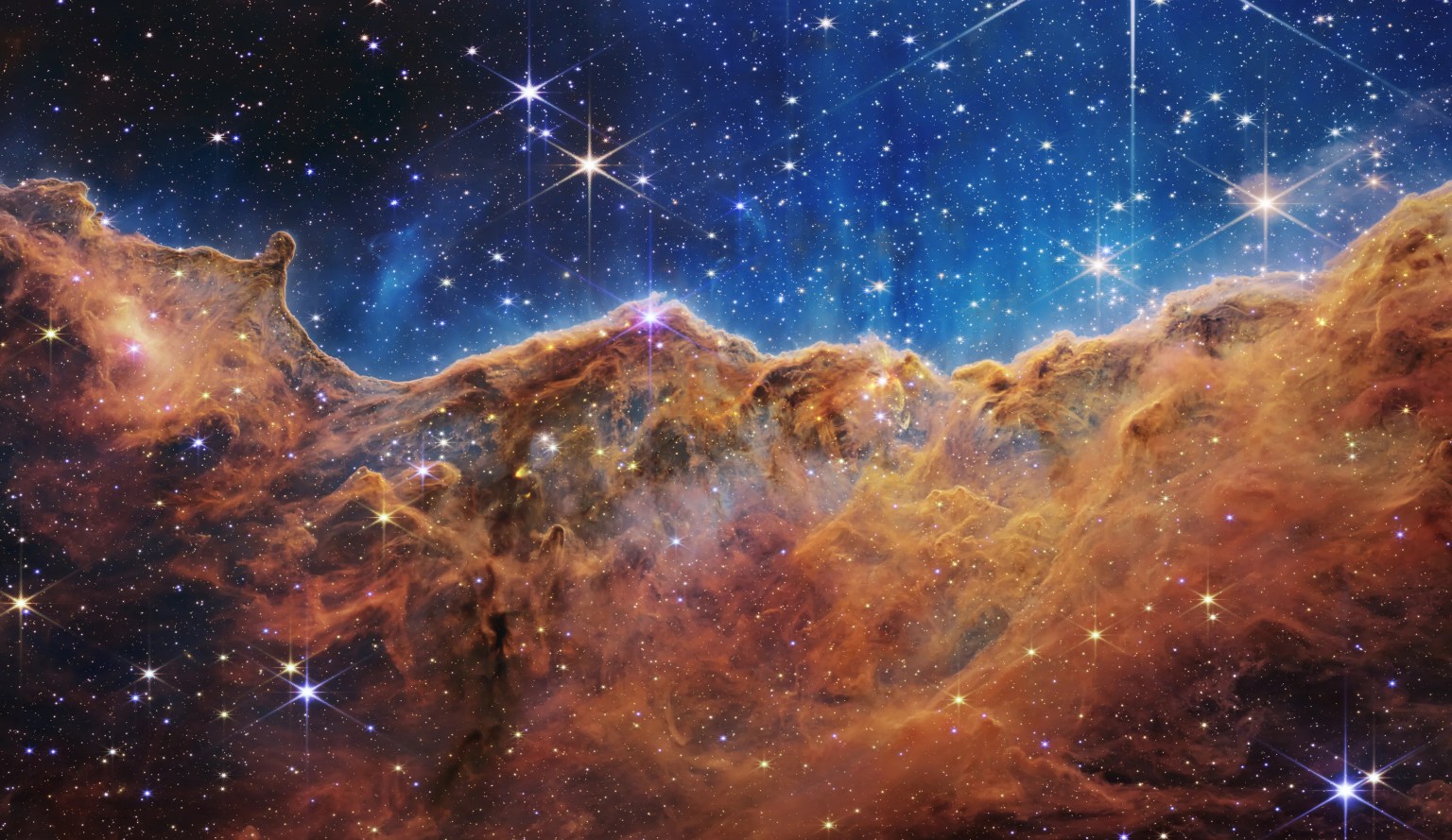
NASA’s Ames Research Center in California’s Silicon Valley invites media to learn more about NASA’s Nancy Grace Roman Space Telescope, scheduled to launch Sunday, Aug. 30, 2026, from NASA’s Kennedy Space Center in Florida. The Roman telescope will provide a wide, detailed view of the universe, helping scientists study dark energy, exoplanets, and cosmic structures. Roman also will test advanced technology designed to directly image planets around nearby stars — a key step in NASA’s search for life beyond Earth.
Ames subject matter experts will be available for virtual interviews to discuss Roman’s goals and the center’s contributions to the mission on Wednesday, Aug. 26, 2026, 10:00 a.m. – 1:00 p.m. PDT.
NASA Ames contributions to Roman
Innovative software developed at NASA Ames, with collaborators at NASA’s Goddard Space Flight Center in Greenbelt, Maryland, and IPAC Caltech in Pasadena, California, is designed to improve Roman’s images and optimize observing plans, enhancing the ability of astronomers to capture expansive high-resolution pictures of the universe in optical and near-infrared light.
Technology called Multi-Star Wavefront Control is designed to suppress excess light and reveal hidden exoplanets by eliminating overlapping glares from multi-star systems.
NASA’s Advanced Supercomputing Division, based at NASA Ames, brings extensive experience in data pipelines and mission operations to advise the Roman project, helping to ensure the reliable performance of Roman’s ground-based systems and operations so that science data processing is efficient and the quality and integrity of the resulting science data products is high.
To request an interview, media can contact the Ames Office of Communications: arc-dl-newsroom@nasa.gov. Media can also request agency interviews about the Roman mission outside of this window by filling out this online form.
NASA Ames Roman subject matter experts
Pamela Marcum, research scientist
Ruslan Belikov, Exoplanet Technologies Group lead
Jon M. Jenkins, TESS (Transiting Exoplanet Survey Satellite) Science Processing Operations Center manager
For more information about NASA’s Roman mission, visit:
Jeanne Neal Ames Research Center, Silicon Valley 650-604-4789 Jeanne.c.neal@nasa.gov
To receive local NASA Ames news, email local-reporters-request@lists.arc.nasa.gov with “subscribe” in the subject line. To unsubscribe, email the same address with “unsubscribe” in the subject line.
NASA’s Pandora Mission Begins Study of Exoplanets, Host Stars
5 min read
NASA’s Pandora Mission Begins Study of Exoplanets, Host Stars
Pandora, NASA’s newest exoplanet mission and the first satellite to launch through the agency’s Astrophysics Pioneers program, is now making unique observations of worlds beyond our solar system and the stars they orbit. The mission will determine the atmospheric make-up of at least 20 exoplanets, including the presence of hazes, clouds, and water.
“Pandora’s data will help close a major gap in our knowledge about planets and their host stars because, right now, we can’t be entirely sure how the star’s light affects measurements of what makes up exoplanet atmospheres,” said Elisa Quintana, Pandora’s principal investigator at NASA’s Goddard Space Flight Center in Greenbelt, Maryland. “We designed the Pandora spacecraft and its in-depth observing program to better understand this vexing issue.”
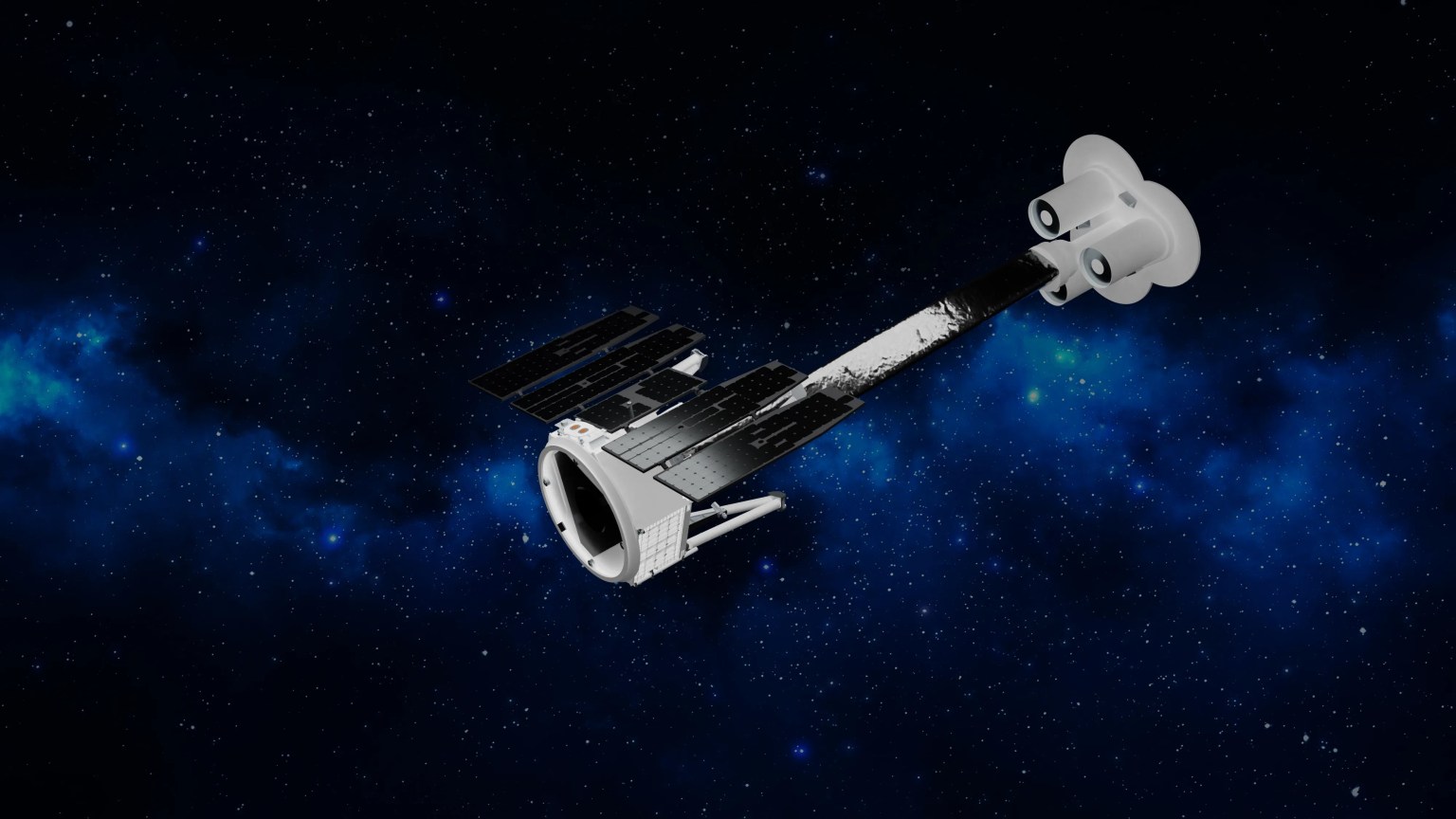
Artist’s concept of NASA’s Pandora mission, which will help scientists untangle the signals from exoplanets’ atmospheres and their stars.
NASA’s Goddard Space Flight Center/Conceptual Image Lab
The results of the mission will lay a firm foundation for interpreting measurements by NASA’s James Webb Space Telescope, as well as future observatories focused on finding habitable worlds. In fact, Pandora’s near-infrared detector is a spare originally developed for Webb.
“The spacecraft is healthy and all of the instruments are performing as well as we could have hoped,” said Jordan Karburn, Pandora’s deputy project manager at Lawrence Livermore National Laboratory in California. “Our team’s hard work throughout the commissioning process has paid off, and we can now confidently start science.”
This artist’s concept summarizes NASA’s Pandora mission and its science goals. Pandora will repeatedly observe multiple planets and their host stars in both visible and near-infrared light. These measurements will enable astronomers to separate chemical fingerprints detected in a planet’s atmosphere from potentially misleading signals originating from its host star.
Launched into low Earth orbit on Jan. 11, Pandora is an ambitious small satellite (SmallSat) funded by NASA’s Astrophysics Pioneers program. Pioneers are designed to explore compelling questions about the universe with fast-paced, low-cost missions that require a higher-than-usual tolerance for failure.
Three factors make Pandora unique. It carries a novel all-aluminum telescope about 18 inches (45 centimeters) in diameter, it will study planets and their host stars simultaneously in both visible and infrared light, and it will observe targets for a much longer time than flagship observatories like Webb are able to.
Telescopes can sample a planet’s atmosphere in systems where the planet passes in front of its star as seen from our perspective. During this event, called a transit, some starlight skims the planet’s atmosphere before making its way to us. As this light interacts with atmospheric molecules, their chemical fingerprints become embedded in it. For each molecule, astronomers see brightness dips at characteristic wavelengths.
But our instruments also see light from the whole star, not just what grazes the planet. Stellar surfaces aren’t uniform. They sport hotter, brighter areas called faculae and cooler, darker regions similar to sunspots. Both can grow, shrink, and change position as the star rotates.
“Water is one of the most important molecules we can measure to understand the composition and physical conditions of an exoplanet atmosphere,” said Benjamin Rackham, a team member at the Massachusetts Institute of Technology in Cambridge. “But features on the star can distort the water signal we’re searching for. Pandora is designed to disentangle the signals from the planet and the star, helping us to understand the planets more accurately and laying the groundwork for the eventual study of planets that could harbor life.”
Watch to learn more about NASA’s Pandora mission, which will revolutionize the study of exoplanet atmospheres. NASA’s Goddard Space Flight Center
Pandora’s telescope, jointly developed by Livermore and Corning Specialty Materials in Keene, New Hampshire, and its detectors make up the mission’s heart. The detectors will capture the star’s brightness in visible light and its near-infrared spectrum at the same time, while also obtaining a near-infrared spectrum from the planet when it transits the star. Over the course of its year-long primary mission, Pandora will observe at least 20 exoplanets 10 times with a long-duration stare covering 24 hours, with a transit included in each observation.
“Pandora’s advantage is its ability to observe targets for extended periods at multiple wavelengths, something high-demand flagship missions like Webb cannot regularly do,” said Knicole Colón, the mission’s project scientist at NASA Goddard. “Combining Pandora and Webb data will uniquely enable scientists to determine the properties of stellar surfaces and cleanly separate star and planetary signals.”
Pandora is led by NASA’s Goddard Space Flight Center. Lawrence Livermore National Laboratory provides the mission’s project management and engineering. Pandora’s telescope was manufactured by Corning and developed collaboratively with Livermore, which also developed the imaging detector assemblies, the mission’s control electronics, and all supporting thermal and mechanical subsystems. The infrared sensor was provided by NASA Goddard. Blue Canyon Technologies provided the bus, performed spacecraft assembly, integration and environmental testing, and is providing mission operations support. NASA’s Ames Research Center in California’s Silicon Valley performs the mission’s data processing. Pandora’s science data is available at the NASA Exoplanet Archive, which is operated by IPAC at the California Institute of Technology in Pasadena. The University of Arizona leads mission operations for Pandora and contributes to its science program. Many additional universities also support the science team.
To learn more about the Pandora mission, please visit:
NASA, ESA Astronauts Begin Spacewalk to Install Antenna
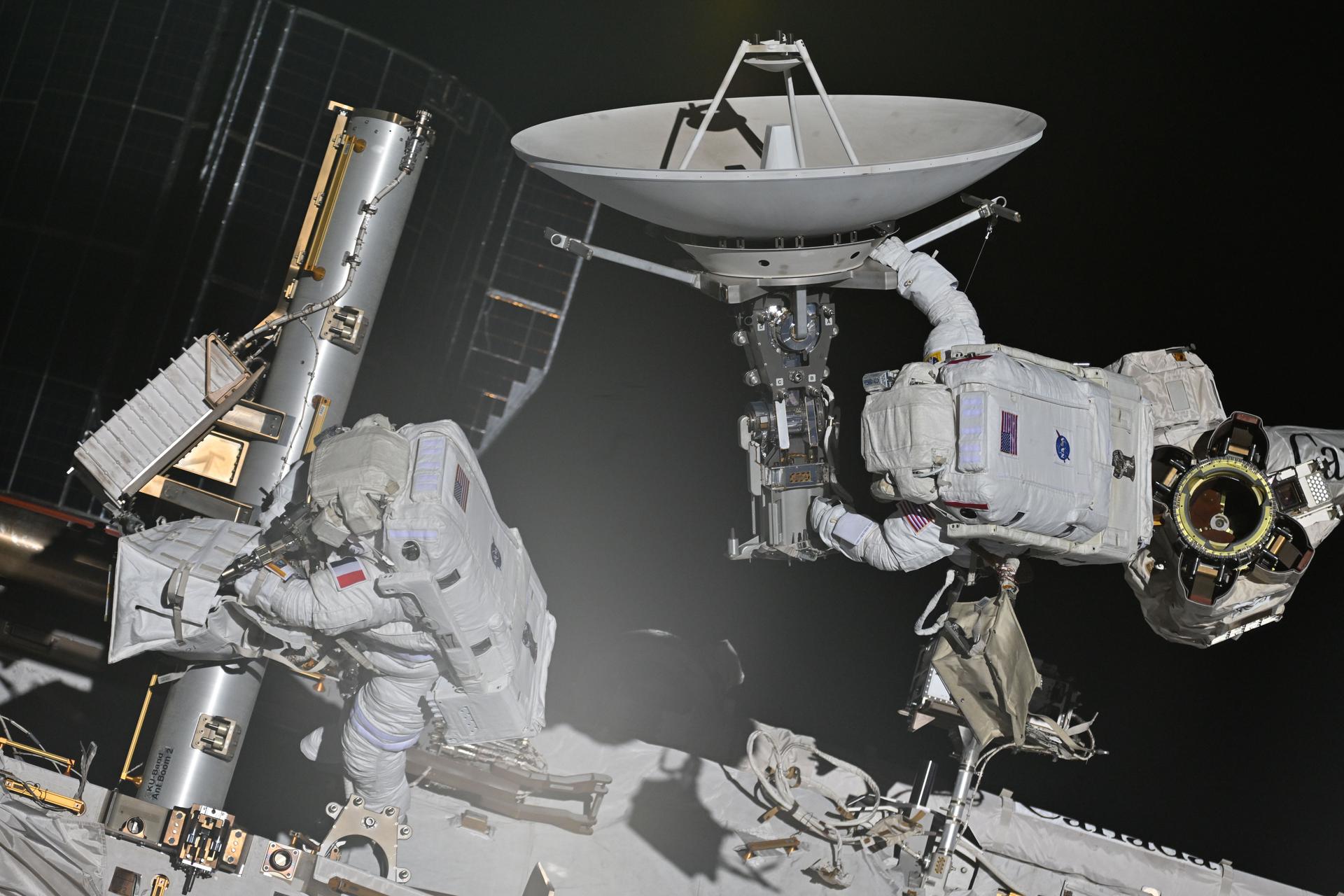
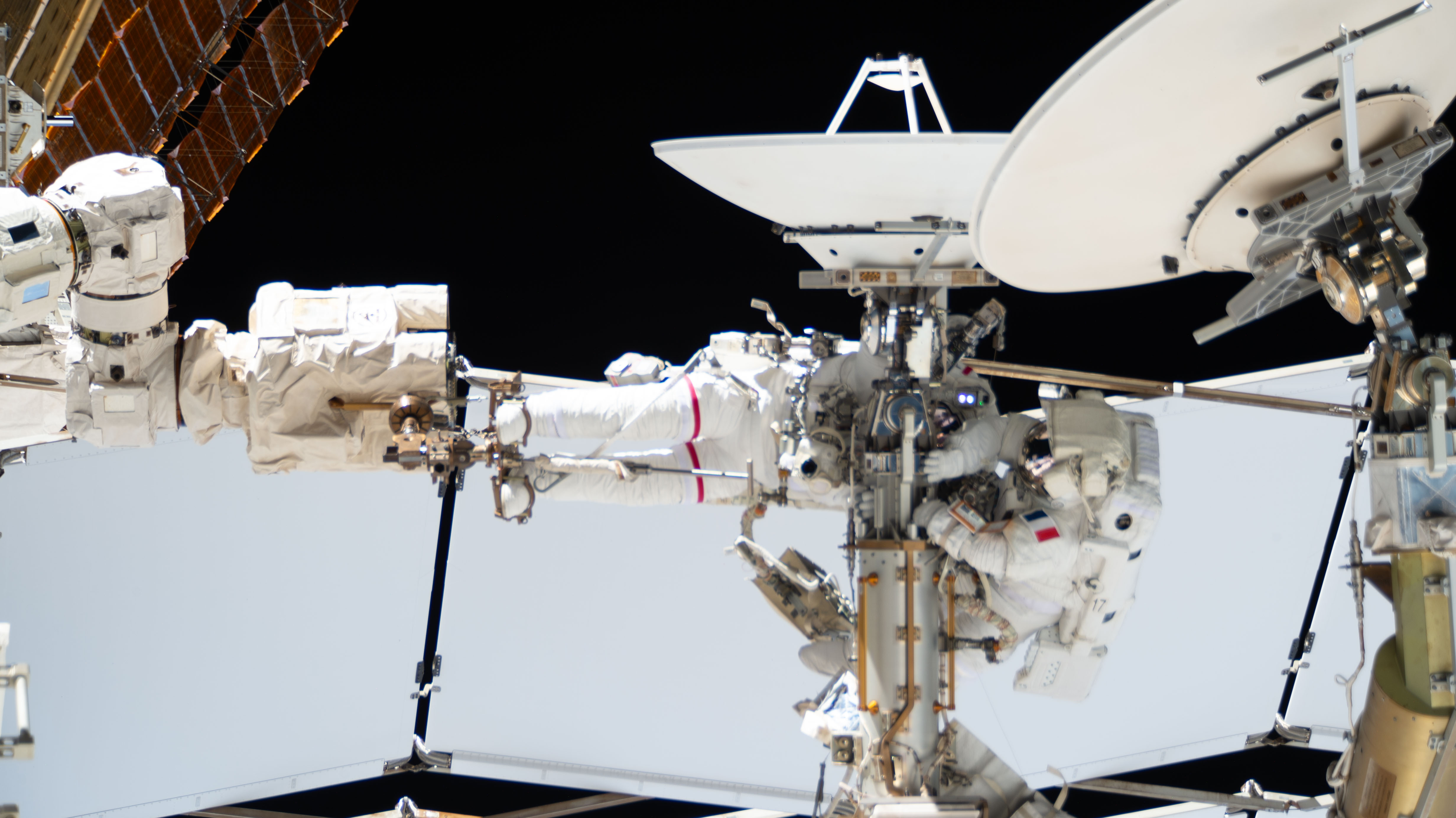
From left, astronauts Sophie Adenot of ESA (European Space Agency) and Anil Menon of NASA work together during a six‑hour, 23‑minute spacewalk outside the International Space Station on Aug. 18. 2026.
Roscosmos/Anna Kikina
NASA astronaut Anil Menon and ESA (European Space Agency) astronaut Sophie Adenot began a spacewalk at 8:27 a.m. EDT outside the International Space Station to replace a Space-to-Ground antenna on the International Space Station.
The spacewalk is streaming through a variety of platforms. Learn where to watch online: https://www.nasa.gov/live
Menon is spacewalk crew member 1, wearing the suit with red stripes. Adenot is crew member 2, wearing the unmarked suit.
Galactic Gems Glisten in New Gallery From NASA’s Chandra
4 Min Read
Galactic Gems Glisten in New Gallery From NASA’s Chandra
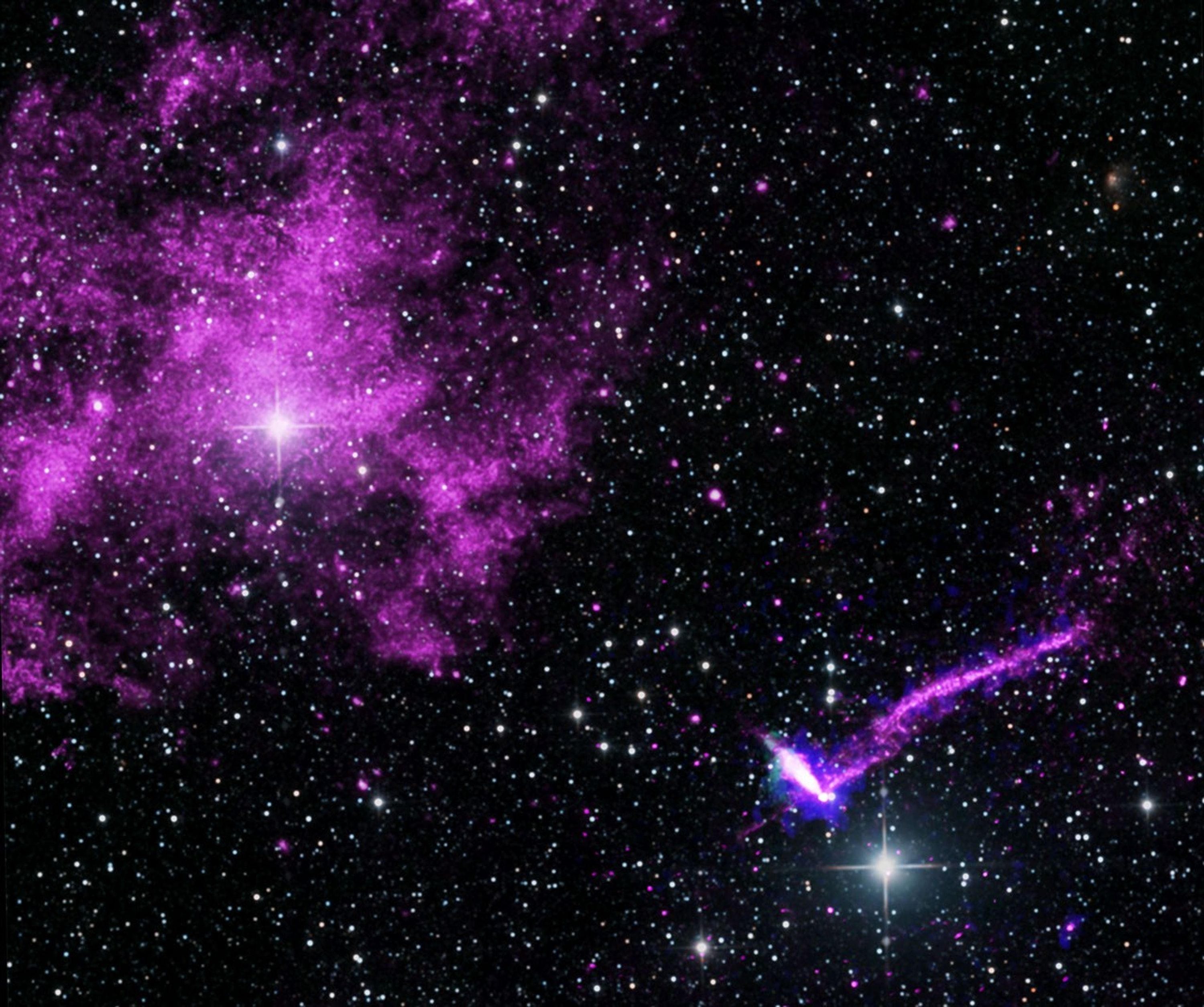
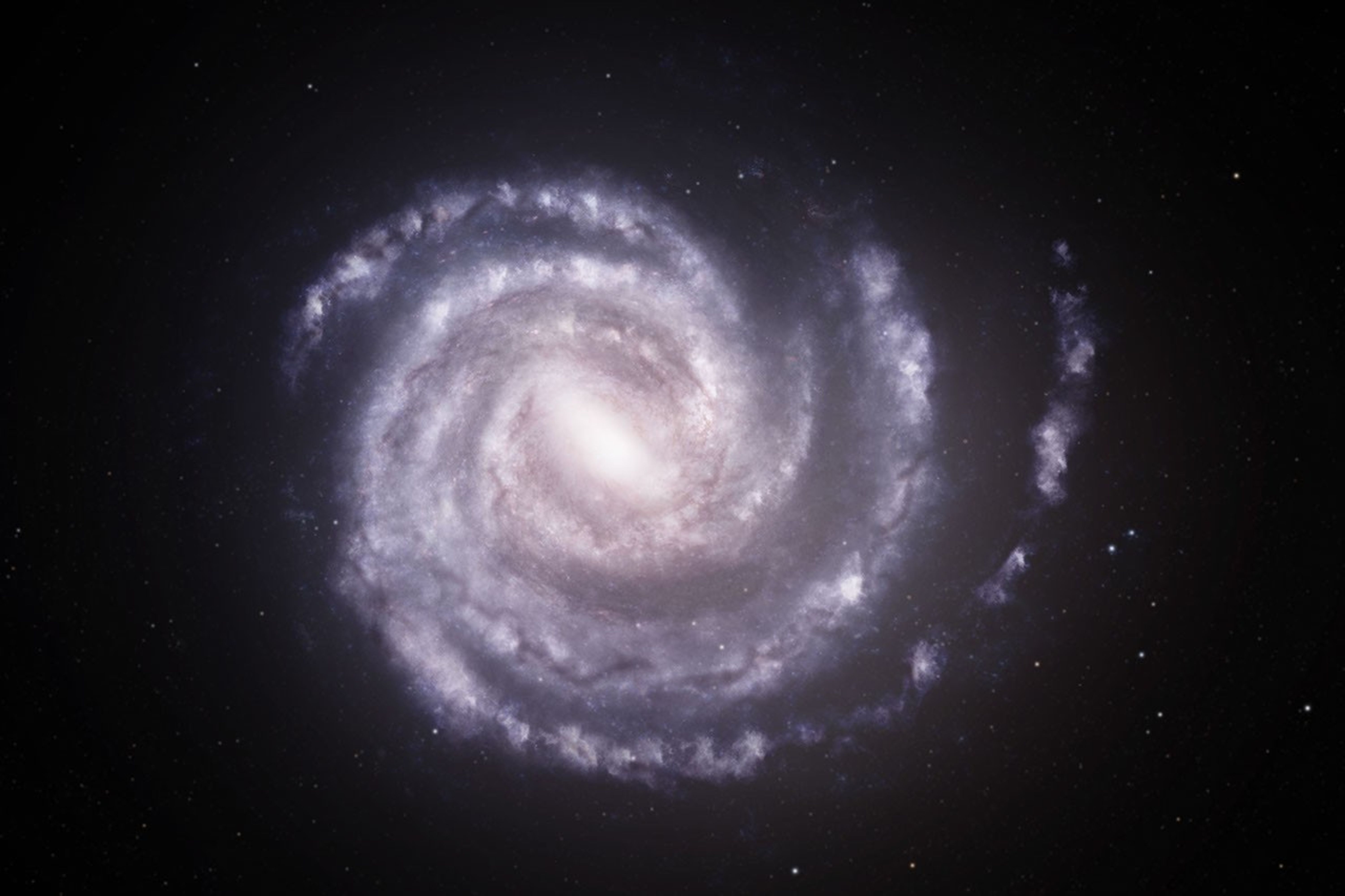
Galaxies are like cosmic gems, each with characteristics including size and shape that make them distinct. A new gallery released today from NASA’s Chandra X-ray Observatory and other telescopes displays a collection of galactic images that showcase this variety.
Astronomers put galaxies into three main categories: spirals like our own Milky Way with arms emanating from their cores, ellipticals that are older and likely the results of mergers, and irregulars that can encompass a wide range of galactic phenomena.
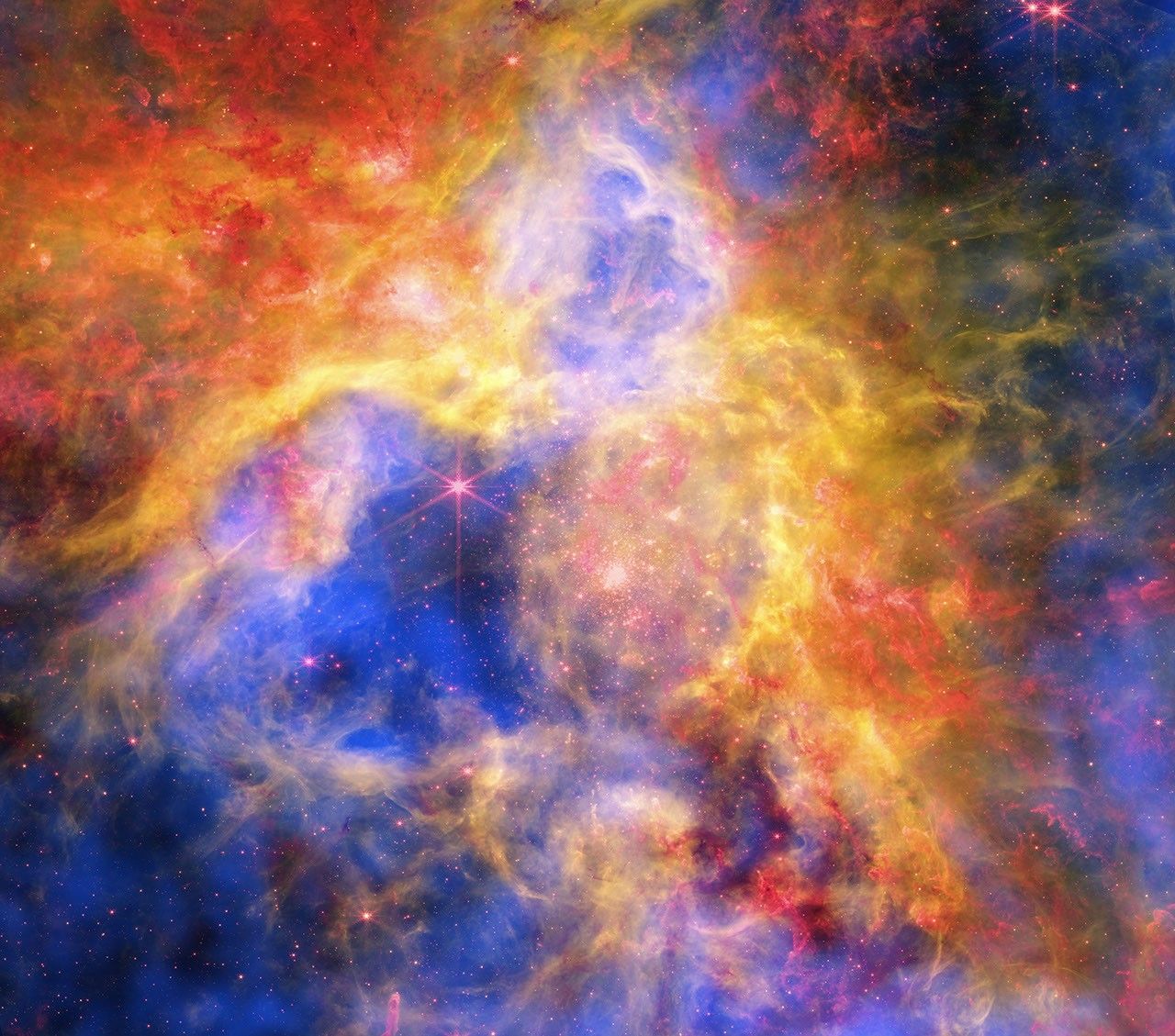
This gallery displays a collection of 16 galactic images from Chandra and other telescopes. Astronomers put galaxies into three main categories: spirals like our own Milky Way, ellipticals that are older and likely the results of mergers, and irregulars that can encompass a wide range of galactic phenomena. All types are represented in this collection. Each galactic image contains X-ray data from Chandra combined with data from telescopes such as NASA’s Webb, Hubble, IXPE, Swift, and NuSTAR, and others both in space and on the ground.
Just as gems reveal the history of Earth through how they were forged over billions of years, these galactic gems are a way to study Earth’s place in our home galaxy of the Milky Way. By looking outward to other galaxies, we learn more about our own – including clues to its past and future.
There are 16 new images in this galactic gallery. Each one contains X-ray data from Chandra that has been collected across Chandra’s decades in space. This high-energy data has been combined with data from telescopes such as NASA’s James Webb and Hubble Space Telescopes, IXPE (Imaging X-ray Polarimetry Explorer), Neil Gehrels Swift Observatory, NuSTAR (Nuclear Spectroscopic Telescope Array), and others both on the ground and in space.
NGC 1672
A barred spiral galaxy featuring a prominent central bar or bridge of stars that channels gas toward its core. Chandra X-rays (purple) highlight growing black holes along the bar and core, merged with Hubble optical light (white, yellow and soft blue) and JWST infrared dust filaments (red). Studying barred spirals in action can help reveal how gas in our own Milky Way, which is also a barred spiral, feeds its central black hole and forms new stars.
X-ray: NASA/CXC/SAO; Optical: NASA/ESA/STScI/Hubble Heritage Team; Infrared: NASA/ESA/CSA/STScI/J. Lee and T. Williams; Image Processing: NASA/CXC/SAO/L. Frattare, J. Major, K. Arcand
II Zw 096
A chaotic, dust-shrouded system of merging galaxies forming stars at a furious rate. Chandra X-ray data (magenta) pinpoint powerful black hole activity and hot gas, while Hubble optical (blue and white) and Webb infrared (red and grey) data illuminate vast stellar nurseries hidden behind interstellar dust. Systems like II Zw 096 show us how powerful galaxy collisions shaped the early universe.
X-ray: NASA/CXC/SAO; Optical: NASA/ESA/STScI; Infrared: NASA/ESA/CSA/STScI; Image Processing: NASA/CXC/SAO/L. Frattare and J. Major
M33
A nearby, face-on spiral galaxy whose clear spiral arms offer an unhindered view of its stellar engine. X-ray data from Chandra (purple) highlights point sources like neutron stars and stellar-mass black holes pulling material off companion stars (systems called X-ray binaries), while optical data from the Very Large Telescope’s MUSE instrument (pink and grey) maps glowing pockets of hydrogen gas. Ultraviolet data from NASA’s Swift telescope (blue) reveals populations of young, massive stars sizzling across the spiral arms. M33’s proximity to us allows astronomers to audit individual high-energy objects and map how stellar feedback affects a galaxy’s ecosystem.
A spiral galaxy famous for having two extra, “anomalous” spiral arms composed of hot gas. Chandra’s X-rays (royal blue) show superheated shockwaves created by central black hole jets, combined with optical light from Hubble (red, yellow and pale blue) and infrared dust filaments from Webb (bright orange). M106 helps show how supermassive black holes can create structural features that mimic star-bearing spiral arms, influencing a galaxy’s evolution.
A compact dwarf irregular galaxy undergoing a violent, compact burst of star formation. Chandra and XMM-Newton observations (blue and purple) reveal massive bubbles of million-degree gas inflated by stellar winds, set against a backdrop of optical light (magenta, orange and white) imaged by Adam Block. Dwarf starburst galaxies can serve as local laboratories for studying the conditions of the early universe, where small, primitive galaxies formed stars at frantic rates.
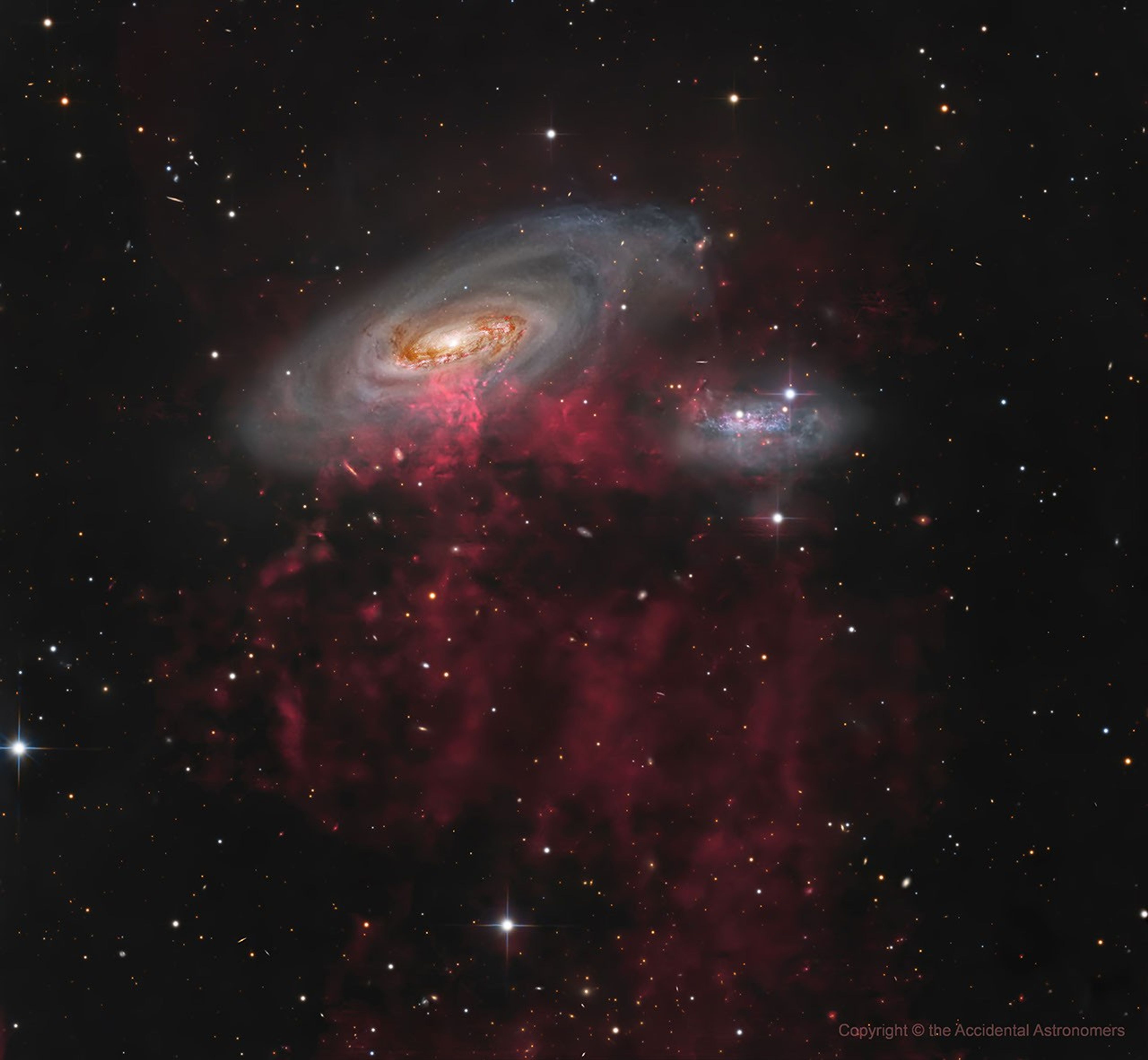
A large spiral galaxy that is being stripped of its gas as it plunges at high speed through hot gas in the Virgo Cluster of galaxies. Chandra’s X-ray data (magenta) pinpoints high-energy point sources—such as X-ray binaries and supernova remnants—and diffuse hot gas nestled within the spiral disk imaged by Hubble (blue, brown and gold). A ground-based optical light image taken from New Mexico by Timothy Martin reveals red filaments of hydrogen gas streaming over 300,000 light-years behind the galaxy as it falls into the Virgo Cluster.
A giant elliptical galaxy undergoing a dusty merger, featuring a powerful jet of particles blasting tens of thousands of light-years into space. Chandra’s X-rays (blue) showcase the high-energy jet, with additional X-rays from IXPE (orange), while Webb infrared (magenta) and optical light (amber and white) from the European Southern Observatory expose a dark, churning dust lane. As one of the closest active galaxies to Earth, Cen A allows astronomers to study the effects of supermassive black hole jets in extraordinary detail.
X-ray: (Chandra) NASA/CXC/SAO, X-ray (IXPE): NASA/MSFC; Optical: ESO; Infrared: NASA/ESA/CSA/STScI; Image Processing: NASA/CXC/SAO/L. Frattare, K. Arcand, and J. Major
M104
Famous for its broad central bulge and dark outer dust ring, this galaxy sits at a nearly edge-on tilt to Earth. Chandra X-rays (cyan and orange) isolate compact point sources and hot gas in the galaxy’s sprawling halo, merged with Hubble optical light (warm white) and Webb infrared vision (purple-red dust lane). Studying M104 may help bridge the gap between spirals and ellipticals, helping astronomers better understand how a galaxy’s giant outer cloud of stars grows and ages alongside its inner disk.
This ring galaxy system formed when a smaller companion galaxy punched straight through its center like a bullseye, creating a powerful cosmic shockwave. Chandra X-rays (purple) uncover bright X-ray binary systems scattered along the collision shock wave, laid over Hubble’s optical image (blue and white) of expanding stellar rings. Such head-on collisions can trigger vast ripple effects, sparking huge waves of star birth across entire galaxies.
A “one-armed” barred spiral galaxy surrounded by a prominent star-forming ring. Chandra’s X-ray data (magenta) pinpoints several bright X-ray sources, likely caused by growing black holes, embedded within the sweeping optical disk (soft blue and white) captured with the Mt. Lemmon Observatory. Galaxies with unusual single arms can offer a window into how the gravity from a passing galaxy can trigger bursts of star formation.
A barred spiral galaxy packed with regions where stars are actively forming. Chandra X-ray data (magenta) highlights stellar nurseries and X-ray binaries scattered along dusty spiral structures brought to life by Hubble optical (white and grey) and Webb infrared (orange and red) observations. Comparing multiwavelength data of barred spirals containing active star formation helps scientists map how local starbursts build up galactic mass over time.
A rare “polar ring” galaxy where a tilted outer ring of stars and dust rotates over the galaxy’s poles, an unusual structure likely caused by a collision with another galaxy about a billion years ago. Chandra’s X-rays (purple) reveal a possible growing supermassive black hole in the center of the galaxy, plus X-ray binaries nestled within the stars and dust captured by the Gemini Observatory in optical light (gold, blue and white). Studying polar rings teaches us about the diverse effects of stellar collisions on the shapes of galaxies.
An irregular galaxy undergoing intense star formation because of a gravitational interaction with a neighboring galaxy hundreds of millions of years ago. Chandra X-rays (blue), supplemented by NuSTAR data, show towering superwinds of million-degree gas blowing thousands of light-years out of the galactic disk, with Hubble optical light (yellow, orange and white) showing the galaxy shape, and Webb and Spitzer detailing infrared dust emission (red). M82 was nicknamed the Cigar Galaxy mostly because of its edge-on angle to Earth, which makes its central disk look like an elongated, cigar-shaped oval with small optical telescopes. The galaxy illustrates how violent galactic “exhaust systems” can regulate a galaxy’s growth by venting gas outwards.
X-ray: NASA/CXC/SAO; Optical: NASA/ESA/STScI; Infrared: NASA/ESA/CSA/STScI; Image Processing: NASA/CXC/SAO/L. Frattare, J. Major, and K. Arcand
NGC 3256
A pair of colliding, gas-rich spiral galaxies merging into a single massive system. Chandra’s X-ray data (pink) isolates point sources and shock-heated gas, Hubble’s optical light (blue and white) captures tidal tails of stars, and Webb’s infrared vision (red and orange) cuts through the dust to show hidden star formation. Galaxy collisions like this offer a preview of our far future, showing what might happen if our own Milky Way collides and merges with the nearby Andromeda Galaxy.
A face-on spiral galaxy whose orientation gives us an unobstructed view of its disk. X-ray emissions from Chandra (magenta) detail energetic X-ray binaries and supernova remnants scattered across dust lanes in an optical image (white, blue and gold) from Adam Block with Mt. Lemmon Observatory. Face-on orientations are important for galactic studies because they provide the most unobstructed views of a galaxy’s stars and gas.
X-ray: NASA/CXC/SAO; Optical: Adam Block/Mount Lemmon SkyCenter/University of Arizona; Image Processing: NASA/CXC/SAO/L. Frattare
NGC 4631
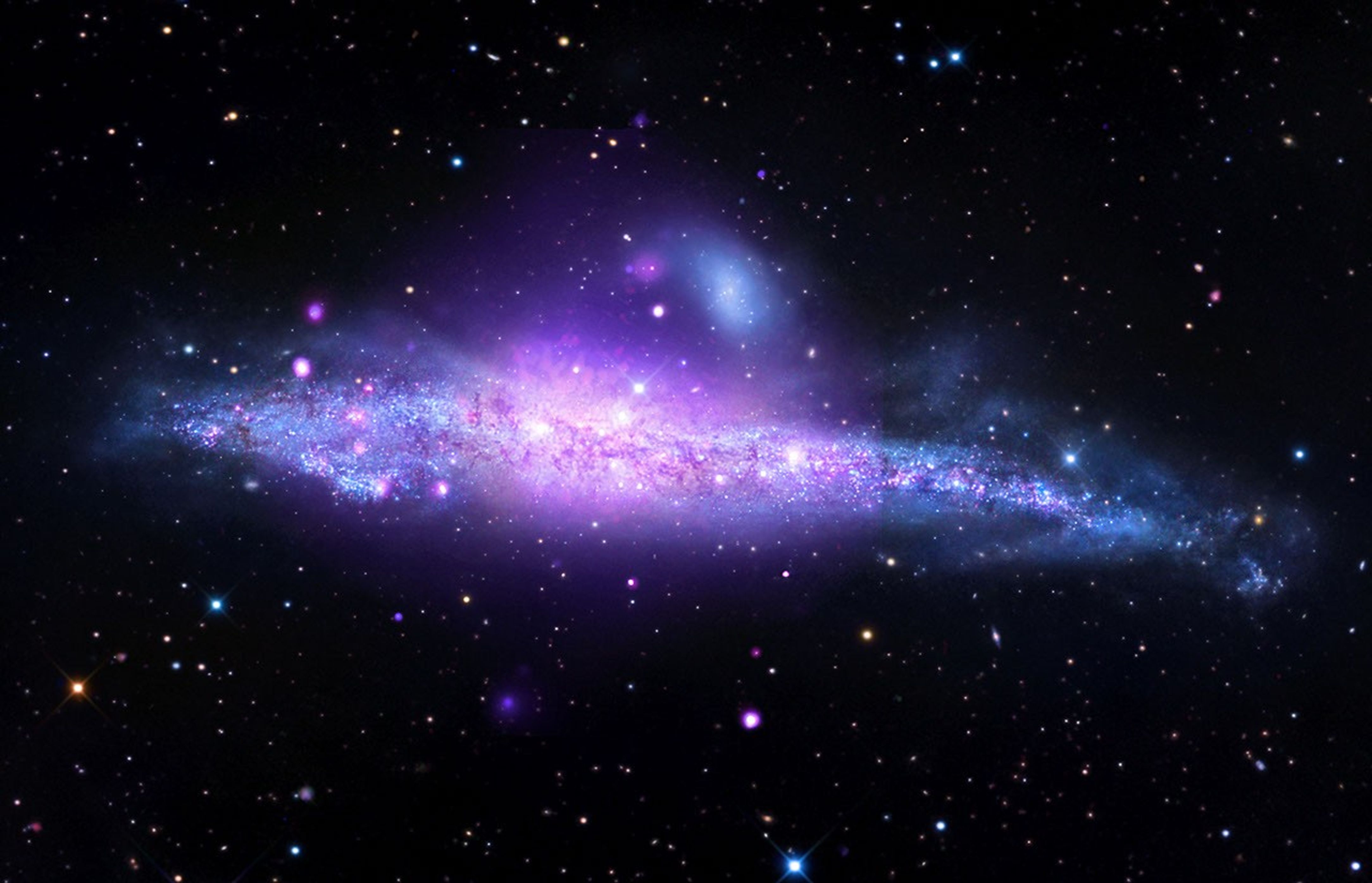
A spiral galaxy viewed from its side, featuring a giant halo of hot gas blowing out of its stellar disk. X-rays from Chandra and ESA’s XMM-Newton (purple and royal blue) trace hot gas driven out by supernovas and black holes and neutron stars pulling gas from their companions, while optical light (light blue, gold and white) from ground-based observer R. Jay GaBany showcases dense dust lanes. Edge-on views of galaxies allow astronomers to study how flat their stellar disks are and provide the clearest views of material located above or below the disk.
X-rays are critical for the study of galaxies, revealing unique and important information about these cosmic building blocks. For example, Chandra exposes gas that has been superheated to millions of degrees by winds from massive stars, the outflows from supermassive black holes, and the debris from exploded stars. These are key sources of elements in our bodies, in the air we breathe, and the planet we live on. Chandra also sees some of the hottest and most energetic galactic phenomena in the universe, forming a more complete picture of how galaxies live, interact, and evolve when combined with data from other types of light and telescopes.
Spiral and star-forming engines
Face-on spiral galaxies like Messier 33 and NGC 3938 offer unobstructed views of places where energetic pairs of stars and cosmic explosions live along spiral arms. Barred spirals like NGC 1672 and NGC 1385 show how central bar-shaped collections of stars, gas, and dust funnel fuel inward to ignite bursts of star formation. NGC 4725 reveals how star formation can be triggered by a previous collision with another galaxy. Meanwhile, edge-on views of NGC 4631 (the Whale Galaxy) and the starburst Messier 82 (the Cigar Galaxy) showcase giant halos and superwinds of million-degree gas driven thousands of light-years into space by intense explosions of stars, enriching surrounding intergalactic space with vital elements.
Active galactic nuclei, black hole outflows
Powerful, growing black holes in the cores of their host galaxies, known as active galactic nuclei, send energy outward in outbursts and jets that impact entire galaxies. In Centaurus A, Chandra and IXPE data expose a high-energy particle jet blasting tens of thousands of light-years into space from its central engine. In Messier 106, jets from the supermassive black hole heat surrounding gas to create spiral arms that are different from those typically found in spiral galaxies. Meanwhile, the iconic Sombrero Galaxy (Messier 104) highlights a supermassive black hole embedded in a colossal stellar bulge, where Chandra’s X-rays map a diffuse halo of million-degree gas and hot stellar remnants surrounding its sweeping dust lanes.
Collisions, mergers, cosmic disruptions
The gallery also showcases galaxies undergoing extreme gravitational transformations. A direct impact in Arp 143 acts like a cosmic bullseye, creating an expanding ring galaxy and triggering waves of star birth. Violent mergers, such as NGC 3256 and the dust-shrouded starburst II Zw 096, reveal the kind of chaotic galaxy collisions that dominated the early universe and offer a preview of the Milky Way’s distant future merger with nearby galaxy Andromeda. NGC 1569 acts as a local laboratory for studying early universe starbursts, NGC 660 showcases a rare “polar ring” galaxy where a ring of stars orbits over its poles, and Messier 90 shows a spiral galaxy plowing through the Virgo Cluster, having its star-forming gas violently stripped away.
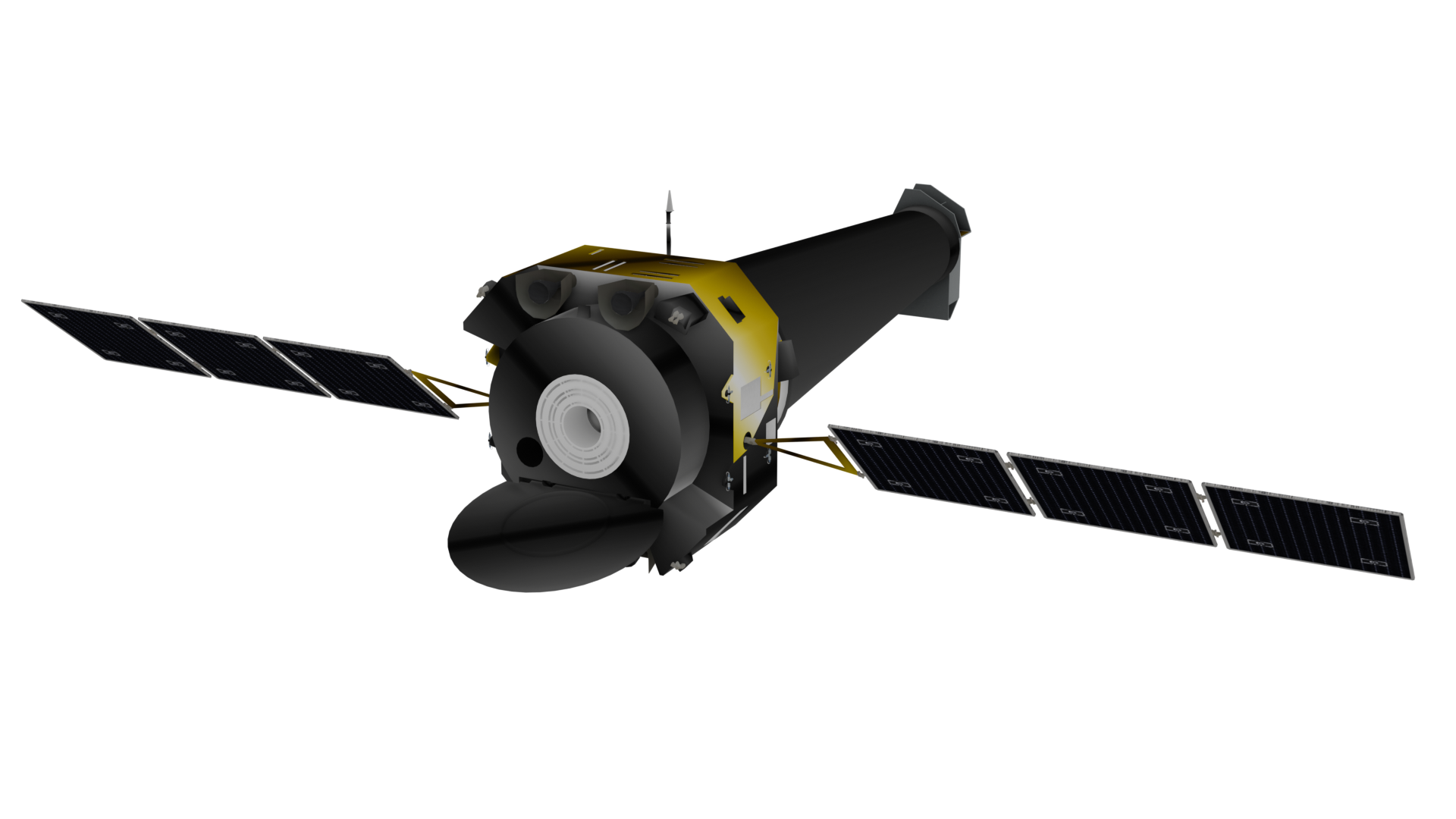
NASA’s Marshall Space Flight Center manages the Chandra program. The Smithsonian Astrophysical Observatory’s Chandra X-ray Center controls science operations from Cambridge, Massachusetts, and flight operations from Burlington, Massachusetts.
Astronauts Anil Menon and Sophie Adenot on Spacewalk
NASA
From left, Expedition 75 flight engineers Anil Menon of NASA (partially obscured and wearing the spacesuit with a red stripe on the legs) and Sophie Adenot of ESA (European Space Agency) work together during a six‑hour and 23‑minute spacewalk outside the International Space Station on Aug. 18, 2026. The pair will finish installing a high-speed communications antenna on Aug. 25, 2026.