Week Wraps with Cargo Packing, Tech Research as Crew-12 Discusses Mission

Week Wraps with Cargo Packing, Tech Research as Crew-12 Discusses Mission
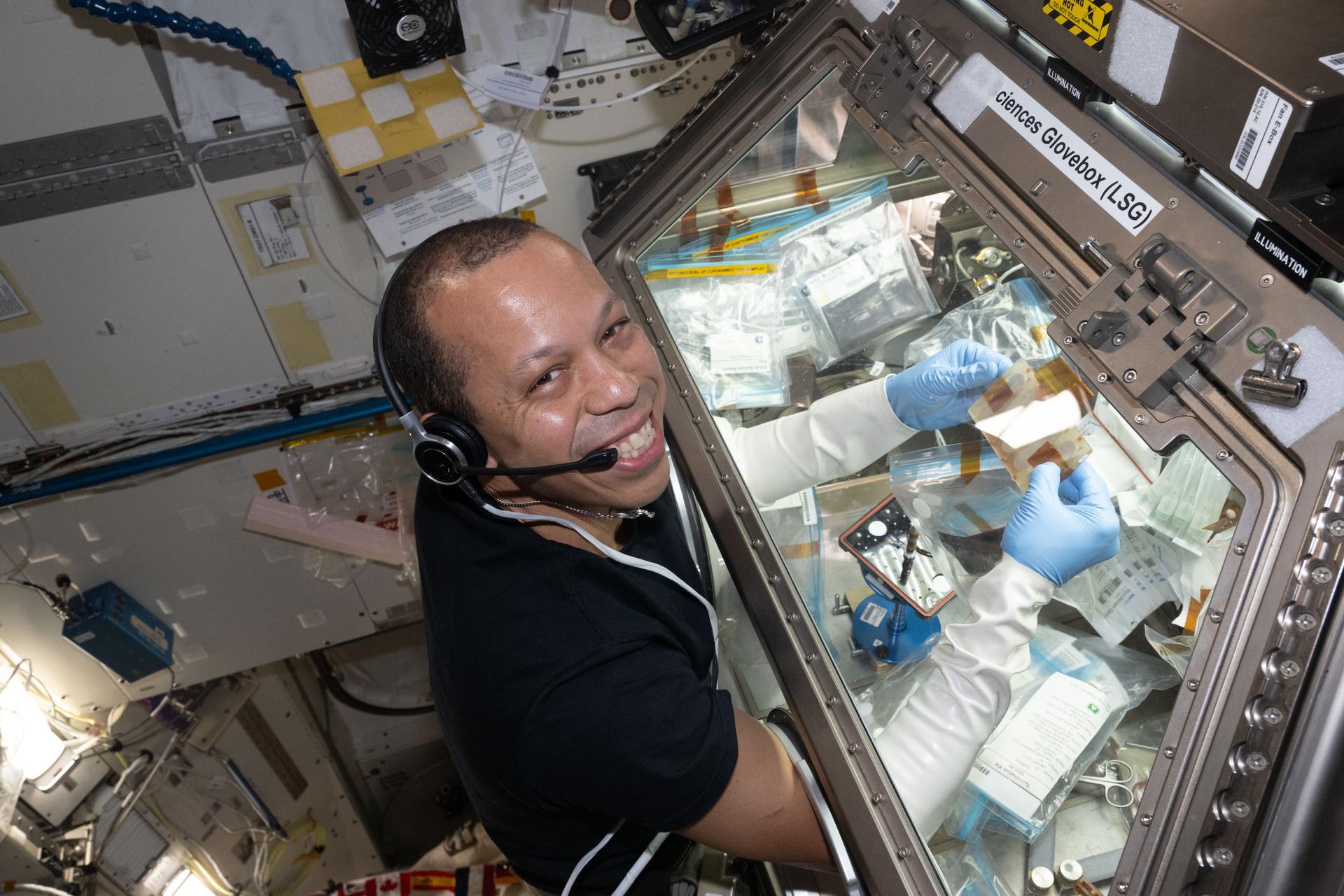
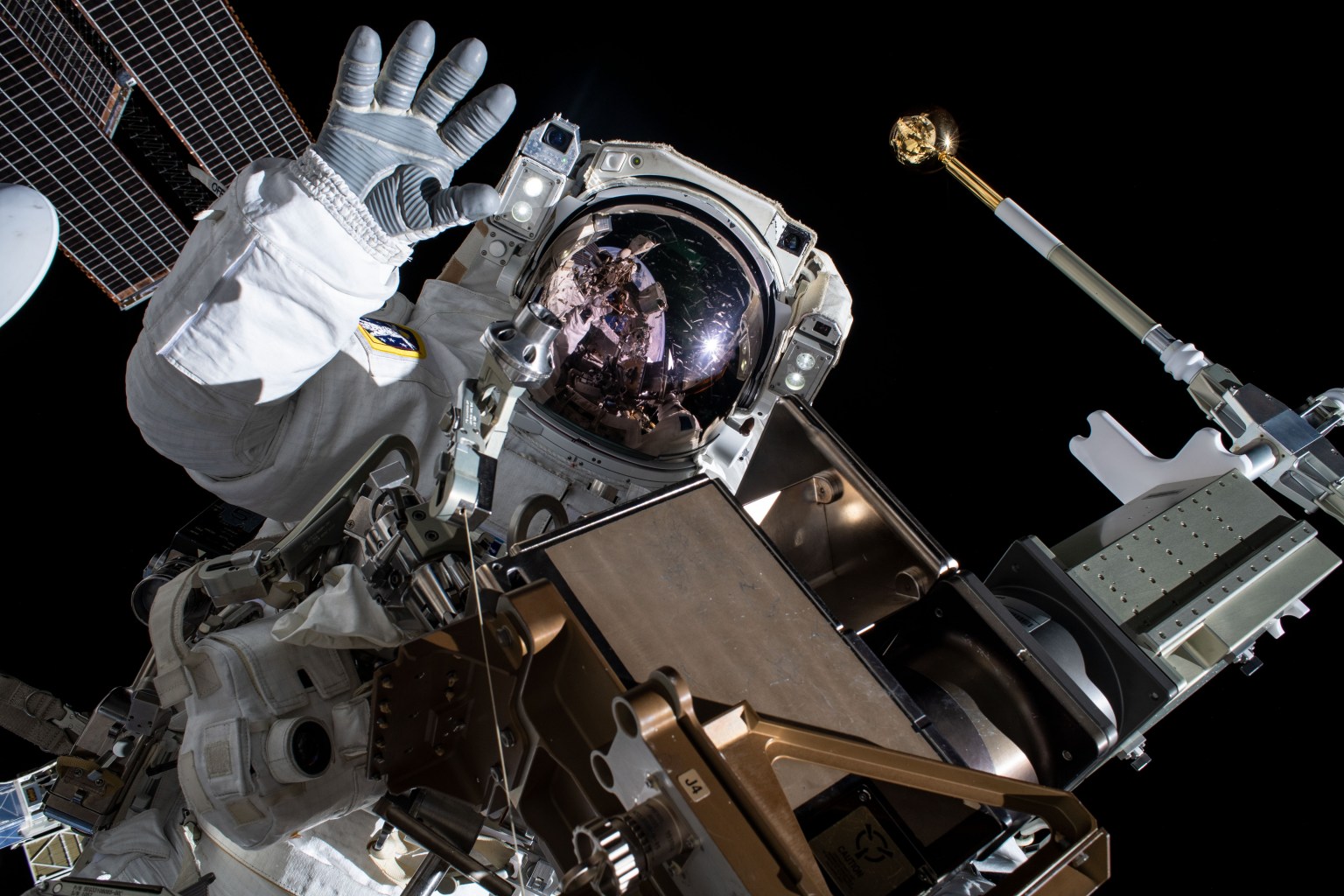
NASA astronaut and Expedition 74 Flight Engineer Chris Williams safely processes samples of a bacterial pathogen inside the Kibo laboratory module’s Life Science Glovebox. Williams was exploring a way to prevent the formation of biofilms, or a layer of microorganisms, anywhere water is found on a spacecraft where they pose human health risks and can damage equipment. The microbe samples are housed inside a specialized cell culture chamber, called a BioCell, and exposed to different levels of ultraviolet light to learn how to inhibit microbial growth and reduce reliance on chemical disinfectants.
NASA astronaut Chris Williams conducts microbiology research inside the Kibo laboratory module’s Life Science Glovebox aboard the International Space Station.
NASA

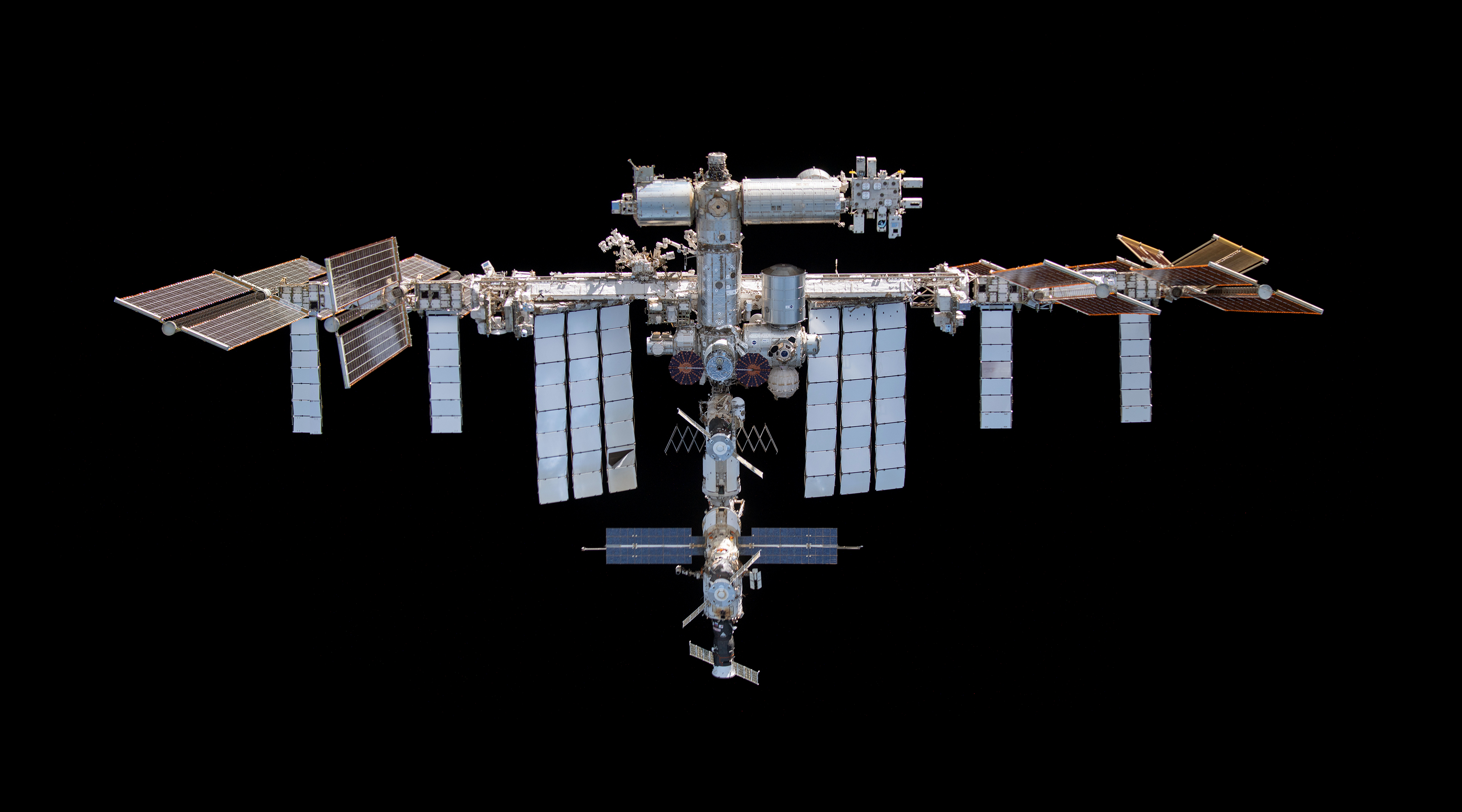
The Expedition 74 trio wrapped up the week packing cargo for return to Earth and exploring artificial intelligence to benefit crew operations. Earth observations and lab gear maintenance rounded out the shift aboard the International Space Station on Friday.

NASA Flight Engineer Chris Williams ended his shift on Friday loading gear inside a SpaceX Dragon for return to Earth next month. Williams, with assistance from station Commander Sergey Kud-Sverchkov of Roscosmos, has begun packing some of the completed experiments and their associated research samples, as well as used hardware and trash, inside Dragon for retrieval and analysis on the ground. Dragon delivered a host of science experiments, crew supplies, and more on August 25, 2025.

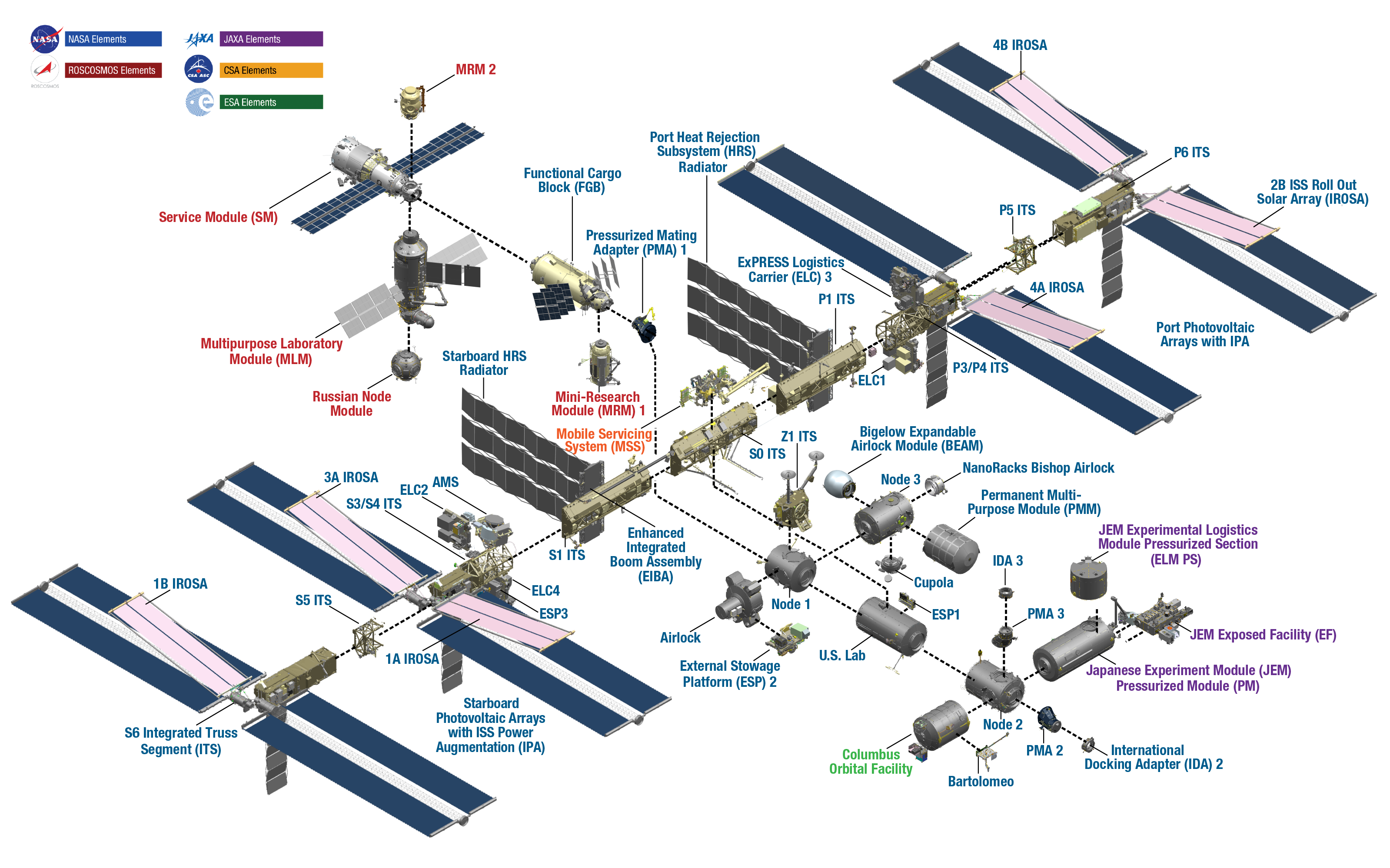
Williams spent the first half of his shift working in the Tranquility module servicing a variety of life support systems. He first swapped out orbital plumbing gear that helps recycle wastewater aboard the orbital outpost. Next, he cleaned the ventilation system inside the Harmony module’s overhead crew quarters then measured the airflow from Harmony into the Destiny laboratory module to ensure a safe breathing environment.

Kud-Sverchkov, on his second spaceflight, worked on a pair of different experiments, the first one documenting the effects of natural disasters across the Earth’s surface, and the second exploring plasma physics. He pointed a camera out different windows in the Zvezda service module and photographed landmarks near water bodies and mountains from northwest Africa to eastern Europe. Next, Kud-Sverchkov studied procedures for the upcoming Plasma Kristall-4 physics investigation that explores complex plasmas possibly advancing spacecraft designs, leading to a better understanding of planet formation, and improving fundamental physics research.

Roscosmos Flight Engineer Sergei Mikaev uninstalled Earth observation gear completing an overnight automated photography session that captured multi-spectral imagery of wildfires from Africa to Southeast Asia during the crew’s sleep session. Next, Mikaev configured data management and control hardware that supports experiment platforms from materials research to space physics, and artificial intelligence systems. Finally, the first-time space flyer turned his attention to another artificial intelligence study studying tools to convert speech-to-text and improve data handling and communications between the crew and ground controllers. Researchers seek to use the new technology to speed up and increase the accuracy of crew documentation benefitting operations aboard spacecraft.

The four members representing NASA’s SpaceX Crew-12 mission discussed their upcoming flight to the space station during a Crew News Conference on YouTube. Commander Jessica Meir and Pilot Jack Hathaway, both from NASA, and Mission Specialists Sophie Adenot of ESA (European Space Agency) and Andrey Fedyaev of Roscosmos are targeting a launch on Feb. 11 to begin a space research mission aboard the orbital laboratory. Mission managers from NASA, ESA, and SpaceX also discussed the research objectives of Crew-12 during the Mission Overview Conference today.

Learn more about station activities by following the space station blog, @space_station on X, as well as the ISS Facebook and ISS Instagram accounts.

Get the latest from NASA delivered every week. Subscribe here.

Powered by WPeMatico

Get The Details…

Mark A. Garcia

NASA Aims to Advance Hypersonic Flight Testing with New Awards 

NASA Aims to Advance Hypersonic Flight Testing with New Awards 

3 min read

Preparations for Next Moonwalk Simulations Underway (and Underwater)

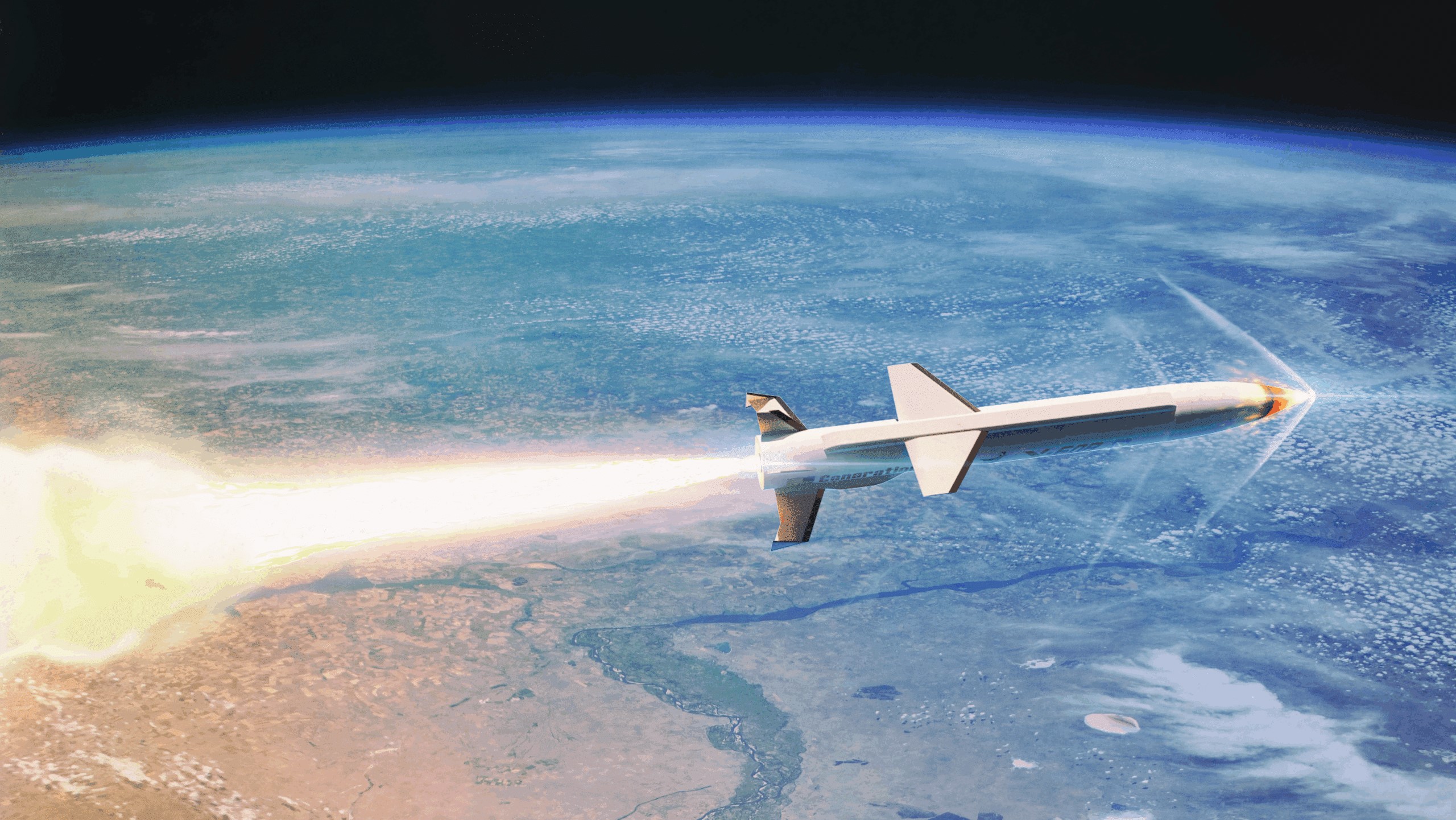
The SpaceWorks X-60 rocket is pictured in flight in the upper atmosphere, with the curvature of the Earth below it.
The NASA award to SpaceWorks Enterprises will focus on research using the company’s X-60 platform. 
SpaceWorks

While NASA is working with U.S. aviation to explore commercial supersonic technologies, the agency is also looking forward to an even faster era of flight – one of vehicles that can fly hypersonic, or five times the speed of sound. And to further that vision, NASA has issued two awards for studies into vehicle concepts. 

Some types of vehicles – such as rockets – achieve hypersonic speeds by carrying supplies of oxygen to allow their fuel to burn, instead of using the surrounding air. In contrast, NASA’s Hypersonic Technology Project works to advance “airbreathing,” reusable hypersonic aircraft, which take in air as they fly, allowing for much longer sustained cruising at hypersonic speeds. 

Given commercial interest in finding applications for airbreathing hypersonic vehicles, the Hypersonic Technology Project is looking to find ways to make testing and development easier. Two contract awards the project made in August are aimed at helping to provide an affordable bridge between hypersonic ground and flight tests. 

“With these awards, NASA will collaborate with the commercial hypersonics industry to identify new ways to evaluate technologies through flight tests while we address the challenges of reusable, routine, airbreathing, hypersonic flight,” said Dr. Nateri Madavan, director of NASA’s Advanced Air Vehicles Program. 

The new awards went to SpaceWorks Enterprises, of Atlanta, Georgia, and Stratolaunch of Mojave, California, both of which will support a six-month NASA study exploring how current vehicles could be modified to meet the need for reusable, high-cadence, affordable flight-testing capabilities. SpaceWorks, which received $500,000, will focus on the X-60 platform. Stratolaunch, which received $1.2 million, will focus on its Talon-A platform. 

Through these awards, NASA wants industry to help define the capabilities needed to achieve flight test requirements. The work will also potentially support a future NASA Making Advancements in Commercial Hypersonics (MACH) project focused on advancing commercial hypersonic vehicles through the development of infrastructure such as cost estimates and schedule requirements for a potential flight vehicle.

NASA advances U.S. hypersonic research through the Hypersonic Technology Project under the agency’s Advanced Air Vehicles Program. NASA intends for these projects to help lead the way in enabling revolutionary advancements in fundamental airbreathing hypersonic technologies.

Share

Details

Last Updated

Jan 30, 2026

Editor
Lillian Gipson
Contact
Jim Banke

Powered by WPeMatico

Get The Details…
Lillian Gipson

Visualizing Perseverance’s AI-Planned Drive on Mars

Visualizing Perseverance’s AI-Planned Drive on Mars

2 Min Read

Visualizing Perseverance’s AI-Planned Drive on Mars

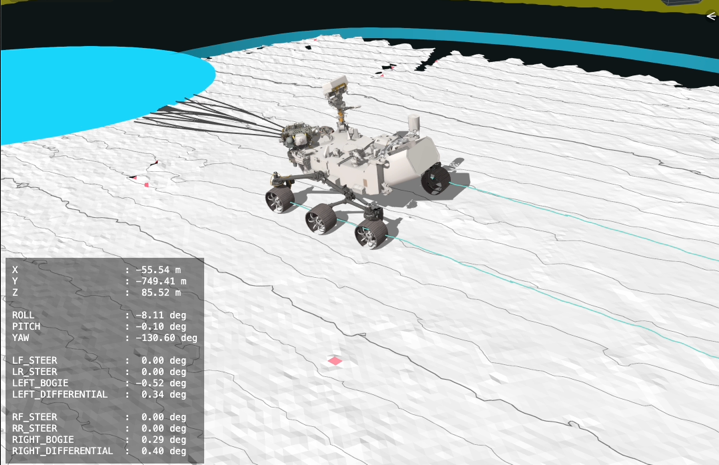
This animation was created using data acquired during Perseverance’s Dec. 10, 2025, drive on Jezero Crater’s rim. Pale blue lines depict the track the rover’s wheels take. Black lines snaking out in front of the rover show the path options the rover is considering. The white terrain is a height map based on rover data. The blue circle that appears near the end of the animation is a waypoint.
PIA26646
Credits:
NASA/JPL-Caltech

Description

This animation of NASA’s Perseverance was created with the Caspian visualization tool using data acquired during an 807-foot (246-meter) drive on the rim of Jezero Crater made by the rover on Dec. 10, 2025, the 1,709th Martian day, or sol, of the mission. The mission’s “drivers,” or rover planners, use the information to understand the Perseverance’s autonomous decision-making process during its drive by showing why it chose one specific path over other options. 

This was one of two drives, the first being on Dec. 8, in which generative artificial intelligence provided the route planning. The AI analyzed high-resolution orbital imagery from the HiRISE (High Resolution Imaging Science Experiment) camera aboard NASA’s Mars Reconnaissance Orbiter and terrain-slope data from digital elevation models to identify critical terrain features — bedrock, outcrops, hazardous boulder fields, sand ripples, and the like. From that analysis, it generated a continuous path complete with waypoints, fixed locations where the rover takes up a new set of instructions.  

The pale blue lines depict the track the rover’s wheels take. The black lines snaking out in front of the rover depict the different path options the rover is considering moment to moment. The white terrain Perseverance drives onto in the animation is a height map generated using data the rover collected during the drive. The pale blue circle that appears in front of the rover near the end of the animation is a waypoint.

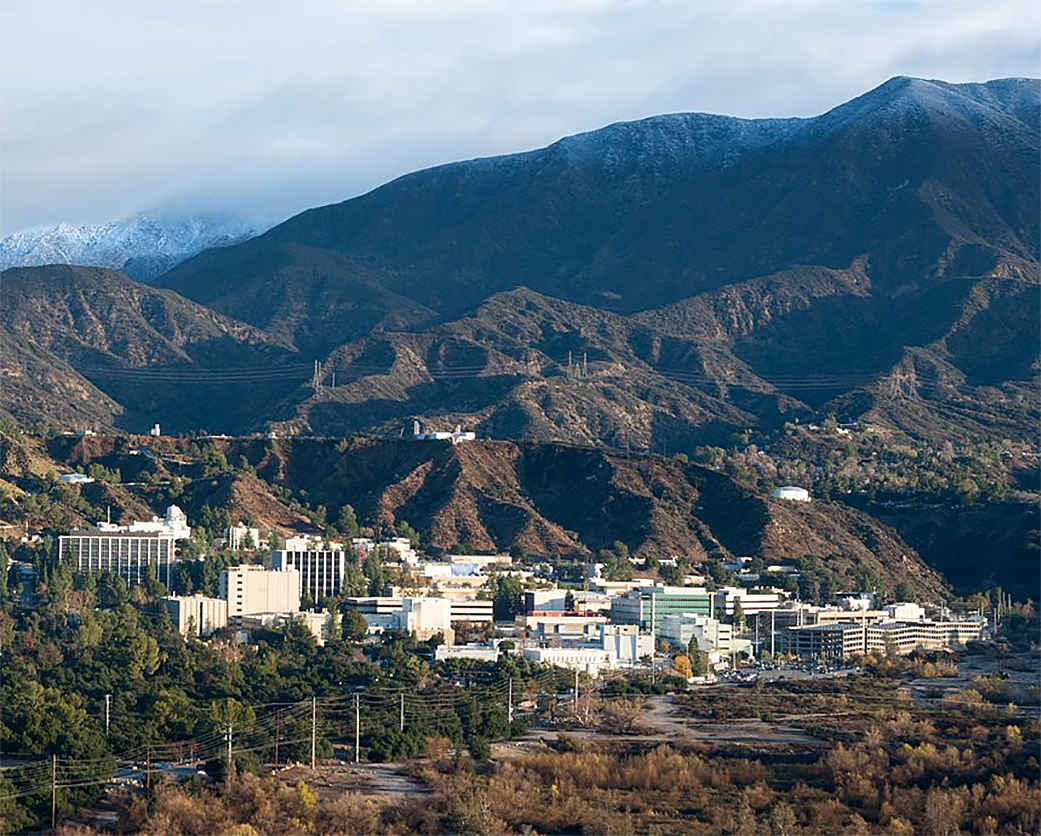
NASA’s Jet Propulsion Laboratory, which is managed for the agency by Caltech, built and manages operations of the Perseverance rover.

For more about Perseverance: science.nasa.gov/mission/mars-2020-perseverance/

Powered by WPeMatico

Get The Details…

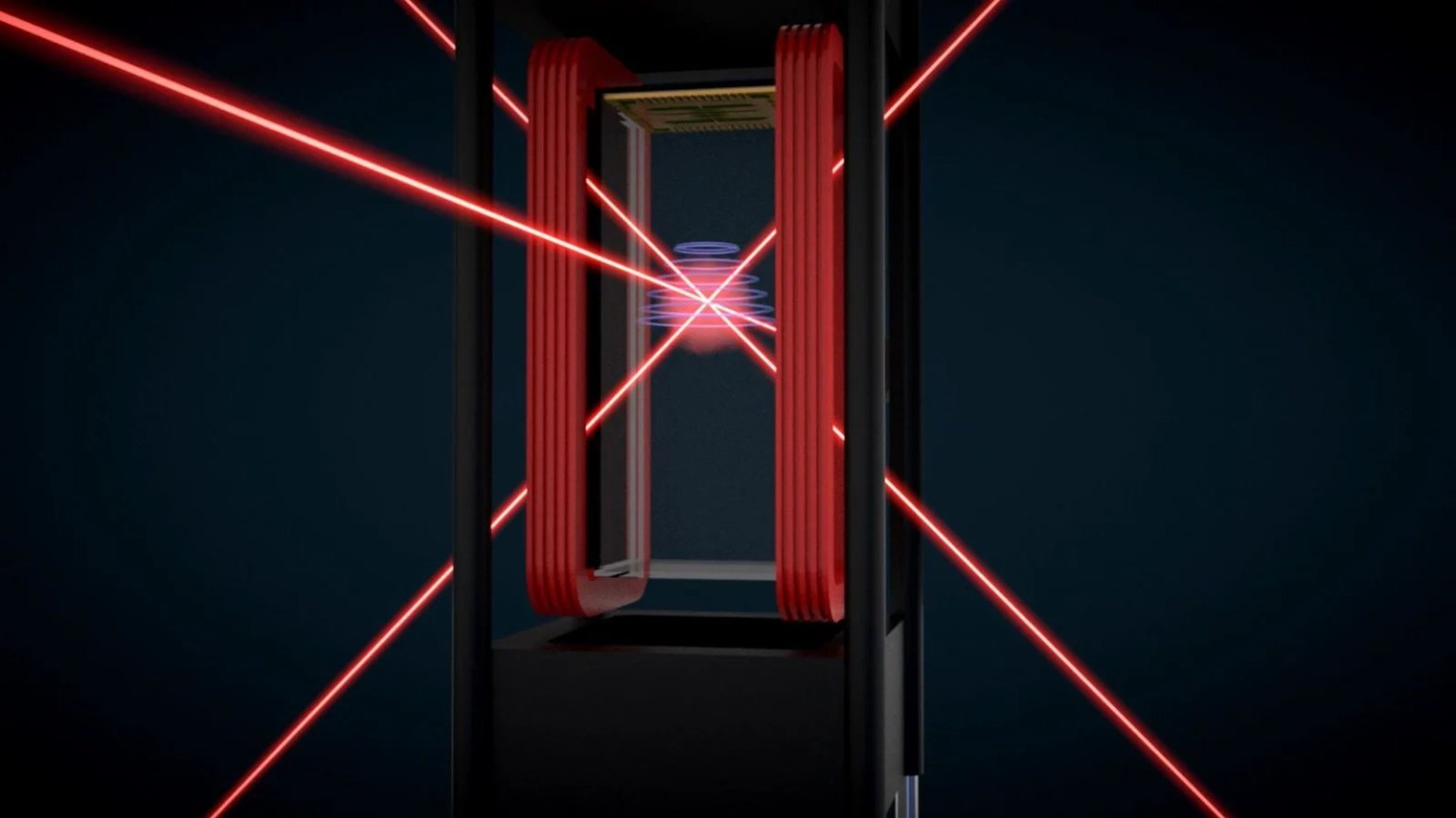
NASA Honor Awards for Cold Atom Lab Team Members

NASA Honor Awards for Cold Atom Lab Team Members

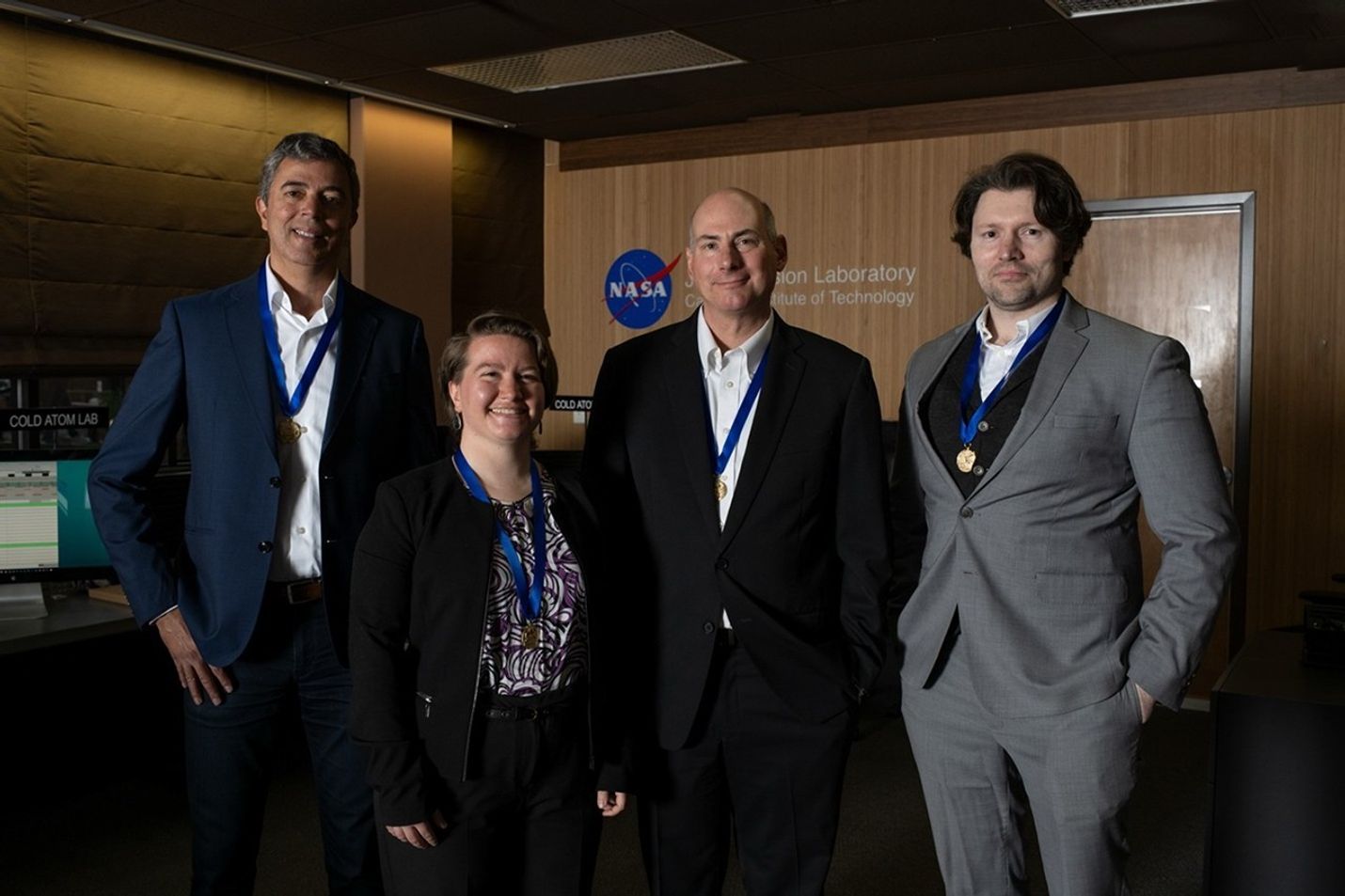
Four people standing together in a room at the Jet Propulsion Laboratory. They are all wearing suits or professional attire and have blue ribbons with gold medals around their necks. The NASA logo and the words
NASA Cold Atom Lab team members were presented with the following NASA Honor Awards. From left to right, Kamal Oudrhiri, Sarah Rees, Jason Williams, and Ethan Elliott.
NASA/JPL-Caltech

NASA OUTSTANDING PUBLIC LEADERSHIP MEDAL

Awarded for notable leadership accomplishments that have significantly influenced NASA’s mission. Sustained leadership and exceptionally high-impact leadership achievements demonstrate the individual’s effectiveness in advancing NASA’s goals and image in present and future terms.

Kamal OudrhiriFor outstanding leadership of the Cold Atom Laboratory, NASA’s first quantum laboratory in space.

NASA EXCEPTIONAL SCIENTIFIC ACHIEVEMENT MEDAL

Awarded for exceptional scientific contributions toward achievement of NASA’s mission. This award is given for individual efforts that have resulted in a key scientific discovery or resulted in contribution(s) of fundamental importance in this field or significantly enhanced understanding of the field.

Jason WilliamsFor exceptional scientific achievements enabling and performing the first pathfinding experiments in quantum sensing of inertial forces with atom interferometry in space.

NASA EXCEPTIONAL PUBLIC ACHIEVEMENT MEDAL

Awarded for a significant specific achievement or substantial improvement in operations, efficiency, service, financial savings, science, or technology which contributes to the mission of NASA.

Ethan ElliottFor exceptional achievement in generating the first quantum gas mixtures in space and using them to demonstrate dual species matter-wave interferometry for quantum tests.

NASA EARLY CAREER ACHIEVEMENT MEDAL

This prestigious NASA medal is awarded for significant performance during the first 10 years of an individual’s career in support of the NASA Mission. The contribution is significant, in that, for an employee who is at such an early phase of career, the contribution has substantially improved the discipline area.

Sarah ReesFor early career achievement in anomaly recovery and complex operation efforts in support of the Cold Atom Laboratory on the International Space Station.

Powered by WPeMatico

Get The Details…

Video: Perseverance Rover’s View of Crater Rim Drive

Video: Perseverance Rover’s View of Crater Rim Drive

1 Min Read

Video: Perseverance Rover’s View of Crater Rim Drive

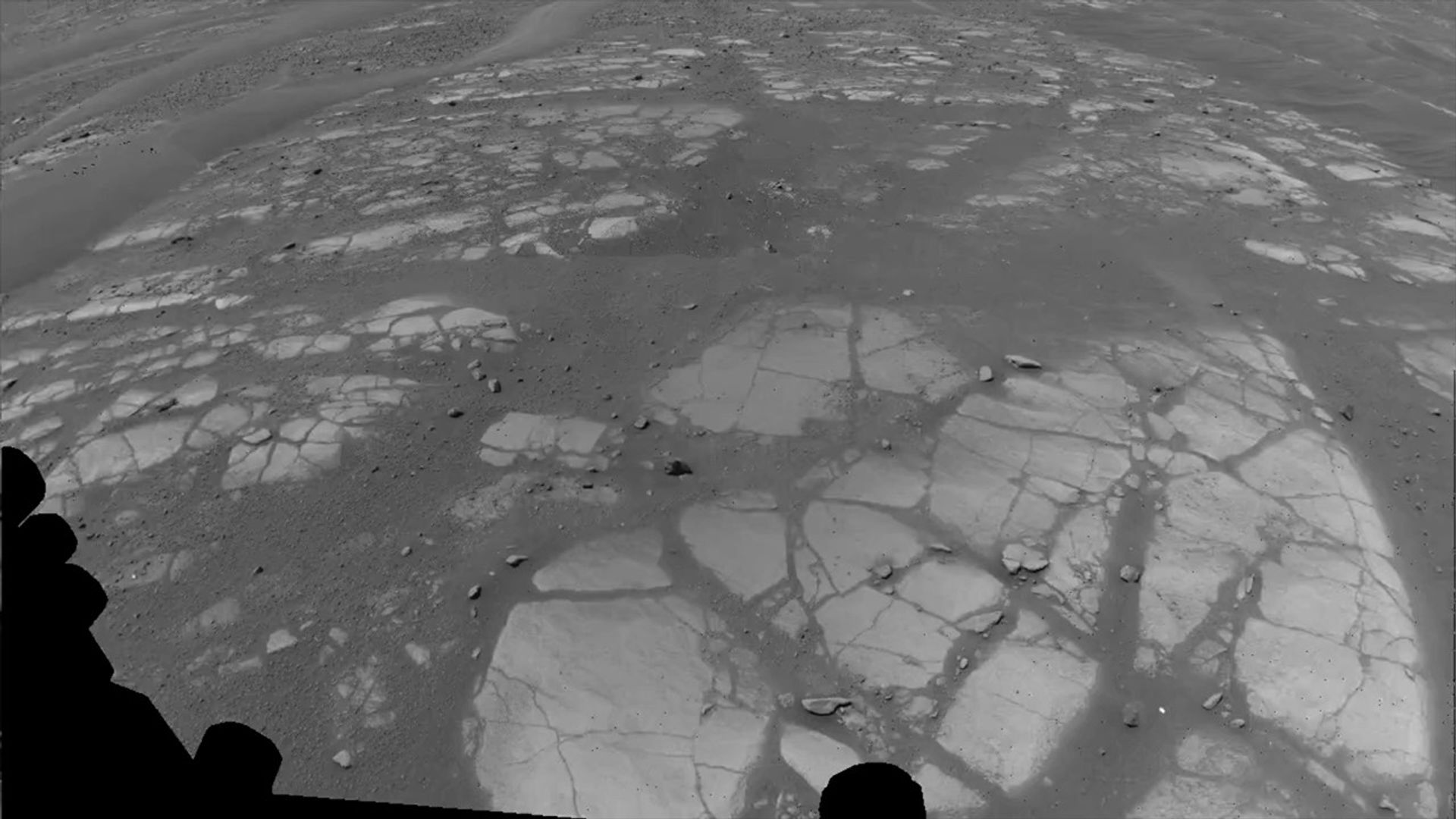
NASA’s Perseverance used its navigation cameras to capture its two-hour 30-minute drive along Jezero Crater’s rim on Dec. 10, 2025. The navcam images were combined with rover data and placed into a 3D virtual environment, resulting in this reconstruction with virtual frames inserted about every 4 inches (0.1 meters) of drive progress.
PIA26647
Credits:
NASA/JPL-Caltech

Description

This animation shows Perseverance’s point of view during drive of 807 feet (246 meters) along the rim of Jezero Crater on Dec. 10, 2025, the 1,709th Martian day, or sol, of the mission. Captured over two hours and 35 minutes, 53 Navigation Camera (Navcam) image pairs were combined with rover data on orientation, wheel speed, and steering angle, as well as data from Perseverance’s Inertial Measurement Unit, and placed into a 3D virtual environment. The result is this reconstruction with virtual frames inserted about every 4 inches (0.1 meters) of drive progress.

NASA’s Jet Propulsion Laboratory, which is managed for the agency by Caltech, built and manages operations of the Perseverance rover.

For more about Perseverance: science.nasa.gov/mission/mars-2020-perseverance/

Powered by WPeMatico

Get The Details…