Departing Crew Talks to Journalists, Keeps Up Human Research and Lab Maintenance

Departing Crew Talks to Journalists, Keeps Up Human Research and Lab Maintenance

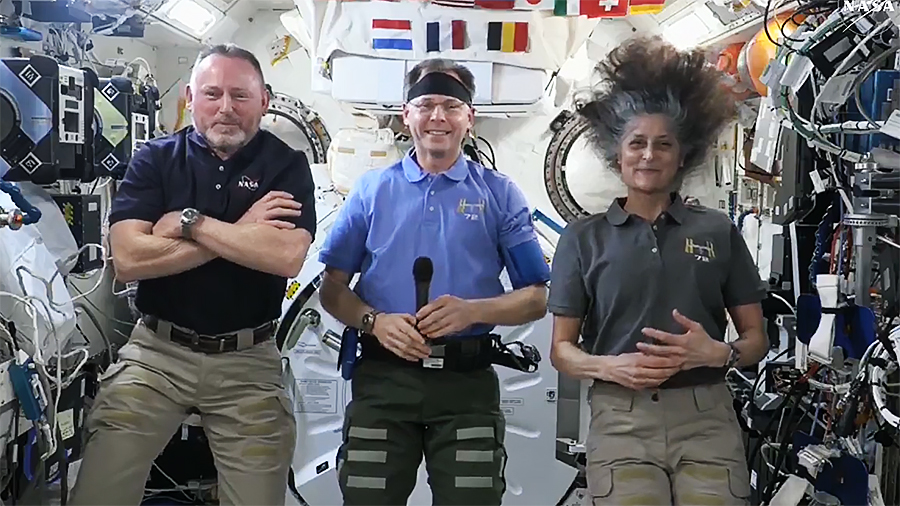
NASA astronauts (from left) Butch Wilmore, Nick Hague, and Suni Williams talk to journalists on the ground during their Pre-Departure News Conference on March 4, 2025.
NASA astronauts (from left) Butch Wilmore, Nick Hague, and Suni Williams talk to journalists on the ground during their pre-departure news conference on March 4, 2025.
NASA

Crew departure preparations and cargo unloading topped the schedule for the Expedition 72 crew aboard the International Space Station on Tuesday. The orbital residents also kept up their human research activities ensuring crews stay healthy while living in space.

Three NASA astronauts and one Roscosmos cosmonaut joined each other on Tuesday and practiced the procedures they will use when they depart the orbital outpost in mid-March. Nick Hague will command the SpaceX Dragon crew spacecraft with Mission Specialists Suni Williams, Butch Wilmore, and Aleksandr Gorbunov during the ride back to Earth. They used Dragon computer tablets and reviewed the steps they will use when Dragon backs away from the orbital outpost and reenters Earth’s atmosphere for a splashdown off the coast of Florida. Hague and Gorbunov have been at the station since Sept. 29, 2024. Williams and Wilmore arrived at the orbital outpost on June 6.

Williams and Wilmore, along with Hague, called down to Mission Control today and discussed their upcoming departure with journalists on the ground. Hague stated at the beginning of the pre-departure news conference, “Here in a few short days Crew-10 is going to arrive. And we are going to hand the baton to Crew-10 and we are going to return to Earth at the end of a successful long-duration mission aboard the space station.”

Their replacements, the SpaceX Crew-10 members, are targeted to launch on March 12. The next Dragon spacecraft will carry Commander Anne McClain and Pilot Nichole Ayers, both NASA astronauts, and Mission Specialists Takuya Onishi of JAXA (Japan Aerospace Exploration Agency) and Kirill Peskov of Roscosmos. The new quartet will join Expedition 72 before becoming the Expedition 73 crew in mid-April.

Advanced space research continued apace as the orbital residents helped scientists on the ground understand how weightlessness affects the human body. Hague was back on exercise research working out on the advanced resistive exercise device, which mimics free weights on Earth, and pedaling on an exercise cycle as a sensor-packed vest and headband recorded his health data. Pettit set up a microscope and a science laptop computer in the Kibo laboratory module to learn how cells sense gravity and possibly treat space-caused muscle atrophy and osteoporosis.

Williams and Wilmore focused on housekeeping throughout Tuesday. Williams packed trash and discarded gear inside the Cygnus space freighter before setting up a camera to photograph the Moon illuminated by sunshine reflected from Earth. Wilmore swapped out a water resupply tank in the Destiny laboratory module then reorganized cargo stowed in the Columbus laboratory module.

Roscosmos cosmonauts Alexey Ovchinin and Ivan Vagner continued unloading some of the nearly three tons of food, fuel, and supplies that arrived inside the Progress 91 cargo craft on March 1. The duo also joined Gorbunov and participated in a test for a study to improve how international crews communicate with mission controllers from around the world.

Learn more about station activities by following the space station blog, @space_station and @ISS_Research on X, as well as the ISS Facebook and ISS Instagram accounts.

Get the latest from NASA delivered every week. Subscribe here: https://www.nasa.gov/subscribe

Powered by WPeMatico

Get The Details…

Mark A. Garcia

NASA Awards Launch Service for Mission to Study Storm Formation

NASA Awards Launch Service for Mission to Study Storm Formation

The letters NASA on a blue circle with red and white detail, all surrounded by a black background
Credit: NASA

NASA has selected Firefly Aerospace Inc. of Cedar Park, Texas, to provide the launch service for the agency’s Investigation of Convective Updrafts (INCUS) mission, which aims to understand why, when, and where tropical convective storms form, and why some storms produce extreme weather. The mission will launch on the company’s Alpha rocket from NASA’s Wallops Flight Facility in Virginia.

The selection is part of NASA’s Venture-Class Acquisition of Dedicated and Rideshare (VADR) launch services contract. This contract allows the agency to make fixed-price indefinite-delivery/indefinite-quantity awards during VADR’s five-year ordering period, with a maximum total value of $300 million across all contracts.

The INCUS mission, comprised of three SmallSats flying in tight coordination, will investigate the evolution of the vertical transport of air and water by convective storms. These storms form when rapidly rising water vapor and air create towering clouds capable of producing rain, hail, and lightning. The more air and water that rise, the greater the risk of extreme weather. Convective storms are a primary source of precipitation and cause of the most severe weather on Earth.

Each satellite will have a high frequency precipitation radar that observes rapid changes in convective cloud depth and intensities. One of the three satellites also will carry a microwave radiometer to provide the spatial content of the larger scale weather observed by the radars. By flying so closely together, the satellites will use the slight differences in when they make observations to apply a novel time-differencing approach to estimate the vertical transport of convective mass.

NASA selected the INCUS mission through the agency’s Earth Venture Mission-3 solicitation and Earth System Science Pathfinder program. The principal investigator for INCUS is Susan van den Heever at Colorado State University in Fort Collins. Several NASA centers support the mission, including Langley Research Center in Hampton, Virginia, the Jet Propulsion Laboratory in Southern California, Goddard Space Flight Center in Greenbelt, Maryland, and Marshall Space Flight Center in Huntsville, Alabama. Key satellite system components will be provided by Blue Canyon Technologies and Tendeg LLC, both in Colorado. NASA’s Launch Services Program, based at the agency’s Kennedy Space Center in Florida, manages the VADR contract.

To learn more about NASA’s INCUS mission, visit:

https://science.nasa.gov/mission/incus

-end-

Tiernan Doyle
Headquarters, Washington
202-358-1600
tiernan.doyle@nasa.gov

Patti Bielling
Kennedy Space Center, Florida
321-501-7575
patricia.a.bielling@nasa.gov

Powered by WPeMatico

Get The Details…
Tiernan P. Doyle

Station Nation: Meet Chris Wade, Visiting Vehicle Integration Manager for SpaceX Vehicles 

Station Nation: Meet Chris Wade, Visiting Vehicle Integration Manager for SpaceX Vehicles 

Chris Wade is a visiting vehicle integration manager for SpaceX vehicles in the International Space Station Transportation Integration Office. He plays a key role in ensuring that all vehicle requirements are on track to support SpaceX missions to the space station. Chris also manages a team of real-time mission support personnel who follow launch, docking, undocking, and splashdown operations. Read on to learn about his career with NASA and more! 

Where are you from? 

I am from Clarksdale, Mississippi. 

Tell us about your role at NASA.  

I manage horizontal integration between the SpaceX vehicle provider and the Commercial Crew and International Space Station Programs. In this role, I work to ensure all vehicle requirements will close in time to support upcoming SpaceX missions to the orbiting laboratory and achieve final certification prior to launch. Additionally, as a vehicle integration manager, I manage a team of real-time mission support personnel who follow launch, docking, undocking, and splashdown operations. 

A man stands and smiles in front of a NASA meatball. He is wearing a white button down and black blazer.
Chris Wade in Mission Control Center at Johnson Space Center following the arrival of a visiting vehicle to the International Space Station.

I enjoy telling people that we have a space station that has been in low Earth orbit with people on it for nearly 25 years.

cHRIS wade

cHRIS wade

Visiting Vehicle Integration Manager for SpaceX Vehicles

How would you describe your job to family or friends who may not be familiar with NASA?  

In my current position, I am responsible for ensuring SpaceX Dragon vehicles have met all requirements to conduct missions to the space station. 

How long have you been working for NASA?  

I have been working at Johnson Space Center for 25 years. 

What advice would you give to young individuals aspiring to work in the space industry or at NASA?  

I would advise young individuals to focus their studies on the STEM fields and work hard. I would also advise aspiring candidates to start applying for NASA internships as soon as feasible and don’t be opposed to opportunities in the contractor workforce. 

What was your path to NASA?  

My path to NASA was through the contractor workforce. I started working in space station robotic assembly analysis for Lockheed Martin directly out of college, then later became a civil servant at NASA. 

Is there someone in the space, aerospace, or science industry that motivated or inspired you to work for the space program? Or someone you discovered while working for NASA who inspires you?   

The Space Shuttle Challenger STS-51-L crew motivated me to pursue a career at NASA. I vividly remember watching the launch from an elementary classroom in Mississippi and thinking, I wish I could do something to help one day. When I got an opportunity to work at Johnson, it was a no-brainer for me to accept the offer. 

What is your favorite NASA memory?  

My favorite NASA memory is when I saw my first rocket launch, which was HTV-1 in Kagoshima, Japan. 

Chris Wade accepting a group achievement award as a member of the Latching End Effector Return Team with Johnson Space Center’s Deputy Center Director Vanessa Wyche and Center Director Mark Geyer in 2019.
NASA/Robert Markowitz

What do you love sharing about station? What’s important to get across to general audiences to help them understand its benefits to life on Earth?  

I enjoy telling people that we have a space station that has been in low Earth orbit with people on it for nearly 25 years and we rotate crews of astronauts every six months. 

If you could have dinner with any astronaut, past or present, who would it be?  

I would have dinner with NASA astronaut Ron McNair. Growing up in a small southern town, my path to NASA was very similar to his. I find it fascinating how individuals from different eras can end up on similar paths in life, and I would love to have a conversation with him about the choices he made that lead to his career as an astronaut. 

Do you have a favorite space-related memory or moment that stands out to you?  

My favorite space-related memory is watching the SpaceX Demo-2 Crew Mission arrive at the International Space Station. That was the first launch of NASA astronauts from American soil since the Space Shuttle Program had ended almost 10 years prior.

What are some of the key projects you’ve worked on during your time at NASA? What have been your favorite?   

Some of the key projects I’ve worked on include: 

  • Robotic assembly of the International Space Station 
  • Robotic visiting vehicle capture  
  • Cargo and crew dragon visiting vehicle mission certification 

Of these, my favorite was the robotic visiting vehicle capture project. For this project, I got to work with the Canadian Space Agency and develop a method of using the space station’s robotic arm to grab unmanned visiting resupply vehicles. 

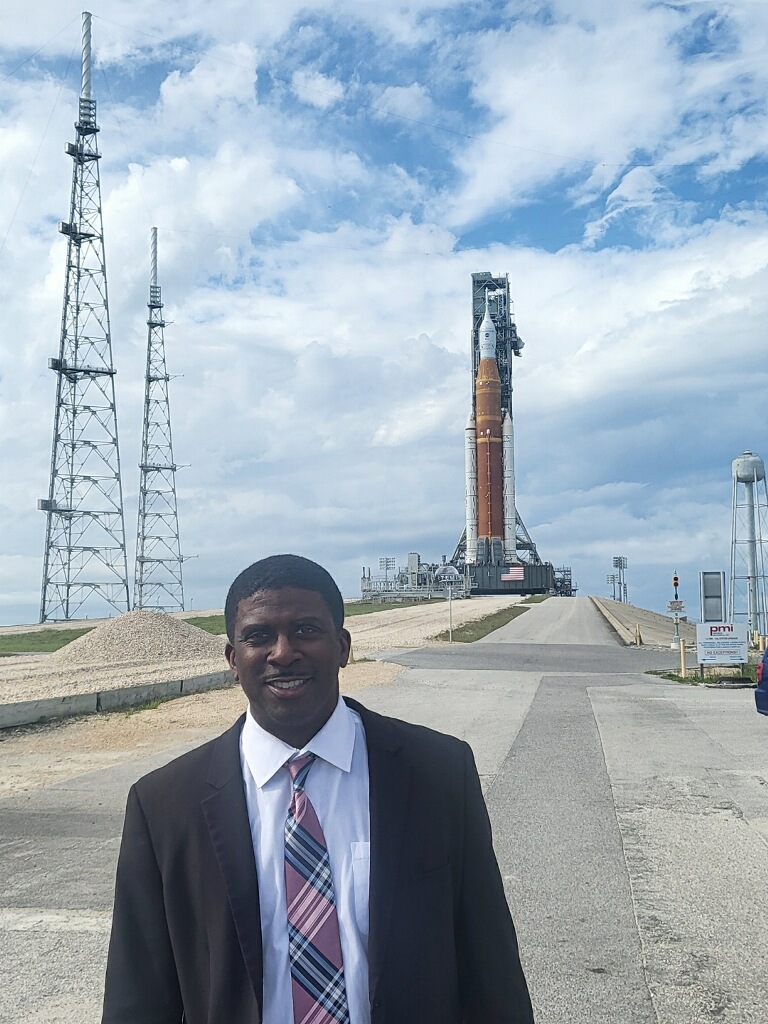
A man stands outside in front of a rocket. He is wearing a white button down
Chris Wade at Kennedy Space Center in front of NASA’s Space Launch System rocket with the Orion spacecraft aboard atop a mobile launcher at Launch Complex 39B.

What are your hobbies/things you enjoy outside of work?  

Some of my favorite hobbies include running, reading, listening to audio books, and visiting family and friends back in Mississippi. 

Day launch or night launch?   

Day launch! 

Favorite space movie?  

Armageddon 

NASA “worm” or “meatball” logo?  

Worm 

NASA spelled out in red letters.

Every day, we’re conducting exciting research aboard our orbiting laboratory that will help us explore further into space and bring benefits back to people on Earth. You can keep up with the latest news, videos, and pictures about space station science on the Station Research & Technology news page. It’s a curated hub of space station research digital media from Johnson and other centers and space agencies.  

Sign up for our weekly email newsletter to get the updates delivered directly to you.  

Follow updates on social media at @ISS_Research on Twitter, and on the space station accounts on Facebook and Instagram.  

Powered by WPeMatico

Get The Details…
Sumer Loggins

FARMing with Data: OpenET Launches new Tool for Farmers and Ranchers

FARMing with Data: OpenET Launches new Tool for Farmers and Ranchers

6 min read

Preparations for Next Moonwalk Simulations Underway (and Underwater)

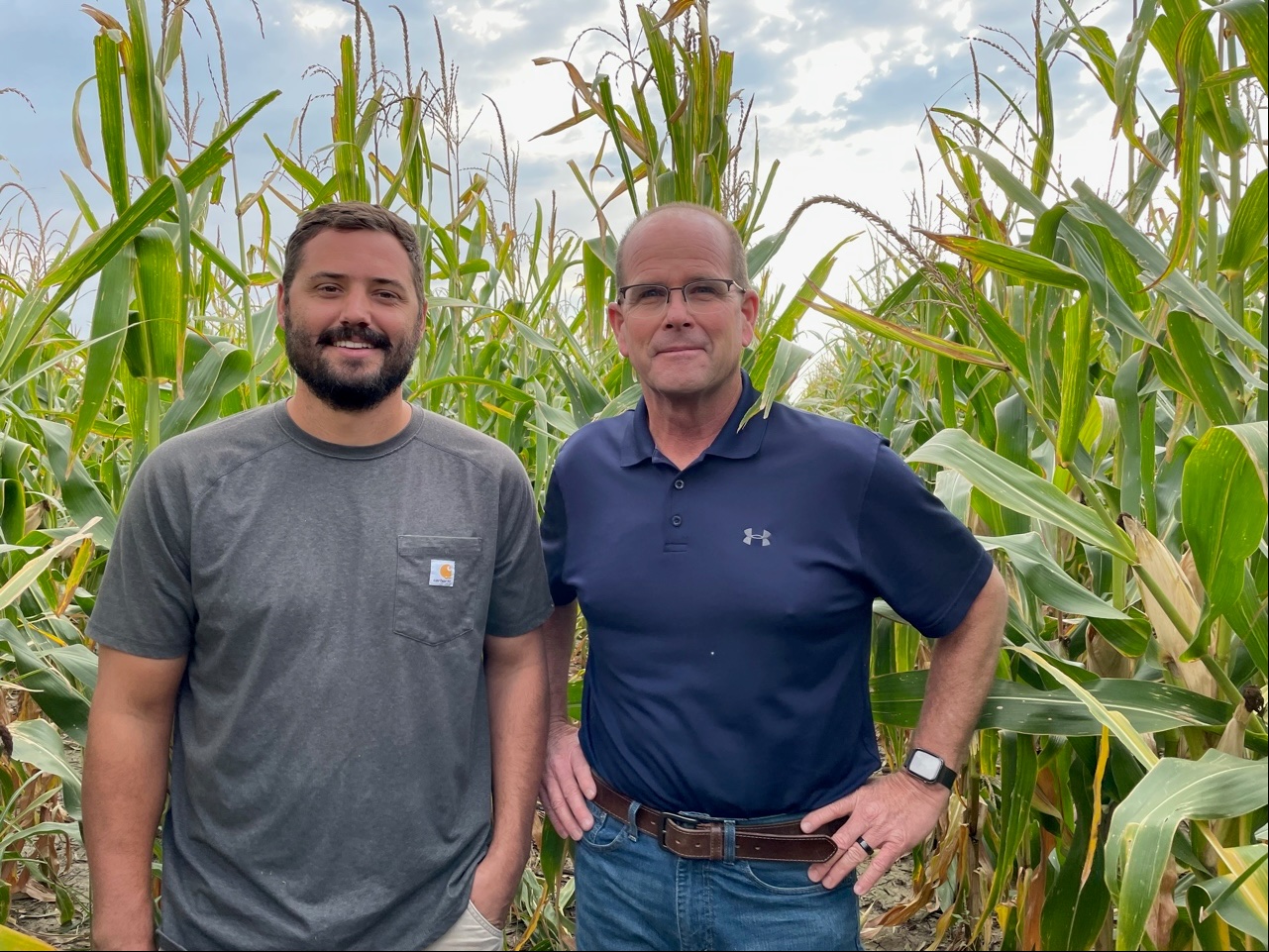
A picture of two white men standing in a cornfield. The one on the left is mid-thirties, with dark brown hair and beard and wearing a gray t-shirt. The man on the right is older, clean-shaven and wearing glasses and a navy blue collared shirt.
Dwane Roth (right), a fourth generation grain farmer in Finney County, Kansas, stands with nephew Zion (left) in one of their corn fields. Roth’s farm became one of the first Water Technology Farms in Kansas around 2016, and he has been using OpenET data for the past few years to track evapotranspiration rates and conserve water.
Photo courtesy of Dwane Roth

A NASA and U.S. Geological Survey (USGS)-supported research and development team is making it easier for farmers and ranchers to manage their water resources.

The team, called OpenET, created the Farm and Ranch Management Support (FARMS) tool, which puts timely, high-resolution water data directly in the hands of individuals and small farm operators. By making the information more accessible, the platform can better support decision-making around agricultural planning, water conservation, and water efficiency.  The OpenET team hopes this will help farmers who are working to build greater resiliency in local and regional agriculture communities.

“It’s all about finding new ways to make satellite data easier to access and use for as many people as possible,” said Forrest Melton, the OpenET project scientist at NASA’s Ames Research Center in Silicon Valley. “The goal is to empower users with actionable, science-based data to support decisions about water management across the West.”

The goal is to empower users with actionable, science-based data to support decisions about water management across the West.

Forrest melton

Forrest melton

OpenET Project Scientist

OpenET Data Explorer Tool: The Road to FARMS

The OpenET data explorer tool centers on providing evapotranspiration data. Evapotranspiration (ET) refers to the amount of water leaving Earth’s surface and returning to the atmosphere through evaporation (from soil and surface water) and transpiration (water vapor released by crops and other plants). Evapotranspiration is an important factor in agriculture, water resource management, irrigation planning, drought monitoring, and fire risk evaluation.

The FARMS resource is the third phase of OpenET’s Data Explorer tool, launched in 2021, which uses satellite data to quantify evapotranspiration across the western U.S.

It starts with using Landsat data to measure patterns in land surface temperature and key indicators of vegetation conditions. The satellite data is combined with agricultural data, such as field boundaries, and weather data, such as air temperature, humidity, solar radiation, wind speed, and precipitation. All of these factors feed into a model, which calculates the final evapotranspiration data.

The new FARMS interface was designed to make that data easier to access, with features that meet specific needs identified by users.

“This amount of data can be complicated to use, so user input helped us shape FARMS,” said Jordan Harding, app developer and interface design leader from HabitatSeven. “It provides a mobile-friendly, map-based web interface designed to make it as easy as possible to get automated, regular reports.”

A top-bottom comparison of the same four fields: all circles except for the top right field, which is shaped like Pacman. The top is a scan of a satellite image, with labels drawn in thick black marker describing the crop type and amount. The bottom image is an electronic dashboard with the fields on the left, each in their own color, and a graph on the right with four lines the same color as the fields.
Top: A section of the 2024 annual report Roth submits to the Farm Service Agency, with hand-written annotations marking which crop will be grown that year.
Bottom: Those same fields in the new OpenET FARMS interface, with a dashboard on the left displaying evapotranspiration data over the course of 2024 at monthly intervals. Each color line corresponds to the same color field on the map, showcasing how much evapotranspiration rates can differ between different crops in the same vicinity. The unique shape of the purple field (forage sorghum), is an example of a case where FARMS’ custom shape feature is helpful. Once the initial report is set up, Roth can re-run reports for the same fields at any time.
NASA/OpenET

“The FARMS tool is designed to help farmers optimize irrigation timing and amounts, simplify planning for the upcoming irrigation season, and automate ET and water use reporting,” said Sara Larsen, CEO of OpenET. “All of this reduces waste, lowers costs, and informs crop planning.”

Although FARMS is geared towards agriculture, the tool has value for other audiences in the western U.S. Land managers who evaluate the impacts of wildfire can use it to evaluate burn scars and changes to local hydrology. Similarly, resource managers can track evapotranspiration changes over time to evaluate the effectiveness of different forest management plans.

New Features in FARMS

To develop FARMS, the OpenET team held listening sessions with farmers, ranchers, and resource managers. One requested function was support for field-to-field comparisons; a feature for planning irrigation needs and identifying problem areas, like where pests or weeds may be impacting crop yields.

The tool includes numerous options for drawing or selecting field boundaries, generating custom reports based on selected models and variables, and  automatically re-running reports at daily or monthly intervals.

The fine spatial resolution and long OpenET data record behind FARMS make these features more effective. Many existing global ET data products have a pixel size of over half a mile, which is too big to be practical for most farmers and ranchers. The FARMS interface provides insights at the scale of a quarter-acre per pixel, which offers multiple data points within an individual field.

“If I had told my father about this 15 years ago, he would have called me crazy,” said Dwane Roth, a fourth-generation farmer in Kansas. “Thanks to OpenET, I can now monitor water loss from my crops in real-time. By combining it with data from our soil moisture probes, this tool is enabling us to produce more food with less water. It’s revolutionizing agriculture.”

Two screenshots of a smartphone interface. The right is a satellite image of an orchard, with one orchard field colored in purple. The left is an electronic dhasboard with a single purple line graph that spikes up and back down five times at regular intervals.
The FARMS mobile interface displays a six-year evapotranspiration report of a pear orchard owned by sixth-generation California farmer Brett Baker. The purple line in the dashboard report (left) corresponds with the field selected in purple on the map view (right), which users can toggle between using the green buttons in the top right corners. Running multi-year reports allows farmers to review historical trends.
NASA/OpenET

For those like sixth-generation California pear farmer Brett Baker, the 25-year span of ET data is part of what makes the tool so valuable. “My family has been farming the same crop on the same piece of ground for over 150 years,” Baker said. “Using FARMS gives us the ability to review historical trends and changes to understand what worked and what didn’t year to year: maybe I need to apply more fertilizer to that field, or better weed control to another. Farmers know their land, and FARMS provides a new tool that will allow us to make better use of land and resources.”

According to Roth, the best feature of the tool is intangible.  “Being a farmer is stressful,” Roth said. “OpenET is beneficial for the farm and the agronomic decisions, but I think the best thing it gives me is peace of mind.”

Being a farmer is stressful. OpenET is beneficial for the farm and the agronomic decisions, but I think the best thing it gives me is peace of mind.

Dwane Roth

Dwane Roth

Fourth-Generation Kansas Grain Farmer

Continuing Evolution of FARMS

Over the coming months, the OpenET team plans to present the new tool at agricultural conferences and conventions in order to gather feedback from as many users as possible. “We know that there is already a demand for a seven-day forecast of ET, and I’m sure there will be requests about the interface itself,” said OpenET senior software engineer Will Carrara. “We’re definitely looking to the community to help us further refine that platform.”

“I think there are many applications we haven’t even thought of yet,” Baker added. “The FARMS interface isn’t just a tool; it’s an entirely new toolbox itself. I’m excited to see what people do with it.”

FARMS was developed through a public-private collaboration led by NASA, USGS, USDA, the non-profit OpenET, Inc., Desert Research Institute, Environmental Defense Fund, Google Earth Engine, HabitatSeven, California State University Monterey Bay, Chapman University, Cornell University, University of Nebraska-Lincoln, UC Berkeley and other universities, with input from more than 100 stakeholders.

For resources/tutorials on how to use FARMS, please visit: https://openet.gitbook.io/docs/additional-resources/farms

About the Author

Milan Loiacono

Milan Loiacono

Science Communication Specialist

Milan Loiacono is a science communication specialist for the Earth Science Division at NASA Ames Research Center.

Powered by WPeMatico

Get The Details…
Milan Loiacono

NASA Sets Coverage for Intuitive Machines’ Second Private Moon Landing

NASA Sets Coverage for Intuitive Machines’ Second Private Moon Landing

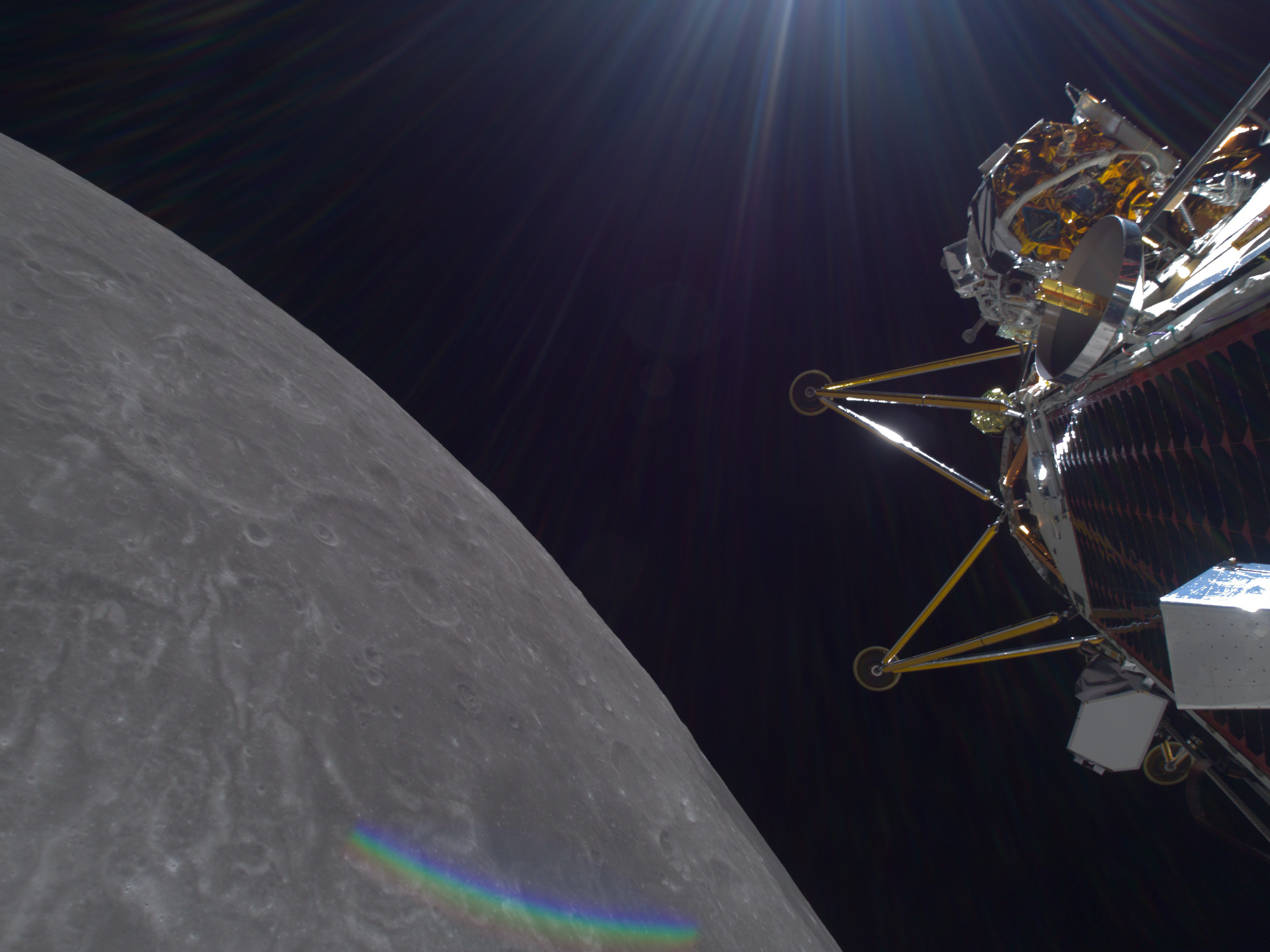
Intuitive Machines’ IM-2 mission lunar lander, Athena, entering lunar orbit on Monday, March 3.
Credit: Intuitive Machines

Carrying NASA technology demonstrations and science investigations, Intuitive Machines is targeting their Moon landing no earlier than 12:32 p.m. EST on Thursday, March 6. The company’s Nova-C lunar lander is slated to land in Mons Mouton, a lunar plateau near the Moon’s South Pole, as part of NASA’s CLPS (Commercial Lunar Payload Services) initiative and Artemis campaign to establish a long-term lunar presence.

Watch live landing coverage of the Intuitive Machines 2 (IM-2) landing, hosted by NASA and Intuitive Machines, on NASA+ starting no earlier than 11:30 a.m., approximately 60 minutes before touchdown. Beginning at 11 a.m. the agency will share blog updates as landing milestones occur.

Following the Moon landing, NASA and Intuitive Machines will host a news conference from NASA’s Johnson Space Center in Houston to discuss the mission, technology demonstrations, and science opportunities that lie ahead as lunar surface operations begin.

U.S. media interested in participating in person must request accreditation by 4 p.m. Wednesday, March 5, by contacting the NASA Johnson newsroom at 281-483-5111 or jsccommu@mail.nasa.gov. A copy of NASA’s media accreditation policy is online. To ask questions via phone, all media must RSVP by 4 p.m. March 5 to the NASA Johnson Newsroom, and dial in at least 15 minutes before the briefing begins.

Full coverage of the IM-2 mission includes (all times Eastern):

Thursday, March 6

  • 11:30 a.m. – Landing coverage begins on NASA+
  • 12:32 p.m. – Landing
  • 4 p.m. – Post-landing news conference on NASA+

After landing, NASA and Intuitive Machines leaders will participate in the news conference: 

  • Nicky Fox, associate administrator, Science Mission Directorate, NASA Headquarters  
  • Clayton Turner, associate administrator, Space Technology Mission Directorate, NASA Headquarters 
  • Joel Kearns, deputy associate administrator for exploration, Science Mission Directorate, NASA Headquarters 
  • Steve Altemus, CEO, Intuitive Machines
  • Tim Crain, chief growth officer, Intuitive Machines

The IM-2 mission launched at 7:16 p.m. Feb. 26 on a SpaceX Falcon 9 rocket from Launch Complex 39A at NASA’s Kennedy Space Center in Florida. The lander is carrying NASA technology that will measure the potential presence of resources from lunar soil that could be extracted and used by future explorers to produce fuel or breathable oxygen.

In addition, a passive Laser Retroreflector Array on the top deck of the lander will bounce laser light back at any orbiting or incoming spacecraft to give future spacecraft a permanent reference point on the lunar surface. Other technologies on this delivery will demonstrate a robust cellular network to help future astronauts communicate and deploy a propulsive drone that can hop across the lunar surface to navigate its challenging terrain.

NASA continues to work with multiple American companies to deliver technology and science to the lunar surface through the agency’s CLPS initiative. This pool of companies may bid on contracts for end-to-end lunar delivery services, including payload integration and operations, launching from Earth, and landing on the surface of the Moon. NASA’s CLPS contracts are indefinite-delivery/indefinite-quantity contracts with a cumulative maximum value of $2.6 billion through 2028. The agency awarded Intuitive Machines the contract to send NASA science investigations and technology demonstrations to the Moon using its American-designed and -manufactured lunar lander for approximately $62.5 million.

Through the Artemis campaign, commercial robotic deliveries will test technologies, perform science experiments, and demonstrate capabilities on and around the Moon to help NASA explore in advance of Artemis Generation astronaut missions to the lunar surface, and ultimately crewed missions to Mars.

Learn how to watch NASA content on various platforms, including social media, and follow all events at: 

https://www.plus.nasa.gov

Let people know you’re following the mission on X, Facebook, and Instagram by using the hashtag #Artemis. You can also stay connected by following and tagging these accounts: 

X: @NASA, @NASA_Johnson, @NASAArtemis, @NASAMoon, @NASA_Technology

Facebook: NASA, NASAJohnsonSpaceCenter, NASAArtemis, NASATechnology

Instagram: @NASA, @NASAJohnson, @NASAArtemis 

For more information about the agency’s Commercial Lunar Payload Services initiative: 

https://www.nasa.gov/clps

-end-

Karen Fox / Jasmine Hopkins
Headquarters, Washington 
202-358-1600  
karen.c.fox@nasa.gov / jasmine.s.hopkins@nasa.gov

Natalia Riusech / Nilufar Ramji
Johnson Space Center, Houston 
281-483-5111 
natalia.s.riusech@nasa.gov / nilufar.ramji@nasa.gov 

Powered by WPeMatico

Get The Details…
Tiernan P. Doyle