March’s Night Sky Notes: Messier Madness
March’s Night Sky Notes: Messier Madness

3 Min Read

March’s Night Sky Notes: Messier Madness

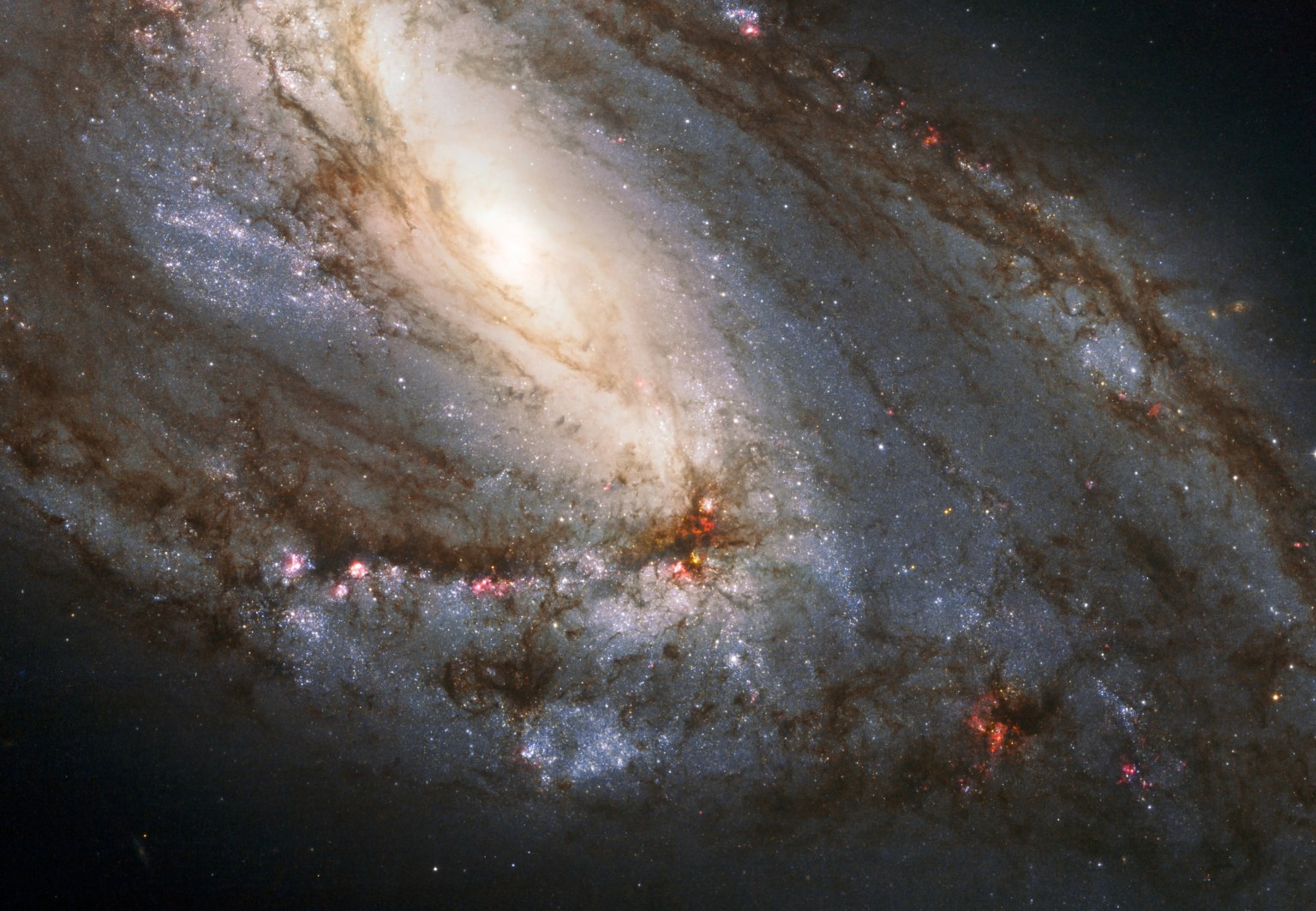
A spiral galaxy is viewed sideways, with the glowing core closer to the upper left of the image. It is surrounded by spiral arms laced through with dark dust and bright regions of star formation.
Showing a large portion of M66, this Hubble photo is a composite of images obtained at visible and infrared wavelengths. The images have been combined to represent the real colors of the galaxy.
Credits:
NASA, ESA and the Hubble Heritage (STScI/AURA)-ESA/Hubble Collaboration; Acknowledgment: Davide De Martin and Robert Gendler

by Kat Troche of the Astronomical Society of the Pacific

What Are Messier Objects?

During the 18th century, astronomer and comet hunter Charles Messier wanted to distinguish the ‘faint fuzzies’ he observed from any potential new comets. As a result, Messier cataloged 110 objects in the night sky, ranging from star clusters to galaxies to nebulae. These items are designated by the letter ‘M’ and a number. For example, the Orion Nebula is Messier 42 or M42, and the Pleiades are Messier 45 or M45. These are among the brightest ‘faint fuzzies’ we can see with modest backyard telescopes and some even with our eyes.

Stargazers can catalog these items on evenings closest to the new moon. Some even go as far as having “Messier Marathons,” setting up their telescopes and binoculars in the darkest skies available to them, from sundown to sunrise, to catch as many as possible. Here are some items to look for this season:
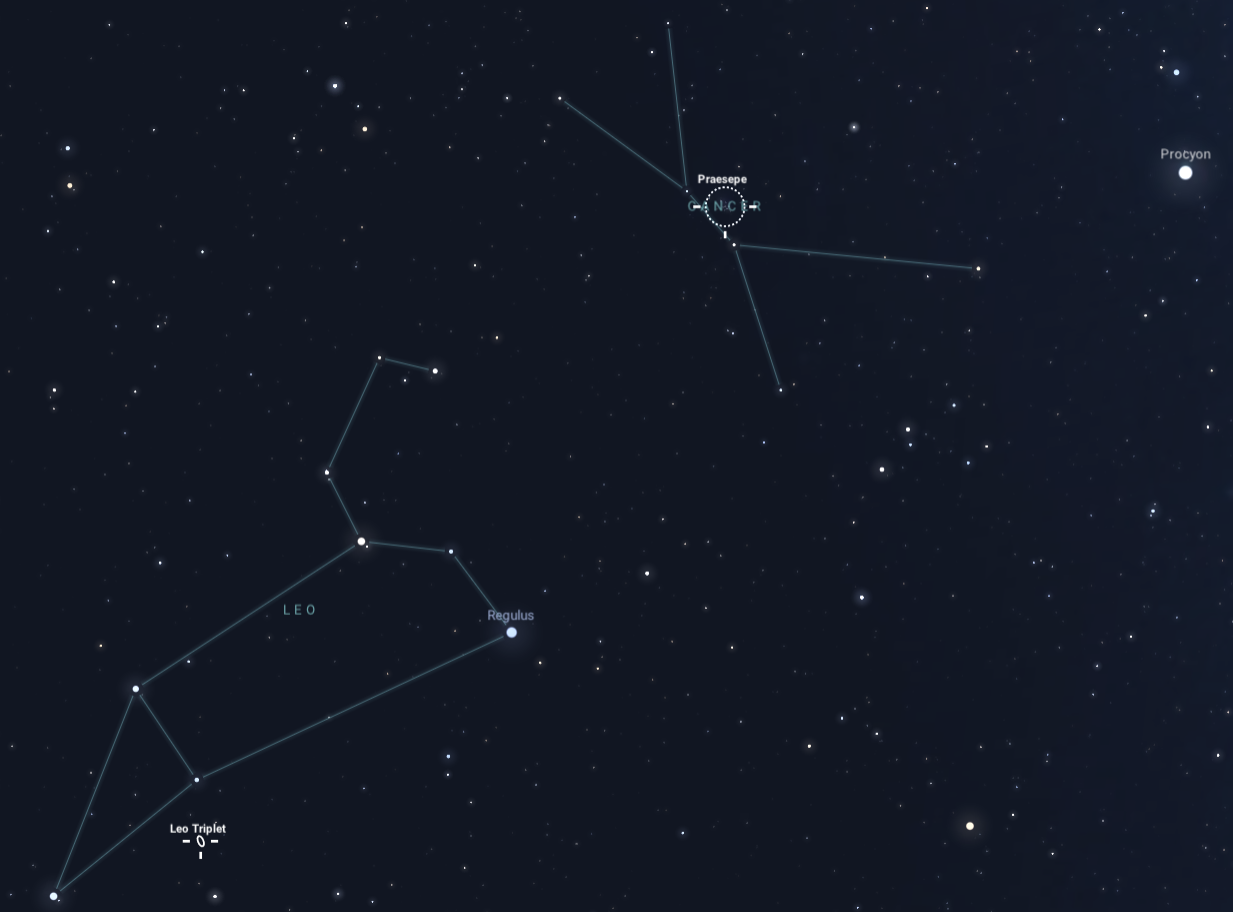
A star map featuring the Leo and Cancer constellations with the Beehive Cluster (M44) in Cancer and the Leo Triplet (M65, M66, and NGC 3628) labeled. The bright stars Regulus and Procyon are also labeled nearby.
M44 in Cancer and M65 and 66 in Leo can be seen high in the evening sky 60 minutes after sunset.
Stellarium Web

Messier 44 in Cancer: The Beehive Cluster, also known as Praesepe, is an open star cluster in the heart of the Cancer constellation. Use Pollux in Gemini and Regulus in Leo as guide stars. A pair of binoculars is enough to view this and other open star clusters. If you have a telescope handy, pay a visit two of the three galaxies that form the Leo Triplet – M65 and M66. These items can be seen one hour after sunset in dark skies.
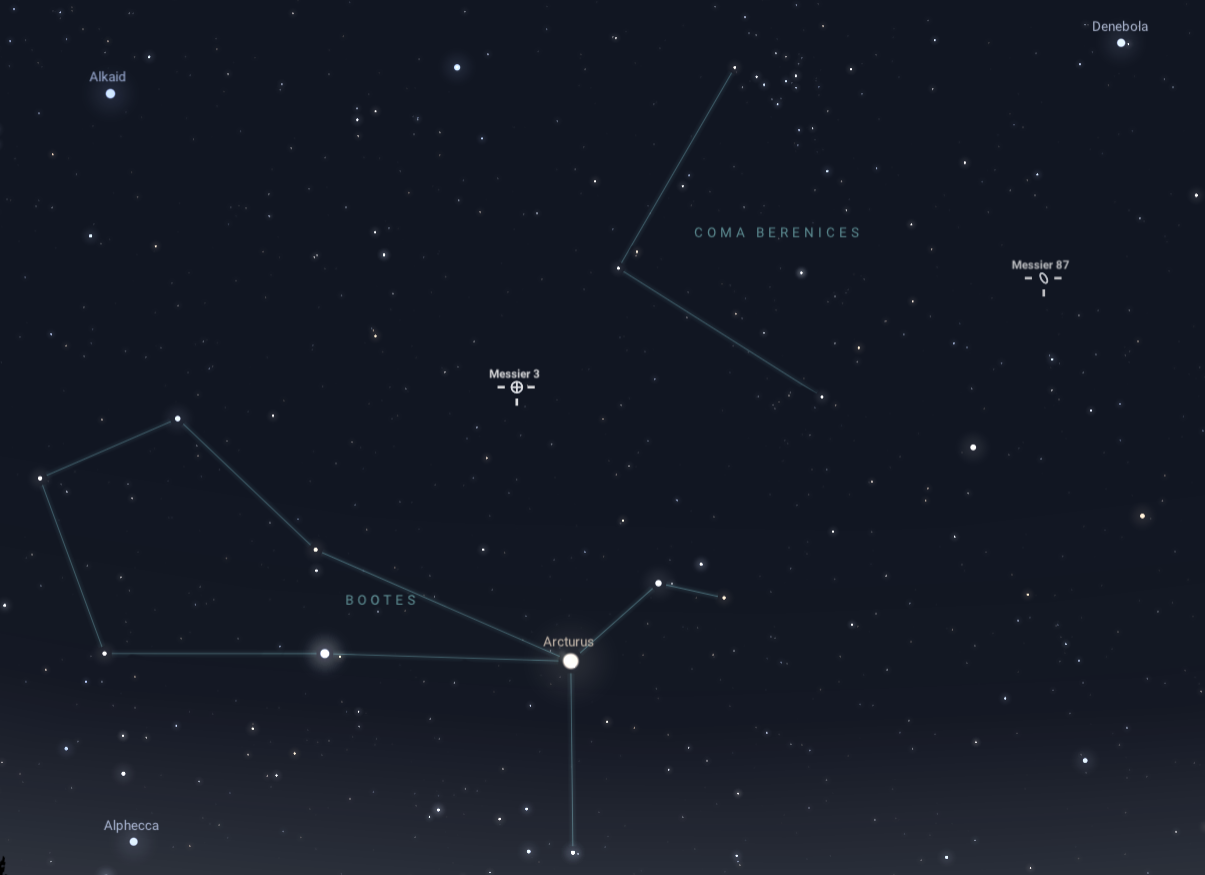
A star chart displaying the Bootes and Coma Berenices constellations. Messier 3 (M3), a globular cluster, is marked near Bootes. Messier 87 (M87), a giant elliptical galaxy, is located in the Virgo Cluster near Coma Berenices. The stars Alkaid, Alphecca, Arcturus and Denebola are also labeled.
Locate M3 and M87 rising in the east after midnight.
Stellarium Web

Messier 3 Canes Venatici: M3 is a globular cluster of 500,000 stars. Through a telescope, this object looks like a fuzzy sparkly ball. You can resolve this cluster in an 8-inch telescope in moderate dark skies. You can find this star cluster by using the star Arcturus in the Boötes constellation as a guide.

Messier 87 in Virgo: Located just outside of Markarian’s Chain, M87 is an elliptical galaxy that can be spotted during the late evening hours. While it is not possible to view the supermassive black hole at the core of this galaxy, you can see M87 and several other Messier-labeled galaxies in the Virgo Cluster using a medium-sized telescope.
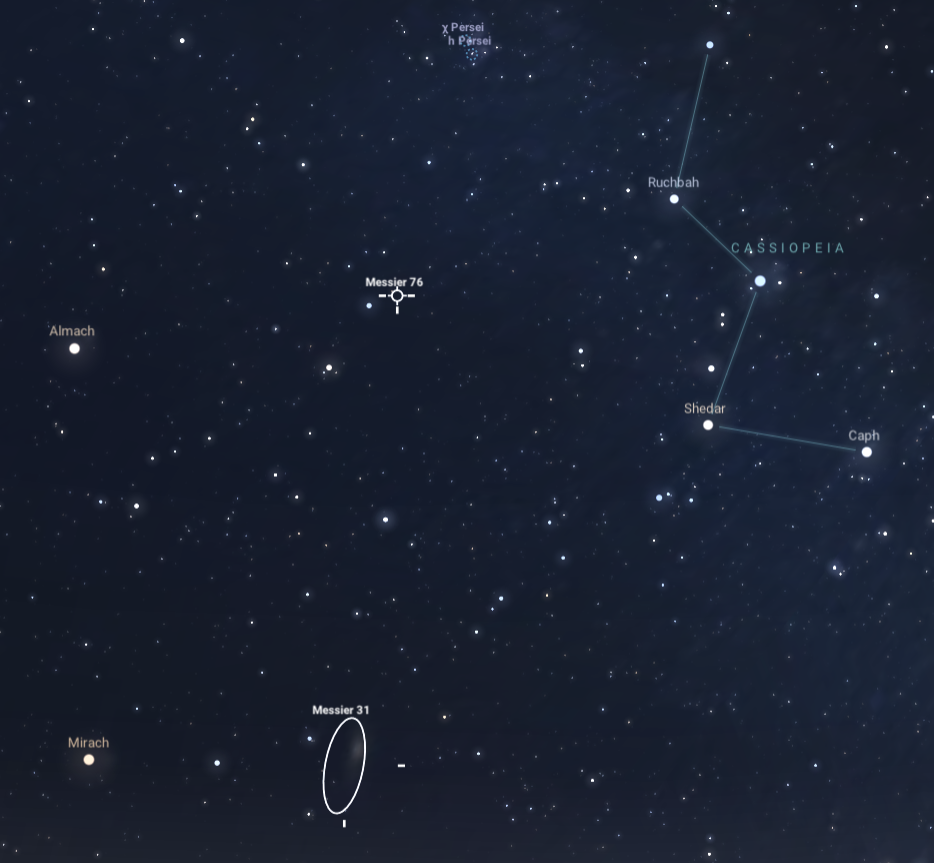
A star chart showing the Cassiopeia constellation along with the Andromeda Galaxy (M31) and the Little Dumbbell Nebula (M76). The bright stars Shedar, Caph, and Ruchbah outline Cassiopeia. M31 is marked as an elongated feature in Andromeda, while M76 appears near Cassiopeia. The stars Almach and Mirach are labeled.
Locate M76 and M31 setting in the west, 60 minutes after sunset.
Stellarium Web

Plan Ahead

When gearing up for a long stargazing session, there are several things to remember, such as equipment, location, and provisions:

  • Do you have enough layers to be outdoors for several hours? You would be surprised how cold it can get when sitting or standing still behind a telescope!
  • Are your batteries fully charged? If your telescope runs on power, be sure to charge everything before you leave home and pack any additional batteries for your cell phone. Most people use their mobile devices for astronomy apps, so their batteries may deplete faster. Cold weather can also impact battery life.
  • Determine the apparent magnitude of what you are trying to see and the limiting magnitude of your night sky. You can learn more about apparent and limiting magnitudes with our Check Your Sky Quality with Orion article.
  • When choosing a location to observe from, select an area you are familiar with and bring some friends! You can also connect with your local astronomy club to see if they are hosting any Messier Marathons. It’s always great to share the stars!

You can see all 110 items and their locations with NASA’s Explore the Night Sky interactive map and the Hubble Messier Catalog, objects that have been imaged by the Hubble Space Telescope.

Powered by WPeMatico

Get The Details…

NASA Successfully Acquires GPS Signals on Moon 

NASA Successfully Acquires GPS Signals on Moon 

3 Min Read

NASA Successfully Acquires GPS Signals on Moon 

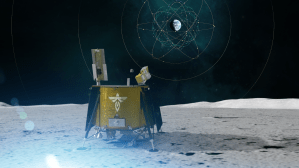
An artist’s concept of the Blue Ghost lunar lander receiving GNSS signals from Earth.

Credits:
NASA/Dave Ryan

NASA and the Italian Space Agency made history on March 3, when the Lunar GNSS Receiver Experiment (LuGRE) became the first technology demonstration to acquire and track Earth-based navigation signals on the Moon’s surface.  

The LuGRE payload’s success in lunar orbit and on the surface indicates that signals from the GNSS (Global Navigation Satellite System) can be received and tracked at the Moon. These results mean NASA’s Artemis missions, or other exploration missions, could benefit from these signals to accurately and autonomously determine their position, velocity, and time. This represents a steppingstone to advanced navigation systems and services for the Moon and Mars.  

An artist's concept of the LuGRE payload on Blue Ghost and its three main records in transit to the Moon, in lunar orbit and on the Moon's surface.
An artist’s concept of the LuGRE payload on Blue Ghost and its three main records in transit to the Moon, in lunar orbit and on the Moon’s surface.
NASA/Dave Ryan

“On Earth we can use GNSS signals to navigate in everything from smartphones to airplanes,” said Kevin Coggins, deputy associate administrator for NASA’s SCaN (Space Communications and Navigation) Program. “Now, LuGRE shows us that we can successfully acquire and track GNSS signals at the Moon. This is a very exciting discovery for lunar navigation, and we hope to leverage this capability for future missions.”  

This is a very exciting discovery for lunar navigation, and we hope to leverage this capability for future missions.  

Kevin Coggins

Kevin Coggins

Deputy Associate Administrator for NASA SCaN

The road to the historic milestone began on March 2 when the Firefly Aerospace’s Blue Ghost lunar lander touched down on the Moon and delivered LuGRE, one of 10 NASA payloads intended to advance lunar science. Soon after landing, LuGRE payload operators at NASA’s Goddard Space Flight Center in Greenbelt, Maryland, began conducting their first science operation on the lunar surface.

The LuGRE team at Goddard Space Flight Center in the payload's operations hub.
Members from NASA and Italian Space Agency watching the Blue Ghost lunar lander touch down on the Moon.
NASA

With the receiver data flowing in, anticipation mounted. Could a Moon-based mission acquire and track signals from two GNSS constellations, GPS and Galileo, and use those signals for navigation on the lunar surface?   

Then, at 2 a.m. EST on March 3, it was official: LuGRE acquired and tracked signals on the lunar surface for the first time ever and achieved a navigation fix — approximately 225,000 miles away from Earth.  

Now that Blue Ghost is on the Moon, the mission will operate for 14 days providing NASA and the Italian Space Agency the opportunity to collect data in a near-continuous mode, leading to additional GNSS milestones. In addition to this record-setting achievement, LuGRE is the first Italian Space Agency developed hardware on the Moon, a milestone for the organization.  

The LuGRE payload also broke GNSS records on its journey to the Moon. On Jan. 21, LuGRE surpassed the highest altitude GNSS signal acquisition ever recorded at 209,900 miles from Earth, a record formerly held by NASA’s Magnetospheric Multiscale Mission. Its altitude record continued to climb as LuGRE reached lunar orbit on Feb. 20 — 243,000 miles from Earth. This means that missions in cislunar space, the area of space between Earth and the Moon, could also rely on GNSS signals for navigation fixes.  

Rise and shine! Firefly’s Blue Ghost lander captured its first sunrise on the Moon, marking the beginning of the lunar day and the start of surface operations in its new home.
Firefly’s Blue Ghost lander captured its first sunrise on the Moon, marking the beginning of the lunar day and the start of surface operations in its new home.
Firefly Aerospace

Traditionally, NASA engineers track spacecraft by using a combination of measurements, including onboard sensors and signals from Earth-based tracking stations. The LuGRE payload demonstrates that using GNSS signals for navigation can reduce reliance on human operators because these signals can be picked up and used autonomously by the spacecraft, even as far away as the Moon. 

The LuGRE payload is a collaborative effort between NASA’s Goddard Space Flight Center in Greenbelt, Maryland and the Italian Space Agency. Funding and oversight for the LuGRE payload comes from NASA’s SCaN Program office. It was chosen by NASA as one of 10 funded research and technology demonstrations for delivery to the lunar surface by Firefly Aerospace Inc., a flight under the agency’s Commercial Lunar Payload Services initiative.

Learn more about LuGRE: https://go.nasa.gov/41qwwQN

The joint NASA and Italian Space Agency team at Goddard Space Flight Center posing for a picture.
The joint NASA and Italian Space Agency LuGRE team at NASA’s Goddard Space Flight Center
NASA

About the Author

Katherine Schauer

Katherine Schauer

Katherine Schauer is a writer for the Space Communications and Navigation (SCaN) program office and covers emerging technologies, commercialization efforts, exploration activities, and more.

Share

Details

Last Updated

Mar 04, 2025

Editor
Goddard Digital Team
Contact
Katherine Schauer
Location
NASA Goddard Space Flight Center

Powered by WPeMatico

Get The Details…
Katherine Schauer

30 Years Ago: STS-67, the Astro-2 Mission 

30 Years Ago: STS-67, the Astro-2 Mission 

On March 2, 1995, space shuttle Endeavour launched from NASA’s Kennedy Space Center in Florida on its eighth trip into space, on the STS-67 Astro-2 mission. The crew included Commander Stephen Oswald, Pilot William Gregory, Mission Specialists John Grunsfeld, Wendy Lawrence, and Tamara Jernigan – who served as payload commander on the mission – and Payload Specialists Samuel Durrance and Ronald Parise. During their then record setting 17-day mission, the astronauts used the three ultraviolet telescopes of the Astro-2 payload to observe hundreds of celestial objects. The mission ended with a landing at Edwards Air Force Base in California. 

In August 1993, NASA assigned Jernigan as the payload commander for Astro-2, for a weeklong flight aboard Columbia then targeted for late 1994. Jernigan, selected by NASA in 1985, had previously flown aboard STS-40 and STS-52. Two months later, NASA assigned Grunsfeld, a space rookie from the class of 1992, as a mission specialist. In January 1994, NASA rounded out the crew by assigning Oswald, Gregory, Lawrence, Durrance, and Parise. Oswald, from the class of 1985, had flown previously as pilot on STS-42 and STS-56, while STS-67 represented the first spaceflight for Gregory, selected in 1990, and Lawrence, chosen in 1992. Durrance and Parise, selected as payload specialists in 1984, had flown on STS-35, the Astro-1 mission. 

The Astro-2 science payload consisted of three ultraviolet telescopes mounted on a Spacelab instrument pointing system in the shuttle’s cargo bay. The trio of telescopes flew previously on STS-35, the Astro-1 mission, in December 1990. That mission, originally planned to fly on STS-61E in March 1986, remained grounded following the Challenger accident. Due to equipment malfunctions, the Astro-1 mission only achieved 80% of its objectives, leading to the reflight of the instruments on Astro-2, originally planned as a seven-day mission aboard Discovery. A switch to Columbia enabled a mission twice as long, with significantly more observation time. A scheduled maintenance period for Columbia resulted in Astro-2 switching to Endeavour, with a new flight duration of more than 15 days, but a launch delay to February 1995. The three telescopes supported 23 different studies, observing more than 250 celestial objects including joint observations with the Hubble Space Telescope of the planet Jupiter. 

Endeavour returned to Kennedy following its previous flight, STS-68, in October 1994. After servicing the orbiter, workers rolled it to the vehicle assembly building on Feb. 3, 1995, for mating with its external tank and solid rocket boosters, and then out to Launch Pad 39A on Feb. 8. At 1:38 a.m. EST on March 2, Endeavour thundered into the night sky to begin the STS-67 mission. Eight and a half minutes later, the shuttle and its crew had reached space. 

Shortly after reaching orbit, the crew opened the payload bay doors and deployed the shuttle’s radiators. Jernigan and Durrance activated the Spacelab pallet and its pointing system and the telescopes. The crew split into two shifts to enable data collection around the clock during the mission. Oswald, Gregory, Grunsfeld, and Parise made up the red shift while Lawrence, Jernigan, and Durrance comprised the blue shift. 

For the remainder of the mission, the astronauts operated the telescopes, conducting 385 maneuvers of Endeavour to point the instruments at the celestial targets. The results met or exceeded preflight expectations. The crew also conducted a series of middeck investigations in technology demonstration and biotechnology. The Middeck Active Control Experiment studied the active control of flexible structures in space. Five years later, a newer version flew as one of the first experiments on the International Space Station. 

Like all space crews, the STS-67 astronauts also spent time taking photographs of the Earth using handheld cameras. The mission’s long duration enabled them to image many targets. 

On March 14, an eighth American joined the STS-67 crew in space when NASA astronaut Norman Thagard blasted off with two cosmonauts, headed for space station Mir. With three other cosmonauts already aboard Mir, the total number of humans in orbit grew to a then-record of 13. Two days later, Oswald and Thagard, who had flown together on STS-42, talked to each other via ship-to-ship radio. 

Inclement weather at Kennedy thwarted the planned reentry on March 17, and the astronauts spent an extra day in space. On March 18, they again waved off a Kennedy landing and one orbit later, Oswald and Gregory piloted Endeavour to a smooth landing at Edwards Air Force Base in California. The crew had flown 262 orbits around the Earth in 16 days, 15 hours, and 9 minutes, at the time the longest space shuttle mission. A few hours later, a large crowd greeted the astronauts upon their return to Houston’s Ellington Field. Endeavour began its ferry flight back to Kennedy on March 26, arriving there the next day. Workers towed Endeavour to the processing facility to prepare it for its next flight, STS-73, then planned for September 1995. 

Watch the crew narrate a video about the STS-67 mission.  

Powered by WPeMatico

Get The Details…
John J. Uri

Blue Ghost Lands on Moon

Blue Ghost Lands on Moon

Carrying a suite of NASA science and technology, Firefly Aerospace’s Blue Ghost Mission 1 successfully landed at 3:34 a.m. EST on Sunday, March 2, 2025, near a volcanic feature called Mons Latreille within Mare Crisium, a more than 300-mile-wide basin located in the northeast quadrant of the Moon’s near side.
Firefly Aerospace

The shadow of Firefly Aerospace’s Blue Ghost lunar lander can be seen in this photo from the Moon, taken after landing on March 2, 2025. The lander safely delivered a suite of 10 NASA science and technology instruments; these instruments will operate on the lunar surface for approximately one lunar day, or about 14 Earth days. The successful Moon delivery is part of NASA’s CLPS (Commercial Lunar Payload Services) initiative and Artemis campaign. This is the first CLPS delivery for Firefly, and their first Moon landing.  

Learn more about Blue Ghost Mission 1.

Image credit: Firefly Aerospace

Powered by WPeMatico

Get The Details…
Monika Luabeya

X-ray Signal Points to Destroyed Planet, Chandra Finds

X-ray Signal Points to Destroyed Planet, Chandra Finds

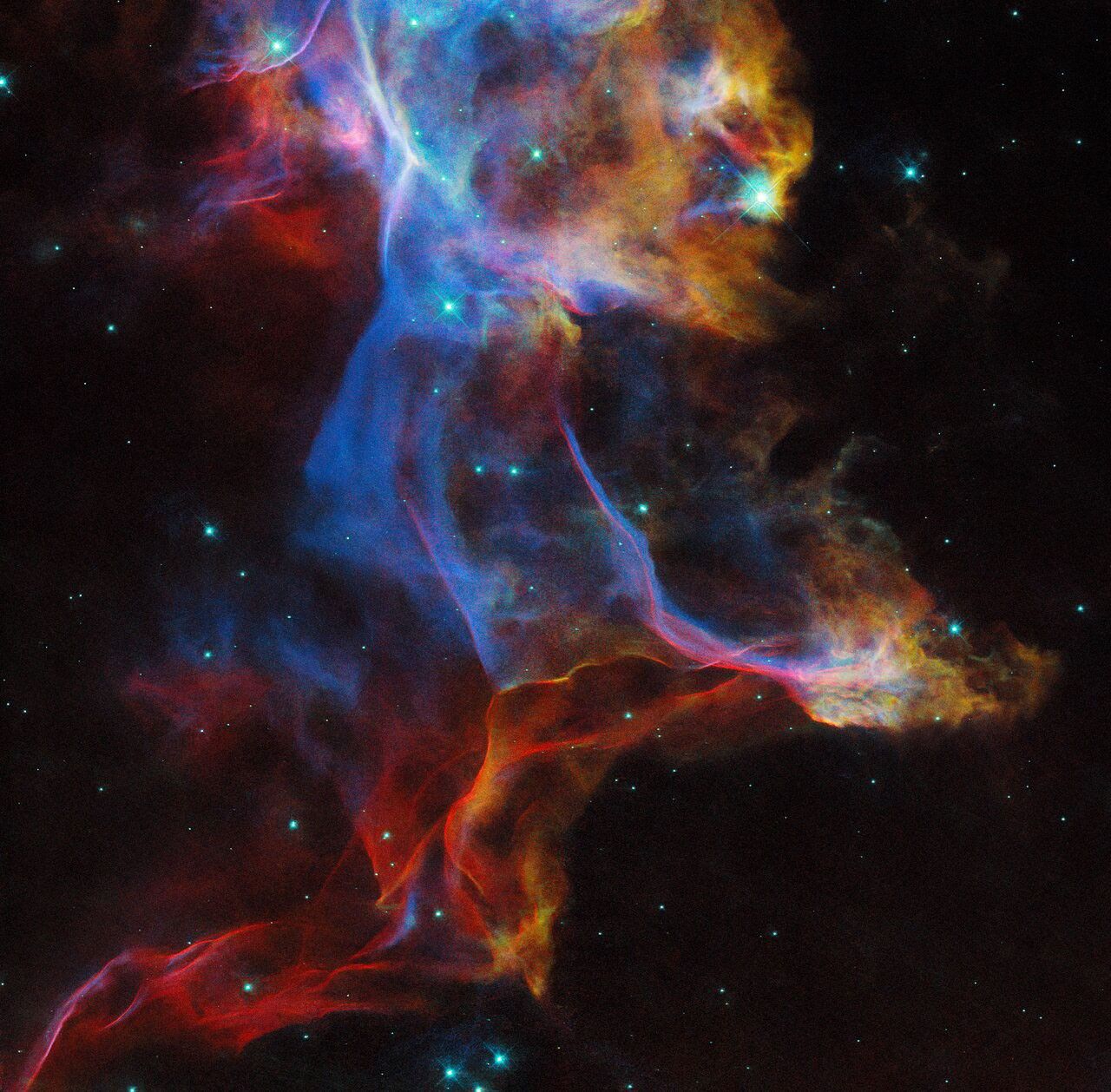
In about 5 billion years, our Sun will run out of fuel and expand, possibly engulfing Earth. These end stages of a star’s life can be utterly beautiful as is the case with this planetary nebula called the Helix Nebula. Astronomers study these objects by looking at all kinds of light. This series of images shows X-rays from Chandra, optical light data from Hubble, infrared data from the European Southern Observatory VISTA telescope, and ultraviolet data from GALEX of the Helix Nebula. At the center of the Helix is a white dwarf, a small dim star that remains after the star shed its outer layers.
X-ray: NASA/CXC/SAO/Univ Mexico/S. Estrada-Dorado et al.; Ultraviolet: NASA/JPL; Optical: NASA/ESA/STScI (M. Meixner)/NRAO (T.A. Rector); Infrared: ESO/VISTA/J. Emerson; Image Processing: NASA/CXC/SAO/K. Arcand;

A planet may have been destroyed by a white dwarf at the center of a planetary nebula — the first time this has been seen. As described in our latest press release, this would explain a mysterious X-ray signal that astronomers have detected from the Helix Nebula for over 40 years. The Helix is a planetary nebula, a late-stage star like our Sun that has shed its outer layers leaving a small dim star at its center called a white dwarf.

This composite image contains X-rays from Chandra (magenta), optical light data from Hubble (orange, light blue), infrared data from ESO (gold, dark blue), and ultraviolet data from GALEX (purple) of the Helix Nebula. Data from Chandra indicates that this white dwarf has destroyed a very closely orbiting planet.

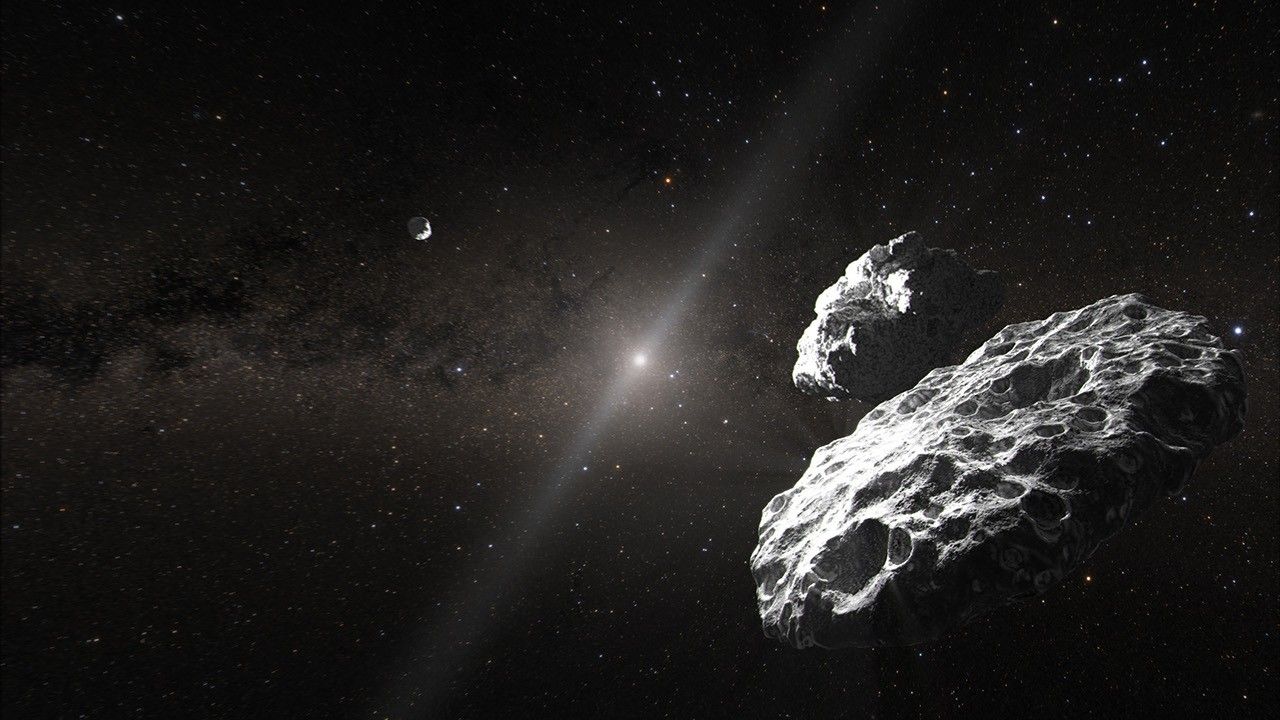
This artist's impression shows a planet (left) that has approached too close to a white dwarf (right) and been torn apart by tidal forces from the star. The white dwarf is in the center of a planetary nebula depicted by the blue gas in the background. The planet is part of a planetary system, which includes one planet in the upper left and another in the lower right. The besieged planet could have initially been a considerable distance from the white dwarf but then migrated inwards by interacting with the gravity of other planets in the system.
This artist’s impression shows a planet (left) that has approached too close to a white dwarf (right) and been torn apart by tidal forces from the star. The white dwarf is in the center of a planetary nebula depicted by the blue gas in the background. The planet is part of a planetary system, which includes one planet in the upper left and another in the lower right. The besieged planet could have initially been a considerable distance from the white dwarf but then migrated inwards by interacting with the gravity of other planets in the system.
CXC/SAO/M.Weiss

An artist’s concept shows a planet (left) that has approached too close to a white dwarf (right) and is being torn apart by tidal forces from the star. The white dwarf is in the center of a planetary nebula depicted by the blue gas in the background. The planet is part of a planetary system, which includes one planet in the upper left and another in the lower right. The besieged planet could have initially been a considerable distance from the white dwarf but then migrated inwards by interacting with the gravity of the other planets in the system.

Eventually debris from the planet will form a disk around the white dwarf and fall onto the star’s surface, creating the mysterious signal in X-rays that astronomers have detected for decades.

Dating back to 1980, X-ray missions, such as the Einstein Observatory and ROSAT telescope, have picked up an unusual reading from the center of the Helix Nebula. They detected highly energetic X-rays coming from the white dwarf at the center of the Helix Nebula named WD 2226-210, located only 650 light-years from Earth. White dwarfs like WD 2226-210 do not typically give off strong X-rays.

In about 5 billion years, our Sun will run out of fuel and expand, possibly engulfing Earth. These end stages of a star’s life can be utterly beautiful as is the case with this planetary nebula called the Helix Nebula.
X-ray: NASA/CXC/SAO/Univ Mexico/S. Estrada-Dorado et al.; Ultraviolet: NASA/JPL; Optical: NASA/ESA/STScI (M. Meixner)/NRAO (T.A. Rector); Infrared: ESO/VISTA/J. Emerson; Image Processing: NASA/CXC/SAO/K. Arcand;

A new study featuring the data from Chandra and XMM-Newton may finally have settled the question of what is causing these X-rays from WD 2226-210: this X-ray signal could be the debris from a destroyed planet being pulled onto the white dwarf. If confirmed, this would be the first case of a planet seen to be destroyed by the central star in a planetary nebula.

Observations by ROSAT, Chandra, and XMM-Newton between 1992 and 2002 show that the X-ray signal from the white dwarf has remained approximately constant in brightness during that time. The data, however, suggest there may be a subtle, regular change in the X-ray signal every 2.9 hours, providing evidence for the remains of a planet exceptionally close to the white dwarf.

Previously scientists determined that a Neptune-sized planet is in a very close orbit around the white dwarf — completing one revolution in less than three days. The researchers in this latest study conclude that there could have been a planet like Jupiter even closer to the star. The besieged planet could have initially been a considerable distance from the white dwarf but then migrated inwards by interacting with the gravity of other planets in the system. Once it approached close enough to the white dwarf the gravity of the star would have partially or completely torn the planet apart.

WD 2226-210 has some similarities in X-ray behavior to two other white dwarfs that are not inside planetary nebulas. One is possibly pulling material away from a planet companion, but in a more sedate fashion without the planet being quickly destroyed. The other white dwarf is likely dragging material from the vestiges of a planet onto its surface. These three white dwarfs may constitute a new class of variable, or changing, object.

A paper describing these results appears in The Monthly Notices of the Royal Astronomical Society and is available online. The authors of the paper are Sandino Estrada-Dorado (National Autonomous University of Mexico), Martin Guerrero (The Institute of Astrophysics of Andalusia in Spain), Jesús Toala (National Autonomous University of Mexico), Ricardo Maldonado (National Autonomous University of Mexico), Veronica Lora (National Autonomous University of Mexico), Diego Alejandro Vasquez-Torres (National Autonomous University of Mexico), and You-Hua Chu (Academia Sinica in Taiwan).

NASA’s Marshall Space Flight Center manages the Chandra program. The Smithsonian Astrophysical Observatory’s Chandra X-ray Center controls science operations from Cambridge, Massachusetts, and flight operations from Burlington, Massachusetts.

Read more from NASA’s Chandra X-ray Observatory.

Learn more about the Chandra X-ray Observatory and its mission here:

https://www.nasa.gov/chandra

https://chandra.si.edu

Visual Description

This release features two images; a composite image of the Helix Nebula, and an artist’s rendering of a planet’s destruction, which may be occurring in the nebula’s core.

The Helix Nebula is a cloud of gas ejected by a dying star, known as a white dwarf. In the composite image, the cloud of gas strongly resembles a creature’s eye. Here, a hazy blue cloud is surrounded by misty, concentric rings of pale yellow, rose pink, and blood orange. Each ring appears dusted with flecks of gold, particularly the outer edges of the eye-shape.

The entire image is speckled with glowing dots in blues, whites, yellows, and purples. At the center of the hazy blue gas cloud, a box has been drawn around some of these dots including a bright white dot with a pink outer ring, and a smaller white dot. The scene which may be unfolding inside this box has been magnified in the artist’s rendering.

The artist’s digital rendering shows a possible cause of the large white dot with the pink outer ring. A brilliant white circle near our upper right shows a white dwarf, the ember of a dying star. At our lower left, in the relative foreground of the rendering, is what remains of a planet. Here, the planet resembles a giant boulder shedding thousands of smaller rocks. These rocks flow off the planet’s surface, pulled back toward the white dwarf in a long, swooping tail. Glowing orange fault lines mar the surface of the crumbling planet. In our upper left and lower right, inside the hazy blue clouds which blanket the rendering, are two other, more distant planets. After the rocks from the planet start striking the surface of the white dwarf, X-rays should be produced.

News Media Contact

Megan Watzke
Chandra X-ray Center
Cambridge, Mass.
617-496-7998
mwatzke@cfa.harvard.edu

Lane Figueroa
Marshall Space Flight Center, Huntsville, Alabama
256-544-0034
lane.e.figueroa@nasa.gov

Powered by WPeMatico

Get The Details…
Lee Mohon