Physics, Eye Checks, and Workout Maintenance Fill Day After Spacewalk

Physics, Eye Checks, and Workout Maintenance Fill Day After Spacewalk

Roscosmos cosmonaut and Expedition 74 commander Sergey Kud-Sverchkov works outside the International Space Station in his Orlan spacesuit with red stripes. During the six-hour and five-minute spacewalk, Kud‑Sverchkov, along with Roscosmos cosmonaut Sergei Mikaev (out of frame), installed a solar radiation experiment and removed physics and microbiology research hardware from the orbital outpost.
Roscosmos cosmonaut Sergey Kud-Sverchkov works outside the International Space Station in his Orlan spacesuit with red stripes on May 27, 2026. During the six-hour and five-minute spacewalk, Kud‑Sverchkov, along with Roscosmos cosmonaut Sergei Mikaev (out of frame), installed a solar radiation experiment and removed physics and microbiology research hardware from the orbital outpost.
NASA

Space physics, eye checks, and workout gear maintenance filled Thursday’s schedule for the Expedition 74 crew members aboard the International Space Station on Thursday. Three cosmonauts are also cleaning up and relaxing following a spacewalk on Wednesday.

NASA flight engineer Chris Williams had a busy shift with a variety of research and medical duties on Thursday. Williams began his day replacing sample hardware inside the Destiny laboratory module’s Microgravity Science Glovebox to support semiconductor crystal research helping advance the commercial space economy and promoting Earth-based industries. Afterward, he took charge of eye exams and operated medical imaging gear to observe the retina, lens, and cornea of NASA flight engineers Jack Hathaway and Jessica Meir while doctors on the ground monitored. The biomedical data helps researchers detect space-caused vision issues and provide treatments to protect eye health in space.

Hathway began his shift inside the Tranquility module and inspected the advanced resistive exercise device that mimics free weights on Earth to maintain muscle and bone health in microgravity. Meir worked in the Columbus laboratory module and removed temporary hardware installed on the new European Enhanced Exploration Exercise Device (E4D) that is informing future exercise programs for long term missions farther away from Earth. Hathaway and Meir also partnered together throughout the day swapping cargo in and out of a SpaceX Dragon spacecraft that arrived at the orbital outpost on May 17.

ESA (European Space Agency) flight engineer Sophie Adenot’s first task of the day was swapping combustion research samples inside the Kibo laboratory module’s Electrostatic Levitation Furnace (ELF). The ELF enables the safe observation of materials exposed to extreme temperatures in microgravity for insights into thermophysical properties unobtainable on Earth. Next, Adenot participated in the E4D maintenance job and replaced cables that power the workout device then photographed the cable work for analysis by engineers on Earth.

Two cosmonauts who participated in a six-hour and five-minute spacewalk on Wednesday slept in on Thursday following their work outside the orbiting lab. After waking up mid-morning, station commander Sergey Kud-Sverchkov and flight engineer Sergei Mikaev cleaned their Orlan spacesuits, reconfigured the Poisk airlock for normal operations, and called down to Roscosmos mission controllers to recap their spacewalk activities from the previous day.

Roscosmos flight engineer Andrey Fedyaev, who monitored the spacewalkers and maneuvered the duo using the European robotic arm, also slept in Thursday. Following his long sleep shift, Fedyaev activated air purification units in the Zvezda and Nauka modules. Next, he returned Roscosmos space station systems and equipment back to their pre-spacewalk configurations.

Learn more about station activities by following the space station blog, @space_station on X, as well as the ISS Facebookand ISS Instagram accounts.

Get the latest from NASA delivered every week. Subscribe here.

Powered by WPeMatico

Get The Details…

Mark A. Garcia

New Landsat Science Team Holds First In-Person Meeting

New Landsat Science Team Holds First In-Person Meeting

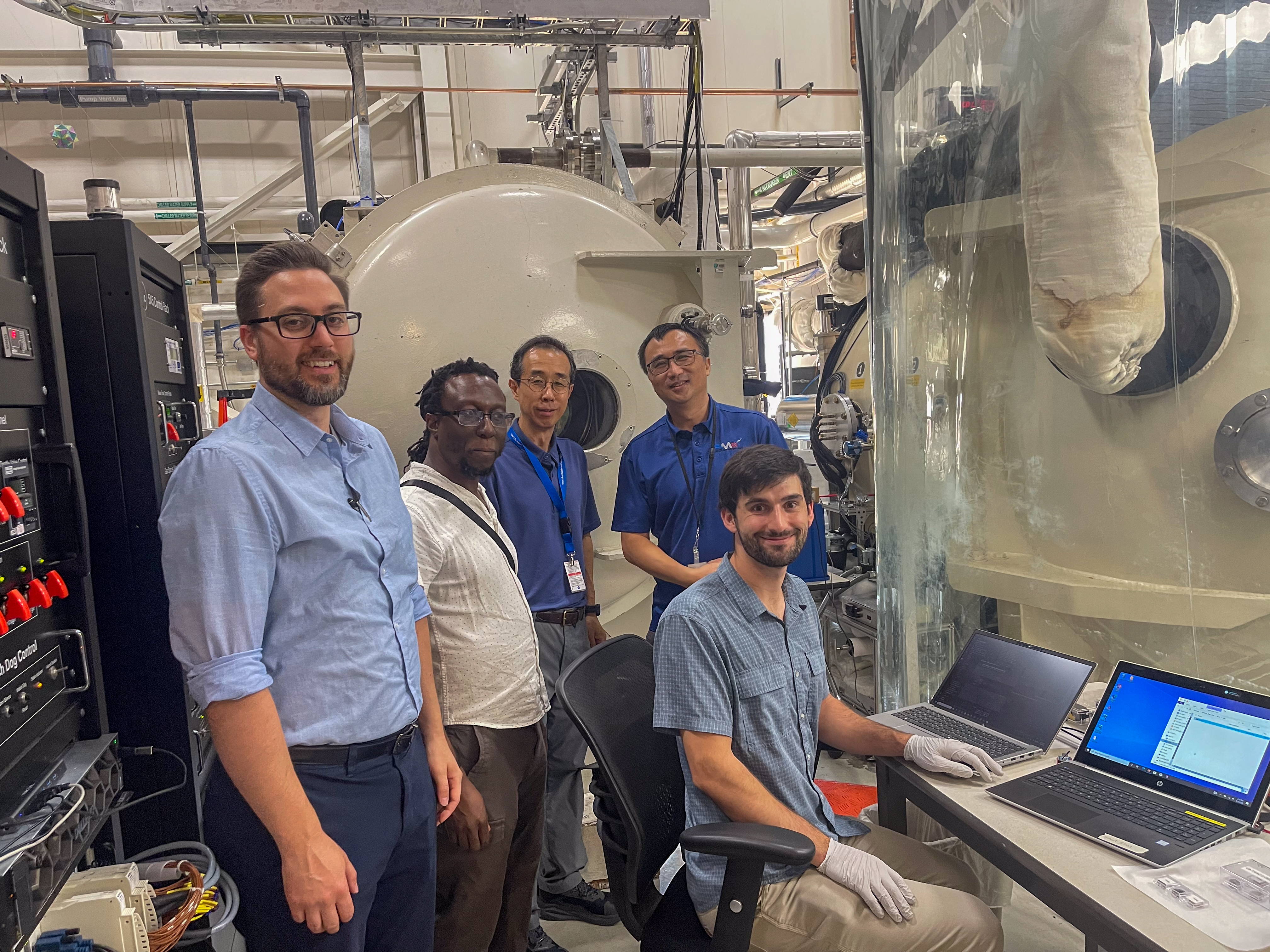
The 2026-2030 Landsat Science Team met for their first in-person meeting May 5-7, 2026 at the USGS EROS Center. 
Front Row:  Raquel De Los Reyes, Courtney Bright, Forrest Melton, Michael Campbell , Hankui Zhang
Standing: Greg Vaughan, Lin Yan, Mike Wulder, David Frantz, Kyle Knipper, Nimrod Carmon, Dean Hively, Yun Yang, Peter Strobl, David Roy, Morgan Crowley, Ned Bair, Phillip Dennison, Ryan O’Shea, Feng Gao, Medhavy Thankappan, Zhuosen Wang. Not pictured: Martha Anderson, Kimberlee Baldry, Eric Vermote. 
USGS

From May 5 to 7, the 2026–2030 Landsat Science Team met for their first in-person meeting at the Earth Resources Observation and Science (EROS) Center in Sioux Falls, SD. The three-day event, co-moderated by Landsat 8, 9, and 10 Project Scientist Chris Neigh, allowed leaders from USGS and NASA to begin work on a vision for the upcoming five-year period.

Attendees shared their current work and a vision for the future of the Landsat program. Participants received comprehensive status updates on the upcoming Landsat 10 project, the ongoing interagency and international collaboration on the Harmonized Landsat and Sentinel-2 (HLS) data products, and detailed plans for Collection 3 (C3).

Throughout the event, team members representing funded, international, and federal programs showcased the far-reaching impact of Landsat data across various Earth science disciplines, spanning snow cover mapping, atmospheric correction, water quality monitoring, evapotranspiration, agricultural applications, volcanic monitoring, and more.

The meeting culminated in focused breakout sessions, where experts drafted vital recommendations across four key technical areas to guide future mission data processing:

Surface Reflectance

The surface reflectance working group identified several priorities, including topography and adjacency corrections, Bidirectional Reflectance Distribution Function (BRDF) correction, and enhanced cloud masking with consistent approaches for HLS data products. Key recommendations included incorporating CMIX2 cloud masking results into future collections and mapping out C3 toolkit dependencies for user-applied corrections.

Temperature and Emissivity

Discussions on land surface temperature and emissivity centered heavily on maintaining archive consistency. The team recommended either maintaining native resolution or standardizing to 60 meters, with additional testing specifically for volcano studies. They endorsed using ASTER GED/CAMEL emissivity datasets and preparing for Landsat 10’s five thermal bands through ECOSTRESS comparison. They also called for better quantification of how atmospheric inputs impact harmonization efforts through collaboration between NASA’s Jet Propulsion Laboratory (JPL), RIT, and EROS.

Aquatic Reflectance 

Aquatic reflectance experts raised critical concerns regarding Landsat 10’s planned 18-day repeat cycle, noting that it severely limits the monitoring of highly dynamic processes such as harmful algal blooms. The group called for increased investment in validation infrastructure for inland waters coordinated with international CEOS efforts. They also strongly advised against pixelwise algorithm switching to prevent data discontinuities and emphasized the need for strict compliance with CEOS Aquatic Reflectance V2.0 standards.

Projections, Tiling, and the Pixel 

Finally, the group reviewing projection and tiling endorsed the USGS pixel grid nesting plan (which spans 10, 15, 20, 30, 60, and 120 meters). However, they recommended further trade analysis to optimize pixel replication errors, manage storage costs, and ensure proper coordination with Sentinel-2 Next Generation. The working group strongly recommended that if these complex grid issues remain unresolved, the program should maintain the Collection 2 approach (UTM and polar stereographic) while continuing to refine Analysis Ready Data (ARD) products for CONUS, Hawaii, and Alaska.

The recommendations generated during these breakout sessions created a roadmap for the new Landsat Science Team, ensuring that the global scientific community continues to receive high-quality, actionable Earth observation data through the end of the decade.

Explore More

New Landsat Science Team Holds First In-Person Meeting

3 min read

From May 5 to 7, the Landsat Science Team meeting convened at the Earth Resources Observation and Science (EROS) Center…

May 28, 2026
Article

A Shift in What’s Shaping U.S. Landscapes

5 min read

Wild disturbances are on the rise, while land disturbed by human activity has been decreasing.

May 28, 2026
Article

Released: NASA Goddard Issues Draft Request for Proposal for the Landsat 10 Spacecraft

2 min read

The Landsat 10 Spacecraft Draft Request for Proposal (DRFP) is available for review via SAM.gov.

May 27, 2026
Article

Powered by WPeMatico

Get The Details…

Curiosity Blog, Sols 4900-4907: Pasadena, We Have a Drill Sample!

Curiosity Blog, Sols 4900-4907: Pasadena, We Have a Drill Sample!

3 min read

Curiosity Blog, Sols 4900-4907: Pasadena, We Have a Drill Sample!

A close-up view of a circular hole drilled into the light brown, layered rock surface of Mars by the Curiosity rover. The dark, cylindrical hole is surrounded by a small, uneven mound of excavated, granular tailings. The surrounding terrain is dry and flat, covered in fine dust with subtle ridges and rocky textures.
NASA’s Mars rover Curiosity acquired this image, the first color look of the “Campo Marte” drill hole, on May 16, 2026. The rover captured the image using its right Mast Camera (Mastcam) — one of a pair of cameras mounted on the head atop the rover’s mast — on Sol 4897, or Martian day 4,897 of the Mars Science Laboratory mission, at 18:05:49 UTC.
NASA/JPL-Caltech/MSSS

Written by Abigail Fraeman, Deputy Project Scientist at Jet Propulsion Laboratory, California Institute of Technology

Earth planning date: Friday, May 22, 2026

I spent this past weekend eagerly awaiting the downlink from Mars that would show us the results of Curiosity’s drill attempt at “Campo Marte.” A few weeks ago, when Curiosity drilled the “Atacama” block, it had been quite the surprise to see the post-drill images arrive on Earth that showed the rover picking up the entire Atacama block along with the drill. After freeing ourselves from this pesky passenger, the team carefully assessed all the telemetry and imaging data we had collected to understand why the entanglement happened and to mitigate the chance of it happening again. We concluded it would be ok to try another drill in this general area, and nearby Campo Marte looked like a great target because it had all the right geologic features and was significantly bigger than Atacama. What a delight it was to see images, like the Mastcam shown above, streaming down on Saturday that showed Curiosity had successfully retracted its drill from the rock and collected some sample to analyze this time around!

On Monday, the team looked at the pinches of drilled rock powder, or portions, that we had dropped as a test onto part of Curiosity, an element of our standard post-drilling activities. You can also take a look at what we saw — here’s a picture of the rover before we did anything, and here’s what we saw after we delivered the first portion, and then the second portion. Can you make out the little bit of powder that appears between the sample deliveries? This test is important to make sure we’ll provide good samples to the analytical instruments inside our chassis, CheMin and SAM. Beyond their science operations value, I also love seeing these images because they remind me how powerful our laboratory instruments are. With just a little pinch of powder, no more than tens of milligrams, these laboratories can reveal incredibly detailed information about the composition of Martian rocks and give us huge new insights into the planet’s past climate and habitability.

We concluded the portions from Campo Marte looked similar to the drilled samples we’ve previously analyzed, so we went ahead and delivered one portion to CheMin in Monday’s plan. We use the results from CheMin to tailor our analysis of the samples with SAM, so after we saw the first CheMin results in the middle of the week, we made decisions about how to run SAM and then planned to analyze four portions with that instrument in today’s plan. We think we’ll be nearly out of sample after that, but it’s hard to know for sure (we only drilled to a depth of 28 millimeters here, about 1.1 inches, rather than our usual 35 millimeters, or 1.38 inches). To learn more, in this upcoming weekend’s plan, we’ll also repeat the sample drop-off test we did right after drilling, which will show us how many portions were left. We do a ton of testing with Curiosity’s twin drill here on Earth, but it’s always insightful to see how our hardware performs on Mars under the unique geologic and environmental conditions of that entirely different world. 

A rover sits on the hilly, orange Martian surface beneath a flat grey sky, surrounded by chunks of rock.
NASA’s Curiosity rover at the base of Mount Sharp
NASA/JPL-Caltech/MSSS

Share

Details

Last Updated
May 28, 2026

Related Terms

Powered by WPeMatico

Get The Details…

NASA Uses Mineralogical Marker to Understand Ancient Martian Climate

NASA Uses Mineralogical Marker to Understand Ancient Martian Climate

5 Min Read

NASA Uses Mineralogical Marker to Understand Ancient Martian Climate

This composite image looking toward the higher regions of Mount Sharp was taken on September 9, 2015, by NASA’s Curiosity rover. In the foreground — about 2 miles (3 kilometers) from the rover — is a long ridge teeming with hematite, an iron oxide. 
Credits:
NASA/JPL-Caltech/MSSS

While NASA imagery has shown evidence of ancient rivers and lakes on Mars that transitioned to dry dunes, uncertainty remains over the timing of the environmental changes that may have contributed to these shifts.

Now, data collected by NASA’s Curiosity rover has revealed that individual crystals in the iron oxide hematite can be used as a mineralogical marker of changes to Mars’ ancient climate. Because the shape and structure of these crystallites reflect the conditions – such as temperature and water presence – under which they were formed, they can serve as an indicator of when these changes occurred.

Scientists studied 20 samples collected by Curiosity across various elevations throughout Gale Crater for a paper published Thursday in Science. Gale Crater’s walls reveal Mars’ environmental history layer by layer, with deeper elevations capturing its earliest years. The team analyzed data from the rover’s Chemistry and Minerology (CheMin) instrument and discovered that hematite showed different crystallite sizes at different elevations. They also discovered that goethite, a mineral that typically forms alongside hematite, was absent in samples from lower elevations but still present in samples from higher elevations. This suggests that warm groundwater might have remained for up to 4.7 million years in the deepest layers of Gale Crater and that during much of this time, these long-lived aquifers could have been potentially habitable.

A 4-by-5 grid of close-up photos showing drilled circular holes in Martian rock and soil. Each image features a different drill site, displaying a range of textures and colors—from pale gray and bluish tones to warm tans, reds, and oranges. The holes vary in how cleanly they were bored, with some surrounded by fine dust and others by broken, chunky rock fragments, highlighting the geological diversity of the sampled terrain.
This image shows the 20 Curiosity drill samples from Gale Crater that were analyzed for this study.
Credit: NASA/JPL-Caltech/MSSS

“What we found was that warm and wet conditions were present for extended periods in buried rocks, despite Mars’ climate becoming colder,” said Tanya Peretyazhko, co-first author of the study and planetary scientist in the Astromaterials Research and Exploration Science division at NASA’s Johnson Space Center in Houston. “It means that deep in those rocks, those warmer conditions could have made for habitable conditions for much longer periods of time, provided that other essential factors were present.”

Iron oxides are considered indicators of water activity because they form in its presence. This study shows that hematite can also be a marker of climate changes based on its crystallite sizes and structures, which change under different temperatures. The scientists found that hematite crystallites from higher elevations in Gale Crater were less than 10 nanometers in size, while crystallites from lower locations were generally larger, reaching up to 65 nanometers. These findings aligned with the observations that samples from higher elevations contained both hematite and goethite, while lower elevation samples lacked goethite.

What we found was that warm and wet conditions were present for extended periods in buried rocks, despite Mars’ climate becoming colder.”

Tanya Peretyazhko

Tanya Peretyazhko

Planetary Scientist

They concluded that, under warmer conditions when the pH of water is neutral or slightly alkaline, goethite can transform into hematite. These warmer conditions also favored an increase in hematite crystallite size in the deeper layers of Gale Crater through a process known as Ostwald ripening, in which smaller crystallites dissolve and contribute to the growth of larger ones.

“This can tell you that the top layers were colder and didn’t have enough water, or the water presence was relatively short-lived, so the crystallites didn’t have sufficient time and conditions to grow in size,” said Peretyazhko. “But the lower layers had longstanding warm water that allowed those crystallites to grow.”

This illustration of Mars rover Curiosity is marked with the locations of 16 instruments installed in various spots on the rover. Scientists used the Chemistry and Minerology (CheMin) instrument to perform X-ray diffraction analysis on samples of powdered rock.
An artist rendering of the Curiosity rover with its scientific instruments labeled. Scientists used the Chemistry and Minerology (CheMin) instrument to perform X-ray diffraction analysis on samples of powdered rock.
Credit: NASA/JPL-Caltech/MSSS

A unique highlight of this study is that the data comes from Martian samples, rather than from theoretical modeling. Curiosity’s robotic arm delivered powdered rock to CheMin’s input funnel, where it was analyzed. “With CheMin’s X-ray diffraction patterns, we can look at the hematite crystal’s size and dimensions, information that that can’t be gathered from satellite analysis of the Martian surface.” said Tom Bristow, principal investigator of the CheMin instrument at NASA’s Ames Research Center in California’s Silicon Valley.

Ashwin Vasavada, Curiosity’s project scientist at NASA’s Jet Propulsion Laboratory in Southern California, said CheMin is capable of making measurements with extraordinary scientific fidelity.

“It doesn’t just tell you there is hematite,” Vasavada explained. “One can use the data to extract the size and shape of the hematite crystallites and the presence of other related minerals, all of which were necessary to produce this result.”

More about Curiosity

Curiosity was built by NASA JPL, which is managed by Caltech in Pasadena, California. NASA JPL leads the mission on behalf of NASA’s Science Mission Directorate in Washington as part of NASA’s Mars Exploration Program portfolio. CheMin, led by NASA Ames , is one of 10 science instruments aboard Curiosity and has a cross-country team of scientists, including researchers at NASA Ames, University of Arizona, California Institute of Technology, Planetary Science Institute, Carnegie Institution for Science, Lunar and Planetary Institute, JPL, NASA’s Goddard Space Flight Center in Greenbelt, Maryland, and NASA’s Johnson. The team combines expertise in mineralogy, petrology, materials science, astrobiology and soil science, with experience studying terrestrial, lunar and Martian rocks.

For more information on NASA’s Curiosity rover, visit:

https://science.nasa.gov/mission/msl-curiosity

Karen Fox / Alana Johnson
Headquarters, Washington
240-285-5155 / 202-672-4780
karen.c.fox@nasa.gov / alana.r.johnson@nasa.gov

Victoria Segovia
Johnson Space Center, Houston
281-483-5111
victoria.segovia@nasa.gov

About the Author

Rachel Barry

Rachel Barry

Keep Exploring

Discover More Topics From NASA

Powered by WPeMatico

Get The Details…