2024: NASA Armstrong Prepares for Future Innovative Research Efforts

2024: NASA Armstrong Prepares for Future Innovative Research Efforts

4 min read

Preparations for Next Moonwalk Simulations Underway (and Underwater)

NASA/Quincy Eggert

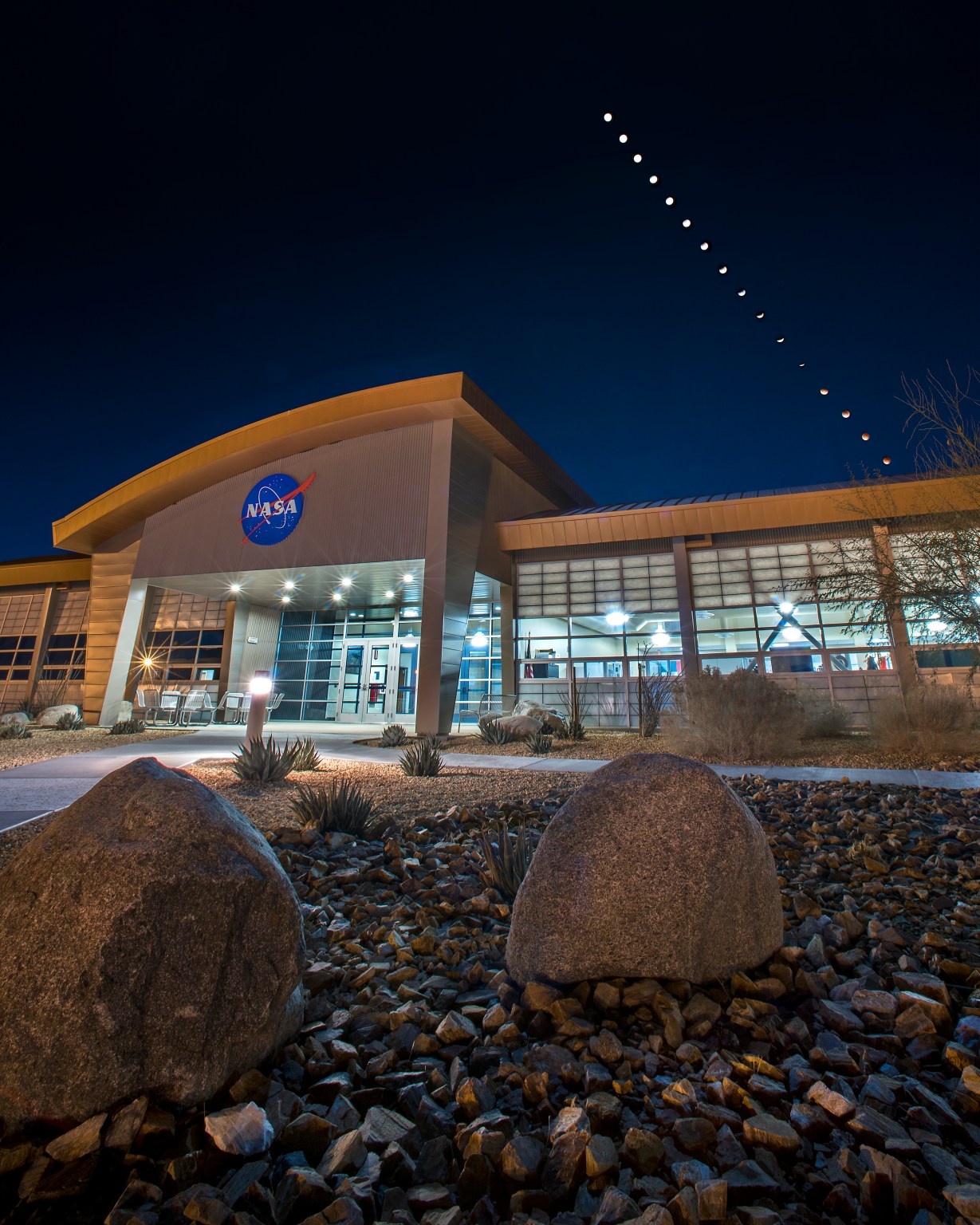
NASA’s Armstrong Flight Research Center in Edwards, California, is preparing today for tomorrow’s mission. Supersonic flight, next generation aircraft, advanced air mobility, climate changes, human exploration of space, and the next innovation are just some of the topics our researchers, engineers, and mission support teams focused on in 2024.

NASA Armstrong began 2024 with the public debut of the X-59 quiet supersonic research aircraft. Through the unique design of the X-59, NASA aims to reduce the sonic boom to make it much quieter, potentially opening the future to commercial supersonic flight over land. Throughout the first part of the year, NASA and international researchers studied air quality across Asia as part of a global effort to better understand the air we breathe. Later in the year, for the first time, a NASA-funded researcher conducted an experiment aboard a commercial suborbital rocket, studying how changes in gravity during spaceflight affect plant biology.

Here’s a look at more NASA Armstrong accomplishments throughout 2024:

  • Our simulation team began work on NASA’s X-66 simulator, which will use an MD-90 cockpit and allow pilots and engineers to run real-life scenarios in a safe environment.
  • NASA Armstrong engineers completed and tested a model of a truss-braced wing design, laying the groundwork for improved commercial aircraft aerodynamics.
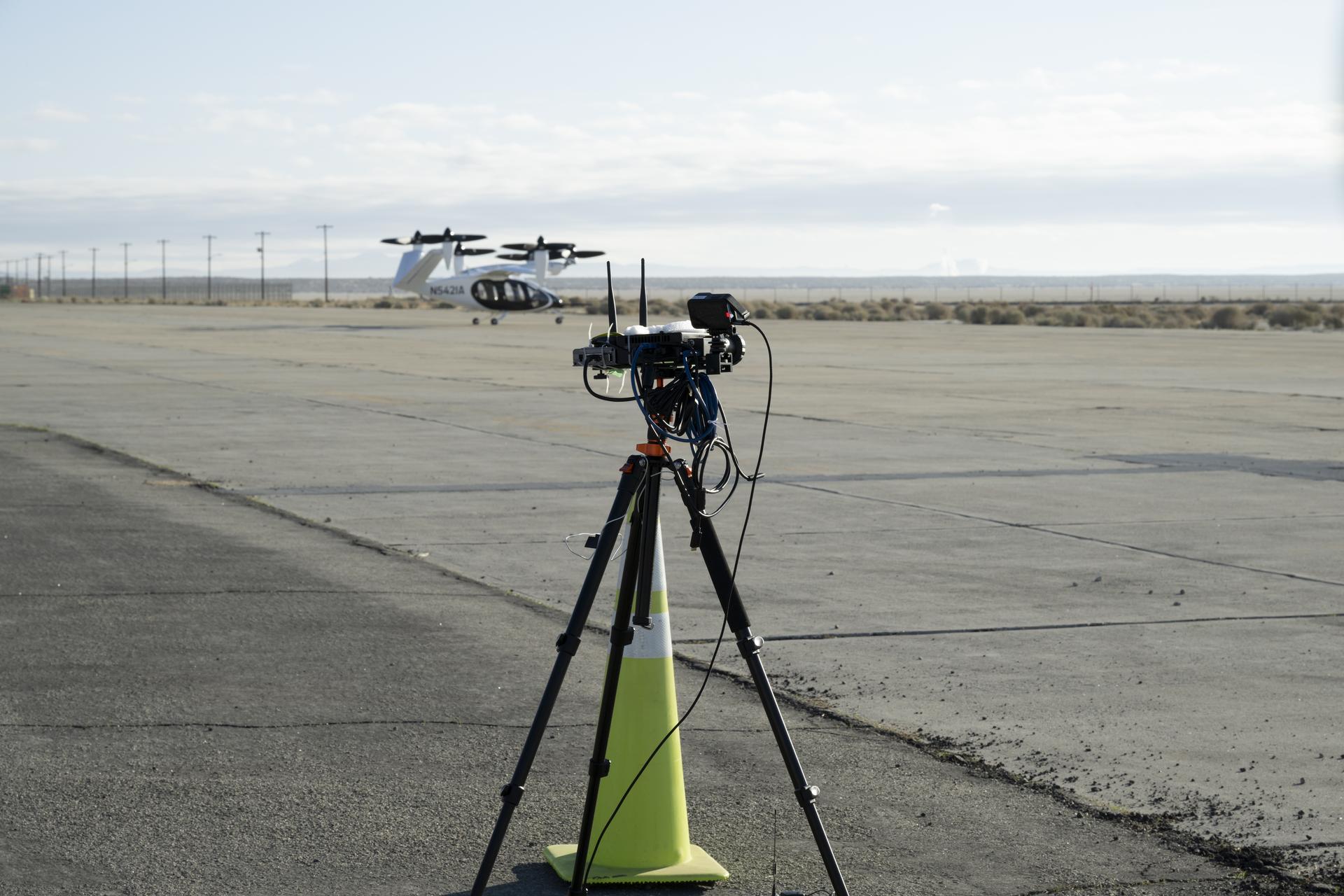
  • NASA’s Advanced Air Mobility mission and supporting projects worked with industry partners who are building innovative new aircraft like electric air taxis. We explored how these new designs may help passengers and cargo move between and inside cities efficiently. The team began testing with a custom virtual reality flight simulator to explore the air taxi ride experience. This will help designers create new aircraft with passenger comfort in mind. Researchers also tested a new technology that will help self-flying aircraft avoid hazards.
  • A NASA-developed computer software tool called OVERFLOW helped several air taxi companies predict aircraft noise and aerodynamic performance. This tool allows manufacturers to see how new design elements would perform, saving the aerospace industry time and money.
  • Our engineers designed a camera pod with sensors at NASA Armstrong to help advance computer vision for autonomous aviation and flew this pod at NASA’s Kennedy Space Center in Florida.
  • NASA’s Quesst mission marked a major milestone with the start of tests on the engine that will power the quiet supersonic X-59 experimental aircraft.
  • In February and March, NASA joined international researchers in Asia to investigate pollution sources. The now retired DC-8 and NASA Langley Gulfstream III aircraft collected air measurements over the Philippines, South Korea, Malaysia, Thailand, and Taiwan. Combined with ground and satellite observations, these measurements continue to enrich global discussions about pollution origins and solutions.
  • The Gulfstream IV joined NASA Armstrong’s fleet of airborne science platforms. Our teams modified the aircraft to accommodate a next-generation science instrument that will collect terrain information of the Earth in a more capable, versatile, and maintainable way.
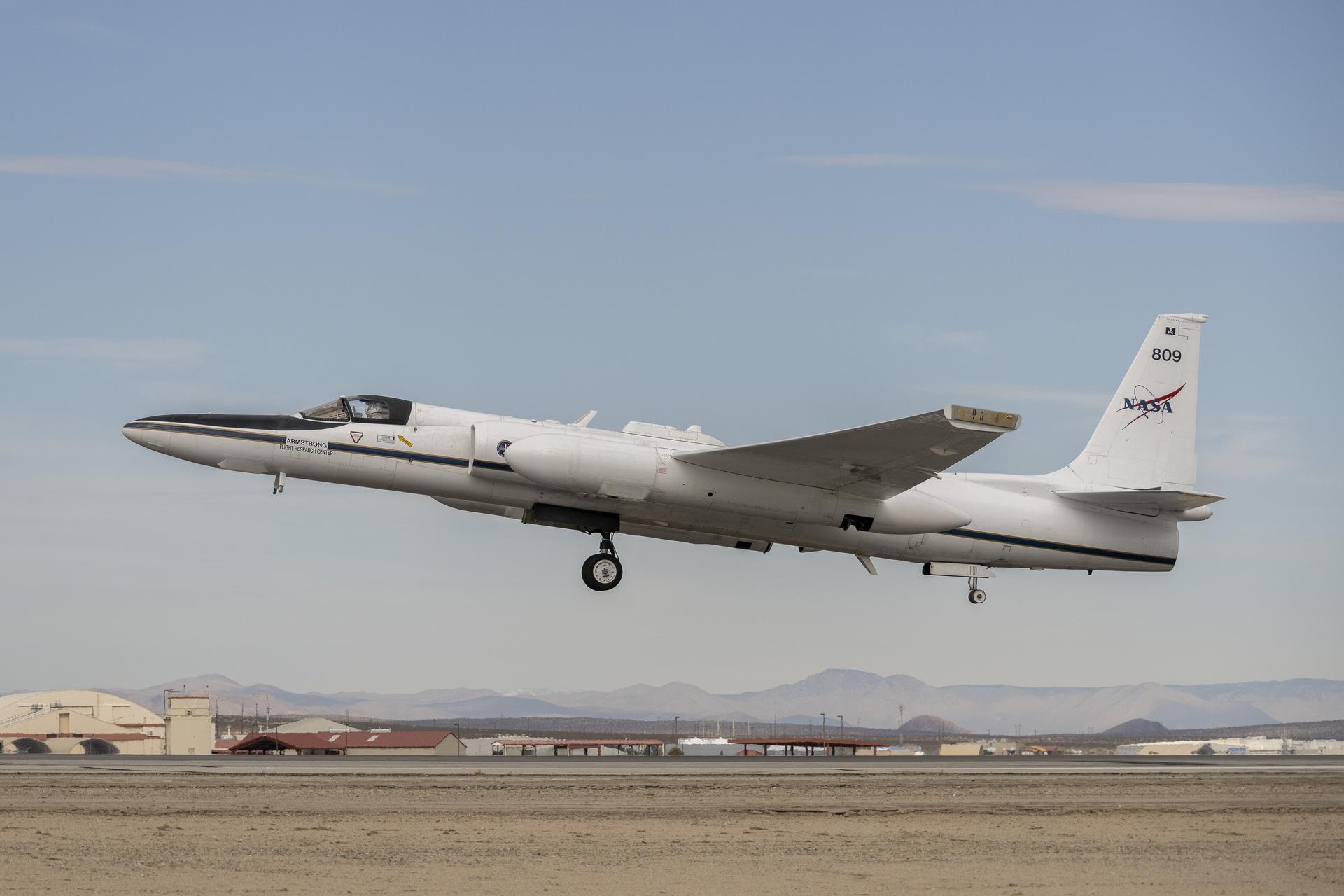
  • The ER-2 and the King Air supported the development of spaceborne instruments by testing them in suborbital settings. On the Plankton, Aerosol, Cloud, ocean Ecosystem Postlaunch Airborne eXperiment mission (PACE-PAX), the ER-2 validated data collected by the PACE satellite about the ocean, atmosphere, and surfaces.
  • Operating over several countries, researchers onboard NASA’s C-20A collected data and images of Earth’s surface to understand global ecosystems, natural hazards, and land surface changes. Following Hurricane Milton, the C-20A flew over affected areas to collect data that could help inform disaster response in the future.
  • We also tested nighttime precision landing technologies that safely deliver spacecraft to hazardous locations with limited visibility.
  • With the goal to improve firefighter safety, NASA, the U.S. Forest Service, and industry tested a cell tower in the sky. The system successfully provided persistent cell coverage, enabling real-time communication between firefighters and command posts.
  • Using a 1960s concept wingless, powered aircraft design, we built and tested an atmospheric probe to better and more economically explore giant planets.
  • NASA Armstrong hosted its first Ideas to Flight workshop, where subject matter experts shared how to accelerate research ideas and technology development through flight.

These are just some of NASA Armstrong’s many innovative research efforts that support NASA’s mission to explore the secrets of the universe for the benefit of all.

Powered by WPeMatico

Get The Details…
Dede Dinius

NASA’s Webb Reveals Smallest Asteroids Yet Found in Main Asteroid Belt

NASA’s Webb Reveals Smallest Asteroids Yet Found in Main Asteroid Belt

Asteroid Belt
Illustration of the main asteroid belt, orbiting the Sun between Mars and Jupiter
NASA

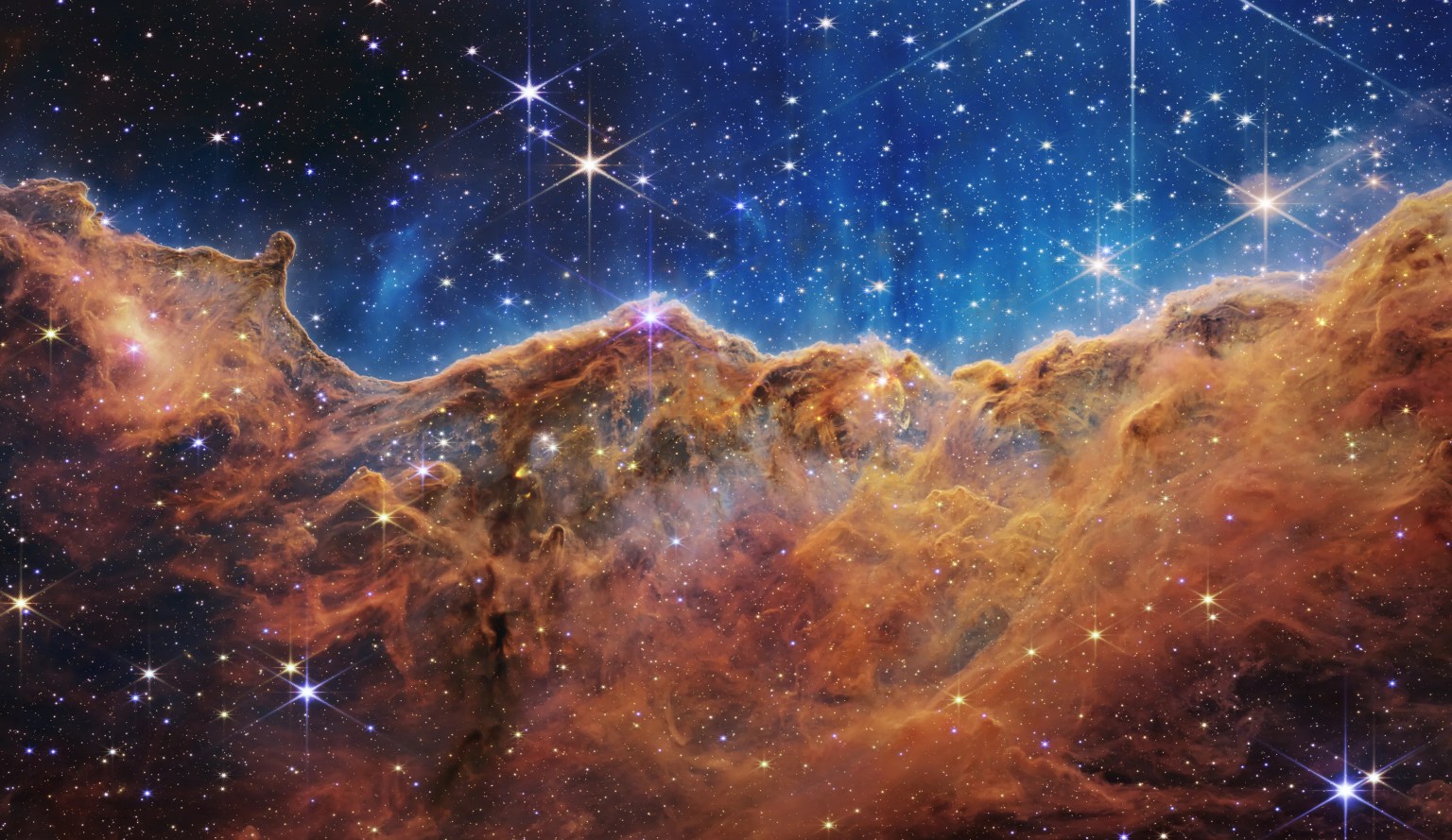
NASA’s powerful James Webb Space Telescope includes asteroids on its list of objects studied and secrets revealed. 

A team led by researchers at the Massachusetts Institute of Technology (MIT) in Cambridge repurposed Webb’s observations of a distant star to reveal a population of small asteroids — smaller than astronomers had ever detected orbiting the Sun in the main asteroid belt between Mars and Jupiter.

The 138 new asteroids range from the size of a bus to the size of a stadium — a size range in the main belt that has not been observable with ground-based telescopes. Knowing how many main belt asteroids are in different size ranges can tell us something about how asteroids have been changed over time by collisions. That process is related to how some of them have escaped the main belt over the solar system’s history, and even how meteorites end up on Earth.  

“We now understand more about how small objects in the asteroid belt are formed and how many there could be,” said Tom Greene, an astrophysicist at NASA’s Ames Research Center in California’s Silicon Valley and co-author on the paper presenting the results. “Asteroids this size likely formed from collisions between larger ones in the main belt and are likely to drift towards the vicinity of Earth and the Sun.”

Insights from this research could inform the work of the Asteroid Threat Assessment Project at Ames. ATAP works across disciplines to support NASA’s Planetary Defense Coordination Office by studying what would happen in the case of an Earth impact and modeling the associated risks. 

“It’s exciting that Webb’s capabilities can be used to glean insights into asteroids,” said Jessie Dotson, an astrophysicist at Ames and member of ATAP. “Understanding the sizes, numbers, and evolutionary history of smaller main belt asteroids provides important background about the near-Earth asteroids we study for planetary defense.”

Illustration of the James Webb Space Telescope
NASA

The team that made the asteroid detections, led by research scientist Artem Burdanov and professor of planetary science Julien de Wit, both of MIT, developed a method to analyze existing Webb images for the presence of asteroids that may have been inadvertently “caught on film” as they passed in front of the telescope. Using the new image processing technique, they studied more than 10,000 images of the star TRAPPIST-1, originally taken to search for atmospheres around planets orbiting the star, in the search for life beyond Earth. 

Asteroids shine more brightly in infrared light, the wavelength Webb is tuned to detect, than in visible light, helping reveal the population of main belt asteroids that had gone unnoticed until now. NASA will also take advantage of that infrared glow with an upcoming mission, the Near-Earth Object (NEO) Surveyor. NEO Surveyor is the first space telescope specifically designed to hunt for near-Earth asteroids and comets that may be potential hazards to Earth.

The paper presenting this research, “Detections of decameter main-belt asteroids with JWST,” was published Dec. 9 in Nature.

The James Webb Space Telescope is the world’s premier space science observatory. Webb is solving mysteries in our solar system, looking beyond to distant worlds around other stars, and probing the mysterious structures and origins of our universe and our place in it. Webb is an international program led by NASA with its partners, ESA (European Space Agency) and CSA (Canadian Space Agency).

For news media:

Members of the news media interested in covering this topic should reach out to the NASA Ames newsroom.

Powered by WPeMatico

Get The Details…
Aaron McKinnon

Lab Work Digs Into Gullies Seen on Giant Asteroid Vesta by NASA’s Dawn

Lab Work Digs Into Gullies Seen on Giant Asteroid Vesta by NASA’s Dawn

NASA’s Dawn spacecraft captured this image of Vesta as it left the giant asteroid’s orbit in 2012. The framing camera was looking down at the north pole, which is in the middle of the image.
NASA/JPL-Caltech/UCLA/MPS/DLR/IDA

Known as flow formations, these channels could be etched on bodies that would seem inhospitable to liquid because they are exposed to the extreme vacuum conditions of space.

Pocked with craters, the surfaces of many celestial bodies in our solar system provide clear evidence of a 4.6-billion-year battering by meteoroids and other space debris. But on some worlds, including the giant asteroid Vesta that NASA’s Dawn mission explored, the surfaces also contain deep channels, or gullies, whose origins are not fully understood.

A prime hypothesis holds that they formed from dry debris flows driven by geophysical processes, such as meteoroid impacts, and changes in temperature due to Sun exposure. A recent NASA-funded study, however, provides some evidence that impacts on Vesta may have triggered a less-obvious geologic process: sudden and brief flows of water that carved gullies and deposited fans of sediment. By using lab equipment to mimic conditions on Vesta, the study, which appeared in Planetary Science Journal, detailed for the first time what the liquid could be made of and how long it would flow before freezing.

Although the existence of frozen brine deposits on Vesta is unconfirmed, scientists have previously hypothesized that meteoroid impacts could have exposed and melted ice that lay under the surface of worlds like Vesta. In that scenario, flows resulting from this process could have etched gullies and other surface features that resemble those on Earth.

To explore potential explanations for deep channels, or gullies, seen on Vesta, scientists used JPL’s Dirty Under-vacuum Simulation Testbed for Icy Environments, or DUSTIE, to simulate conditions on the giant asteroid that would occur after meteoroids strike the surface.
NASA/JPL-Caltech

But how could airless worlds — celestial bodies without atmospheres and exposed to the intense vacuum of space — host liquids on the surface long enough for them to flow? Such a process would run contrary to the understanding that liquids quickly destabilize in a vacuum, changing to a gas when the pressure drops.

“Not only do impacts trigger a flow of liquid on the surface, the liquids are active long enough to create specific surface features,” said project leader and planetary scientist Jennifer Scully of NASA’s Jet Propulsion Laboratory in Southern California, where the experiments were conducted. “But for how long? Most liquids become unstable quickly on these airless bodies, where the vacuum of space is unyielding.”

The critical component turns out to be sodium chloride — table salt. The experiments found that in conditions like those on Vesta, pure water froze almost instantly, while briny liquids stayed fluid for at least an hour. “That’s long enough to form the flow-associated features identified on Vesta, which were estimated to require up to a half-hour,” said lead author Michael J. Poston of the Southwest Research Institute in San Antonio.

Launched in 2007, the Dawn spacecraft traveled to the main asteroid belt between Mars and Jupiter to orbit Vesta for 14 months and Ceres for almost four years. Before ending in 2018, the mission uncovered evidence that Ceres had been home to a subsurface reservoir of brine and may still be transferring brines from its interior to the surface. The recent research offers insights into processes on Ceres but focuses on Vesta, where ice and salts may produce briny liquid when heated by an impact, scientists said.

Re-creating Vesta

To re-create Vesta-like conditions that would occur after a meteoroid impact, the scientists relied on a test chamber at JPL called the Dirty Under-vacuum Simulation Testbed for Icy Environments, or DUSTIE. By rapidly reducing the air pressure surrounding samples of liquid, they mimicked the environment around fluid that comes to the surface. Exposed to vacuum conditions, pure water froze instantly. But salty fluids hung around longer, continuing to flow before freezing.

The brines they experimented with were a little over an inch (a few centimeters) deep; scientists concluded the flows on Vesta that are yards to tens of yards deep would take even longer to refreeze.

The researchers were also able to re-create the “lids” of frozen material thought to form on brines. Essentially a frozen top layer, the lids stabilize the liquid beneath them, protecting it from being exposed to the vacuum of space — or, in this case the vacuum of the DUSTIE chamber — and helping the liquid flow longer before freezing again.

This phenomenon is similar to how on Earth lava flows farther in lava tubes than when exposed to cool surface temperatures. It also matches up with modeling research conducted around potential mud volcanoes on Mars and volcanoes that may have spewed icy material from volcanoes on Jupiter’s moon Europa.

“Our results contribute to a growing body of work that uses lab experiments to understand how long liquids last on a variety of worlds,” Scully said.

Find more information about NASA’s Dawn mission here:

https://science.nasa.gov/mission/dawn/

News Media Contacts

Gretchen McCartney
Jet Propulsion Laboratory, Pasadena, Calif.
818-287-4115
gretchen.p.mccartney@jpl.nasa.gov 

Karen Fox / Molly Wasser
NASA Headquarters, Washington
202-358-1600
karen.c.fox@nasa.gov / molly.l.wasser@nasa.gov

2024-178

Share

Details

Last Updated

Dec 20, 2024

Powered by WPeMatico

Get The Details…
Naomi Hartono

Avalanches, Icy Explosions, and Dunes: NASA Is Tracking New Year on Mars

Avalanches, Icy Explosions, and Dunes: NASA Is Tracking New Year on Mars

5 min read

Preparations for Next Moonwalk Simulations Underway (and Underwater)

It’s a new year on Mars, and while New Year’s means winter in Earth’s northern hemisphere, it’s the start of spring in the same region of the Red Planet. And that means ice is thawing, leading to all sorts of interesting things. JPL research scientist Serina Diniega explains. NASA/JPL-Caltech

Instead of a winter wonderland, the Red Planet’s northern hemisphere goes through an active — even explosive — spring thaw.

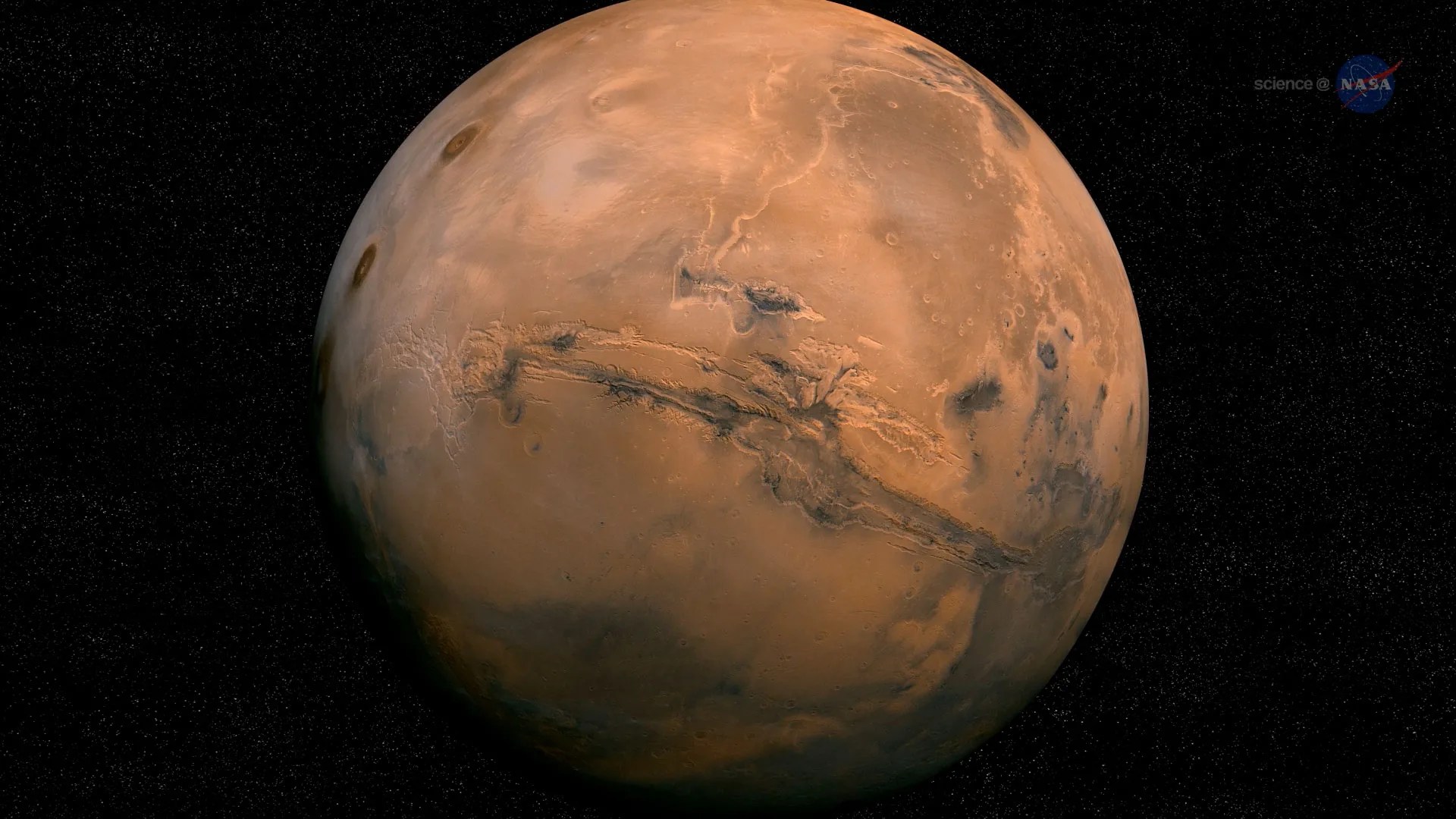
While New Year’s Eve is around the corner here on Earth, Mars scientists are ahead of the game: The Red Planet completed a trip around the Sun on Nov. 12, 2024, prompting a few researchers to raise a toast.

But the Martian year, which is 687 Earth days, ends in a very different way in the planet’s northern hemisphere than it does in Earth’s northern hemisphere: While winter’s kicking in here, spring is starting there. That means temperatures are rising and ice is thinning, leading to frost avalanches crashing down cliffsides, carbon dioxide gas exploding from the ground, and powerful winds helping reshape the north pole.

“Springtime on Earth has lots of trickling as water ice gradually melts. But on Mars, everything happens with a bang,” said Serina Diniega, who studies planetary surfaces at NASA’s Jet Propulsion Laboratory in Southern California.

Mars’ wispy atmosphere doesn’t allow liquids to pool on the surface, like on Earth. Instead of melting, ice sublimates, turning directly into a gas. The sudden transition in spring means a lot of violent changes as both water ice and carbon dioxide ice — dry ice, which is much more plentiful on Mars than frozen water — weaken and break.

“You get lots of cracks and explosions instead of melting,” Diniega said. “I imagine it gets really noisy.”

Using the cameras and other sensors aboard NASA’s Mars Reconnaissance Orbiter (MRO), which launched in 2005, scientists study all this activity to improve their understanding of the forces shaping the dynamic Martian surface. Here’s some of what they track.

Frost Avalanches

In 2015, MRO’s High-Resolution Imaging Science Experiment (HiRISE) camera captured a 66-foot-wide (20-meter-wide) chunk of carbon dioxide frost in freefall. Chance observations like this are reminders of just how different Mars is from Earth, Diniega said, especially in springtime, when these surface changes are most noticeable.

66-foot-wide (20-meter-wide) chunk of carbon dioxide frost on Mars
Martian spring involves lots of cracking ice, which led to this 66-foot-wide (20-meter-wide) chunk of carbon dioxide frost captured in freefall by the HiRISE camera aboard NASA’s Mars Reconnaissance Orbiter in 2015
NASA/JPL-Caltech/University of Arizona

“We’re lucky we’ve had a spacecraft like MRO observing Mars for as long as it has,” Diniega said. “Watching for almost 20 years has let us catch dramatic moments like these avalanches.”

Gas Geysers

Diniega has relied on HiRISE to study another quirk of Martian springtime: gas geysers that blast out of the surface, throwing out dark fans of sand and dust. These explosive jets form due to energetic sublimation of carbon dioxide ice. As sunlight shines through the ice, its bottom layers turn to gas, building pressure until it bursts into the air, creating those dark fans of material.

Light shines through carbon dioxide ice on Mars
As light shines through carbon dioxide ice on Mars, it heats up its bottom layers, which, rather than melting into a liquid, turn into gas. The buildup gas eventually results in explosive geysers that toss dark fans of debris on to the surface.
NASA/JPL-Caltech/University of Arizona

But to see the best examples of the newest fans, researchers will have to wait until December 2025, when spring starts in the southern hemisphere. There, the fans are bigger and more clearly defined.

Spiders

Another difference between ice-related action in the two hemispheres: Once all the ice around some northern geysers has sublimated in summer, what’s left behind in the dirt are scour marks that, from space, look like giant spider legs. Researchers recently re-created this process in a JPL lab.

Spider-shaped features called araneiform terrain are found in the southern hemisphere of Mars
Sometimes, after carbon dioxide geysers have erupted from ice-covered areas on Mars, they leave scour marks on the surface. When the ice is all gone by summer, these long scour marks look like the legs of giant spiders.
NASA/JPL-Caltech/University of Arizona

Powerful Winds

For Isaac Smith of Toronto’s York University, one of the most fascinating subjects in springtime is the Texas-size ice cap at Mars’ north pole. Etched into the icy dome are swirling troughs, revealing traces of the red surface below. The effect is like a swirl of milk in a café latte.

“These things are enormous,” Smith said, noting that some are a long as California. “You can find similar troughs in Antarctica but nothing at this scale.”

Ice cap of Mars’ north pole
As temperatures rise, powerful winds kick up that carve deep troughs into the ice cap of Mars’ north pole. Some of these troughs are as long as California, and give the Martian north pole its trademark swirls. This image was captured by NASA’s now-inactive Mars Global Surveyor.
NASA/JPL-Caltech/MSSS

Fast, warm wind has carved the spiral shapes over eons, and the troughs act as channels for springtime wind gusts that become more powerful as ice at the north pole starts to thaw. Just like the Santa Ana winds in Southern California or the Chinook winds in the Rocky Mountains, these gusts pick up speed and temperature as they ride down the troughs — what’s called an adiabatic process.

Wandering Dunes

The winds that carve the north pole’s troughs also reshape Mars’ sand dunes, causing sand to pile up on one side while removing sand from the other side. Over time, the process causes dunes to migrate, just as it does with dunes on Earth.

This past September, Smith coauthored a paper detailing how carbon dioxide frost settles on top of polar sand dunes during winter, freezing them in place. When the frost all thaws away in the spring, the dunes begin migrating again.

Martian dunes in Mars’ northern hemisphere
Surrounded by frost, these Martian dunes in Mars’ northern hemisphere were captured from above by NASA’s Mars Reconnaissance Orbiter using its HiRISE camera on Sept. 8, 2022.
NASA/JPL-Caltech/University of Arizona

Each northern spring is a little different, with variations leading to ice sublimating faster or slower, controlling the pace of all these phenomena on the surface. And these strange phenomena are just part of the seasonal changes on Mars: the southern hemisphere has its own unique activity.

More About MRO

The University of Arizona, in Tucson, operates HiRISE, which was built by Ball Aerospace & Technologies Corp., in Boulder, Colorado. NASA’s Jet Propulsion Laboratory, a division of Caltech in Pasadena, California, manages the Mars Reconnaissance Orbiter Project for NASA’s Science Mission Directorate, Washington.

For more information, visit:

https://science.nasa.gov/mission/mars-reconnaissance-orbiter

News Media Contacts

Andrew Good
Jet Propulsion Laboratory, Pasadena, Calif.
818-393-2433
andrew.c.good@jpl.nasa.gov

Karen Fox / Molly Wasser
NASA Headquarters, Washington
202-358-1600
karen.c.fox@nasa.gov / molly.l.wasser@nasa.gov

2024-177

Share

Details

Last Updated

Dec 20, 2024

Powered by WPeMatico

Get The Details…
Anthony Greicius

NASA Runs X-59 Engine with Maximum Afterburner for First Time

NASA Runs X-59 Engine with Maximum Afterburner for First Time

1 min read

Preparations for Next Moonwalk Simulations Underway (and Underwater)

The nearly 100-foot-long X-59 sits partially inside a large run stall, with the rear of the aircraft and its engine extending outside the run stall’s open bay door. Flames are visible from the engine, producing additional thrust during full afterburner tests.
NASA’s X-59 quiet supersonic research aircraft completed its first maximum afterburner test at Lockheed Martin’s Skunk Works facility in Palmdale, California. This full-power test, during which the engine generates additional thrust, validates the additional power needed for meeting the testing conditions of the aircraft. The X-59 is the centerpiece of NASA’s Quesst mission, which aims to overcome a major barrier to supersonic flight over land by reducing the noise of sonic booms.
Lockheed Martin Corporation/Garry Tice

NASA completed the first maximum afterburner engine run test on its X-59 quiet supersonic research aircraft on Dec. 12. The ground test, conducted at Lockheed Martin’s Skunk Works facility in Palmdale, California, marks a significant milestone as the X-59 team progresses toward flight.

An afterburner is a component of some jet engines that generates additional thrust. Running the engine, an F414-GE-100, with afterburner will allow the X-59 to meet its supersonic speed requirements. The test demonstrated the engine’s ability to operate within temperature limits and with adequate airflow for flight. It also showed the engine’s ability to operate in sync with the aircraft’s other subsystems.

The X-59 is the centerpiece of NASA’s Quesst mission, which seeks to solve one of the major barriers to supersonic flight over land by making sonic booms quieter. The X-59’s first flight is expected to occur in 2025.

Powered by WPeMatico

Get The Details…
Dede Dinius