Station Crew Works Science Installs and Spacewalk Cleanup Before Holidays
NASA astronauts Don Pettit and Suni Williams pose for a fun holiday season portrait while speaking on a ham radio inside the Columbus laboratory module.
Science hardware installations wrapped up the week for the Expedition 72 crew members aboard the International Space Station. The cosmonauts also slept in on Friday following a spacewalk the day before.
NASA Flight Engineers Don Pettit and Nick Hague finalized the installation of the European Enhanced Exploration Exercise Device that provides advanced bicycling, rowing, and resistive capabilities in the Columbus laboratory module. The astronauts checked the fit of the workout gear’s vibration isolation system, installed grounding brackets, greased rails, and tested the device’s motion. The small and compact futuristic exercise hardware will be evaluated in the orbital outpost’s microgravity environment before being used on longer term missions to the Moon, Mars, and beyond.
Hague also joined Commander Suni Williams and Flight Engineer Butch Wilmore, both NASA astronauts, in the Tranquility module for more installation work. The trio outfitted the Nanoracks Bishop airlock with a variety of hardware after it was berthed to Tranquility and pressurized following robotic transfers for scientific work at the beginning of the week. Wilmore completed the Bishop configurations at the end of the day after he installed computer hardware.
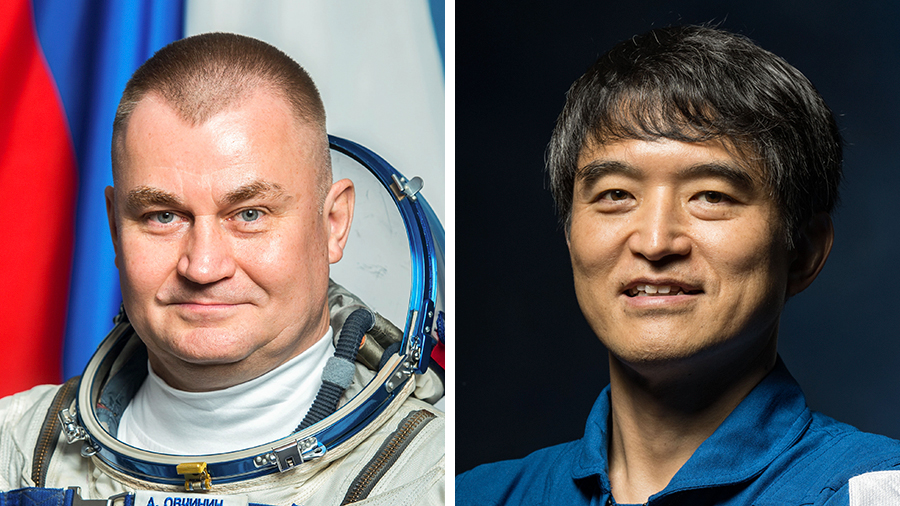
The orbiting lab’s three cosmonauts from Roscosmos slept in on Friday following a seven-hour and 17-minute spacewalk on Thursday. Flight Engineers Alexey Ovchinin and Ivan Vagner installed a celestial X-ray investigation and removed older experiments for disposal during the spacewalk. Flight Engineer Aleksandr Gorbunov remained inside the space station monitoring the spacewalkers and maneuvering Ovchinin with the European robotic arm (ERA). The trio spent Friday cleaning spacesuits and returning the ERA to its stowage position on the Nauka science module.
The seven astronauts and cosmonauts will spend Christmas and New Year’s Day orbiting Earth taking time to relax, open gifts, share a meal, and talk to family. The orbital septet will go into 2025 continuing more advanced space research benefitting humans on and off the Earth. The next space station blog is planned to publish on Jan. 6.
NASA Welcomes Liechtenstein as Newest Artemis Accords Signatory
From left to right, Ambassador of the Principality of Liechtenstein to the United States of America Georg Sparber, Director of the Office for Communications of the Principality of Liechtenstein Dr. Rainer Schnepfleitner, NASA Deputy Administrator Pam Melroy, and Ambassador Extraordinary and Plenipotentiary to the Swiss Confederation and to the Principality of Liechtenstein Scott Miller, pose for a group photo during an Artemis Accords signing ceremony, Friday, Dec. 20, 2024, at the Mary W. Jackson NASA Headquarters building in Washington. The Principality of Liechtenstein is the 52nd country to sign the Artemis Accords, which establish a practical set of principles to guide space exploration cooperation among nations participating in NASA’s Artemis program.
Credit: NASA/Keegan Barber
Liechtenstein signed the Artemis Accords Friday during a ceremony hosted by NASA Deputy Administrator Pam Melroy at the agency’s headquarters in Washington, becoming the 52nd nation to commit to the responsible exploration of space for all humanity.
“Today, as Liechtenstein signs the Artemis Accords, we take another step forward together, united by the promise of international cooperation and discovery,” said Melroy. “Liechtenstein’s commitment strengthens our vision, where space is explored with peace, transparency, and sustainability as guiding principles. With each new signatory, the Artemis Accords community adds fresh energy and capabilities to ensure the benefits of space reach the entire world.”
Director of Liechtenstein’s Office for Communications Rainer Schnepfleitner signed the Artemis Accords on behalf of Liechtenstein. The Ambassador of the Principality of Liechtenstein to the United States Georg Sparber and U.S. Ambassador to the Swiss Confederation and the Principality of Liechtenstein Scott Miller also participated in the event.
“With its participation in the Artemis Accords, Liechtenstein looks forward to advancing space exploration among a strong group of like-minded countries committed to the peaceful use of space for the benefit of all humanity,” Sparber said.
The United States, led by NASA and the U.S. Department of State, and seven other initial signatory nations established the Artemis Accords in 2020, identifying a set of principles promoting the beneficial use of space for humanity. Since then, signatories have expanded to represent a quarter of the world’s countries, with 19 countries signing in 2024.
In addition to an increase in numbers, the Artemis Accords signatories, representing every region of the world, continued to build consensus this year and make significant progress in implementing the accords principles.
NASA co-chaired the Artemis Accords Principals’ Meeting in October, which brought together 42 nations and furthered discussions on the safe and responsible use of space. They agreed on recommendations for non-interference, interoperability, release of scientific data, long-term sustainability guidelines, and registration of space objects to advance implementation.
The Artemis Accords are grounded in the Outer Space Treaty and other agreements including the Registration Convention, the Rescue and Return Agreement, as well as best practices for responsible behavior that NASA and its partners have supported, including the public release of scientific data.
NASA’s Ames Research Center Celebrates 85 Years of Innovation
5 Min Read
NASA’s Ames Research Center Celebrates 85 Years of Innovation
The NACA Ames laboratory in 1944
Credits: NASA
Ames Research Center in California’s Silicon Valley pre-dates a lot of things. The center existed before NASA – the very space and aeronautics agency it’s a critical part of today. And of all the marvelous advancements in science and technology that have fundamentally changed our lives over the last 85 years since its founding, one aspect has remained steadfast; an enduring commitment to what’s known by some on-center simply as, “an atmosphere of freedom.”
Years before breaking ground at the site that would one day become home to the world’s preeminent wind tunnels, supercomputers, simulators, and brightest minds solving some of the world’s toughest challenges, Joseph Sweetman Ames, the center’s namesake, described a sentiment that would guide decades of innovation and research:
My hope is that you have learned or are learning a love of freedom of thought and are convinced that life is worthwhile only in such an atmosphere
Joseph sweetman ames
Founding member of the N.A.C.A.
“My hope is that you have learned or are learning a love of freedom of thought and are convinced that life is worthwhile only in such an atmosphere,” he said in an address to the graduates of Johns Hopkins University in June 1935.
That spirit and the people it attracted and retained are a crucial part of how Ames, along with other N.A.C.A. research centers, ultimately made technological breakthroughs that enabled humanity’s first steps on the Moon, the safe return of spacecraft through Earth’s atmosphere, and many other discoveries that benefit our day-to-day lives.
Russell Robinson momentarily looks to the camera while supervising the first excavation at what would become Ames Research Center.
NACA
“In the context of my work, an atmosphere of freedom means the freedom to pursue high-risk, high-reward, innovative ideas that may take time to fully develop and — most importantly — the opportunity to put them into practice for the benefit of all,” said Edward Balaban, a researcher at Ames specializing in artificial intelligence, robotics, and advanced mission concepts.
Balaban’s career at Ames has involved a variety of projects at different stages of development – from early concept to flight-ready – including experimenting with different ways to create super-sized space telescopes in space and using artificial intelligence to help guide the path a rover might take to maximize off-world science results. Like many Ames researchers over the years, Balaban shared that his experience has involved deep collaborations across science and engineering disciplines with colleagues all over the center, as well as commercial and academic partners in Silicon Valley where Ames is nestled and beyond. This is a tradition that runs deep at Ames and has helped lead to entirely new fields of study and seeded many companies and spinoffs.
Before NASA, Before Silicon Valley: The 1939 Founding of Ames Aeronautical Laboratory
“In the fields of aeronautics and space exploration the cost of entry can be quite high. For commercial enterprises and universities pursuing longer term ideas and putting them into practice often means partnering up with an organization such as NASA that has the scale and multi-disciplinary expertise to mature these ideas for real-world applications,” added Balaban.
“Certainly, the topics of inquiry, the academic freedom, and the benefit to the public good are what has kept me at Ames,” reflected Ross Beyer, a planetary scientist with the SETI Institute at Ames. “There’s not a lot of commercial incentive to study other planets, for example, but maybe there will be soon. In the meantime, only with government funding and agencies like NASA can we develop missions to explore the unknown in order to make important fundamental science discoveries and broadly share them.”
For Beyer, his boundary-breaking moment came when he searched – and found – software engineers at Ames capable and passionate about open-source software to generate accurate, high-resolution, texture-mapped, 3D terrain models from stereo image pairs. He and other teams of NASA scientists have since applied that software to study and better understand everything from changes in snow and ice characteristics on Earth, as well as features like craters, mountains, and caves on Mars or the Moon. This capability is part of the Artemis campaign, through which NASA will establish a long-term presence at the Moon for scientific exploration with commercial and international partners. The mission is to learn how to live and work away from home, promote the peaceful use of space, and prepare for future human exploration of Mars.
“As NASA and private companies send missions to the Moon, they need to plan landing sites and understand the local environment, and our software is freely available for anyone to use,” Beyer said. “Years ago, our management could easily have said ‘No, let’s keep this software to ourselves; it gives us a competitive advantage.’ They didn’t, and I believe that NASA writ large allows you to work on things and share those things and not hold them back.”
When looking forward to what the next 85 years might bring, researchers shared a belief that advancements in technology and opportunities to innovate are as expansive as space itself, but like all living things, they need a healthy atmosphere to thrive. Balaban offered, “This freedom to innovate is precious and cannot be taken for granted. It can easily fall victim if left unprotected. It is absolutely critical to retain it going forward, to ensure our nation’s continuing vitality and the strength of the other freedoms we enjoy.”
NASA’s Terra Satellite Captures 2015 Eclipse Shadow
NASA Goddard MODIS Rapid Response Team
During the morning of March 20, 2015, a total solar eclipse was visible from parts of Europe, and a partial solar eclipse from northern Africa and northern Asia. NASA’s Terra satellite passed over the Arctic Ocean on March 20 at 10:45 UTC (6:45 a.m. EDT) and captured the eclipse’s shadow over the clouds in the Arctic Ocean.
On Nov. 28, 2024, one of Terra’s power-transmitting shunt units failed. A response team reviewed Terra’s status and discussed potential impacts and options. Consequently, the team placed ASTER into Safe Mode. As a result, ASTER data are not currently being collected. All other instruments continue uninterrupted.
Image Credit: NASA Goddard MODIS Rapid Response Team
A method for evaluating thermophysical properties of metal alloys
Simulation of the solidification of metal alloys, a key step in certain industrial processes, requires reliable data on their thermophysical properties such as surface tension and viscosity. Researchers propose comparing predictive models with experimental outcomes as a method to assess these data.
Scientists use data on surface tension and viscosity of titanium-based alloys in industrial processes such as casting and crystal growth. Non-Equilibrium Solidification, Modelling for Microstructure Engineering of Industrial Alloys, an ESA (European Space Agency) investigation, examined the microstructure and growth of these alloys using the station’s Electromagnetic Levitator. This facility eliminates the need for containers, which can interfere with experiment results.
European Space Agency (ESA) astronaut Alexander Gerst is shown in the Columbus module of the International Space Station during the installation of the Electromagnetic Levitator.
ESA/Alexander Gerst
Overview of techniques for measuring thermal diffusion
Researchers present techniques for measuring thermal diffusion of molecules in a mixture. Thermal diffusion is measured using the Soret coefficient – the ratio of movement caused by temperature differences to overall movement within the system. This has applications in mineralogy and geophysics such as predicting the location of natural resources beneath Earth’s surface.
A series of ESA investigations studied diffusion, or how heat and particles move through liquids, in microgravity. Selectable Optical Diagnostics Instrument-Influence of VIbrations on DIffusion of Liquids examined how vibrations affect diffusion in mixtures with two components and SODI-DCMIX measured more-complex diffusion in mixtures of three or more components. Understanding and predicting the effects of thermal diffusion has applications in various industries such as modeling of underground oil reservoirs.
NASA astronaut Kate Rubins works on Selectable Optical Diagnostics Instrument Experiment Diffusion Coefficient Mixture-3 (SODI) DCMix-3 installation inside the station’s Microgravity Science Glovebox.
Researchers validated the concept of using ferrofluid technology to operate a thermal control switch in a spacecraft. This outcome could support development of more reliable and long-lasting spacecraft thermal management systems, increasing mission lifespan and improving crew safety.
Überflieger 2: Ferrofluid Application Research Goes Orbital analyzed the performance of ferrofluids, a technology that manipulates components such as rotors and switches using magnetized liquids and a magnetic field rather than mechanical systems, which are prone to wear and tear. This technology could lower the cost of materials for thermal management systems, reduce the need for maintenance and repair, and help avoid equipment failure. The paper discusses possible improvements to the thermal switch, including optimizing the geometry to better manage heat flow.
A view of hardware for the Ferrofluid Application Research Goes Orbital investigation.