APOD: 2026 September 21 – Cocoon Nebula Wide Field

APOD: 2026 September 21 – Cocoon Nebula Wide Field

APOD

Astronomy Picture of the Day

Discover the cosmos! Each day a different image or photograph of our fascinating universe is featured, along with a brief explanation written by a professional astronomer.
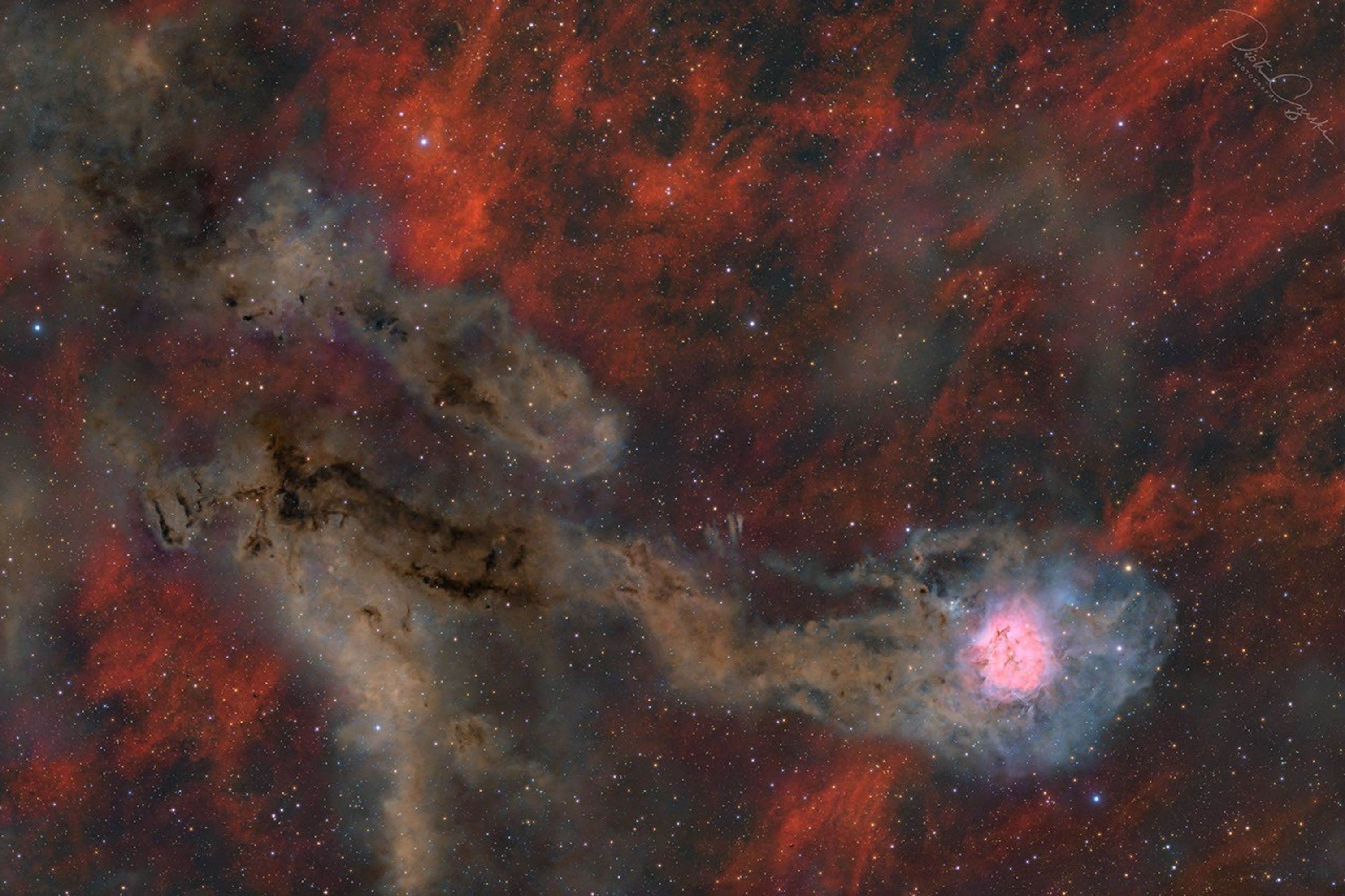
A starfield is shown against a patchy red-glowing background. Two irregular brown trails occur, the lower of which culminates in a bright pink and white region.

Cocoon Nebula Wide Field

Explanation: When does a nebula look like a comet? In this crowded starfield covering over two degrees within the high-flying constellation of the Swan (Cygnus), the eye is drawn to the Cocoon Nebula. A compact star forming region, the cosmic Cocoon punctuates a nebula bright in emission and reflection on the lower right, with a long trail of interstellar dust clouds to the left, making the entire complex appear a bit like a comet. Cataloged as IC 5146, the central bright head of the nebula spans about 10 light years, while the dark dusty tail spans nearly 100 light years. Both are located about 2,500 light years away. A bright star near the colorful nebula’s center likely supplies power and helps clear out a cavity. The long dusty filaments of the tail, although dark in this visible light image, hide stars in the process of formation. The featured image was captured in July from Death Valley, California, USA.

APOD’s main NASA site is moving: From apod.nasa.gov to science.nasa.gov/apod
Tomorrow’s picture: triple eclipse

Date: September 21, 2026
Credit & Copyright: Piotr Czerski
Authors & editors: Robert Nemiroff, Jerry Bonnell, Cecilia Chirenti, Keighley Rockcliffe
A service of: ASD at NASA / GSFC,
NASA Science Activation & Michigan Tech. U.

Powered by WPeMatico

Get The Details…

APOD: 2026 September 20 – Analemma over the Callanish Stones

APOD: 2026 September 20 – Analemma over the Callanish Stones

APOD

Astronomy Picture of the Day

Discover the cosmos! Each day a different image or photograph of our fascinating universe is featured, along with a brief explanation written by a professional astronomer.

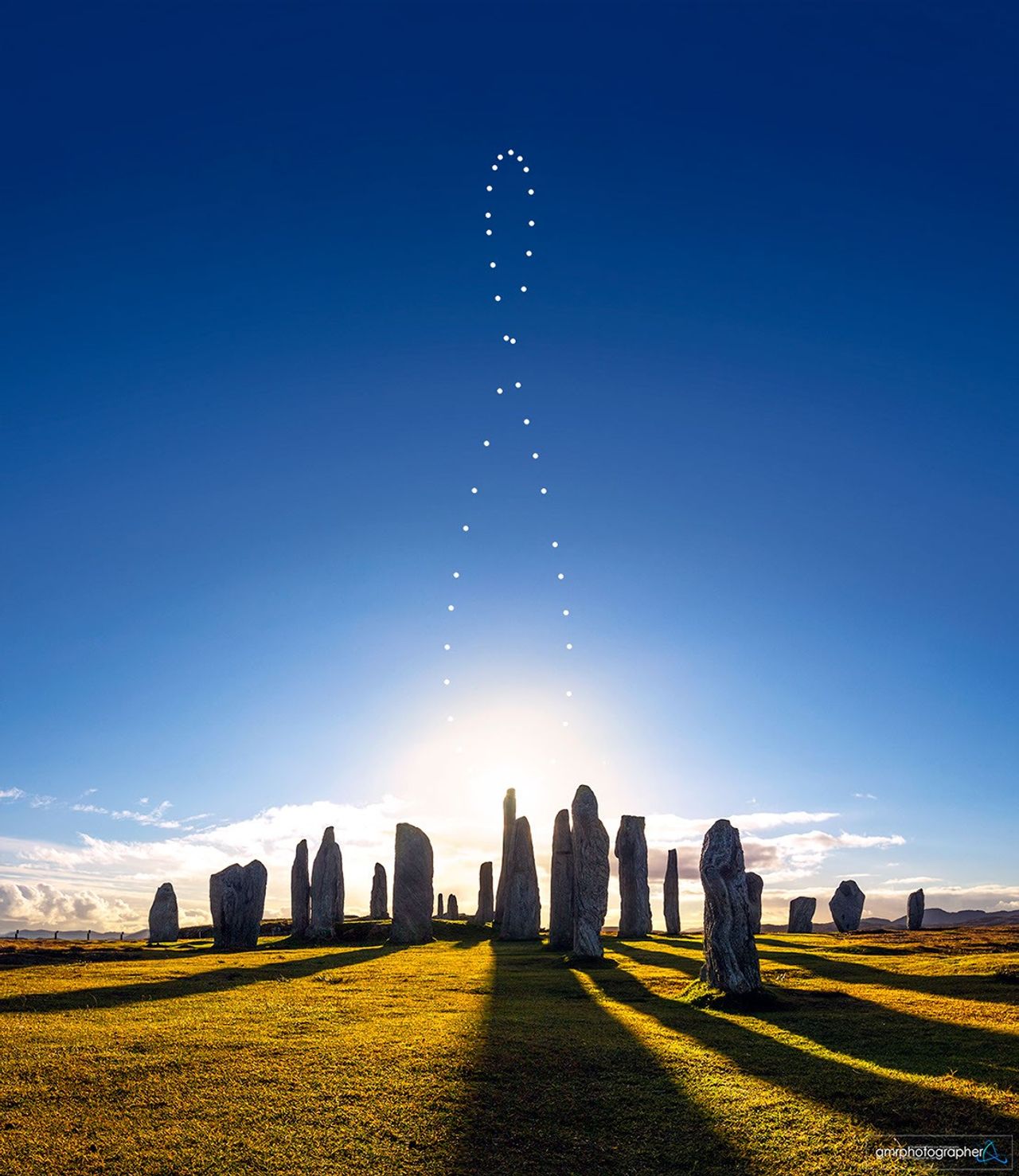
Multiple images of the Sun trace out an analemma curve in the daytime sky above the Callanish stones.

Analemma over the Callanish Stones

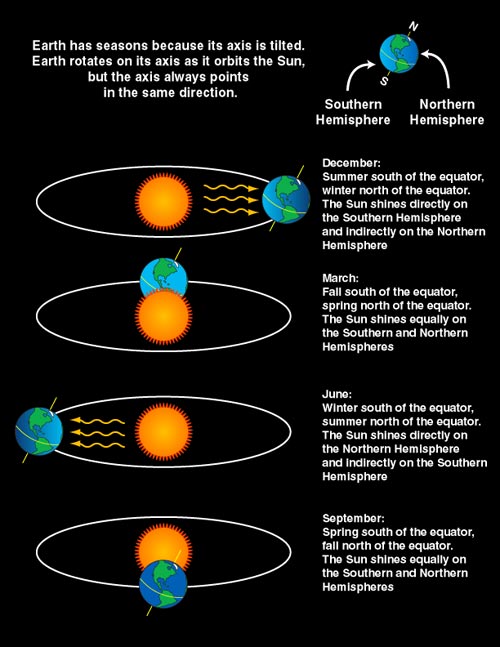
Explanation: If you went outside at the same time every day and took a picture that included the Sun, how would the Sun’s position change? A visual answer to that question is an analemma, a composite image taken from the same spot at the same time over the course of a year. The featured analemma was composed from images taken every few days at noon near the village of Callanish in the Outer Hebrides in Scotland, UK. In the foreground are the Callanish Stones, a stone circle built around 2700 BC during humanity’s Bronze Age. It is not known if the placement of the Callanish Stones has or had astronomical significance. The ultimate causes for the figure-8 shape of this and all analemmas are the tilt of the Earth axis and the ellipticity of the Earth’s orbit around the Sun. At the solstices, the Sun will appear at the top or bottom of an analemma. The featured image was taken near the December solstice and so the Sun appears near the bottom. Equinoxes, however, correspond to analemma middle points — not the intersection point. In two days there will be an equinox (“equal night”), when day and night are equal over all of planet Earth. Many cultures celebrate a change of season at an equinox.

APOD’s main NASA site is moving: From apod.nasa.gov to science.nasa.gov/apod
Tomorrow’s picture: open space

Date September 20, 2026
Credit & Copyright: Giuseppe Petricca
Authors & editors: Robert Nemiroff, Jerry Bonnell, Cecilia Chirenti, Keighley Rockcliffe
A service of: ASD at NASA / GSFC,
NASA Science Activation & Michigan Tech. U.

Powered by WPeMatico

Get The Details…

Progress 96 Cargo Spacecraft Docks to Station to Resupply Crew

Progress 96 Cargo Spacecraft Docks to Station to Resupply Crew

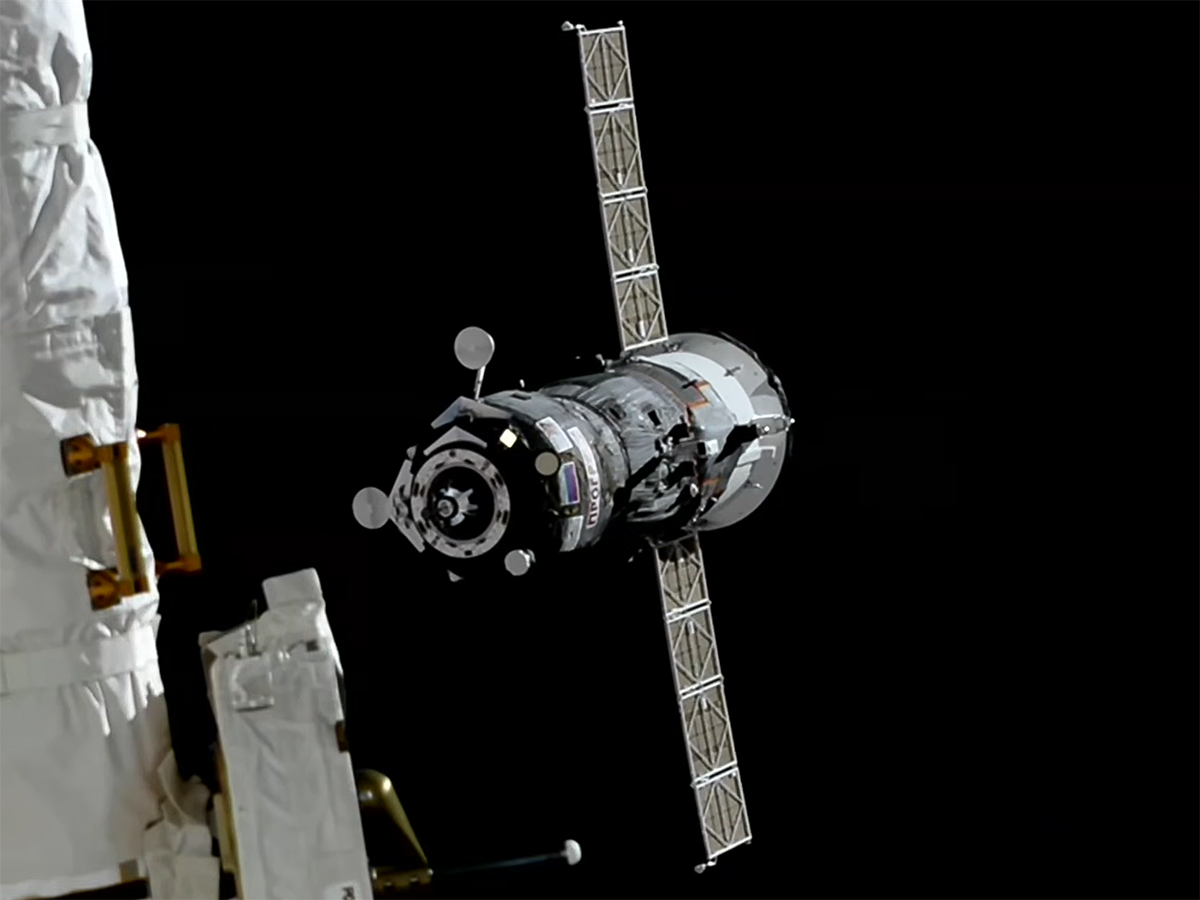
The Progress 96 cargo spacecraft approaches the International Space Station for a docking to the Poisk module.
The Progress 96 cargo spacecraft approaches the International Space Station for an automated docking to the Poisk module.
NASA+

The Roscosmos Progress 96 spacecraft docked to the space-facing port of the International Space Station’s Poisk module at 9:44 a.m. EDT Saturday.  

The spacecraft is delivering about three tons of food, fuel and supplies for the Expedition 75 crew and will remain at the space station for about five months before departing for a planned destructive re-entry that will dispose of trash.  

It launched at 9:33 a.m. (6:33 p.m. Baikonur time) on Sept. 16 on a Soyuz rocket from the Baikonur Cosmodrome in Kazakhstan. 

Learn more about station activities by following the space station blog, @space_station on X, as well as the ISS Facebook and ISS Instagram accounts.

Get the latest from NASA delivered every week. Subscribe here.

Powered by WPeMatico

Get The Details…

Mark A. Garcia

Progress 96 Cargo Spacecraft Approaching Station for Docking

Progress 96 Cargo Spacecraft Approaching Station for Docking

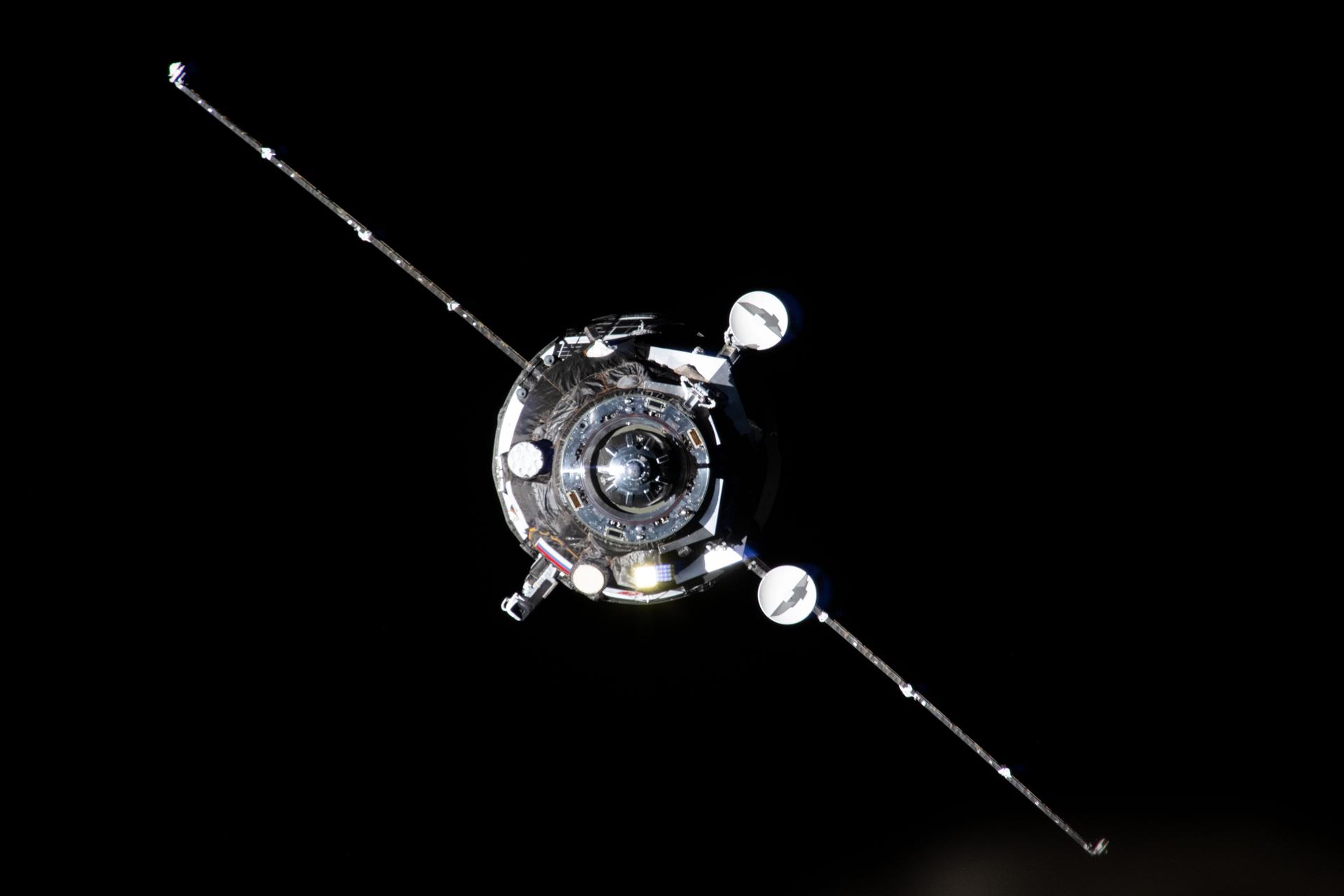
The Progress 93 resupply ship from Roscosmos, carrying about three tons of food, fuel, and supplies for the Expedition 73 crew, is pictured automatically approaching the International Space Station before docking to the Zvezda service module's rear port for six months of cargo activities.
The Progress 93 resupply ship from Roscosmos, carrying about three tons of food, fuel, and supplies for the Expedition 73 crew, is pictured on Sept. 13, 2025, automatically approaching the International Space Station.
NASA

NASA is streaming live rendezvous and docking coverage as the Roscosmos Progress 96 cargo spacecraft makes its way to the International Space Station. Watch online at:  https://www.nasa.gov/live

The unpiloted spacecraft is on track for its planned 9:46 a.m. EDT autonomous docking to the Poisk module’s space-facing port. It launched at 9:33 a.m. (6:33 p.m. Baikonur time) on Sept. 16 on a Soyuz rocket from the Baikonur Cosmodrome in Kazakhstan. 

Learn more about station activities by following the space station blog, @space_station on X, as well as the ISS Facebook and ISS Instagram accounts.

Get the latest from NASA delivered every week. Subscribe here.

Powered by WPeMatico

Get The Details…

Mark A. Garcia

APOD: 2026 September 19 – A Zodiacal Night

APOD: 2026 September 19 – A Zodiacal Night

APOD

Astronomy Picture of the Day

Discover the cosmos! Each day a different image or photograph of our fascinating universe is featured, along with a brief explanation written by a professional astronomer.

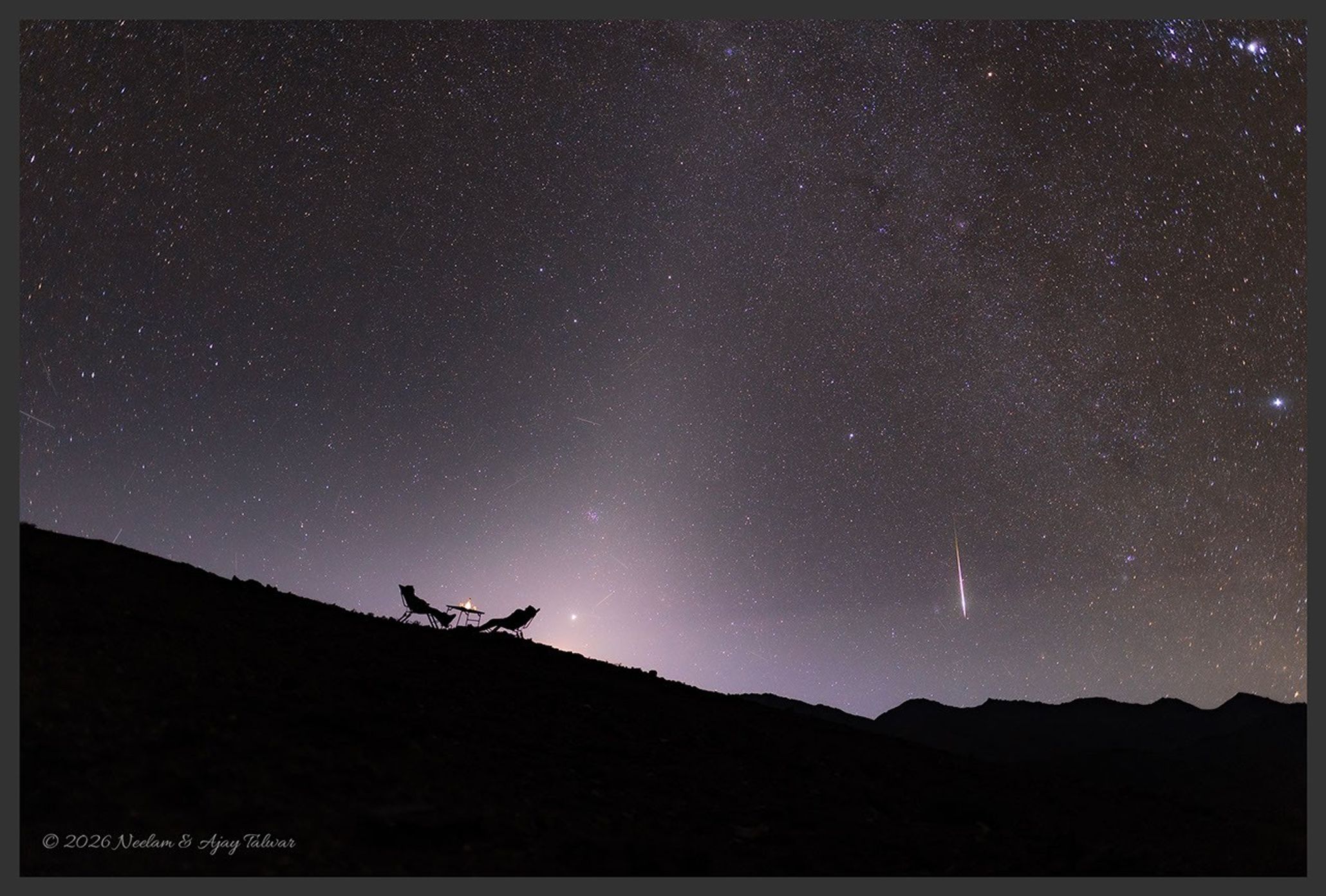
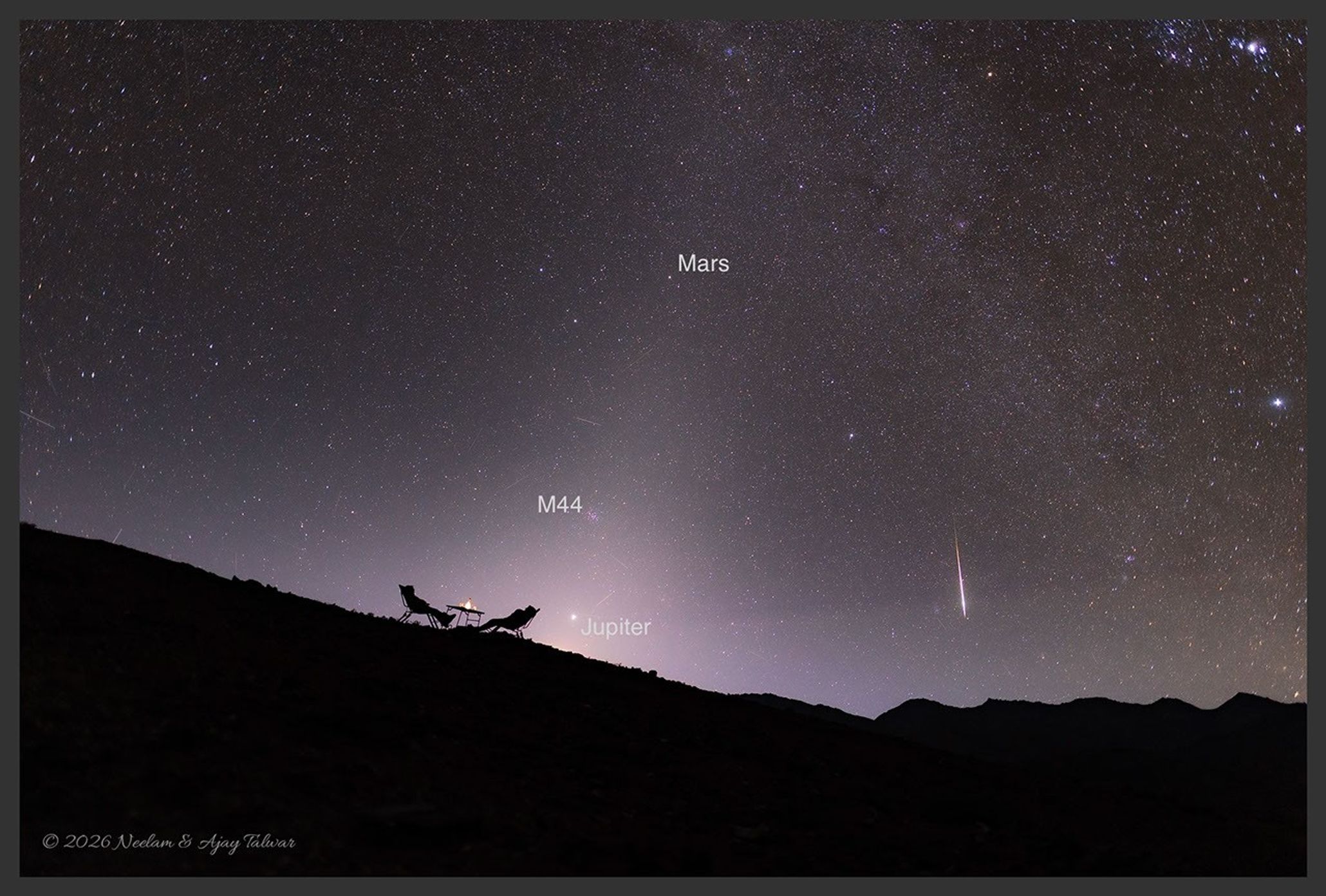
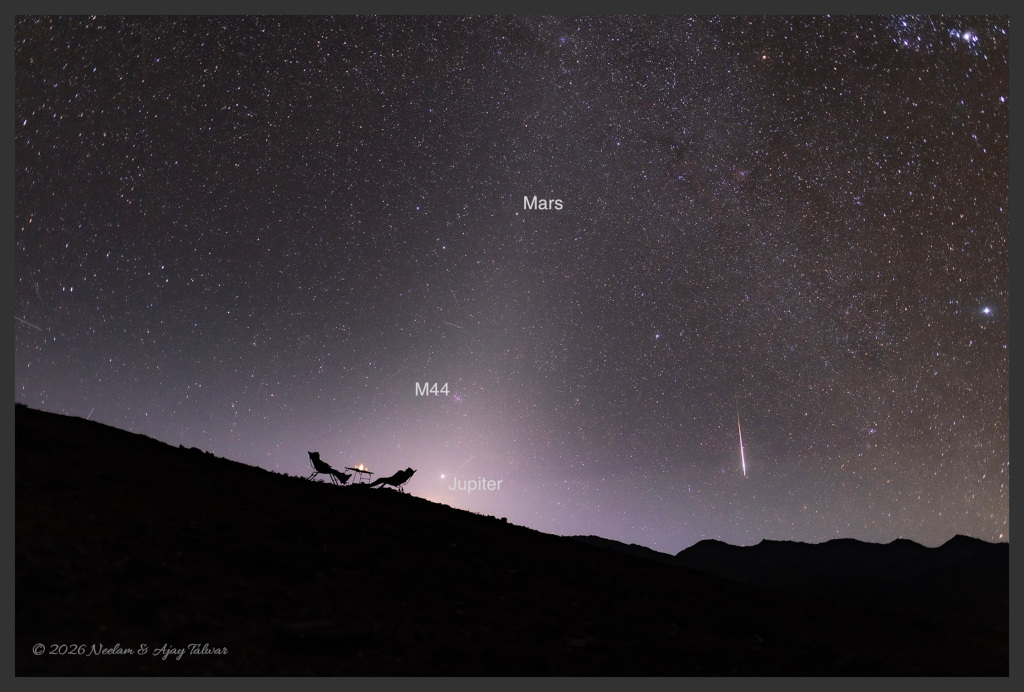
Two people are seated looking up at the night sky.Two people are seated looking up into the night sky. Jupiter, M44, and Mars are indicated with text labels.

A Zodiacal Night

Explanation: Also known as the false dawn, a luminous band of zodiacal light is captured in this dark night skyscape. The serene view was recorded just before the beginning of astronomical twilight during September’s star party at the remote Hanle Dark Sky Reserve, Ladakh, India, planet Earth. At about 4,500 meters altitude, the dark sky reserve presents a haven for hardy stargazing and astrophotography enthusiasts. While meteors streak through the night, bright planet Jupiter appears immersed in the faint zodiacal glow near the eastern horizon. Follow the zodiacal band toward the zenith to find open star cluster M44 and a yellowish tinged planet Mars near the center of the frame. In fact, serendipitous detections of interplanetary dust by NASA’s Juno spacecraft suggest Mars itself is the source of dust that back scatters sunlight and creates zodiacal light in planet Earth’s night.

APOD’s main NASA site is moving: From apod.nasa.gov to science.nasa.gov/apod
Tomorrow’s picture: only sunny days

Date September 19, 2026
Credit & Copyright: Neelam and Ajay Talwar (TWAN)
Authors & editors: Jerry Bonnell, Cecilia Chirenti, Robert Nemiroff, Keighley Rockcliffe
A service of: ASD at NASA / GSFC,
NASA Science Activation & Michigan Tech. U.

Powered by WPeMatico

Get The Details…