NASA’s Hubble Spots an Out-of-Sync Galaxy

NASA’s Hubble Spots an Out-of-Sync Galaxy

3 min read

NASA’s Hubble Spots an Out-of-Sync Galaxy
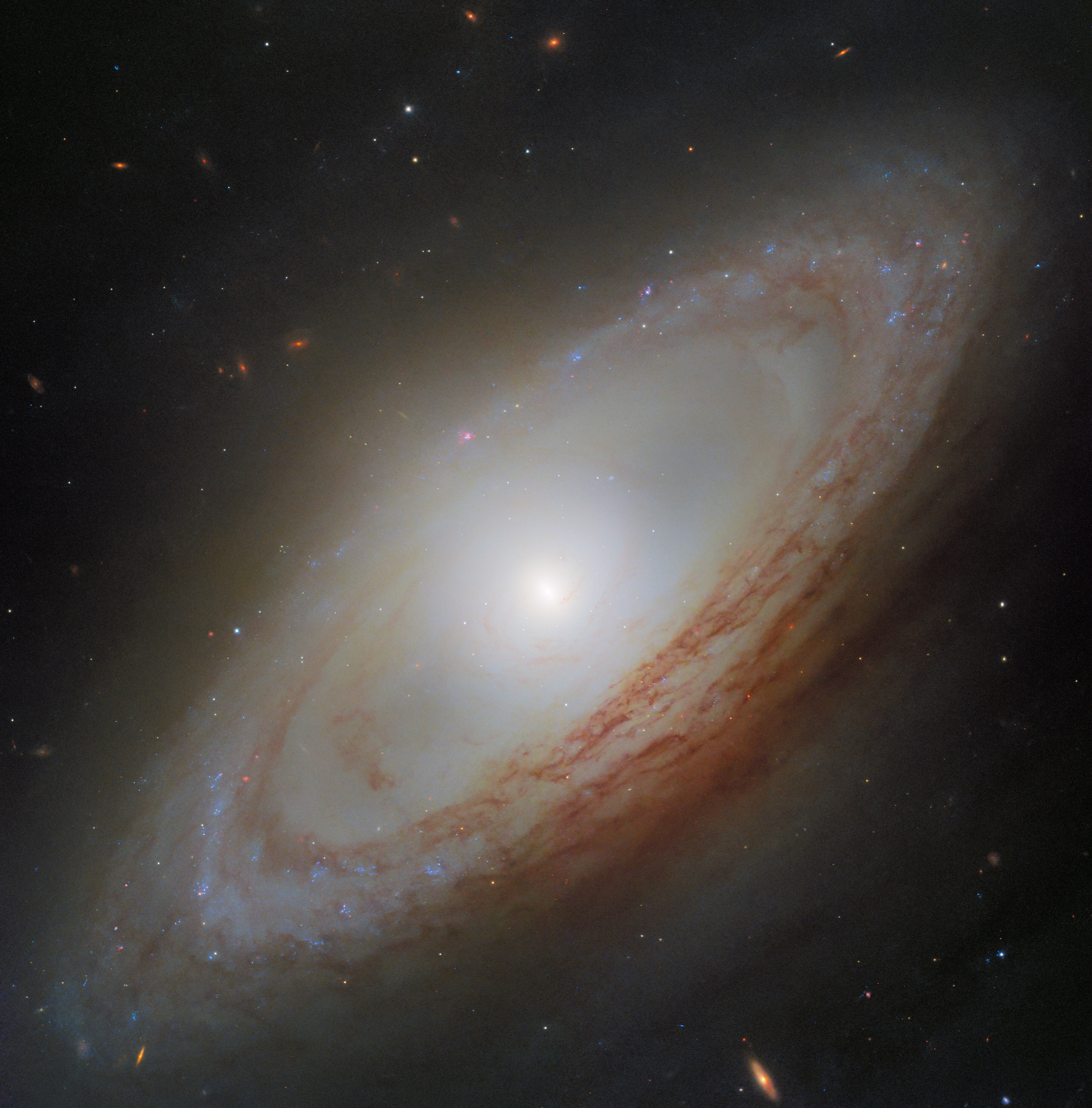
A spiral galaxy viewed at an angle, with a bright central bulge and winding spiral arms. The arms form a ring around the galaxy, without appearing to reach its center. Prominent red-brown dust lanes weave through the arms, which are also dotted with bright blue and reddish regions of star formation. The galaxy is set against a dark background scattered with stars and faint distant galaxies.
The spiral galaxy NGC 4698 shines in this image from the NASA/ESA Hubble Space Telescope.
ESA/Hubble & NASA, D. Thilker, the MAUVE-HST Team

Though the spiral galaxy in this new image from the NASA/ESA Hubble Space Telescope seems serene, it hides a chaotic secret. This galaxy is NGC 4698, and it lies about 55 million light-years away in the constellation Virgo. It’s one of over a thousand galaxies in the Virgo Cluster, the nearest large cluster of galaxies bound together by gravity.

As a spiral galaxy similar to our own Milky Way galaxy, NGC 4698 has spiral arms that curl around within a thin disk of stars, gas, and dust. These arms are marked by opaque clumps of brown dust and dotted with small collections of bright blue stars. Unlike many other spiral galaxies, like this one recently photographed by Hubble, NGC 4698’s delicate spiral arms are only prominent in the outer reaches of the disk; spiral arms often wind down to the very center of a galaxy, but NGC 4698’s spiral arms appear to shy away from its glowing center. The arms instead hover in a ring-like structure around the perimeter of the galaxy.

NGC 4698’s center is dominated by an elongated galactic bulge . The diffuse off-white glow of the galaxy’s bulge comes from stars smaller, older, and cooler than the massive blue stars that dot the galaxy’s outer disk. These tightly packed stars orbit a supermassive black hole containing millions of times the Sun’s mass. Scientists have found signs that this black hole is actively growing, drawing gas inward with its gravitational pull.

With a flat, starry disk and diffusely glowing center, NGC 4698 looks a lot like a typical spiral galaxy — but this galaxy is far from normal. NGC 4698 is one of only a few known spiral galaxies with a bulge that extends out from the disk at a right angle. The elongation is faintly visible in this Hubble image, which shows the ghostly glow of the starry bulge peeking above and below the dusty disk. What’s more, the stars and gas nearest the galaxy’s center rotate perpendicular to the rest of the disk!

What could cause a galaxy to be so out of sync? Astronomers have found that the culprit likely lies outside the galaxy. If NGC 4698 funneled in gas from an outside source, the newly collected gas could have formed a disk of gas and stars in the galaxy’s center, at an angle relative to the rest of the disk. Some observations suggest that this galaxy once experienced a minor galactic merger, as evidenced by a short ‘tail’ of hydrogen streaming from one side of the galaxy.

The data used to create this image come from an observing program focusing on galaxies in the Virgo Cluster. This program zooms in on the details of these relatively nearby galaxies, such as individual star clusters and nebulae. At the same time, researchers will use these data to take stock of the larger picture, learning how a galaxy’s journey through a cluster affects the galaxy’s evolution and ability to form new stars.

Text credit: ESA/Hubble

Media Contact:

Claire Andreoli
NASA’s Goddard Space Flight Center, Greenbelt, MD
claire.andreoli@nasa.gov


Powered by WPeMatico

Get The Details…

APOD: 2026 September 18 – Messier 33: The Triangulum Galaxy

APOD: 2026 September 18 – Messier 33: The Triangulum Galaxy

APOD

Astronomy Picture of the Day

Discover the cosmos! Each day a different image or photograph of our fascinating universe is featured, along with a brief explanation written by a professional astronomer.

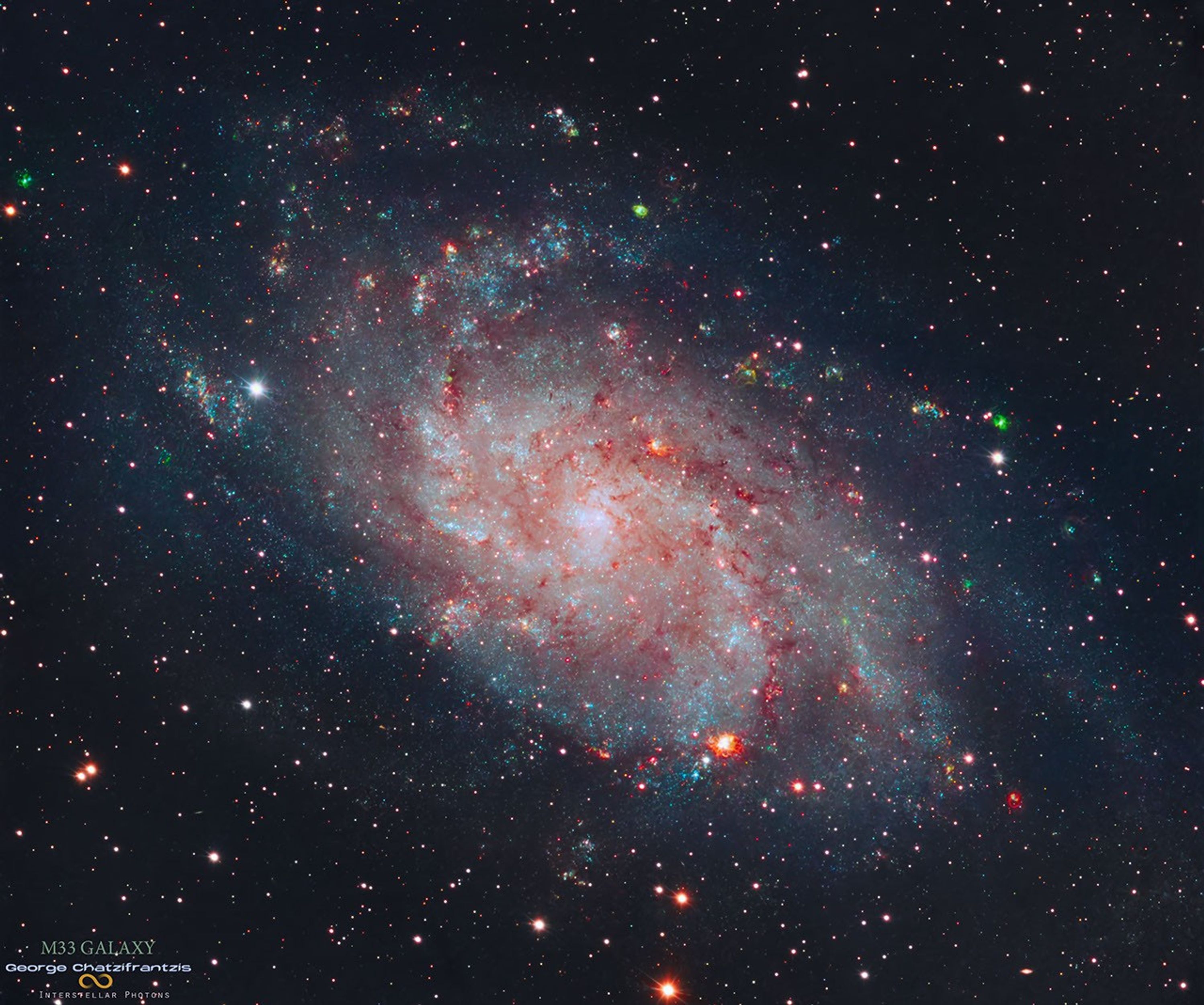
Image of a face-on spiral galaxy.

Messier 33: The Triangulum Galaxy

Explanation: The small, northern constellation Triangulum harbors this magnificent face-on spiral galaxy, Messier 33. Its popular names include the Pinwheel Galaxy or just the Triangulum Galaxy. M33 is over 50,000 light-years in diameter, third largest in the Local Group of galaxies after the Andromeda Galaxy (M31), and our own Milky Way. About 3 million light-years from the Milky Way, M33 is itself thought to be a satellite of the Andromeda Galaxy and astronomers in these two galaxies would likely have spectacular views of each other’s grand spiral star systems. As for the view from the Milky Way, this sharp telescopic image shows off M33’s blue star clusters and pinkish star forming regions along the galaxy’s loosely wound spiral arms. In fact, the cavernous NGC 604 is the brightest star forming region, seen here at about the 5 o’clock position from the galaxy center. Like M31, M33’s population of well-measured variable stars have helped make this nearby spiral a cosmic yardstick for establishing the distance scale of the Universe.

APOD’s main NASA site is moving: From apod.nasa.gov to science.nasa.gov/apod
Tomorrow’s picture: star party weekend

Date September 18, 2026
Credit & Copyright: George Chatzifrantzis
Authors & editors: Jerry Bonnell, Cecilia Chirenti, Robert Nemiroff, Keighley Rockcliffe
A service of: ASD at NASA / GSFC,
NASA Science Activation & Michigan Tech. U.

Powered by WPeMatico

Get The Details…

NASA, SpaceX Continue Crew‑13 Prep as Crew Enters Quarantine

NASA, SpaceX Continue Crew‑13 Prep as Crew Enters Quarantine

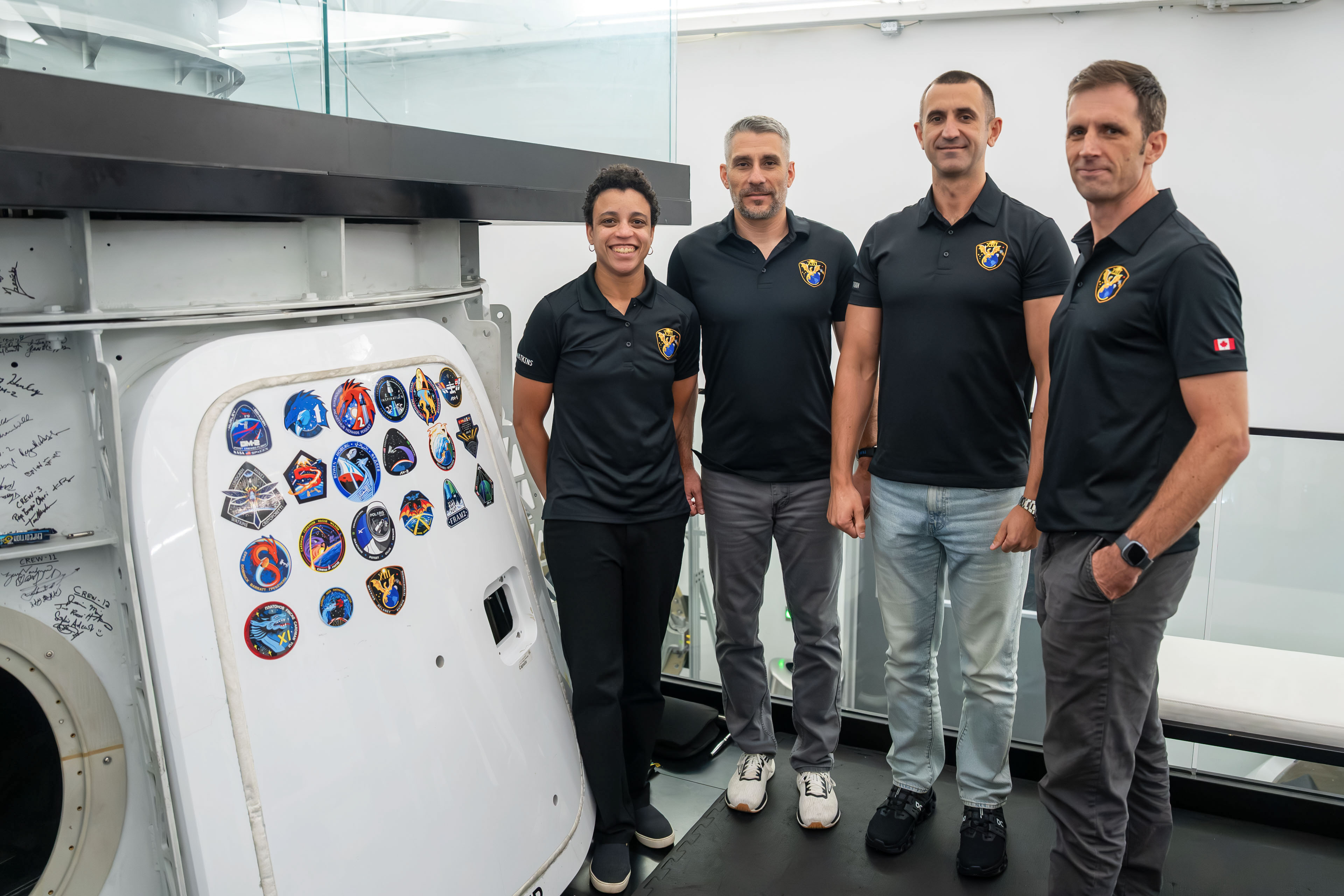
Four astronauts in matching black shirts pose for a photo in a training facility.
The four members representing NASA’s SpaceX Crew-13 mission to the International Space Station pose for a portrait next to the Dragon spacecraft mockup after completing a preflight training session at SpaceX’s facility in Hawthorne, California.
SpaceX

The crew of NASA’s SpaceX Crew-13 mission entered quarantine late Thursday at the agency’s Johnson Space Center in Houston. Mission preparations continue as NASA and SpaceX target an early October launch to the International Space Station.

As part of routine prelaunch quarantine, NASA astronauts Jessica Watkins and Luke Delaney, CSA (Canadian Space Agency) astronaut Joshua Kutryk, and Roscosmos cosmonaut Sergey Teteryatnikov will limit in‑person contact. Most interactions will occur remotely, and family members and selected mission-related personnel must undergo medical screening before meeting with the crew. This practice, begun during NASA’s Apollo Program, reduces the risk of preflight illnesses and prevents symptoms from developing during flight.

Before quarantine, the crew completed preflight training at the SpaceX facility in Hawthorne, California, and performed a Crew Equipment Interface Test at the company’s facility at Cape Canaveral Space Force Station in Florida. During the daylong exercise, the crew members put on their spacesuits, entered the Dragon spacecraft, conducted suit leak checks, and verified good seat fit. They also familiarized themselves with the spacecraft’s interior, completed communications checks, and listened to the Dragon’s fans and pumps to prepare for sounds they will hear during flight. 

Once aboard the orbiting laboratory, Crew-13 will join the space station’s Expedition 75. During its mission, the crew will conduct a variety of science experiments aimed at advancing research and technology for missions to the Moon and Mars and improving life back on Earth.

Learn more about the mission by following the commercial crew blog, @NASASpaceOps and @space_station on X, as well as the International Space Station’s Facebook and Instagram accounts. 

Powered by WPeMatico

Get The Details…

Jason Costa

Crew Works Soldering, Cardiac Research, Virtual Reality and Prepares for Cargo Mission

Crew Works Soldering, Cardiac Research, Virtual Reality and Prepares for Cargo Mission

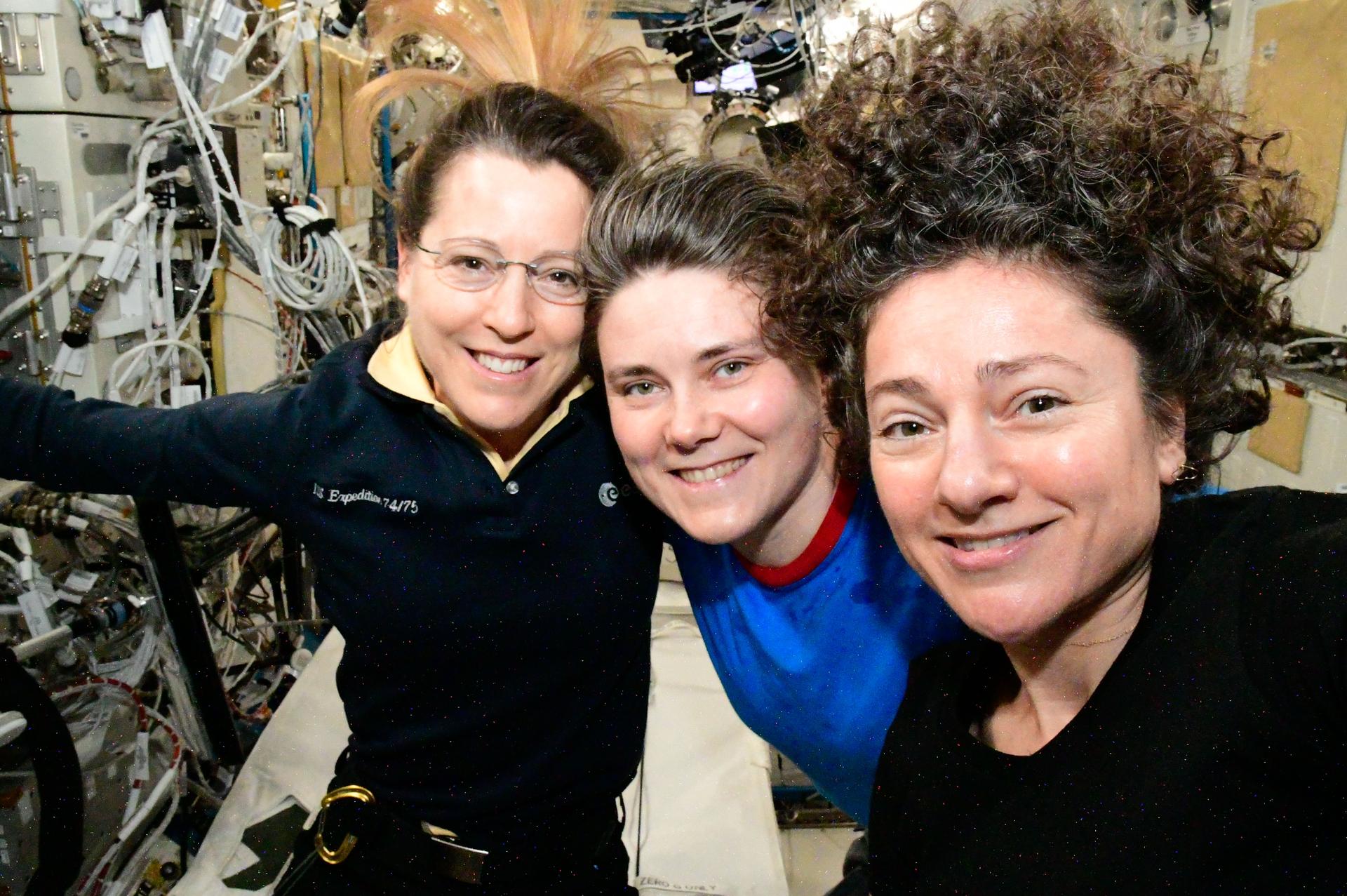
From left, Expedition 75 crew members Sophie Adenot of ESA (European Space Agency) and Anna Kikina of Roscosmos, both flight engineers, and International Space Station commander Jessica Meir of NASA gather together for a portrait inside the Kibo laboratory module.
From left, Expedition 75 crew members Sophie Adenot of ESA, Anna Kikina of Roscosmos, and Jessica Meir of NASA gather together for a portrait inside the Kibo laboratory module.
Roscosmos

Circuit board soldering, spacesuit maintenance, and cargo mission operations topped the schedule for the Expedition 75 crew aboard the International Space Station on Thursday. The orbital residents also worked on cardiac research, virtual reality tests, and housekeeping tasks throughout the day.

Longer space missions farther away from Earth will require crews to be more self-sufficient and less dependent on cargo missions and ground support. As a result, NASA flight engineer Anil Menon has been working on the MIYOKA experiment this week to demonstrate the safe manufacturing and repairing of electronics in microgravity. Menon has been using a lead-free soldering technique to solder components on a circuit board that will be returned to Earth and compared to identical ground-soldered samples. Results may inform future crews travelling to the Moon, Mars, and beyond reducing reliance on costly resupply missions.

Spacesuits have been occupying the crew following a busy period of four spacewalks that took place over a monthlong period. Station commander Jessica Meir and flight engineer Jack Hathaway of NASA took turns in the Quest airlock cleaning, inspecting, and checking the functionality of spacesuit cooling systems to ensure their readiness for future spacewalks. Meir commented about her most recent spacewalk when she rode the Canadarm2 robotic arm on Sept. 1 during a news conference on Wednesday, “I felt like I was just there levitating above the Earth. I think that was the biggest eureka moment for me.”

Hathaway also joined up with flight engineer Sophie Adenot of ESA (European Space Agency) in the cupola, configuring cleaning tools, and preparing its seven windows overlooking the Earth for an upcoming deep-cleaning session. Adenot began her shift listening to a relaxing narrative then filling out a questionnaire, both on a computer tablet, for the RelaxPro investigation that seeks to reduce stress and improve sleep for astronauts. She wrapped up her shift exercising on the Tranquility module’s advanced resistive exercise device as experts on the ground monitored in real time to learn how to improve workouts in weightlessness.

Roscosmos flight engineers Pyotr Dubrov and Anna Kikina are preparing for the arrival of 2.8 tons of food, fuel, and supplies packed aboard the Progress 96 cargo spacecraft that launched from Kazakhstan on Wednesday. Dubrov and Kikina tested the Zvezda service module’s tele-operated robotic unit, or TORU, in advance of Progress 96 docking automatically to the Poisk module at 9:46 a.m. EDT on Saturday. The TORU would be used to remotely control a Roscosmos spacecraft in the unlikely event its automated rendezvous and docking system failed.

The cosmonaut pair also took turns wearing arm, wrist, and finger cuffs measuring their blood pressure to document microgravity’s effect on the microcirculatory system. Finally, the duo wore virtual reality headsets and a special body-worn control device to simulate manipulating robots aboard the space station for the Teledroid investigation.

Roscosmos flight engineer Andrey Fedyaev spent his shift servicing laptop computers in the Nauka science module and transferring water between tanks in Zvezda.

Learn more about station activities by following the space station blog, @space_station on X, as well as the ISS Facebook and ISS Instagram accounts.

Get the latest from NASA delivered every week. Subscribe here.

Powered by WPeMatico

Get The Details…

Mark A. Garcia

NASA Awards Launch Services for StarBurst Gamma-Ray Detector

NASA Awards Launch Services for StarBurst Gamma-Ray Detector

NASA insignia.
Credit: NASA

NASA has selected SpaceX to provide launch services for the agency’s StarBurst mission, a small satellite designed to investigate neutron star mergers and the origins of short gamma-ray bursts.

StarBurst will launch aboard a Bandwagon rideshare mission on a Falcon 9 rocket from Space Launch Complex 40 at Cape Canaveral Space Force Station in Florida no earlier than 2028.

The selection is a firm-fixed-price task order under NASA’s VADR (Venture-Class Acquisition of Dedicated and Rideshare) launch services contract. This indefinite-delivery/indefinite-quantity contract allows NASA to acquire launch services during a 10-year ordering period, with a maximum total value of $1 billion across all contracts.

The StarBurst mission is designed to observe the entire portion of the sky not blocked by Earth to search for brief, powerful explosions called gamma-ray bursts. The satellite will focus on detecting the initial high-energy emission from short gamma-ray bursts, which occur when dense stellar remnants called neutron stars merge.

By combining StarBurst’s observations with gravitational-wave measurements and follow-up observations from other telescopes, researchers will study these events through multiple types of signals, an approach known as multimessenger astronomy.

StarBurst is part of NASA’s Astrophysics Pioneers Program, which supports lower-cost investigations using small spacecraft and other platforms.

NASA’s Launch Services Program Office, based at the agency’s Kennedy Space Center in Florida, manages the VADR contract.

For more information about NASA’s StarBurst, visit:

https://science.nasa.gov/mission/starburst

-end-

Joshua Finch / Jimi Russell
Headquarters, Washington
202-358-1100
joshua.a.finch@nasa.gov / james.j.russell@nasa.gov

Leejay Lockhart
Kennedy Space Center, Fla.
321-747-8310
leejay.lockhart@nasa.gov

Powered by WPeMatico

Get The Details…
Jessica Taveau