Sculpted by Luminous Stars

Sculpted by Luminous Stars

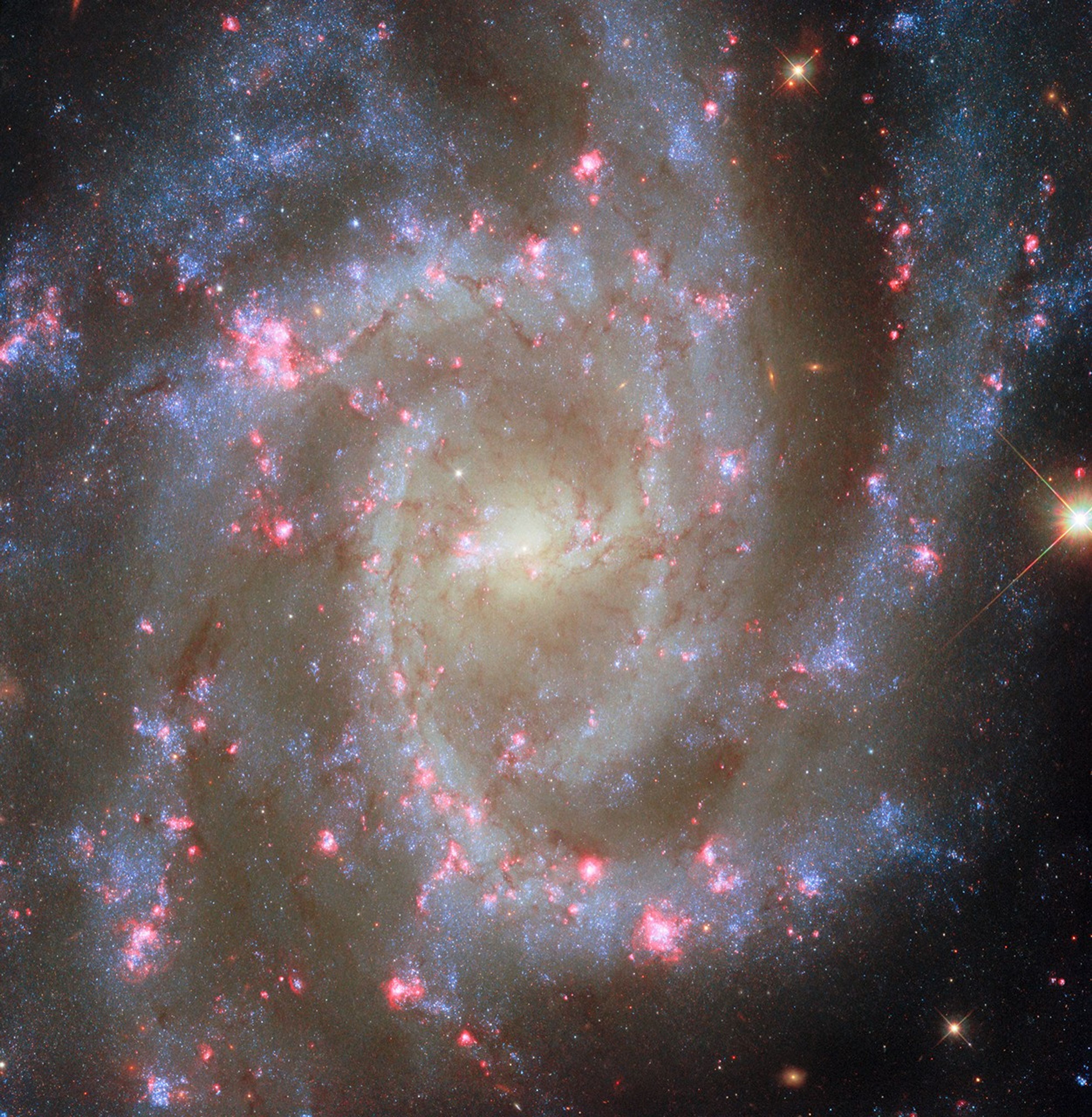
Bright blue stars curve gently toward the center of the image. Nestled around, in front of, and behind the clustered stars are large arcs of dense, reddish-brown dust. Thin, pale-blue wisps of clouds fill the background while denser areas of pinkish clouds appear stacked upon the wispier clouds. Thousands of orange stars are visible in the background behind the clouds of the nebula.
ESA/Hubble and NASA, A. Nota, P. Massey, E. Sabbi, C. Murray, M. Zamani (ESA/Hubble)

This new image, released on April 4, 2025, showcases the dazzling young star cluster NGC 346. Although both the James Webb Space Telescope and the Hubble Space Telescope have released images of NGC 346 previously, this image includes new data and is the first to combine Hubble observations made at infrared, optical, and ultraviolet wavelengths into an intricately detailed view of this vibrant star-forming factory.

Hubble’s exquisite sensitivity and resolution were instrumental in uncovering the secrets of NGC 346’s star formation. Using two sets of observations taken 11 years apart, researchers traced the motions of NGC 346’s stars, revealing them to be spiraling in toward the center of the cluster. This spiraling motion arises from a stream of gas from outside of the cluster that fuels star formation in the center of the turbulent cloud.

Learn more about NGC 346 and the nebula it has shaped.

Image credit: ESA/Hubble and NASA, A. Nota, P. Massey, E. Sabbi, C. Murray, M. Zamani (ESA/Hubble)

Powered by WPeMatico

Get The Details…
Monika Luabeya

NASA’s Lucy Spacecraft Prepares Second Asteroid Encounter

NASA’s Lucy Spacecraft Prepares Second Asteroid Encounter

NASA’s Lucy spacecraft is 6 days and less than 50 million miles (80 million km) away from its second close encounter with an asteroid; this time, the small main belt asteroid Donaldjohanson.

Download high-resolution video and images from NASA’s Scientific Visualization Studio.
NASA/Dan Gallagher

This upcoming event represents a comprehensive “dress rehearsal” for Lucy’s main mission over the next decade: the exploration of multiple Trojan asteroids that share Jupiter’s orbit around the Sun. Lucy’s first asteroid encounter – a flyby of the tiny main belt asteroid Dinkinesh and its satellite, Selam, on Nov. 1, 2023 – provided the team with an opportunity for a systems test that they will be building on during the upcoming flyby.

Lucy’s closest approach to Donaldjohanson will occur at 1:51pm EDT on April 20, at a distance of 596 miles (960 km). About 30 minutes before closest approach, Lucy will orient itself to track the asteroid, during which its high-gain antenna will turn away from Earth, suspending communication. Guided by its terminal tracking system, Lucy will autonomously rotate to keep Donaldjohanson in view. As it does this, Lucy will carry out a more complicated observing sequence than was used at Dinkinesh. All three science instruments – the high-resolution greyscale imager called L’LORRI, the color imager and infrared spectrometer called L’Ralph, and the far infrared spectrometer called L’TES – will carry out observation sequences very similar to the ones that will occur at the Trojan asteroids.

However, unlike with Dinkinesh, Lucy will stop tracking Donaldjohanson 40 seconds before the closest approach to protect its sensitive instruments from intense sunlight.

“If you were sitting on the asteroid watching the Lucy spacecraft approaching, you would have to shield your eyes staring at the Sun while waiting for Lucy to emerge from the glare. After Lucy passes the asteroid, the positions will be reversed, so we have to shield the instruments in the same way,” said encounter phase lead Michael Vincent of Southwest Research Institute (SwRI) in Boulder, Colorado. “These instruments are designed to photograph objects illuminated by sunlight 25 times dimmer than at Earth, so looking toward the Sun could damage our cameras.” 

Fortunately, this is the only one of Lucy’s seven asteroid encounters with this challenging geometry. During the Trojan encounters, as with Dinkinesh, the spacecraft will be able to collect data throughout the entire encounter.

After closest approach, the spacecraft will “pitch back,” reorienting its solar arrays back toward the Sun. Approximately an hour later, the spacecraft will re-establish communication with Earth.

“One of the weird things to wrap your brain around with these deep space missions is how slow the speed of light is,” continued Vincent. “Lucy is 12.5 light minutes away from Earth, meaning it takes that long for any signal we send to reach the spacecraft. Then it takes another 12.5 minutes before we get Lucy’s response telling us we were heard. So, when we command the data playback after closest approach, it takes 25 minutes from when we ask to see the pictures before we get any of them to the ground.”

Once the spacecraft’s health is confirmed, engineers will command Lucy to transmit the science data from the encounter back to Earth, which is a process that will take several days.

Donaldjohanson is a fragment from a collision 150 million years ago, making it one of the youngest main belt asteroids ever visited by a spacecraft. 

“Every asteroid has a different story to tell, and these stories weave together to paint the history of our solar system,” said Tom Statler, Lucy mission program scientist at NASA Headquarters in Washington. “The fact that each new asteroid we visit knocks our socks off means we’re only beginning to understand the depth and richness of that history. Telescopic observations are hinting that Donaldjohanson is going to have an interesting story, and I’m fully expecting to be surprised – again.”

NASA’s Goddard Space Flight Center in Greenbelt, Maryland, designed and built the L’Ralph instrument and provides overall mission management, systems engineering and safety and mission assurance for Lucy. Hal Levison of SwRI’s office in Boulder, Colorado, is the principal investigator. SwRI, headquartered in San Antonio, also leads the science team and the mission’s science observation planning and data processing. Lockheed Martin Space in Littleton, Colorado, built the spacecraft, designed the original orbital trajectory and provides flight operations. Goddard and KinetX Aerospace are responsible for navigating the Lucy spacecraft. The Johns Hopkins Applied Physics Laboratory in Laurel, Maryland, designed and built the L’LORRI (Lucy Long Range Reconnaissance Imager) instrument. Arizona State University in Tempe, Arizona, designed and build the L’TES (Lucy Thermal Emission Spectrometer) instrument. Lucy is the thirteenth mission in NASA’s Discovery Program, which is managed by NASA’s Marshall Space Flight Center in Huntsville, Alabama.

By Katherine Kretke, Southwest Research Institute

Media Contact:
Karen Fox / Molly Wasser
Headquarters, Washington
202-358-1600
karen.c.fox@nasa.gov / molly.l.wasser@nasa.gov

Nancy N. Jones
NASA’s Goddard Space Flight Center, Greenbelt, Md.

Share

Details

Last Updated

Apr 14, 2025

Editor
Madison Olson
Contact
Nancy N. Jones
Location
Goddard Space Flight Center

Powered by WPeMatico

Get The Details…
Madison Olson

NASA Sets Coverage for Astronaut Don Pettit, Crewmates Return

NASA Sets Coverage for Astronaut Don Pettit, Crewmates Return

This long-duration photograph highlights the Roscosmos segment of the International Space Station with the Soyuz MS-26 spacecraft docked to the Rassvet module. Star trails and Earth’s atmospheric glow also are pictured from the orbital outpost as it soared 258 miles above the Pacific Ocean.
Credit: NASA

NASA astronaut Don Pettit, along with Roscosmos cosmonauts Alexey Ovchinin and Ivan Vagner, will depart the International Space Station aboard the Soyuz MS-26 spacecraft and return to Earth on Saturday, April 19.

Pettit, Ovchinin, and Vagner will undock from the orbiting laboratory’s Rassvet module at 5:57 p.m. EDT, heading for a parachute-assisted landing at 9:20 p.m. (6:20 a.m. Kazakhstan time, Sunday, April 20) on the steppe of Kazakhstan, southeast of the town of Dzhezkazgan. Landing will occur on Pettit’s 70th birthday.

NASA’s live coverage of return and related activities will stream on NASA+. Learn how to stream NASA content through a variety of platforms.

A change of command ceremony also will stream on NASA platforms at 2:40 p.m. Friday, April 18. Ovchinin will handover station command to JAXA (Japan Aerospace Exploration Agency) astronaut Takuya Onishi for Expedition 73, which begins at the time of undocking.

Spanning 220 days in space, Pettit and his crewmates will have orbited the Earth 3,520 times and completed a journey of 93.3 million miles over the course of their mission. The Soyuz MS-26 spacecraft launched and docked to the station on Sept. 11, 2024.

This was Pettit’s fourth spaceflight, where he served as flight engineer for Expedition 71 and 72. He has a career total of 590 days in orbit. Ovchinin completed his fourth flight in space, totaling 595 days, and Vagner has earned an overall total of 416 days in space during two trips to the orbiting laboratory.

After returning to Earth, the three crew members will fly on a helicopter from the landing site to the recovery staging city of Karaganda, Kazakhstan. Pettit will board a NASA plane and return to Houston, while Ovchinin and Vagner will depart for a training base in Star City, Russia.

NASA’s coverage is as follows (all times Eastern and subject to changed based on real-time operations):

Friday, April 18:

2:40 p.m. – Expedition 72/73 change of command ceremony begins on NASA+.

Saturday, April 19:

2 p.m. – Farewells and hatch closing coverage begins on NASA+.

2:25 p.m. – Hatch closing

5:30 p.m. – Undocking coverage begins on NASA+.

5:57 p.m. – Undocking

8 p.m. – Coverage begins for deorbit burn, entry, and landing on NASA+

8:26 p.m. – Deorbit burn

9:20 p.m. – Landing

For more than two decades, people have lived and worked continuously aboard the International Space Station, advancing scientific knowledge, and making research breakthroughs that are not possible on Earth. The station is a critical testbed for NASA to understand and overcome the challenges of long-duration spaceflight and to expand commercial opportunities in low Earth orbit. As commercial companies focus on providing human space transportation services and destinations as part of a robust low Earth orbit economy, NASA is focusing more resources on deep space missions to the Moon as part of Artemis in preparation for future human missions to Mars.

Learn more about International Space Station research and operations at:

https://www.nasa.gov/station

-end-

Claire O’Shea / Josh Finch
Headquarters, Washington
202-358-1100
claire.a.o’shea@nasa.gov / joshua.a.finch@nasa.gov

Sandra Jones
Johnson Space Center, Houston
281-483-5111
sandra.p.jones@nasa.gov

Share

Details

Last Updated

Apr 14, 2025

Powered by WPeMatico

Get The Details…
Lauren E. Low

With NASA’s Webb, Dying Star’s Energetic Display Comes Into Full Focus

With NASA’s Webb, Dying Star’s Energetic Display Comes Into Full Focus

5 Min Read

With NASA’s Webb, Dying Star’s Energetic Display Comes Into Full Focus

What looks like a single large, bright star (but is two) shines with bright purple diffraction spikes at the center of a large, diffuse cylinder of gas and dust that is tipped to the right. At the center is a bright pink clumpy cloud that takes up about 25% of the view. The pink region has some holes and diffuse areas. Beyond that are two large rings seen at a roughly 60-degree angle that appear joined at top left and bottom right. The edges are denser, and form shallow V-shapes that go inward. The rings appear orange at top left and bottom right, and are blue at bottom and center right. There is diffuse orange material around the body. The black background of space is speckled with tiny stars and galaxies mostly in blues and yellows. A bigger blue star with spikes is just below and to the left of the central stars, but it is slightly smaller. Areas Webb did not observe are along the top edges, a thin vertical near the nebula at top left, and at the bottom left and right corners.
NASA’s James Webb Space Telescope has taken the most detailed image of planetary nebula NGC 1514 to date thanks to its unique mid-infrared observations. Webb shows its rings as intricate clumps of dust. It’s also easier to see holes punched through the bright pink central region.
Credits:
NASA, ESA, CSA, STScI, Michael Ressler (NASA-JPL), Dave Jones (IAC)

Gas and dust ejected by a dying star at the heart of NGC 1514 came into complete focus thanks to mid-infrared data from NASA’s James Webb Space Telescope. Its rings, which are only detected in infrared light, now look like “fuzzy” clumps arranged in tangled patterns, and a network of clearer holes close to the central stars shows where faster material punched through.

“Before Webb, we weren’t able to detect most of this material, let alone observe it so clearly,” said Mike Ressler, a researcher and project scientist for Webb’s MIRI (Mid-Infrared Instrument) at NASA’s Jet Propulsion Laboratory in southern California. He discovered the rings around NGC 1514 in 2010 when he examined the image from NASA’s Wide-field Infrared Survey Explorer (WISE). “With MIRI’s data, we can now comprehensively examine the turbulent nature of this nebula,” he said.

This scene has been forming for at least 4,000 years — and will continue to change over many more millennia. At the center are two stars that appear as one in Webb’s observation, and are set off with brilliant diffraction spikes. The stars follow a tight, elongated nine-year orbit and are draped in an arc of dust represented in orange.

One of these stars, which used to be several times more massive than our Sun, took the lead role in producing this scene. “As it evolved, it puffed up, throwing off layers of gas and dust in in a very slow, dense stellar wind,” said David Jones, a senior scientist at the Institute of Astrophysics on the Canary Islands, who proved there is a binary star system at the center in 2017.

Once the star’s outer layers were expelled, only its hot, compact core remained. As a white dwarf star, its winds both sped up and weakened, which might have swept up material into thin shells.

Image A: Planetary Nebula NGC 1514 (MIRI Image)

What looks like a single large, bright star (but is two) shines with bright purple diffraction spikes at the center of a large, diffuse cylinder of gas and dust that is tipped to the right. At the center is a bright pink clumpy cloud that takes up about 25% of the view. The pink region has some holes and diffuse areas. Beyond that are two large rings seen at a roughly 60-degree angle that appear joined at top left and bottom right. The edges are denser, and form shallow V-shapes that go inward. The rings appear orange at top left and bottom right, and are blue at bottom and center right. There is diffuse orange material around the body. The black background of space is speckled with tiny stars and galaxies mostly in blues and yellows. A bigger blue star with spikes is just below and to the left of the central stars, but it is slightly smaller. Areas Webb did not observe are along the top edges, a thin vertical near the nebula at top left, and at the bottom left and right corners.
NASA’s James Webb Space Telescope has taken the most detailed image of planetary nebula NGC 1514 to date thanks to its unique mid-infrared observations. Webb shows its rings as intricate clumps of dust. It’s also easier to see holes punched through the bright pink central region.
NASA, ESA, CSA, STScI, Michael Ressler (NASA-JPL), Dave Jones (IAC)

Image B: Planetary Nebula NGC 1514 (WISE and Webb Images Side by Side)

Two views of the same planetary nebula cataloged NGC 1514, split down the middle. Both show roughly the same features, an outline of a cylinder tipped to the right with a large blob of material in the middle. At the center of the blob is a bright star. At left is the Wide-field Infrared Survey Explorer (WISE) view. The outlines of the cylinder are orange and thicker, and within it is a bright green irregular cloud with a larger blue central star. This view has hazier lines, and colors that appear to bleed into one another. At right is the view from the James Webb Space Telescope. The outline of the cylinder is clearer with crisp, wispy details. Where the cylinder appears to connect at top left and bottom right, the outline forms shallow V-shapes. It’s a lot easier to see where material begins, ends, and overlaps. In both images, the background of space is black. The WISE image shows bright blue orbs. The Webb image shows tiny pinpoints of light.
Two infrared views of NGC 1514. At left is an observation from NASA’s Wide-field Infrared Survey Explorer (WISE). At right is a more refined image from NASA’s James Webb Space Telescope.
NASA, ESA, CSA, STScI, NASA-JPL, Caltech, UCLA, Michael Ressler (NASA-JPL), Dave Jones (IAC)

Its Hourglass Shape

Webb’s observations show the nebula is tilted at a 60-degree angle, which makes it look like a can is being poured, but it’s far more likely that NGC 1514 takes the shape of an hourglass with the ends lopped off. Look for hints of its pinched waist near top left and bottom right, where the dust is orange and drifts into shallow V-shapes.

What might explain these contours? “When this star was at its peak of losing material, the companion could have gotten very, very close,” Jones said. “That interaction can lead to shapes that you wouldn’t expect. Instead of producing a sphere, this interaction might have formed these rings.”

Though the outline of NGC 1514 is clearest, the hourglass also has “sides” that are part of its three-dimensional shape. Look for the dim, semi-transparent orange clouds between its rings that give the nebula body.

A Network of Dappled Structures

The nebula’s two rings are unevenly illuminated in Webb’s observations, appearing more diffuse at bottom left and top right. They also look fuzzy, or textured. “We think the rings are primarily made up of very small dust grains,” Ressler said. “When those grains are hit by ultraviolet light from the white dwarf star, they heat up ever so slightly, which we think makes them just warm enough to be detected by Webb in mid-infrared light.”

In addition to dust, the telescope also revealed oxygen in its clumpy pink center, particularly at the edges of the bubbles or holes.

NGC 1514 is also notable for what is absent. Carbon and more complex versions of it, smoke-like material known as polycyclic aromatic hydrocarbons, are common in planetary nebulae (expanding shells of glowing gas expelled by stars late in their lives). Neither were detected in NGC 1514. More complex molecules might not have had time to form due to the orbit of the two central stars, which mixed up the ejected material. A simpler composition also means that the light from both stars reaches much farther, which is why we see the faint, cloud-like rings.

What about the bright blue star to the lower left with slightly smaller diffraction spikes than the central stars? It’s not part of this nebula. In fact, this star lies closer to us.

This planetary nebula has been studied by astronomers since the late 1700s. Astronomer William Herschel noted in 1790 that NGC 1514 was the first deep sky object to appear genuinely cloudy — he could not resolve what he saw into individual stars within a cluster, like other objects he cataloged. With Webb, our view is considerably clearer.

NGC 1514 lies in the Taurus constellation approximately 1,500 light-years from Earth.

The James Webb Space Telescope is the world’s premier space science observatory. Webb will solve mysteries in our solar system, look beyond to distant worlds around other stars, and probe the mysterious structures and origins of our universe and our place in it. Webb is an international program led by NASA with its partners, ESA (European Space Agency) and the Canadian Space Agency.

To learn more about Webb, visit: https://science.nasa.gov/webb

Downloads

Click any image to open a larger version.

View/Download all image products at all resolutions for this article from the Space Telescope Science Institute.

Media Contacts

Laura Betz – laura.e.betz@nasa.gov
NASA’s Goddard Space Flight Center, Greenbelt, Md.

Claire Blomecblome@stsci.edu
Space Telescope Science Institute, Baltimore, Md.

Christine Pulliamcpulliam@stsci.edu
Space Telescope Science Institute, Baltimore, Md.

Science Advisor

Michael Ressler (NASA-JPL)

Related Information

Read more about other planetary nebulae

Watch: ViewSpace video about planetary nebulae

View images of other planetary nebulae on AstroPix

More Webb News

More Webb Images

Webb Science Themes

Webb Mission Page

Related For Kids

What is the Webb Telescope?

SpacePlace for Kids

En Español

Ciencia de la NASA

NASA en español 

Space Place para niños

Powered by WPeMatico

Get The Details…
NASA Announces Call for New Computing Approaches to Earth Science

NASA Announces Call for New Computing Approaches to Earth Science

A geometric image of dark blue in the background. Waves of pixelated light blue and teal are in the foreground, creating an almost digital-looking cloud.

In an open challenge, NASA is seeking innovative business models that propose new approaches to solving complex Earth science problems using unconventional computing methods and is holding an informational webinar on Monday, April 28.  

The agency’s Beyond the Algorithm Challenge, sponsored by NASA’s Earth Science Technology Office, asks for proposals to more rapidly and accurately understand our home planet using transformative computing methods such as quantum computing, quantum machine learning, neuromorphic computing, in-memory computing, or other approaches.  

The Beyond the Algorithm Challenge kicked off in March and consists of three phases. Participant submissions, which are due on July 25, will be evaluated based on creativity, technical feasibility, impact, business model evaluation, and presentation. Up to 10 finalists will be invited to present their ideas to a panel of judges at a live pitch event, and winners will a monetary prize.  

For details about the challenge, interested participants can sign up for the informational webinar on Monday, April 28, here

Using the vantage point of space, NASA’s observations of Earth increase our understanding of our home planet, improve lives, and safeguard our future. The capabilities of NASA’s Earth Science Division include developing new technology, delivering actionable science, and providing environmental information to meet the increased demand for more sophisticated, more accurate, more trustworthy, and more actionable environmental information for decision-makers and policymakers.  

For example, rapid flood analysis is one area that may benefit from computing advancements. Flood hazards affect personal safety and land use, directly affecting individual livelihoods, community property, and infrastructure development and resilience. Advanced flood analysis capability enables contributions to protect and serve impacted communities, making a tangible difference in areas such as disaster preparedness, recovery, and resilience.  

Advancements in computing capabilities show promise in overcoming processing power, efficiency, and performance limitations of conventional computing methods in addressing Earth science challenges like rapid flood analysis. Quantum computers offer a fundamentally different paradigm of computation and can solve certain classes of problems exponentially faster than their classical counterparts. Likewise, quantum machine learning offers the potential to reduce required training data or produce more accurate models. The emerging field of neuromorphic, or brain-inspired, computing holds significant promise for algorithm development optimized for high-speed, low power. And in-memory computing saves time and energy for data-heavy processes like artificial intelligence training. 

Blue Clarity is hosting the Beyond the Algorithm Challenge on behalf of NASA. The NASA Tournament Lab, part of the Prizes, Challenges, and Crowdsourcing program in the Space Technology Mission Directorate, manages the challenge. The program supports global public competitions and crowdsourcing as tools to advance NASA research and development and other mission needs. 

For more information about the contest and a full list of rules and eligibility requirements, visit:  

https://www.nasa-beyond-challenge.org

Powered by WPeMatico

Get The Details…

Sarah Douglas