NASA’s Curiosity Rover May Have Solved Mars’ Missing Carbonate Mystery

NASA’s Curiosity Rover May Have Solved Mars’ Missing Carbonate Mystery

3 min read

Preparations for Next Moonwalk Simulations Underway (and Underwater)

An image of Mars shows rocks and small sand dunes, with a larger mountain range in the background. Two wheel tracks in the foreground show Curiosity rover's path before it captured the image.
NASA’s Curiosity Mars rover sees its tracks receding into the distance at a site nicknamed “Ubajara” on April 30, 2023. This site is where Curiosity made the discovery of siderite, a mineral that may help explain the fate of the planet’s thicker ancient atmosphere.
Credit: NASA/JPL-Caltech/MSSS

New findings from NASA’s Curiosity Mars rover could provide an answer to the mystery of what happened to the planet’s ancient atmosphere and how Mars has evolved over time.

Researchers have long believed that Mars once had a thick, carbon dioxide-rich atmosphere and liquid water on the planet’s surface. That carbon dioxide and water should have reacted with Martian rocks to create carbonate minerals. Until now, though, rover missions and near-infrared spectroscopy analysis from Mars-orbiting satellites haven’t found the amounts of carbonate on the planet’s surface predicted by this theory.

Reported in an April paper in Science, data from three of Curiosity’s drill sites revealed the presence of siderite, an iron carbonate mineral, within the sulfate-rich rocky layers of Mount Sharp in Mars’ Gale Crater.

“The discovery of abundant siderite in Gale Crater represents both a surprising and important breakthrough in our understanding of the geologic and atmospheric evolution of Mars,” said Benjamin Tutolo, associate professor at the University of Calgary, Canada, and lead author of the paper.

To study the Red Planet’s chemical and mineral makeup, Curiosity drills three to four centimeters down into the subsurface, then drops the powdered rock samples into its CheMin instrument. The instrument, led by NASA’s Ames Research Center in California’s Silicon Valley, uses X-ray diffraction to analyze rocks and soil. CheMin’s data was processed and analyzed by scientists at the Astromaterials Research and Exploration Science (ARES) Division at NASA’s Johnson Space Center in Houston.

“Drilling through the layered Martian surface is like going through a history book,” said Thomas Bristow, research scientist at NASA Ames and coauthor of the paper. “Just a few centimeters down gives us a good idea of the minerals that formed at or close to the surface around 3.5 billion years ago.”

The discovery of this carbonate mineral in rocks beneath the surface suggests that carbonate may be masked by other minerals in near-infrared satellite analysis. If other sulfate-rich layers across Mars also contain carbonates, the amount of stored carbon dioxide would be a fraction of that needed in the ancient atmosphere to create conditions warm enough to support liquid water. The rest could be hidden in other deposits or have been lost to space over time.

In the future, missions or analyses of other sulfate-rich areas on Mars could confirm these findings and help us better understand the planet’s early history and how it transformed as its atmosphere was lost.

Curiosity, part of NASA’s Mars Exploration Program (MEP) portfolio, was built by NASA’s Jet Propulsion Laboratory, which is managed by Caltech in Pasadena, California. JPL leads the mission on behalf of NASA’s Science Mission Directorate in Washington.

For more information on Curiosity, visit: 

https://science.nasa.gov/mission/msl-curiosity

News Media Contacts 

Karen Fox / Molly Wasser 
NASA Headquarters, Washington
202-358-1600
karen.c.fox@nasa.gov / molly.l.wasser@nasa.gov 

Andrew Good 
Jet Propulsion Laboratory, Pasadena, Calif.
818-393-2433
andrew.c.good@jpl.nasa.gov

Powered by WPeMatico

Get The Details…
Tara Friesen

NASA Announces First Mentor-Protégé Agreement Under Enhanced Program

NASA Announces First Mentor-Protégé Agreement Under Enhanced Program

A yellow and blue star logo stands next to text that reads "Office of Small Business Mentor-Protégé Program."
Credit: NASA

NASA is marking progress in strengthening the agency’s small business partnerships, supply chain resiliency, and domestic space manufacturing capabilities.

Under the agency’s enhanced Mentor-Protégé Program, NASA has announced the first Mentor-Protégé Agreement between L3Harris Technologies, a NASA large prime contractor, and Parametric Machining, Inc., a veteran-owned small business.

This agreement will help advance NASA’s mission by fostering innovation and reinforcing the agency’s supply chain. As NASA continues to advance the Artemis campaign, deep space exploration, and aeronautics research, partnerships like this are essential in securing a resilient and efficient supplier base.

“We are excited to facilitate the first agreement under the newly enhanced NASA Mentor-Protégé Program,” said Dwight Deneal, assistant administrator for NASA’s Office of Small Business Programs. “This agreement, and the many that will follow, promote domestic ingenuity and manufacturing and provide opportunities for small businesses to grow and thrive within NASA’s industrial base.”

Through Mentor-Protégé Agreements, large prime contractors serve as mentors, offering technical and business development assistance to small business protégés. This collaboration not only enhances protégés’ capabilities but also provides mentors with a stronger, more reliable subcontracting base, enabling them to fill their supply chain gaps. Additionally, protégés gain potential prime and subcontract opportunities, enhanced technical capabilities, technical training, and long-term business growth.

Relaunched in November 2024, the merit-based NASA Mentor-Protégé Program is designed to bolster small business development while strengthening NASA’s supply chain and industry base. By focusing on a targeted set of North American Industry Classification System codes, including research and development and aerospace manufacturing, NASA ensures that participating small businesses are well-positioned to contribute to long-term mission objectives.

The agreement between L3Harris Technologies and Parametric Machining, Inc. demonstrates the value of NASA’s revamped Mentor-Protégé Program. NASA is actively accepting new Mentor-Protégé Agreements and encourages large prime contractors and small businesses to explore the benefits of forming partnerships under the program. Participating in the Mentor-Protégé Program provides:

  • Enhanced manufacturing capabilities and subcontracting opportunities.
  • Mentorship from experienced NASA prime contractors.
  • Opportunities to advance competitiveness in government contracts.
  • Access to technical assistance and business development support.
  • A pathway for small businesses to integrate into NASA’s supply chain.

L3Harris Technologies is a prime contractor at NASA’s Goddard Space Flight Center in Greenbelt, Maryland, supporting the Geostationary Extended Observations Imager Instrument Implementation contract. NASA Goddard also will serve as the administering center for this agreement.

For more information on NASA’s Mentor-Protégé Program and how to participate, visit:

https://www.nasa.gov/osbp/mentor-protege-program

-end-

Share

Details

Last Updated

Apr 17, 2025

Contact
Tiernan P. Doyle

Powered by WPeMatico

Get The Details…
Tiernan P. Doyle

NASA Supports Next Generation of Innovators

NASA Supports Next Generation of Innovators

2 min read

Preparations for Next Moonwalk Simulations Underway (and Underwater)

When young minds come together to test their knowledge and creativity in technology and innovation, the results are truly inspiring. In its sixth year, Aerospace Valley Regional FIRST Robotics Competition at East High School in Lancaster, California, proved to be another success. During three action-packed days, hundreds of students from around the world showcased their skills in building and programming robots designed to tackle real-world challenges. Volunteers from NASA’s Armstrong Flight Research Center in Edwards, California, played a key role, mentoring students and sharing expertise to guide the next generation of engineers.

The Aerospace Valley Regional was started with NASA’s support through the Robotics Alliance Project, which has helped expand robotics programs nationwide. As part of the project, NASA Armstrong supports five local teams and fosters innovation and mentorship for young minds. “It’s more than just a game – it’s a launchpad for future innovators,” said David Voracek, NASA Armstrong’s chief technologist, who has volunteered for 20 years and is the primary logistics manager.

Brad Flick, NASA Armstrong center director, toured the venue and talked to students, highlighting NASA’s continued commitment to inspiring the next generation of engineers and innovators. The event kicked off with an exciting F/A-18 flyover by NASA Armstrong research test pilots Nils Larson and James Less.

Throughout the competition, NASA volunteers – judges, scorers, and machinists – offered guidance and ensured smooth operations. The mobile shop supported students by repairing and fabricating parts for their robots, completing 79 jobs during the event. “Almost everything we do needs to get done in minutes,” says Jose Vasquez, volunteer, and engineering technician at NASA Armstrong’s fabrication lab, who volunteered at the event.

Beyond the competition, students engaged with industry professionals and explored career opportunities. “They don’t just build robots; they build confidence, resilience, and real-world skills alongside mentors who inspire them and volunteers who make it all possible,” Voracek said. This event showcased the talent, determination, and creativity that will shape the future of technology and innovation.

NASA’s Robotics Alliance Project provides grants for high school teams across the country and supports FIRST Robotics competitions, encouraging students to pursue STEM careers.

Share

Details

Last Updated

Apr 17, 2025

Editor
Dede Dinius
Contact
Priscila Valdez

Powered by WPeMatico

Get The Details…
Dede Dinius

Meet the Space Ops Team: Becky Brocato

Meet the Space Ops Team: Becky Brocato

4 min read

Preparations for Next Moonwalk Simulations Underway (and Underwater)

As an adventurous individual, Becky Brocato, Ph.D.,  has a deep curiosity for understanding the conditions of the human body, especially as it pertains to spaceflight. This passion directly translates to her role at NASA, where Brocato serves as the Element Scientist in the Human Health Countermeasures division and oversees research that seeks to reduce medical risks that astronauts face from spaceflight, ensuring the continual health and safety of current and future NASA astronauts.

As part of the Human Research Program, the group strives to understand the physiological effects of spaceflight and develop strategies to mitigate any detrimental effects on human health and performance. For Brocato, her role presents the exciting opportunity to tangibly improve the lives of astronauts and actively contribute to the success of their missions.

A graphic features a photo of Becky Brocato, Human Health Countermeasures Element Scientist, and a quote from Brocato: "The thrill of my job comes from the sheer audacity of what we are undertaking-enabling humans to conquer the challenges of deep space."
Becky Brocato, Human Health Countermeasures Element Scientist for NASA’s Human Research Program

“The thrill of my job comes from the sheer audacity of what we are undertaking—enabling humans to conquer the challenges of deep space,” said Brocato. “I’m invested in ensuring our astronauts are not just prepared—but confident—as they tackle immense physical and mental demands.”

Brocato attributes her early interest in flight and space research to her father and grandfather, who built a plane together when Brocato was younger. She recalls sitting in the plane’s fuselage, pretending she was traveling the world.

“My dad was my childhood hero for opening my eyes to the skies,” said Brocato. Fueled by this passion, she began her career as an aerospace engineer at the U.S. Army’s Yuma Proving Ground in Arizona, where she tested parachutes for aerial delivery, including the parachute designed for NASA’s X-38 crew return vehicle.

Now, having worked at NASA for four years, Brocato is excited to pass down her insight to younger generations, teaching them how her work ensures the sustainability of future space missions. Recently, after delivering a seminar on the methods to counter the risks humans face from spaceflight, Brocato spoke with college students eager to learn more about the complexities of the human body.

Becky Brocato gives a presentation on the research strategy for NASA’s Human Research Program to the Food and Nutrition Risk at the International Space Life Sciences Working Group Plant Symposium, held in Liverpool, England in September 2024.
Becky Brocato

“I felt like I wasn’t just sharing knowledge; I was helping to inspire a new generation of potential researchers to tackle the challenges of space exploration that was a real bright spot,” said Brocato. “Seeing their enthusiasm reaffirmed exactly why I came to NASA.”

This enthusiasm manifests in Brocato’s personal life: as a mother, she loves witnessing her child’s reaction to launches. “It was awesome to see the pure, unadulterated awe in my 7-year-old’s eyes when NASA’s SpaceX Crew-8 lifted off,” said Brocato. “Moments like that are a reminder that spaceflight can touch all generations, which fuels my passion both at work and at home.”

For Brocato, prioritizing her personal time is crucial, and she enjoys spending it pursuing physical activities. She is an avid runner, whether she is jogging to work at NASA’s Johnson Space Center or competing in local adventure races. She has even been skydiving, which is where she met her husband.

Brocato is excited to witness NASA continue to push boundaries in human exploration, returning to the Moon and onto Mars. As a dedicated worker known for her curiosity and enthusiasm, Brocato’s work is crucial to advancing NASA’s mission.

NASA’s Space Operations Mission Directorate maintains a continuous human presence in space for the benefit of people on Earth. The programs within the directorate are the hub of NASA’s space exploration efforts, enabling Artemis, commercial space, science, and other agency missions through communication, launch services, research capabilities, and crew support.

To learn more about NASA’s Space Operation Mission Directorate, visit:  

https://www.nasa.gov/directorates/space-operations

Share

Details

Last Updated

Apr 17, 2025

Editor
Heather Monaghan

Powered by WPeMatico

Get The Details…
Heather Monaghan

Science Meets Art: NASA Astronaut Don Pettit Turns the Camera on Science

Science Meets Art: NASA Astronaut Don Pettit Turns the Camera on Science

4 Min Read

Science Meets Art: NASA Astronaut Don Pettit Turns the Camera on Science

NASA astronaut Don Pettit takes an out-of-focus selfie facing the camera while floating through an International Space Station corridor. He is wearing glasses and a black t-shirt. The walls surrounding him are blurry and light yellow in color.

NASA astronaut Don Pettit is scheduled to return home in mid-April after a seven-month mission aboard the International Space Station as part of Expedition 72. Throughout his stay, Pettit contributed to research that benefits humanity and future space missions.

Pettit also shared what he calls “science of opportunity” to demonstrate how experimenting with our surroundings can help gain a better understanding of how things work. This understanding is perhaps enhanced when art, science, and microgravity come together.

Electrostatic Displays

A closeup image of a Teflon knitting needle with what looks like white scribbles around it. The image is a compilation of all the frames taken from a video of water droplets orbiting the needle. The superimposed frames make the water droplets look like white scribbles. The background is black.

NASA astronaut Don Pettit demonstrates electrostatic forces using charged water droplets and a knitting needle made of Teflon. This series of overlapping frames displays the unique attraction-repulsion properties of Teflon and charged droplets, similar to how charged particles from the Sun behave when they come in contact with Earth’s magnetic field. Highly energetic particles from space that collide with atoms and molecules in the atmosphere create the aurora borealis.

Specialized Equipment for Superb Science

Two pairs of hands in white gloves give a thumbs-up from within a sealed glovebox. The gloves are attached to a transparent enclosure used for handling sensitive materials in a sterile or hazardous setting. Various scientific tools, test kits, and lab equipment are visible inside the glovebox.

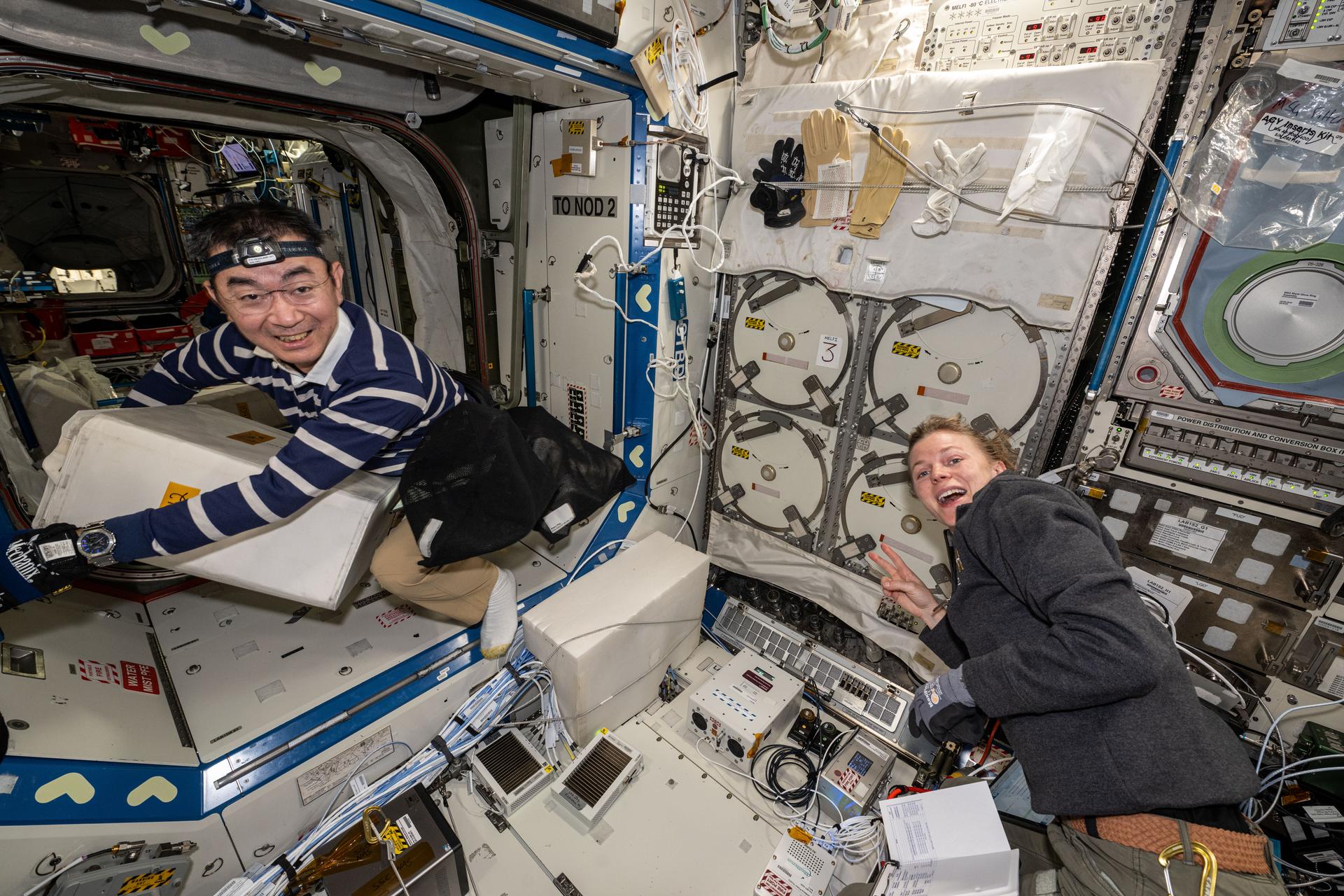
NASA astronaut Don Pettit snaps an image of the hands of NASA astronauts Nick Hague, left, and Suni Williams inside the Life Science Glovebox, a facility at the International Space Station that separates the science from the scientists, thus protecting both from contamination.

The freezers on the International Space Station are as crucial as its experiment modules, preserving samples for further analysis on Earth. The Minus Eighty-Degree Laboratory Freezer for International Space Station stores samples at ultra-cold temperatures. NASA astronaut Don Pettit used it to freeze thin ice wafers, which he photographed with a polarizing filter to reveal unique crystal structures.

New Tech Roll-Out

NASA astronaut Don Pettit films a time-lapse sequence of Canadarm2 retrieving Materials International Space Station Experiment (MISSE-20-Commercial) samples at the International Space Station. This investigation exposed various experiments to the harsh space environment, such as vacuum, radiation, and extreme temperatures. Findings could help in many areas, from designing more durable materials to advancing quantum communications.

Two solar arrays fill this image diagonally. The solar array on the left has a rectangular grid pattern and is dark blue with a light brown outer edge. The solar array to the right is black with a red grid pattern and many parallel white lines within the grid. In the background is part of the Earth is blue, and space is black.

A surge in International Space Station research supports NASA’s exploration efforts at the Moon and beyond, requiring more energy to operate the orbiting laboratory. NASA astronaut Don Pettit photographs new and old solar arrays side by side. The technology used by the International Space Station Roll-Out Solar Arrays (IROSA) on the right was first tested aboard the station in 2017. By 2023, six IROSAs were deployed aboard station, providing a 20-30% increase in power for research and operations. Roll-Out Solar Arrays were also used on NASA’s DART asteroid mission and now are slated for the Gateway lunar outpost, a vital component of Artemis.

Squire for Spacewalks

Two uncrewed white spacewalk spacesuits are positioned next to another. A fisheye effect focuses on the reflective helmets from which NASA astronaut Don Pettit’s reflection can be seen. The spacesuits are surrounded by narrow white walls.

I am the nameless boy who stays in the confines of the tent helping the Knights suit up for battle. I remain in the airlock, preparing these knights for a walk outside.

Don Pettit

Don Pettit

«Space Squire» posted to X

NASA astronaut Don Pettit helped his colleagues suit up for two spacewalks in January. The first spacewalk involved patching the Neutron Star Interior Composition Explorer (NICER), a telescope that measures X-rays from neutron stars and other cosmic objects. Sunlight interference affected data collection, and the patches reduced this issue. On the second spacewalk, astronauts collected samples from the exterior of the International Space Station for ISS External Microorganisms. This investigation examines whether the orbiting laboratory releases microbes, how many, and how far these may travel. Findings could inform the design of future spacecraft, including spacesuits, to limit biocontamination during future space missions.

Photography with a Spin

A small part of Earth from space is shown in dark green, and the edge of the curvature is illuminated with light that diffuses into space in shades of violet and then dark blue. In the background, a portion of the Milky Way runs perpendicular to the Earth’s curvature. Many other stars dot the area surrounding the Milky Way.

NASA astronaut Don Pettit photographs “cosmic colors at sunrise.” From 250 miles above, the International Space Station’s orbital path covers most of Earth’s population, offering valuable data and a great opportunity for shooting breathtaking photography.

NASA astronaut Don Pettit faces the camera wearing a gray short-sleeve shirt, with a camera floating on his right side and a large lens the size of a water pitcher floating on his left. His arms are crossed, and the walls of the space station are visible in the background, along with various equipment and wires. He grabs the camera on his right side, untwists its lens, and lets it float, then grabs the lens on his left side and installs it on the camera.

NASA astronaut Don Pettit leveraged his stay aboard the International Space Station to photograph our planet with an artistic twist.

Swirls of water, like paintbrush strokes, display shades of gray and white glints.

NASA astronaut Don Pettit wrote on social media about his snapshot of the Mediterranean Sea from the International Space Station, “Sun glint off the Mediterranean Sea (infrared and converted to black and white). When the Sun reflects off the ocean, watery details unseen with normal lighting appear. Small centimeter differences in ocean height become visible, revealing hidden currents.”

Light purple lightning illuminates the center of puffy clouds while the edges, untouched by light, are pitch-black.

NASA astronaut Don Pettit’s photography could contribute to the study of transient luminous events, colorful electrical discharges that occur above thunderstorms. His imagery can be paired with data from the Atmosphere-Space Interactions Monitor (ASIM) and Thor-Davis, a high-speed thunderstorm camera. The combined efforts of crew photography and instruments aboard the International Space Station help scientists better understand thunderstorms and their impacts on Earth’s upper atmosphere.

More of Pettit’s photography can be found on his X profile, @astro_Pettit.

Powered by WPeMatico

Get The Details…
Christian M. Getteau