Crew Swaps Command on Friday Before Soyuz Departure and Dragon Launch

Crew Swaps Command on Friday Before Soyuz Departure and Dragon Launch

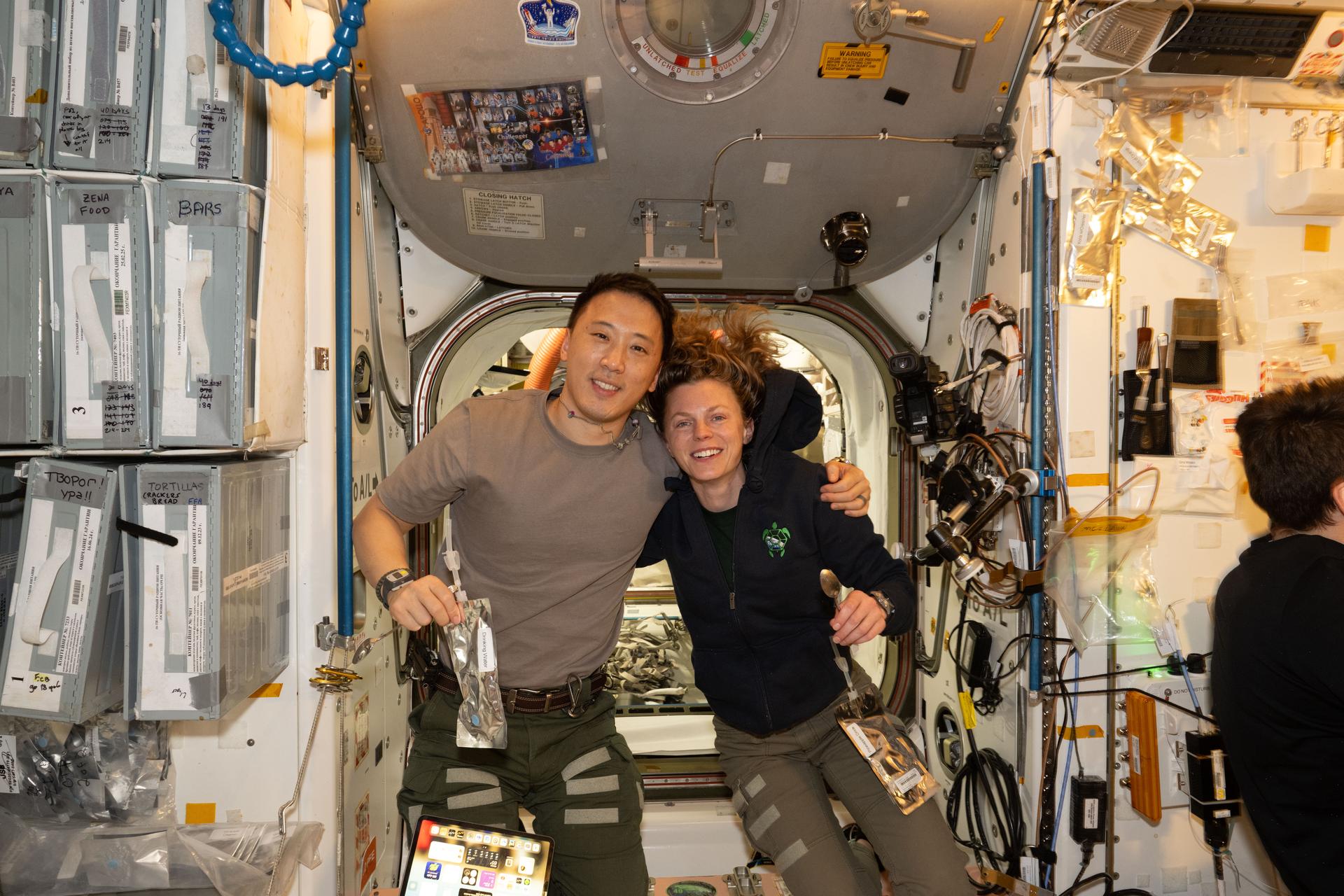
Roscosmos cosmonaut and Expedition 72 Commander Alexey Ovchinin (left) will hand over command of the orbital outpost to JAXA (Japan Aerospace Exploration Agency) astronaut and Expedition 73 Commander Takuya Onishi (right) on Friday, April 18.
NASA

Expedition 72 will come to an end and segue into the Expedition 73 mission after three veteran crewmembers depart the International Space Station on Saturday. Meanwhile, the orbital residents stayed busy on Thursday with cargo mission preparations, spacesuit checks, and microgravity research.

Station Commander Alexey Ovchinin of Roscosmos will hand over command of the orbital laboratory to JAXA (Japan Aerospace Exploration Agency) astronaut Takuya Onishi at 2:40 p.m. EDT on Friday. Afterward, Ovchinin will turn his attention to returning to Earth with Flight Engineers Don Pettit of NASA and Ivan Vagner of Roscosmos after 220 days in space. The trio will undock in their Soyuz MS-26 spacecraft from the Rassvet module at 5:57 p.m. EDT on Saturday ending Expedition 72 then parachute to a landing in Kazakhstan at 8:20 p.m. the same day (6:20 a.m. on Sunday, April 20, in Kazakhstan) on Pettit’s 70th birthday. NASA+ will broadcast Saturday’s crew farewell, undocking, and landing activities live beginning at 2 p.m.

Onishi will stay onboard the space station leading Expedition 73 and orbiting Earth until July. Remaining with Onishi will be NASA astronauts Anne McClain, Nichole Ayers, and Jonny Kim, and Roscosmos cosmonauts Sergey Ryzhikov, Alexey Zubritsky, and Kirill Pskov.

Onishi and Kim will be on duty early next week monitoring the automated approach and rendezvous of the SpaceX Dragon cargo craft carrying about 6,700 pounds of science and supplies for the orbital residents. Dragon will launch at 4:15 a.m. EDT on Monday, April 21, from NASA’s Kennedy Space Center and dock at 8:20 a.m. the following day to the Harmony module’s space-facing port for a month long cargo mission. The duo continued training on Thursday for Dragon’s arrival reviewing spacecraft monitoring techniques on a computer.

Kim began his Thursday shift studying how McClain‘s sense of balance is adapting to microgravity as she wore virtual reality goggles for the CIPHER human research investigation. Afterward, Kim examined the retina, optic nerve, and cornea of his crew mates Ayers and Onishi using medical imaging hardware.

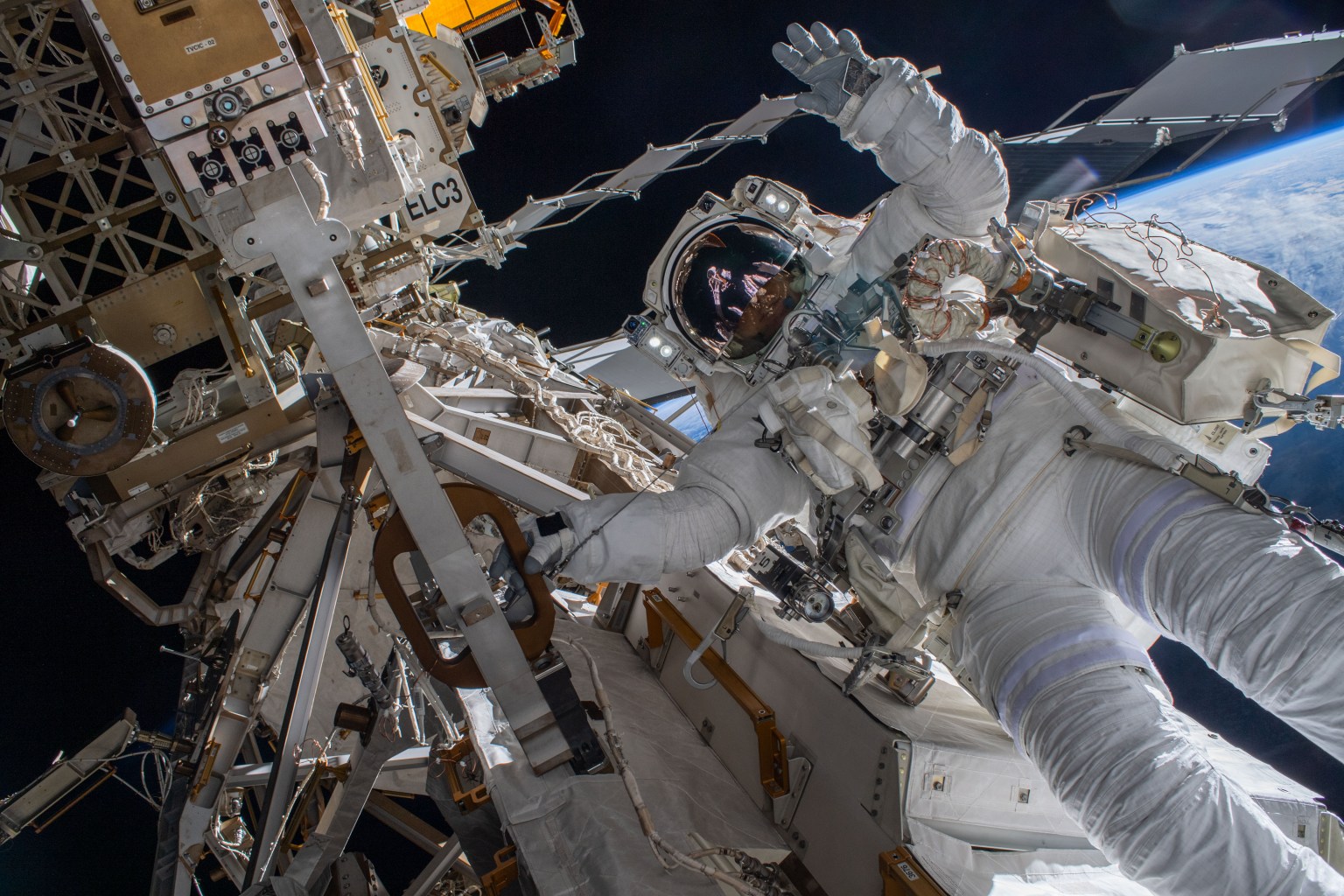
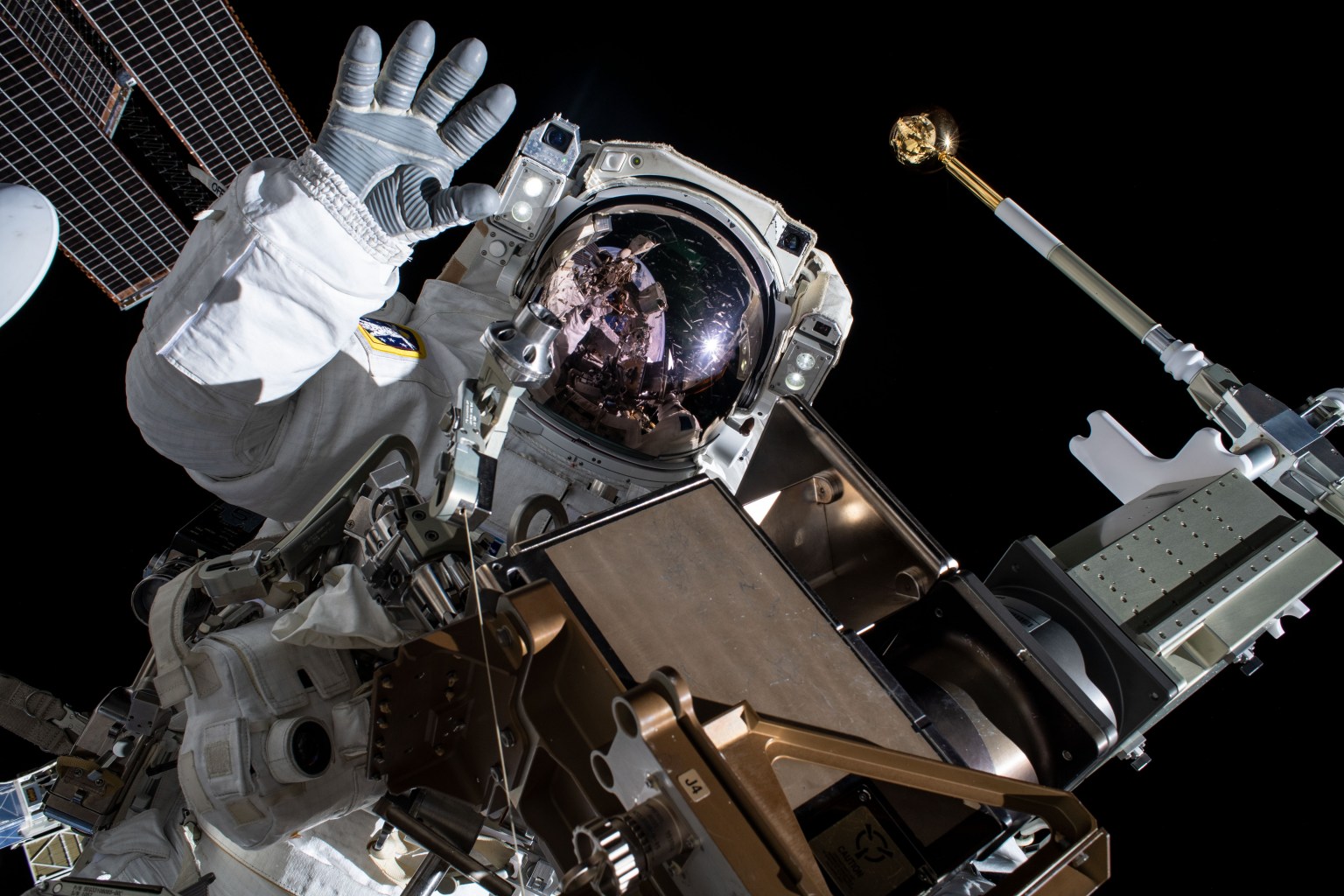
McClain and Ayers are due to exit the orbital outpost on May 1 for a six-and-a-half-hour spacewalk. The duo will prepare the port side truss structure for a new rollout solar array and relocate an antenna that communicates with commercial spacecraft at the station. Pettit spent Thursday preparing their spacesuits, cleaning the cooling loops, and inspecting suit components. Later, Kim and Onishi practiced installing jetpacks on the spacesuits that would be used to maneuver back to safety in the unlikely event a spacewalker became untethered from the space station.

Ryzhikov and Zubritsky are settling in for a seven-and-a-half-month space research mission and beginning to pick up Ovchinin’s and Vagner’s crew responsibilities. The cosmonauts also attached sensors to themselves and studied how a long duration spaceflight affects the respiratory system. Flight Engineer Kirill Peskov wrapped up a research session with the departing Vagner as they tested the lower body negative pressure suit that may help a crew member returning to Earth adjust quicker to gravity.

Learn more about station activities by following the space station blog, @space_station and @ISS_Research on X, as well as the ISS Facebook and ISS Instagram accounts.

Get the latest from NASA delivered every week. Subscribe here: https://www.nasa.gov/subscribe

Powered by WPeMatico

Get The Details…

Mark A. Garcia

NASA Studies Wind Effects and Aircraft Tracking with Joby Aircraft

NASA Studies Wind Effects and Aircraft Tracking with Joby Aircraft

3 min read

Preparations for Next Moonwalk Simulations Underway (and Underwater)

A yellow traffic cone and a black tripod with black testing instruments stands in the foreground on a concrete pad with a desert landscape, power lines, and a black and white aircraft in the background. The aircraft has six black propellors that sit on white arms and connect to the aircraft body, which has black doors and is pod-shaped. The aircraft sits on three small wheels.
One of several NASA distributed sensing ground nodes is set up in the foreground while an experimental air taxi aircraft owned by Joby Aviation sits in the background near NASA’s Armstrong Flight Research Center in Edwards, California, on March 12, 2025. NASA is collecting information during this study to help advance future air taxi flights, especially those occurring in cities, to track aircraft moving through traffic corridors and around landing zones.
NASA/Genaro Vavuris

NASA engineers began using a network of ground sensors in March to collect data from an experimental air taxi to evaluate how to safely integrate such vehicles into airspace above cities – in all kinds of weather.

Researchers will use the campaign to help improve tools to assist with collision avoidance and landing operations and ensure safe and efficient air taxi operations in various weather conditions.

For years, NASA has looked at how wind shaped by terrain, including buildings in urban areas, can affect new types of aircraft. The latest test, which is gathering data from a Joby Aviation demonstrator aircraft, looks at another kind of wind – that which is generated by the aircraft themselves.

Joby flew its air taxi demonstrator over NASA’s ground sensor array near the agency’s Armstrong Flight Research Center in Edwards, California producing air flow data. The Joby aircraft has six rotors that allow for vertical takeoffs and landings, and tilt to provide lift in flight. Researchers focused on the air pushed by the propellers, which rolls into turbulent, circular patterns of wind.

Five orange traffic cones and barriers sit in front of a large white box in the foreground. In the background, a man wearing jeans and a black sweatshirt stands in front of a black laptop. Behind him, there are several cream-colored trailers, other construction equipment, and a few cars.
NASA aeronautical meteorologist Luke Bard adjusts one of several wind lidar (light detection and ranging) sensors near NASA’s Armstrong Flight Research Center in Edwards, California, on March 12, 2025, in preparation to collect data from Joby Aviation’s experimental air taxi aircraft. NASA is collecting information during this study to help advance weather-tolerant air taxi operations for the entire industry
NASA/Genaro Vavuris

This rolling wind can affect the aircraft’s performance, especially when it’s close to the ground, as well as others flying in the vicinity and people on the ground. Such wind turbulence is difficult to measure, so NASA enhanced its sensors with a new type of lidar – a system that uses lasers to measure precise distances – and that can map out the shapes of wind features.

“The design of this new type of aircraft, paired with the NASA lidar technology during this study, warrants a better understanding of possible wind and turbulence effects that can influence safe and efficient flights,” said Grady Koch, lead for this research effort, from NASA’s Langley Research Center in Hampton, Virginia.

Data to Improve Aircraft Tracking

NASA also set up a second array of ground nodes including radar, cameras, and microphones in the same location as the sensors to provide additional data on the aircraft. These nodes will collect tracking data during routine flights for several months.

The agency will use the data gathered from these ground nodes to demonstrate the tracking capabilities and functions of its “distributed sensing” technology, which involves embedding multiple sensors in an area where aircraft are operating.

The top of a black tripod with black testing instruments stands in the foreground on a concrete pad with a desert landscape and power lines in the background. A black and white aircraft is in the sky above in the background with blue sky and clouds behind as the aircraft hovers. The aircraft has six black propellors that sit on white arms and connect to the aircraft body, which has black doors and is pod-shaped. The aircraft sits on three small wheels.
One of multiple NASA distributed sensing ground nodes is set up in the foreground while an experimental air taxi aircraft owned by Joby Aviation hovers in the background near NASA’s Armstrong Flight Research Center in Edwards, California, on March 12, 2025. NASA is collecting information during this study to help advance future air taxi flights, especially those occurring in cities, to track aircraft moving through traffic corridors and around landing zones.
NASA/Genaro Vavuris

This technology will be important for future air taxi flights, especially those occurring in cities by tracking aircraft moving through traffic corridors and around landing zones. Distributed sensing has the potential to enhance collision avoidance systems, air traffic management, ground-based landing sensors, and more.

“Our early work on a distributed network of sensors, and through this study, gives us the opportunity to test new technologies that can someday assist in airspace monitoring and collision avoidance above cities,” said George Gorospe, lead for this effort from NASA’s Ames Research Center in California’s Silicon Valley.

Using this data from an experimental air taxi aircraft, NASA will further develop the technology needed to help create safer air taxi flights in high-traffic areas. Both of these efforts will benefit the companies working to bring air taxis and drones safely into the airspace.

The work is led by NASA’s Transformational Tools and Technologies and Convergent Aeronautics Solutions projects under the Transformative Aeronautics Concepts program in support of NASA’s Advanced Air Mobility mission. NASA’s Advanced Air Mobility mission seeks to deliver data to guide the industry’s development of electric air taxis and drones.

Powered by WPeMatico

Get The Details…
Dede Dinius

NASA Astronaut to Answer Questions from Colorado Students

NASA Astronaut to Answer Questions from Colorado Students

NASA astronaut Nichole Ayers is seen in the International Space Station's Destiny Laboratory as she works at the controls of the robotics workstation.
NASA astronaut Nichole Ayers works at the controls of the robotics workstation in the International Space Station’s Destiny Laboratory.
Credit: NASA

Students from Woodland Park, Colorado, will connect with NASA astronaut Nichole Ayers as she answers prerecorded science, technology, engineering, and mathematics-related questions from aboard the International Space Station.

Watch the 20-minute space-to-Earth call at 11:55 a.m. EDT on Monday, April 21, on the NASA STEM YouTube Channel.

The event, hosted by Woodland Park High School, also is open to students from Woodland Park Middle School. The Colorado high school wants to show students that even though they reside in a small town, they can achieve big dreams. Ayers, who considers Colorado Springs and Divide, Colorado, home, is a graduate of Woodland Park.

Media interested in covering the event must RSVP by 5 p.m., Friday, April 18 to Lindsey Prahl at lprah@wpsdk12.org or 719-922-1019.

For more than 24 years, astronauts have continuously lived and worked aboard the space station, testing technologies, performing science, and developing skills needed to explore farther from Earth. Astronauts aboard the orbiting laboratory communicate with NASA’s Mission Control Center in Houston 24 hours a day through SCaN’s (Space Communications and Navigation) Near Space Network.

Important research and technology investigations taking place aboard the space station benefit people on Earth and lays the groundwork for other agency missions. As part of NASA’s Artemis campaign, the agency will send astronauts to the Moon to prepare for future human exploration of Mars; inspiring Artemis Generation explorers and ensuring the United States continues to lead in space exploration and discovery.

See videos and lesson plans highlighting space station research at:

https://www.nasa.gov/stemonstation

-end-

Tiernan Doyle
Headquarters, Washington
202-358-1600
tiernan.doyle@nasa.gov  

Sandra Jones
Johnson Space Center, Houston
281-483-5111
sandra.p.jones@nasa.gov

Powered by WPeMatico

Get The Details…
Tiernan P. Doyle

Space Shuttle Discovery Lifts Off

Space Shuttle Discovery Lifts Off

A space shuttle takes off into a gray-blue sky, leaving a bright column of white vapor behind it. The view is from below.
The space shuttle Discovery launches from NASA’s Kennedy Space Center in Florida, heading through Atlantic skies toward its 51-D mission. The seven-member crew lifted off at 8:59 a.m. ET, April 12, 1985.
NASA

The launch of space shuttle Discovery is captured in this April 12, 1985, photo. This mission, STS-51D, was the 16th flight of NASA’s Space Shuttle program, and Discovery’s fourth flight.

Discovery carried out 39 missions, more than any other space shuttle. Its missions included deploying and repairing the Hubble Space Telescope and 13 flights to the International Space Station – including the very first docking in 1999. The retired shuttle now resides at the National Air and Space Museum’s Steven F. Udvar-Hazy Center in Virginia.

Learn more about NASA’s Space Shuttle Program.

Image credit: NASA

Powered by WPeMatico

Get The Details…
Monika Luabeya

Building for a Better World: Norfolk Students Bring STEM to Life with NASA Partnership

Building for a Better World: Norfolk Students Bring STEM to Life with NASA Partnership

6 min read

Building for a Better World: Norfolk Students Bring STEM to Life with NASA Partnership

At Norfolk Technical Center in Norfolk, Virginia, carpentry students in Jordan Crawford’s first-year class aren’t just learning how to measure and cut wood—they’re discovering how their skills can serve a greater purpose.

When the NASA Science Activation program’s NASA eClips project—led by the National Institute of Aerospace’s Center for Integrative Science, Technology, Engineering, and Mathematics (STEM) Education (NIA-CISE)—needed help building weather instrument shelters for local schools, Norfolk Public Schools’ Career and Technical Education (CTE) team saw an opportunity to connect students to something bigger than the classroom. The shelters are used to house scientific equipment that K–12 students rely on to collect data using GLOBE (Global Learning and Observations to Benefit the Environment) protocols—a set of standardized, internationally recognized methods for gathering environmental data such as temperature, soil moisture, and cloud cover. These observations contribute to a global citizen science database, giving young learners a meaningful role in real-world environmental research.

Originally, shelters were being ordered from a national supplier to support GLOBE training sessions for teachers in GO (Growth & Opportunity) Virginia Region 5, an economic development region. These training sessions were funded through a generous grant from the Coastal Virginia STEM Hub (COVA STEM Hub), which supports regional collaboration in STEM education. But when the supplier couldn’t keep up with demand, Norfolk Public Schools CTE Specialist Dr. Deborah Marshall offered a bold solution: why not have local students build them?

That’s when the project truly took off. Under the guidance of Jordan Crawford, students took on the challenge of building 20 high-quality shelters in spring 2024, following precise construction plans provided through the GLOBE Program. Materials were funded by the COVA STEM grant, and the students rolled up their sleeves to turn lumber into lasting educational tools for their community.

“As an instructor, you look for opportunities that challenge your students, allow them to do things bigger than themselves, and let them see a project through from start to finish,” Crawford said. “This project allowed my students to hone existing skills and build new ones, and I saw incredible growth not just in craftsmanship but in teamwork. The most rewarding part was seeing the impact of their work in real schools.”

And the students rose to the occasion—taking pride in their work, learning advanced techniques, and developing new confidence. One of the most challenging parts of the build involved crafting the louvers—angled slats on the sides of the shelters needed for proper air circulation. Student Zymere Watts took the lead in designing and building a jig to make sure the louvers could be cut uniformly and precisely for every unit.

“Building the weather shelters was a fun and challenging task that pushed me to strive for perfection with each one,” said student Amir Moore. “After completion, I was delighted to see the faces of the people who were proud and happy with what we built.”
“It was an extreme pleasure working on this project. I would love to work with NIA again,” added LaValle Howard. “I am proud to be a part of this vocational school and team.”
Jaymyson Burden agreed: “It was fun and great to be exposed to the carpentry realm and install them in the real world. It was gratifying to know what we have done has an impact.”

After completing the shelters, the students volunteered to install them at seven Hampton City Schools. Their work completed the full circle—from building the shelters in their carpentry classroom to setting them up where younger students would use them to collect real environmental data.

Their dedication did not go unnoticed. The team was invited to NASA’s Langley Research Center for a behind-the-scenes tour of the NASA Model Shop, where they met Sam James, a Mechanical Engineering Technician and Fabrication Specialist. James showed the students how the same kind of craftsmanship they’d used is essential in the creation of tools and components for NASA missions. They also learned about NASA summer internships and discovered that their hands-on skills could open doors to exciting careers in STEM fields.

“It was an honor to help where we were needed,” said student Josh Hunsucker. “Assembling these gave us a new perspective on the importance of duplication and how each step impacts the result. We’re happy to help wherever or whenever we’re needed—it provides a learning experience for us.”
Kyra Pope summed it up: “It’s been a great amount of work over the past few months, but it pays off—especially when you’re giving back to the community.”

According to Dr. Sharon Bowers, Associate Director and Senior STEM Education Specialist for NIA-CISE, the project demonstrates what’s possible when regional partners come together to empower students and educators alike. “The financial support from COVA STEM Hub supported sustained educator professional learning within our STEM learning ecosystem. Work with the Norfolk Technical Center truly made this a real-world, problem-solving experience. This is just the beginning for more collaborative work that will bring the region together to engage educators and learners in authentic STEM learning experiences.”

This collaboration wasn’t just about building boxes to house thermometers. It was about building bridges—between technical education and science, between high school students and their futures, and between local classrooms and global research. With each shelter they crafted, the students created something that will outlast them, reminding others—and themselves—of what’s possible when learning is hands-on, meaningful, and connected to the world beyond school walls.

Thanks to Betsy McAllister, NIA’s Educator-in-Residence from Hampton City Schools, for her impactful contributions and for sharing this story. The NASA eClips project provides educators with standards-based videos, activities, and lessons to increase STEM literacy through the lens of NASA. It is supported by NASA under cooperative agreement award number NNX16AB91A and is part of NASA’s Science Activation Portfolio. Learn more about how Science Activation connects NASA science experts, real content, and experiences with community leaders to do science in ways that activate minds and promote deeper understanding of our world and beyond: https://science.nasa.gov/learn

Two students in purple and black jackets are leaning over a GLOBE instrument shelter lying on the ground, attaching the white shelter box to the green post, preparing it for installation into the ground.
Carpentry students from the Norfolk Technical Center install a digital, multi-day, minimum/maximum thermometer in the GLOBE instrument shelter.

Share

Details

Last Updated
Apr 17, 2025
Editor
NASA Science Editorial Team
Location
NASA Langley Research Center

Powered by WPeMatico

Get The Details…