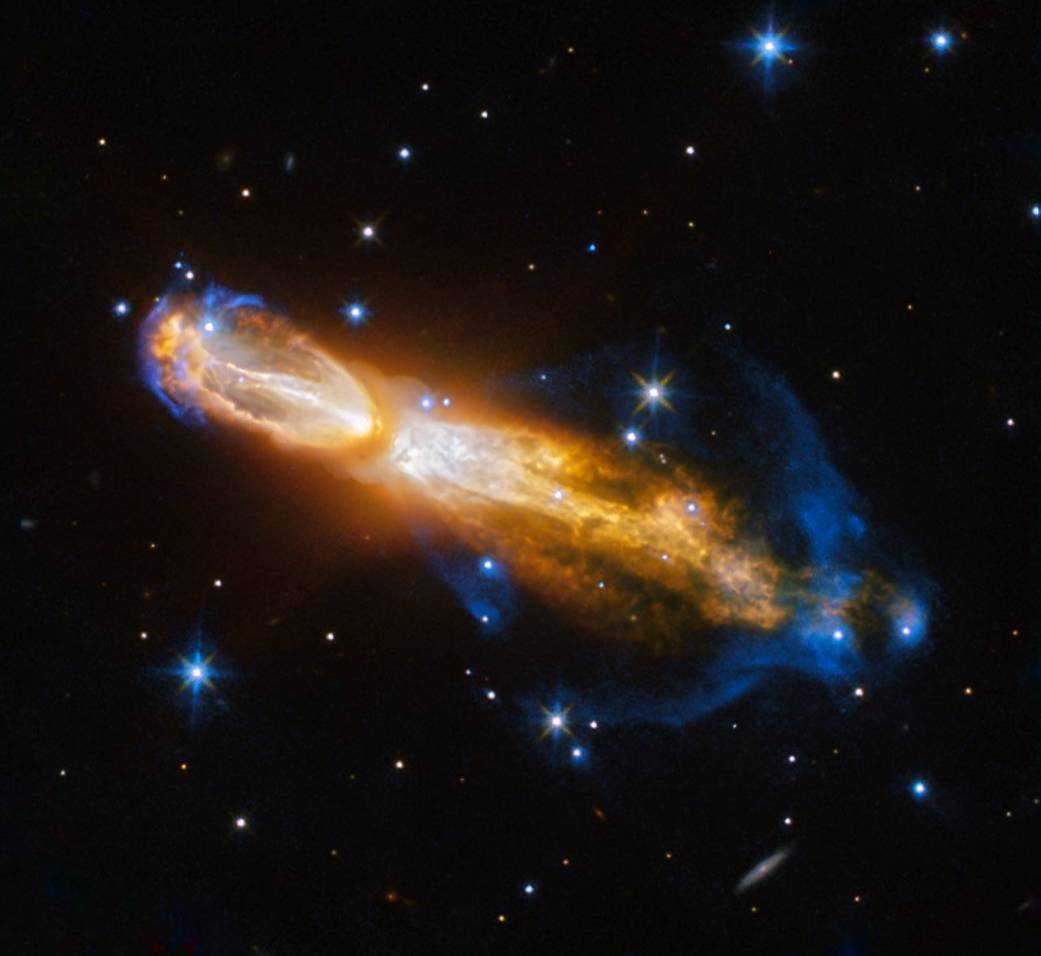
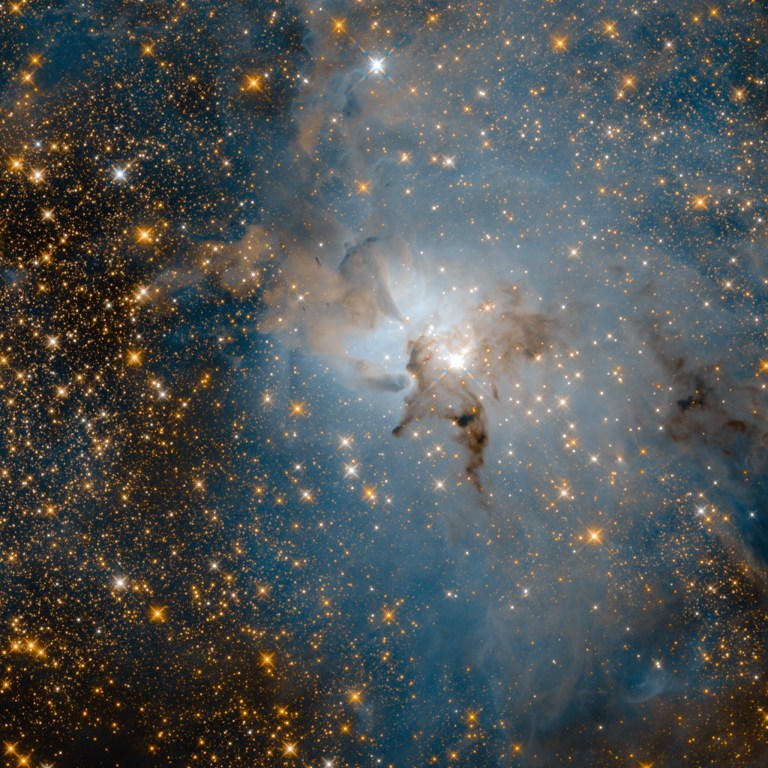
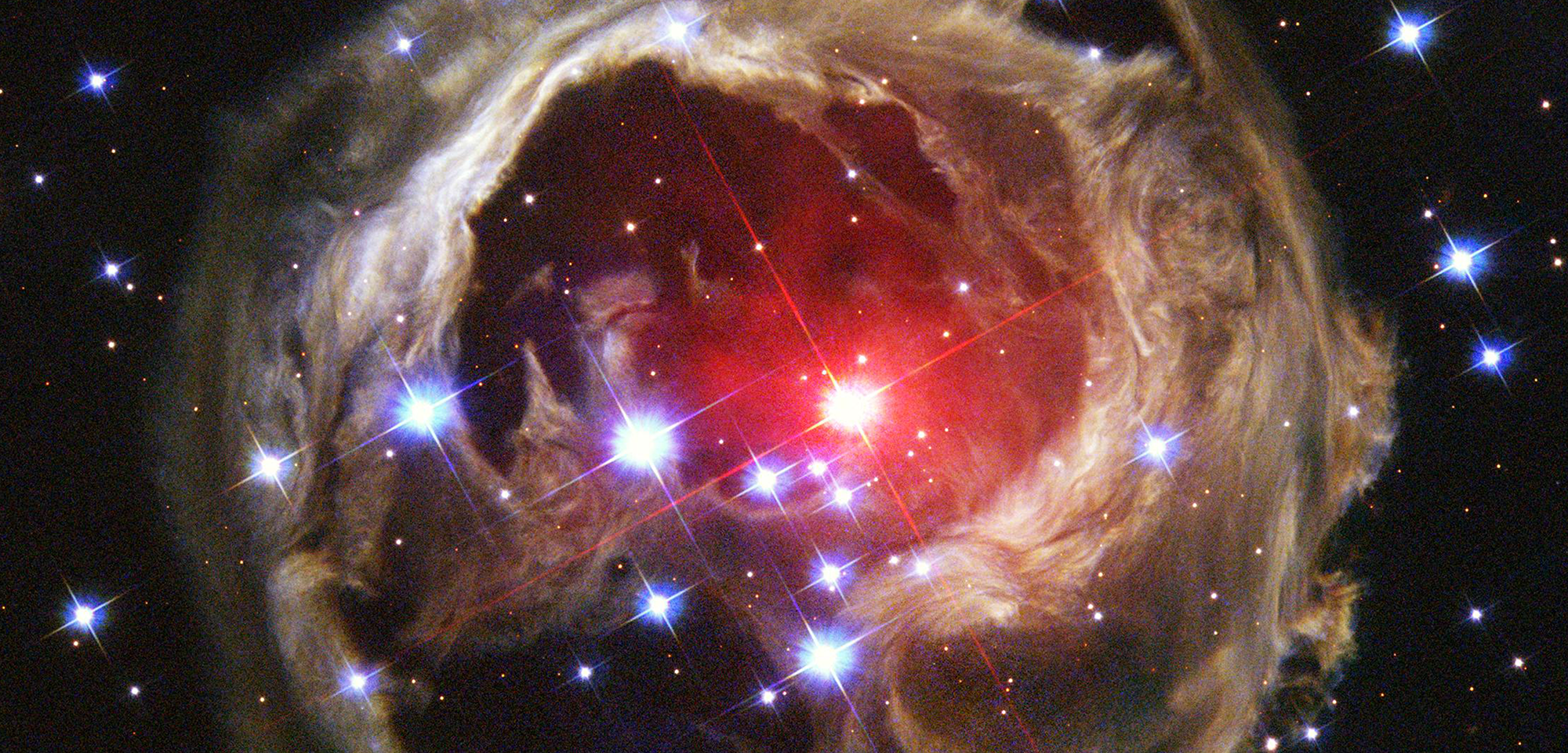
NASA’s Hubble Space Telescope captured an uncommon sight – the death of a low-mass star – in this image of the Calabash Nebula released on Feb. 3, 2017.
Here, we can see the star going through a rapid transformation from a red giant to a planetary nebula, during which it blows its outer layers of gas and dust out into the surrounding space. The recently ejected material is spat out in opposite directions with immense speed — the gas shown in yellow is moving close to a million kilometers an hour.
Astronomers rarely capture a star in this phase of its evolution because it occurs within the blink of an eye – in astronomical terms. Over the next thousand years the nebula is expected to evolve into a fully-fledged planetary nebula.
NASA Announces Plan to Map Milky Way With Roman Space Telescope
NASA’s Nancy Grace Roman Space Telescope team has released detailed plans for a major survey that will reveal our home galaxy, the Milky Way, in unprecedented detail. In one month of observations spread across two years, the survey will unveil tens of billions of stars and explore previously uncharted structures.
This video begins with a view of the Carina Nebula — a giant, relatively nearby star-forming region in the southern sky. Roman will view the entire nebula as well as its surroundings, including a 10,000 light-year-long swath of the spiral arm it resides in. The observation will offer an unparalleled opportunity to watch how stars grow, interact, and sculpt their environments, and it’s just one of many thousands of highlights astronomers are looking forward to from the Galactic Plane Survey NASA’s Nancy Grace Roman Space Telescope will conduct. Credit: NASA’s Goddard Space Flight Center
“The Galactic Plane Survey will revolutionize our understanding of the Milky Way,” said Julie McEnery, Roman’s senior project scientist at NASA’s Goddard Space Flight Center in Greenbelt, Maryland. “We’ll be able to explore the mysterious far side of our galaxy and its star-studded heart. Because of the survey’s breadth and depth, it will be a scientific mother lode.”
The Galactic Plane Survey is Roman’s first selected general astrophysics survey — one of many observation programs Roman will do in addition to its three core surveys and Coronagraph technology demonstration. At least 25% of Roman’s five-year primary mission is reserved for astronomers worldwide to propose more surveys beyond the core programs, fully leveraging Roman’s capabilities to conduct groundbreaking science. Roman is slated to launch by May 2027, but the team is on track for launch as early as fall 2026.
While ESA’s (European Space Agency’s) retired Gaia spacecraft mapped around 2 billion Milky Way stars in visible light, many parts of the galaxy remain hidden by dust. By surveying in infrared light, Roman will use powerful heat vision that can pierce this veil to see what lies beyond.
“It blows my mind that we will be able to see through the densest part of our galaxy and explore it properly for the first time,” said Rachel Street, a senior scientist at Las Cumbres Observatory in Santa Barbara, California, and a co-chair of the committee that selected the Galactic Plane Survey design.
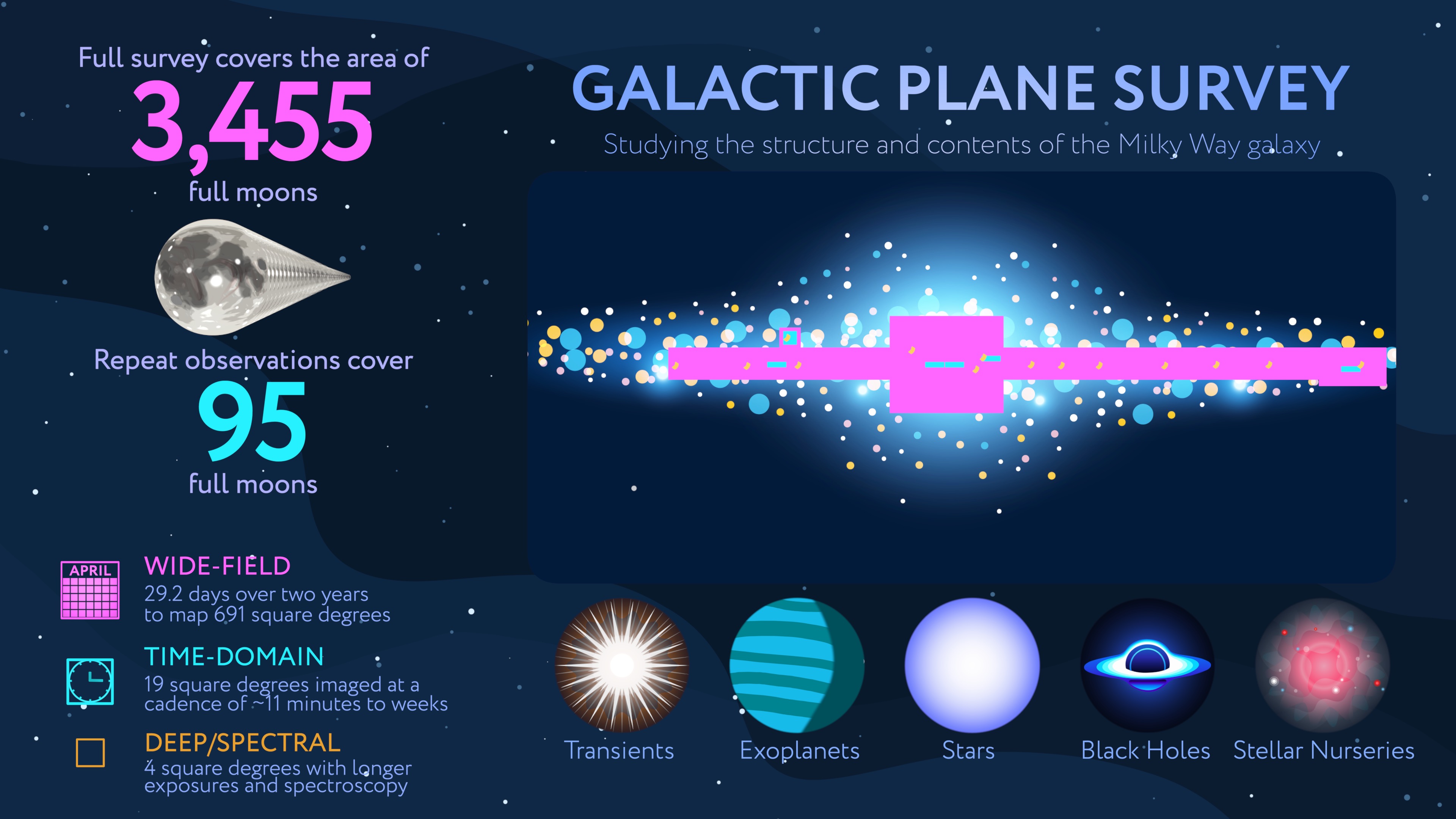
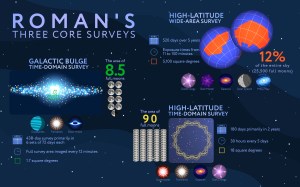
This infographic describes the 29-day Galactic Plane Survey that will be conducted by NASA’s Nancy Grace Roman Space Telescope. The survey’s main component will cover 691 square degrees — a region of sky as large as around 3,500 full moons — in 22.5 days. Roman will also view a smaller area — 19 square degrees, the area of 95 full moons — repeatedly for about 5.5 days total to capture things that change over time. The survey’s final component will image a smattering of even smaller areas, adding up to about 4 square degrees (the area of 20 full moons) and 31 total hours, with Roman’s full suite of filters and spectroscopic tools. The survey will reveal our home galaxy in unprecedented detail including many in regions we’ve never been able to see before because they’re blocked by dust, unveiling tens of billions of stars and other objects.
Credit: NASA’s Goddard Space Flight Center
The survey will cover nearly 700 square degrees (a region of sky as large as about 3,500 full moons) along the glowing band of the Milky Way — our edge-on view of the disk-shaped structure containing most of our galaxy’s stars, gas, and dust. Scientists expect the survey to map up to 20 billion stars and detect tiny shifts in their positions with repeated high-resolution observations. And it will only take 29 days spread over the course of the mission’s first two years.
Cosmic Cradles
Stars are born from parent clouds of gas and dust. Roman will peer through the haze of these nesting grounds to see millions of stellar embryos, newborn stars still swaddled in shrouds of dust, tantrumming toddler stars that flare unpredictably, and young stars that may have planetary systems forming around them. Astronomers will study stellar birth rates across a wide range of masses and stitch together videos that show how stars change over time.
“This survey will study such a huge number of stars in so many different stellar environments that we’ll be sampling every phase of a star’s evolution,” Street said.
Observing so many stars in various stages of early development will shed light on the forces that shape them. Star formation is like a four way tug-of-war between gravity, radiation, magnetism, and turbulence. Roman will help us study how these forces influence whether gas clouds collapse into full-fledged stars, smaller brown dwarfs — in-between objects that are much heavier than planets but not massive enough to ignite like stars — or new worlds.
The Galactic Plane Survey by NASA’s Nancy Grace Roman Space Telescope will scan the densest part of our galaxy, where most of its stars, gas, and dust reside — the most difficult region to study from our place inside the Milky Way since we have to look through so much light-blocking material. Roman’s wide field of view, crisp resolution, and infrared vision will help astronomers peer through thick bands of dust to chart new galactic territory. Credit: NASA’s Goddard Space Flight Center
Some stars are born in enormous litters called clusters. Roman will study nearly 2,000 young, loosely bound open clusters to see how the galaxy’s spiral arms trigger star formation. The survey will also map dozens of ancient, densely packed globular clusters near the center of the galaxy that could help astronomers reconstruct the Milky Way’s early history.
Comparing Roman’s snapshots of clusters scattered throughout the galaxy will enable scientists to study nature versus nurture on a cosmic scale. Because a cluster’s stars generally share the same age, origin, and chemical makeup, analyzing them allows astronomers to isolate environmental effects very precisely.
Pulse Check
When they run out of fuel, Sun-like stars leave behind cores called white dwarfs and heavier stars collapse to form neutron stars and black holes. Roman will find these stellar embers even when they’re alone thanks to wrinkles in space-time.
Anything that has mass warps the underlying fabric of the universe. When light from a background star passes through the gravitational well around an intervening object on its journey toward Earth, its path slightly curves around the object. This phenomenon, called microlensing, can temporarily brighten the star. By studying these signals, astronomers can learn the mass and size of otherwise invisible foreground objects.
A separate survey — Roman’s Galactic Bulge Time-Domain Survey — will conduct deep microlensing observations over a smaller area in the heart of the Milky Way. The Galactic Plane Survey will conduct repeated observations over a shorter interval but across the whole center of the galaxy, giving us the first complete view of this complex galactic environment. An unobscured view of the galaxy’s central bar will help astronomers answer the question of its origin, and Roman’s videos of stars in this region will enable us to study some ultratight binary objects at the very ends of their lives thanks to their interactions with close companions.
“Compact binaries are particularly interesting because they’re precursors to gravitational-wave sources,” said Robert Benjamin, a visiting professor at the University of Wisconsin-Whitewater, and a co-chair of the committee that selected the Galactic Plane Survey design. When neutron stars and black holes merge, the collision is so powerful that it sends ripples through the fabric of space-time. “Scientists want to know more about the pathways that lead to those mergers.”
optical
infrared
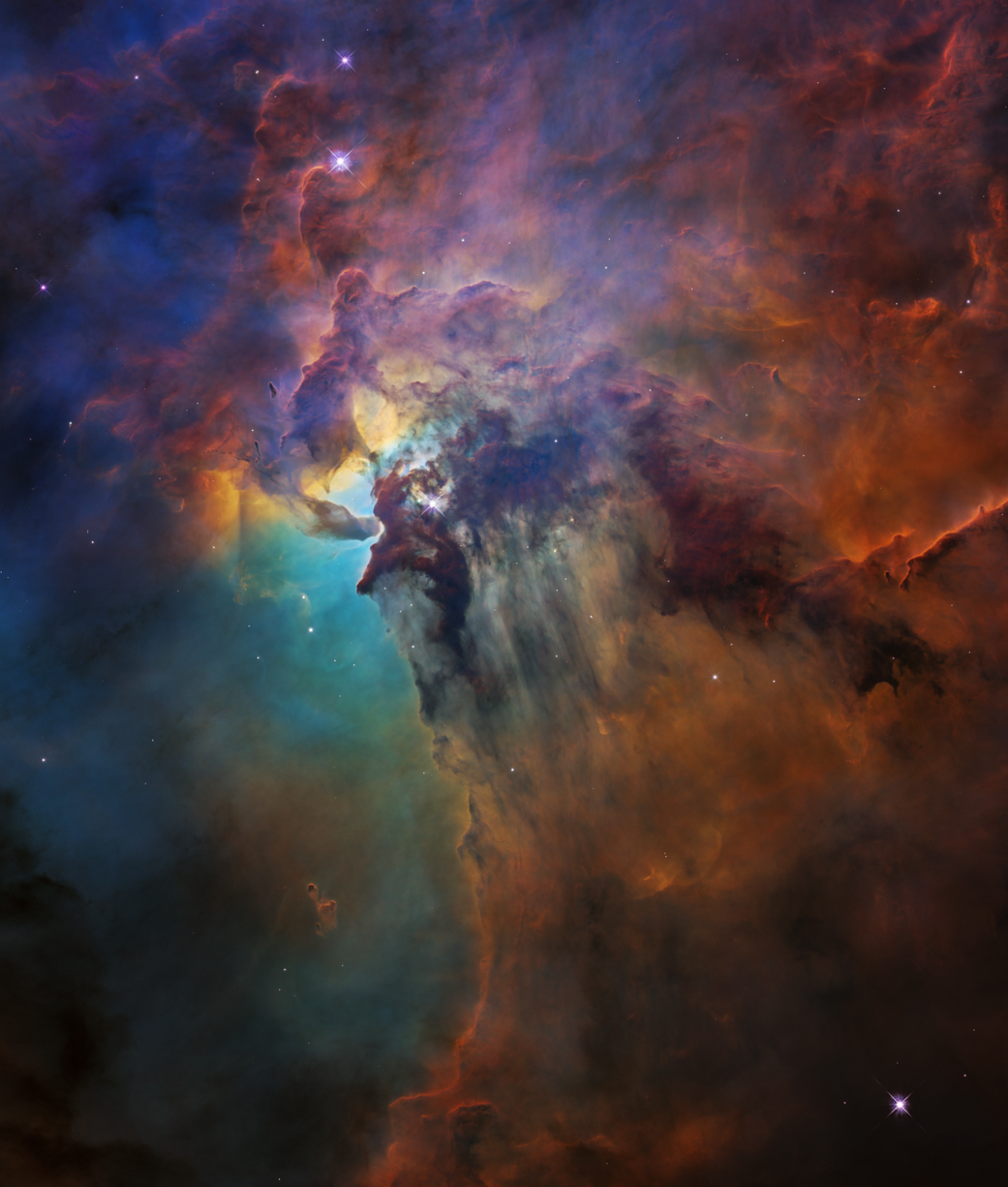
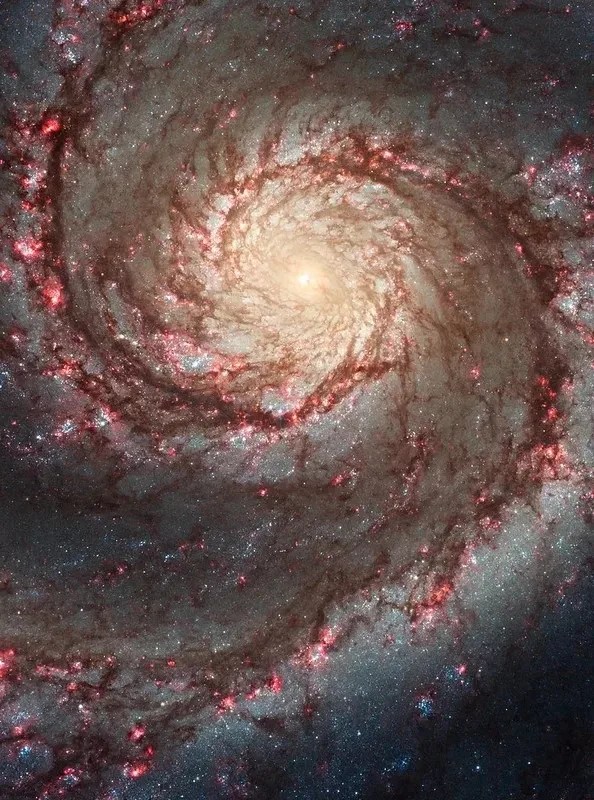
This colorful image, taken by the Hubble Space Telescope and published in 2018, celebrated the observatory’s 28th anniversary of viewing the heavens.
This colorful image, taken by the Hubble Space Telescope and published in 2018, celebrated the observatory’s 28th anniversary of viewing the heavens.
optical
infrared
Optical vs infrared
Two Views
The Galactic Plane Survey by NASA’s Nancy Grace Roman Space Telescope will scan the densest part of our galaxy, where most of its stars, gas, and dust reside — the most difficult region to study from our place inside the Milky Way since we have to look through so much light-blocking material. Roman’s wide field of view, crisp resolution, and infrared vision will help astronomers peer through thick bands of dust to chart new galactic territory. Credit: NASA, ESA, and STScI
Roman’s repeated observations will also monitor stars that flicker. Ground-based surveys detect thousands of bright stellar outbursts, but often can’t see the faint, dust-obscured stars that produce them. Roman will pinpoint the culprits plus take high-resolution snapshots of the aftermath.
Some stars throb rhythmically, and the speed of their pulsing is directly linked to their intrinsic brightness. By comparing their true brightness to how bright they appear from Earth, astronomers can measure distances across the galaxy. Roman will find these blinking stars farther away than ever before and track them over time, helping astronomers improve their cosmic measuring sticks.
“Pairing Roman’s Galactic Plane Survey with other Milky Way observations will create the best portrait of the galaxy we’ve ever had,” Benjamin said.
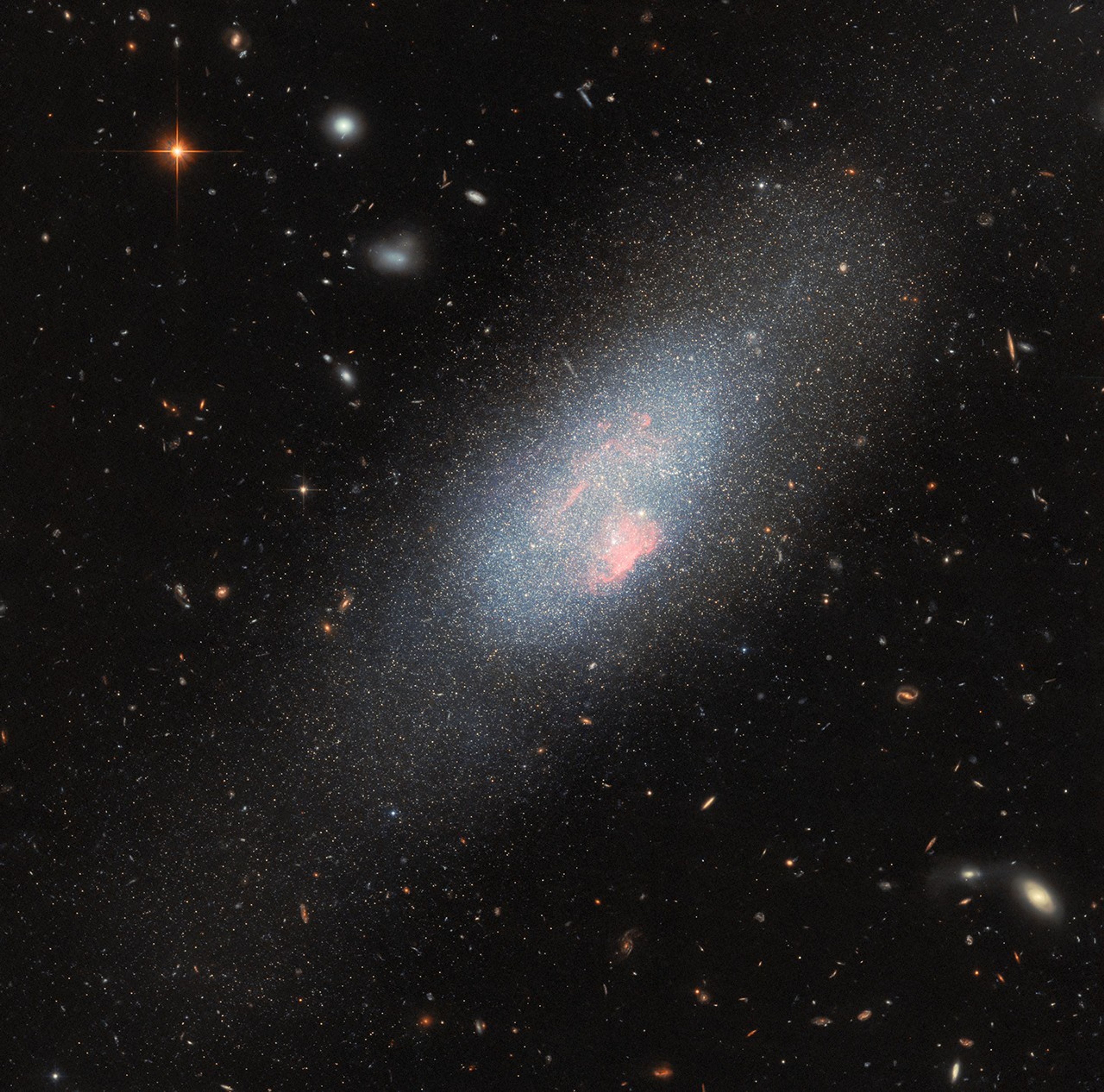
This NASA/ESA Hubble Space Telescope image features the blue dwarf galaxy Markarian 178 (Mrk 178) against a backdrop of distant galaxies in all shapes and sizes. Some of these distant galaxies even shine through the diffuse edges of Mrk 178.
ESA/Hubble & NASA, F. Annibali, S. Hong
This NASA/ESA Hubble Space Telescope image features a glittering blue dwarf galaxy called Markarian 178 (Mrk 178). The galaxy, which is substantially smaller than our own Milky Way, lies 13 million light-years away in the constellation Ursa Major (the Great Bear).
Mrk 178 is one of more than 1,500 Markarian galaxies. These galaxies get their name from the Armenian astrophysicist Benjamin Markarian, who compiled a list of galaxies that were surprisingly bright in ultraviolet light.
While the bulk of the galaxy is blue due to an abundance of young, hot stars with little dust shrouding them, Mrk 178 gets a red hue from a collection of rare massive Wolf–Rayet stars. These stars are concentrated in the brightest, reddish region near the galaxy’s edge. Wolf–Rayet stars cast off their atmospheres through powerful winds, and the bright emission lines from their hot stellar winds are etched upon the galaxy’s spectrum. Both ionized hydrogen and oxygen lines are particularly strong and appear as a red color in this photo.
Massive stars enter the Wolf–Rayet phase of their evolution just before they collapse into black holes or neutron stars. Because Wolf–Rayet stars last for only a few million years, researchers know that something must have triggered a recent burst of star formation in Mrk 178. At first glance, it’s not clear what could be the cause — Mrk 178 doesn’t seem to have any close galactic neighbors that may have stirred up its gas to form new stars. Instead, researchers suspect that a gas cloud crashed into Mrk 178, or that the intergalactic medium disturbed its gas as the galaxy moved through space. Either disturbance could light up this tiny galaxy with a ripple of bright new stars.
Waves of heavy rainfall in early December 2025 spurred landslides and flooding in parts of the Pacific Northwest. The deluge was the result of a potent atmospheric river that took aim at the region starting around December 7.
Atmospheric rivers are long, narrow bands of moisture that move like rivers in the sky, transporting water vapor from the tropics toward the poles. They occur around the planet, most often in autumn and winter, with the U.S. West Coast typically affected by moist air that originates near Hawaii. In this event, however, some of the moisture arrived from even farther away, originating roughly 7,000 miles (11,000 kilometers) across the Pacific from near the Philippines.
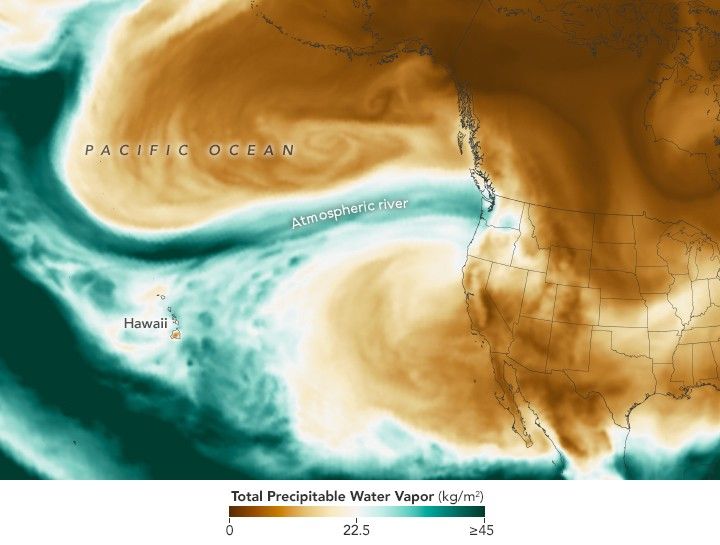
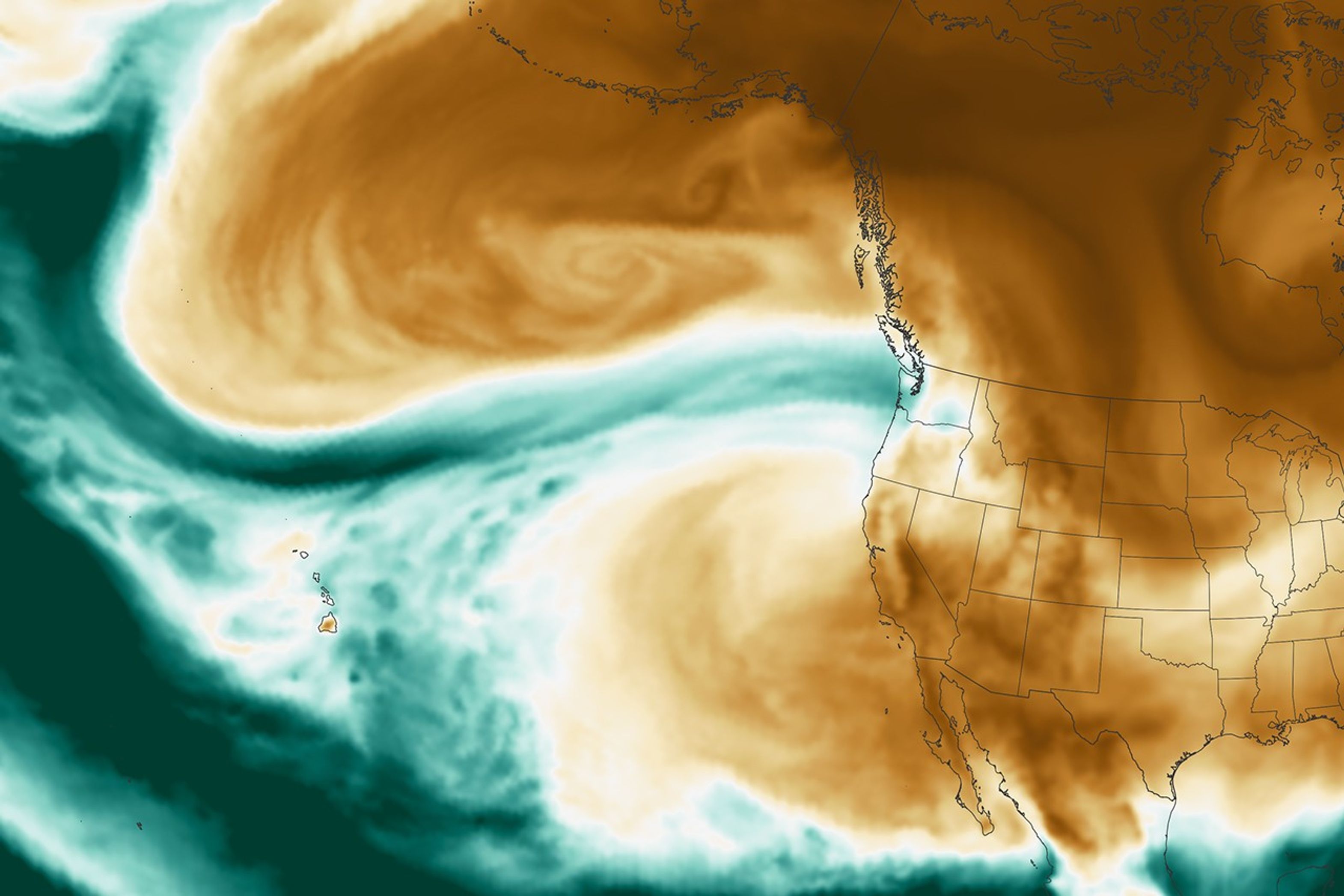
This map shows the total precipitable water vapor in the atmosphere at 11:30 p.m. Pacific Time on December 10. It is derived from NASA’s GEOS (Goddard Earth Observing System) and uses satellite data and models of physical processes to approximate what is happening in the atmosphere.
Precipitable water vapor represents the amount of water contained in a column of air, assuming all the water vapor condensed into liquid. The map’s green areas indicate the highest amounts of moisture. Note that not all precipitable water vapor falls as rain; at least some remains in the atmosphere. Nor is it a cap on how much rain can fall, since rainfall can increase as more moisture flows into a column of air. Still, it serves as a useful indicator of areas where excessive rainfall is likely.
According to the National Weather Service, preliminary ground-based measurements showed that several locations in western Washington received more than 10 inches (250 millimeters) of rain over a 72-hour period ending on the morning of December 11. Seattle-Tacoma International Airport set a daily rainfall record on December 10, with 1.6 inches (40 millimeters).
River flooding was ongoing on December 11, with the Skagit River and Snohomish River seeing record or near-record flood levels that day. Floodwater and mudslides have closed numerous roadways, including the eastbound lanes of I-90 out of western Washington.
NASA’s Disasters Response Coordination System has been activated to support the ongoing response efforts by the Washington State Emergency Operations Center. The team will be posting maps and data products on its open-access mapping portal as new information becomes available.
NASA Earth Observatory images by Lauren Dauphin, using GEOS data from the Global Modeling and Assimilation Office at NASA GSFC. Story by Kathryn Hansen.
NASA Selects Two Heliophysics Missions for Continued Development
NASA
NASA has selected one small explorer mission concept to advance toward flight design and another for an extended period of concept development.
NASA’s Science Mission Directorate Science Management Council selected CINEMA (Cross-scale Investigation of Earth’s Magnetotail and Aurora) to enter Phase B of development, which includes planning and design for flight and mission operations. The principal investigator for the CINEMA mission concept is Robyn Millan from Dartmouth College in Hanover, New Hampshire.
The proposed CINEMA mission aims to advance our understanding of how plasma energy flows into the Earth’s magnetosphere. This highly dynamic convective flow is unpredictable — sometimes steady and sometimes explosive — driving phenomena like fast plasma jets, global electrical current systems, and spectacular auroral displays.
“The CINEMA mission will help us to research magnetic convection in Earth’s magnetosphere — a critical piece of the puzzle in understanding why some space weather events are so influential, such as causing magnificent aurora displays and impacts to ground- and space-based infrastructure, and others seem to fizzle out,” said Joe Westlake, director of the Heliophysics Division at NASA Headquarters in Washington. “Using multiple, multi-point measurements to improve predictions of these impacts on humans and technology across the solar system is a key strategy for the future of heliophysics research.”
The CINEMA mission’s constellation of nine small satellites will investigate the convective mystery using a combination of instruments — an energetic particle detector, an auroral imager, and a magnetometer — on each spacecraft in a polar low Earth orbit. By relating the energetic particles observed in this orbit to simultaneous auroral images and local magnetic field measurements, CINEMA aims to connect energetic activity in Earth’s large-scale magnetic structure to the visible signatures like aurora that we see in the ionosphere. The mission has been awarded approximately $28 million to enter Phase B. The total cost of the mission, not including launch, will not exceed $182.8 million. Phase B will last 10 months, and if selected, the mission would launch no earlier than 2030.
NASA also selected the proposed CMEx (Chromospheric Magnetism Explorer) mission for an extended Phase A study. This extended phase is for the mission to assess and refine their design for potential future consideration. The principal investigator for the CMEx mission concept study is Holly Gilbert from the National Center for Atmospheric Research in Boulder, Colorado. The cost of the extended Phase A, which will last 12 months, is $2 million.
The CMEx concept is a proposed single-spacecraft mission that would use proven UV spectropolarimetric instrumentation that has been demonstrated during NASA’s CLASP (Chromospheric Layer Spectropolarimeter) sub-orbital sounding rocket flight. Using this heritage hardware, CMEx would be able to diagnose lower layers of the Sun’s chromosphere to understand the origin of solar eruptions and determine the magnetic sources of the solar wind.
The proposed missions completed a one-year early concept study in response to the 2022 Heliophysics Explorers Program Small-class Explorer (SMEX) Announcement of Opportunity.
“Space is becoming increasingly more important and plays a role in just about everything we do,” said Asal Naseri, acting associate flight director for heliophysics at NASA Headquarters. “These mission concepts, if advanced to flight, will improve our ability to predict solar events that could harm satellites that we rely on every day and mitigate danger to astronauts near Earth, at the Moon, or Mars.”
To learn more about NASA heliophysics missions, visit: