NASA’s Fermi Glimpses Power Source of Supercharged Supernovae

NASA’s Fermi Glimpses Power Source of Supercharged Supernovae

5 min read

NASA’s Fermi Glimpses Power Source of Supercharged Supernovae

An international team studying data from NASA’s Fermi Gamma-ray Space Telescope concludes the mission detected a rare, unusually luminous supernova. The researchers say it likely received its power-up from a supermagnetized neutron star born in the stellar collapse that triggered the explosion.

Gamma rays detected by NASA’s Fermi Gamma-ray Space Telescope gave scientists a look under the hood of a rare supernova that produced much more light than normal.
NASA’s Goddard Space Flight Center

The Fermi mission is part of NASA’s fleet of observatories monitoring the changing cosmos to help humanity better understand how the universe works.

“For nearly 20 years, astronomers have searched Fermi data for gamma-ray signals from thousands of supernovae, and while a few intriguing hints have been reported, none were definitive until now,” study lead Fabio Acero at the French National Centre for Scientific Research (CNRS) and the University of Paris-Saclay.

A paper describing the findings published Wednesday in the journal Astronomy & Astrophysics.

Composite showing optical and gamma-ray observations of SN 2017egm
This composite image shows two views of SN 2017egm, in visible light (inset) and gamma rays (background). The optical image shows the supernova — the brightest object in the scene — and its host galaxy on July 1, 2017. The background map shows a wide area of the sky surrounding the supernova’s position. Brighter colors indicate greater statistical likelihood that gamma rays are associated with the explosion. The map includes gamma rays detected by Fermi’s Large Area Telescope from July 5, 2017, to Oct. 25, 2017, or from 43 to 155 days after the supernova was discovered.
Background, NASA/DOE/Fermi LAT Collaboration and Acero et. al. 2026; inset, NOT+ALFSOC/Bose et al. 2020

Core-collapse supernovae occur when the energy-producing center of a star many times our Sun’s mass runs out of fuel, collapses under its own weight, and explodes. During the collapse, a city-sized neutron star or an even smaller black hole may form. A blast wave blows away the rest of the star, which rapidly expands as a hot, dense cloud of ionized gas.

In the last couple of decades, nearly 400 exceptional core-collapse supernovae have been identified. Each of these events, dubbed superluminous supernovae, produced 10 or more times the amount of visible light normally seen.

In 2024, a study led by Li Shang at Anhui University in Hefei, China, noted that Fermi’s Large Area Telescope may have seen gamma rays — the most energetic form of light — from a superluminous supernova that occurred years earlier.

Dubbed SN 2017egm, this supercharged outburst occurred in galaxy NGC 3191, located about 440 million light-years away in the constellation Ursa Major. Even at this distance, the explosion remains one of the closest of its type to us on Earth.

NGC 3191 before and after SN 2017egm
The superluminous supernova SN 2017egm was discovered by the European Space Agency’s Gaia mission on May 23, 2017. It exploded in a massive barred spiral galaxy known as NGC 3191, shown on the left before the eruption. The image at right, taken on July 1, 2017, shows the supernova outshining the entire galaxy.
Left, SDSS and PS1; right, NOT+ALFSOC/Bose et al. 2020

“We searched for gamma rays from the six nearest superluminous supernovae seen during the first 16 years of Fermi’s mission,” said Guillem Martí-Devesa, a researcher previously at the University of Trieste in Italy and now a fellow at the Institute of Space Sciences in Barcelona, Spain. “Only SN 2017egm shows evidence for gamma rays, confirming earlier hints that some supernovae can be as luminous in gamma rays as they are in visible light. This opens up a new window for studying these fascinating events.”

Theorists have debated the possible energy sources that give these explosions their extra punch. High on the list has been the formation of a magnetar, a type of neutron star with the strongest magnetic fields known — up to 1,000 times the intensity of typical neutron stars. That’s 10 trillion times stronger than a refrigerator magnet.

The team undertook a deeper analysis of the supernova’s observed optical and gamma-ray features to compare how well different theoretical models reproduced them. A model developed by co-authors Indrek Vurm at the University of Tartu in Estonia and Brian Metzger at Columbia University in New York City traced how light and particles produced by a newborn magnetar would move outward and interact with the supernova’s expanding debris.

Scientists expect a newly formed magnetar to spin a few hundred times a second. This rapid rotation produces a strong outflow of electrons and positrons, their antimatter counterparts, that forms a vast cloud of energetic particles.

X-ray and infrared composite of the Crab Nebula
The Crab Nebula formed in a supernova explosion observed in 1054. At its heart lies an isolated neutron star, the crushed core of the original star. It spins about 30 times a second, sweeping a beam of radiation toward Earth with every rotation, lighthouse style, which classifies the neutron star as a pulsar. This rapid spin powers X-ray jets (elongated blue-white feature near center) and a high-speed outflow of electrons and other particles. The particles collect in a vast cloud-like structure called a pulsar wind nebula, which also forms around magnetars, the pulsar’s supermagnetized cousin. This emission gradually slows the neutron star’s spin. These images combine X-ray data from NASA’s Chandra X-ray Observatory (bluish white) and infrared data from NASA’s James Webb Space Telescope.
X-ray, Chandra: NASA/CXC/SAO; Infrared, Webb: NASA/STScI; Image Processing: NASA/CXC/SAO/J. Major

Within this cloud — called a magnetar wind nebula — various interactions fuel the production and absorption of gamma rays. For example, an electron and a positron can annihilate into a pair of gamma-ray photons, or two gamma rays can collide and produce the particles. In these and other ways, gamma rays interact with the supernova debris. Unable to escape directly, they become reprocessed, downshifted into lower-energy visible light that provides the supernova with its extra boost in luminosity.

“About three months after the collapse, as the supernova debris expands and cools, the gamma rays can begin to leak out,” Acero said. “This magnetar model best reproduces the supernova’s luminosity and the arrival time of its gamma rays during the first months, but we see room for improvement at later times, when the visible light fades quite irregularly.”

Acero and his colleagues suggest that additional processes likely played contributing roles during SN 2017egm’s long fade-out. These include debris falling back onto the magnetar and interactions between the blast wave and matter ejected by the star in the centuries prior to its demise.

X-ray image of first known magnetar wind nebula
The X-ray glow associated with a source known as Swift J1834.9-0846, located near the center of the W41 supernova remnant, comes from the first magnetar wind nebula identified (outline).
ESA/XMM-Newton and Younes et al. 2016

The team also examined how well a new ground-based gamma-ray facility, the Cerenkov Telescope Array Observatory, might detect events like SN 2017egm. With about 50 hours of observing time, they say, a similar supernova could be detected out to about 500 million light-years. Our understanding of phenomena like SN 2017egm will improve thanks to cooperation between such facilities and NASA’s fleet of space-based observatories that watch for rapid changes in the universe.

“The magnetar central engine mechanism discussed in this paper builds upon a lot of observational and theoretical advances in magnetars over the last 20 years,” said Judy Racusin, a deputy project scientist for the Fermi mission at NASA’s Goddard Space Flight Center in Greenbelt, Maryland. “Observing gamma rays from supernovae will give us a new way to explore their inner workings.” 

By Francis Reddy
NASA’s Goddard Space Flight Center, Greenbelt, Md.

Media Contact:
Claire Andreoli
301-286-1940
claire.andreoli@nasa.gov
NASA’s Goddard Space Flight Center, Greenbelt, Md.

Powered by WPeMatico

Get The Details…

Fire Chars Santa Rosa Island

Fire Chars Santa Rosa Island


False Color
Natural Color

A downward-looking image of Santa Rosa Island shows a dark-brown burned area toward the bottom-right. A thin, bright orange line runs along the burned area, indicating the active fire front.
NASA Earth Observatory / Lauren Dauphin

A downward-looking image of Santa Rosa Island is mostly brown, with a darker brown area on the bottom-right side. Gray-white smoke drifts toward the bottom-right over dark blue ocean water.
NASA Earth Observatory / Lauren Dauphin

A downward-looking image of Santa Rosa Island shows a dark-brown burned area toward the bottom-right. A thin, bright orange line runs along the burned area, indicating the active fire front.
NASA Earth Observatory / Lauren Dauphin
A downward-looking image of Santa Rosa Island is mostly brown, with a darker brown area on the bottom-right side. Gray-white smoke drifts toward the bottom-right over dark blue ocean water.
NASA Earth Observatory / Lauren Dauphin

False Color

Natural Color


A wildland fire burns on Santa Rosa Island in California’s Channel Islands National Park, visible in these false-color (left) and natural-color (right) images captured on May 16, 2026, by the OLI (Operational Land Imager) on Landsat 9.

Channel Islands National Park, a chain of five ecologically rich islands off the coast of mainland California, is known for its diversity of plant and animal species, earning it the nickname “North America’s Galapagos.” For part of May 2026, Santa Rosa Island—the park’s second-largest island—was closed to the public as firefighters worked to contain a wildland fire burning through grassland, coastal sage scrub, and areas of island chaparral.

The fire was first spotted from aircraft on May 15, 2026, and confirmed by the National Park Service that morning. The Landsat 9 satellite captured these images the next day, when the burned area had grown to 5,690 acres (2,300 hectares). By May 19, it had burned around 16,600 acres (6,700 hectares), including much of the southeastern quadrant of the island. Its perimeter remained uncontained.

The left image is false color, composed of wavelengths that cut through the smoke to reveal the burned area (dark brown). The infrared signature of the actively burning fire front is orange. The second image, on the right, shows the same area in natural color, as human eyes would see it, with smoke pouring over the Pacific Ocean.

Officials and news accounts said the fire was human-caused, though investigators were still working to determine the circumstances surrounding the event. According to news reports, the fire burned near a stand of Torrey pines, a rare type of pine that in the United States grows naturally only on Santa Rosa Island and near San Diego.

NASA Earth Observatory images by Lauren Dauphin, using Landsat data from the U.S. Geological Survey. Story by Kathryn Hansen.

References & Resources

You may also be interested in:

Stay up-to-date with the latest content from NASA as we explore the universe and discover more about our home planet.

North America’s Greenhouse Hub

3 min read

The expansion of greenhouses in southern Ontario is changing the appearance of the land surface—and the night sky.

Article

Northern Glow Spans Iceland and Canada

3 min read

A vivid display of the aurora lit up skies over the Denmark Strait and eastern Canada during a minor geomagnetic…

Article

Shades of a Lunar Eclipse

3 min read

A series of nighttime satellite images revealed how moonlight reaching Earth varied throughout a total lunar eclipse.

Article

Powered by WPeMatico

Get The Details…

Astronauts Work Cancer, Cartilage Treatments, Cosmonauts Prep for Spacewalk

Astronauts Work Cancer, Cartilage Treatments, Cosmonauts Prep for Spacewalk

A SpaceX Dragon cargo spacecraft, with its nose cone open to reveal its docking mechanism, approaches the International Space Station carrying nearly 6,500 pounds of food, supplies, and equipment for the Expedition 74 crew. This mission marked SpaceX’s 34th commercial resupply services flight to the space station for NASA.
A SpaceX Dragon cargo spacecraft, with its nose cone open to reveal its docking mechanism, approaches the International Space Station carrying nearly 6,500 pounds of food, supplies, and equipment for the Expedition 74 crew on May 17, 2026.
NASA/Jessica Meir

The Expedition 74 crew explored advanced treatments for cancer and cartilage injuries on Tuesday using the weightless environment to gain new biomedical insights. The orbital residents also continued gearing up for a spacewalk planned at the end of the month outside the International Space Station.

Space Cancer Therapeutics, one of the newest investigations delivered aboard the SpaceX Dragon, is getting underway aboard the orbital outpost. NASA flight engineer Chris Williams set up the cancer research hardware inside one of the Kibo laboratory module’s research racks to begin observing microgravity’s effect on an anti-cancer drug and its molecular mechanisms. Results may lead to the development of more effective therapies to treat pancreatic cancer both on  Earth and in microgravity.

NASA flight engineer Jessica Meir is exploring ways to grow cartilage tissue in space using specialized hardware to form more natural structures. Meir processed and preserved cartilage samples—grown on Earth and launched aboard Dragon—inside Kibo’s Life Science Glovebox. The tissue samples will be incubated inside the Space Automated Bioproduct Laboratory to learn how to improve cartilage tissue engineering methods in weightlessness. Insights may provide new fitness regimens to protect astronaut health and promote the development of advanced implants to repair and regenerate injured cartilage in patients on Earth.

NASA flight engineer Jack Hathaway kicked off his shift swapping hardware inside the Advanced Space Experiment Processor-2 to support a biotechnology study that explores the synthesis of pharmaceutical compounds. Next, Hathaway serviced a centrifuge in the Columbus laboratory module’s Human Research Facility. At the end of his shift, he photographed new botany research hardware delivered aboard Dragon that will support the growth of microgreens, or plants with higher vitamin and mineral content than mature leaves, as part of a healthy diet for astronauts.

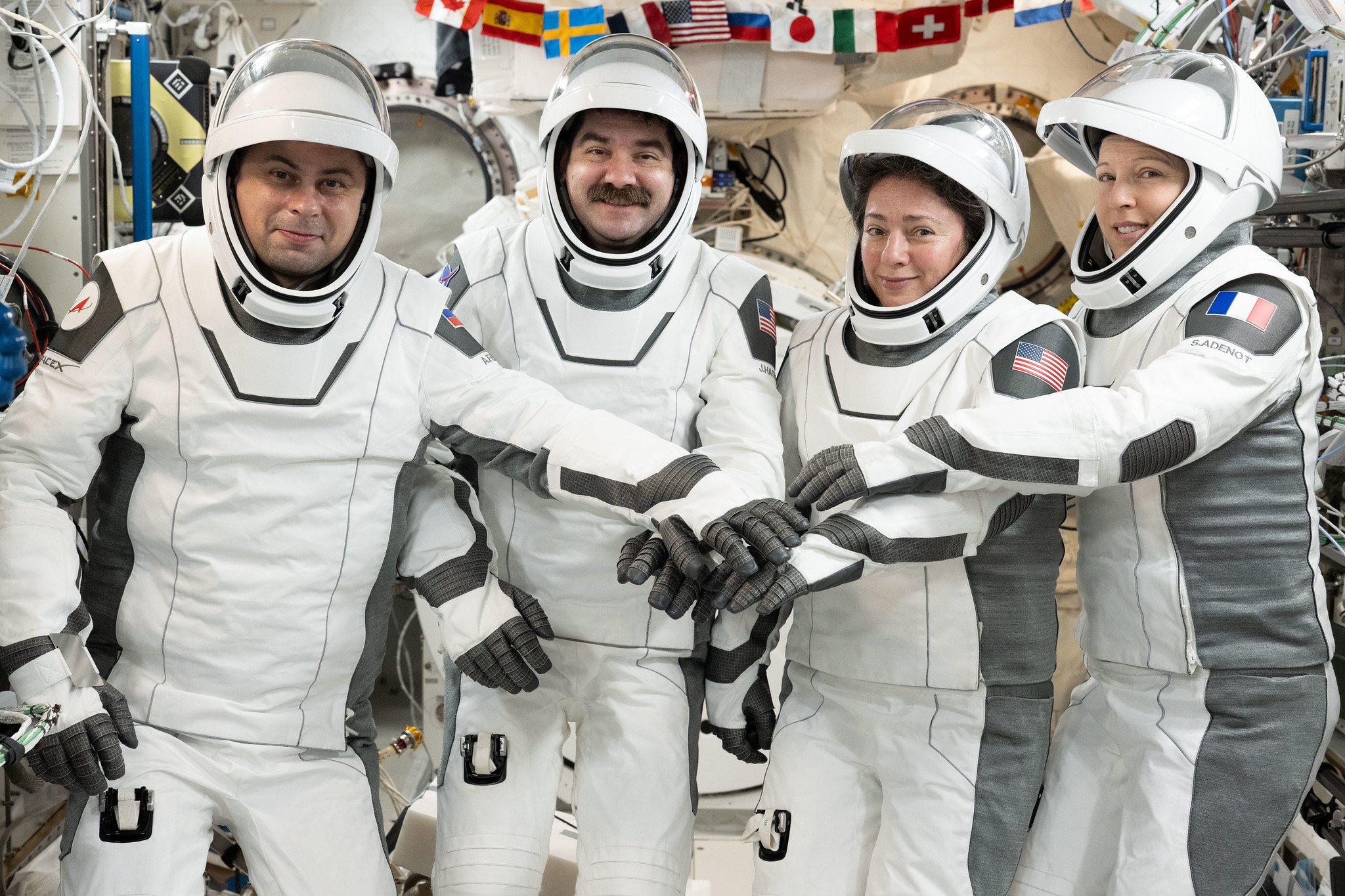
Flight engineer Sophie Adenot of ESA (European Space Agency) worked throughout Tuesday supporting a variety of research taking place aboard the orbital outpost. Adenot began her shift inside the cupola and pointed a camera toward the Moon capturing imagery of Earth’s light reflecting off the lunar surface. Next, she installed a humidifier on the Cell Biology Experiment Facility-L that is housing samples collected for William’s cancer research. Finally, she processed tubes containing biological and material samples shipped on Dragon for a variety of student-designed experiments.

Roscosmos cosmonauts Sergey Kud-Sverchkov and Sergey Mikaev inspected a pair of Orlan spacesuits ensuring life support and communications components were installed correctly and functioning correctly. The duo then studied the procedures for a spacewalk planned at the end of the month with a time and date to be officially announced soon by NASA.

Roscosmos flight engineer Andrey Fedyaev uploaded data to a computer configuring the European robotic arm for its use during the upcoming spacewalk. Next, he joined his cosmonaut crewmates and reviewed the spacewalking activities slated to be conducted outside the orbiting lab.

Learn more about station activities by following the space station blog, @space_stationon X, as well as the ISS Facebookand ISS Instagram accounts.

Get the latest from NASA delivered every week. Subscribe here.

Powered by WPeMatico

Get The Details…

Mark A. Garcia

NASA’s Psyche Mission Images Mars’ Huygens Crater

NASA’s Psyche Mission Images Mars’ Huygens Crater

1 Min Read

NASA’s Psyche Mission Images Mars’ Huygens Crater

A false-color, top-down view of a Martian surface densely pockmarked with impact craters of various sizes, highlighted in vivid shades of blue, tan, and purple to differentiate geological materials.
PIA26775
Credits:
NASA/JPL-Caltech/ASU

Description

Captured by the multispectral imager instrument on NASA’s Psyche mission, this is an enhanced-color view of the large double-ring crater Huygens (upper left; about 290 miles, or 470 kilometers, in diameter) and the surrounding heavily cratered southern highlands near 15 degrees south latitude. The various colors in this dramatic scene are likely due to differences in the compositional properties of dust, sand, and bedrock in this ancient terrain. The image scale is around 2,200 feet (670 meters) per pixel.

The image was acquired with Imager A on May 15, 2026, at about 1:18 p.m. PDT, shortly after closest approach with the planet. The images have been processed into an enhanced-color view (to bring out color details beyond what the human eye can see) using red, green, and blue data from imager filters.

For more information about NASA’s Psyche mission, visit:

https://science.nasa.gov/mission/psyche/

Powered by WPeMatico
Get The Details…

NASA’s Psyche Mission Spies Mars’ Wind-Blown Craters During Close Approach

NASA’s Psyche Mission Spies Mars’ Wind-Blown Craters During Close Approach

1 Min Read

NASA’s Psyche Mission Spies Mars’ Wind-Blown Craters During Close Approach

An overhead view of a reddish-brown Martian landscape, heavily pockmarked with impact craters and covered in numerous parallel, wind-blown streaks stretching horizontally across the terrain.
PIA26774
Credits:
NASA/JPL-Caltech/ASU

Description

This view of the Martian surface, captured by NASA’s Psyche spacecraft on May 15, 2026, shows streaks that have formed due to wind blowing over impact craters in the Syrtis Major region. The image scale is nearly 1,200 feet (360 meters) per pixel. The wind streaks extend to about 30 miles (50 kilometers) long, and the large craters near center-bottom of the scene average around 30 miles in diameter. 

The images have been processed into a natural-color view (approximating what the human eye would see) using red, green, and blue data from imager filters.

For more information about NASA’s Psyche mission, visit:

https://science.nasa.gov/mission/psyche/

Powered by WPeMatico

Get The Details…