Playing the Moon Game 

Playing the Moon Game 

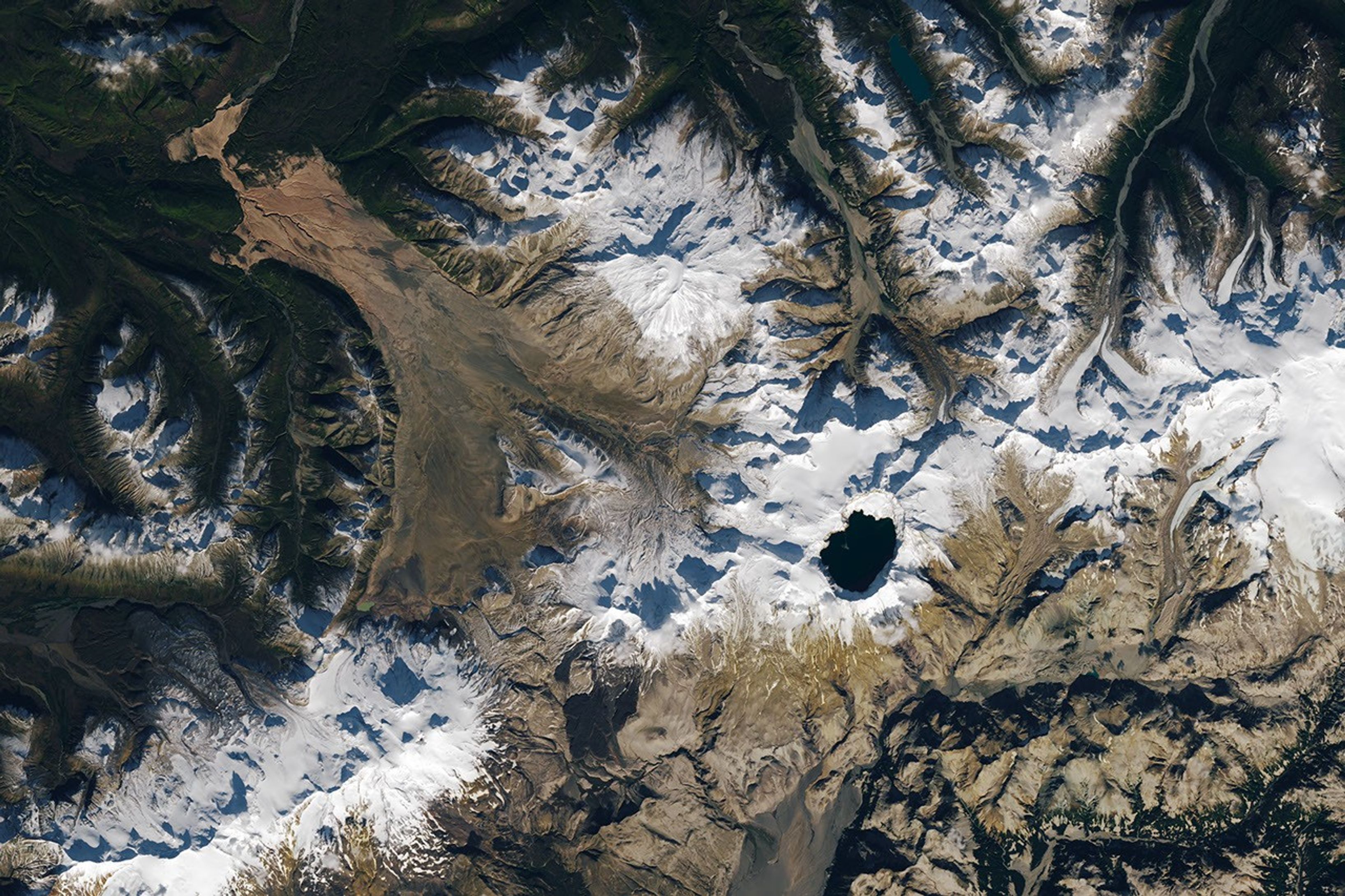
A satellite image shows part of Alaska’s Katmai National Park. A chain of snowy mountain peaks stretches from the bottom left corner to the right side of the image. The Valley of Ten Thousand Smokes is a long, tan-colored feature runs toward the northwest in the upper-left.
September 29, 2025

In preparing to visit the Moon’s surface, soon-to-be lunar explorers in NASA’s Apollo program first ventured into a variety of unfamiliar landscapes on Earth. A couple of these trips, in the summers of 1965 and 1966, took astronauts to Alaska’s remote Katmai National Park for simulations of field geology in Moon-like environments.

In one exercise, which they called “playing the Moon game,” pairs of astronauts were placed at unfamiliar field sites and asked to pretend as if they were on the Moon. By the account of William Phinney, Apollo’s science training coordinator, they were tasked with collecting representative geologic samples and practicing how to communicate their observations to scientists.

A detailed satellite image centers on the Valley of Ten Thousand Smokes in Alaska. The tan-colored feature runs southeast-to-northwest. Snowy peaks appear on the right side of the image, and green, forested valleys fill the left side.
September 29, 2025

The Alaskan setting for the Moon game was an unusual volcanic landscape called the Valley of Ten Thousand Smokes. The valley is full of debris deposited by the 1912 eruption of Novarupta—the largest volcanic event on Earth in the 20th century.

The images above, acquired on September 29, 2025, with the OLI (Operational Land Imager) on Landsat 9, show the massive ash flow deposited by Novarupta. The layer measures up to 660 feet (200 meters) thick and was emplaced at a searing 1,380 degrees Fahrenheit (750 degrees Celsius). 

The Valley of Ten Thousand Smokes, shown in the 1917 photo below, is so named because of the abundance of fumaroles—gas and steam-emitting vents—that filled the valley for a decade after the eruption. A few hundred persisted more than 10 years, with some lasting until the 1990s.

Three people stand in the foreground of this black-and-white photo, silhouetted by steam coming from a fumarole. A dark, barren landscape dotted with plumes of rising steam extends into the background.
1917

Scientists initially suspected that the monster eruption occurred at Mount Katmai, a neighboring volcano with a large caldera located 6 miles (10 kilometers) east of Novarupta’s dome. However, they later determined that the eruption actually occurred at Novarupta—whose name means “new eruption”—after stealing magma from beneath Katmai. As the magma chamber emptied, Katmai collapsed, forming the 2.5-mile-wide (4-kilometer-wide) caldera present today.

The volcanic landscape in the Valley of Ten Thousand Smokes is far fresher than the ancient lava flows that formed the Moon’s volcanic features. But for the Apollo astronauts, it offered an “excellent opportunity to view volcanic materials and landforms in nearly pristine condition,” Phinney wrote. They studied evidence of fumaroles and examined vertical sections of the deposits where streams had eroded deep gorges.

This photo shows a broad valley filled with tan-colored volcanic material in the foreground and snowy mountains in the background. The ashy volcanic deposits create a mostly flat valley floor, except where steep-sided chasms formed by erosion run through it.
June 9, 1991

Researchers continue to visit this Alaskan wilderness in search of clues that could help decipher the geology of the Moon and Mars. In 2024, the Goddard Instrument Field Team (GIFT) trekked to the Valley of Ten Thousand Smokes to study its icy volcanic landscape. Like the valley, Mars contains glaciers and ice sheets layered with dust and ash, a dynamic and difficult-to-interpret environment.

Advancing lunar science, the GIFT team also collected samples from rock formations comparable to the Moon’s Gruithuisen Domes. These mysterious features are made of hardened lava with a different composition than the surrounding rock. With more to learn about our nearest celestial neighbor, the spirit of the Moon game lives on in the 21st century.

NASA Earth Observatory images by Lauren Dauphin, using Landsat data from the U.S. Geological Survey. Photos from National Geographic Society Katmai expeditions photographs, Archives and Special Collections, Consortium Library, University of Alaska Anchorage, and from the U.S. Geological Survey Volcano Hazards Program. Story by Lindsey Doermann. 
References & Resources

You may also be interested in:

Stay up-to-date with the latest content from NASA as we explore the universe and discover more about our home planet.
Scoria Cones on Earth and Mars

7 min read

The hill-shaped features are a sign of explosive volcanic activity—a rarity on the Red Planet.
Article

A Volcanic Medley Near Mammoth Lakes 

4 min read

A massive, old caldera and more recently formed craters shape the landscape in the eastern Sierra Nevada.
Article

Restless Kīlauea Launches Lava and Ash

3 min read

Episode 43 of the Hawaiian volcano’s current eruption was marked by high lava fountains and widespread ash dispersal.

Article

Powered by WPeMatico

Get The Details…

NASA Announces Spacewalkers for Robotic Arm Repair Work

NASA Announces Spacewalkers for Robotic Arm Repair Work

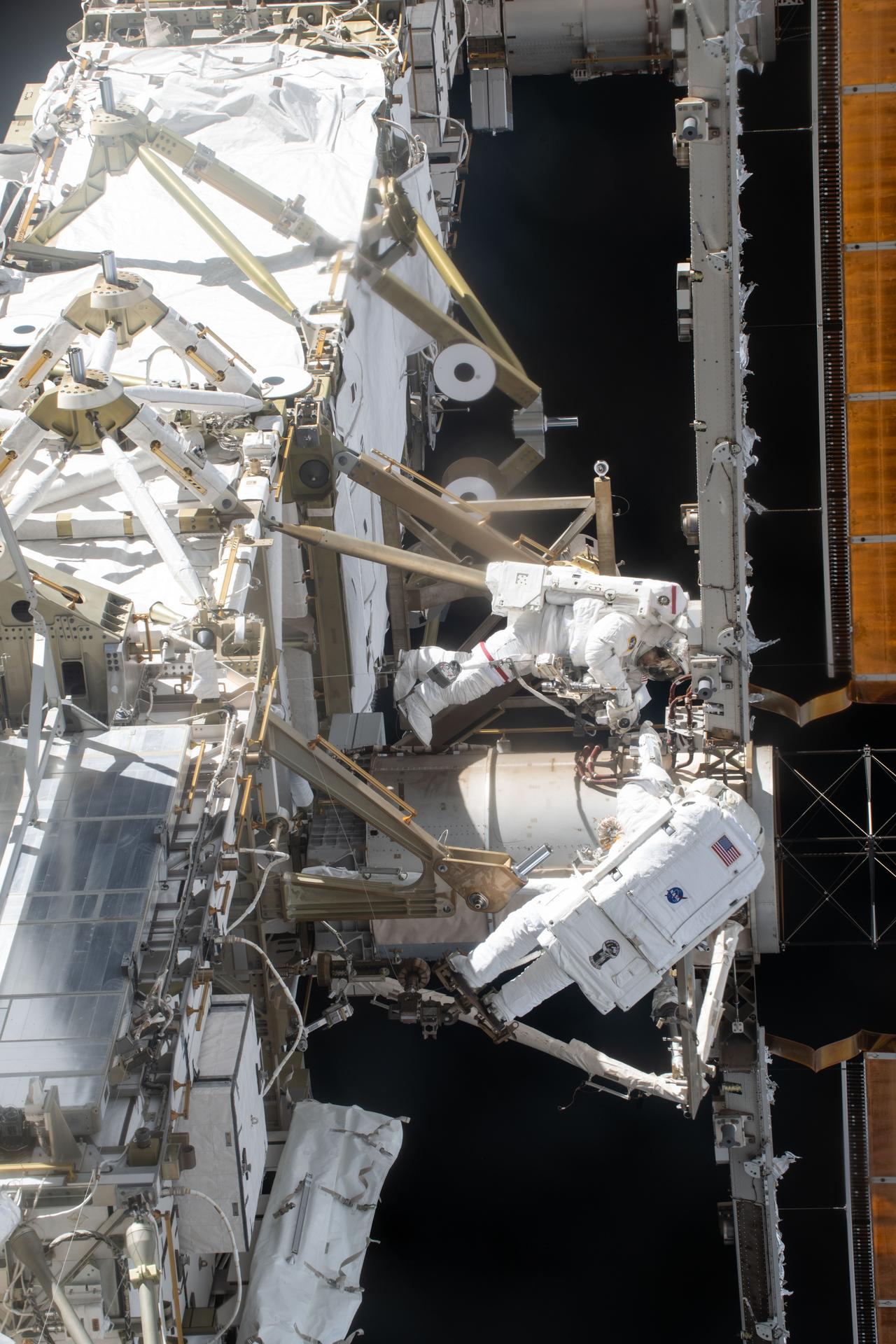
NASA astronauts Jessica Meir and Chris Williams, both Expedition 74 flight engineers, are pictured outside the International Space Station during a spacewalk to complete installation of a modification kit ahead of future solar array installation on the 2A power channel of the orbital outpost. It was William’s first spacewalk, Meir's fourth, and the 278th in support of space station maintenance, upgrades, and assembly.
NASA astronauts Jessica Meir (top) and Chris Williams are pictured during a spacewalk on March 18, 2026, to complete the installation of a solar array modification kit on the International Space Station.
NASA/Jack Hathaway

Spacewalk preparations filled the schedule aboard the International Space Station on Tuesday as a pair of astronauts gear up for next week’s external robotics repair job. CubeSat maintenance and eye checks rounded out the day for the Expedition 74 crew.

NASA flight engineers Chris Williams and Jessica Meir will once again wear their spacesuits and work together in the vacuum of space to repair a wrist joint on the Canadarm2 robotic arm starting at 7:35 a.m. EDT on Tuesday, June 30. The duo will spend about six hours and 40 minutes on the outside of the orbital lab replacing the malfunctioned wrist joint on Canadarm2 that has been in operation for over 25 years. NASA and the Canadian Space Agency (CSA) analyzed the issue and determined a spacewalk was necessary to replace the wrist joint with a spare already on the station. NASA and CSA officials will preview the upcoming spacewalk tasks during a news conference on NASA’s YouTube channel at 2 p.m. on Thursday, June 25.

Williams tried on his spacesuit Tuesday and tested the suit in its powered configuration with assistance from flight engineer Sophie Adenot from ESA (European Space Agency). The duo worked inside the Quest airlock checking the pressurized suit’s comfort and mobility and its communications and life support systems while engineers on the ground monitored.

Williams then joined Meir and reviewed on a computer a 3D interactive animation of the procedures and maneuvers they will use to return the Canadarm2 to full motion. Afterward, the pair took turns servicing emergency jet packs that will be installed on the spacesuits the day the spacewalk begins. Meir also installed batteries inside the pistol grip tools — designed especially for microgravity — they will use to work on the robotic arm.

Adenot and NASA flight engineer Jack Hathaway, who will monitor the spacewalkers from inside the orbital outpost, studied their spacewalk support roles including carefully adjusting the Canadarm2 into position during the repair work. Hathaway also had time for CubeSat work first removing a small satellite orbital deployer that was stowed inside the Kibo laboratory module’s airlock. Next, he installed a set of CubeSats inside the NanoRacks CubeSat deployer that will soon be placed outside Kibo’s airlock for deployment into Earth orbit. The tiny satellites were designed by university students for a variety of communications and technology investigations.

Station commander Sergey Kud-Sverchkov joined flight engineer Sergei Mikaev in the Harmony module for eye checks using standard medical imaging hardware. Doctors on the ground were examining how living in space affects the retina, lens, and cornea. Roscosmos flight engineer Andrey Fedyaev continued testing artificial intelligence tools to boost crew efficiency and communications in space.

Learn more about station activities by following the space station blog, @space_stationon X, as well as the ISS Facebook and ISS Instagram accounts.

Get the latest from NASA delivered every week. Subscribe here.

Powered by WPeMatico

Get The Details…

Mark A. Garcia

NASA Names Sean Gallagher as Chief Information Officer

NASA Names Sean Gallagher as Chief Information Officer

Sean Gallagher
Official NASA portrait of Sean Gallagher
Credit: NASA

NASA has selected Sean Gallagher as the agency’s chief information officer (CIO). In this role, he is responsible for the agency’s entire portfolio of Information Technology products and services. Gallagher has been serving in an acting capacity since January and his permanent role is effective immediately.

“Sean Gallagher’s leadership has been instrumental in strengthening NASA’s IT foundation and ensuring our workforce has the secure, modern tools needed to enable groundbreaking missions every day,” said NASA Deputy Administrator Matt Anderson. “As CIO, Sean will continue advancing the agency’s technology capabilities to support discovery, innovation, and mission success across NASA.”

Most recently, Gallagher also has served as the deputy chief information officer for Operations in the Office of the Chief Information Officer at NASA Headquarters in Washington, as well as a senior advisor for Transformation. This team provides services to tens of thousands of end users located in the U.S. and abroad in support of NASA missions, enabling discoveries, faster data sharing, increased workforce productivity, and more. Gallagher has worked with all NASA centers to implement efficient and effective IT operating models.

Previously, Gallagher was the CIO of NASA’s Glenn Research Center in Cleveland, leading IT initiatives for aeronautics, space, research and engineering, and test missions. He joined NASA in 2012 as Glenn’s deputy CIO and previously worked at Booz Allen Hamilton as a senior associate supporting a variety of federal, defense, and commercial customers.

Gallagher developed his leadership and management experience as a Signal Corps officer in the United States Army. He also served as a platoon leader managing the combat service support readiness of a tactical communications unit, a human resource manager for the 40th Signal Battalion, and as a network engineer for the 11th Signal Brigade. He has a bachelor’s degree in physics from John Carroll University and a master’s degree in computer information systems from the University of Phoenix.

For more information about NASA’s missions, visit:

https://www.nasa.gov

-end-

Camille Gallo / Cheryl Warner
Headquarters, Washington
202-358-1600
camille.m.gallo@nasa.gov / cheryl.m.warner@nasa.gov

Share

Details

Last Updated

Jun 23, 2026

Editor
Jennifer M. Dooren

Related Terms

Powered by WPeMatico

Get The Details…
Jennifer M. Dooren

CSDA Selects Eight Commercial Satellite Data Providers for On-Ramp 2 Contract Awards

CSDA Selects Eight Commercial Satellite Data Providers for On-Ramp 2 Contract Awards

NASA’s Commercial Satellite Data Acquisition program (CSDA) announced contract awards with eight commercial satellite data providers offering a range of data types to support the agency’s Earth science research and application goals.  

The CSDA program On-Ramp 2 Multiple Award contract is a firm-fixed-price indefinite-delivery/indefinite-quantity (IDIQ) multiple-award contract with a maximum cumulative value of $476 million and a performance period through November 2028.

The CSDA IDIQ contract includes an on‑ramp provision that allows NASA to periodically reopen the solicitation, giving new vendors the opportunity to submit proposals. This mechanism also enables existing CSDA vendors to propose new data products, whether newly developed or derived from new instruments, that were not available during the original proposal period.

Newly Added Contract Holders

Vendor Sensor
HydroSat Thermal Infrared Visible and Near-Infrared (VNIR)
Ororatech Thermal Infrared – Medium Wavelength Infrared (MWIR) and Long Wavelength Infrared (LWIR)
ImageSat Optical Multispectral Instrument (MSI)
Satlantis Optical MSI / Greenhouse Gas (GHG) Emissions
Kuva Space Hyperspectral – VNIR and Short Wavelength Infrared (SWIR)
Wyvern Hyperspectral – VNIR
Orbital Sidekick Hyperspectral – VNIR and SWIR
Muon Space Global Navigation Satellite System – Radar (GNSS-R)

Current CSDA Contract Holders with New Products

Vendor Sensor
Airbus Optical MSI / Synthetic Aperture Radar (SAR)
ICEYE SAR
GHGSat GHG Emissions
Planet Labs Optical MSI / Hyperspectral
PlanetiQ Global Navigation Satellite System – Radio Occultation (GNSS-RO)
Tomorrow.io Microwave Sounder

“NASA’s Earth science community relies on a diverse suite of observations from spaceborne, airborne, and in situ assets to better understand our changing planet,” said CSDA Project Manager Dana Ostrenga. “The commercial providers added through this latest CSDA contract on-ramp complement NASA’s existing Earth observation capabilities and our current portfolio of commercial partners, expanding the range of data available for evaluation and use. Together, these observations provide researchers with a more comprehensive view of Earth’s atmosphere, land, oceans, cryosphere, and solid Earth, helping advance scientific discovery and applications that benefit our communities.”

Following issuance of the contract awards, the selected vendors’ data products will be made available to authorized CSDA data users via the Satellite Data Explorer (SDX), CSDA’s web-based data discovery and data access tool that allows approved users to search, discover, access, task, and download the data the program has acquired from its commercial partners.

The Vendor Selection Process

The award process begins with the CSDA issuing a request for proposals that is posted on Sam.gov, the U.S. government’s official system for managing federal contract proposals. Interested companies then submit proposals to enter into an IDIQ contract with CSDA. A Solicitation Evaluation Board is formed to determine whether the proposals are competitive and meet the CSDA’s technical requirements for continuous observations, orbit platforms, and data that aligns with NASA Earth Science Division (ESD) goals. The CSDA makes its selections from the proposals that meet the requirements and then submits them to NASA leadership for approval. Once approved, the contracts are then awarded and the companies are able to get their data evaluated by CSDA. Once the evaluations are complete, the commercial data providers can then compete for competitive task orders through CSDA.

About the CSDA Program

NASA’s Earth Science Division (ESD) established the CSDA Program as the agency’s central mechanism for identifying, acquiring, and evaluating commercial Earth observation (EO) data. The program augments NASA’s and partner agencies’ Earth-observing capabilities by acquiring commercial satellite data that offer higher spatial resolution, increased revisit frequency, complementary measurement capabilities, and taskable observations. To learn more about the program, its commercial partners, data evaluation process, and more, visit the CSDA website.

Become an Authorized Data User

Commercial data discoverable through the SDX is made available to CSDA authorized data users. To become an authorized user, fill out the CSDA Program Data Authorization Form. Note: Use of SDX also requires an Earthdata Login.

Powered by WPeMatico

Get The Details…

58th Girl Scouts Unite Event

58th Girl Scouts Unite Event

58th Girl Scouts Unite Event, July 23-25, 2026

Join NASA in the Exhibit Hall (Booth #206) for Hyperwall Storytelling by NASA experts. Full Hyperwall Agenda below.

Thursday, July 23

11:00AM – 11:15 AM From Daisy to NASA Engineer Barbara Hilton
11:15AM – 11:30 AM Exploring Mars, The Planet Next Door Lindsay Hays
11:30AM – 11:45 AM Get Ready With Me: Going to the Moon Naoma McCall
11:45Am – 12:00 PM NASA Is for Everyone! (talk about careers at NASA beyond science and engineering) Amy Kaminski
12:00PM – 12:15 PM Finding Asteroids Before They Find Us: Planetary Defense at NASA Kelly Fast

2:15 PM – 2:30 PM How to Nerd Your Way Into Science Communications Karen Romano Young
2:30 PM – 2:45 PM Earth: Exploring our home planet is a team effort Lesley Ott
2:45 PM – 3:00 PM TBD Jenny Mottar
3:00 PM – 3:15 PM The Journey Starts HERE: One CREW, Your HOME, Our MISSION Kaitlin Harbeck
3:15 PM – 3:30PM TBD – Artemis Overview Dominique Brewer
3:45 PM – 4:00 PM Social Media… For Science! Sofie Bates

:

Powered by WPeMatico

Get The Details…