Crew Members Kick-Start New Year with Ongoing Science and Maintenance

Crew Members Kick-Start New Year with Ongoing Science and Maintenance

Four Expedition 70 crew members share new year's remarks. From left, Commander Andreas Mogensen of ESA, Flight Engineer Jasmin Moghbeli of NASA, Flight Engineer Satoshi Furukawa of JAXA, and Flight Engineer Loral O'Hara of NASA. Credits: NASA
Four Expedition 70 crew members share new year’s remarks. From left, Commander Andreas Mogensen of ESA, Flight Engineer Jasmin Moghbeli of NASA, Flight Engineer Satoshi Furukawa of JAXA, and Flight Engineer Loral O’Hara of NASA. Credits: NASA

The seven-member Expedition 70 crew is back to work after Monday saw an off-duty day for the International Space Station residents. A variety of activities took place in orbit on Tuesday, while some members conducted cleaning activities and others picked back up on scientific research to kick-start the new year.

Flight Engineer Loral O’Hara of NASA spent part of her day unstowing materials in the Combustion Integrated Rack to prep for the SoFIE-GEL investigation. As part of ongoing science, crew members study burning in microgravity to determine how material flammability is affected by fuel temperatures. To continue this research, O’Hara swapped out a used manifold gas bottle in the experiment with a new one. In the evening, she donned the Actiwatch to monitor sleep-wake patterns throughout the night.

Flight Engineer Jasmin Moghbeli of NASA cleaned up in the Harmony module in the morning, then set out to replenish the water supply in the distribution and recovery reservoirs of Plant Habitat-06—an investigation that studies the physiological and genetic responses to defense activation in wild-type tomatoes. Afterward, Moghbeli began an experiment to test the efficiency of an antimicrobial coating in space.

Commander Andreas Mogensen of ESA (European Space Agency) began the day swapping out the heart rate monitor on CEVIS, the station’s bicycle. He then completed a robotics training session, practicing the capture of a cargo craft, reviewing how to control free-flying assistants, and operating the robotic arm. After lunch, Mogensen deployed the Life Sciences Glovebox that will be used for ongoing science activities this week, then analyzed water from the station’s water processor assembly.

Meanwhile, Satoshi Furukawa of JAXA (Japan Aerospace Exploration Agency) hydrated and incubated production packs for the BioNutrients-1 investigation which uses technology for on-demand production of human nutrients over long-duration missions.

The three cosmonauts aboard the orbiting laboratory—Oleg Kononenko, Nikolai Chub, and Konstantin Borisov—split up maintenance duties on Tuesday. Kononenko ran the 3D printer in Zvezda and audited cargo in the Prichal module, while Chub conducted maintenance on the water management system and Borisov inventoried accessories of the Roscosmos docking system.


Learn more about station activities by following the space station blog, @space_station and @ISS_Research on X, as well as the ISS Facebook and ISS Instagram accounts.

Get weekly video highlights at: https://roundupreads.jsc.nasa.gov/videoupdate/

Get the latest from NASA delivered every week. Subscribe here: www.nasa.gov/subscribe

Powered by WPeMatico

Get The Details…

Abby Graf

NASA’s SpaceX Crew-6 Preflight

NASA’s SpaceX Crew-6 Preflight

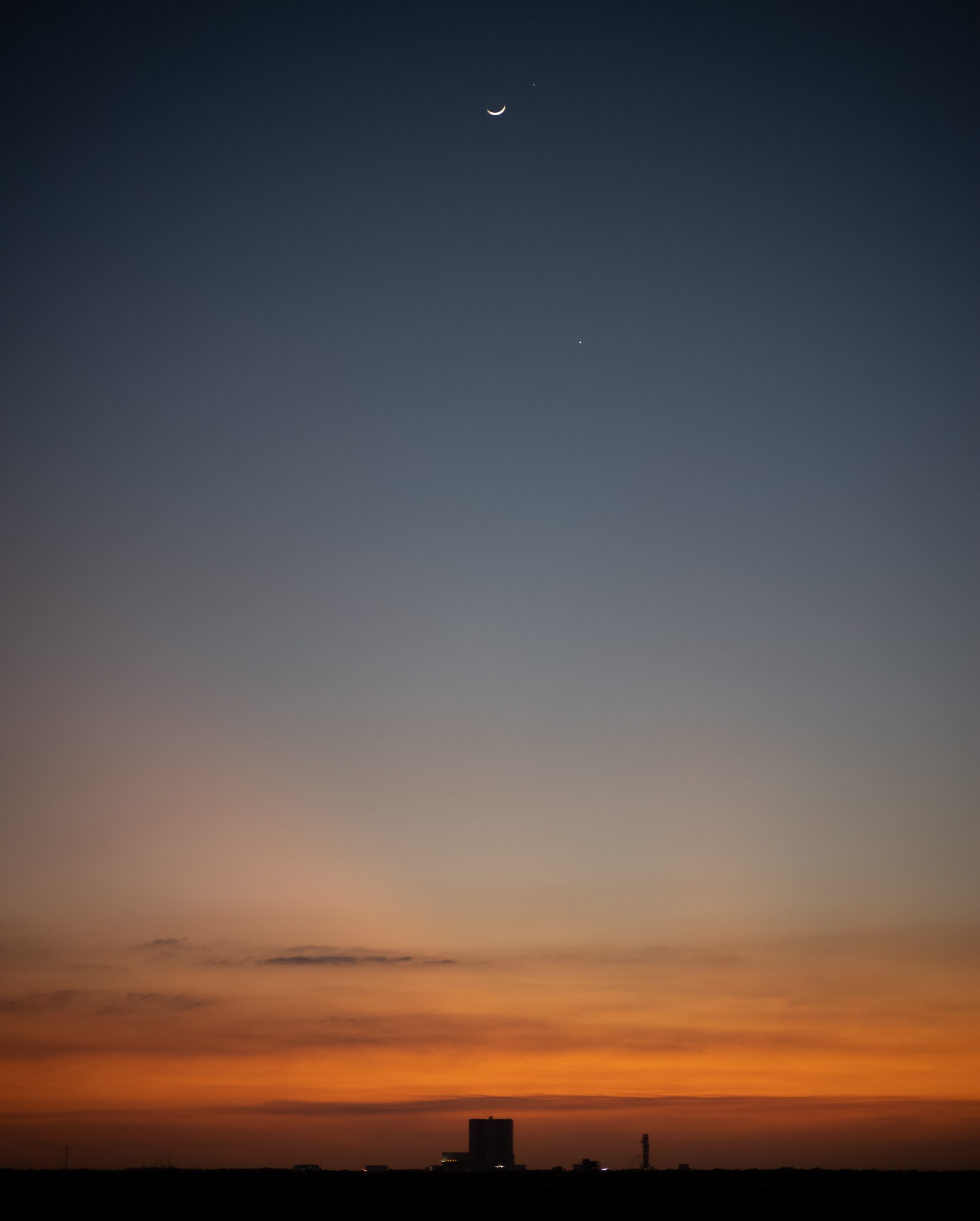
Jupiter, top, and Venus, bottom, are seen with the crescent Moon above the Vehicle Assembly Building, Wednesday, Feb. 22, 2023, at NASA’s Kennedy Space Center in Florida as preparations continued for NASA’s SpaceX Crew-6 mission. The agency’s SpaceX Crew-6 mission was the sixth crew rotation mission of the SpaceX Dragon spacecraft and Falcon 9 rocket to the International Space Station as part of the agency’s Commercial Crew Program.

Powered by WPeMatico

Get The Details…

Crescent Moon Over NASA’s Kennedy Space Center

Crescent Moon Over NASA’s Kennedy Space Center

The sky shifts from a deep blue to burnt orange (top to bottom). The crescent moon is at the top of the image, with Jupiter to its right and Venus below it. The silhouette of the Vehicle Assembly Building at NASA's Kennedy Space Center stands out against the orange sky.
NASA / Joel Kowsky

The crescent moon, along with Jupiter (top right of Moon) and Venus (below Moon) appeared over the Vehicle Assembly Building at NASA’s Kennedy Space Center in Florida Feb. 22, 2023, as preparations continued for NASA’s SpaceX Crew-6 mission. NASA astronauts Stephen Bowen and Warren “Woody” Hoburg, UAE (United Arab Emirates) astronaut Sultan Alneyadi, and Roscosmos cosmonaut Andrey Fedyaev launched to the International Space Station March 2, 2023.

The NASA Headquarters photographers chose this photo as one of the best images from 2023. See the rest on Flickr.

Image Credit: NASA/Joel Kowsky

Powered by WPeMatico

Get The Details…
Monika Luabeya

Payroll

Payroll

1 Min Read

Payroll

The NASA Shared Services Center (NSSC) Payroll Office (NPO) reviews, validates, and delivers time and attendance data to the Department of the Interior (DOI) Interior Business Center (IBC) for NASA Centers.  NPO acts as liaison between Centers, employees and IBC for other payroll related activities such as supplemental payments, prior pay period adjustments  (PPPA) and settlement agreements.

2024 NASA Payroll Calendar

Employment Verification

POD A-12 – Non-Receipt of DD/EFT Payment

Payroll Schedule Calendars

Powered by WPeMatico

Get The Details…
NASA

January’s Night Sky Notes: Connecting the ‘Dots’ with Asterisms

January’s Night Sky Notes: Connecting the ‘Dots’ with Asterisms

3 min read

January’s Night Sky Notes: Connecting the ‘Dots’ with Asterisms

by Kat Troche of the Astronomical Society of the Pacific

In our December Night Sky Notes, we mentioned that the Orion constellation has a distinct hourglass shape that makes it easy to spot in the night sky. But what if we told you that this is not the complete constellation, but rather, an asterism?

An asterism is a pattern of stars in the night sky, forming shapes that make picking out constellations easy. Cultures throughout history have created these patterns as part of storytelling, honoring ancestors, and timekeeping. Orion’s hourglass is just one of many examples of this, but did you know Orion’s brightest knee is part of another asterism that spans six constellations, weaving together the Winter night sky? Many asterisms feature bright stars that are easily visible to the naked eye. Identify these key stars, and then connect the dots to reveal the shape.

Asterisms Through the Seasons

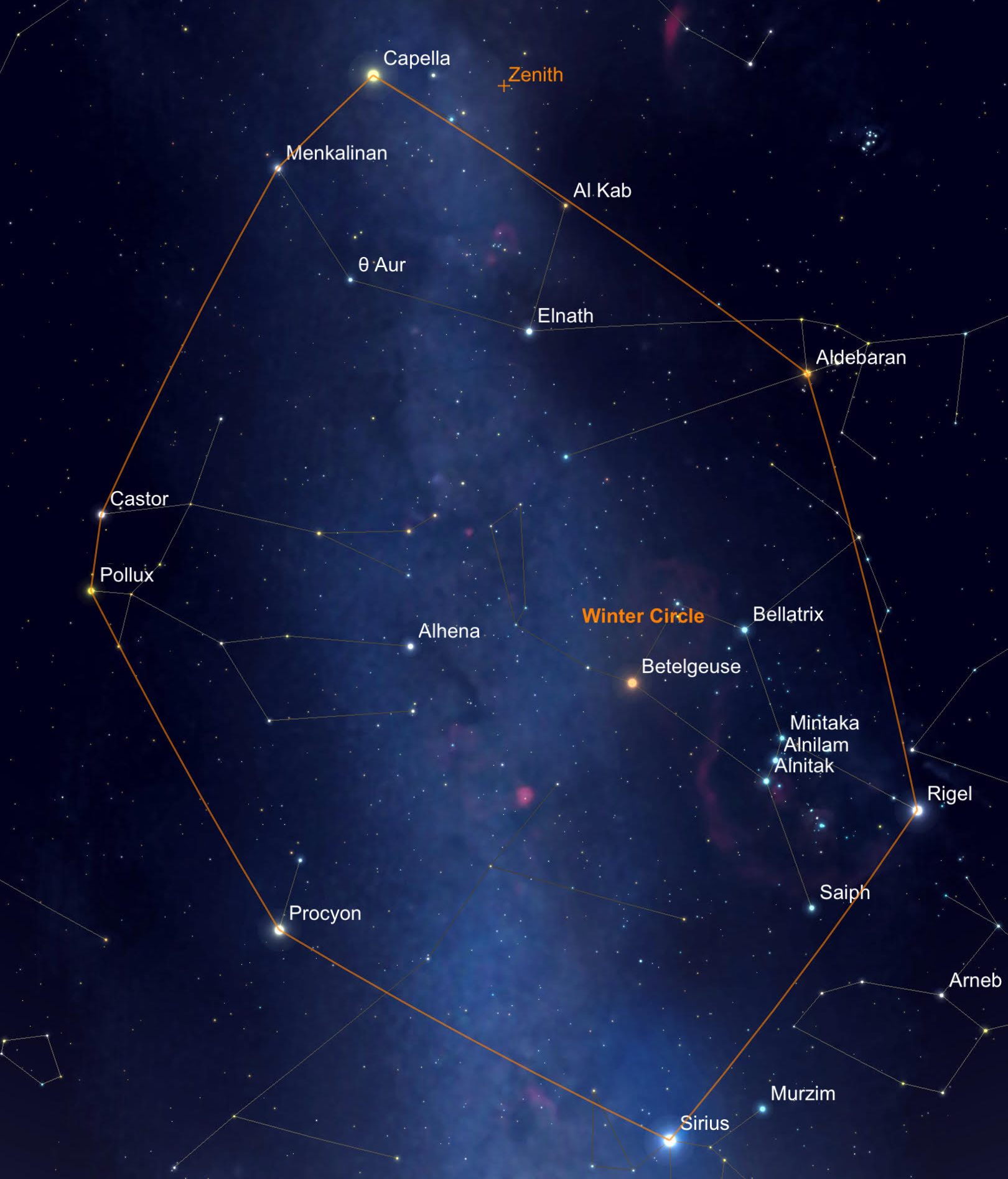
Six stars that make up with Winter Circle, connected by an orange line, against a blue night sky.
Stars that make up the Winter Circle, as seen on January 1, 2024
Sky Safari

Try looking for these asterisms this season and beyond:

  • Winter Circle – this asterism, also known as the Winter Hexagon, makes up a large portion of the Winter sky using stars Rigel, Aldebaran, Capella, Pollux, Procyon, and Sirius as its points. Similarly, the Winter Triangle can be found using Procyon, Sirius, and Betelgeuse as points. Orion’s Belt is also considered an asterism.
  • Diamond of Virgo – this springtime asterism consists of the following stars: Arcturus, in the constellation Boötes; Cor Caroli, in Canes Venatici; Denebola in Leo, and Spica in Virgo. Sparkling at the center of this diamond is the bright cluster Coma Berenices, or Bernice’s Hair – an ancient asterism turned constellation!
  • Summer Triangle – as the nights warm up, the Summer Triangle dominates the heavens. Comprising the bright stars Vega in Lyra, Deneb in Cygnus, and Altair in Aquila, this prominent asterism is the inspiration behind the cultural festival Tanabata. Also found is Cygnus the Swan, which makes up the Northern Cross asterism.
  • Great Square of Pegasus – by Autumn, the Great Square of Pegasus can be seen. This square-shaped asterism takes up a large portion of the sky, and consists of the stars: Scheat, Alpheratz, Markab and Algenib.
Orange and blue stars from the Hyades cluster on a dark background with two stars labelled: WD 0421+162, and WD 0431+126
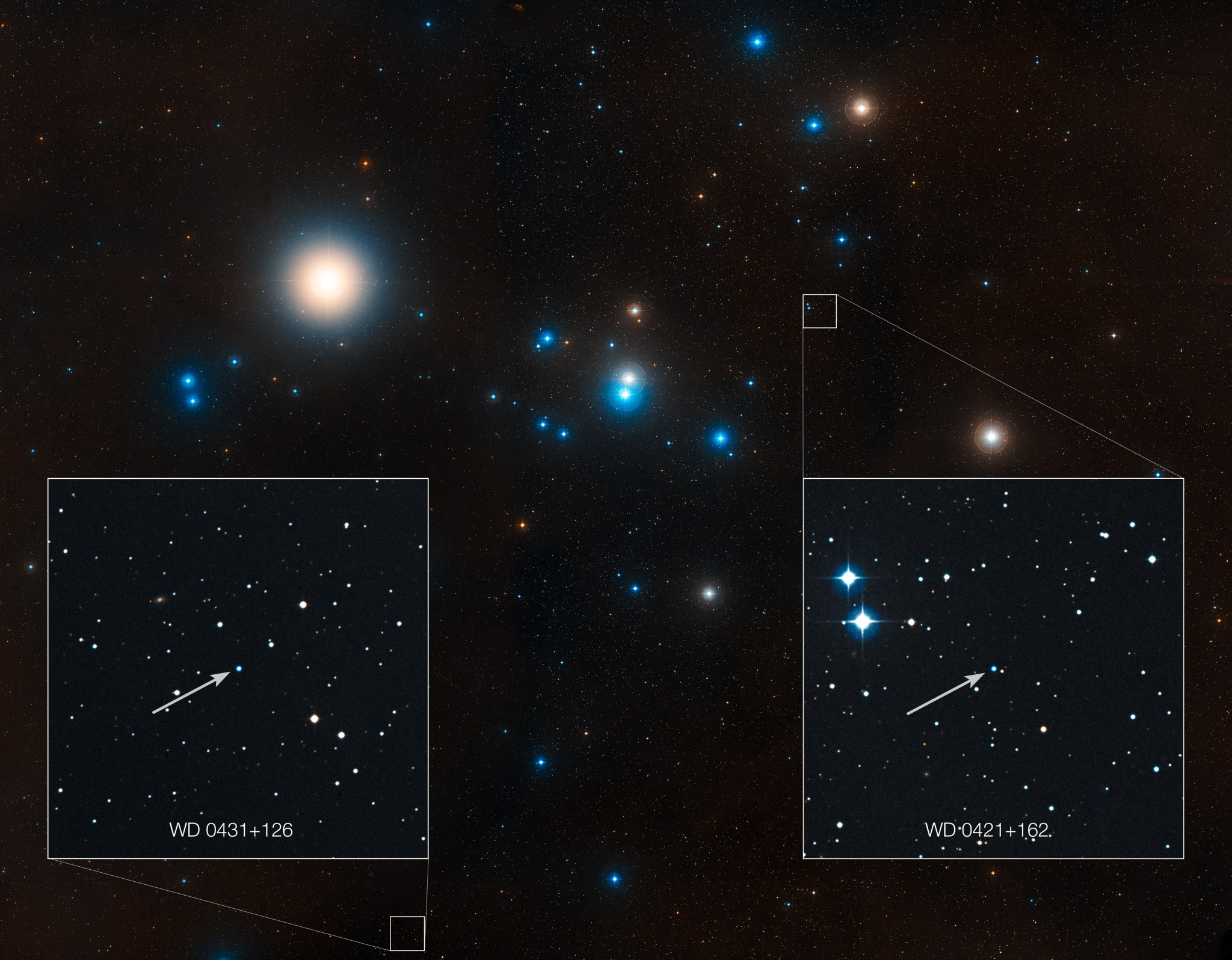
This image shows the region around the Hyades star cluster, the nearest open cluster to us. The Hyades cluster is very well-studied due to its location, but previous searches for planets have produced only one. A new study led by Jay Farihi of the University of Cambridge, UK, has now found the atmospheres of two burnt-out stars in this cluster — known as white dwarfs — to be “polluted” by rocky debris circling the star. Inset, the locations of these white dwarf stars are indicated — stars known as WD 0421+162, and WD 0431+126.
NASA, ESA, STScI, and Z. Levay (STScI)

Tracing these outlines can guide you to objects like galaxies and star clusters. The Hyades, for example, is an open star cluster in the Taurus constellation with evidence of rocky planetary debris. In 2013, Hubble Space Telescope’s Cosmic Origins Spectrograph was responsible for breaking down light into individual components. This observation detected low levels of carbon and silicon – a major chemical for planetary bodies. The Hyades can be found just outside the Winter Circle and is a favorite of both amateur and professional astronomers alike.

How to Spot Asterisms

  • Use Star Maps and Star Apps – Using star maps or stargazing apps can help familiarize yourself with the constellations and asterisms of the night sky.
  • Get Familiar with Constellations – Learning the major constellations and their broader shapes visible each season will make spotting asterisms easier.
  • Use Celestial Landmarks –Orient yourself by using bright stars, or recognizable constellations. This will help you navigate the night sky and pinpoint specific asterisms. Vega in the Lyra constellation is a great example of this.

Learn more about how to stay warm while observing this Winter with our upcoming mid-month article on the Night Sky Network page through NASA’s website!

Powered by WPeMatico

Get The Details…