Living on the Edge: Supernova Bubble Expands in New Hubble Time-Lapse Movie

Living on the Edge: Supernova Bubble Expands in New Hubble Time-Lapse Movie

4 min read

Living on the Edge: Supernova Bubble Expands in New Hubble Time-Lapse Movie
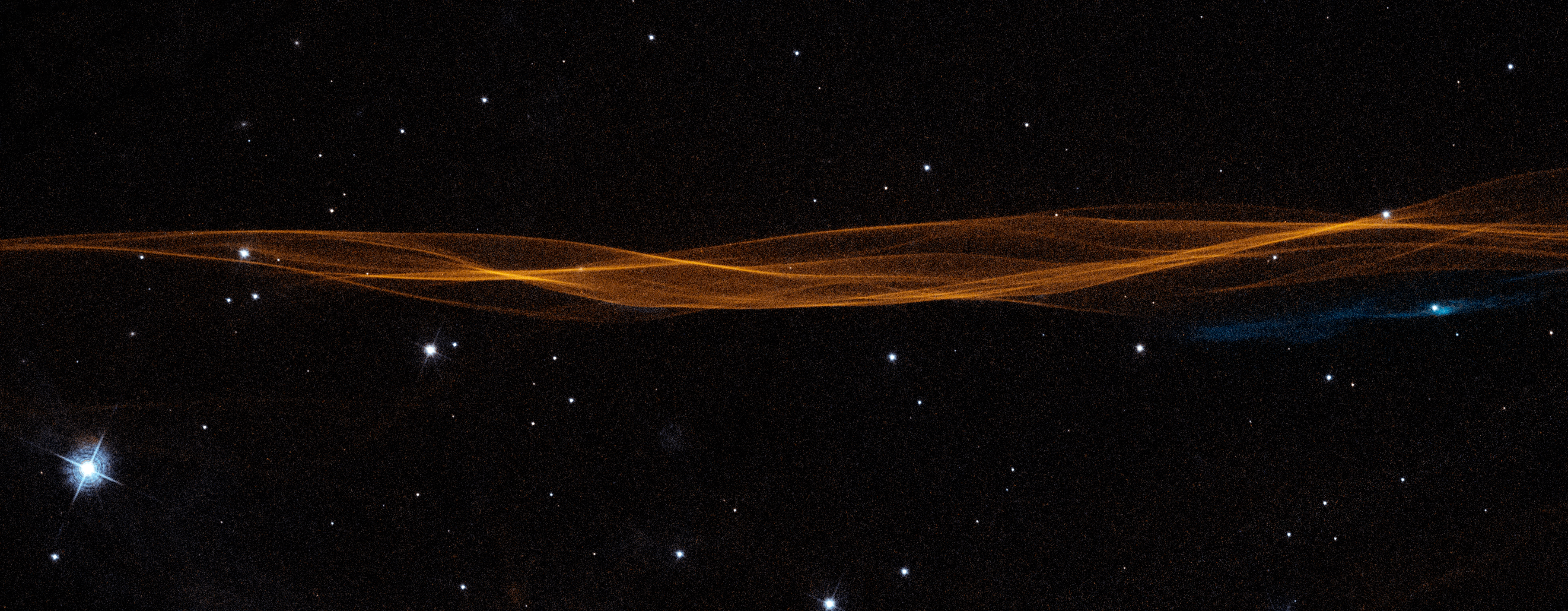
A long, thin, twisted ribbon of orange gas and dust stretches from left to right across the image. Bright-white stars dot the black background. One bright, blue-white star at bottom left. A small swath of blue gas stretches below the orange ribbon on the right side.
NASA’s Hubble Space Telescope, ESA, Ravi Sankrit (STScI)

Though a doomed star exploded some 20,000 years ago, its tattered remnants continue racing into space at breakneck speeds – and NASA’s Hubble Space Telescope has caught the action.

The nebula, called the Cygnus Loop, forms a bubble-like shape that is about 120 light-years in diameter. The distance to its center is approximately 2,600 light-years. The entire nebula has a width of six full Moons as seen on the sky.

Astronomers used Hubble to zoom into a very small slice of the leading edge of this expanding supernova bubble, where the supernova blast wave plows into surrounding material in space. Hubble images taken from 2001 to 2020 clearly demonstrate how the remnant’s shock front has expanded over time, and they used the crisp images to clock its speed.

By analyzing the shock’s location, astronomers found that the shock hasn’t slowed down at all in the last 20 years, and is speeding into interstellar space at over half a million miles per hour – fast enough to travel from Earth to the Moon in less than half an hour. While this seems incredibly fast, it’s actually on the slow end for the speed of a supernova shock wave. Researchers were able to assemble a “movie” from Hubble images for a close-up look at how the tattered star is slamming into interstellar space.

“Hubble is the only way that we can actually watch what’s happening at the edge of the bubble with such clarity,” said Ravi Sankrit, an astronomer at the Space Telescope Science Institute in Baltimore, Maryland. “The Hubble images are spectacular when you look at them in detail. They’re telling us about the density differences encountered by the supernova shocks as they propagate through space, and the turbulence in the regions behind these shocks.”

A very close-up look at a nearly two-light-year-long section of the filaments of glowing hydrogen and ionized oxygen shows that they look like a wrinkled sheet seen from the side. “You’re seeing ripples in the sheet that is being seen edge-on, so it looks like twisted ribbons of light,” said William Blair of the Johns Hopkins University, Baltimore, Maryland. “Those wiggles arise as the shock wave encounters more or less dense material in the interstellar medium.” The time-lapse movie over nearly two decades shows the filaments moving against the background stars but keeping their shape.


Video Credit: NASA’s Hubble Space Telescope, ESA, STScI; Acknowledgment:
NSF’s NOIRLab, Akira Fujii , Jeff Hester , Davide De Martin , Travis A. Rector , Ravi Sankrit (STScI), DSS

“When we pointed Hubble at the Cygnus Loop we knew that this was the leading edge of a shock front, which we wanted to study. When we got the initial picture and saw this incredible, delicate ribbon of light, well, that was a bonus. We didn’t know it was going to resolve that kind of structure,” said Blair.

Blair explained that the shock is moving outward from the explosion site and then it starts to encounter the interstellar medium, the tenuous regions of gas and dust in interstellar space. This is a very transitory phase in the expansion of the supernova bubble where invisible neutral hydrogen is heated to one million degrees Fahrenheit or more by the shock wave’s passage. The gas then begins to glow as electrons are excited to higher energy states and emit photons as they cascade back to low energy states. Further behind the shock front, ionized oxygen atoms begin to cool, emitting a characteristic glow shown in blue.

The Cygnus Loop was discovered in 1784 by William Herschel, using a simple 18-inch reflecting telescope. He could have never imagined that a little over two centuries later we’d have a telescope powerful enough to zoom in on a very tiny slice of the nebula for this spectacular view.

The Hubble Space Telescope is a project of international cooperation between NASA and ESA. NASA’s Goddard Space Flight Center in Greenbelt, Maryland, manages the telescope. The Space Telescope Science Institute (STScI) in Baltimore, Maryland, conducts Hubble science operations. STScI is operated for NASA by the Association of Universities for Research in Astronomy, in Washington, D.C.


Video Credits: NASA’s Hubble Space Telescope, ESA, STScI; Acknowledgment:
NSF’s NOIRLab, Akira Fujii , Jeff Hester , Davide De Martin , Travis A. Rector , Ravi Sankrit (STScI), DSS

Share

Details

Last Updated
Sep 29, 2023
Editor
Andrea Gianopoulos
Contact

Powered by WPeMatico

Get The Details…

Hubble Views a Glistening Red Nebula

Hubble Views a Glistening Red Nebula

3 min read

Hubble Views a Glistening Red Nebula

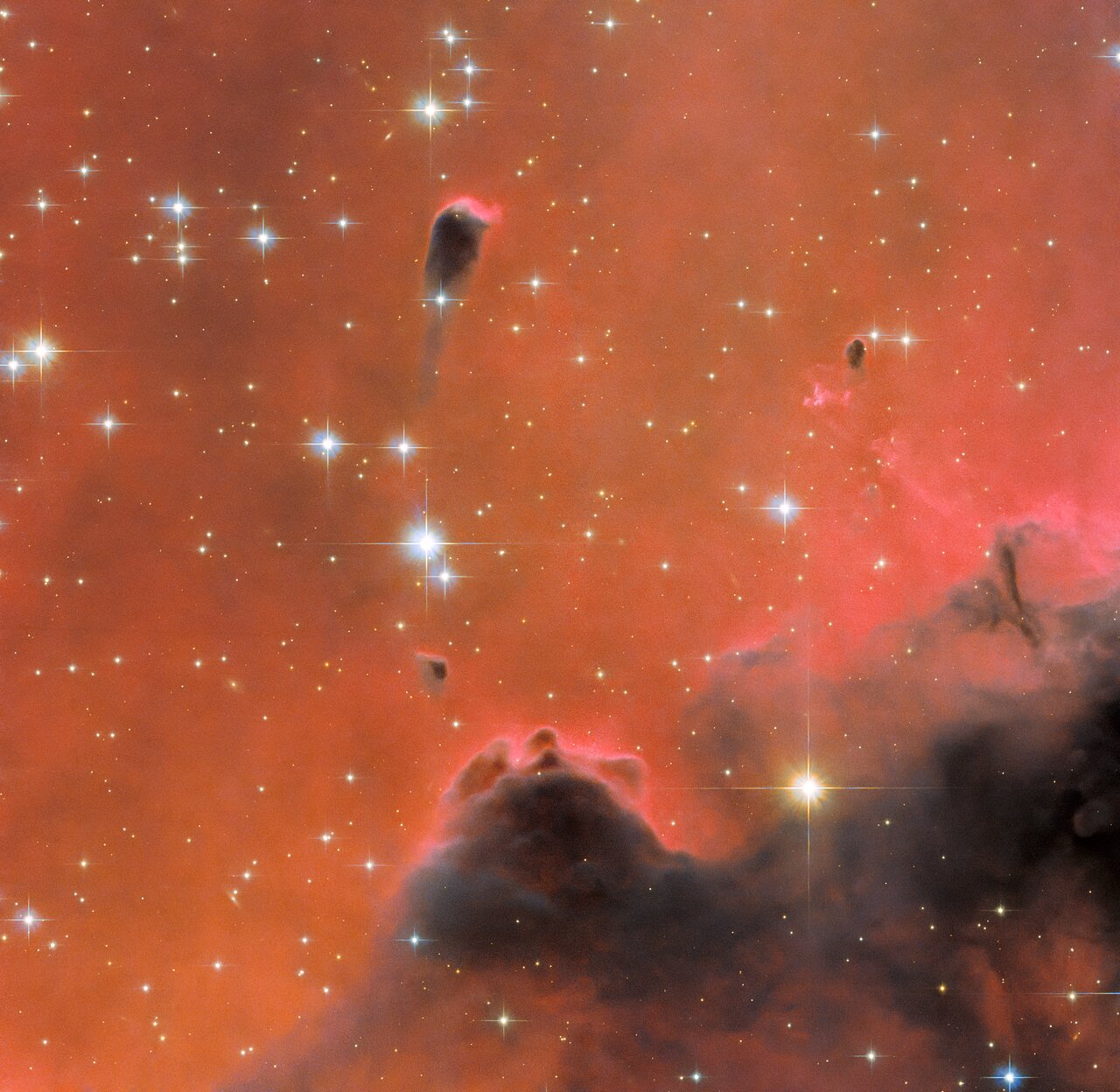
The background is filled with bright orange-red clouds of varying density. Towards the top-left, several large, pale blue stars with prominent cross-shaped spikes are scattered. A small, tadpole-shaped dark patch floats near one of these stars. More of the same dark, dense gas fills the lower-right, resembling black smoke. A bright yellow star and a smaller blue star shine in front of this.
NASA’s Hubble Space Telescope, ESA/Hubble, R. Sahai

Just in time for the fall foliage season, this image from the NASA/ESA Hubble Space Telescope features a glistening scene in red. It reveals a small region of the nebula Westerhout 5, which lies about 7,000 light-years from Earth. Suffused with bright red light, this luminous image hosts a variety of interesting features, including a free-floating Evaporating Gaseous Globule (frEGG). The frEGG in this image is the small tadpole-shaped dark region in the upper center-left. This buoyant-looking bubble is lumbered with two names – [KAG2008] globule 13 and J025838.6+604259.

FrEGGs are a particular class of Evaporating Gaseous Globules (EGGs). Both frEGGs and EGGs are denser regions of gas that photoevaporate less easily than the less dense gas surrounding them. Photoevaporation occurs when gas is ionized and dispersed away by an intense source of radiation – typically young, hot stars releasing vast amounts of ultraviolet (UV) light. EGGs were identified fairly recently, most notably at the tips of the iconic Pillars of Creation captured by Hubble in 1995. FrEGGs were classified even more recently and are distinguished from EGGs because they are detached and have a distinct ‘head-tail’ shape. FrEGGs and EGGs are of particular interest because their density makes it more difficult for intense UV radiation, found in regions rich in young stars, to penetrate them. Their relative opacity means that the gas within them is protected from ionization and photoevaporation. Astronomers think this is important for the formation of protostars, and that many FrEGGs and EGGs play host to the birth of new stars.

FrEGGs are a particular class of Evaporating Gaseous Globules (EGGs). Both frEGGs and EGGs are denser regions of gas that photoevaporate less easily than the less dense gas surrounding them. Photoevaporation occurs when gas is ionized and dispersed away by an intense source of radiation – typically young, hot stars releasing vast amounts of ultraviolet (UV) light. EGGs were identified fairly recently, most notably at the tips of the iconic Pillars of Creation captured by Hubble in 1995. FrEGGs were classified even more recently and are distinguished from EGGs because they are detached and have a distinct ‘head-tail’ shape. FrEGGs and EGGs are of particular interest because their density makes it more difficult for intense UV radiation, found in regions rich in young stars, to penetrate them. Their relative opacity means that the gas within them is protected from ionization and photoevaporation. Astronomers think this is important for the formation of protostars, and that many FrEGGs and EGGs play host to the birth of new stars.
The frEGG in this image is a dark spot in the sea of red light. The red color is a type of light emission known as H-alpha emission. H-alpha occurs when a very energetic electron within a hydrogen atom loses a set amount of its energy, releasing this distinctive red light as it becomes less energetic.

Text credit: European Space Agency (ESA)

Media Contact:

Claire Andreoli
NASA’s Goddard Space Flight CenterGreenbelt, MD
claire.andreoli@nasa.gov

Share

Details

Last Updated
Sep 29, 2023
Editor
Andrea Gianopoulos
Contact
Keep Exploring

Discover More Topics From NASA

Powered by WPeMatico

Get The Details…

NASA Publishes Beta Flagship, Science Websites as Improvements Continue

NASA Publishes Beta Flagship, Science Websites as Improvements Continue

NASA has switched its primary World Wide Web addresses to a beta version of the new NASA.gov and science.nasa.gov websites, continuing the long-term development and consolidation of its public web presence. The new sites will offer visitors an improved, intuitive web design and elevated user experience.

The ongoing work on the agency’s upgraded website is the first step to a broad new digital experience from NASA, which will include a new on-demand streaming service called NASA + and an updated NASA app. This enhanced digital presence will allow the space agency to share science, research, exploration, and innovation with the world through cohesive platforms, encouraging users to spend more time experiencing the universe through the eyes of NASA.

This new site will be the foundation of a one-stop-shop for the agency’s missions and research, climate data, Artemis updates and more. The new, topic-driven experience will ensure easier, integrated access to NASA information currently found across the agency’s many websites.

Design features of the new site include enlarged image formats and NASA’s collection of imagery covering all agency research and programs. NASA will continue to update and improve the site on a rolling-basis as it receives feedback from website visitors.

This is the eighth significant update for NASA’s website, which first launched in 1993. The site won the Webby Award for best government website four times, and received the People’s Voice, voted on by the public 10 times.

The agency will continue to connect NASA websites and multimedia libraries into this new digital experience to further streamline the information shared across its centers, missions, and programs.

Share

Details

Last Updated

Sep 28, 2023

Related Terms

Powered by WPeMatico
Get The Details…
Brian Dunbar

Commercial Law Resources

Commercial Law Resources

The following resources relevant to the Commercial Law Practice Group are available on this site.
Note: the information below is updated annually, and users of this web page will need to verify the accuracy of the citations and the information contained in the web links:

1. Statutes
A. Commercial

Commercial Space Competitiveness Act:
Definitions — 51 U.S.C. § 50501
Anchor Tenancy and Termination Liability — 51 U.S.C. § 50503
Title 51 Chapter 509, formerly the Commercial Space Launch Act of 1984– Commercial Space Act of 1998, Title II — P.L. 105-303
Commercial Use of Government Facilities –15 U.S.C. § 5807
Cross-Waiver/Indemnification Authority (user of space vehicle) — 42 U.S.C.§ 2458b
Cross-Waiver/Indemnification Authority (developer of experimental aerospace vehicle) — 42 U.S.C. § 2458c
Launch Voucher Demonstration Program — 15 U.S.C. § 5803
Shuttle Pricing Policy — 42 U.S.C. § 2466
Space Shuttle Use Policy — 51 U.S.C. § 70102

B. Miscellaneous

Acquisition of Space Science Data — 51 U.S.C. § 50113
Charges for Use of Government Services — 31 U.S.C.§ 9701
Disclosure of Confidential Information — 18 U.S.C. § 1905
Joint Development of NASA Wind Tunnels – 50 U.S.C. Chapter 20
Landsat — 51 U.S.C. § § 60111-113
Special Maritime & Territorial Jurisdiction of US — 18 U.S.C. § 7
Sources of Earth Science Data — 51 USC § 50115
Stevenson Wydler Act — 15 U.S.C. § 3701 et seq. V2

2. Presidential Directives

Convergence of U.S. Polar-Orbiting Operational Environmental Satellite Systems (PDDNSTC-2)
Landsat Remote Sensing Strategy
U.S. National Space Policy (NSPD-49)(PDF)
U.S. Space Transportation Policy (NSPD-40)(PDF)
National Space Policy of the United States (June 28, 2010)(PDF)

3. Relevant Regulations

Cross-Waiver of Liability — 14 CFR Part 1266 (PDF)
Cooperative Agreements with Commercial Firms — 14 CFR Part 1274 (PDF)
Duty-Free Entry of Space Articles — 14 CFR Part 1217 (PDF)
Space Flight — 14 CFR Part 1214 (PDF)

4. Relevant NASA Policies and Management Instructions

Authority to Enter into Space Act Agreements (NPD 1050)

5. Relevant NASA Web Sites

NASA Export Control Program (ECP)
Office of International and Interagency Relations (OIIR)

6. Relevant Federal and Other Web Sites

FAA Office of Commercial Space Transportation
Department of Commerce Bureau of Industry and Security (BIS) Export Enforcement
Department of Justice Office of Information Policy (OIP) FOIA

Powered by WPeMatico

Get The Details…
Mia N. Concilus

SCaN STEM Navigation Activities

SCaN STEM Navigation Activities

Navigate Space: Space Communications and Navigation Workbook

Grades 8 – 12 

NASA navigates throughout the solar system and beyond, revealing the mysteries of the universe. In this workbook, you’ll use basic mathematics concepts to explore space navigation. We’ll use simplified, real-world examples supplied by navigation engineers to delve deep into the exciting world of space exploration. As NASA goes forward to the Moon and journeys on to Mars, maybe you could be the one to plan our next big mission!

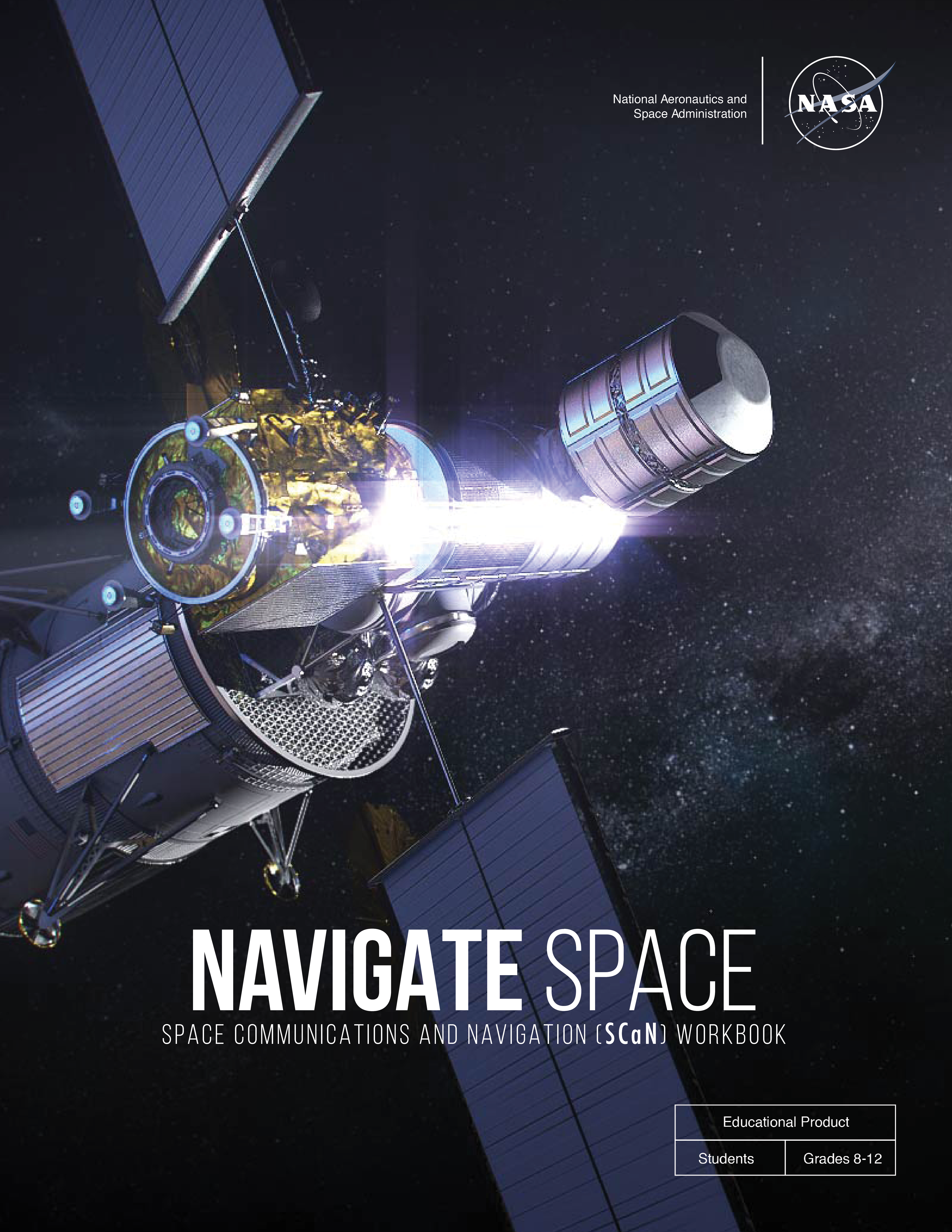
Image of a space station with a starry background. The text reads "Navigate Space: Space Communications and Navigation (SCaN) Workbook)"
Navigate Space Workbook

Workbook Answers

NASA’s Search and Rescue Coloring Book 

Grades K – 3

Satellite-aided search and rescue is a collaborative effort involving a number of national and international organizations. The international Cospas-Sarsat Programme was founded in 1979 to provide timely, accurate and reliable location data to first responders. The U.S. serves on the Cospas-Sarsat Council and a number of U.S. agencies are instrumental in ensuring the robustness of the search and rescue network. NASA lends its expertise in technology development through their Search and Rescue (SAR) office. NASA’s SAR office is based out of NASA’s Goddard Space Flight Center in Greenbelt, Maryland, and is a project of their Exploration and Space Communications projects division. Programmatic oversight is provided by NASA’s Space Communications and Navigation program office at NASA Headquarters in Washington, DC.

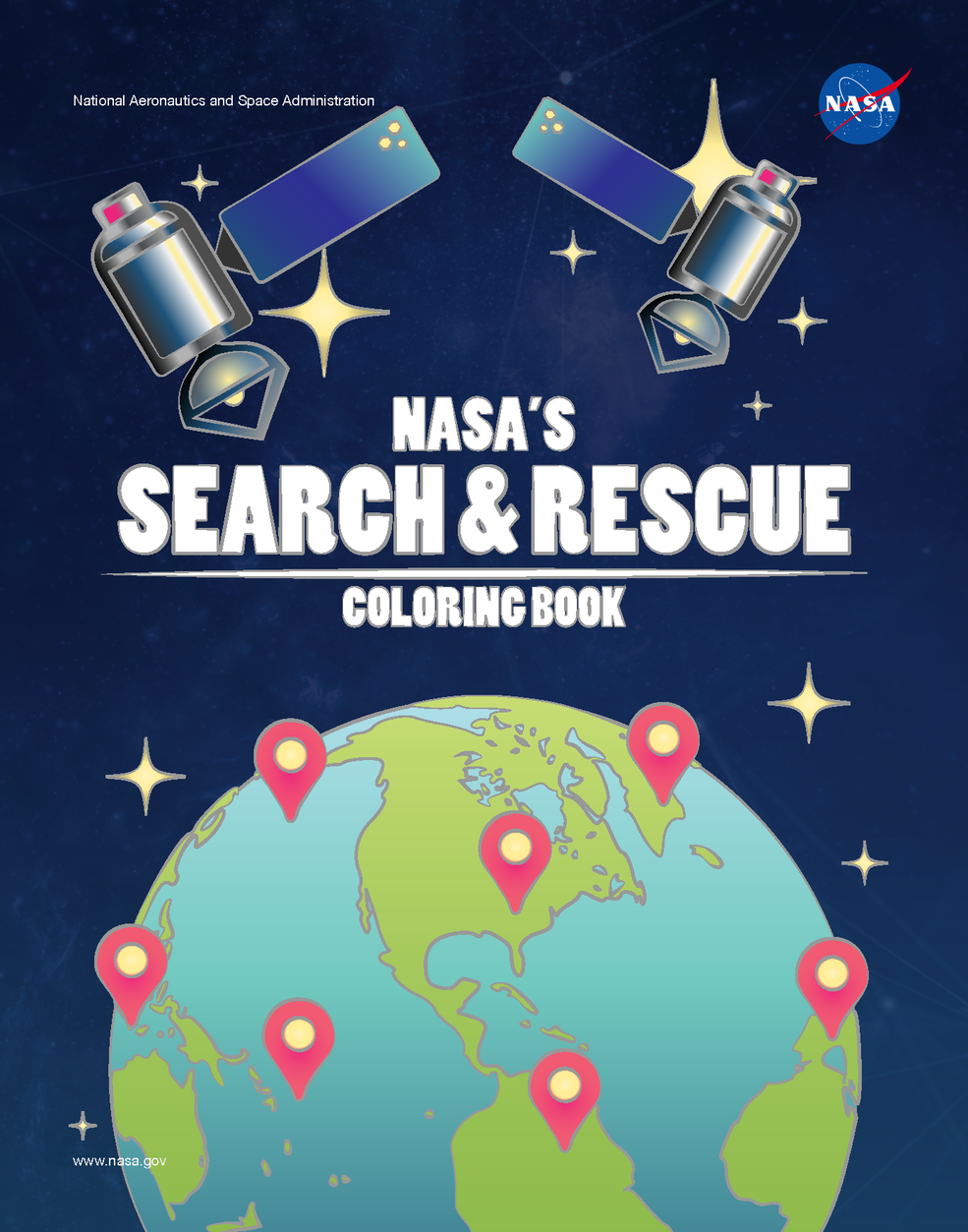
Illustration o the Earth with two satellites orbiting above. The text reads
Search and Rescue Coloring Book

Powered by WPeMatico

Get The Details…
Catherine G. Manning