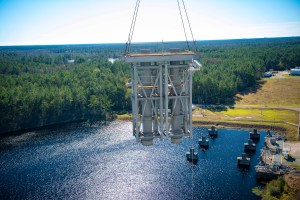
Dream Chaser Undergoes Testing at NASA Test Facility in Ohio

Dream Chaser Undergoes Testing at NASA Test Facility in Ohio

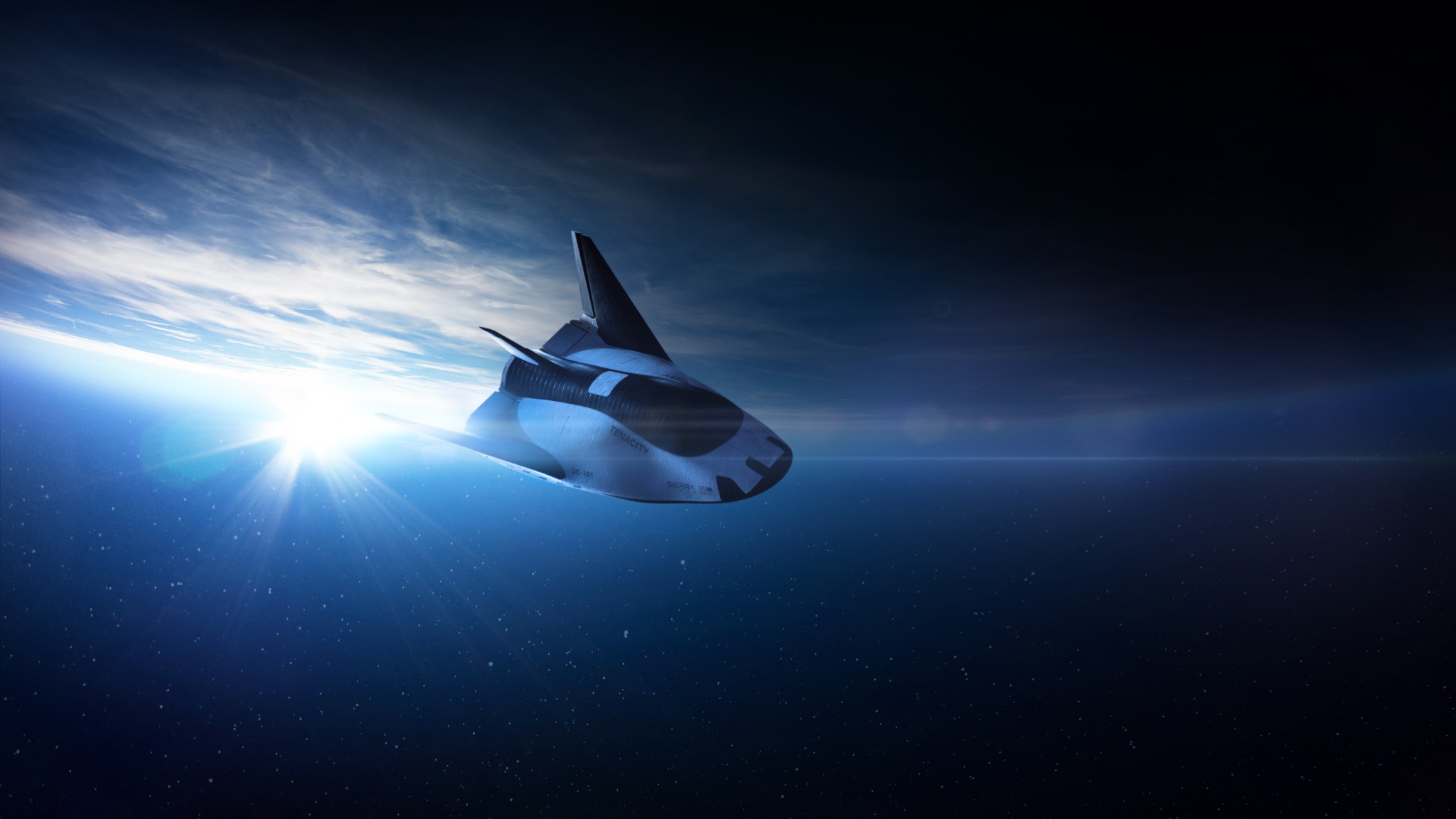
NASA and Sierra Space are making progress on the first flight of the company’s Dream Chaser spacecraft to the International Space Station. The uncrewed cargo spaceplane is planned to launch its demonstration mission in 2024 to the orbital complex as part of NASA’s commercial resupply services. Credit: Sierra Space/Shay Saldana

NASA and Sierra Space are preparing for the first flight of the company’s Dream Chaser spacecraft to the International Space Station. Dream Chaser and its companion cargo module, called Shooting Star, arrived at NASA’s Neil Armstrong Test Facility in Sandusky, Ohio, for environmental testing, scheduled to start in mid-December, ahead of its first flight, scheduled for the first half of 2024.

The Neil Armstrong Test Facility, part of NASA’s Glenn Research Center in Cleveland, is home to multiple test facilities, including the Space Environments Complex and the In-Space Propulsion Facility, both stops for Dream Chaser. The complex is home to the Mechanical Vibration Facility, which subjects test articles to the rigorous conditions of launch.

While at Armstrong, the Dream Chaser winged spacecraft will be stacked atop its Shooting Star cargo module on the vibration table to experience vibrations like those during launch and re-entry to the Earth’s atmosphere.

Following vibration testing, Dream Chaser will be moved to the propulsion facility for thermal vacuum testing. Dream Chaser will be placed in a vacuum and exposed to low ambient pressures, low-background temperatures, and replicated dynamic solar heating, which simulates the environment the spacecraft will encounter during its mission. This facility is the only one capable of testing full-scale, upper stage rockets and rocket engines under simulated space conditions and conducting altitude hot fire.

After completion of testing at Armstrong, Dream Chaser will be shipped to NASA’s Kennedy Space Center in Florida for further launch preparations, currently scheduled for liftoff in the first half of 2024.


Learn more about station activities by following the space station blog@space_station and @ISS_Research on X, as well as the ISS Facebook and ISS Instagram accounts.

Get weekly video highlights at: https://roundupreads.jsc.nasa.gov/videoupdate/

Get the latest from NASA delivered every week. Subscribe here: www.nasa.gov/subscribe

Powered by WPeMatico

Get The Details…

Mark Garcia

Research Physical Scientist Tra-My Justine Richardson 

Research Physical Scientist Tra-My Justine Richardson 

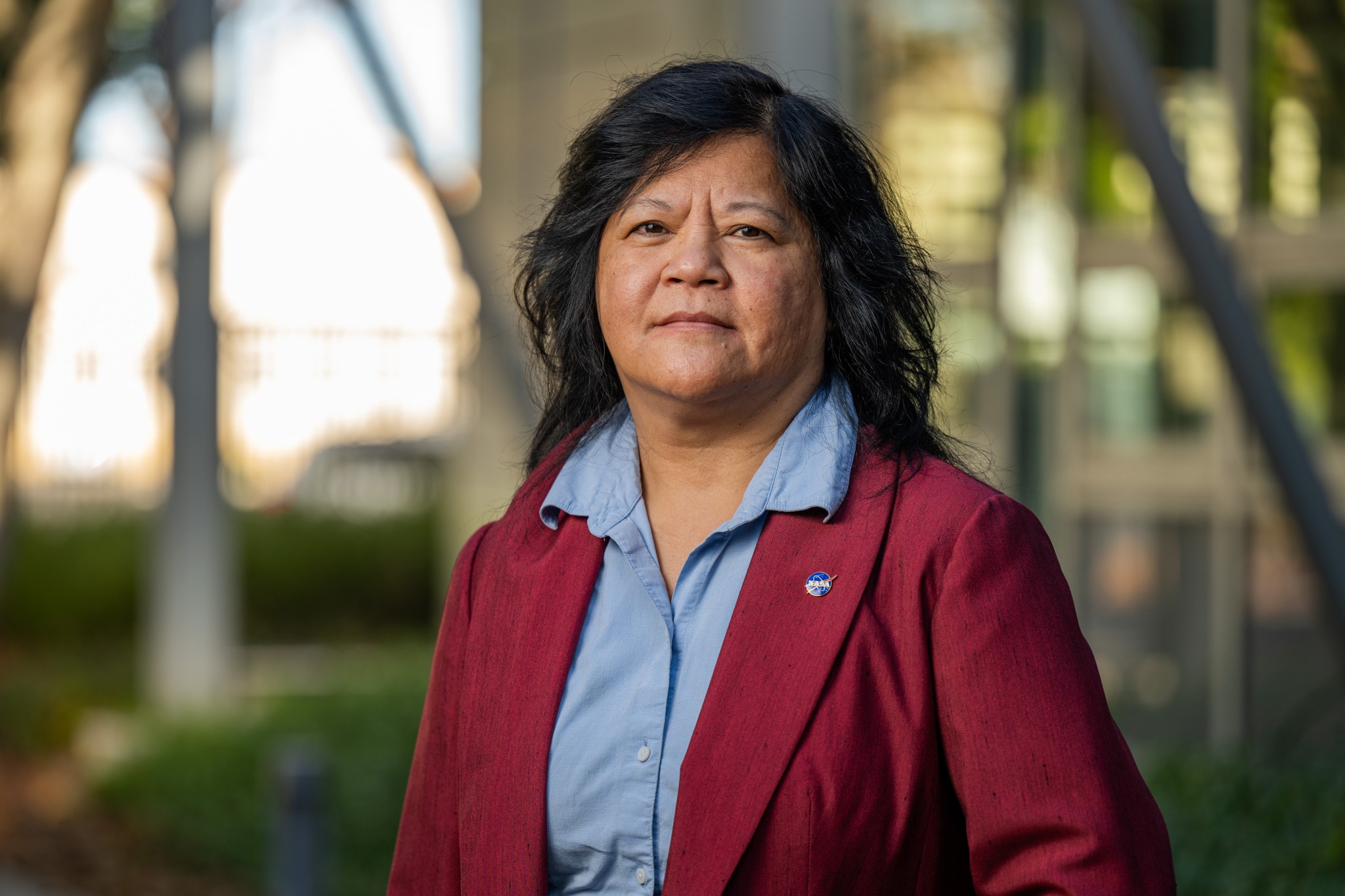
“When I mentor students, their academic [talents] are a given. They’re very bright. They’re very smart. But I mentor them to teach them what they don’t learn in school: how to work with other people, how to seek help, and how to mature from a student to a professional. 

“[I teach them that] when you fail, it’s OK. Admit what you did wrong, be honest about it, and talk through it. Don’t hide it. Don’t avoid it. We will deal with it together. 

“That takes a lot of courage and a lot of maturity, but I try to show them to grow from the challenge and move past it. Face it head on. That is one thing that I did not learn [growing up] and had to learn later in life. It takes a lot of courage to confront your fears and failures. Each and every time is really difficult, but you will feel really empowered. It’s a very significant step in your life if you can do that.”

—Tra-My Justine Richardson, Research Physical Scientist, NASA’s Ames Research Center

Image Credit: NASA / Brandon Torres
Interviewer: NASA / Thalia Patrinos

Check out some of our other Faces of NASA. 

Powered by WPeMatico

Get The Details…
Thalia K. Patrinos

120th Anniversary of the First Powered, Controlled Flight

120th Anniversary of the First Powered, Controlled Flight

In this black and white photo, a white airplane with two sets of stacked wings with wires connecting them flies low to the ground. A man, Wilbur Wright, stands on the right with his back to the camera.
Library of Congress

In this image from Dec. 17, 1903, Orville Wright makes the first powered, controlled flight on Earth as his brother Wilbur looks on. Orville Wright covered 120 feet in 12 seconds during the first flight of the day. The Wright brothers made four flights that day, each longer than the last.

The aircraft, Flyer 1, was wrecked beyond repair after the fourth flight, but Orville took the wreckage home to Ohio and restored it. It went on display at the London Science Museum until 1948 when the Smithsonian Institution took ownership.

The Wrights’ legacy has traveled beyond Earth; engineers attached a postage-stamp-sized piece of Flyer 1’s wing material to a cable underneath NASA’s Ingenuity Mars Helicopter. As of Dec. 2, 2023, Ingenuity has traveled a total distance of 9.6 miles with a total flight time of 2 hours 1 minute 5 seconds. Its ground-breaking mission continues, paving the way for future aerial explorers of Mars.

Explore this historic flight and its effect on aeronautics.

Image Credit: Library of Congress

Powered by WPeMatico

Get The Details…
Monika Luabeya

Sierra Space’s Dream Chaser New Station Resupply Spacecraft for NASA

Sierra Space’s Dream Chaser New Station Resupply Spacecraft for NASA

NASA and Sierra Space are making progress on the first flight of the company’s Dream Chaser spacecraft to the International Space Station. The uncrewed cargo spaceplane is planned to launch its demonstration mission in 2024 to the orbital complex as part of NASA’s commercial resupply services.
Sierra Space

NASA and Sierra Space are making progress on the first flight of the company’s Dream Chaser spacecraft to the International Space Station. The uncrewed cargo spaceplane is planned to launch its demonstration mission in 2024 to the orbital complex as part of NASA’s commercial resupply services.

Dream Chaser and Shooting Star

The Dream Chaser cargo system, manufactured by Sierra Space in Louisville, Colorado, consists of two major elements: the Dream Chaser spacecraft and the Shooting Star cargo module. As a lifting body spacecraft, Dream Chaser is designed to be reused up to 15 times, and is modified from the HL-20 spacecraft developed at NASA’s Langley Research Center in Hampton, Virginia.

The spaceplane’s cargo module companion, Shooting Star, is designed to support delivery and disposal of pressurized and unpressurized cargo to and from the space station. The cargo module can be used only once and is disposed of prior to re-entry.

The Dream Chaser system will launch with its wings folded inside a five-meter fairing aboard a ULA (United Launch Alliance) Vulcan Centaur rocket from Space Launch Complex 41 at Cape Canaveral Space Force Station in Florida. The fairing panels will protect the spacecraft during ascent but are jettisoned once in orbit. Solar arrays mounted on the cargo module and wings of Dream Chaser are deployed during its autonomous rendezvous to the space station. In the event of a scrub, Dream Chaser is designed to be ready for launch in as little as 24 hours.

Mission Overview

During its first flight, Sierra Space will conduct in-orbit demonstrations to certify Dream Chaser for future missions. Teams at NASA’s Kennedy Space Center in Florida, NASA’s Johnson Space Center in Houston, and the Dream Chaser Mission Control Center in Louisville, Colorado, will monitor the flight. Sierra Space flight controllers will control the Dream Chaser spacecraft on the launch pad until the spacecraft is handed over to the Sierra Space ground operations team at NASA Kennedy following landing.

Far-field demonstrations will be conducted outside the vicinity of the space station before the spacecraft enters the approach ellipsoid, a 2.5-by-1.25-by-1.25-mile (4-by-2-by-2-kilometer) invisible boundary around the orbiting laboratory. These demonstrations will be required before Dream Chaser can enter joint operations with the NASA team at the Mission Control Center in Houston. These include demonstrating attitude control, translational maneuvers, and abort capabilities.

Near-field demonstrations, which must happen closer to the space station, include activating and using light detection and ranging (LIDAR) sensors, responding to commands sent from the space station, retreating from the station when commanded, and holding its approach, first at 1,083 feet (330 meters), then 820 feet (250 meters), and finally, at 98 feet (30 meters) from the station. Following successful completion of the demonstrations, Dream Chaser will move towards the space station.

As Dream Chaser approaches the orbiting laboratory, it will hold a final time approximately 38 feet (11.5 meters) from the space station, when a station crew member will use Canadarm2 robotic arm to grapple a fixture on the spacecraft’s cargo module before teams on the ground install the cargo module to an Earth-facing port on the Unity or Harmony module.

On its first flight to the International Space Station, Dream Chaser is scheduled to deliver over 7,800 pounds of cargo. On future missions, Dream Chaser is being designed to stay attached to the station for up to 75 days and deliver as much as 11,500 pounds of cargo. Cargo can be loaded onto the spacecraft as late as 24 hours prior to launch. Dream Chaser can return over 3,500 pounds of cargo and experiment samples to Earth, while over 8,700 pounds of trash can be disposed of during reentry using its cargo module.

Return to Earth

Dream Chaser will remain at the space station for about 45 days before it is uninstalled using Canadarm2. The spacecraft can land as quickly as 11 to 15 hours after departure, and there are daily opportunities if weather criteria are met. Landing weather criteria for Dream Chaser generally require crosswinds at less than 17.2 miles per hour (15 knots), headwinds under 23 mph (20 knots), and tailwinds below 11.5 mph (10 knots). Thunderstorms, lightning, and rain within a 20-mile radius of the runway or 10 miles along the approach path are not acceptable conditions for landing. Detailed flight rules will guide controllers in determining whether landing opportunities are favorable.

A combination of Dream Chaser’s 26 reaction control system thrusters will fire to commit the spacecraft to deorbit. Dream Chaser will re-enter Earth’s atmosphere and glide to a runway landing at Kennedy’s Launch and Landing Facility in the style of NASA’s space shuttle, becoming the first spacecraft to land at the facility since the final space shuttle flight in 2011.

Once Dream Chaser is powered down after landing, the Sierra Space ground operations team will transfer it to the Space System Processing Facility to perform necessary inspections, off-load remaining NASA cargo, and begin the process of preparing it for the next mission.

Sierra Space, formerly Sierra Nevada Corporation, was selected in 2016 as NASA’s third commercial cargo resupply spacecraft to service the International Space Station

For updates on NASA’s commercial resupply services, visit:

https://www.nasa.gov/mission_pages/station/structure/launch/index.html

Powered by WPeMatico

Get The Details…
Mark A. Garcia

NASA Geologist Paves the Way for Building on the Moon

NASA Geologist Paves the Way for Building on the Moon

5 min read

Preparations for Next Moonwalk Simulations Underway (and Underwater)

By Jessica Barnett

For many at NASA’s Marshall Space Flight Center in Huntsville, Alabama, a love – be it for space, science, or something else – drew them to the career they’re in today. For geologist Jennifer Edmunson, there were multiple reasons.

Her love for geology dates back to her childhood in Arizona, playing in the mud, fascinated by the green river rocks she would find and how they fit together. As she grew older, her love for astronomy led her to study the regolith and geology of the Moon and Mars in graduate school.

A blonde woman with a black jacket poses in for a headshot in front of a blue background.
Jennifer Edmunson, geologist and MMPACT project manager at NASA’s Marshall Space Flight Center.
NASA

That, in turn, led her to Marshall for her post-doctorate, where she studied how shock processes from meteorite impacts potentially affect scientists’ work to determine the age of rocks using different radioisotope systems. On her first day, she needed help from the center’s IT department, which is how she met Joel Miller, the man she now calls her husband.

“I met him on April Fools’ Day, and he asked me out on Friday the 13th,” Edmunson recalled. “I knew I needed to get a stable job, so I got a job as the junior geologist on the simulant team here at Marshall. That was back in 2009.”

Fourteen years later, they still work at Marshall. He’s now the center’s acting spectrum manager, and she manages the MMPACT (Moon-to-Mars Planetary Autonomous Construction Technology) project. Through MMPACT, Marshall is working with commercial partners and academia to develop and test robotic technology that will one day use lunar soil and 3-D printing technology to build structures on the Moon.

“It’s phenomenal to see the development of the different materials we’ve been working on,” Edmunson said. “We started with this whole array of materials, and now we’re like, ‘OK, what’s the best one for our proof of concept?’”

NASA aims for a proof-of-concept mission to validate the technology and capability by the end of this decade. This mission would involve traveling to the Moon to create a representative element of a landing pad.

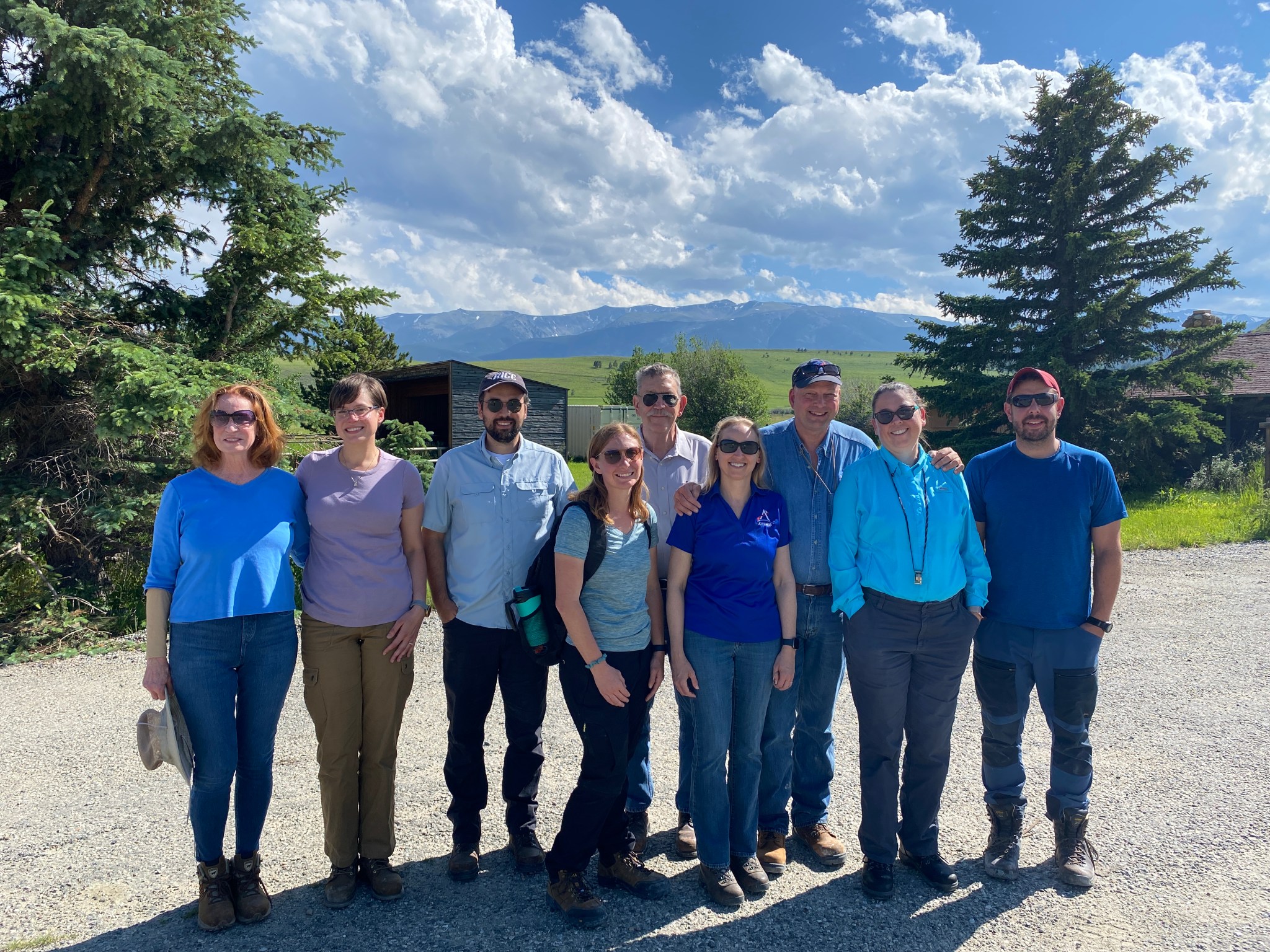
A group of people, some wearing sunglasses, all wearing blue shirts stand on a gravel lot outside with a blue sky and green trees behind them.
Marshall geologist and MMPACT project manager Jennifer Edmunson, fourth from right, joined several other scientists for a trip to Stillwater, Montana, earlier this year. Stillwater is known to have rocks like those found on the Moon.

MMPACT aims to build lunar infrastructure using the materials readily available on the Moon. This process, known as in-situ resource utilization, allows NASA engineers to use lunar regolith, fine-grained silicate minerals thought to be available in a layer between 10 to 70 feet deep on the lunar surface, to build different structures and infrastructure elements.

However, regolith can’t be used like cement here on Earth, as it wouldn’t solidify in the low-pressure environment. So, Edmunson and her team are now looking at microwaves and laser technology to heat the regolith to create solid building materials.

After successfully building a full-scale landing pad on the Moon, MMPACT will likely focus on a vertical structure, like a garage, habitat, or safe haven for astronauts.

“The possibilities are endless,” she said. “There is so much potential for using different materials for different applications. There’s just a wealth of opportunity for anyone who wants to play in the field, really.”

Edmunson hopes to get more lunar regolith first, as NASA is still working with samples from the Apollo missions and simulants based on those samples. She’s also looking forward to Artemis bringing back samples from different parts of the lunar surface because it will provide her team with a wider pool of regolith samples to analyze.

“We want to learn more about different locations on the Moon,” she said. “We have to understand the differences and how that might affect our processes.”

Knowing this will make it easier not just to build landing pads and habitats but to build roadways and the start of a lunar economy, Edmunson said.

“I want there to be sufficient structures there to make things safe for crew, so if we want to build a hotel on the Moon, we could,” she said. “We could have tourists going there, mining districts pulling rare Earth elements from the Moon. We could do that and get a lot of resources that way.

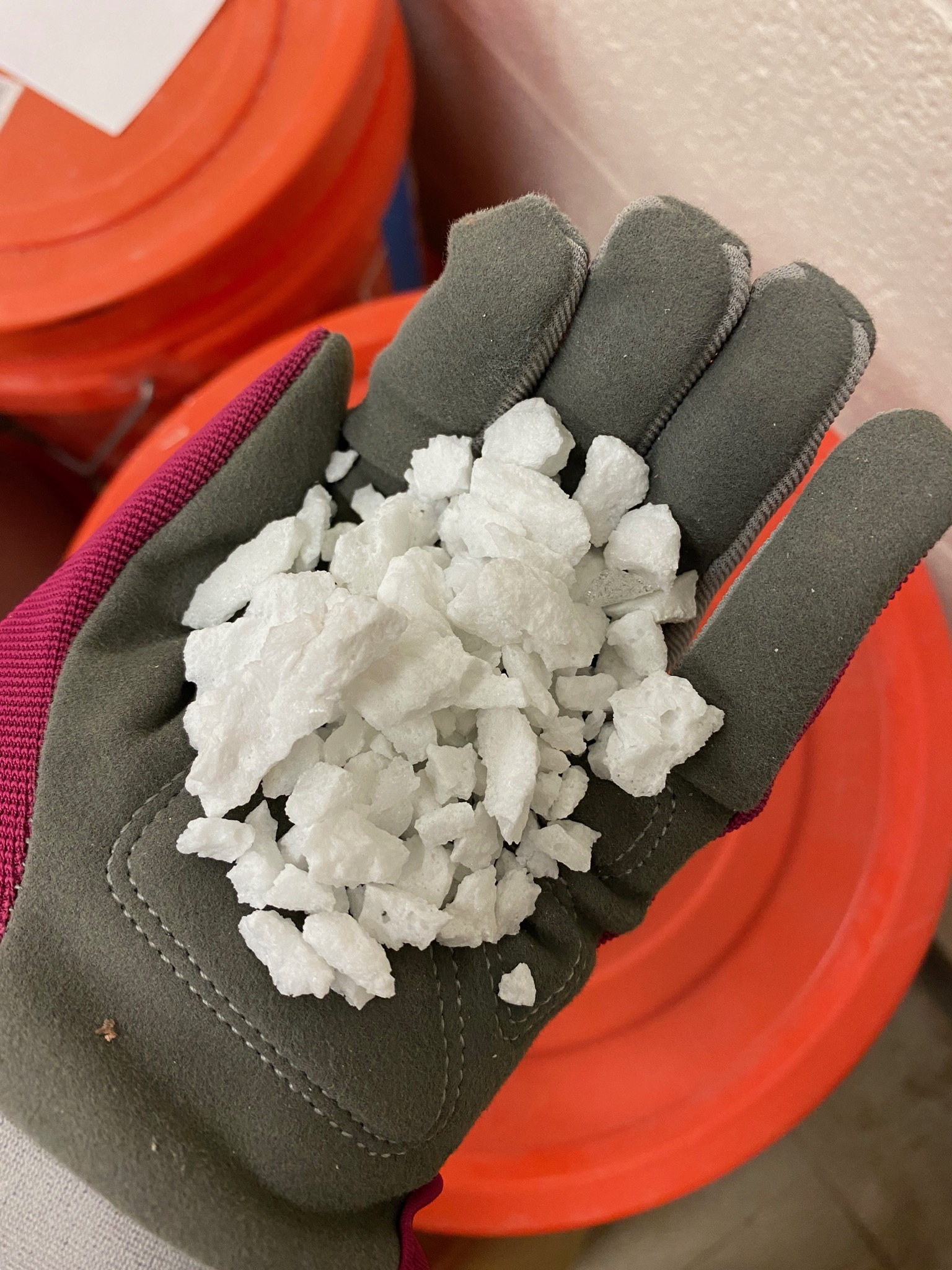
A gloved hand holds a handful of white looking synthetic minerals over a orange bucket.
Some minerals are rare on Earth but abundant on the Moon. To study how those minerals could be used for building, scientists rely on simulants, like the synthetic anorthite pictured here.
NASA

“I want science to progress, things like building a radio telescope on the far side of the Moon. I want more information on more of the different sites around the Moon, so we can get a better understanding of how the Moon formed and the history of the Moon. We’ve only scratched the surface there.”

There are parts of the Moon that can only be explored in detail by visiting in person, Edmunson explained, and she’s excited to be working at Marshall as that exploration is made possible.

“It’s awesome to be part of this. Honestly, it’s the reason I get out of bed in the morning,” she said. “I was born in ’77, so I missed the Apollo lunar landings. I would love to see humans on the Moon in my lifetime, and on Mars would just be amazing.”

Her advice is simple to anyone considering a career like hers: Just go for it.

“A lot of it comes down to passion and tenacity,” she said. “If you really love what you do and you get to do it every day, you find more enjoyment in your career. I feel like I’m making a difference, and with surface construction at such an infant kind of stage right now, I feel like it’s a contribution that will last for a very long time.”

Ramon J. Osorio
Marshall Space Flight Center, Huntsville, Alabama
256-544-0034
ramon.j.osorio@nasa.gov

Share

Details

Last Updated

Dec 13, 2023

Editor
Beth Ridgeway

Powered by WPeMatico

Get The Details…
Beth Ridgeway