NASA’s Tech Demo Streams First Video From Deep Space via Laser

NASA’s Tech Demo Streams First Video From Deep Space via Laser
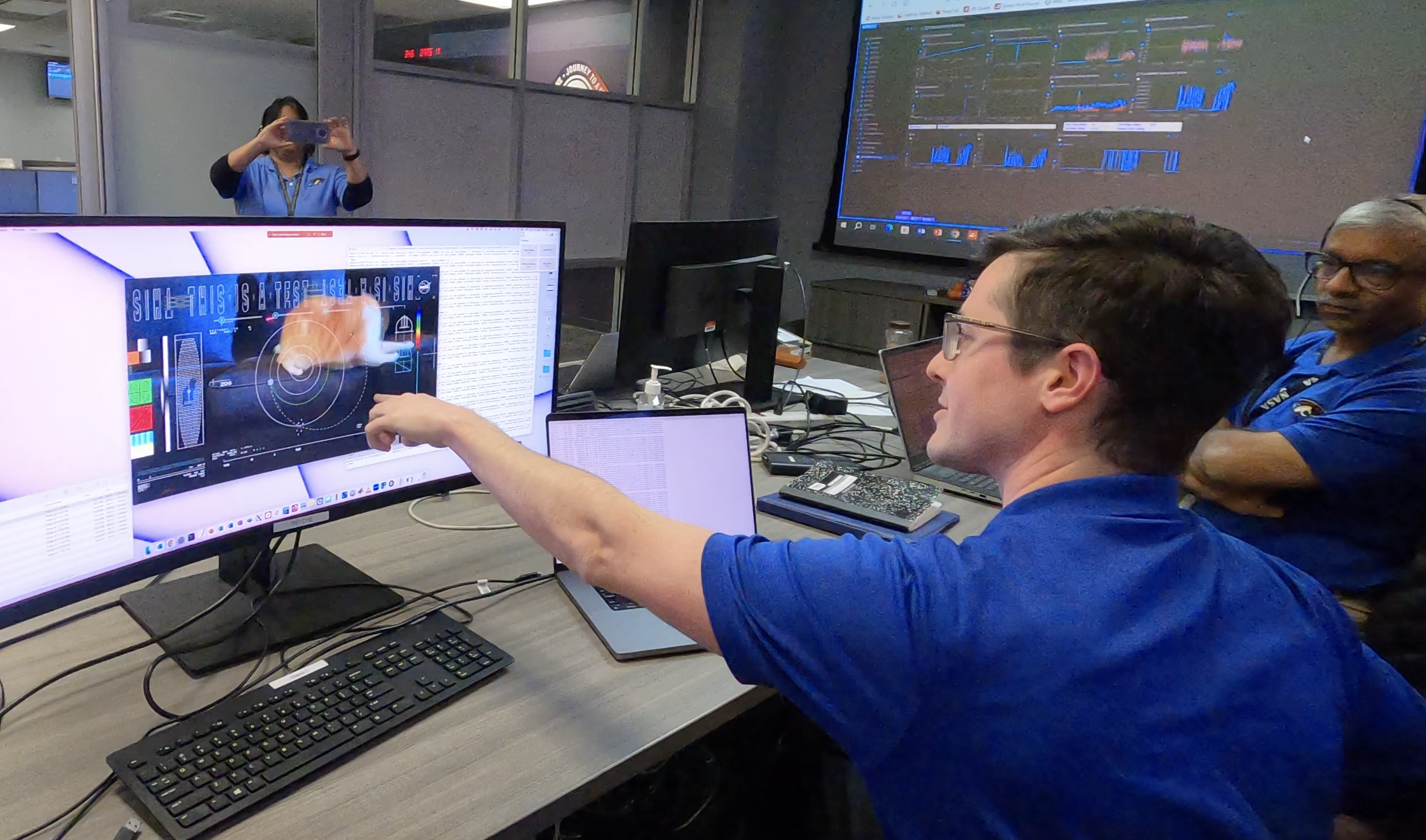
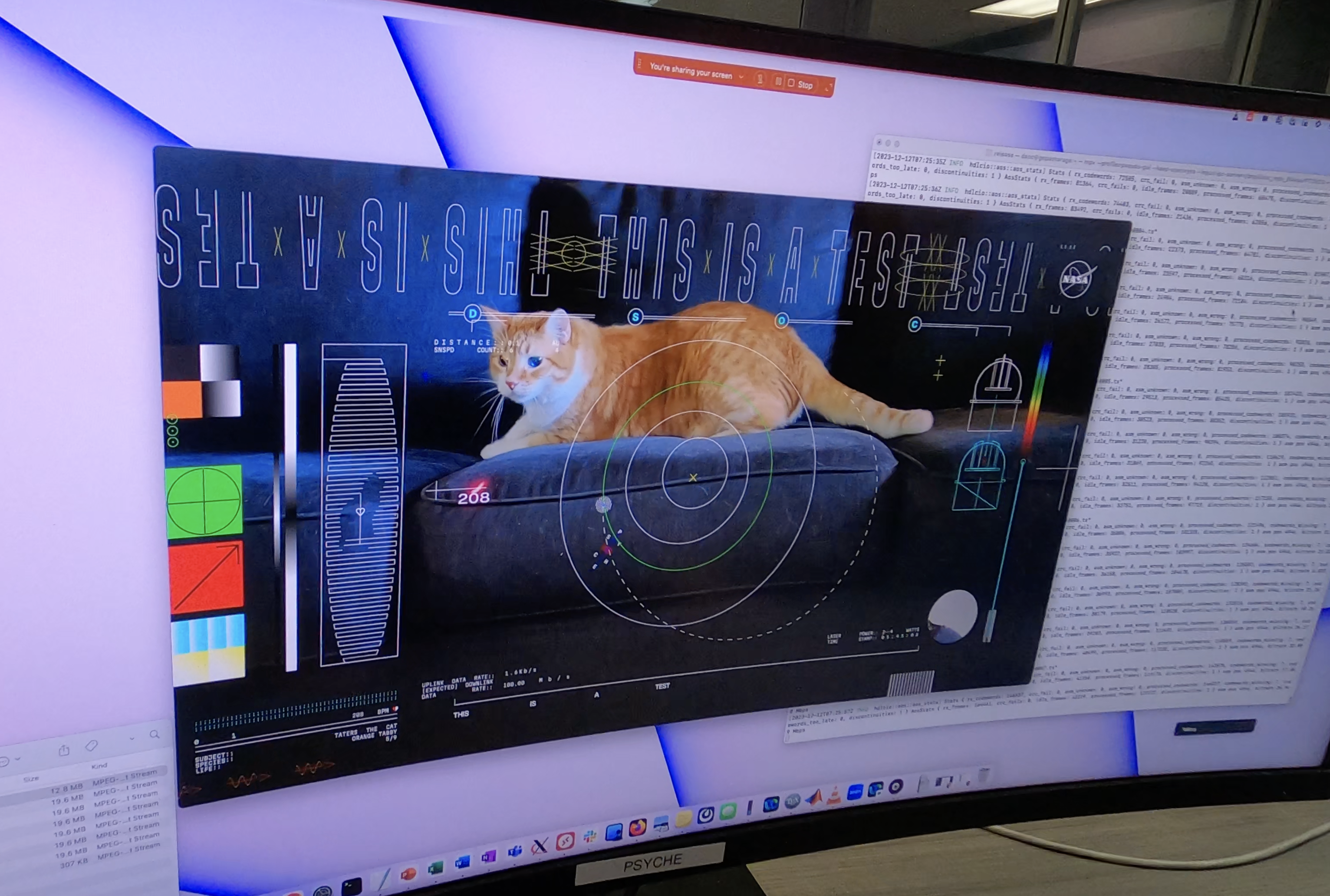
The video, featuring a cat named Taters, was sent back from nearly 19 million miles away by NASA’s laser communications demonstration, marking a historic milestone.

NASA’s Deep Space Optical Communications experiment beamed an ultra-high definition streaming video on Dec. 11 from a record-setting 19 million miles away (31 million kilometers, or about 80 times the Earth-Moon distance). The milestone is part of a NASA technology demonstration aimed at streaming very high-bandwidth video and other data from deep space – enabling future human missions beyond Earth orbit.

“This accomplishment underscores our commitment to advancing optical communications as a key element to meeting our future data transmission needs,” said NASA Deputy Administrator Pam Melroy. “Increasing our bandwidth is essential to achieving our future exploration and science goals, and we look forward to the continued advancement of this technology and the transformation of how we communicate during future interplanetary missions.”

The demo transmitted the 15-second test video via a cutting-edge instrument called a flight laser transceiver. The video signal took 101 seconds to reach Earth, sent at the system’s maximum bit rate of 267 megabits per second (Mbps). Capable of sending and receiving near-infrared signals, the instrument beamed an encoded near-infrared laser to the Hale Telescope at Caltech’s Palomar Observatory in San Diego County, California, where it was downloaded. Each frame from the looping video was then sent “live” to NASA’s Jet Propulsion Laboratory in Southern California, where the video was played in real time.

This 15-second clip shows the first ultra-high-definition video sent via laser from deep space, featuring a cat named Taters chasing a laser with test graphics overlayed. To see a “cheat sheet” explaining the components of the video, click here. Credit: NASA/JPL-Caltech

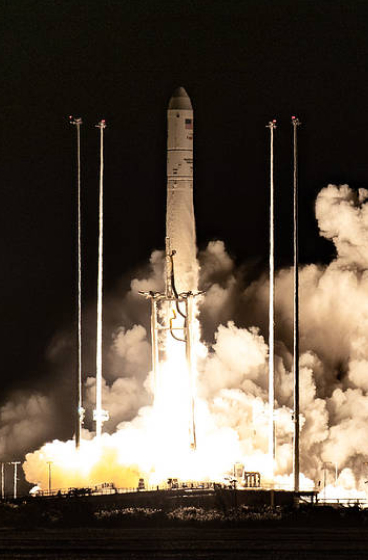
The laser communications demo, which launched with NASA’s Psyche mission on Oct. 13, is designed to transmit data from deep space at rates 10 to 100 times greater than the state-of-the-art radio frequency systems used by deep space missions today. As Psyche travels to the main asteroid belt between Mars and Jupiter, the technology demonstration will send high-data-rate signals as far out as the Red Planet’s greatest distance from Earth. In doing so, it paves the way for higher-data-rate communications capable of sending complex scientific information, high-definition imagery, and video in support of humanity’s next giant leap: sending humans to Mars.

“One of the goals is to demonstrate the ability to transmit broadband video across millions of miles. Nothing on Psyche generates video data, so we usually send packets of randomly generated test data,” said Bill Klipstein, the tech demo’s project manager at JPL. “But to make this significant event more memorable, we decided to work with designers at JPL to create a fun video, which captures the essence of the demo as part of the Psyche mission.”

Feline Frequency

Uploaded before launch, the short ultra-high definition video features an orange tabby cat named Taters, the pet of a JPL employee, chasing a laser pointer, with overlayed graphics. The graphics illustrate several features from the tech demo, such as Psyche’s orbital path, Palomar’s telescope dome, and technical information about the laser and its data bit rate. Tater’s heart rate, color, and breed are also on display.
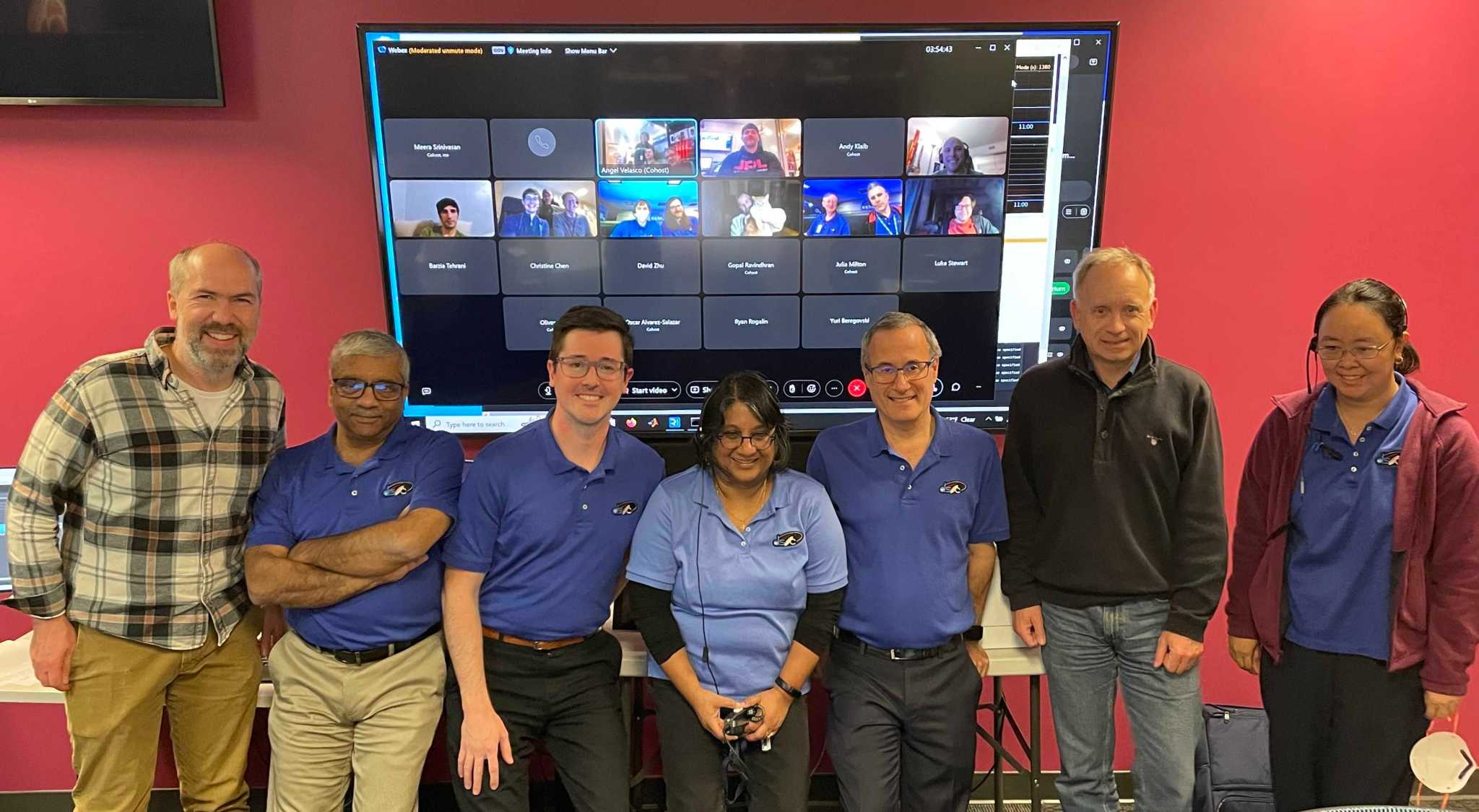
Members of the JPL team pose after the first streamed ultra-HD video was received from deep space. Remote team members (including Taters the cat) appear on the meeting screen. Standing, from left, are: Dan Goods, Abi Biswas, Ryan Rogalin, Meera Srinivasan, Bill Klipstein, Oliver Lay, and Christine Chen.
NASA/JPL-Caltech

“Despite transmitting from millions of miles away, it was able to send the video faster than most broadband internet connections,” said Ryan Rogalin, the project’s receiver electronics lead at JPL. “In fact, after receiving the video at Palomar, it was sent to JPL over the internet, and that connection was slower than the signal coming from deep space. JPL’s DesignLab did an amazing job helping us showcase this technology – everyone loves Taters.”

There’s also a historical link: Beginning in 1928, a small statue of the popular cartoon character Felix the Cat was featured in television test broadcast transmissions. Today, cat videos and memes are some of the most popular content online.

Milestone After Milestone

This latest milestone comes after “first light” was achieved on Nov. 14. Since then, the system has demonstrated faster data downlink speeds and increased pointing accuracy during its weekly checkouts. On the night of Dec. 4, the project demonstrated downlink bit rates of 62.5 Mbps, 100 Mbps, and 267 Mbps, which is comparable to broadband internet download speeds. The team was able to download a total of 1.3 terabits of data during that time. As a comparison, NASA’s Magellan mission to Venus downlinked 1.2 terabits during its entire mission from 1990 to 1994.

“When we achieved first light, we were excited, but also cautious. This is a new technology, and we are experimenting with how it works,” said Ken Andrews, project flight operations lead at JPL. “But now, with the help of our Psyche colleagues, we are getting used to working with the system and can lock onto the spacecraft and ground terminals for longer than we could previously. We are learning something new during each checkout.”

More About the Mission

The Deep Space Optical Communications demonstration is the latest in a series of optical communication demonstrations funded by the Technology Demonstration Missions (TDM) program under NASA’s Space Technology Mission Directorate and supported by NASA’s SCaN (Space Communications and Navigation) program within the agency’s Space Operations Mission Directorate.

The Psyche mission is led by Arizona State University. JPL is responsible for the mission’s overall management, system engineering, integration and test, and mission operations. Psyche is the 14th mission selected as part of NASA’s Discovery Program under the Science Mission Directorate, managed by the agency’s Marshall Space Flight Center in Huntsville, Alabama. NASA’s Launch Services Program, based at the agency’s Kennedy Space Center in Florida, managed the launch service. Maxar Technologies in Palo Alto, California, provided the high-power solar electric propulsion spacecraft chassis

For more information about the laser communications demo, visit:

https://www.jpl.nasa.gov/missions/dsoc

News Media Contact

Ian J. O’Neill
Jet Propulsion Laboratory, Pasadena, Calif.
818-354-2649
ian.j.oneill@jpl.nasa.gov

2023-184

Powered by WPeMatico

Get The Details…
Naomi Hartono

Cosmic Companionship Quest Marks Major Milestone

Cosmic Companionship Quest Marks Major Milestone

2 min read

Cosmic Companionship Quest Marks Major Milestone

Are we alone in the universe? About 30,000 volunteers want to know! These volunteers visited arewealone.earth to sift through a huge data set from the 100 meter Green Bank Telescope—inspecting it for signals that might indicate intelligent extraterrestrial life. As of this week, this giant team has made ONE MILLION inspections!

“We are thrilled that our volunteers have accomplished so much in the short 10-month period since our launch,” said project PI Jean-Luc Margot.

A group of 6 men and women are standing and smiling in front of a white board with the equation N-R*fpnef1fifcL written in large black print.
The Science and Communications team of the “Are we alone in the universe?” project. From left to right: Ella, Jay, Megan, Jeremy, Priscella, Jean-Luc. Not pictured: Liam.

It’s a major milestone to be sure. But does that mean this search is over? Not even close. The Green Bank Telescope collects millions of signals per hour! So UCLA graduate student Megan Li is building on the volunteer-submitted data to design and train a machine learning application that will help tackle that enormous data rate. She will present her preliminary results at a meeting of the American Astronomical Society this January. 

If you’ve been helping out—thank you!  And please come help some more! The 10th batch of UCLA SETI data has now been uploaded to the platform. Moreover, thanks to volunteer translators, the project is now available in French (translated by Louis Verhaeghe) and in Portuguese (translated by Fernando Nogal).

“Are we alone in the universe?” was built by UCLA SETI on the Zooniverse platform with funding from The Planetary Society and the NASA Citizen Science Seed Funding Program.

Share

Details

Last Updated

Dec 18, 2023

Powered by WPeMatico

Get The Details…

Ice Flows on Mars

Ice Flows on Mars

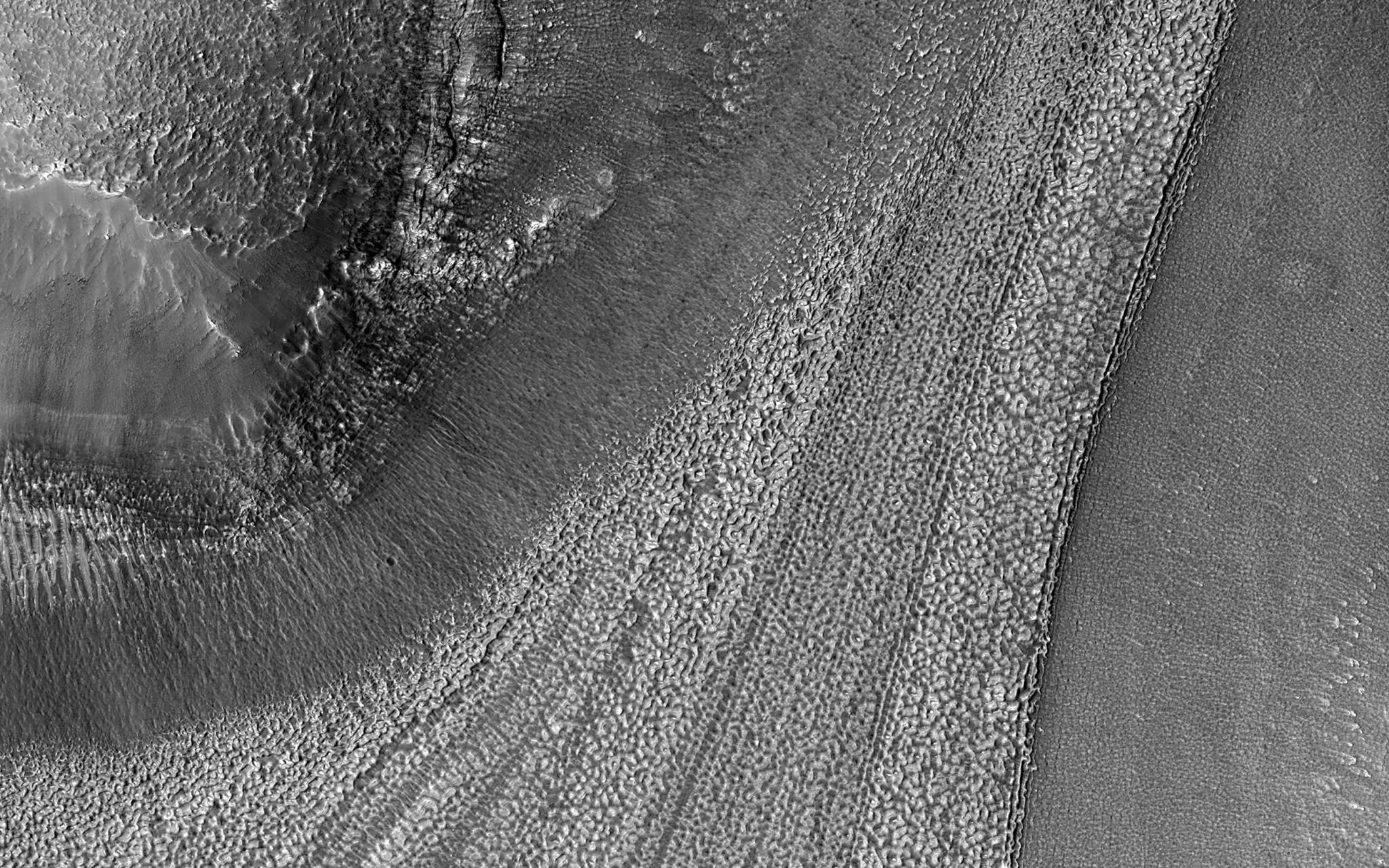
A black and white image of a portion of Mars' surface from above. Ridges stretch from top right to the bottom, the result of ice moving over possibly thousands of years. The glacier-like forms left behind have a mottled appearance.
NASA / JPL-Caltech / University of Arizona

On Aug. 18, 2023, the Mars Reconnaissance Orbiter (MRO) captured ridged lines carved onto Mars’ landscape by the gradual movement of ice. While surface ice deposits are mostly limited to Mars’ polar caps, these patterns appear in many non-polar Martian regions.

As ice flows downhill, rock and soil are plucked from the surrounding landscape and ferried along the flowing ice surface and within the icy subsurface. While this process takes perhaps thousands of years or longer, it creates a network of linear patterns that reveal the history of ice flow.

The MRO has been studying Mars since 2006. Its instruments zoom in for extreme close-up photography of the Martian surface, analyze minerals, look for subsurface water, trace how much dust and water are distributed in the atmosphere, and monitor daily global weather. These studies are identifying deposits of minerals that may have formed in water over long periods of time, looking for evidence of shorelines of ancient seas and lakes, and analyzing deposits placed in layers over time by flowing water.

Image Credit: NASA/JPL-Caltech/University of Arizona

Powered by WPeMatico

Get The Details…
Monika Luabeya

NASA’s BurstCube Passes Milestones on Journey to Launch

NASA’s BurstCube Passes Milestones on Journey to Launch

3 min read

NASA’s BurstCube Passes Milestones on Journey to Launch

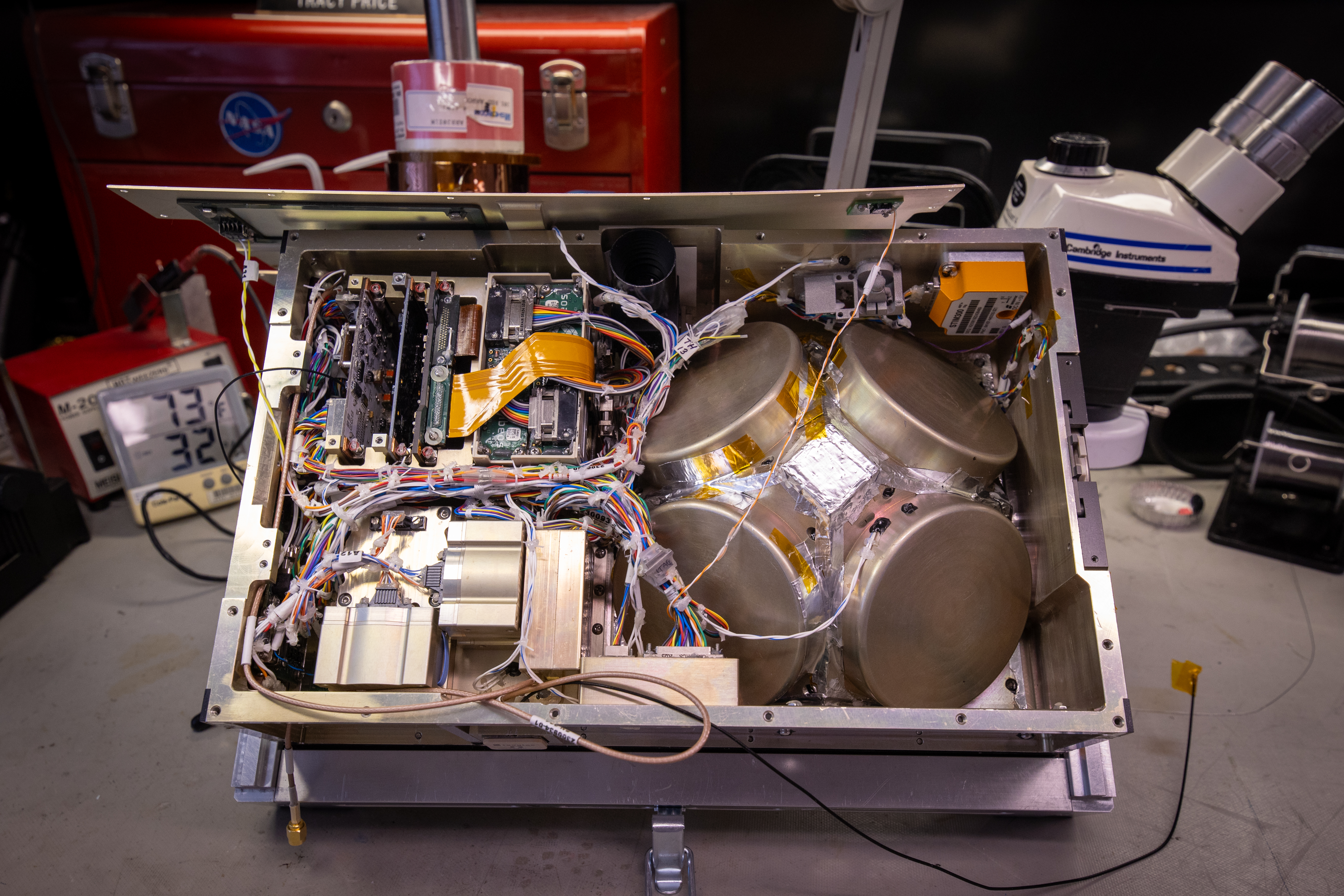
Scientists and engineers at NASA’s Goddard Space Flight Center in Greenbelt, Maryland, have completed testing for BurstCube, a shoebox-sized spacecraft designed to study the universe’s most powerful explosions. Members of the team have also delivered the satellite to their partner Nanoracks (part of Voyager Space) in Houston, Texas, where it will be packed for launch.

The BurstCube satellite sits on a table with its solar panels extended.
The BurstCube satellite sits in its flight configuration in this photo. The shoebox-size spacecraft will launch aboard a resupply mission to the International Space Station, where it will be released into orbit and the solar panels on either side will deploy.
Credit: NASA/Sophia Roberts

“Even a satellite as tiny as BurstCube requires extensive verification before it can go to space,” said Goddard’s Lucia Tian, the mission’s science instrument lead. “We characterized its magnetic field, tested it at extreme temperatures, and recreated the shaking it will experience at launch – just to name a few assessments.”

BurstCube will search the sky for short gamma-ray bursts, brief flashes of the highest-energy form of light. Dense stellar remnants called neutron stars create these bursts when they collide with other neutron stars or black holes.

Small missions like BurstCube provide valuable opportunities for early career scientists and engineers to see all aspects of a project from start to finish.

Jeremy Perkins

Jeremy Perkins

BurstCube principal investigator

Astronomers are interested in learning more about these collisions because they’re an important source of the universe’s heavy elements, like gold and platinum. BurstCube’s goal is to detect and locate bursts and alert other observatories to coordinate detailed follow-up studies. BurstCube will join a growing network of satellites and telescopes working together to witness changes in the universe as they unfold.

The spacecraft is slated for takeoff in March 2024 from NASA’s Kennedy Space Center in Florida aboard a resupply mission to the International Space Station.

To ensure it can withstand the rattling it will experience at launch, the mission team transported BurstCube to Washington Laboratories in Frederick, Maryland, for vibration testing. Engineers strapped the satellite to a plate, which then vibrated at frequencies ranging from 20 to 20,000 hertz. Translated into sound, that spans bass to the upper limit of human hearing.

BurstCube will use Earth’s magnetic field to orientate itself as it scans the sky. To do so, the mission team had to map the spacecraft’s own magnetic field using a special facility at NASA’s Wallops Flight Facility in Virginia.

“The magnetic calibration chamber generates a known magnetic field that cancels out Earth’s,” said Goddard engineer Kate Gasaway. “Our measurements of BurstCube’s field in the chamber will help us figure out where the satellite is pointing once in space, so we can locate gamma-ray bursts and tell other observatories where to look.”

As BurstCube orbits, it will experience major temperature swings every 90 minutes as it passes in and out of daylight. The team evaluated how the spacecraft will operate in these new conditions using a thermal vacuum chamber at Goddard, where temperatures ranged from minus 4 to 113 degrees Fahrenheit (minus 20 to 45 Celsius).

In addition to these tests, the team ran many other assessments, like software and communications checks and ensuring the solar panels will open uninhibited after deployment from the space station.

“Small missions like BurstCube provide valuable opportunities for early career scientists and engineers to see all aspects of a project from start to finish,” said Jeremy Perkins, BurstCube’s principal investigator at Goddard. “Now that we’ve completed testing, the team and BurstCube are gearing up for the next steps toward launch.”

By Jeanette Kazmierczak
NASA’s Goddard Space Flight Center, Greenbelt, Md.

Media Contact:
Claire Andreoli
claire.andreoli@nasa.gov
NASA’s Goddard Space Flight Center, Greenbelt, Md.

Powered by WPeMatico

Get The Details…

NASA’s Webb Rings in Holidays With Ringed Planet Uranus

NASA’s Webb Rings in Holidays With Ringed Planet Uranus

4 Min Read

NASA’s Webb Rings in Holidays With Ringed Planet Uranus

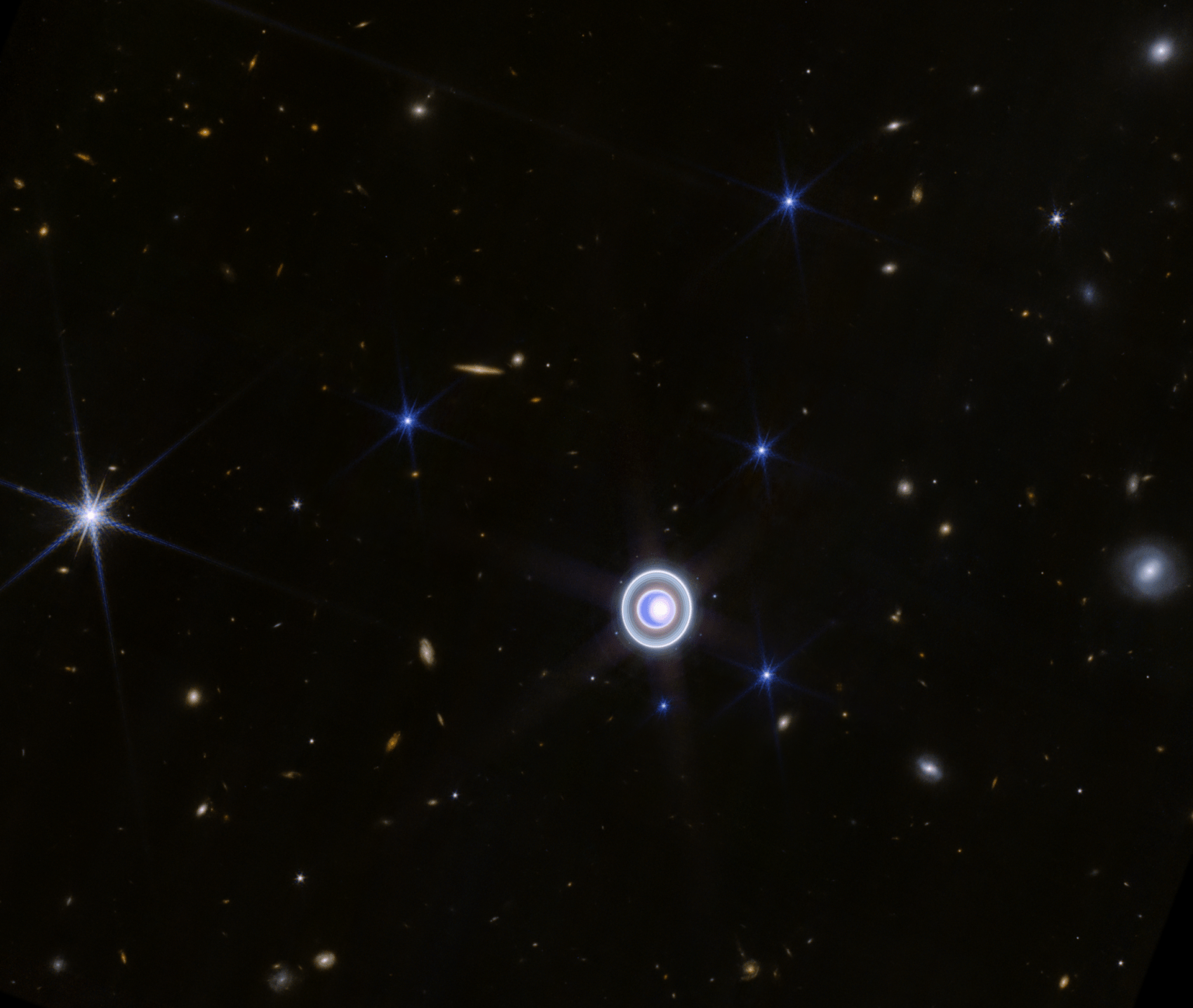
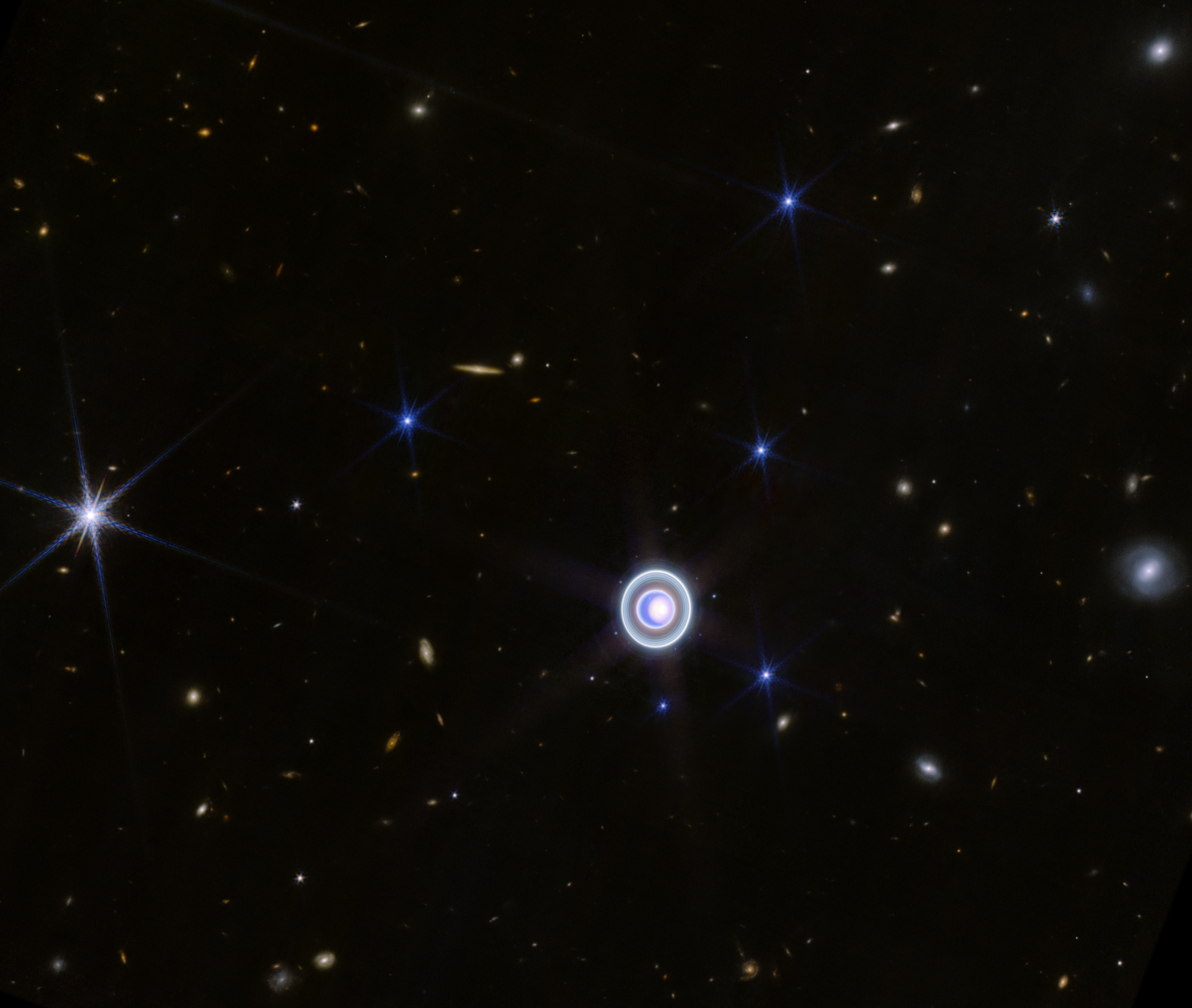
alt="An image with a black background. The planet Uranus is a glowing orb near the center surrounded by rings. The planet appears blue with a large, white patch taking up the right half. The patch is whitest at the center, then fades into blue at it expands from right to left. A thin outline of Uranus is also white. Around the planet is a system of nested rings. There are faint orange and off-white smudges, some oval, some circular, that are background galaxies scattered throughout the image. Several bright blue point sources closer to Uranus are the planet’s moons. There is also a bright star at the left of the field, with 8 diffraction spikes."

A slice of the most recent Wide-field image of Uranus from NIRCam (Near-Infrared Camera) on NASA’s James Webb Space Telescope

Credits:
NASA, ESA, CSA, STScI

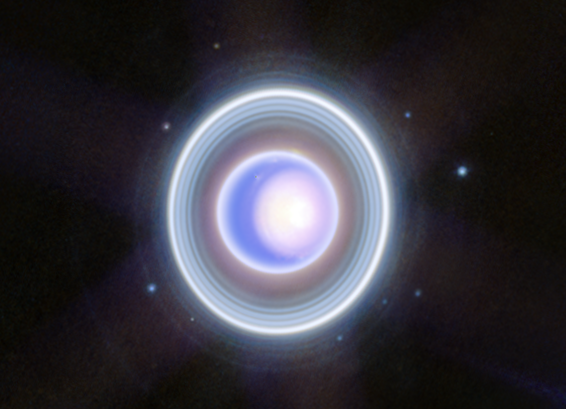
NASA’s James Webb Space Telescope recently trained its sights on unusual and enigmatic Uranus, an ice giant that spins on its side. Webb captured this dynamic world with rings, moons, storms, and other atmospheric features – including a seasonal polar cap. The image expands upon a two-color version released earlier this year, adding additional wavelength coverage for a more detailed look.

With its exquisite sensitivity, Webb captured Uranus’ dim inner and outer rings, including the elusive Zeta ring – the extremely faint and diffuse ring closest to the planet. It also imaged many of the planet’s 27 known moons, even seeing some small moons within the rings.

Image: Uranus and its rings

The planet Uranus on a black background. The planet appears blue with a large, white patch taking up the right half. The patch is whitest at the center, then fades into blue at it expands from right to left. A thin outline of Uranus is also white. Around the planet is a system of nested rings. The outermost ring is the brightest while the innermost ring is the faintest. Unlike Saturn’s horizontal rings, the rings of Uranus are vertical and so they appear to surround the planet in an oval shape. There are 9 blueish white dots scattered around the rings.
This image of Uranus from NIRCam (Near-Infrared Camera) on NASA’s James Webb Space Telescope exquisitely captures Uranus’s seasonal north polar cap and dim inner and outer rings. This Webb image also shows 9 of the planet’s 27 moons – clockwise starting at 2 o’clock, they are: Rosalind, Puck, Belinda, Desdemona, Cressida, Bianca, Portia, Juliet, and Perdita.
NASA, ESA, CSA, STScI

In visible wavelengths as seen by Voyager 2 in the 1980s, Uranus appeared as a placid, solid blue ball. In infrared wavelengths, Webb is revealing a strange and dynamic ice world filled with exciting atmospheric features.

One of the most striking of these is the planet’s seasonal north polar cloud cap. Compared to the Webb image from earlier this year, some details of the cap are easier to see in these newer images. These include the bright, white, inner cap and the dark lane in the bottom of the polar cap, toward the lower latitudes.

Several bright storms can also be seen near and below the southern border of the polar cap. The number of these storms, and how frequently and where they appear in Uranus’s atmosphere, might be due to a combination of seasonal and meteorological effects.

The polar cap appears to become more prominent when the planet’s pole begins to point toward the Sun, as it approaches solstice and receives more sunlight. Uranus reaches its next solstice in 2028, and astronomers are eager to watch any possible changes in the structure of these features. Webb will help disentangle the seasonal and meteorological effects that influence Uranus’s storms, which is critical to help astronomers understand the planet’s complex atmosphere.

Image: Uranus Wide-Field

alt="An image with a black background. The planet Uranus is a glowing orb near the center surrounded by rings. The planet appears blue with a large, white patch taking up the right half. The patch is whitest at the center, then fades into blue at it expands from right to left. A thin outline of Uranus is also white. Around the planet is a system of nested rings. There are faint orange and off-white smudges, some oval, some circular, that are background galaxies scattered throughout the image. Several bright blue point sources closer to Uranus are the planet’s moons. There is also a bright star at the left of the field, with 8 diffraction spikes."
This wide-field image of Uranus from NIRCam (Near-Infrared Camera) on NASA’s James Webb Space Telescope shows the planet amid a smattering of distant background galaxies. This image also includes 14 of the planet’s 27 moons: Oberon, Titania, Umbriel, Juliet, Perdita, Rosalind, Puck, Belinda, Desdemona, Cressida, Ariel, Miranda, Bianca, and Portia.
NASA, ESA, CSA, STScI

Because Uranus spins on its side at a tilt of about 98 degrees, it has the most extreme seasons in the solar system. For nearly a quarter of each Uranian year, the Sun shines over one pole, plunging the other half of the planet into a dark, 21-year-long winter.

With Webb’s unparalleled infrared resolution and sensitivity, astronomers now see Uranus and its unique features with groundbreaking new clarity. These details, especially of the close-in Zeta ring, will be invaluable to planning any future missions to Uranus.

Uranus can also serve as a proxy for studying the nearly 2,000 similarly sized exoplanets that have been discovered in the last few decades. This “exoplanet in our backyard” can help astronomers understand how planets of this size work, what their meteorology is like, and how they formed. This can in turn help us understand our own solar system as a whole by placing it in a larger context.

Image: Uranus’ Moons Labelled

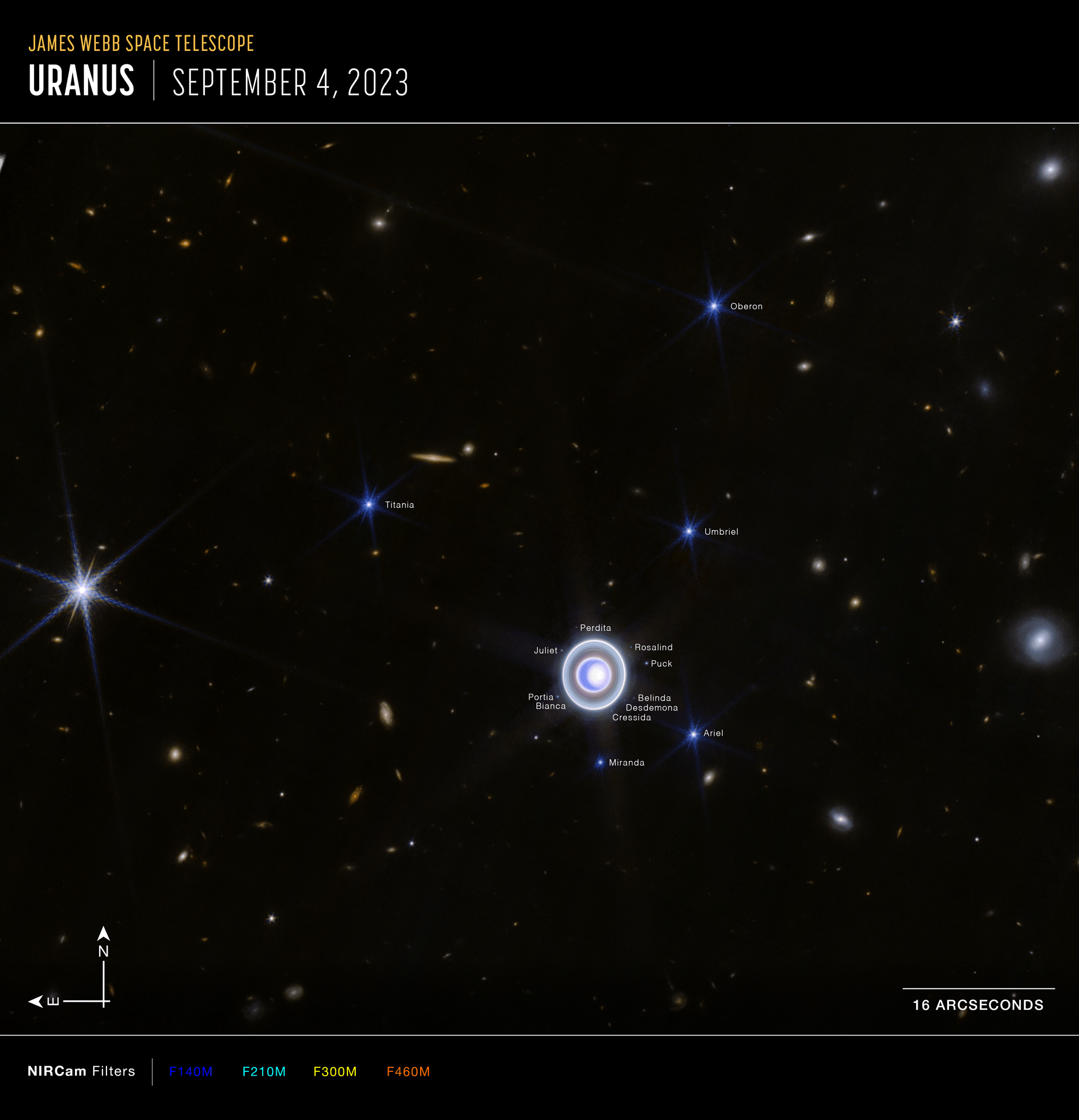
An image titled James Webb Space Telescope, Uranus, September 4, 2023. An image with a black background, a glowing orb near the center surrounded by rings. There are smudges that are background galaxies scattered throughout the image and several bright blue point sources that are the planet’s moons. At the bottom left are compass arrows indicating the orientation of the image on the sky. The north arrow points in the 12 o’clock direction. The east arrow points toward 6 o’clock. Below the image is a color key showing which filters were used to create the image and which visible-light color is assigned to each infrared-light filter. From left to right, Webb NIRCam filters are F140M (blue), F210M (cyan), F300M (yellow), and F460M (orange). A scale bar at the lower right of the image is about one-seventh the total width of the image, and text below it reads 16 arcseconds.
Annotated wide-field compass image of Uranus with some of its 27 moons and a few prominent stars (with characteristic diffraction spikes) labelled.
NASA, ESA, CSA, STScI

The James Webb Space Telescope is the world’s premier space science observatory. Webb is solving mysteries in our solar system, looking beyond to distant worlds around other stars, and probing the mysterious structures and origins of our universe and our place in it. Webb is an international program led by NASA with its partners, ESA (European Space Agency) and the Canadian Space Agency.

Downloads

Download full resolution images for this article from the Space Telescope Science Institute.

Right click the images in this article to open a larger version in a new tab/window.

Media Contacts

Laura Betzlaura.e.betz@nasa.gov, Rob Gutrorob.gutro@nasa.gov
NASA’s  Goddard Space Flight Center, Greenbelt, Md.

Ann Jenkins- jenkins@stsci.edu, Christine Pulliamcpulliam@stsci.edu
Space Telescope Science Institute, Baltimore, Md.

Related Information

Uranus

Uranus in a 3d Solar System

Uranus Facts

Uranus Moons

Our Solar System

More Webb News – https://science.nasa.gov/mission/webb/latestnews/

More Webb Images – https://science.nasa.gov/mission/webb/multimedia/images/

Webb Mission Page – https://science.nasa.gov/mission/webb/

Related For Kids

Uranus

How many moons does each planet have?

Our Solar System

What is the Webb Telescope?

SpacePlace for Kids

En Español

Ciencia de la NASA

NASA en español 

Space Place para niños

Share

Details

Last Updated

Dec 18, 2023

Editor
Steve Sabia
Contact
Laura Betz

Powered by WPeMatico

Get The Details…
Steve Sabia