NASA Glenn Established in Cleveland in 1941
NASA Glenn Established in Cleveland in 1941

3 Min Read

NASA Glenn Established in Cleveland in 1941

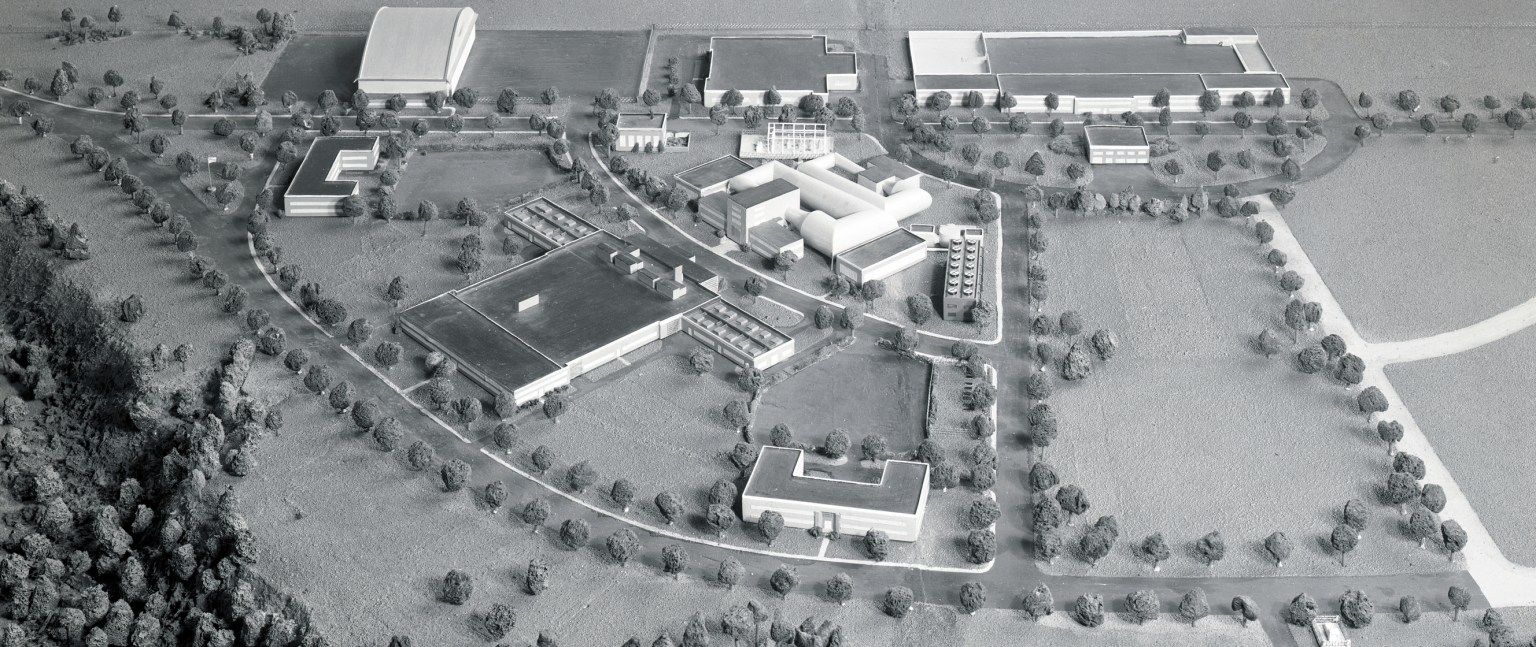
A model of the campus.

A model of the new campus shows that it contained nine primary buildings—Administration, Flight Research, Engine Research, Technical Services, Fuels and Lubrication, Engine Propeller Research, Research Equipment, and the Altitude Wind and Icing Research tunnels.

Credits:
NASA

On January 23, 1941, local authorities, military representatives, and agency officials assembled in Cleveland to initiate construction of the National Advisory Committee for Aeronautics (NACA) new research laboratory. NACA Director of Research George Lewis stated, “I feel confident today in saying that this new aircraft engine research laboratory will be the mecca for all the world’s aircraft engine engineers and research workers.”

Today, the laboratory, now known as NASA’s John H. Glenn Research Center, is one of 10 centers and a leading economic contributor to the Cleveland area.

Exactly one year before the groundbreaking, the NACA formally proposed the creation of a new research lab dedicated to aero propulsion.  During the interim, the committee evaluated locations for the facility across the Midwest before selecting Cleveland, Ohio in November 1940.

The Cleveland Chamber of Commerce scheduled a full day of activities for that cold January Thursday in 1941. In the morning, the cadre of officials toured the Alcoa and the Cleveland Pneumatic Tool Company plants. The former was a key supplier of aluminum aircraft parts and the latter produced landing gears for the Douglas XB–19—then, the nation’s largest bomber.

Afterwards the group joined 240 local businessmen in the Hotel Cleveland’s Red Room for a luncheon hosted by Cleveland’s newly elected mayor Edward Blythin and Chamber of Commerce President Frederick Crawford. The George Worthington Hardware Company presented the NACA with a chrome-plated pick and shovel to be used for the groundbreaking.

NACA officials described the site selection activities, while Crawford reminded area businesses to maintain their pledges of support to the NACA.  Lewis told the attendees, “The future of aviation as regards to speed, efficiency, and safety, will, in a very large measure, depend on the results which come from this laboratory.”

With the war in Europe on the front pages, Edward Warner of Civil Aviation Authority added ominously, “What we are doing here today may mean the difference between America’s survival and subjugation. The difference between winning a war and losing it may be the difference between a 1,000- and 2,000-horsepower motor, or the difference between the ability to fly at 20,000 feet or 30,000 feet.”

In the afternoon the group traveled out to the construction site adjacent to Cleveland Municipal Airport. Shortly after 3 p.m., Lewis struck the ground with the chrome pick to loosen the soil, which Major General George Brett, acting chief of the Army Air Corps, then scooped up. The moment was immortalized by a local newspaper photographer.

That evening, Crawford held a dinner for the dignitaries at the Union Club. Construction of the NACA laboratory began in the ensuing days. Research commenced in May 1942.

Group of men in field with shovels.
NACA and city officials broke ground at the future site of the NASA Glenn Research Center. From left to right: William Hopkins (former city manager), John Berry (airport manager), Ray Sharp (AERL), Frederick Crawford (Chamber of Commerce), George Brett (Air Corps), [behind] S. Paul Johnston (NACA), Edward Warner (Civil Aeronautics Board), Sydney Kraus (Bureau of Aeronautics), Edward Blythin (Cleveland mayor) and George Lewis (director of NACA research).
NASA

Robert S. Arrighi
NASA’s Glenn Research Cent
er

Powered by WPeMatico

Get The Details…
Robert S. Arrighi
NASA’s IXPE Awarded Prestigious Prize in High-energy Astronomy

NASA’s IXPE Awarded Prestigious Prize in High-energy Astronomy

3 min read

Preparations for Next Moonwalk Simulations Underway (and Underwater)

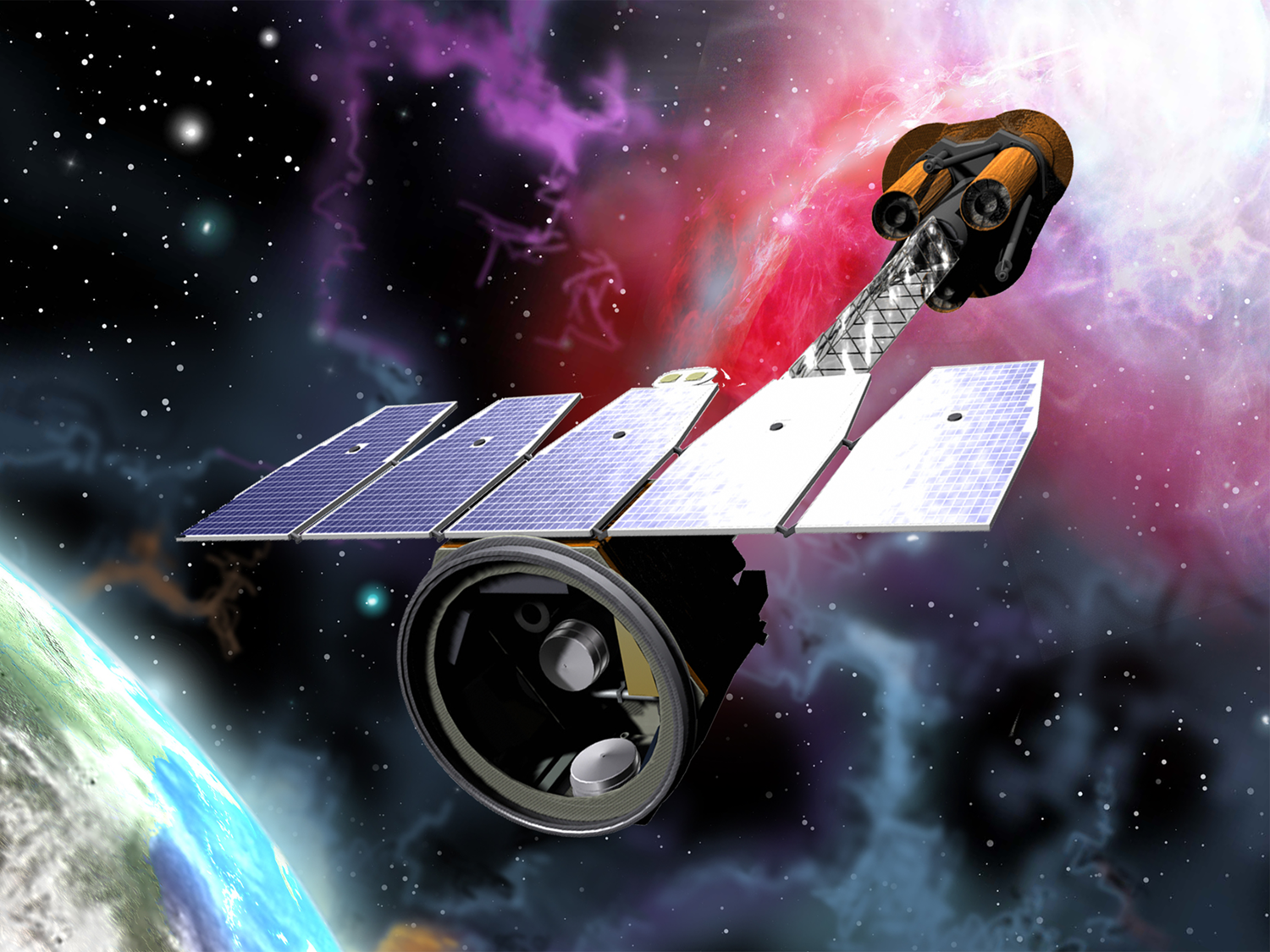
Artist’s concept of the Imaging X-ray Polarimetry Explorer spacecraft.
An artist’s illustration of the IXPE spacecraft in orbit, studying high-energy phenomena light-years from Earth
NASA

NASA’s IXPE (Imaging X-ray Polarimetry Explorer) team has been awarded a top prize in high-energy astronomy.

The High Energy Astrophysics Division of the American Astronomical Society (AAS) has awarded the 2024 Bruno Rossi Prize to retired NASA astrophysicist Martin Weisskopf, Italian Space Agency principal investigator Paolo Soffitta, and their team for development of IXPE, “whose novel measurements advance our understanding of particle acceleration and emission from astrophysical shocks, black holes and neutron stars,” according to the AAS announcement.

“IXPE is a realization of decades of work and belief in the importance of X-ray polarization measurements for X-ray astronomy,” said Weisskopf of NASA’s Marshall Space Flight Center in Huntsville, Alabama, who served as the principal investigator of IXPE during its development, prior to retiring from the agency in 2022. “I am honored and excited to share this prize with Paolo Soffitta and the entire IXPE team.”

A double photo of two male IXPE scientists. The man on the left is an older man with grey hair, glasses and a blue shirt. The man on the right has short brown hair and a blue button up shirt.
NASA’s Imaging X-ray Polarimetry Explorer mission, led by retired NASA astrophysicist Martin Weisskopf, left, and Italian Space Agency principal investigator Paolo Soffitta, has received the 2024 Rossi Prize in high-energy astronomy, awarded annually by the American Astronomical Society.

“IXPE is the demonstration of how an idea pursued for more than 30 years has been transformed into a successful mission, thanks to the collaboration between the United States and Italy,” Soffitta said. “It’s incredible to receive this prize along with Martin Weisskopf and on behalf of so many people whose expertise and enthusiasm have made this breakthrough in astrophysics possible.”

Launched on Dec. 9, 2021, and developed by NASA, the Italian Space Agency, and partners in a dozen countries around the globe, IXPE orbits Earth some 340 miles up to observe X-ray emissions from powerful cosmic phenomena hundreds or thousands of light-years from Earth. In 2023 alone, its subjects of study included blazars such as Markarian 501 and Markarian 421, supernova remnants including Tycho and SN 1006, and the supermassive black hole at the center of our own galaxy.

IXPE also supports study of unanticipated cosmic events – such as the brightest pulse of high-energy radiation ever recorded, which swept through Earth’s solar system in late 2022. IXPE’s success led NASA to formally extend the mission for an additional 20 months, through at least September 2025.

“We at NASA are incredibly proud of Dr. Weisskopf and the IXPE team around the world,” said Acting Marshall Center Director Joseph Pelfrey. “IXPE allows us to look at the universe through a vantage point never seen before. It’s particularly gratifying to continue Marshall’s long association with the Rossi Prize, which identifies singular breakthroughs and unprecedented innovation in high-energy astrophysics – a field in which our researchers excel.”

Weisskopf, together with Harvard astrophysicist Harvey Tananbaum, previously received the Rossi Prize in 2004 for their work to develop and fly NASA’s Chandra X-ray Observatory, which continues to study high-energy X-ray phenomena across the cosmos. NASA Marshall researchers Gerald Fishman and Colleen Wilson-Hodge also were awarded the Rossi Prize in 1994 and 2018, respectively. Fishman was honored for his contributions to the Compton Gamma-ray Observatory’s BATSE (Burst and Transient Source Experiment) mission. Wilson-Hodge received the honor for her work with the Fermi GBM (Gamma-ray Burst Monitor) in August 2017, detecting gravitational and light waves from the spectacular smashup of two neutron stars in a distant galaxy.

The Rossi Prize is awarded annually for a significant recent contribution to high-energy astrophysics. The honor includes an engraved certificate and a $1,500 award.

Learn more about NASA’s high-energy astrophysics research:

https://science.nasa.gov/astrophysics

Elizabeth Landau
NASA Headquarters
elizabeth.r.landau@nasa.gov
202-358-0845

Jonathan Deal
Marshall Space Flight Center, Huntsville, Ala.
256-544-0034
jonathan.e.deal@nasa.gov

Share

Details

Last Updated

Jan 23, 2024

Editor
Beth Ridgeway

Powered by WPeMatico

Get The Details…
Beth Ridgeway

Hubble Glimpses a Bright Galaxy Group

Hubble Glimpses a Bright Galaxy Group

2 min read

Hubble Glimpses a Bright Galaxy Group

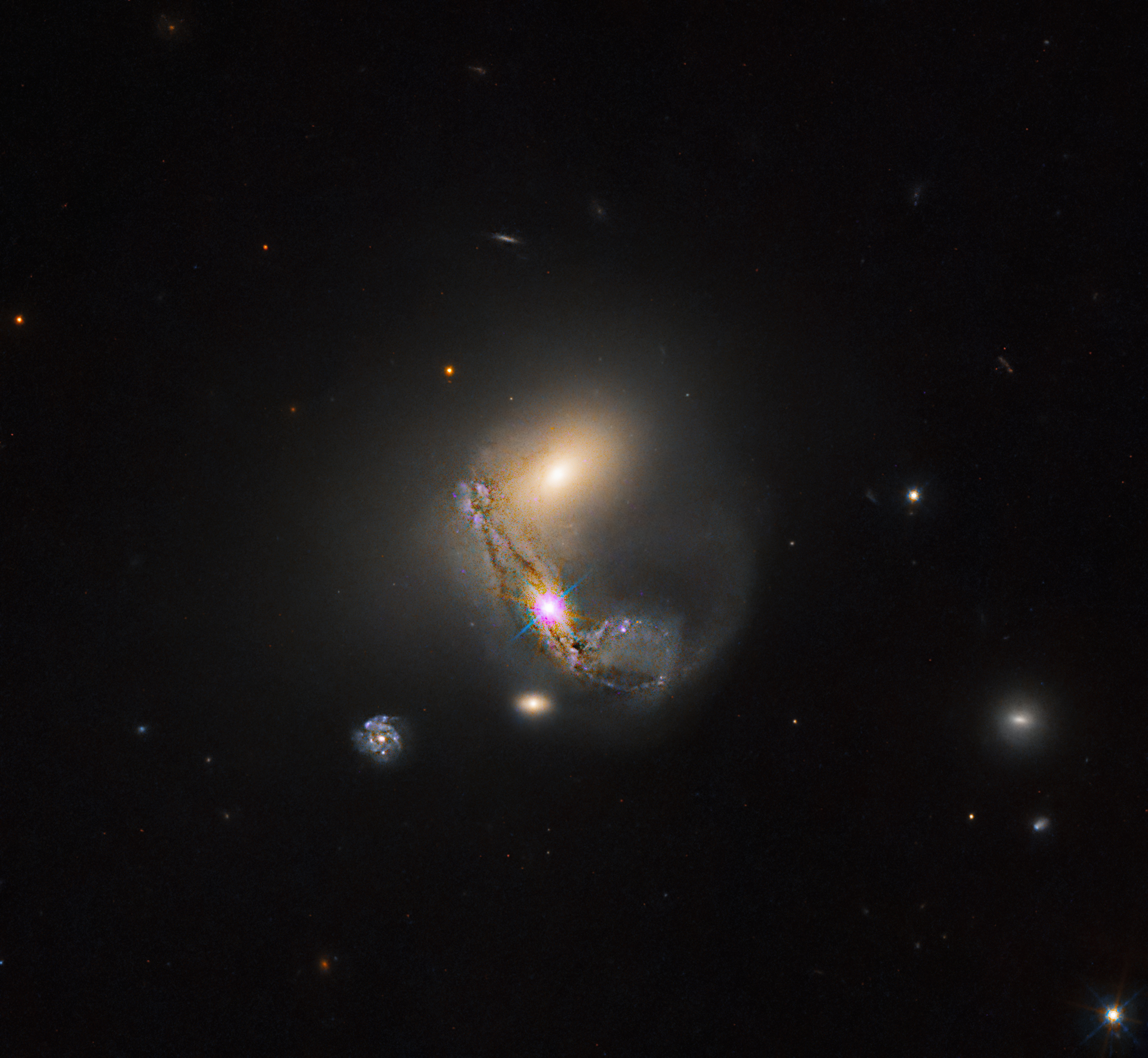
This new NASA Hubble Space Telescope image shows a tangled group of interacting galaxies called LEDA 60847.
NASA/ESA/A. Barth (University of California – Irvine)/M. Koss (Eureka Scientific Inc.)/A. Robinson (Rochester Institute of Technology)/Processing: Gladys Kober (NASA/Catholic University of America)

This new NASA Hubble Space Telescope image shows a group of interacting galaxies known as LEDA 60847.

LEDA 60847 is classified as an active galactic nuclei, or AGN. An AGN has a supermassive black hole in the galaxy’s central region that is accreting material. The AGN emits radiation across the entire electromagnetic spectrum and shines extremely brightly. By studying powerful AGNs that are relatively nearby, astronomers can better understand how supermassive black holes grow and affect galaxies.

Galaxy mergers are relatively common occurrences. Most larger galaxies are the result of smaller galaxies merging. The Milky Way itself contains traces of other galaxies, indicating it is the product of past mergers. Astronomers believe somewhere between 5% and 25% of all galaxies are currently merging. 

This image of LEDA 60847 combines ultraviolet, visible, and near-infrared data from Hubble. The ability to see across all those wavelengths is one of the things that makes Hubble unique. Different types of light across the electromagnetic spectrum tell astronomers different things about our universe. Ultraviolet light traces the glow of stellar nurseries and is used to identify the hottest stars. Visible light shows us moderate-temperature stars and material, and also how the view would appear to our own eyes. Last but not least, near-infrared light can penetrate cold dust, allowing us to study warm gas and dust, and relatively cool stars.

LEARN MORE:

Media Contact:

Claire Andreoli
NASA’s Goddard Space Flight CenterGreenbelt, MD
claire.andreoli@nasa.gov

Share

Details

Last Updated
Jan 23, 2024
Editor
Andrea Gianopoulos
Location
Goddard Space Flight Center

Powered by WPeMatico

Get The Details…

Expedition 70 and Ax-3 Crews Working Together on Station

Expedition 70 and Ax-3 Crews Working Together on Station

The SpaceX Dragon Freedom spacecraft carrying the Ax-3 crew is pictured approaching the space station above southern India.

Eleven astronauts and cosmonauts from around the world are living and working together aboard the International Space Station today. The four Axiom Mission 3 (Ax-3) private astronauts met the seven Expedition 70 crew members on Saturday beginning two weeks of dual operations.

The Ax-3 crew spent the weekend getting familiar with space station systems and emergency procedures before starting Monday with a full schedule of science and media activities. Ax-3 Commander Michael López-Alegría joined Pilot Walter Villadei and studied how microgravity affects the biochemistry of neurodegenerative diseases such as Alzheimer’s to improve health on Earth and in space. The duo later inserted samples into a fluorescence microscope for a study seeking to prevent and predict cancer diseases to protect crews in space and humans on Earth.

Mission Specialist Alper Gezeravcı worked on a space botany experiment looking at ways to sustain spacecraft life support systems and improve crop yields on Earth. Mission Specialist Marcus Wandt explored plasma physics observing low temperature gaseous mixtures composed of ionized gas, neutral gas, and micron-sized particles. The foursome then called down to Earth at the end of the day talking to space professionals in Vienna, Austria, about their mission.

The Expedition 70 crew spent Monday on a variety of science and maintenance tasks while assisting the Ax-3 crew. The orbital residents are also preparing for an upcoming cargo mission.

NASA Flight Engineers Loral O’Hara and Jasmin Moghbeli partnered together Monday afternoon getting ready for a Cygnus cargo mission planned to launch next week. The duo reviewed Cygnus’ mission profile, rendezvous procedures, and command and control interfaces. Both astronauts will be on duty commanding the Canadarm2 robotic arm to capture Cygnus when it arrives at the orbital outpost.

Astronaut Satoshi Furukawa from JAXA (Japan Aerospace Exploration Agency) took turns with Moghbeli, astronaut Andreas Mogensen, and cosmonaut Konstantin Borisov for a vision test using the standard eye chart seen in doctors’ offices on Earth. Furukawa then organized food inside the Permanent Multipurpose Module and Unity module before servicing a variety of science and life support gear the rest of the day.

Mogensen worked in the Tranquility module cleaning the ventilation system before conducting a session for the VR Mental Care study exploring how virtual reality movies may improve crew morale. At the end of the day, the Expedition 70 Commander then assisted the Ax-3 crew members helping them get used to life in microgravity.

In the station’s Roscosmos segment, the three cosmonauts focused on their set of science and maintenance tasks. Borisov installed hardware for a pair of Earth observation experiments, one uses a student-controlled camera targeting landmarks on the ground, the other views the nighttime atmosphere in ultraviolet wavelengths. Veteran Flight Engineer Oleg Kononenko started his day updating computer software then studied piloting techniques future crew members may use on planetary missions. Flight Engineer Nikolai Chub attached sensors to his chest for a heart study, inventoried medical gear, then cleaned station cameras.


Learn more about station activities by following the space station blog@space_station and @ISS_Research on X, as well as the ISS Facebook and ISS Instagram accounts.

Get weekly video highlights at: https://roundupreads.jsc.nasa.gov/videoupdate/

Get the latest from NASA delivered every week. Subscribe here: www.nasa.gov/subscribe

Powered by WPeMatico

Get The Details…

Mark Garcia

NASA Invites Media to First Intuitive Machines, SpaceX Moon Launch

NASA Invites Media to First Intuitive Machines, SpaceX Moon Launch

The Nova-C lunar lander is seen in the high bay of Intuitive Machines Headquarters in Houston, before it shipped to NASA’s Kennedy Space Center in Florida for integration with a SpaceX Falcon 9 rocket for launch, as part of NASA’s CLPS (Commercial Lunar Payload Services) initiative and Artemis campaign.
Credits: Intuitive Machines

As part of NASA’s CLPS (Commercial Lunar Payload Services) initiative and Artemis campaign, media accreditation is open for Intuitive Machines’ first robotic flight to the Moon’s surface. The robotic deliveries will transport agency science and technology demonstrations to the Moon for the benefit of all.

The Intuitive Machines Nova-C lander carrying NASA science and commercial payloads will launch on a SpaceX Falcon 9 rocket. Liftoff is targeted for a multi-day launch window, which opens no earlier than mid-February, from Launch Complex 39A at NASA’s Kennedy Space Center in Florida.

Among the NASA items on its lander, the Intuitive Machines mission will carry instruments focusing on plume-surface interactions, space weather/lunar surface interactions, radio astronomy, precision landing technologies, and a communication and navigation node for future autonomous navigation technologies. A successful landing will help support the CLPS model for commercial payload deliveries to the lunar surface. As the anchor customer of CLPS, NASA is investing in lower-cost methods of Moon deliveries and aims to be one of many customers.

Media prelaunch and launch activities will take place at NASA Kennedy. Media who are U.S. citizens interested in attending in person must apply for credentials no later than 12 p.m. EST on Monday, Jan. 29, by emailing media@spacex.com.  

In May 2019, NASA awarded a task order for the delivery to Intuitive Machines. Through Artemis, commercial robotic deliveries will perform science experiments, test technologies, and demonstrate capabilities to help NASA explore the Moon in advance of Artemis Generation astronaut missions to the lunar surface, in preparation for future missions to Mars.

NASA is working with several U.S. companies to deliver science and technology to the lunar surface through the agency’s CLPS initiative. This pool of companies may bid on delivery task orders. A task order award includes payload integration and operations, as well as launching from Earth and landing on the surface of the Moon. NASA’s CLPS contracts are indefinite-delivery/indefinite-quantity contracts with a cumulative maximum contract value of $2.6 billion through 2028.

For more information about the agency’s Commercial Lunar Payload Services initiative, see:

https://www.nasa.gov/clps

-end-

Alise Fisher
Headquarters, Washington
202-358-2546
alise.m.fisher@nasa.gov  

Nilufar Ramji
Johnson Space Center, Houston
281-483-5111
nilufar.ramji@nasa.gov

Antonia Jaramillo
Kennedy Space Center, Florida
321-501-8425
antonia.jaramillobotero@nasa.gov

Powered by WPeMatico

Get The Details…
Roxana Bardan