40 Years Ago: President Reagan Directs NASA to Build a Space Station
On Jan. 25, 1984, President Ronald W. Reagan directed NASA to build a permanently inhabited Earth orbiting space station within a decade. The President’s announcement turned years of NASA studies into a real program. As originally envisioned, the modular space station would use the space shuttle for assembly and serve as a microgravity research laboratory and observation platform, a servicing station for satellites, and a staging ground for exploration missions. The President urged NASA to invite its international partners to participate in the program. The complexity and cost of such an outpost resulted in multiple redesigns, with the initial Space Station Freedom ultimately evolving into the International Space Station. On-orbit assembly began in 1998, with permanent human habitation beginning two years later.
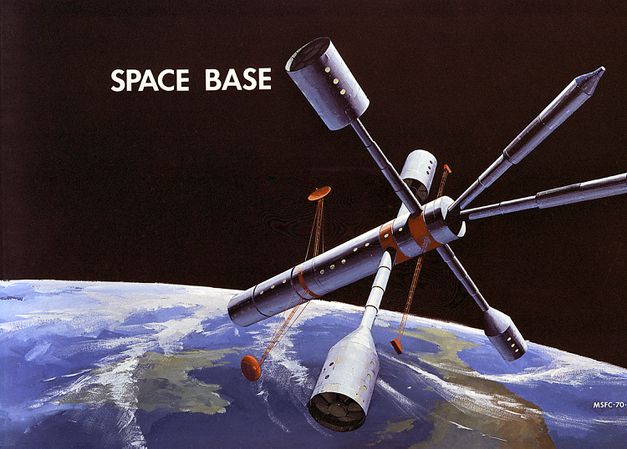
Left: Wernher von Braun demonstrates a model of his wheel-shaped space station in 1956. Middle: Illustration of one concept of a space base as proposed by the Space Task Group in 1969. Right: The Skylab space station, photographed by the third and final crew after its departure in 1974.
As early as the 1950s, American space pioneer Wernher von Braun already had ideas for large orbiting space stations. He envisioned a wheel-shaped facility, slowly rotating to provide artificial gravity to its several thousand occupants. While such an orbital outpost exceeded available technologies for the foreseeable future, shortly after its founding in 1958, NASA began considering more modest space stations. With President John F. Kennedy’s 1961 pronouncement of a Moon landing as a national goal, plans for space stations took a back seat until after NASA achieved that objective. The Space Task Group (STG) that President Richard M. Nixon commissioned in 1969 to assess post-Apollo space objectives proposed an Earth-orbiting space station for the mid-1970s followed later by a much larger space base among several other ambitious projects. Economic realities of the time precluded such lofty goals; President Nixon approved the space shuttle in 1972, the only STG-recommended project to receive funding. Approval of an American space station awaited a later president. In the meantime, the highly successful experimental Skylab space station, based on Apollo hardware, housed three successive crews of three astronauts each, for 28, 59, and 84 days, in 1973 and 1974.
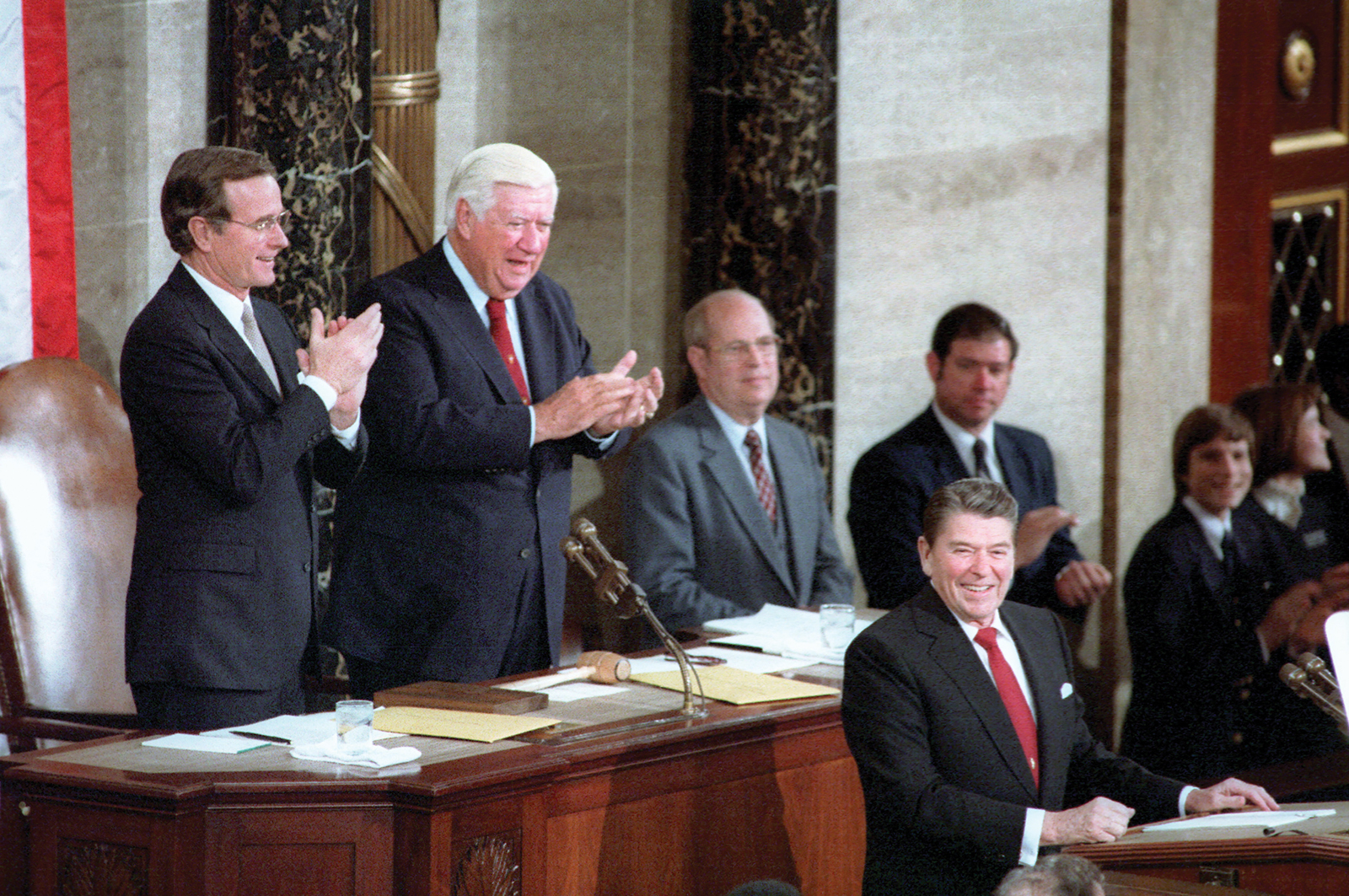
Left: President Ronald W. Reagan during his 1984 State of the Union address to Congress. Right: Space Station Power Tower reference configuration (1984).
During his Jan. 25, 1984, State of the Union address to a joint session of Congress, President Reagan directed NASA to develop a “permanently manned space station and to do it within a decade.” His comments reflected his view of American pre-eminence in space, but also explicitly stated that the United States would invite other nations to join in the project. President Reagan spelled out the benefits to be derived from such an orbiting platform:
Our progress in space—taking giant steps for all mankind—is a tribute to American teamwork and excellence. Our finest minds in government, industry, and academia have all pulled together. And we can be proud to say: We are first; we are the best; and we are so because we’re free. America has always been greatest when we dared to be great. We can reach for greatness again. We can follow our dreams to distant stars, living and working in space for peaceful, economic, and scientific gain. … A space station will permit quantum leaps in our research in science, communications, in metals, and in lifesaving medicines which could be manufactured only in space. We want our friends to help us meet these challenges and share in their benefits. NASA will invite other countries to participate so we can strengthen peace, build prosperity, and expand freedom for all who share our goals.
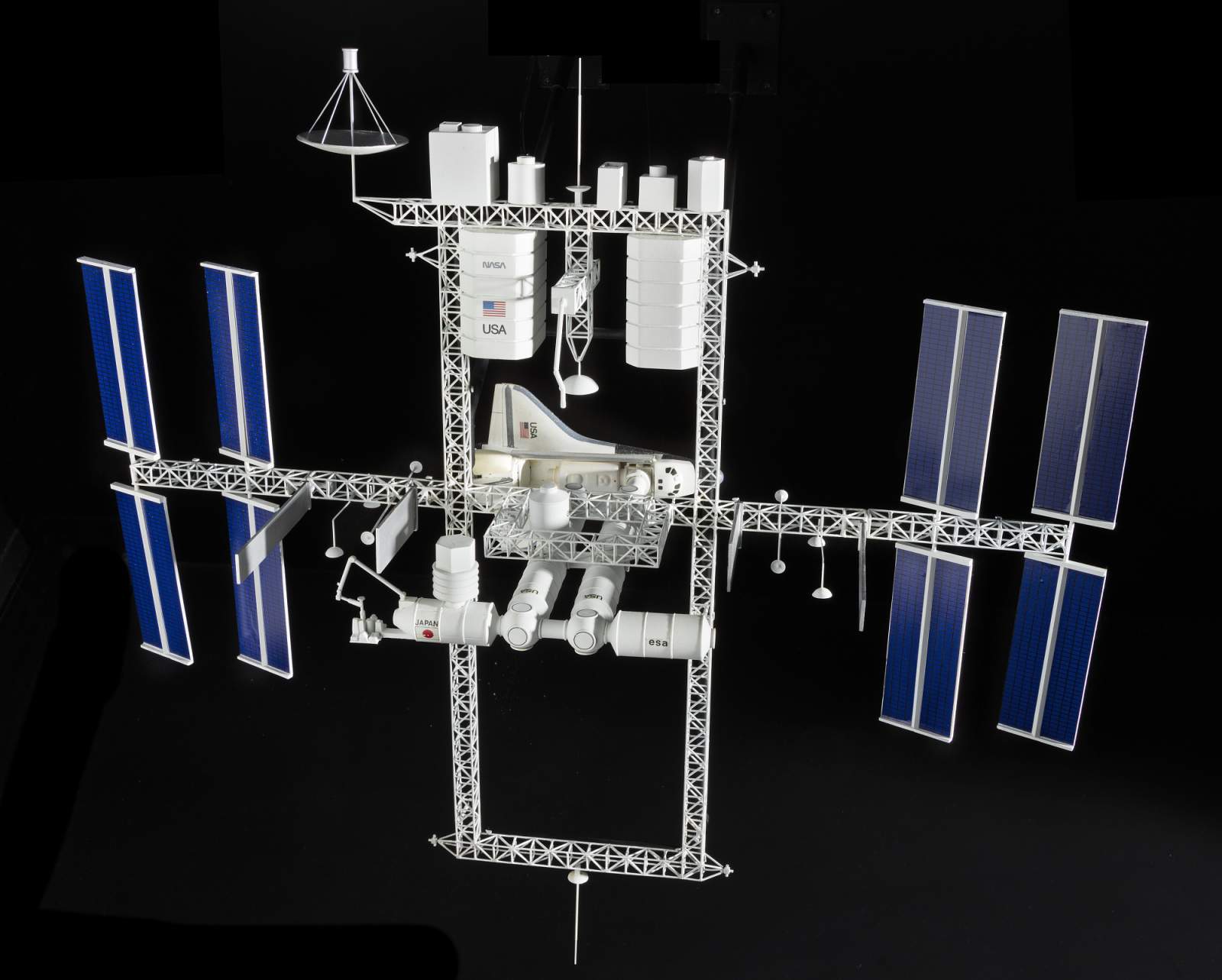
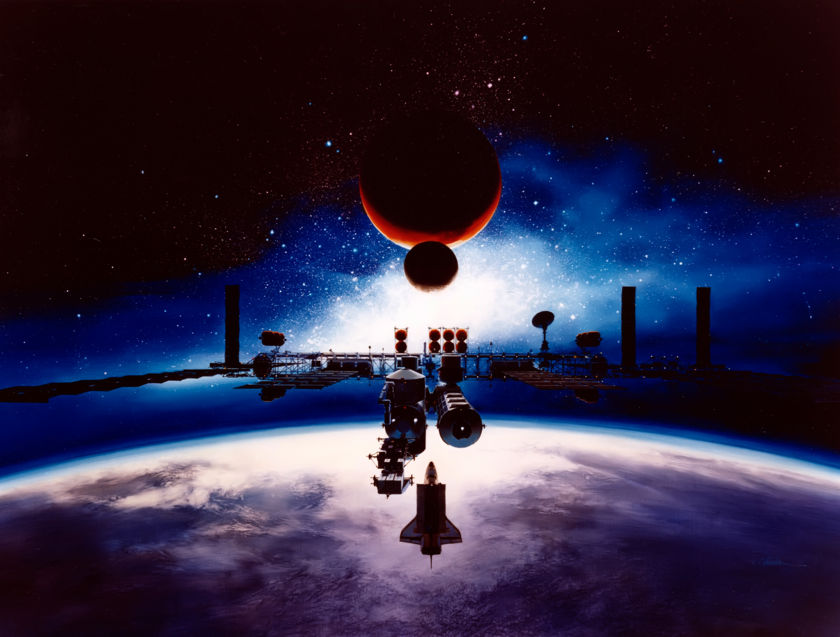
In response to President Reagan’s direction, NASA Administrator James M. Beggs said, “The space program is alive and well, and we have a new initiative. … The space station will give us a permanent presence in low Earth orbit … and will be the cornerstone of our activities in space through the end of the century and beyond.” He added that the President’s initiatives, “are the right ones for the right time in our history.” In the optimism that followed President Reagan’s announcement, NASA laid out an ambitious plan for a space station composed of three separate orbital platforms to conduct microgravity research as well as Earth and celestial observations, to serve as a transportation and servicing node for space vehicles and satellites, and to stage missions for deep-space exploration. NASA signed agreements with the European Space Agency (ESA) and Japan’s National Space Development Agency (NASDA), now the Japan Aerospace Exploration Agency (JAXA), to provide their own research modules. Canada agreed to provide a robotic servicing system. In April 1985, NASA established a Space Station Program Office at the Johnson Space Center in Houston. Assessments of the original “Dual Keel” design determined that it was overly complex to build and cost estimates for the ambitious space station continued to rise. Over the next several years, engineers and managers redesigned the facility and simplified it to a single-truss configuration with the pressurized modules clustered near the core and the solar arrays for power generation at the ends of the truss. In July 1988, President Reagan announced that the orbital facility would be called Space Station Freedom, and two months later the Unites States, Japan, Canada and nine ESA member states signed an Inter-Governmental Agreement (IGA) for its construction and utilization. The redesigned facility would focus on microgravity research.
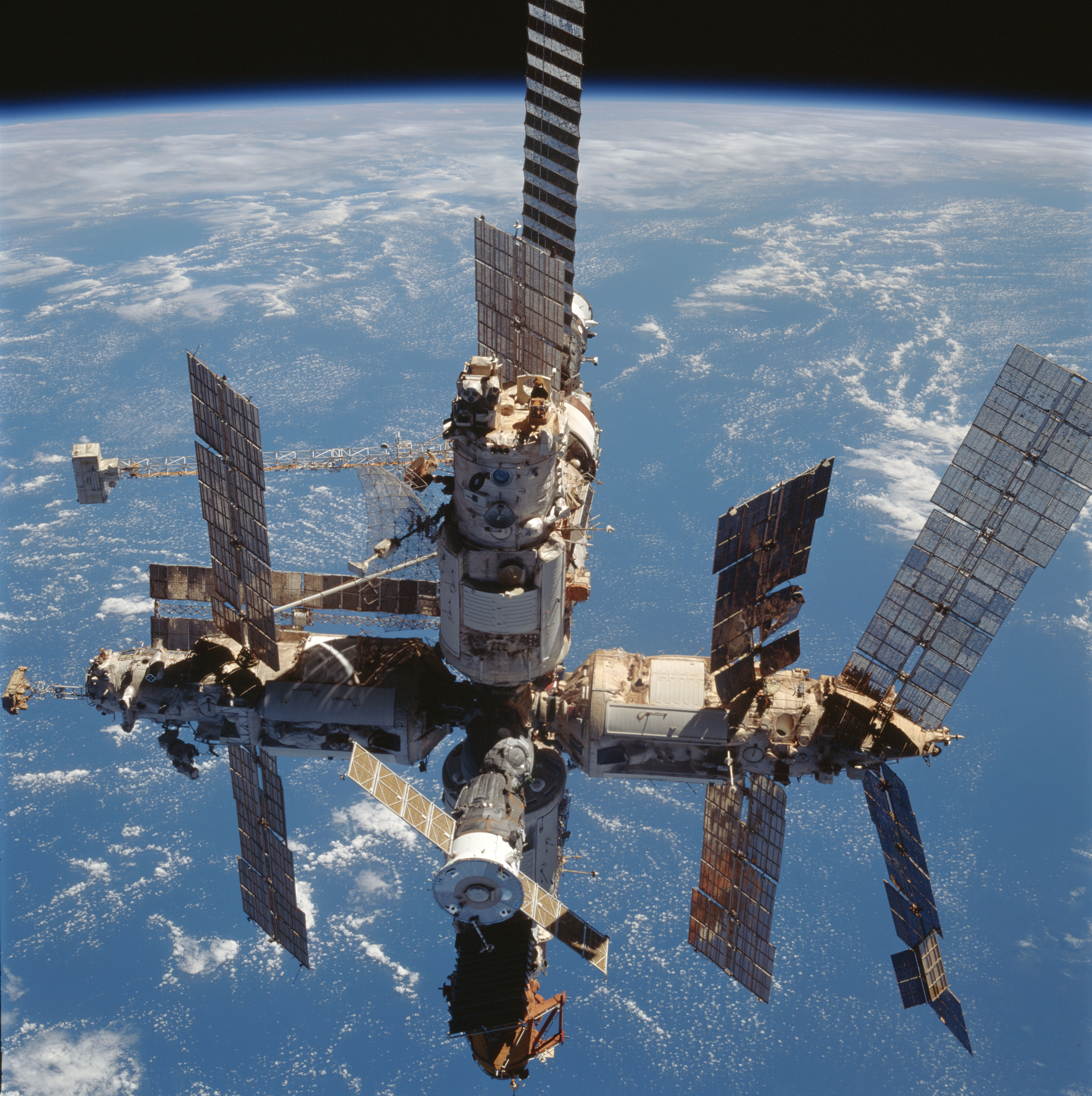
Left: Model of the Space Station showing the proposed dual keel configuration (1985). Middle: Illustration of Space Station Freedom by Alan Chinchar (1991). Right: Russian space station Mir photographed from Space Shuttle Discovery during the STS-91 mission (1998).
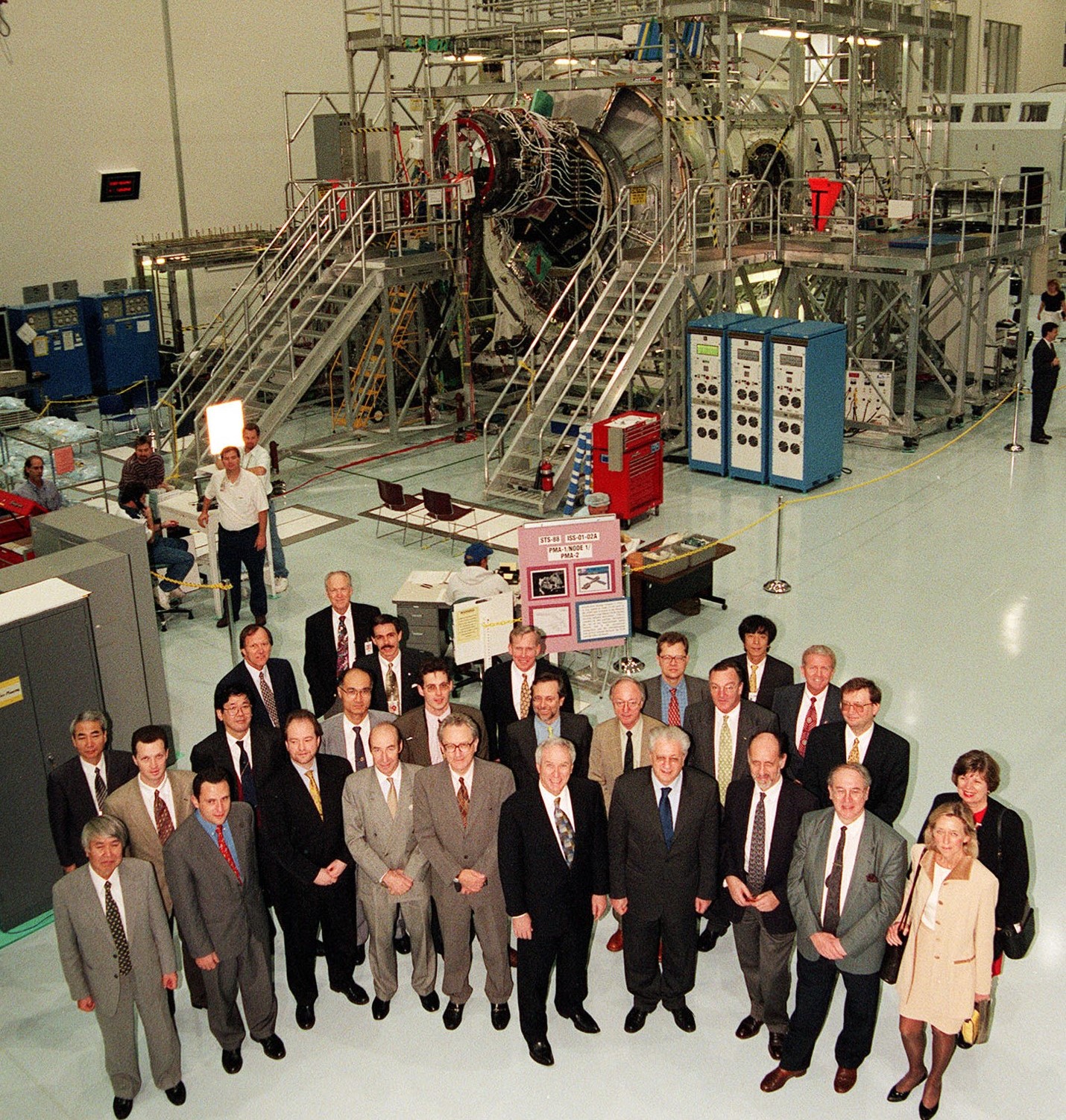
Space Station Freedom underwent several more redesigns to keep it cost-effective. In the meantime, the Soviet Union operated its Mir space station beginning with the launch of its first module in 1986. Over the years, the Soviets added several elements to increase the facility’s research and habitation capabilities. With the collapse of the Soviet Union in 1991, the future of Mir and its planned Mir-2 successor faced uncertainty in the new cash-strapped Russia. To take advantage of its extensive experience with operating space stations and keeping crews on orbit for up to a year, in 1993 President William J. “Bill” Clinton invited Russia to join the space station program as a full partner, essentially adding modules planned for Mir-2 to U.S., European, Japanese, and Canadian elements from Space Station Freedom. The new outpost would be called the International Space Station. In preparation for space station operations, between 1995 and 1998, seven American astronauts joined Russian cosmonauts as long-duration residents aboard Mir, with space shuttles providing transportation and resupply logistics. On Jan. 29, 1998, representatives from the United States, Russia, Japan, Canada and 11 participating ESA countries met at the U.S. State Department in Washington, D.C., and signed an updated IGA on Space Station Cooperation. The new IGA established the overall cooperative framework for the design, development, operation, and utilization of the space station and addressed several legal topics, including civil and criminal jurisdiction, intellectual property, and the operational responsibilities of the partners.
Left: Signatories of the 1998 Intergovernmental Agreement visit the Space Station Processing Facility at NASA’s Kennedy Space Center in Florida, and pose in front of the Unity Node 1 module being prepared for launch. Middle: Zarya, left, and Unity, the first two modules of the nascent space station. Right: The Expedition 1 crew of Yuri P. Gidzenko of the Russian Space Agency (RSA), now Roscosmos, William M. Shepherd of NASA, and Sergei K. Krikalev of RSA.
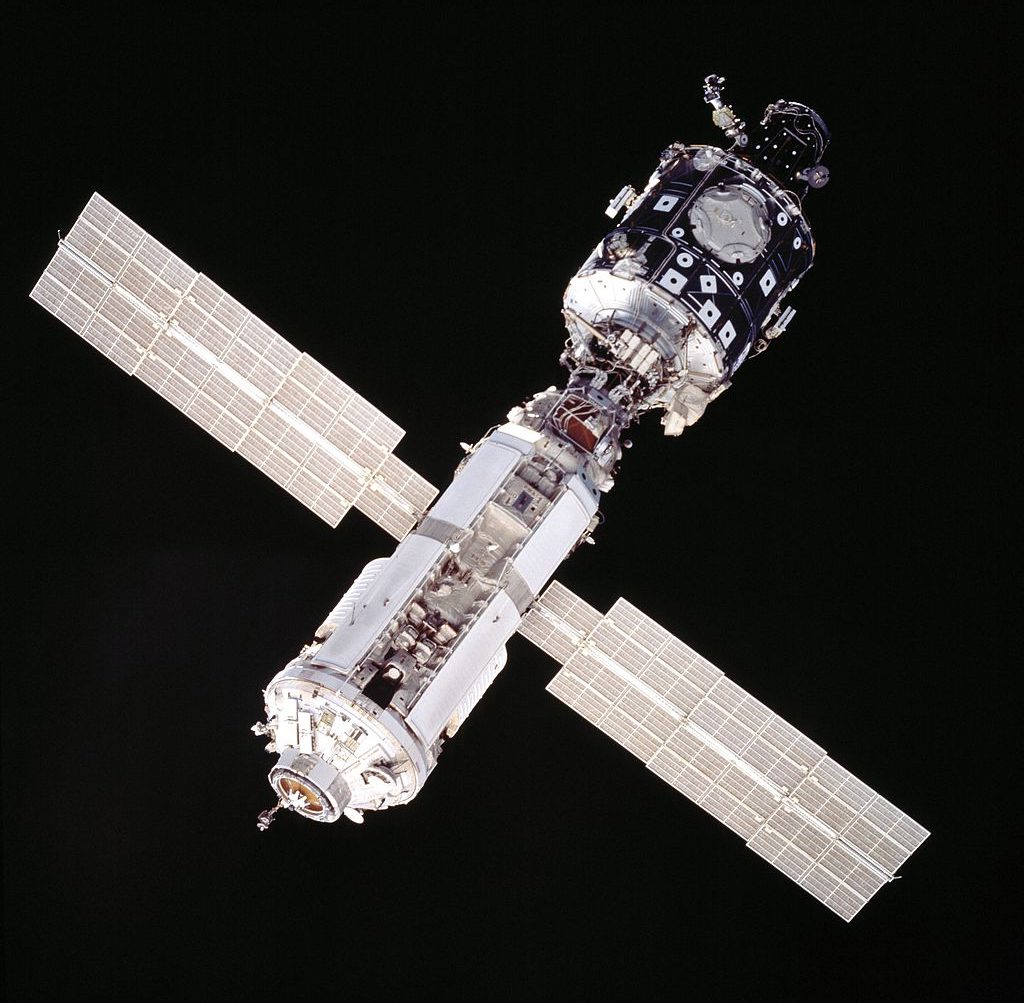
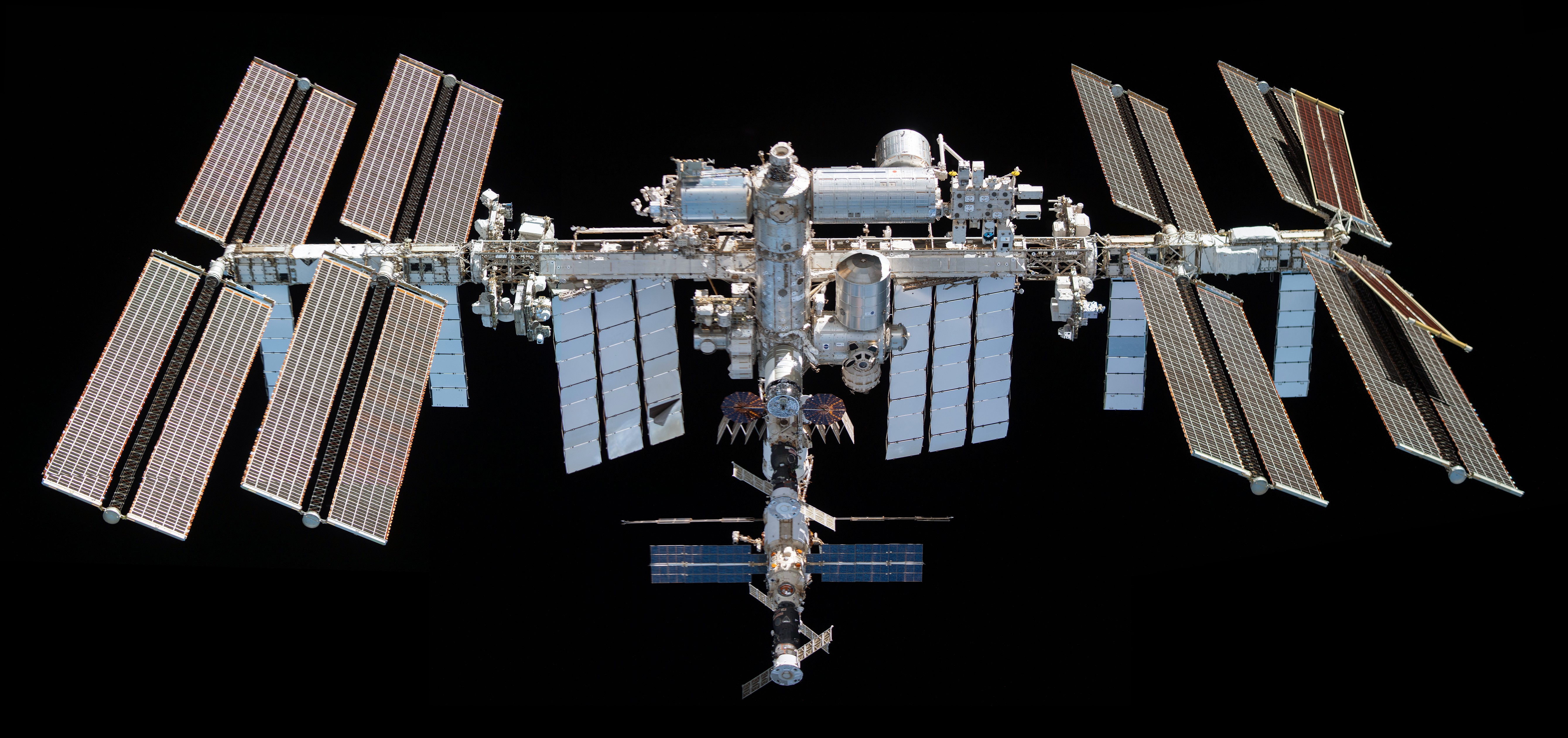
Ten months after the signing of the 1998 IGA, on-orbit construction of the space station began during the STS-88 mission, with the joining of the first two elements, the Zarya and Unity modules. The first expedition crew of NASA astronaut William M. Shepherd and Russian Space Agency, now Roscosmos, cosmonauts Yuri P. Gidzenko and Sergei K. Krikalev arrived to take up residence aboard the station on Nov. 2, 2000. More than 23 years later, multinational crews continue to live and work aboard a much enlarged and permanently inhabited space station, a unique microgravity laboratory for conducting research in a wide variety of scientific disciplines and a testbed for future human exploration programs.
The International Space Station as it appeared in 2021.
NASA Sets Coverage for Northrop Grumman Cargo Space Station Mission
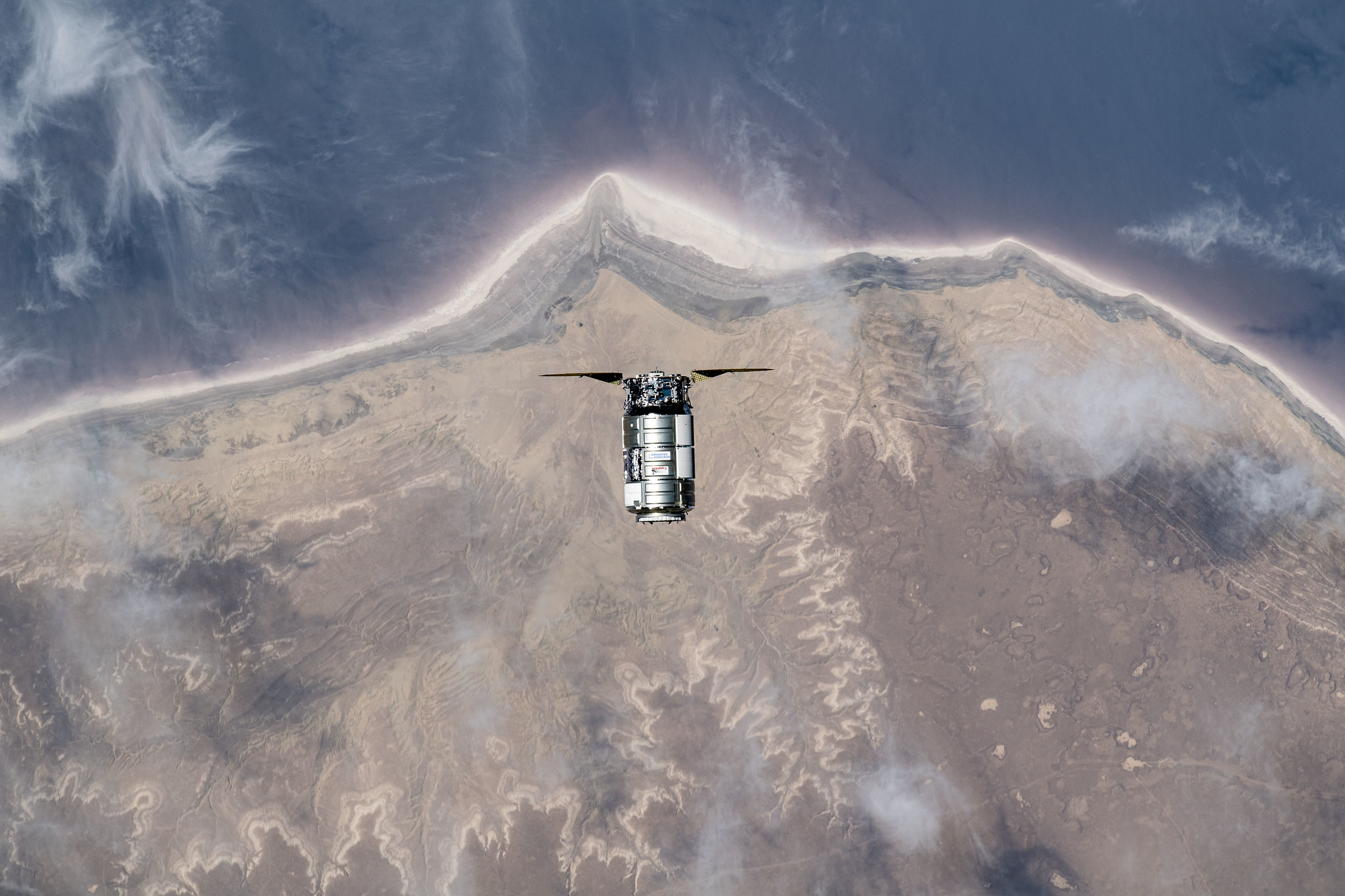
Northrop Grumman’s Cygnus cargo craft is pictured from the International Space Station as it approaches while orbiting 261 miles above the coast of the Garabogazköl Basin in Turkmenistan.
NASA
NASA, Northrop Grumman, and SpaceX are targeting 12:29 p.m. EST on Monday, Jan. 29, for the next launch to deliver science investigations, supplies, and equipment to the International Space Station for the agency and its partners. This launch is the 20th Northrop Grumman commercial resupply services mission to the orbital laboratory for the agency.
Live launch coverage will begin at 12:15 p.m. and air on NASA+, NASA Television, the NASA app, YouTube, and on the agency’s website, with prelaunch events starting Friday, Jan. 26. Learn how to stream NASA TV through a variety of platforms.
Filled with more than 8,200 pounds of supplies, the Cygnus cargo spacecraft, carried on the SpaceX Falcon 9 rocket, will launch from Space Launch Complex 40 at Cape Canaveral Space Force Station in Florida. It will arrive at the space station Wednesday, Jan. 31.
NASA coverage of rendezvous and capture will begin at 2 a.m., followed by installation coverage at 5 a.m. NASA astronaut Jasmin Moghbeli will capture Cygnus using the station’s robotic arm, and NASA astronaut Loral O’Hara will act as backup. After capture, the spacecraft will be installed on the Unity module’s Earth-facing port.
Highlights of space station research facilitated by delivery aboard this Cygnus are:
the MSTIC facility, an autonomous semiconductor manufacturing platform
and a metal 3D printer that will test the capability for printing small metal parts
Media interested in speaking to a subject matter expert about science aboard, should contact Sandra Jones at sandra.p.jones@nasa.gov.
The Cygnus spacecraft is scheduled to remain at the space station until May when it will depart the orbiting laboratory at which point it will harmlessly burn up in the Earth’s atmosphere. This spacecraft is named the S.S. Patricia “Patty” Hilliard Robertson after the former NASA astronaut.
NASA coverage of the mission is as follows (all times Eastern and subject to change based on real-time operations):
Friday, Jan. 26:
1 p.m. – The International Space Station National Lab will host a science webinar with the following participants:
Lisa Carnell, director, NASA’s Biological and Physical Sciences Division
Meg Everett, deputy scientist, NASA’s International Space Station Program
Shane Farritor, co-founder and chief scientific officer, Virtual Incision Corporation
Mark Fernandez, principal investigator of Spaceborne Computer-2, Hewlett Packard Enterprise
Mary Murphy, director of programs, Nanoracks
Michael Roberts, chief scientific officer, International Space Station National Lab
6 p.m. – Prelaunch media teleconference (no earlier than one hour after completion of the Launch Readiness Review) with the following participants:
Dina Contella, operations integration manager, NASA’s International Space Station Program
Meghan Everett, deputy program scientist, NASA’s International Space Station Program
William Gerstenmaier, vice president, Build and Flight Reliability, SpaceX
Cyrus Dhalla, vice president and general manager, tactical space systems, Northrop Grumman
Arlena Moses, launch weather officer, Cape Canaveral Space Force Station’s 45th Weather Squadron
Media who wish to participate by phone must request dial-in information by 4 p.m. Jan. 26, by emailing Kennedy’s newsroom at ksc-media-accreditat@mail.nasa.gov.
Monday, Jan. 29:
12:15 p.m. – Launch coverage begins
12:29 p.m. – Launch
Wednesday, Jan. 31:
2 a.m. – Rendezvous coverage begins
3:35 a.m. – Capture of Cygnus with the space station’s robotic arm
5 a.m. – Cygnus installation operations coverage
NASA Television launch coverage Live coverage of the launch on NASA Television will begin at 12:15 p.m., Jan. 29. For downlink information, schedules, and links to streaming video, visit: https://nasa.gov/nasatv.
Audio of the news teleconference and launch coverage will not be carried on the NASA “V” circuits. Launch coverage without NASA TV commentary via a tech feed will not be available for this launch.
NASA website launch coverage Launch day coverage of the mission will be available on the NASA website. Coverage will include live streaming and blog updates beginning no earlier than 12:15 p.m., Monday, Jan. 29, as the countdown milestones occur. On-demand streaming video on NASA+ and photos of the launch will be available shortly after liftoff. For questions about countdown coverage, contact the NASA Kennedy newsroom at 321-867-2468. Follow countdown coverage on our International Space Station blog for updates.
Attend launch virtually
Members of the public can register to attend the launch virtually. Virtual guests will have access to curated resources, schedule changes, and mission-specific information straight to your inbox. Following each activity, virtual guests are sent a mission-specific collectable stamp for their virtual guest passport.
Watch, engage on social media Let people know you’re watching the mission on X, Facebook, and Instagram by following and tagging these accounts:
Para obtener información sobre cobertura en español en el Centro Espacial Kennedy o si desea solicitar entrevistas en español, comuníquese con Antonia Jaramillo o Messod Bendayan a: antonia.jaramillobotero@nasa.gov o messod.c.bendayan@nasa.gov.
Learn more about the commercial resupply mission at: https://www.nasa.gov/mission/nasas-northrop-grumman-crs-20/.
Ax-3 Research on Station Advancing Health and Space Tech
Astronaut Satoshi Furukawa peers at the Earth from inside the cupola as the International Space Station orbited above the south Atlantic Ocean.
Biomedical science and advanced technology topped the research schedule for the 11 crew members representing Expedition 70 and Axiom Mission 3 (Ax-3). The International Space Station residents are also gearing up for the arrival of a U.S. cargo craft next week.
Cancer research and space botany were the focus of Wednesday’s biology work as the Ax-3 crew continued its busy space science schedule. Pilot Walter Villadei observed cancerous cell cultures inside the Kermit microscope to understand how microgravity conditions such as radiation affect cancer growth. Mission Specialist Alper Gezeravcı processed microbe samples growing in petri dishes for a study exploring using propolis, a natural antibacterial agent, on space station surfaces. Both experiments seek to improve health on Earth and in space.
Robotics is an important part of the Ax-3 science mission as Mission Specialist Marcus Wandt tested remotely controlling robots on Earth from the space station. The Surface Avatar study explores the orbit-to-ground control of robots that may inform future missions on Mars or asteroids. Commander and former NASA astronaut Michael López-Alegría assisted his Ax-3 crewmates throughout the day while also servicing a variety of life support hardware onboard the orbiting lab.
Station Commander Andreas Mogensen of ESA (European Space Agency) kicked off his day watching a virtual reality movie exploring VR’s potential to sustain mental health during long duration missions. He later set up the Kermit microscope and the Life Science Glovebox to support Ax-3 research. Flight Engineer Satoshi Furukawa from JAXA (Japan Aerospace Exploration Agency) turned off and stowed the Kermit microscope at the end of the Ax-3 cancer study. He also assisted NASA Flight Engineer Loral O’Hara cleaning cooling loops inside a pair of U.S. spacesuits.
O’Hara joined NASA Flight Engineer Jasmin Moghbeli at the end of the day and practiced on a computer capturing Northrop Grumman’s Cygnus space freighter with the Canadarm2 robotic arm. Cygnus is due to launch early next week and arrive a day-and-a-half later when Moghbeli will command the Canadarm2 to capture Cygnus as O’Hara monitors its arrival. Moghbeli spent most of Wednesday swapping out station science hardware.
The orbital outpost’s three cosmonauts remained focused on their list of Roscosmos science tasks. Veteran cosmonaut Oleg Kononenko strapped sensors to himself measuring his heart activity in microgravity for a long-running cardiac study. Flight Engineer Nikolai Chub explored futuristic robotic and spacecraft piloting techniques on a computer that may inform planetary missions. Flight Engineer Konstantin Borisov swapped out a lens on a camera pointed toward Earth then participated in a space digestion study with Chub. At the end of the day, Borisov scanned Chub’s optical nerve, retina, and cornea using standard medical imaging hardware found on Earth.
At 1 p.m. EST on Thursday, mission managers on NASA TV will discuss the upcoming SpaceX Crew-8 mission to the space station. Following that, at 2:30 p.m. the SpaceX Crew-8 mission members will introduce themselves as they count down to launch next month.
Both news conferences will be available on the NASA+ streaming service via the web or NASA app, and will air live on NASA Television, the NASA app, YouTube, and the agency’s website. Learn how to stream NASA TV through a variety of platforms including social media.
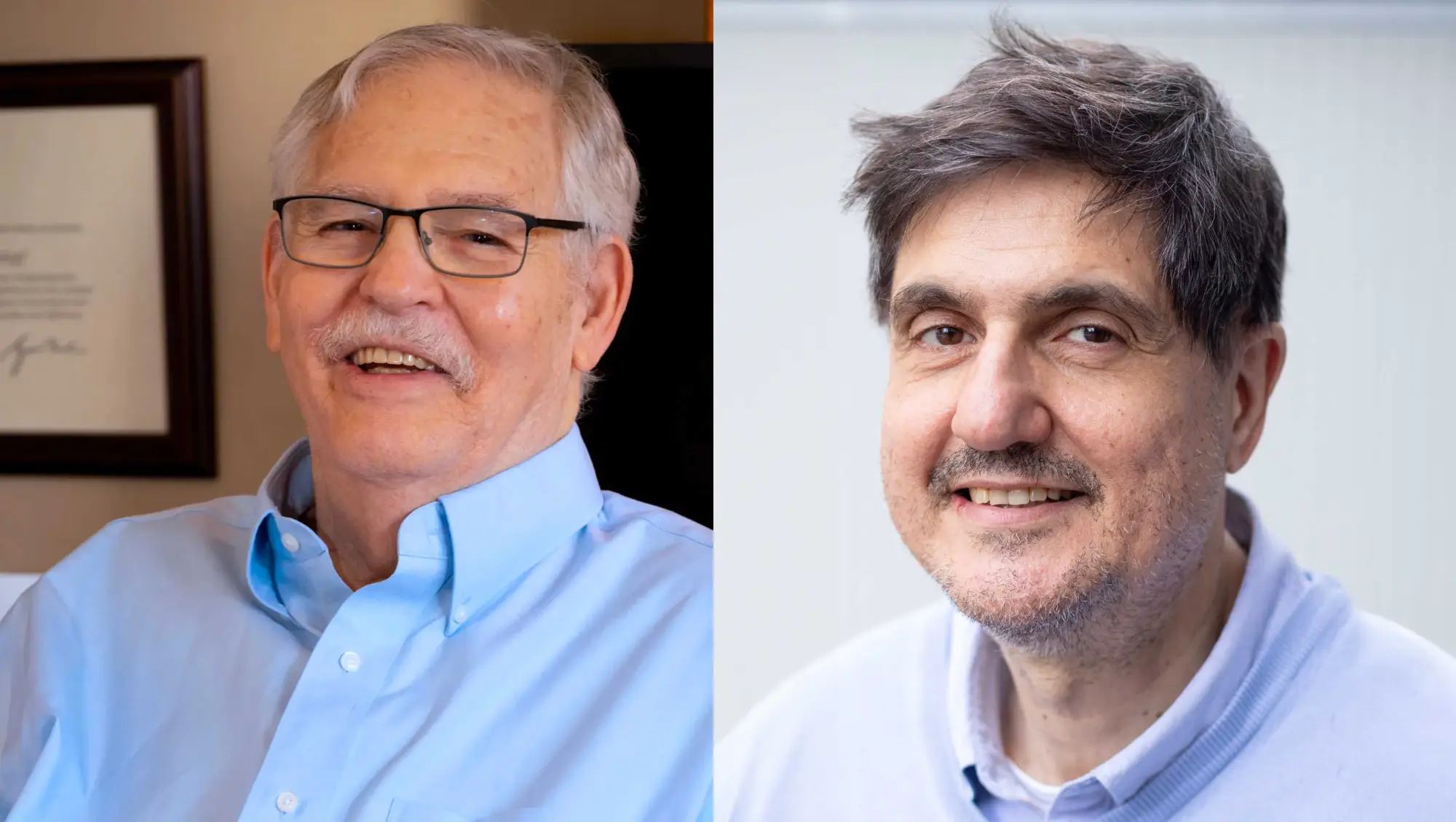
The High Energy Astrophysics Division of the American Astronomical Society (AAS) has awarded the 2024 Bruno Rossi Prize to retired NASA astrophysicist Martin Weisskopf, Italian Space Agency principal investigator Paolo Soffitta, and their team for development of IXPE, “whose novel measurements advance our understanding of particle acceleration and emission from astrophysical shocks, black holes and neutron stars,” according to the AAS announcement.
NASA’s Imaging X-ray Polarimetry Explorer mission, led by retired NASA astrophysicist Martin Weisskopf, left, and Italian Space Agency principal investigator Paolo Soffitta, has received the 2024 Rossi Prize in high-energy astronomy, awarded annually by the American Astronomical Society.
NASA/INAF
“IXPE is a realization of decades of work and belief in the importance of X-ray polarization measurements for X-ray astronomy. I am honored and excited to share this prize with Paolo Soffitta and the entire IXPE team,” said Weisskopf, who was IXPE’s principal investigator during its development. He retired from NASA in 2022.
“IXPE is the demonstration of how an idea pursued for more than 30 years has been transformed into a successful mission, thanks to the collaboration between the United States and Italy,” Soffitta said. “It’s incredible to receive this prize along with Martin Weisskopf and on behalf of so many people whose expertise and enthusiasm have made this breakthrough in astrophysics possible.”
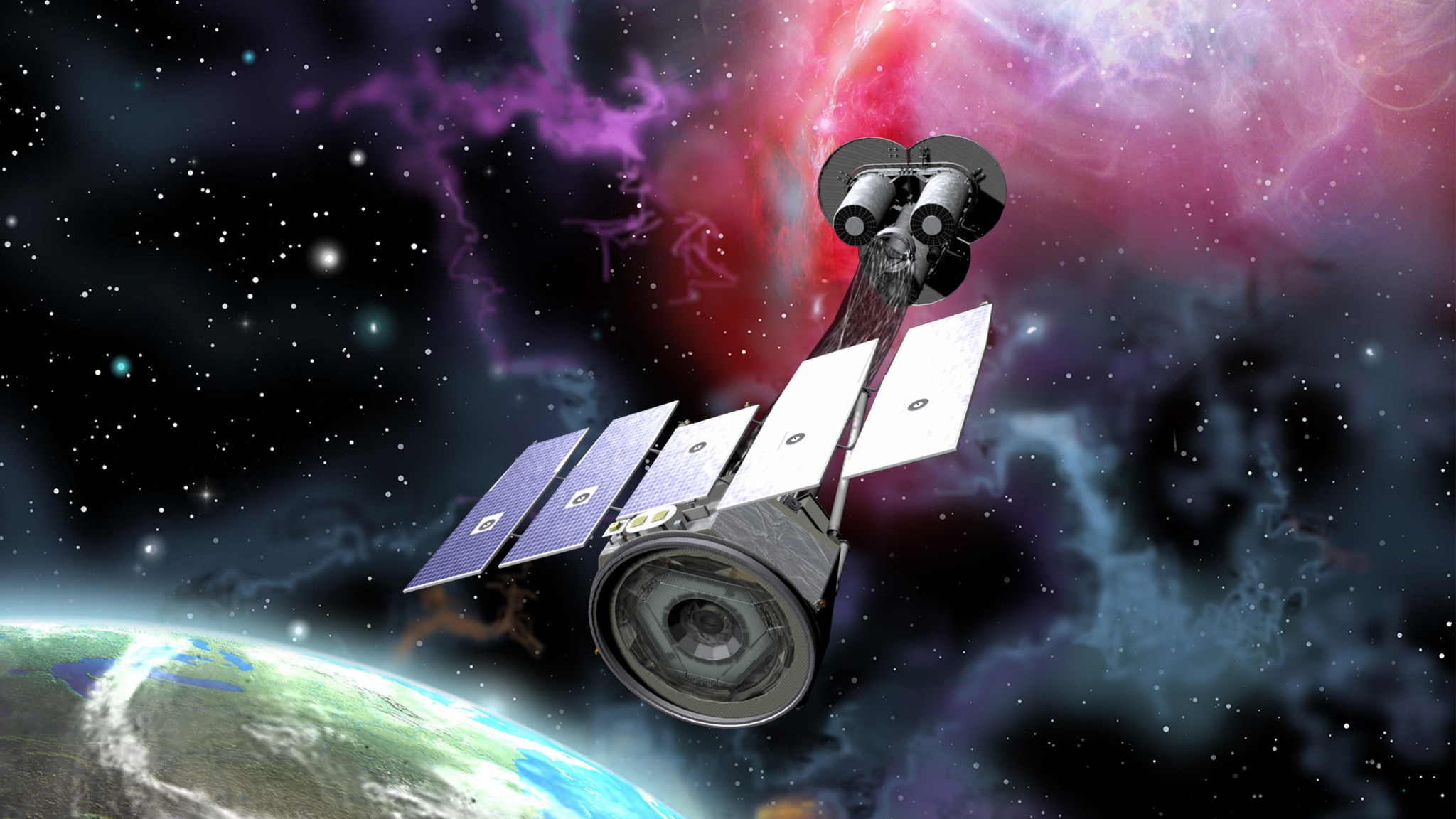
Developed by NASA, the Italian Space Agency, and partners in a dozen countries, IXPE was launched to space on Dec. 9, 2021. Today, it orbits Earth some 340 miles up to observe X-ray emissions from powerful cosmic phenomena hundreds or thousands of light-years away. In 2023 alone, its subjects of study included blazars such as Markarian 501 and Markarian 421, supernova remnants including Tycho and SN 1006, and the supermassive black hole at the center of our own galaxy. Its success led NASA to formally extend the mission for an additional 20 months, through at least September 2025.
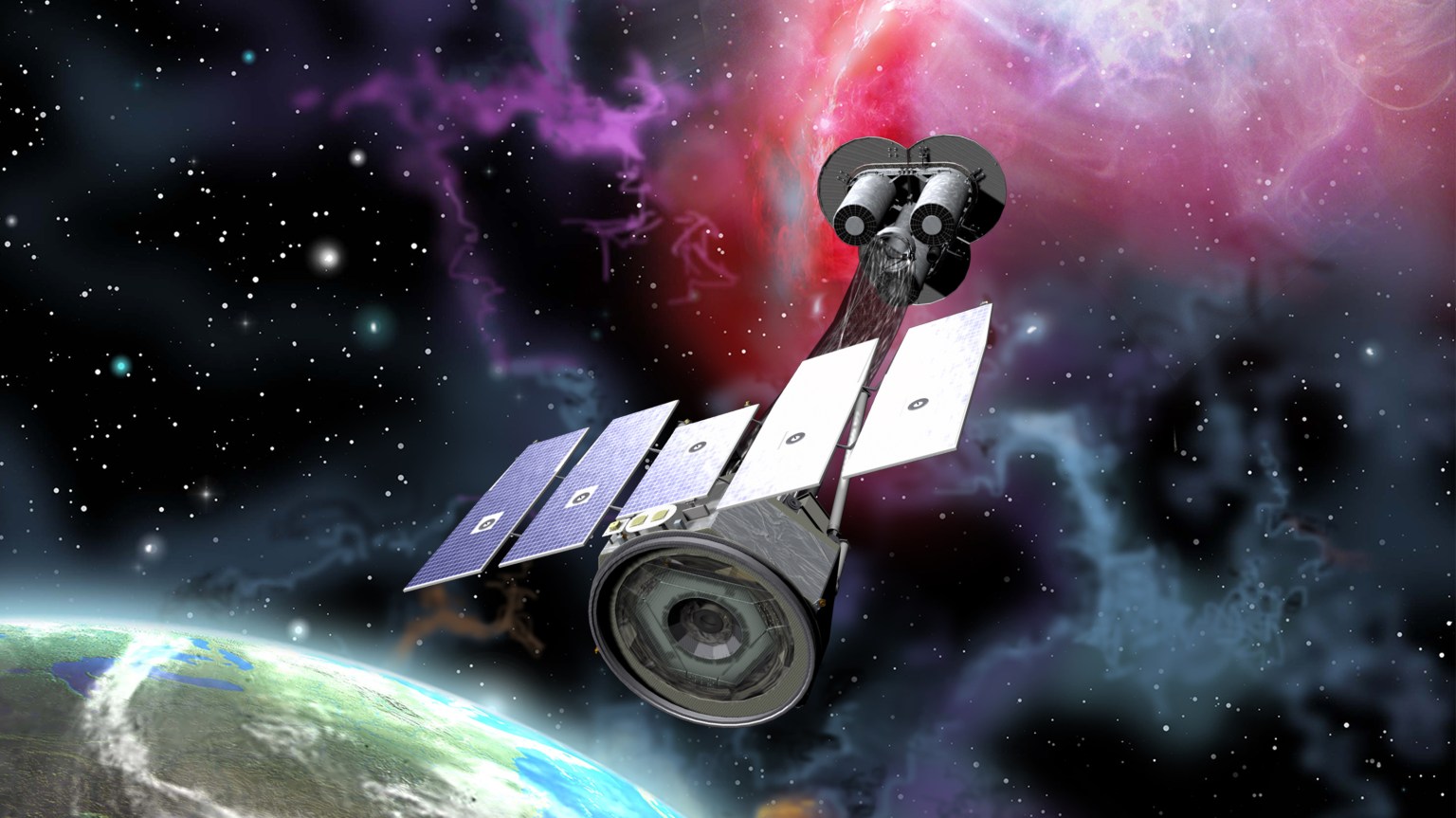
An artist’s illustration of the IXPE spacecraft in orbit, studying high-energy phenomena light-years from Earth.
NASA
“We at NASA are incredibly proud of Dr. Weisskopf and the IXPE team around the world,” said acting Marshall Center Director Joseph Pelfrey. “IXPE allows us to look at the universe through a vantage point never seen before. It’s particularly gratifying to continue Marshall’s long association with the Rossi Prize, which identifies singular breakthroughs and unprecedented innovation in high-energy astrophysics – a field in which our researchers excel.”
Weisskopf, together with Harvard astrophysicist Harvey Tananbaum, previously received the Rossi Prize in 2004 for their work to develop and fly NASA’s Chandra X-ray Observatory, which continues to study X-ray phenomena across the cosmos. Marshall researchers Gerald Fishman and Colleen Wilson-Hodge also were awarded the Rossi Prize in 1994 and 2018, respectively. Fishman was honored for his contributions to the Compton Gamma-ray Observatory’s BATSE (Burst and Transient Source Experiment) mission, Wilson-Hodge for her work with the Fermi GBM (Gamma-ray Burst Monitor) in August 2017, detecting gravitational and light waves from the spectacular smashup of two neutron stars in a distant galaxy.
The Rossi Prize is awarded annually for a significant recent contribution to high-energy astrophysics. The honor includes an engraved certificate and a $1,500 award.
Smith, an Aeyon/MTS employee, supports the Marshall Office of Communications.
National Mentoring Month: The Right Type of Mentorship with Erika Alvarez and Dave Reynolds
By Celine Smith
Erika Alvarez’s path to becoming a Systems Engineering & Integration manager at NASA Headquarters has impacted the way she mentors.
“What we do at NASA takes a village,” Alvarez said. “It may take one person to make something, but there could be 10 or 15 or 20 people who help them get there.”
Erika Alvarez, System Engineering and Integration manager at NASA Headquarters, and mentor to Dave Reynolds, a deputy program manager at NASA’s Marshall Space Flight Center.
NASA
Alvarez wants to be one of many guiding others to meet their goals, which is how she began mentoring Dave Reynolds, a deputy program manager at NASA’s Marshall Space Flight Center.
Alvarez and Reynolds don’t have a traditional mentorship. Both began in Marshall’s propulsion systems department in 2004. While Alvarez is younger than Reynolds, Alvarez is mentoring Reynolds.
Alvarez may not have decades more experience than Reynolds, but Alvarez joining the SES (Senior Executive Service) coincided with Reynolds wanting to transition to the SES. Their shared working experience and similar goal made a perfect fit for their mentorship.
Reynolds is currently being mentored by Alvarez in preparation for a Senior Executive Service position.
NASA
Hoping their experience can help others during National Mentoring Month, they discussed their insight about finding the right type of mentorship.
Question: What does mentorship mean to you?
Reynolds: Mentorship is an outside perspective that benefits me by providing a better solution. You can ask your mentor about your ideas to self-examine the path that you’re on. They know you and have your best interest in mind. Your decisions are not directly going to affect them, so they can offer candid advice.
Alvarez: For me, mentorship is worth the time investment because we can get stuck in our day-to-day routine. It’s a refreshing time during the week to sit down with someone knowing what they’re experiencing and helping them, so they don’t have to navigate certain challenges on their own. I have templates, articles, rubrics, books, and other perspectives I gained through my first year in SES. Now I can offer those resources. It’s something that I want to pass on to somebody else because it takes a village to do this. Mentoring is very energizing and fruitful. It reminds me that I love NASA and it’s a great place to work. I hope that I can provide that feeling and energy to someone else and it just keeps going.
Question: What impact has mentorship had on you and your career?
Alvarez: With Dave and I starting from the same department, we had some of the same mentors early on. Mentors give you confidence to move to the next role when you’re down in the details, doing the work, and years into a position. I would also say I was fortunate enough to have a great mentor that was outside of my department. The most important trait she gave to me was resiliency. There are many times when you go for something and are unsuccessful. Having somebody that believes in you during those times is huge.
Reynolds: My first formal mentor was assigned to me while I was in the Mid-Level Leadership Program and she was in SES at NASA’s Glenn Research Center. She encouraged me to get out of engineering, because she believed I was ready for a leadership role. Without her, I wouldn’t have transitioned as quickly as I did. My current mentorship is also kicking me to the next level and informing me of all the options I need to consider. Having a mentor that has known you for a long time, like Alvarez, is beneficial. You can trust their guidance more because they’ve seen you fail, and they still believe in your success.
Question: What was the initial goal and how has that impacted the type of mentoring relationship you built?
Reynolds: The initial goal was Alvarez prepping me to become SES qualified and she’s helped me at every step. Alvarez encouraged me to apply for the ASPIRE program. Programs and tools like that are exactly what I need to know about. She’s provided a lot of information that I didn’t know I would need to consider.
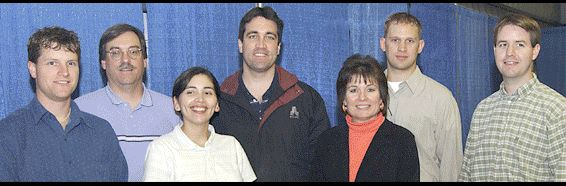
A young Alvarez, third from left, and Reynolds, far right, smile for a photo taken while they were both working in the propulsion systems department at Marshall.
NASA
Alvarez: I mentor a lot of people at different levels. Reynolds is a unique mentee because he is seeking out a big goal. Other mentees coming to me are in different stages, or they’re in a similar field and want to discuss the type of work I do. His goal is personal. I don’t want Reynolds to feel unprepared. I want him to go into his interview and any future roles with confidence and his best foot forward. I want Dave’s future peers to know he’s ready to lead. If Dave is successful in achieving his goal, I want to help him through that transition during the first year of his new role as well, especially with the person who last had the position being gone. I have executive mentors who are the only people I can discuss certain topics with. A part of the goal is Reynolds’ long-term success, which is why it’s important for him to have access to that network of people. If Reynolds needs help with something I’m not well-versed in, I can get him in contact with someone who is.
Question: How do you think the dynamic between mentor and mentee may differ in a formal mentoring relationship compared to an informal, casual mentoringencounter?
Reynolds: Formal mentoring relationships are more deliberate. We have a goal that we set. We’re not just having lunch, we set a scheduled time where we each have ideas we bring to discuss. Formal encounters are more structured. With informal mentorships you can also have casual lunches where good advice is thrown back and forth, but I have noticed if you’re more deliberate, you’ll get concrete progress.
Alvarez: Dave having a specific objective made the mentorship formal. The structure provided time for me to gather materials I found helpful in preparation for SES. With a hands-on approach, I could help Reynolds during his time in the ASPIRE program. We methodically planned how to reach each goal and in turn the objective. As we’re doing the work, we’re checking in consistently. Informal mentorships are hard. There’s no set amount of time spent together, and its disorganization makes it easier to lose momentum toward the objective. Informal mentorships also make it harder to feel a sense of accomplishment because progress is harder to assess.
Question: What advice do you have for someone else considering finding or being a mentor?
Alvarez: Think outside the box. Some people come in with an unconscious bias of what a mentor is. Mentees can become overly concerned with a mentor’s background. Not knowing their background is a good thing. Remain open minded about what someone else can offer you. You’re always going to get some good nuggets out of a mentorship. If someone suggests a mentor to you, take it. They might see something that neither of you do that would make a great pairing. I also recommend that some people choose mentors with a different career path like Dave and me. We shared the same foundation but then we went off in two different branches. Getting to combine those different insights is amazing because it makes us stronger.
Reynolds: As a mentee, check that you have humility. It’d be easy for me to dismiss Alvarez as a mentor because of our similarities. I recognize, she’s had a completely different life and is therefore capable of giving me an outside perspective. She’s also wicked smart, and I listen to wicked smart people. I’ve heard people reject advice from others because they are on the same tier or below career wise. That’s not a good approach. Ask yourself who can help with growth as opposed to finding somebody that that will help you up the ladder.
Editor’s note: This is the second in a Marshall Star series during National Mentoring Month in January. Marshall team members can learn more about the benefits of mentoring on Inside Marshall.
Smith, a Media Fusion employee, supports the Marshall Office of Communications.
Larry Leopard Named Acting Director of Marshall’s Engineering Directorate
Larry Leopard has been named acting director of NASA Marshall Space Flight Center’s Engineering Directorate upon the retirement of Don Holder this month. He will fill the role until a permanent director is named as well as continuing his duties as Marshall’s associate director, technical.
Larry Leopard, Marshall’s associate director, technical, has been named acting director of NASA Marshall Space Flight Center’s Engineering Directorate.
NASA
As Marshall’s associate director, technical, Leopard provides expert advice in all facets of the center’s responsibilities by conducting special studies; provides authoritative advice and assistance in policy review; manages and reports on centerwide and directorate metrics; and develops benchmark strategies. He was appointed to the position in December 2020. Leopard previously served as director of the Engineering Directorate from 2018 to 2020.
Lisa Bates will remain as deputy director of Marshall’s Engineering Directorate.
NASA
Lisa Bates will remain as deputy director and will be responsible for the day-to-day management of the Engineering Directorate.
Whether he’s advising student robotic competitions or managing production of a powerful, new Moon rocket stage, Erick Holsonback meets technical challenges with enthusiasm.
Holsonback, a Jacobs Technology employee, is subsystem manager for production and launch operations of the exploration upper stage (EUS) for NASA’s SLS (Space Launch System) rocket. SLS is NASA’s super heavy lift rocket that will launch the agency’s Artemis campaign to the Moon. The exploration upper stage is one of two upgrades to the SLS rocket as it evolves to the Block 1B variant for missions beginning with Artemis IV. Along with the rocket’s new universal stage adapter, the SLS rocket in its Block 1B configuration will be able to send 40% more payload to the Moon in a single launch.
Eric Holsonback, a Jacobs Technology employee, is subsystem manager for production and launch operations of the exploration upper stage for NASA’s SLS (Space Launch System) rocket.
NASA/Michael DeMocker
Holsonback’s job stretches from setting up production for the future upper stage at NASA’s Michoud Assembly Facility, where it’s built, to preparing it for launch from the agency’s Kennedy Space Center.
“It’s exciting to be part of a capability that will send more crew and cargo to the Moon in a single launch than any other current rocket,” Holsonback said. “That’s going to make operations in the challenging space environment a lot simpler.”
Growing up in North Georgia, Holsonback remembers wanting to be an astronaut and turning street cars into hot rods. He figured he’d wind up in the auto industry, until Pratt & Whitney offered him a job working on space shuttle main engine turbomachinery straight out of college in 1997. He briefly left the space business but jumped at a chance to get back in with the SLS Program in 2016 at NASA’s Marshall Space Flight Center.
“I wanted to come back and do rockets,” he recalled. “It gets in your blood. You’re part of something bigger that just yourself. Through Artemis, we are truly impacting the space program at its foundational level of how we are getting back to the Moon and to Mars.”
Holsonback’s enthusiasm for space challenges doesn’t end at the office door. In his free time, Holsonback has mentored and coached his two daughters’ technology challenge competitions. While the challenge is foremost a robotics contest, Holsonback is proud of the lessons in problem solving, technology, and project management he’s helped impart to the team along the way – which he likens to his NASA job.
You could say Erick Holsonback is working on the future personally as well as professionally, but it’s hard to beat working on a Moon rocket.
“I’ve had some great opportunities with NASA, but my current role is pretty amazing – getting to be part of building and launching,” he reflected. “I get to play a little part in the overall foundation work that is going to be part of the history of our country for years to come.”
NASA is working to land the first woman and first person of color on the Moon under Artemis. SLS is part of NASA’s backbone for deep space exploration, along with the Orion spacecraft, advanced spacesuits and rovers, the Gateway in orbit around the Moon, and commercial human landing systems. SLS is the only rocket that can send Orion, astronauts, and supplies to the Moon in a single launch.
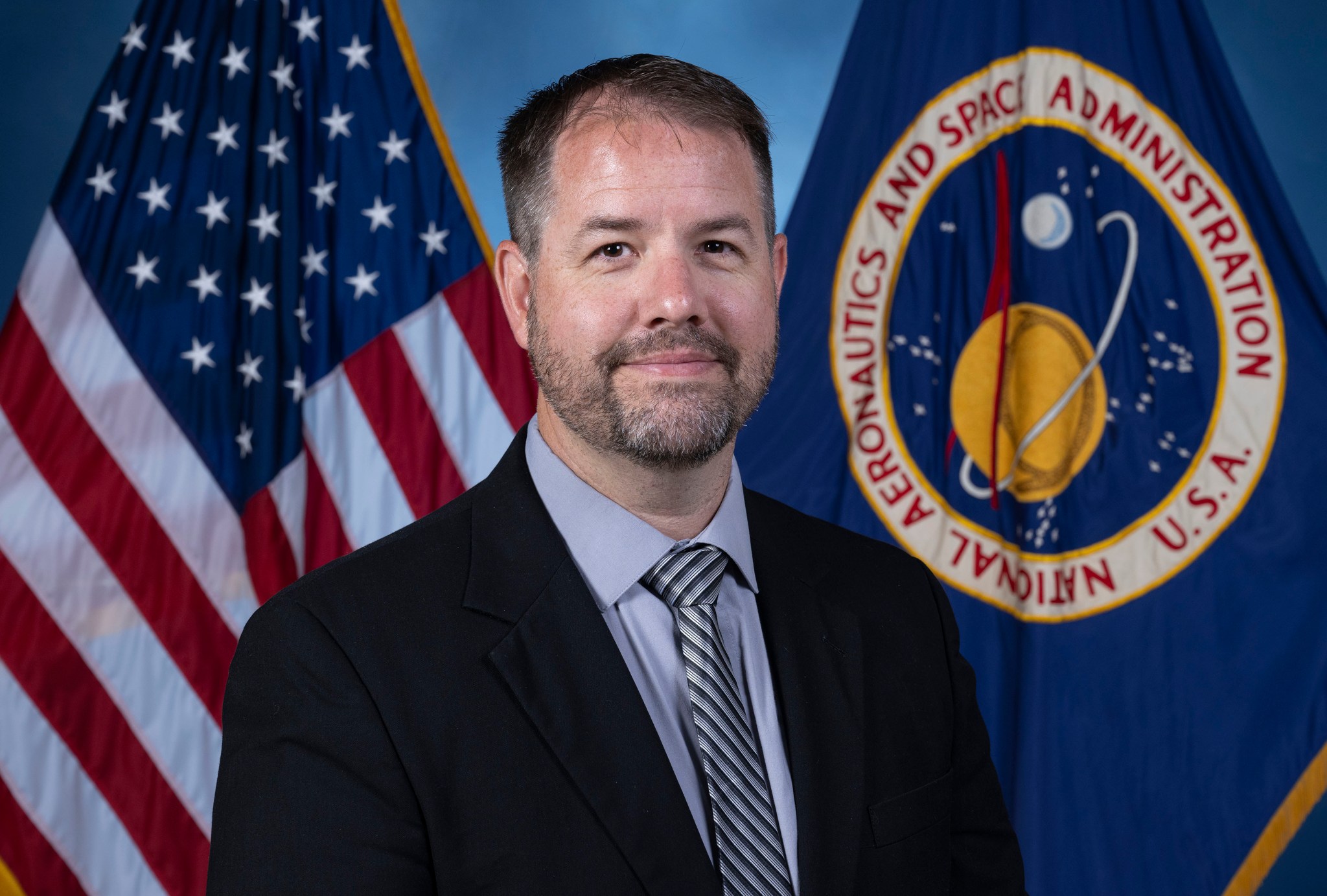
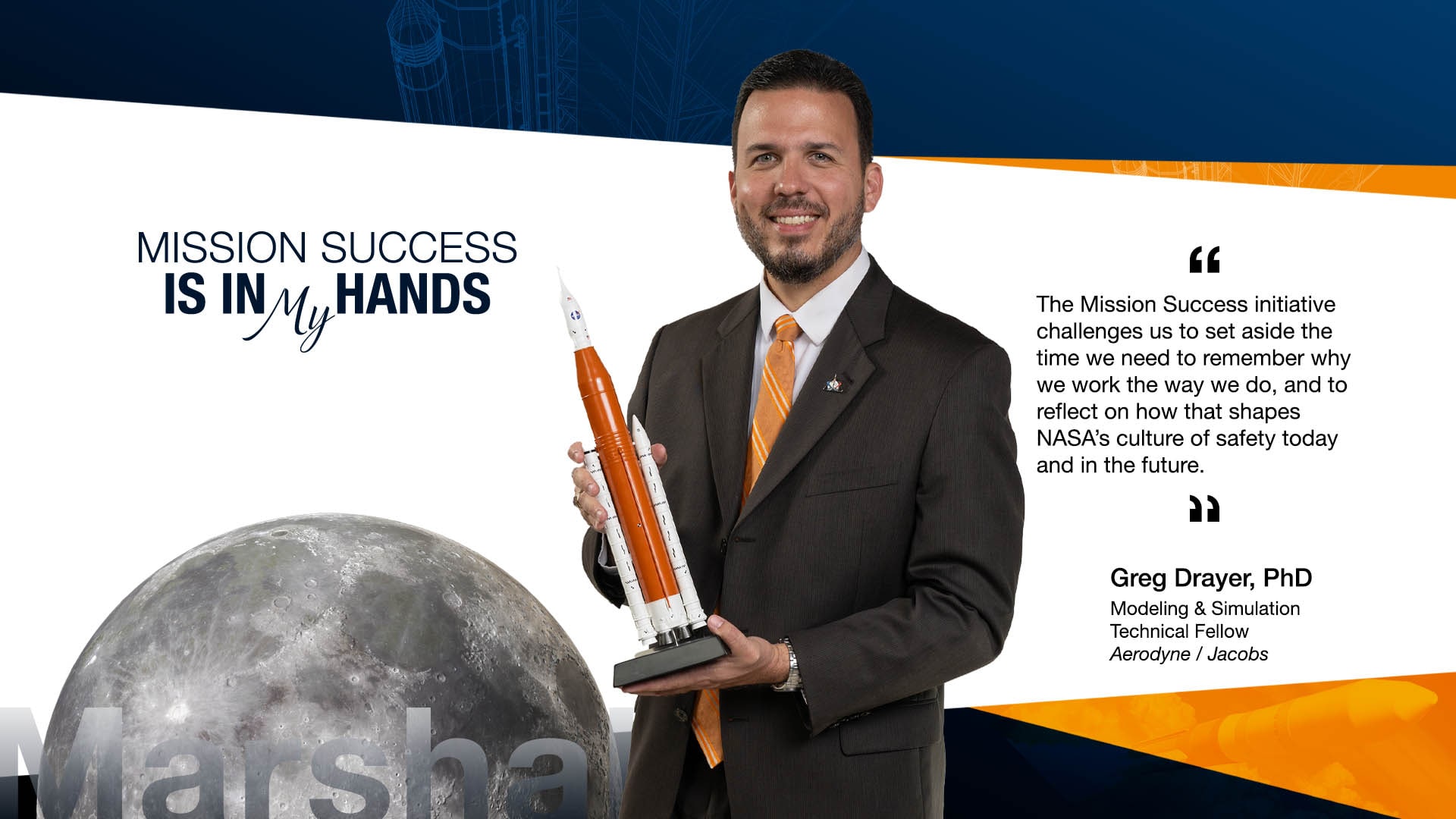
Mission Success is in Our Hands is a safety initiative collaboration between NASA’s Marshall Space Flight Center and Jacobs. As part of the initiative, eight Marshall team members are featured in new testimonial banners placed around the center. This is the third in a Marshall Star series profiling team members featured in the testimonial banners.
Greg Drayer is the JSEG (Jacobs Space Exploration Group) team lead for EV74, the Systems Analysis Branch, working at NASA’s Marshall Space Flight Center. He is also the JSEG Tech Fellow for Modeling and Simulation.
Greg Drayer is the JSEG (Jacobs Space Exploration Group) team lead for EV74, the Systems Analysis Branch, working at NASA’s Marshall Space Flight Center.
NASA/Charles Beason
He previously was a Modeling and Simulation integration systems engineer, representing NASA’s SLS (Space Launch System) Program to the Data Integration Integrated Task Team and supporting the certification of Design Math Models. He started working at Marshall in 2020. A native of Caracas, Venezuela, Drayer is a graduate of both Universidad Simon Bolivar, where he earned a bachelor’s degree in electrical engineering and magister in systems engineering, and the Georgia Institute of Technology, where he earned his doctorate with the School of Electrical and Computer Engineering. He was sponsored by the U.S. Department of State International Fulbright Science and Technology Program.
Question: What are some of your key responsibilities?
Drayer: I am responsible for the proactive management of the EV74 Branch JSEG Task Order and Systems Evaluation personnel to ensure the safe and effective accomplishment of Marshall requirements by providing engineering, scientific, and technical support to various NASA programs. My team is a high-performing group of three different sub-teams executing challenging tasks for Marshall’s Systems Engineering and Integration Division (EV70) in support of SLS, HLS (Human Landing System), and MAV (Mars Ascent Vehicle) programs, providing unique expertise in the following domains:
Program compliance with the NASA Standard for Models and Simulations, NASA-STD-7009.
Vehicle mass properties and weight management.
SLS photogrammetric imaging and analysis.
Data integration tools, systems, and processes.
Adoption of model-based systems engineering methodologies.
Question: How does your work support the safety and success of NASA and Marshall missions?
Drayer: The goal of our Modeling and Simulation Sub-Team at NASA is to help reduce the risks associated with models and simulations-influenced decisions by properly conveying the credibility of results to those making critical decisions in support of program compliance with NASA-STD-7009, Standard for Models and Simulations. We ensure the NASA’s commitment to excellence in satisfying the requirements of NASA-STD-7009, an outcome resulting from the Columbia Accident Investigation Board Report.
Question: What does the Mission Success is in Our Hands initiative mean to you?
Drayer: Working in support of NASA-STD-7009, this initiative hits close to home as another reminder of why we do our work the way we are required. Beyond any statistics, to me this campaign is a reminder and a challenge to ensure that we ‘Know what we build. Test what we build. Test what we fly. Test like we fly.’ We should continue learning from our past to make sure that it does not repeat in the future. This initiative helps us dedicate the time to remember why we do things the way we do them, and how we arrived at today’s NASA culture.
Question: Do you have a story or personal experience you can share that might help others understand the significance of mission assurance or flight safety?
Drayer: Coming back from COVID-19 has been a great challenge to overcome. Incredibly, we all have found some strange comfort zones from which we are now needing to come back to collaborate better. I know how much some of us value our ability to telework at times. However, I would like us all to also understand how some in-person conversations can save us many if not several hours of unending electronic communications. I would like all of us to demonstrate to ourselves why we truly need to be present in our meetings and engage as best as we can to reap the fruit of those interactions. Let us lead by example and ‘preach’ about it along the way with our actions, to the benefit of the NASA culture in a post-COVID era. As an agency, this can greatly impact our ability to ensure mission success and flight safety.
Question: How can we work together better to achieve mission success?
Drayer: We go all the way to the Moon in search of discoveries, science, and developing new technologies. And even beyond all these, we go to the Moon to find ourselves personally and each other. That journey has begun already with each weekday and at times weekends that we dedicate to work with the mission in mind, working hard to meet and exceed the expectations of our customers and our stakeholders, most important of which are our astronauts and their families.
Smith, a Media Fusion employee and the Marshall Star editor, supports the Marshall Office of Communications.
NASA Continues Artemis Moon Rocket Engine Tests with First Hot Fire of 2024
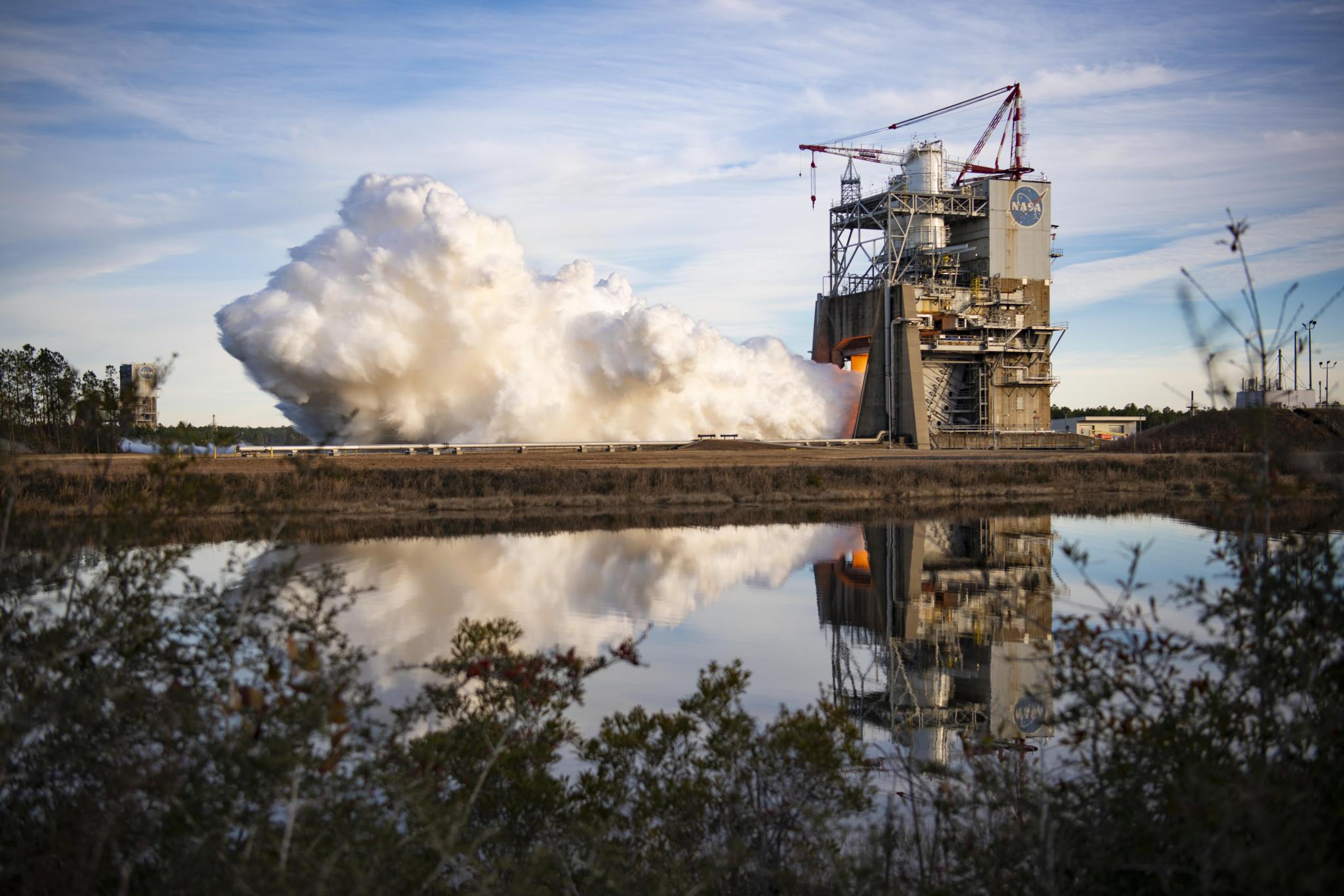
NASA continued a critical test series for future flights of NASA’s SLS (Space Launch System) rocket in support of the Artemis campaign Jan. 17 with a full-duration hot fire of the RS-25 engine on the Fred Haise Test Stand at NASA’s Stennis Space Center.
Data collected from the test series will be used to certify production of new RS-25 engines by lead contractor Aerojet Rocketdyne, an L3Harris Technologies company, to help power the SLS rocket on future Artemis missions to the Moon and beyond, beginning with Artemis V. NASA’s Marshall Space Flight Center manages the SLS Program.
NASA completed a full-duration, 500-second hot fire of an RS-25 certification engine Jan. 17, continuing a critical test series to support future SLS (Space Launch System) missions to the Moon and beyond as NASA explores the secrets of the universe for the benefit of all.
NASA/Danny Nowlin
Teams are evaluating the performance of several new engine components, including a nozzle, hydraulic actuators, flex ducts, and turbopumps. The current series is the second and final series to certify production of the upgraded engines. NASA completed an initial 12-test certification series with the upgraded components in June 2023.
During the Jan. 17 test, operators followed a “test like you fly” approach, firing the engine for the same amount of time – almost eight-and-a-half minutes (500 seconds) – needed to launch SLS and at power levels ranging between 80% to 113%.
The Jan. 17 test comes three months after the current series began in October. During three tests last fall, operators fired the engine for durations from 500 to 650 seconds. The longest planned test of the series occurred on Nov. 29 when crews gimbaled, or steered, the engine during an almost 11-minute (650 seconds) hot fire. The gimbaling technique is used to control and stabilize SLS as it reaches orbit.
Each SLS flight is powered by four RS-25 engines, firing simultaneously during launch and ascent to generate over 2 million pounds of thrust.
The first four Artemis missions with SLS are using modified space shuttle main engines that can power up to 109% of their rated level. The newly produced RS-25 engines will power up to the 111% level to provide additional thrust. Testing to the 113% power level provides an added margin of operational safety.
With the completion of the test campaign in 2024, all systems are expected to be “go” for production of 24 new RS-25 engines for missions beginning with Artemis V.
Through Artemis, NASA will establish a long-term presence at the Moon for scientific exploration with commercial and international partners, learn how to live and work away from home, and prepare for future human exploration of Mars.
Station Crew Assists Ax-3 on Advanced Space Research
The Expedition 70 crew spent Jan. 23 on a host of research activities and spacesuit maintenance while assisting their Axiom Mission 3 (Ax-3) guests on the International Space Station. The four Ax-3 crew members had their hands full as they explored cancer research, space botany, and robotics for Earth and space benefits.
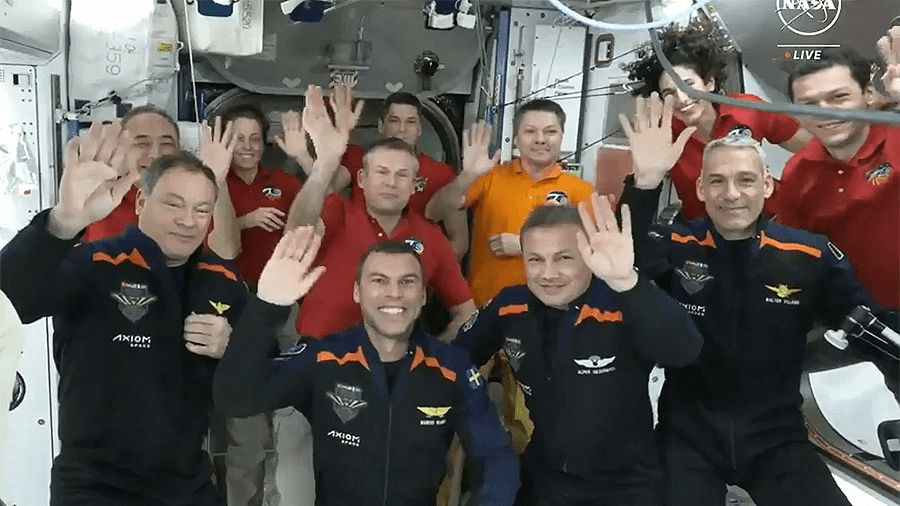
The Ax-3 crew arrived Jan. 20. Astronauts Andreas Mogensen, Loral O’Hara, and Satoshi Furukawa dedicated part of their schedule to the Ax-3 mission. The trio helped the four private astronauts get up to speed with life on orbit as well as conduct advanced microgravity science.
The four Axiom Mission 3 astronauts, front row, and the seven Expedition 70 crew members wave to the camera following a crew greeting ceremony on the International Space Station on Jan. 20.
NASA TV
Mogensen from ESA (European Space Agency) spent a couple of hours ensuring the Ax-3 crewmates are familiarized with systems throughout the orbital lab. O’Hara from NASA set up the LSG (Life Science Glovebox) for an Ax-3 space botany investigation while Furukawa from JAXA (Japan Aerospace Exploration) activated a microscope to look at cell samples for an Ax-3 cancer study.
Ax-3 Commander Michael López-Alegría and Mission Specialist Alper Gezeravcı worked in the Kibo laboratory module’s LSG and tested the genetic editing of space-grown plants. Results may enable genetic modifications allowing plants to adapt to weightlessness and promote crew health. Ax-3 Pilot Walter Villadei peered at cell samples inside the Kermit microscope to learn how to predict and prevent cancer both on Earth and in space.
Ax-3 Mission Specialist Marcus Wandt tested the ability to remotely control robots on Earth from the space station. Working in the Columbus laboratory module, Wandt used a laptop computer to command a team of Earth-bound robots simulating a robotic exploration mission on another planet controlled from a spacecraft.
Mogensen would go on to organize food packs, charge virtual reality hardware for a mental health study, then videotape a space physics demonstration for junior high school students. Furukawa serviced science freezers and combustion research gear before cleaning vents inside the Unity module. Furukawa wrapped up his day with eye checks with NASA Flight Engineer Jasmin Moghbeli. O’Hara operated the medical imaging gear examining the optic nerve, retina, and cornea of both astronauts. Moghbeli earlier installed and tested a camera and lights on a spacesuit helmet.
The orbiting lab’s three cosmonauts from Roscosmos focused on operations in their segment. Veteran Flight Engineer Oleg Kononenko spent his day inspecting the Zvezda service module and servicing communication and computer systems in the Nauka science module. Flight Engineer Nikolai Chub photographed the condition of Zvezda’s windows then studied how microgravity conditions such as magnetic and electrical fields affect fluid physics. Flight Engineer Konstantin Borisov deactivated Earth observation gear, downloaded vibration data the station experiences while orbiting Earth, then worked on orbital plumbing duties.
The Payload Operations Integration Center at NASA’s Marshall Space Flight Center operates, plans, and coordinates the science experiments onboard the space station 365 days a year, 24 hours a day.
Learn more about station activities by following the space station blog.
NASA’S OSIRIS-REx Curation Team Reveals Remaining Asteroid Sample
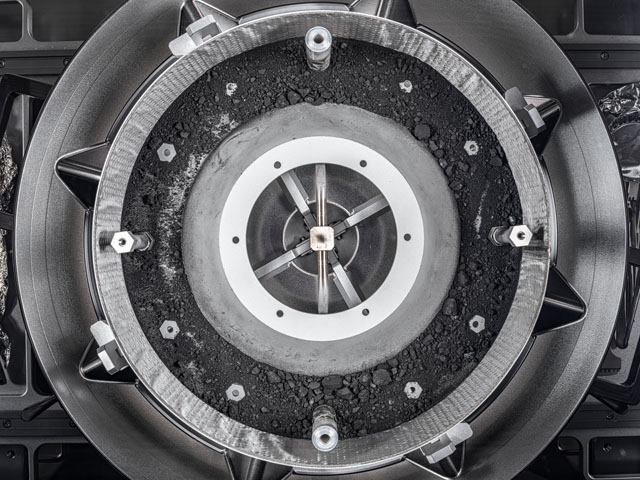
The astromaterials curation team at NASA’s Johnson Space Center has completed the disassembly of the OSIRIS-REx sampler head to reveal the remainder of the asteroid Bennu sample inside. On Jan. 10, they successfully removed two stubborn fasteners that had prevented the final steps of opening the TAGSAM (Touch-and-Go-Sample-Acquisition-Mechanism) head.
A top-down view of the OSIRIS-REx Touch-and-Go-Sample-Acquisition-Mechanism head with the lid removed, revealing the remainder of the asteroid sample inside.
NASA/Erika Blumenfeld & Joseph Aebersold
Erika Blumenfeld, creative lead for AIVA (Advanced Imaging and Visualization of Astromaterials) and Joe Aebersold, AIVA project lead, captured a photograph of the open TAGSAM head including the asteroid material inside using manual high-resolution precision photography and a semi-automated focus stacking procedure. The result is an image that shows extreme detail of the sample.
Next, the curation team will remove the round metal collar and prepare the glovebox to transfer the remaining sample from the TAGSAM head into pie-wedge sample trays.
These trays will be photographed before the sample is weighed, packaged, and stored at Johnson, home to the most extensive collection of astromaterials in the world. The remaining sample material includes dust and rocks up to about 0.4 inch in size. The final mass of the sample will be determined in the coming weeks. The curation team members had already collected 2.48 ounces of asteroid material from the sample hardware before the lid was removed, surpassing the agency’s goal of bringing at least 2.12 ounces to Earth.
The curation team will release a catalog of all the Bennu samples later this year, which will allow scientists and institutions around the world to submit requests for research or display.
OSIRIS-REx is the third mission in NASA’s New Frontiers Program, managed by the agency’s Marshall Space Flight Center.
NASA, Sierra Space Invite Media to See Spaceplane for Cargo Missions
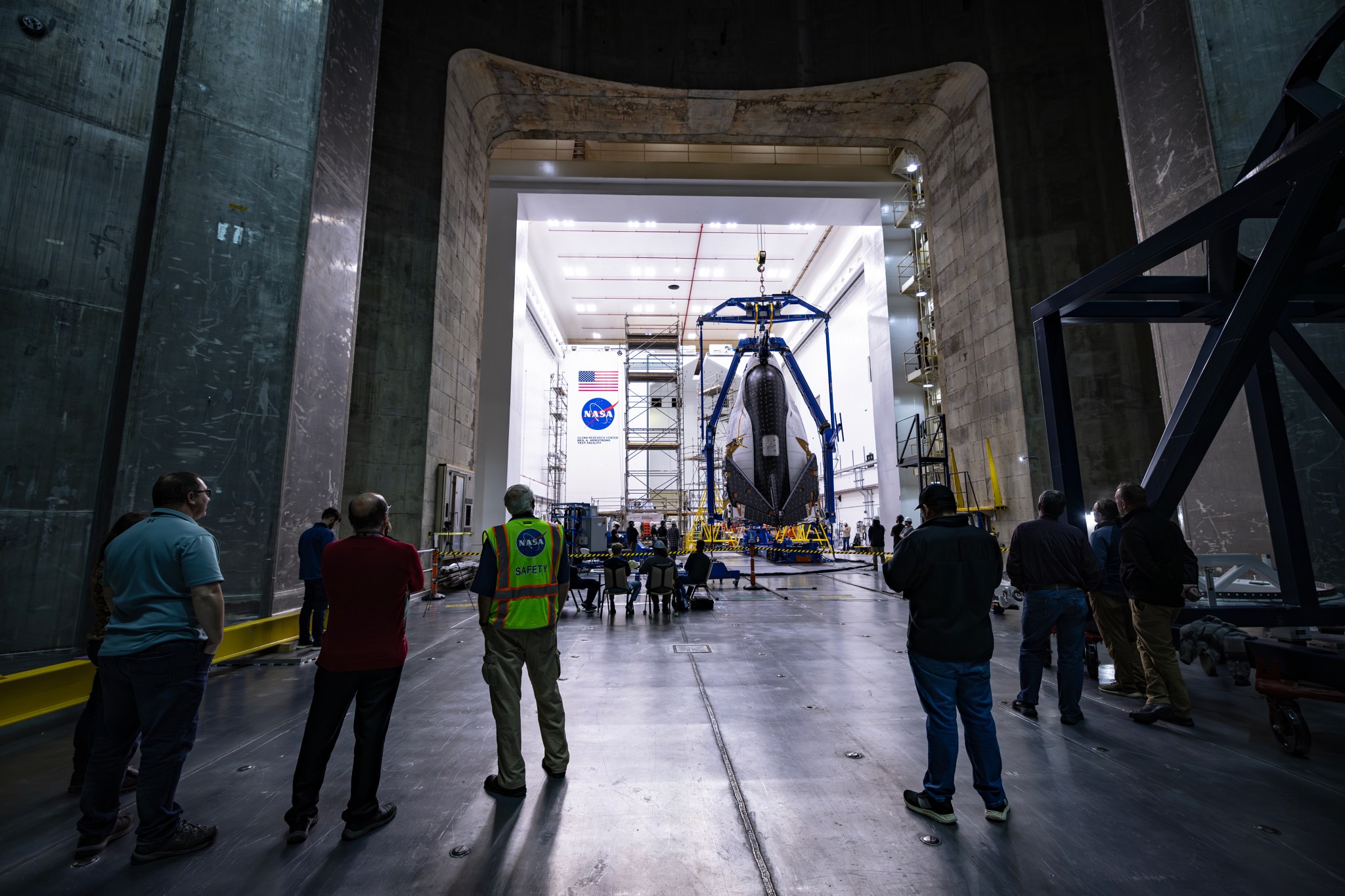
NASA and Sierra Space team members move the Dream Chaser spaceplane into NASA’s Neil Armstrong Test Facility in Sandusky, Ohio.
Credits: Sierra Space/Shay Saldana
As part of NASA’s efforts to expand commercial resupply in low Earth orbit, media are invited to view Sierra Space’s uncrewed commercial spaceplane ahead of its first demonstration flight for the agency to the International Space Station in 2024.
The Dream Chaser event is scheduled to begin at 10:15 a.m. EST Thursday, Feb. 1, at NASA’s Neil Armstrong Test Facility in Sandusky, Ohio.
For the first time, the spaceplane is coupled with its companion Shooting Star cargo module in a 55-foot-tall vertical stack for environmental testing in the Mechanical Vibration Facility at Armstrong Test Facility’s Space Environments Complex.
During the event, the following officials will provide brief remarks about the agency’s efforts to enable commercial industry, the unique capabilities of the NASA test facility, as well as share more about Dream Chaser and its ongoing testing at NASA Glenn:
Dr. Jimmy Kenyon, director, NASA’s Glenn Research Center in Cleveland
Tom Vice, chief executive officer, Sierra Space
A question-and-answer session will follow remarks. Dr. Tom Marshburn, former NASA astronaut and chief medical officer for Sierra Space, also will be in attendance and available for interviews.
Media interested in attending must RSVP by 2 p.m. Wednesday, Jan. 31, to Brian Newbacher at brian.t.newbacher@nasa.gov or 216-433-5644.
Attendance is in-person only and limited to participants, invited guests, and credentialed media.
Dream Chaser and its cargo module are undergoing testing on NASA’s spacecraft shaker table, exposing the stack to vibrations like those it will experience during launch and re-entry to the Earth’s atmosphere. Armstrong Test Facility is part of NASA Glenn. Located on 6,400 acres, it is home to some of the world’s largest and most capable space simulation test facilities, where ground tests are conducted for the U.S. and international space and aeronautics communities.
In 2016, NASA awarded a Commercial Resupply Services-2 contract to Sierra Space to resupply the International Space Station with its Dream Chaser spaceplane and companion Shooting Star cargo module. NASA is opening access to space to more science by enabling commercial resupply missions to the International Space Station for the crew members aboard the microgravity laboratory. The agency is helping build a low Earth orbit economy where NASA is one of many customers of U.S. private industry for cargo, crew, and space destinations for the benefit of humanity. As NASA transitions low Earth orbit to industry, the agency also is returning to the Moon as part of Artemis in preparation for Mars.