Overview for NASA’s Northrop Grumman 20th Commercial Resupply Mission

Overview for NASA’s Northrop Grumman 20th Commercial Resupply Mission
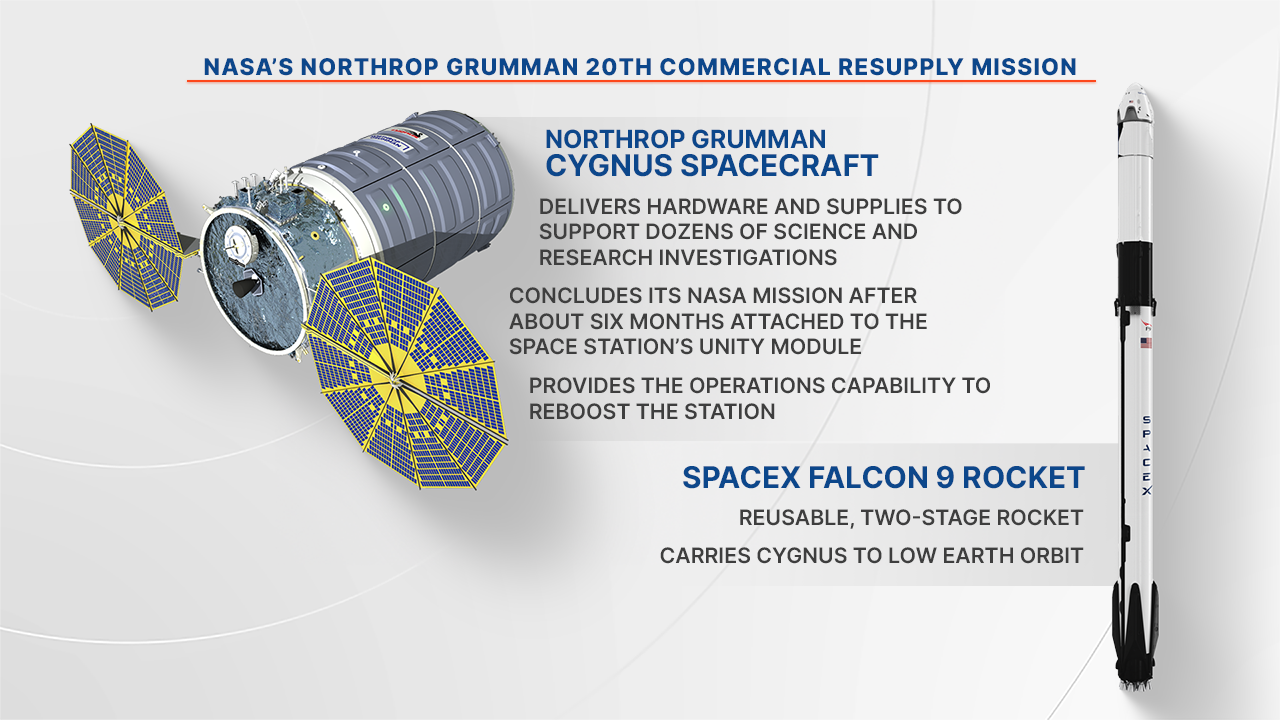
NASA's Northrop Grumman 20th commercial resupply mission will launch atop a SpaceX Falcon 9 rocket to deliver science and supplies to the International Space Station.
NASA’s Northrop Grumman 20th commercial resupply mission will launch atop a SpaceX Falcon 9 rocket to deliver science and supplies to the International Space Station.
NASA
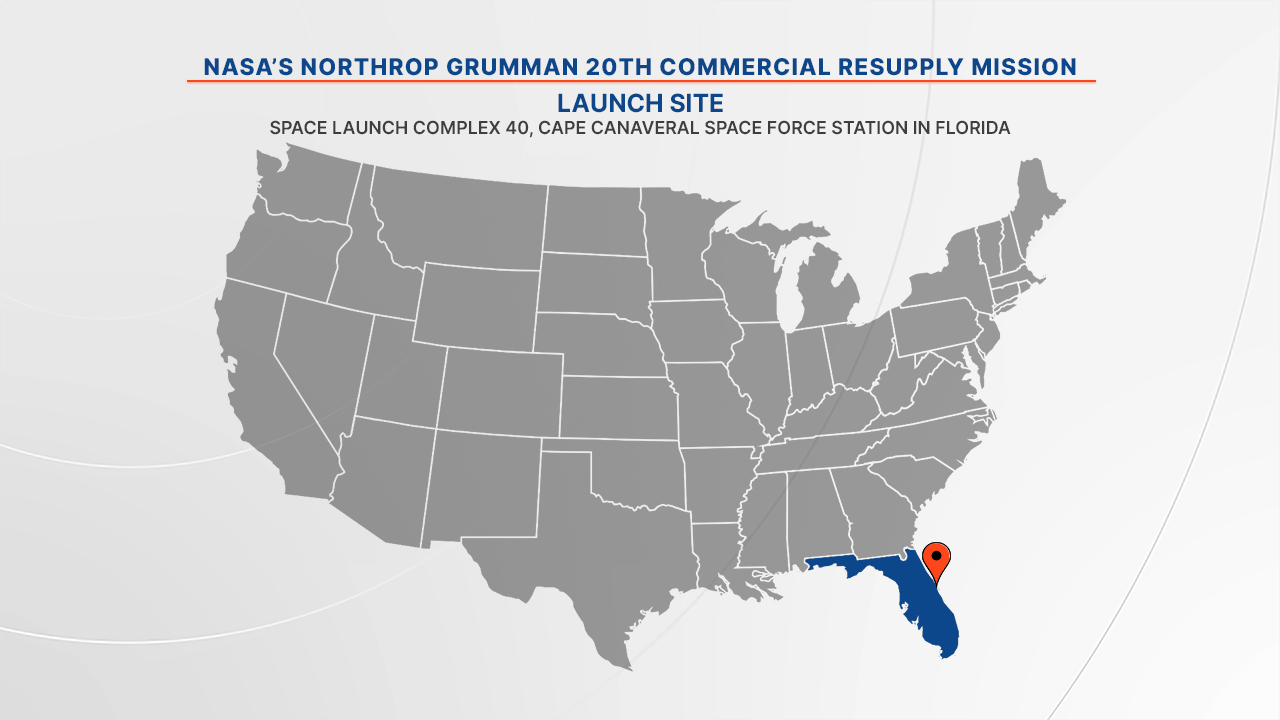
NASA's Northrop Grumman 20th commercial resupply mission will launch from Space Launch Complex 40 at Cape Canaveral Space Force Station in Florida.
NASA’s Northrop Grumman 20th commercial resupply mission will launch from Space Launch Complex 40 at Cape Canaveral Space Force Station in Florida.
NASA

NASA, Northrop Grumman, and SpaceX are targeting 12:29 p.m. EST on Monday, Jan. 29, for the next launch to deliver science investigations, supplies, and equipment to the International Space Station. Filled with more than 7,800 pounds of supplies, the Cygnus cargo spacecraft, carried atop the SpaceX Falcon 9 rocket, will launch from Space Launch Complex 40 at Cape Canaveral Space Force Station in Florida. This launch is the 20th Northrop Grumman commercial resupply services mission to the orbital laboratory for the agency. The backup launch opportunity will be at 12:07 p.m. Tuesday, Jan. 30.

Live launch coverage will begin at 12:15 p.m. and air on NASA+, NASA Television, the NASA app, YouTube, and on the agency’s website, with prelaunch events starting Wednesday, Jan. 24. Learn how to stream NASA TV through a variety of platforms

Learn more at:  nasa.gov/northropgrumman

Northrop Grumman S.S. Patricia “Patty” Hilliard Robertson
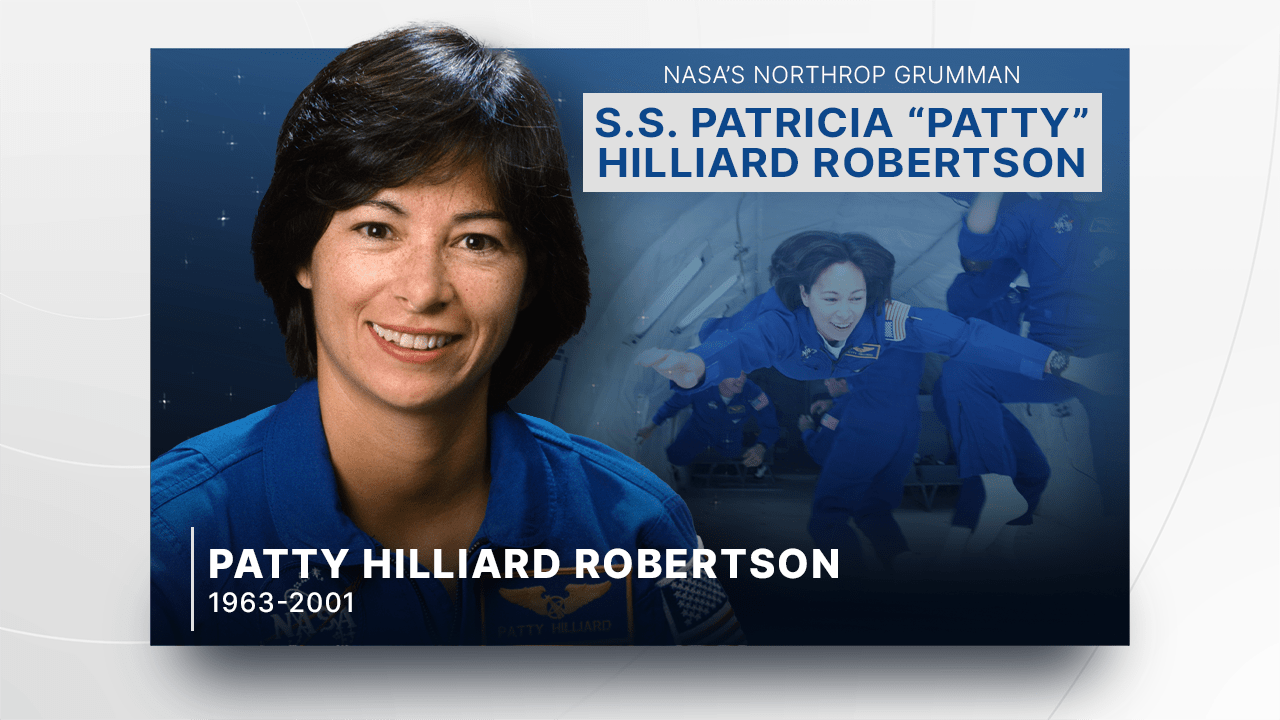
Patricia Robertson was selected as a NASA astronaut in 1998 and scheduled to fly to the International Space Station in 2002, before her untimely death in 2001 from injuries sustained in a private plane crash.
NASA

Arrival & Departure

The Cygnus spacecraft will arrive at the orbiting laboratory at 3:35 a.m. Wednesday, Jan. 31, filled with supplies, hardware, and critical materials to directly support dozens of science and research investigations during Expeditions 70 and 71. NASA astronaut Jasmin Moghbeli will capture Cygnus using the station’s robotic arm, and NASA astronaut Loral O’Hara will act as backup.

After capture, the spacecraft will be installed on the Unity module’s Earth-facing port and will spend about six months connected to the orbiting laboratory before departing in May. Cygnus also provides the operational capability to reboost the station’s orbit.

After departure, the Kentucky Re-entry Probe Experiment-2 (KREPE-2), stowed inside Cygnus, will take measurements to demonstrate a thermal protection system for spacecraft and their contents during re-entry in Earth’s atmosphere, which can be difficult to replicate in ground simulations.

Live coverage of Cygnus’ arrival will begin at 2 a.m., Wednesday, Jan. 31.
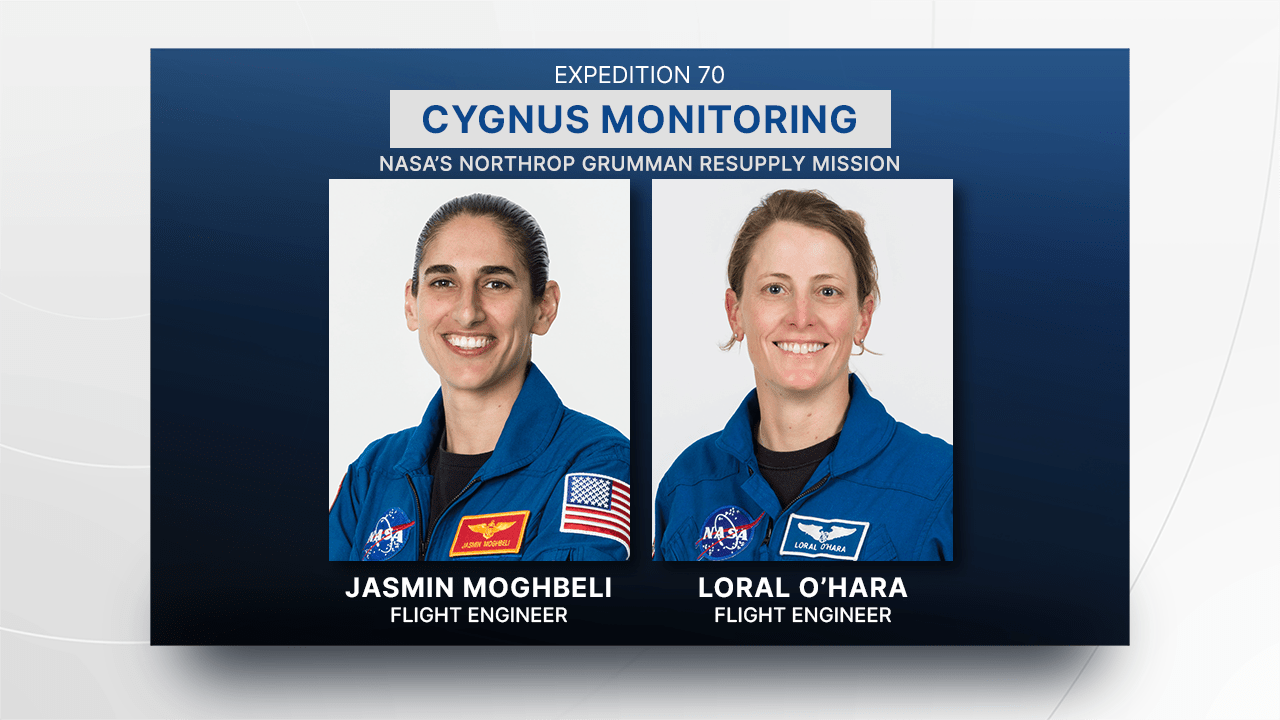
NASA astronauts Jasmin Moghbeli and Loral O'Hara will be on duty during the Cygnus cargo craft's aproach and rendezvous. Moghbeli will be at the controls of the Canadarm2 ready to capture Cygnus as O’Hara monitors the vehicle’s arrival.
NASA astronauts Jasmin Moghbeli and Loral O’Hara will be on duty during the Cygnus cargo craft’s aproach and rendezvous. Moghbeli will be at the controls of the Canadarm2 robotic arm ready to capture Cygnus as O’Hara monitors the vehicle’s arrival.
NASA

Research Highlights

Scientific investigations traveling in the Cygnus spacecraft include tests of a 3D metal printer, semiconductor manufacturing, and thermal protection systems for re-entry to Earth’s atmosphere.

3D Printing in Space
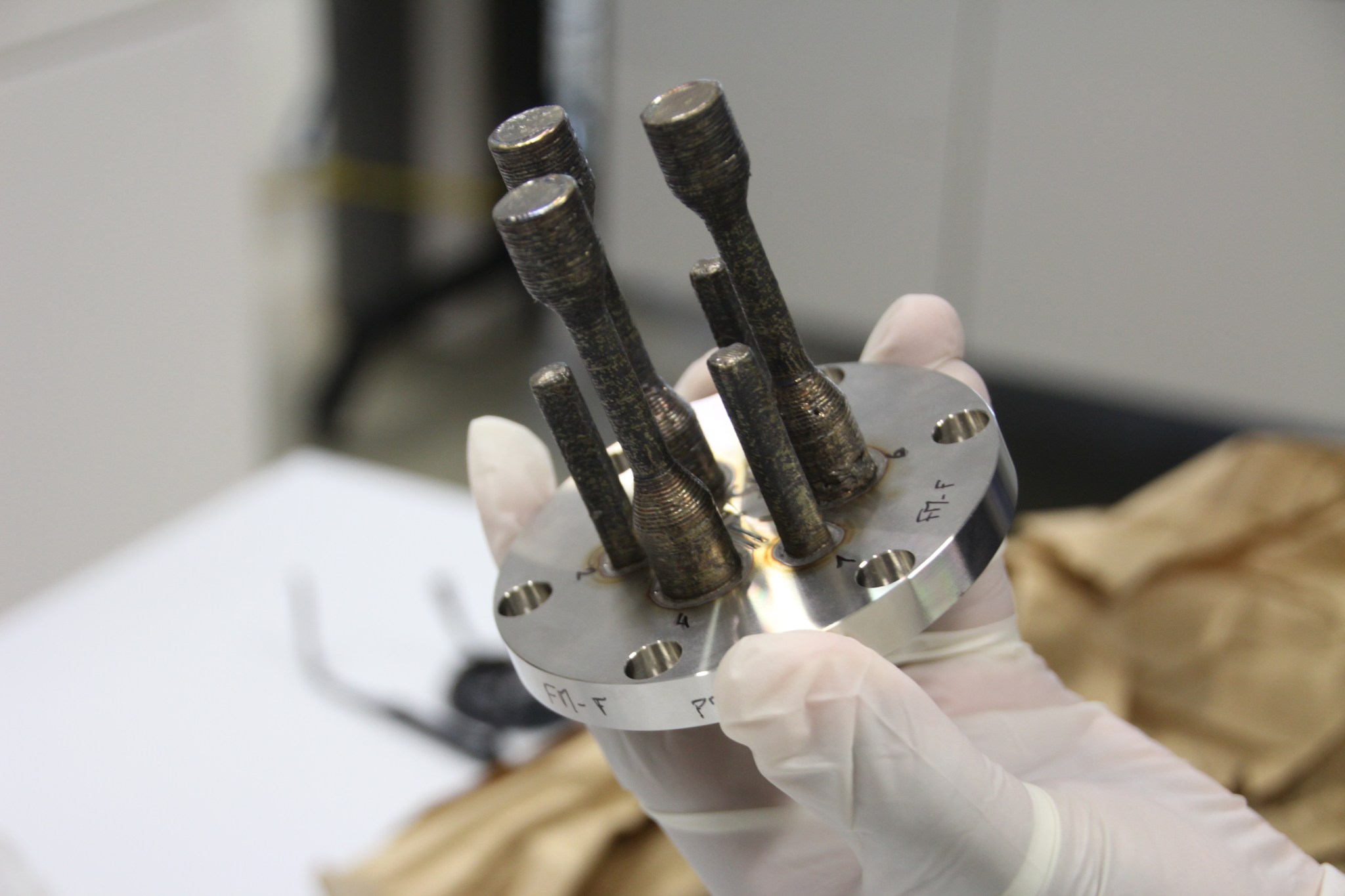
Samples produced by the Metal 3D Printer prior to launch to the space station.
ESA (European Space Agency)

An investigation from ESA (European Space Agency), Metal 3D Printer tests additive manufacturing or 3D printing of small metal parts in microgravity.

“This investigation provides us with an initial understanding of how such a printer behaves in space,” said Rob Postema of ESA. “A 3D printer can create many shapes, and we plan to print specimens, first to understand how printing in space may differ from printing on Earth and second to see what types of shapes we can print with this technology. In addition, this activity helps show how crew members can work safely and efficiently with printing metal parts in space.”

Results could improve understanding of the functionality, performance, and operations of metal 3D printing in space, as well as the quality, strength, and characteristics of the printed parts. Resupply presents a challenge for future long-duration human missions. Crew members could use 3D printing to create parts for maintenance of equipment on future long-duration spaceflight and on the Moon or Mars, reducing the need to pack spare parts or to predict every tool or object that might be needed, saving time and money at launch.

Advances in metal 3D printing technology also could benefit potential applications on Earth, including manufacturing engines for the automotive, aeronautical, and maritime industries and creating shelters after natural disasters.

Semiconductor Manufacturing in Microgravity
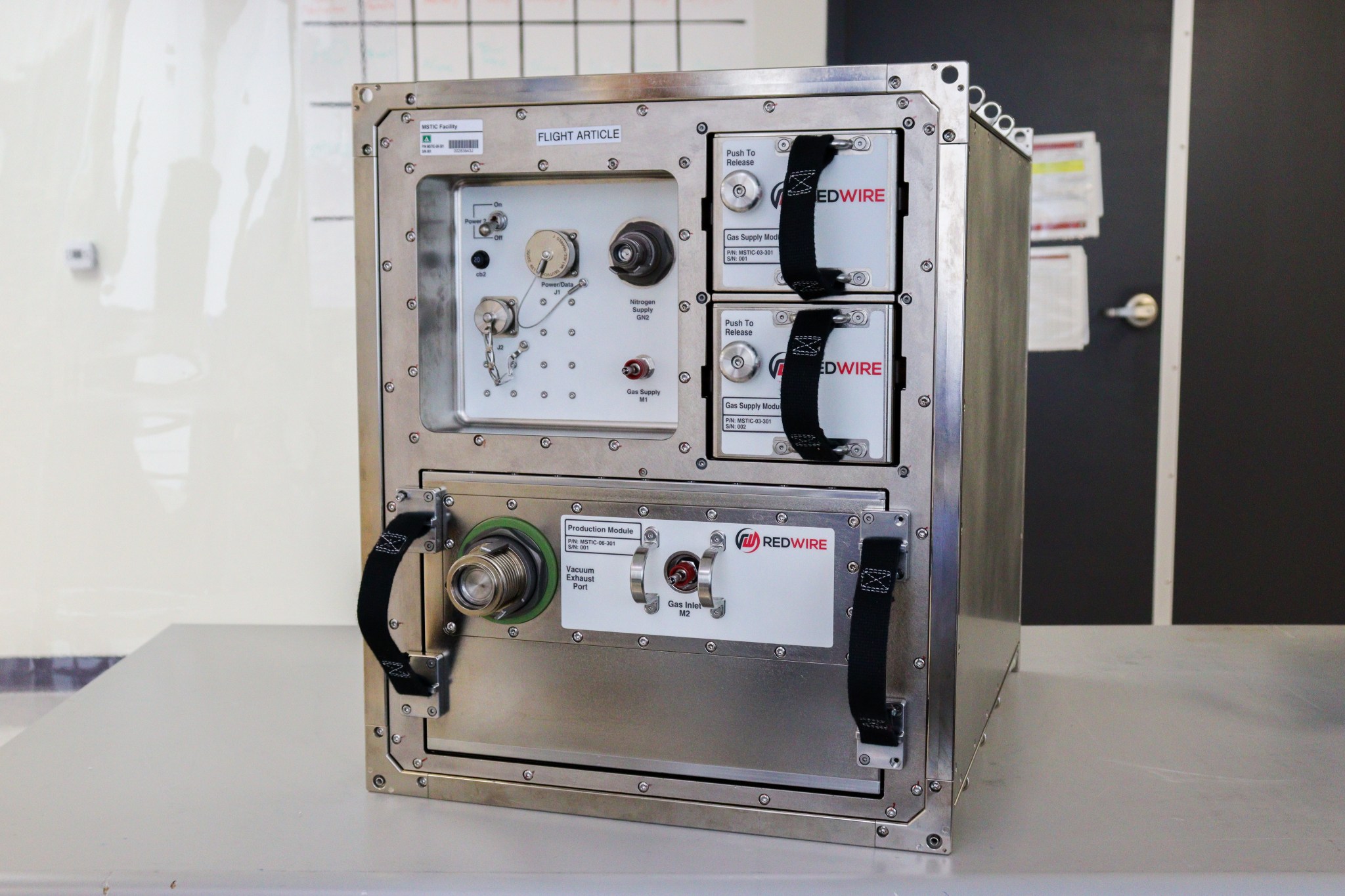
The gas supply modules and production module for Redwire's MSTIC investigation.
The gas supply modules and production module for Redwire’s MSTIC investigation.
Redwire

Manufacturing of Semiconductors and Thin-Film Integrated Coatings (MSTIC) examines how microgravity affects thin films that have a wide range of uses.

This technology could enable autonomous manufacturing to replace the many machines and processes currently used to make a wide range of semiconductors, potentially leading to the development of more efficient and higher-performing electrical devices.

Manufacturing semiconductor devices in microgravity also may improve their quality and reduce the materials, equipment, and labor required. On future long-duration missions, this technology could provide the capability to produce components and devices in space, reducing the need for resupply missions from Earth. The technology also has applications for devices that harvest energy and provide power on Earth.

Modeling Atmospheric Re-Entry
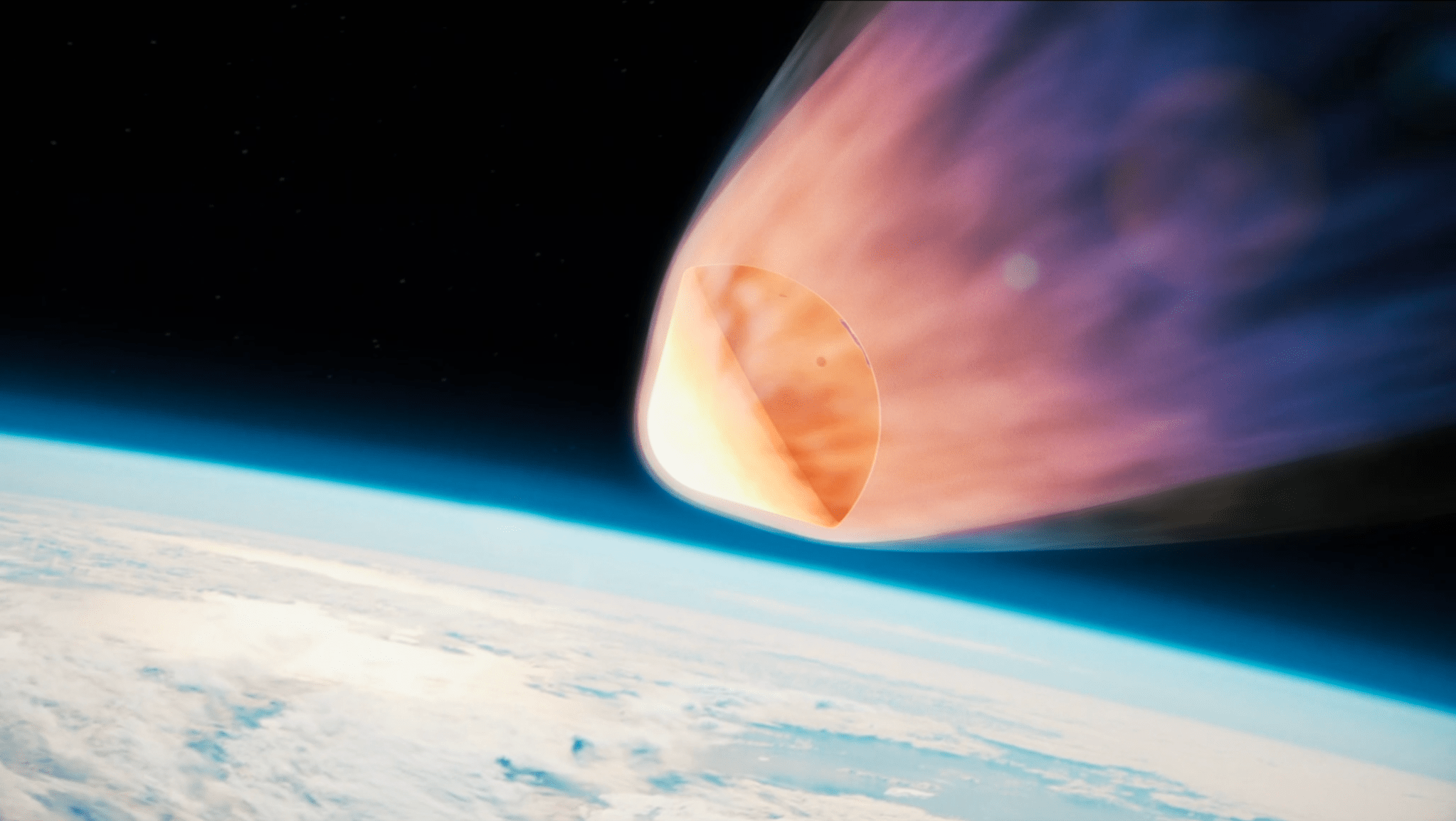
An artist’s rendering of one of the Kentucky Re-entry Probe Experiment-2 (KREPE-2) capsules during re-entry.
University of Kentucky

Scientists who conduct research on the space station often return their experiments to Earth for additional analysis and study. But the conditions that spacecraft experience during atmospheric reentry, including extreme heat, can have unintended effects on their contents. Thermal protection systems used to shield spacecraft and their contents are based on numerical models that often lack validation from actual flight, which can lead to significant overestimates in the size of system needed and take up valuable space and mass. Kentucky Re-entry Probe Experiment-2 (KREPE-2), part of an effort to improve thermal protection system technology, uses three capsules outfitted with different heat shield materials and a variety of sensors to obtain data on actual reentry conditions.

“Building on the success of KREPE-1, we have improved the sensors to gather more measurements and improved the communication system to transmit more data,” said Alexandre Martin, principal investigator at the University of Kentucky. “We have the opportunity to test several heat shields provided by NASA that have never been tested before, and another manufactured entirely at the University of Kentucky, also a first.”

The capsules can be outfitted for other atmospheric re-entry experiments, supporting improvements in heat shielding for applications on Earth, such as protecting people and structures from wildfires.

Remote Robotic Surgery

The surgical robot during testing on the ground before launch.
Virtual Incision Corporation

Robotic Surgery Tech Demo tests the performance of a small robot that can be remotely controlled from Earth to perform surgical procedures. Researchers plan to compare procedures in microgravity and on Earth to evaluate the effects of microgravity and time delays between space and ground.

The robot uses two “hands” to grasp and cut rubber bands, which simulate surgical tissue and provide tension that is used to determine where and how to cut, according to Shane Farritor, chief technology officer at Virtual Incision Corp., developer of the investigation with the University of Nebraska.

Longer space missions increase the likelihood that crew members may need surgical procedures, whether simple stiches or an emergency appendectomy. Results from this investigation could support development of robotic systems to perform these procedures. In addition, the availability of a surgeon in rural areas of the country declined nearly a third between 2001 and 2019. Miniaturization and the ability to remotely control the robot help make surgery available anywhere and anytime on Earth. 

NASA has sponsored research on miniature robots for more than 15 years. In 2006, remotely operated robots performed procedures in the underwater NASA’s Extreme Environment Mission Operations (NEEMO) 9 mission. In 2014, a miniature surgical robot performed simulated surgical tasks on the zero-g parabolic airplane.

Growing Cartilage Tissue in Space
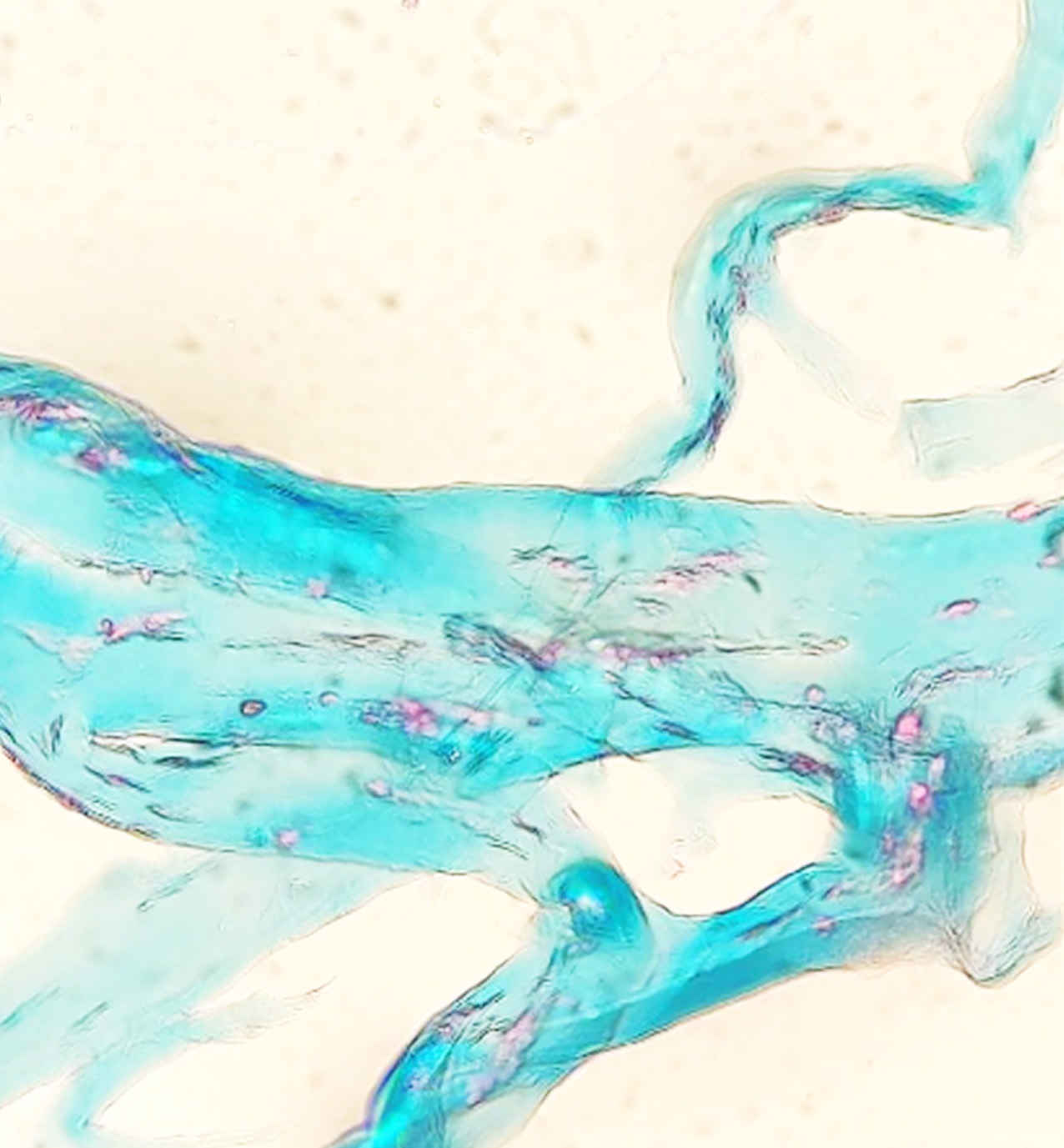
The Janus Base Nano-matrix anchor cartilage cells (red) and facilitates the formation of the cartilage tissue matrix (green).
University of Connecticut

Compartment Cartilage Tissue Construct demonstrates two technologies, Janus Base Nano-Matrix and Janus Base Nanopiece. Nano-Matrix is an injectable material that provides a scaffold for formation of cartilage in microgravity, which can serve as a model for studying cartilage diseases. Nanopiece delivers an RNA (ribonucleic acid)-based therapy to combat diseases that cause cartilage degeneration.

Cartilage has a limited ability to self-repair and osteoarthritis is a leading cause of disability in older patients on Earth. Microgravity can trigger cartilage degeneration that mimics the progression of aging-related osteoarthritis but happens more quickly, so research in microgravity could lead to faster development of effective therapies. Results from this investigation could advance cartilage regeneration as a treatment for joint damage and diseases on Earth and contribute to development of ways to maintain cartilage health on future missions to the Moon and Mars.

Cargo Highlights

SpaceX’s Falcon 9 rocket will launch the Northrop Grumman Cygnus spacecraft to the International Space Station
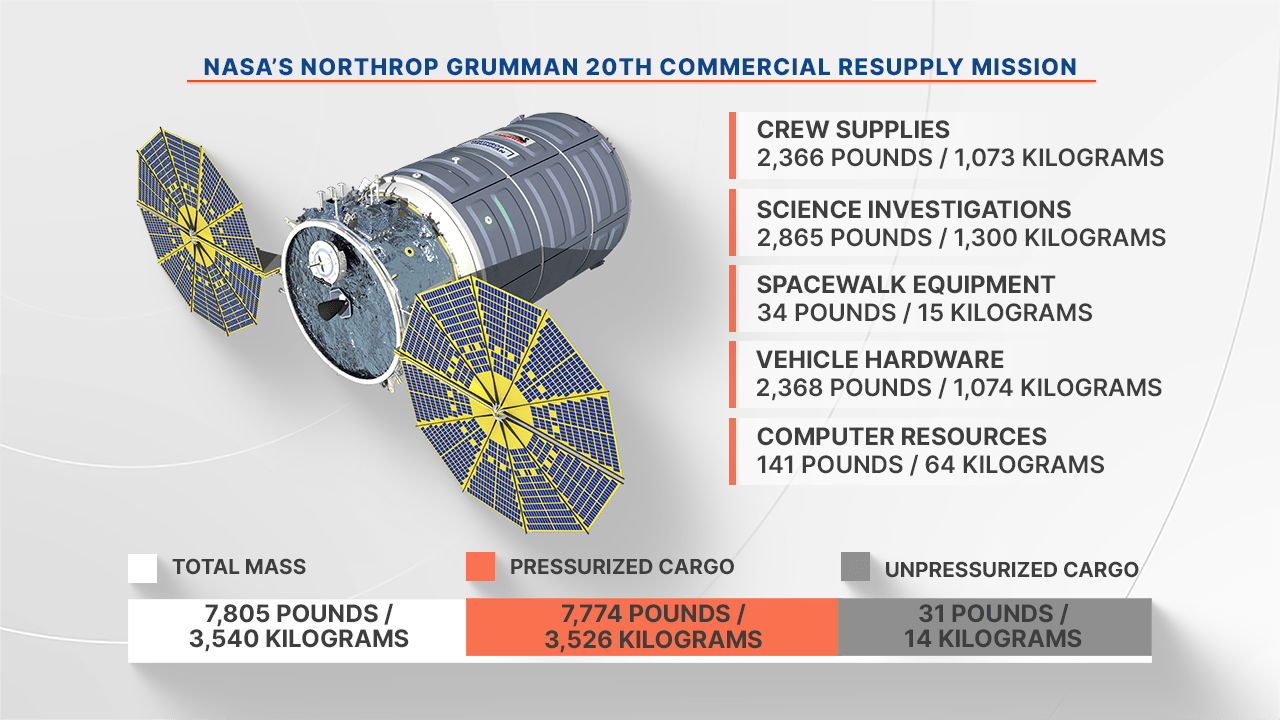
NASA's Northrop Grumman 20th commercial resupply mission will carry 7,805 pounds (3,540 kilograms) of cargo to the International Space Station.
NASA’s Northrop Grumman 20th commercial resupply mission will carry 7,805 pounds (3,540 kilograms) of cargo to the International Space Station.
NASA

Hardware  

  • Hydrogen Dome Assembly includes all  hydrogen and oxygen electrolysis replacement components within the International Space Station’s Oxygen Generation Assembly. These items are contained in a sub-ambient dome maintained at near vacuum pressure, designed to contain an explosion or fire in the electrolysis cell stack during operation. The dome provides a second barrier to protect against cabin air internal leakage and external leakage into the rack environment, and is pressurized with nitrogen gas for launch. This will launch as an  on-orbit spare.
  • Ion Exchange Bed — The ion exchange bed replacement unit consists of a pair of tubes in series containing ion exchange resins, which remove organic acids from the catalytic reactor effluent, and microbial check valve resin, which injects iodine into the water as a biocide agent. This will launch  as an on-orbit spare.
  • Catalytic Reactor — The catalytic reactor replacement unit oxidizes volatile organics from the wastewater so they can be removed by the gas separator and ion exchange bed replacement units as part of the station’s water recycling system. This will launch as an on-orbit spare.
  • Biocide Maintenance Canister — The Internal Thermal Control System Coolant Maintenance Assembly is designed to administer o-phthalaldehyde, a biocide used to purify the internal cooling loops in the Destiny laboratory, and the Harmony, Tranquility, Columbus, and Japanese Experiment Modules, to prevent the growth of microorganisms in the thermal control system. This unit will replace the current one installed in the laboratory.
  • Cylinder Flywheel — The ARED (Advanced Resistive Exercise Device) cylinder-flywheel assemblies provide the resistive loads for astronaut anaerobic exercise. The cylinder flywheels impart inertial forces to simulate Earth’s gravity during exercise.
  • International Space Station Roll Out Solar Array Modification Kit 7 – This upgrade kit consists of upper, mid, and lower struts (one each for left and right), a backbone, brackets, and support hardware for the new solar panels. This is the third in series of four modification kits needed to support the installation of the fourth set of upgraded solar arrays. The new arrays are designed to augment the station’s original solar arrays which have degraded over time. The replacement solar arrays are installed on top of existing arrays to provide a net increase in power with each array generating more than 20 kilowatts of power.
  • Urine Processor Assembly Pressure Control and Pump Assembly — The assembly evacuates the urine distillation assembly at startup and periodically purges non-condensable gases and water vapor and pumps them to the separator plumbing assembly. The purge pump housing and pressure control and pump assembly manifolds are liquid cooled to promote steam condensation, thereby reducing the volume of the purge gas. All these systems make up the system used to covert urine to drinking water.
  • Collection Packet and Adapter — Required for minimal, nominal water microbial sampling. In-flight water quality assessment is needed to assure that water of acceptable, defined quality will be available aboard the space station.

Watch and Engage

Live coverage of the launch from Cape Canaveral Space Force Station in Cape Canaveral, Florida, will air on NASA TV, NASA+ and the agency’s website. Live coverage will begin at 12:15 p.m.

Live coverage of Cygnus’ rendezvous and capture at the space station will begin at 3:35 a.m. Jan. 31. Read more about how to watch and engage.

Powered by WPeMatico

Get The Details…
Mark A. Garcia

Crews Study Eyes, Physics and Prep for Cygnus Cargo Mission

Crews Study Eyes, Physics and Prep for Cygnus Cargo Mission

Astronauts (from left) Jasmin Moghbeli and Loral O'Hara are pictured inside the International Space Station's cupola holding NASA's first graphc novel,
Astronauts (from left) Jasmin Moghbeli and Loral O’Hara are pictured inside the International Space Station’s cupola holding NASA’s first graphic novel, “First Woman.”

Human research and space physics were the dominant science topics aboard the International Space Station on Thursday. The Expedition 70 crew is also preparing for a U.S. cargo mission targeted to launch next week.

NASA astronaut Jasmin Moghbeli and Roscosmos cosmonaut Konstantin Borisov took turns as crew medical officer on Thursday and performed eye scans of their crewmates using the Ultrasound 2 device. Moghbeli operated the device imaging the eyes of Commander Andreas Mogensen and Flight Engineer Satoshi Furukawa. Borisov also scanned Roscosmos Flight Engineer Nikolai Chub’s eyes. Doctors on the ground monitored and assisted the diagnostic exam in real-time. The ultrasound scanning procedure uses high-frequency soundwaves to observe how microgravity affects a crew member’s eye structure.

Afterward, Mogensen from ESA (European Space Agency) and Furukawa from JAXA (Japan Aerospace Exploration Agency) reviewed procedures planned for the Wednesday, Jan. 31, arrival and capture of the Northrop Grumman Cygnus cargo craft. Moghbeli joined NASA Flight Engineer Loral O’Hara and practiced on a computer capturing Cygnus with the Canadarm2 robotic arm. The duo will be on duty Wednesday with Moghbeli at the controls of the Canadarm2 while O’Hara monitors the vehicle’s approach and rendezvous. Cygnus is counting down to a launch at 12:29 p.m. EST on Monday aboard a SpaceX Falcon 9 rocket from Kennedy Space Center.

The astronaut quartet still had time for other activities including more research, Axiom Mission 3 (Ax-3) crew assistance, and lab maintenance. Mogensen explored virtual reality movies as a method to maintain crew mental health while Furukawa swapped samples inside a specialized microgravity furnace. O’Hara set up the Life Science Glovebox (LSG) for an Ax-3 physics study as Moghbeli serviced life support components.

Ax-3 Commander Michael López-Alegría and Mission Specialist Alper Gezeravcı used the glovebox and explored particle dynamics, or how solid particles and gases mix in weightlessness. Results may lead to advanced space propulsion and zero carbon emission solutions. Pilot Walter Villadei tested a new spacesuit, documented his meals, and photographed Earth’s thunderstorms. Finally, Mission Specialist Marcus Wandt tested an artificial intelligence mobile device then supplied gas for a plasma physics study.

At the beginning of the day, Chub and Borisov had another ultrasound test as they scanned their stomachs after breakfast for a space digestion study. Chub then moved on to a fluid physics study while Borisov worked on photographic duties. Veteran cosmonaut Oleg Kononenko photographed Roscosmos biology research hardware and continued ongoing Zvezda service module inspections.


Learn more about station activities by following the space station blog@space_station and @ISS_Research on X, as well as the ISS Facebook and ISS Instagram accounts.

Get weekly video highlights at: https://roundupreads.jsc.nasa.gov/videoupdate/

Get the latest from NASA delivered every week. Subscribe here: www.nasa.gov/subscribe

Powered by WPeMatico

Get The Details…

Mark Garcia

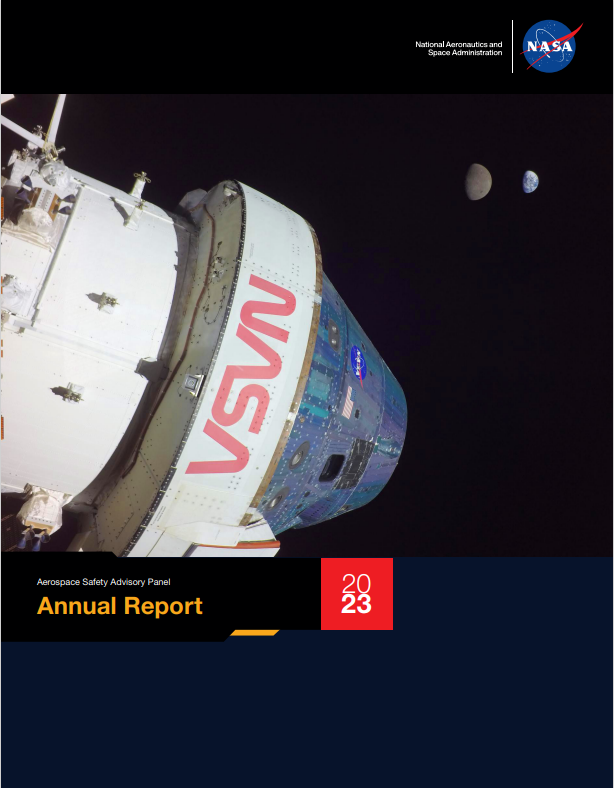
NASA’s Aerospace Safety Advisory Panel Releases 2023 Annual Report

NASA’s Aerospace Safety Advisory Panel Releases 2023 Annual Report

The Aerospace Safety Advisory Panel (ASAP), an advisory committee that reports to NASA and Congress, issued its 2023 annual report Thursday examining the agency’s safety performance, accomplishments, and challenges over the past year. 

The report highlights 2023 activities and observations on NASA’s:

  • Strategic Vision and Guiding Principles
  • Agency Governance
  • Moon to Mars Program Management

In 2023, NASA continued to make meaningful progress toward meeting the intent of the broad-ranging recommendations the panel made in 2022. As a result, the ASAP’s latest report includes information on the advances NASA made in its operations, decision-making, program and personnel management, and the tasks that remain.

“This report reflects the panel’s strong emphasis on strategic-level aspects of NASA leadership, risk management, and safety culture – a primary focus over the past two years – while also giving attention to the tactical level of technical execution. We believe that the principles and processes the agency employs to evaluate and make decisions, manage programs, and communicate to its workforce have a direct and consequential impact on safety and mission assurance,” said Dr. Patricia Sanders, ASAP chair. “We also highlight some steps that the Congress can take to assist NASA in safely accomplishing its challenging mission.”

The report highlights the progress made toward top recommendations offered in 2022, including the establishment of a Moon to Mars Program Office, as well as the NASA 2040 new agencywide initiative to operationalize the agency’s vision and strategic objectives across headquarters and centers.

Furthermore, this report addresses safety assessments for both the Moon to Mars Program and the operations – current and future – in low Earth orbit. It also touches on relevant areas of human health and medicine in space, regulatory requirements for commercial space operations as they affect NASA, and the impact of budget constraints and uncertainty on safety.

The 2023 report provides details on the concrete actions the agency should take to fulfill the 2022 recommendations. It spotlights recommendations for the agency moving ahead, including the establishment of a comprehensive International Space Station to Commercial low Earth Orbit destination transition plan.

The report is based on the panel’s 2023 fact-finding and quarterly public meetings; direct observations of NASA operations and decision-making; discussions with NASA management, employees, and contractors; and the panel members’ past experiences.

Congress established the panel in 1968 to provide advice and make recommendations to the NASA administrator on safety matters after the 1967 Apollo 1 fire claimed the lives of three American astronauts.

For more information about the ASAP, view the 2023 report or reports from previous years, visit:

https://oiir.hq.nasa.gov/asap

-end-

Roxana Bardan
Headquarters, Washington
202-358-1600
roxana.bardan@nasa.gov

Share

Details

Last Updated

Jan 25, 2024

Powered by WPeMatico

Get The Details…
Roxana Bardan

Kennedy Honors Fallen During Day of Remembrance

Kennedy Honors Fallen During Day of Remembrance

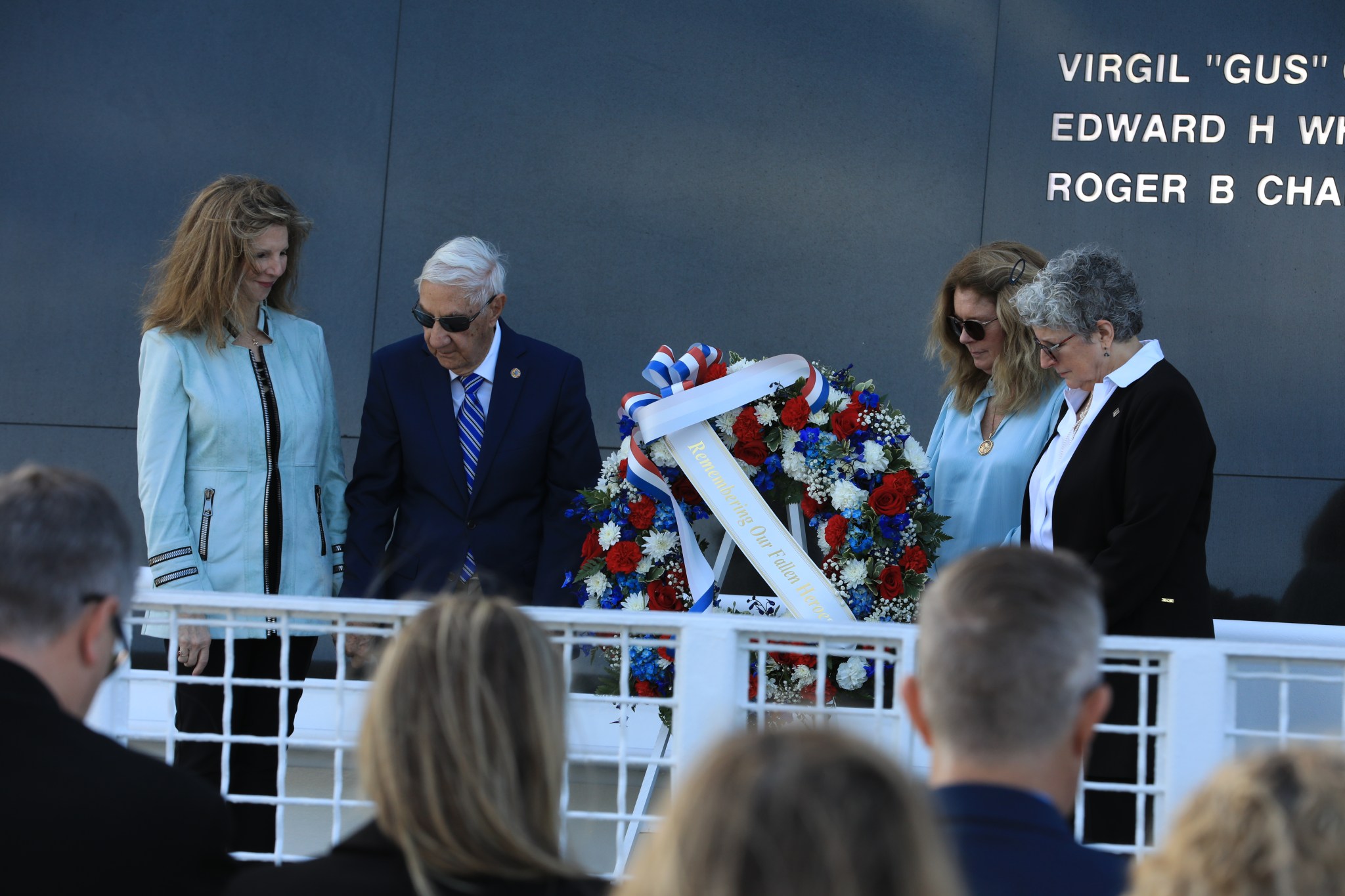
Family members of fallen astronauts Kathie Scobee Fulgham, Lowell Grissom, Sheryl Chaffee, and Karen Bassett Stevenson place a wreath at the Space Mirror Memorial at NASA’s Kennedy Space Center Visitor Complex in Florida on Thursday, Jan. 25, 2024, during the agency’s Day of Remembrance.

Family members of fallen astronauts Kathie Scobee Fulgham, Lowell Grissom, Sheryl Chaffee, and Karen Bassett Stevenson place a wreath at the Space Mirror Memorial at NASA’s Kennedy Space Center Visitor Complex in Florida on Thursday, Jan. 25, 2024, during the agency’s Day of Remembrance. The annual tradition pays tribute to fallen astronauts and astronaut candidates who lost their lives while furthering the cause of exploration and discovery, including the crews of Apollo 1, Challenger STS-51L, and Columbia STS-107.

Burt Summerfield, associate director, management, at NASA’s Kennedy Space Center in Florida, spoke during the annual Day of Remembrance to honor fallen astronauts and astronaut candidates. “Today is an important day for NASA and the nation to recognize the contribution and sacrifice made in pursuit of space exploration and discovery for all.” Summerfield said. “As we push forward to the Moon and continue our missions to the International Space Station, it’s vital that we always remember and implement the lessons from the past in our preparations.”

View additional photos of the Day of Remembrance here.

Image Credit: NASA/Kim Shiflett

Powered by WPeMatico

Get The Details…
Elyna N. Niles-Carnes

After Three Years on Mars, NASA’s Ingenuity Helicopter Mission Ends

After Three Years on Mars, NASA’s Ingenuity Helicopter Mission Ends

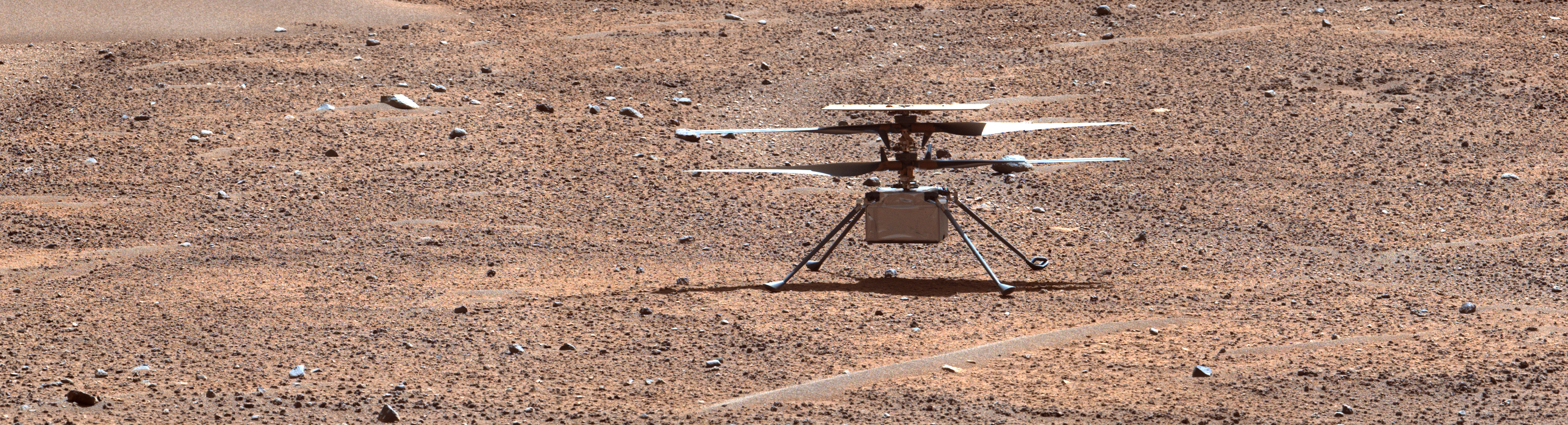
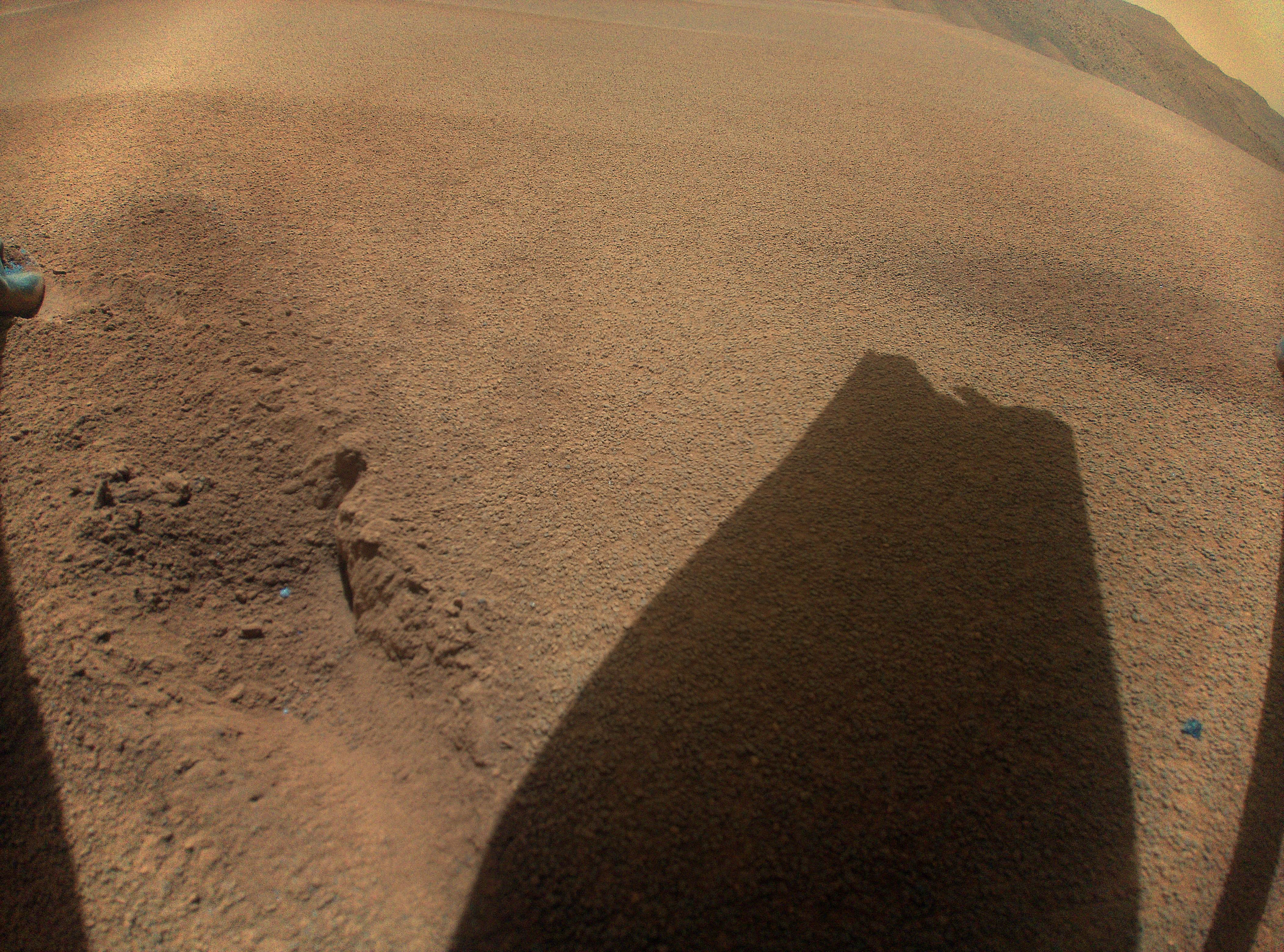
NASA’s history-making Ingenuity Mars Helicopter has ended its mission at the Red Planet after surpassing expectations and making dozens more flights than planned. While the helicopter remains upright and in communication with ground controllers, imagery of its Jan. 18 flight sent to Earth this week indicates one or more of its rotor blades sustained damage during landing, and it is no longer capable of flight.

Originally designed as a technology demonstration to perform up to five experimental test flights over 30 days, the first aircraft on another world operated from the Martian surface for almost three years, performed 72 flights, and flew more than 14 times farther than planned while logging more than two hours of total flight time.

“The historic journey of Ingenuity, the first aircraft on another planet, has come to end,” said NASA Administrator Bill Nelson. “That remarkable helicopter flew higher and farther than we ever imagined and helped NASA do what we do best – make the impossible, possible. Through missions like Ingenuity, NASA is paving the way for future flight in our solar system and smarter, safer human exploration to Mars and beyond.”

NASA to Discuss Ingenuity Mission in Media Call Today

In addition to video comments shared from Nelson about the mission’s conclusion, NASA will host a media teleconference at 5 p.m. EST today, Thursday, Jan. 25, to provide an update on Ingenuity Mars Helicopter.

Audio of the call will stream live on the agency’s website.

Participants in the call are expected to include:

  • Lori Glaze, director, Planetary Science Division, NASA’s Science Mission Directorate at the agency’s headquarters in Washington
  • Laurie Leshin, director, NASA’s Jet Propulsion Laboratory in Southern California
  • Teddy Tzanetos, Ingenuity project manager, NASA JPL

Media who wish to participate by phone can request dial-in information by emailing hq-media@mail.nasa.gov.

Ingenuity landed on Mars Feb. 18, 2021, attached to the belly of NASA’s Perseverance rover and first lifted off the Martian surface on April 19, proving that powered, controlled flight on Mars was possible. After notching another four flights, it embarked on a new mission as an operations demonstration, serving as an aerial scout for Perseverance scientists and rover drivers. In 2023, the helicopter executed two successful flight tests that further expanded the team’s knowledge of its aerodynamic limits.

“At NASA JPL, innovation is at the heart of what we do,” said Leshin. “Ingenuity is an exemplar of the way we push the boundaries of what’s possible every day. I’m incredibly proud of our team behind this historic technological achievement and eager to see what they’ll invent next.” 

Ingenuity’s team planned for the helicopter to make a short vertical flight on Jan. 18 to determine its location after executing an emergency landing on its previous flight. Data shows that, as planned, the helicopter achieved a maximum altitude of 40 feet (12 meters) and hovered for 4.5 seconds before starting its descent at a velocity of 3.3 feet per second (1 meter per second).

However, about 3 feet (1 meter) above the surface, Ingenuity lost contact with the rover, which serves as a communications relay for the rotorcraft. The following day, communications were reestablished and more information about the flight was relayed to ground controllers at NASA JPL. Imagery revealing damage to the rotor blade arrived several days later. The cause of the communications dropout and the helicopter’s orientation at time of touchdown are still being investigated.

Triumphs, Challenges

Over an extended mission that lasted for almost 1,000 Martian days, more than 33 times longer than originally planned, Ingenuity was upgraded with the ability to autonomously choose landing sites in treacherous terrain, dealt with a dead sensor, cleaned itself after dust storms, operated from 48 different airfields, performed three emergency landings, and survived a frigid Martian winter.

Designed to operate in spring, Ingenuity was unable to power its heaters throughout the night during the coldest parts of winter, resulting in the flight computer periodically freezing and resetting. These power “brownouts” required the team to redesign Ingenuity’s winter operations in order to keep flying.

With flight operations now concluded, the Ingenuity team will perform final tests on helicopter systems and download the remaining imagery and data in Ingenuity’s onboard memory. The Perseverance rover is currently too far away to attempt to image the helicopter at its final airfield.

“It’s humbling Ingenuity not only carries onboard a swatch from the original Wright Flyer, but also this helicopter followed in its footsteps and proved flight is possible on another world,” said Ingenuity’s project manager, Teddy Tzanetos of NASA JPL. “The Mars helicopter would have never flown once, much less 72 times, if it were not for the passion and dedication of the Ingenuity and Perseverance teams. History’s first Mars helicopter will leave behind an indelible mark on the future of space exploration and will inspire fleets of aircraft on Mars – and other worlds – for decades to come.”

More About Ingenuity

The Ingenuity Mars Helicopter was built by NASA JPL, which also manages the project for NASA Headquarters. It is supported by NASA’s Science Mission Directorate. NASA’s Ames Research Center in California’s Silicon Valley and NASA’s Langley Research Center in Hampton, Virginia, provided significant flight performance analysis and technical assistance during Ingenuity’s development. AeroVironment Inc., Qualcomm, and SolAero also provided design assistance and major vehicle components. Lockheed Space designed and manufactured the Mars Helicopter Delivery System. At NASA Headquarters, Dave Lavery is the program executive for the Ingenuity Mars helicopter.

For more information about Ingenuity:

https://mars.nasa.gov/technology/helicopter

-end-

Alise Fisher / Alana Johnson
Headquarters, Washington
202-358-2546 / 202-358-1501
alise.m.fisher@nasa.govalana.r.johnson@nasa.gov

DC Agle
Jet Propulsion Laboratory, Pasadena, Calif.
818-393-9011
agle@jpl.nasa.gov

Share

Details

Last Updated

Jan 25, 2024

Powered by WPeMatico

Get The Details…
Abbey A. Donaldson