NASA Astronomer Sees Power in Community, Works to Build More

NASA Astronomer Sees Power in Community, Works to Build More
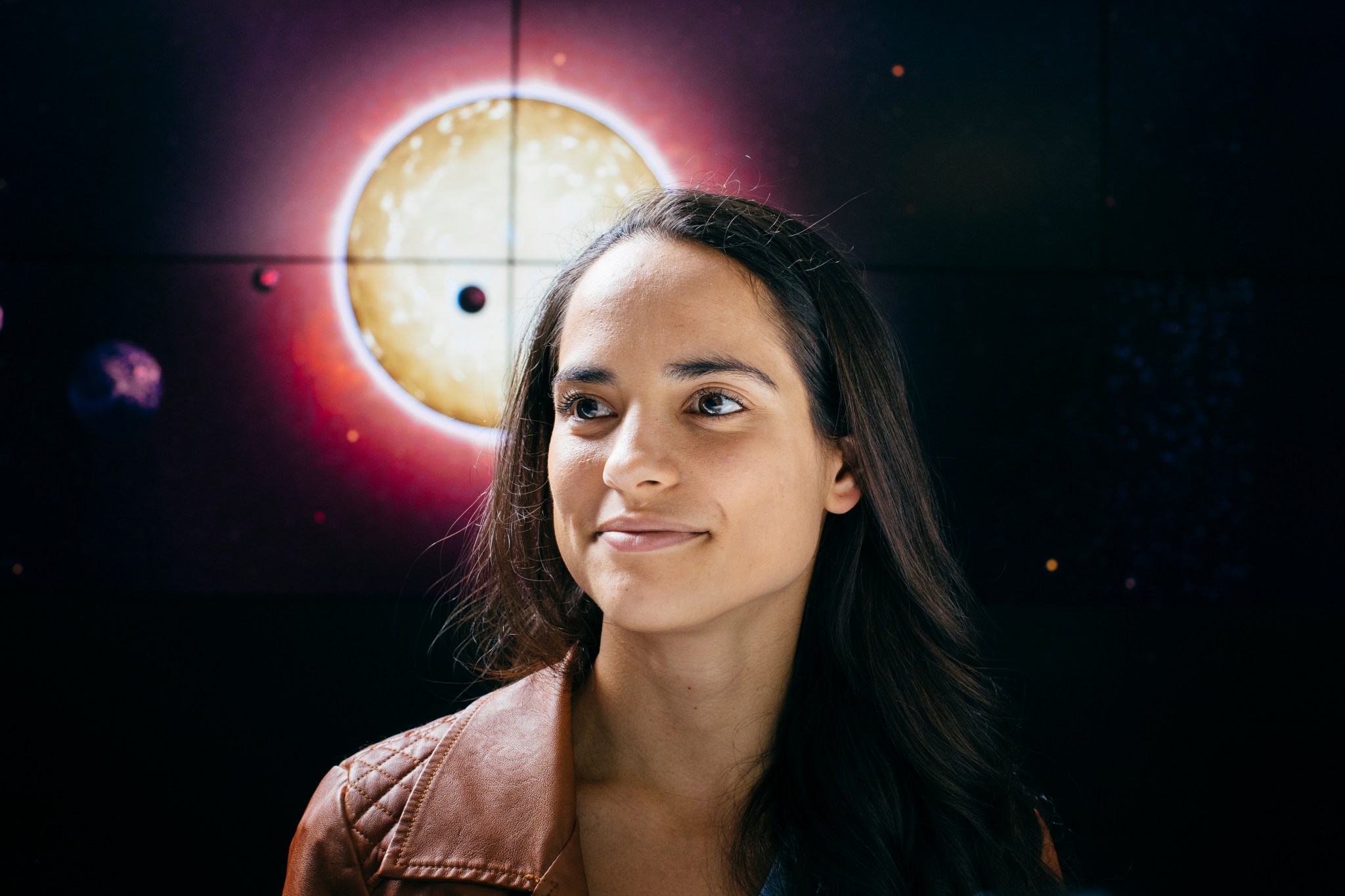
Dr. Natasha Batalha, an astronomer at NASA’s Ames Research Center in California’s Silicon Valley, says collaborating with her teams is one of the best parts of her job.
UC Santa Cruz, UC Regents

Science is often portrayed as a solitary affair, where discoveries are made by lone geniuses toiling in isolation. But Dr. Natasha Batalha, an astronomer at NASA’s Ames Research Center in California’s Silicon Valley, says solving problems with the people around her is one of the best parts of her job.

 “Oh, man, working with people is all I do!” said Batalha, whose current research involves using NASA’s James Webb Space Telescope to study exoplanets, planets outside our solar system that orbit other stars.

Batalha’s work explores hot, Jupiter-like exoplanets; smaller, rocky exoplanets more similar to Earth; and brown dwarfs, mysterious objects smaller than a star but huge compared to the biggest planets. A single question has driven her since she was a kid: “Does life exist beyond Earth?”

It’s a lofty question, bigger than any one scientist. And that’s the point.

“I love being part of a larger community,” she said, “We’re working together to try to solve this question that people have been asking for centuries.”

However, the particular joy of belonging wasn’t always present in Batalha’s life.

When she was 10, her family moved from Brazil to the U.S., where she was met with culture shock, pressure to assimilate, and a language barrier. She thinks the latter is partly why she gravitated toward the universal language of math.

Eventually, her interests and strengths took shape around astronomy. When she chose to study physics in college, followed by a dual PhD in astronomy and astrobiology, her parents – who are also scientists – helped fill in for the community she was otherwise lacking.

“In high school, I watched female students drop out of my physics classes,” Batalha said. “The honors physics track in college was devoid of women and people of color. I didn’t feel I had a community in my college classes.”

Her mother, Natalie Batalha, is an astronomer who served as project scientist for NASA’s Kepler space telescope– the mission that taught us there are more planets than stars. Natasha’s father is a LatinX physicist. Both her parents had already faced similar challenges in their careers, and having their example to look at of people who had successfully overcome those barriers helped her push on.  

“I identify as female and LatinX, which are both underrepresented groups in STEM,” she said, “but I also have a ton of privilege because my parents are in the field. That gave me a dual perspective on how powerful community is.”

I love being part of a larger community. We’re working together to try to solve this question that people have been asking for centuries.
Natasha Batalha

Natasha Batalha

NASA Astronomer

Since then, empowering her own science community has been a focus of Batalha’s work.

She builds open-source tools, like computer programs for interpreting data, that are available to all. They help scientists use Webb’s exoplanet data to study what climates they may have, the behavior of clouds in their atmospheres, and the chemistry at work there.

“I saw how limiting closed toolsets could be for the community, when only an ‘inner circle’ had access to them,” Batalha said. “So, I wanted to create new tools that would put everyone on the same footing.”

Batalha herself recently used Webb to explore the skies of exoplanet WASP-39 b, a hot gas giant orbiting a star 700 light-years away. She is part of the team that found carbon dioxide and sulfur dioxide there, marking the first time either was detected in an exoplanet atmosphere. Now, she is turning to the difficult-to-discern characteristics of smaller, cooler planets.
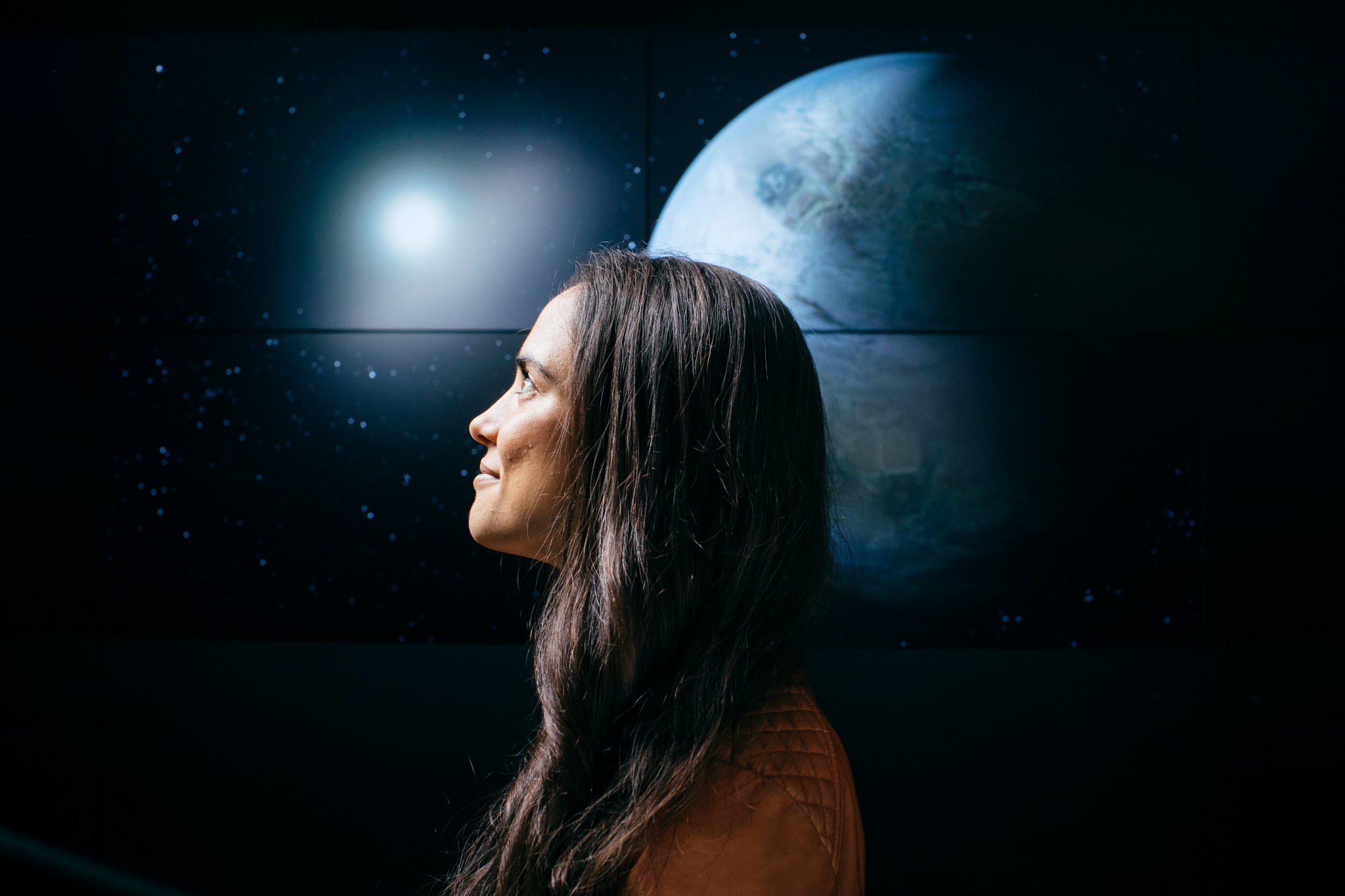
Dr. Natasha Batalha has been hooked on the search for life beyond Earth since elementary school.
UC Santa Cruz, UC Regents

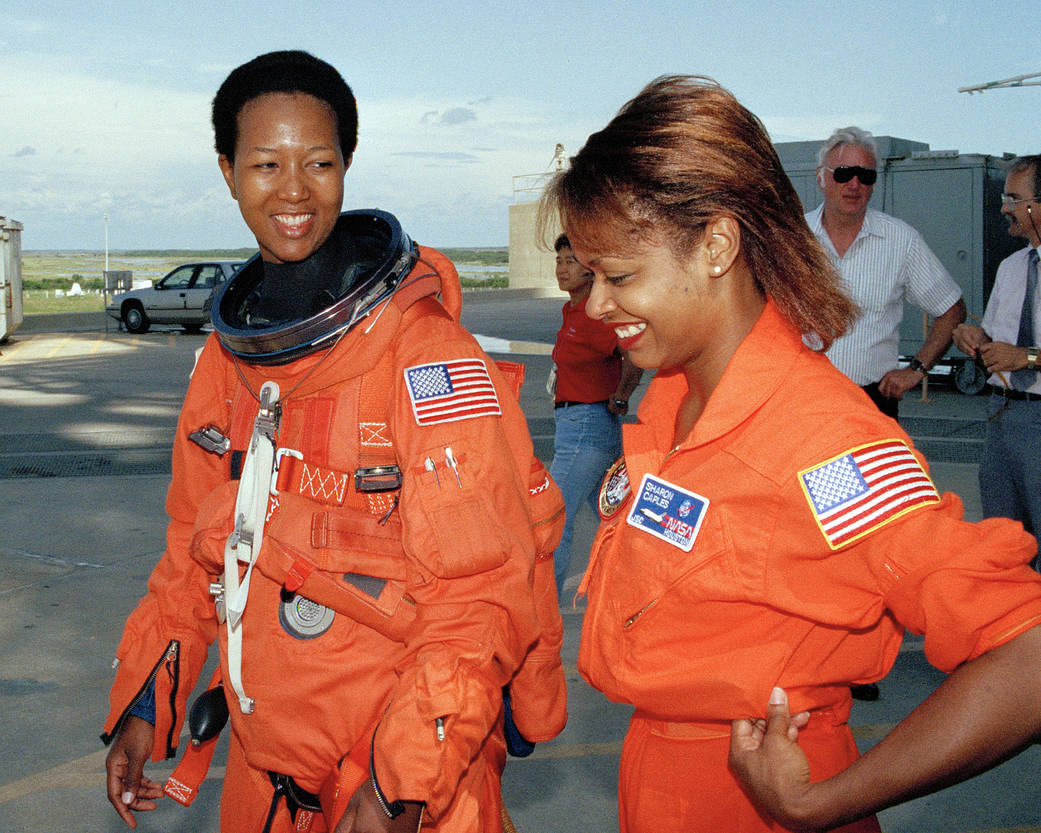
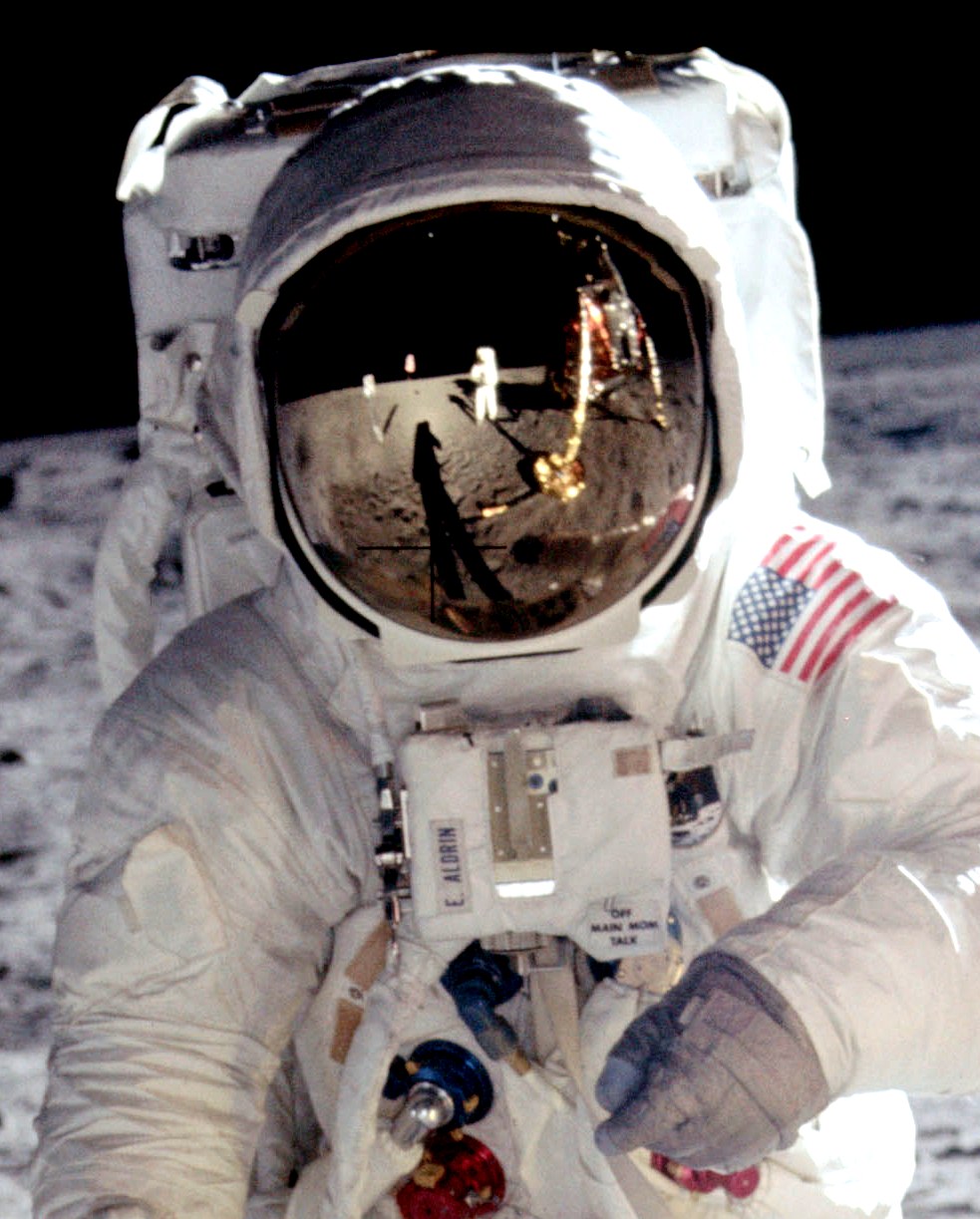
Batalha says she’s exactly where her 6th-grade self imagined she would be. In elementary school, she read a biography of NASA astronaut Sally Ride and was hooked by an idea it contained: that in 20 years the kids reading those words could be the ones pioneering the search for life on Mars.

Today’s youth belong to the Artemis Generation, who will explore farther than people have ever gone before. The Artemis program will send the first woman and first person of color to the lunar surface. Missions over time will build a presence at the Moon to unlock a new era of science and prepare for human missions to Mars and beyond. Along the way, scientists will continue to search for signs of life beyond Earth, an endeavor building on the work of many generations and relying on those in the future to carry on the search. 

“That’s something really rewarding about my work at NASA,” she said. “These questions have been asked throughout human history and, by joining the effort to answer them, you’re taking the baton for a while, before passing it on to someone else.”

Powered by WPeMatico

Get The Details…
Abby Tabor

Ride the Wave of Radio Astronomy During the Solar Eclipse  

Ride the Wave of Radio Astronomy During the Solar Eclipse  

5 min read

Ride the Wave of Radio Astronomy During the Solar Eclipse  

Against a deep blue sky and on a concrete ground, a large white disk faces upward. There are stairs leading from the base to the dish itself.
GAVRT DSS-28 dish at the NASA Deep Space Communications Complex near Goldstone, California.
NASA/Russell Torres

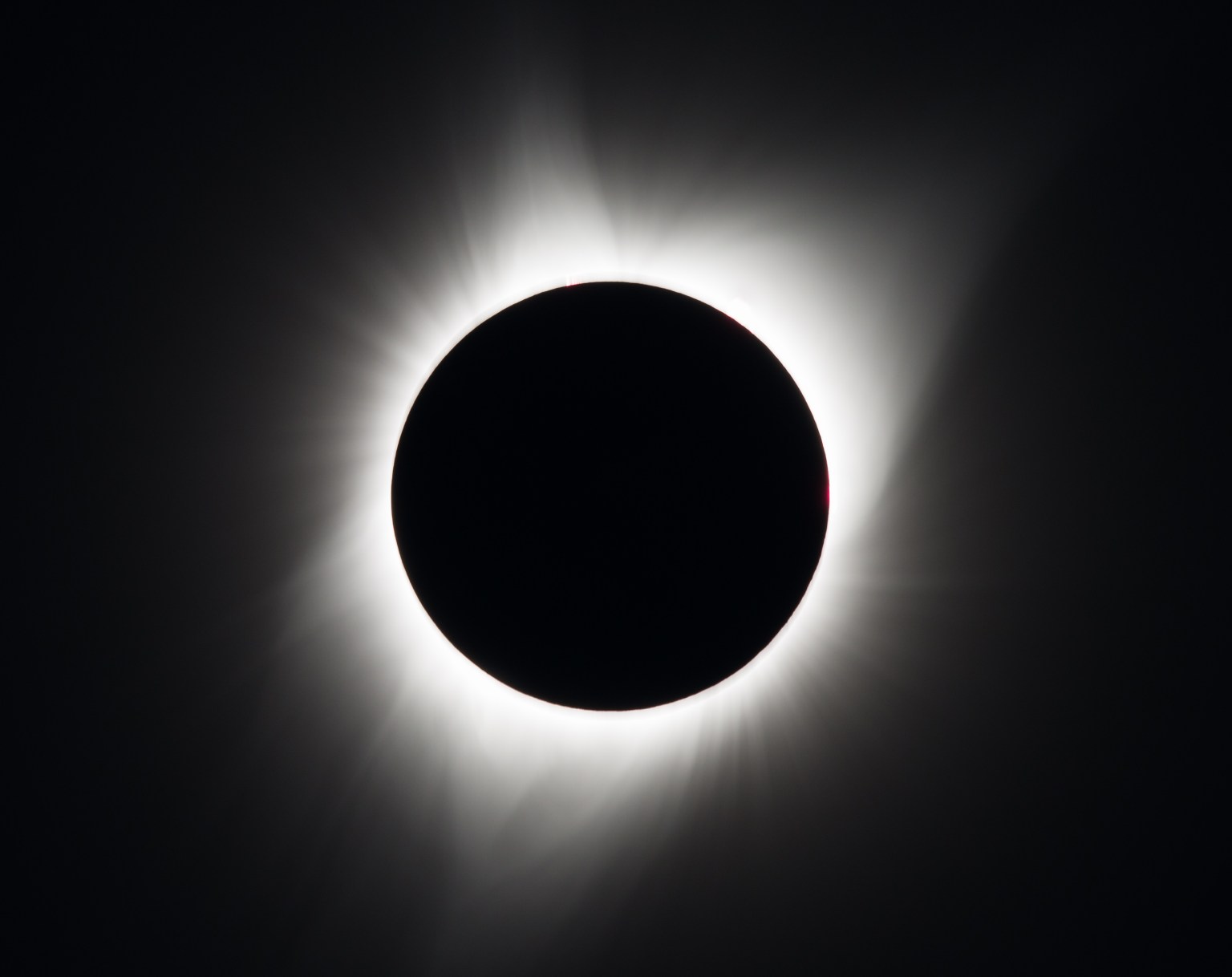
Students and science enthusiasts are invited to catch a real-time look at radio astronomy as scientists explore magnetic hotspots on the Sun during a live, virtual solar eclipse event on April 8, 2024.

A massive, 34-meter telescope once used by NASA’s Deep Space Network to communicate with spacecraft will point towards the Sun during the solar eclipse that day. The Moon’s position in front of the Sun will help the antenna detect radio waves from solar active regions in more detail than is usually possible. 

The Solar Patrol team at California’s Lewis Center for Educational Research, in partnership with NASA’s Jet Propulsion Laboratory, will remotely operate the Goldstone Apple Valley Radio Telescope (GAVRT) while sharing observations and commentary during an interactive webinar open for the public. 

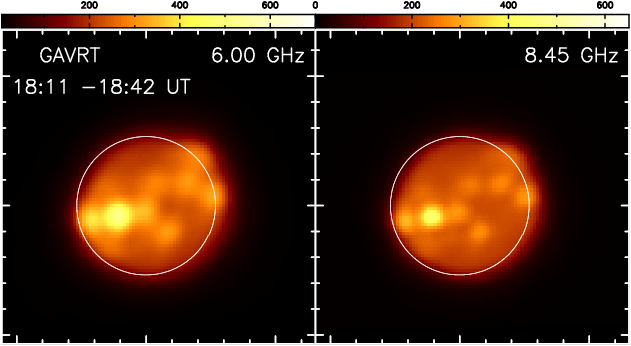
Scientists and students regularly use the single-dish GAVRT antenna, located in the Mojave Desert of California, to scan the Sun. They use the observations to build maps of radio waves formed along strong magnetic field lines in the outer atmosphere of the Sun. By studying these images, researchers can measure the strength and structure of those powerful magnetic regions. These observations offer insight into magnetically driven processes on the Sun, like solar flares and coronal mass ejections, which generate space weather events that can interfere with satellite electronics, radio communications and GPS signals, spacecraft orbits, and power grids on Earth. 

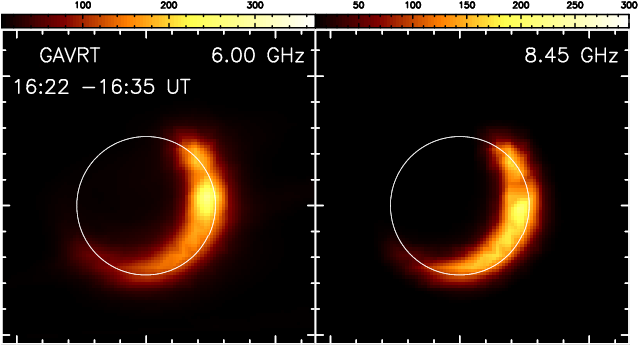
During the April 8, 2024, total solar eclipse, NASA’s Jet Propulsion Laboratory, educators at the Lewis Center for Education Research in Southern California, and participants in the center’s Solar Patrol citizen science program will use the Goldstone Apple Valley Radio Telescope (GAVRT) to observe solar “active regions” – the magnetically complex regions that form over sunspots – as the Moon moves over them.
Video credit: NASA’s Goddard Space Flight Center
Producer: Beth Anthony (eMITS)

During normal solar observing, GAVRT can only detect and distinguish relatively large features on the Sun. A solar eclipse offers a unique opportunity for GAVRT to capture sharper and more refined information about the magnetic field structure in the solar active regions that are often marked by sunspots.

“It’s special during the eclipse because, as the Moon is passing in front of an active region, that really sharp edge of the Moon covers up more and more of the structure in that active region,” says Marin Anderson, a research scientist at NASA’s Jet Propulsion Laboratory and GAVRT Solar Patrol scientist. 

Anderson explains how, as the Moon blocks a portion of the active region, it’s easier to tell what part of the active region the radio emissions are coming from. 

“It’s basically a way of probing magnetic field structures in the corona of the Sun in a way that we wouldn’t be able to unless an eclipse was happening.” 

Anyone in the world can join the live-streamed webinar on April 8 from 1-3:30 p.m. EDT (10 a.m. to 12:30 p.m. PDT) and ask the hosts questions as a partial eclipse becomes visible in California. Participants will be able to see the telescope controls, data visualization tools like Helioviewer, incoming radio data, a map of active hot spot regions, and imagery of the eclipsed Sun at radio wavelengths. 

GAVRT was awarded a NASA grant to carry out observations during both the 2023 and 2024 solar eclipses in the U.S. GAVRT supports an open science framework by making all data and radio maps available for viewing and downloading by the public. Images collected during the eclipse will be posted online with instructions on how to run software and analyze the data. 

The Solar Patrol team hopes the public webinar inspires people to become active members of the GAVRT program where they can learn to remotely operate the telescope themselves while taking part in data analysis and scientific discovery. 

“I think one of the really great aspects of GAVRT Solar Patrol is that it connects any participant, but particularly students, with the Sun, beyond what they see and experience every day from the star,” Anderson says. “It’s seeing the Sun at radio wavelengths and being able to connect different parts of the electromagnetic spectrum with unique physics that’s happening on the Sun.”

Since its launch in 1997, GAVRT has offered many opportunities to combine science observations with education and outreach. In addition to Solar Patrol, GAVRT is used in campaigns where participants can study Jupiter’s radiation belts, monitor radio emissions from black holes, or search for extraterrestrial intelligence.

Anderson says giving students the tools to do science themselves empowers them. 

“It’s a really hands-on process and I think the way to get kids excited and invested in not only solar science but the scientific process in general.” 

To register for the GAVRT April 8 eclipse livestream event, visit: https://register.gotowebinar.com/register/4920123655757293655

For other ways to get involved in GAVRT, including signing up a classroom to participate in observations, contact: mc@lcer.org or visit gavrt.lewiscenter.org.

By Rose Brunning, Communications Lead
NASA Heliophysics Digital Resource Library

Share

Details

Last Updated
Feb 21, 2024
Keep Exploring

Discover More on the 2024 Solar Eclipse

Powered by WPeMatico

Get The Details…

NASA Selects University Teams to Explore Innovative Aeronautical Research

NASA Selects University Teams to Explore Innovative Aeronautical Research

4 min read

Preparations for Next Moonwalk Simulations Underway (and Underwater)

Five college students in a library look at a tablet as simulated screen shots float in the air.
This staged scene and illustration represents what you might see when NASA’s University Innovation project awards teams of students with funds to conduct real-world aeronautical research that will help the agency transform aviation for the 21st century.
NASA /Lillian Gipson / Getty Images

NASA has selected another five university teams to participate in real-world aviation research challenges that could help transform flight in the skies above our communities.

Research topics range from safeguarding automated aircraft from cyberattacks to finding ways to help aircraft operations across the nation more quickly recover from delays due to major storms or technical problems.

“The idea is to give students, faculty and their partners the chance to conduct research – both physical and digital – that helps us realize our vision for 21st century aviation that is sustainable and offers more diverse air travel options,” said Koushik Datta, University Innovation project manager for NASA’s Aeronautics Research Mission Directorate.

The University Innovation project includes two efforts through which universities are invited to submit research proposals and from which teams are then selected: the University Leadership Initiative (ULI) and the University Student Research Challenge (USRC).

A key ULI goal is for faculty-led student teams to gain experience by participating in aeronautics research on a multidisciplinary team made up of partners from other universities and industry, including faculty and student populations who are underrepresented or have not applied their skills to aviation problems.

Meanwhile, in addition to conducting technical research, student-led USRC teams help them develop skills in entrepreneurship and public communication. Each team of students selected receives a USRC grant from NASA – and the additional challenge of raising funds from the public through student-led crowdfunding.

ULI makes selections once a year, while USRC manages multiple selection cycles each year, with proposals for the next selection cycle due by 5 p.m. EDT on March 21. Visit the NASA Aeronautics Solicitations page for more information.

For ULI, three teams were selected resulting in a total of $18 million in awards during the next three years. For each team, the proposing university will serve as lead. The new ULI selections are:

University of California, Berkeley

The team will test ideas for improving the ability of the National Airspace System to become more resilient to reduce the disruptive impact major storms, facility outages, and other technical issues can have on airline flight operations. Team members include University of Maryland, University of Michigan, Morgan State University, University of Pennsylvania, Elizabeth City State University, United Airlines, Patty Clark Aviation Advisors, ATAC Corporation, Mead and Hunt, American Airlines, Vaughan College of Aeronautics and Technology, The Federal Aviation Administration, Lansing Community College, Community College of Philadelphia, and City College of San Francisco.

Ohio University

The team will seek to solve technical challenges associated with the ability of large drones to safely taxi, take off, and land at airports using automated navigation systems. Team members include Illinois Institute of Technology, Virginia Polytechnic Institute and State University, Tufts University, Stanford University, Veth Research Associates LLC, Reliable Robotics Corporation, Boeing, and Virginia Tech Transportation Institute.

The George Washington University

The team will investigate measures that can be taken to safeguard autonomous aircraft flying in high-density urban airspace from cyberattacks that could disrupt safe operations. Team members include Vanderbilt University, Purdue University, Tennessee State University, University of California, Irvine, The University of Texas at Austin, Collins Aerospace, Northern Virginia Community College, Cyber Security and Privacy Research Institute at The George Washington University, Skygrid (a Boeing Company), and the Secure Resilient Systems and Technology Group at MIT Lincoln Laboratory.

For USRC, NASA selected two new university student teams to participate in this cycle with a USRC grant that can be up to $80,000. The new USRC selections are:

Cornell University

The team’s project is titled “Learning Cooperative Policies for Adaptive Human-Drone Teaming in Shared Airspace” and will work to enable new coordination and communication models for smoother, more efficient and robust air traffic flow. The student team members are: Mehrnaz Sabet (lead), Aaron Babu, Marcus Lee, Joshua Park, Francis Pham, Owen Sorber, Roopak Srinivasan, and Austin Zhao. Faculty mentors are Sanjiban Choudhury and Susan Fussell.

University of Washington, Seattle

The team’s project is titled “Investigation on Cryogenic Fluid Chill-Down Time for Supersonic Transport Usage” and will investigate using vortex generators to reduce the  boil-off of cryogenic fluids in pipes. Student team members are Ryan Fidelis (lead), Alexander Ala, and Robert Breidenthal. The faculty mentor is Fiona Spencer.

About the Author

Jim Banke

Jim Banke

Managing Editor/Senior Writer

Jim Banke is a veteran aviation and aerospace communicator with more than 35 years of experience as a writer, producer, consultant, and project manager based at Cape Canaveral, Florida. He is part of NASA Aeronautics’ Strategic Communications Team and is Managing Editor for the Aeronautics topic on the NASA website.

Powered by WPeMatico

Get The Details…
Jim Banke

Become a SunSketcher, and Help Measure the Shape of the Sun!

Become a SunSketcher, and Help Measure the Shape of the Sun!

1 min read

Become a SunSketcher, and Help Measure the Shape of the Sun!

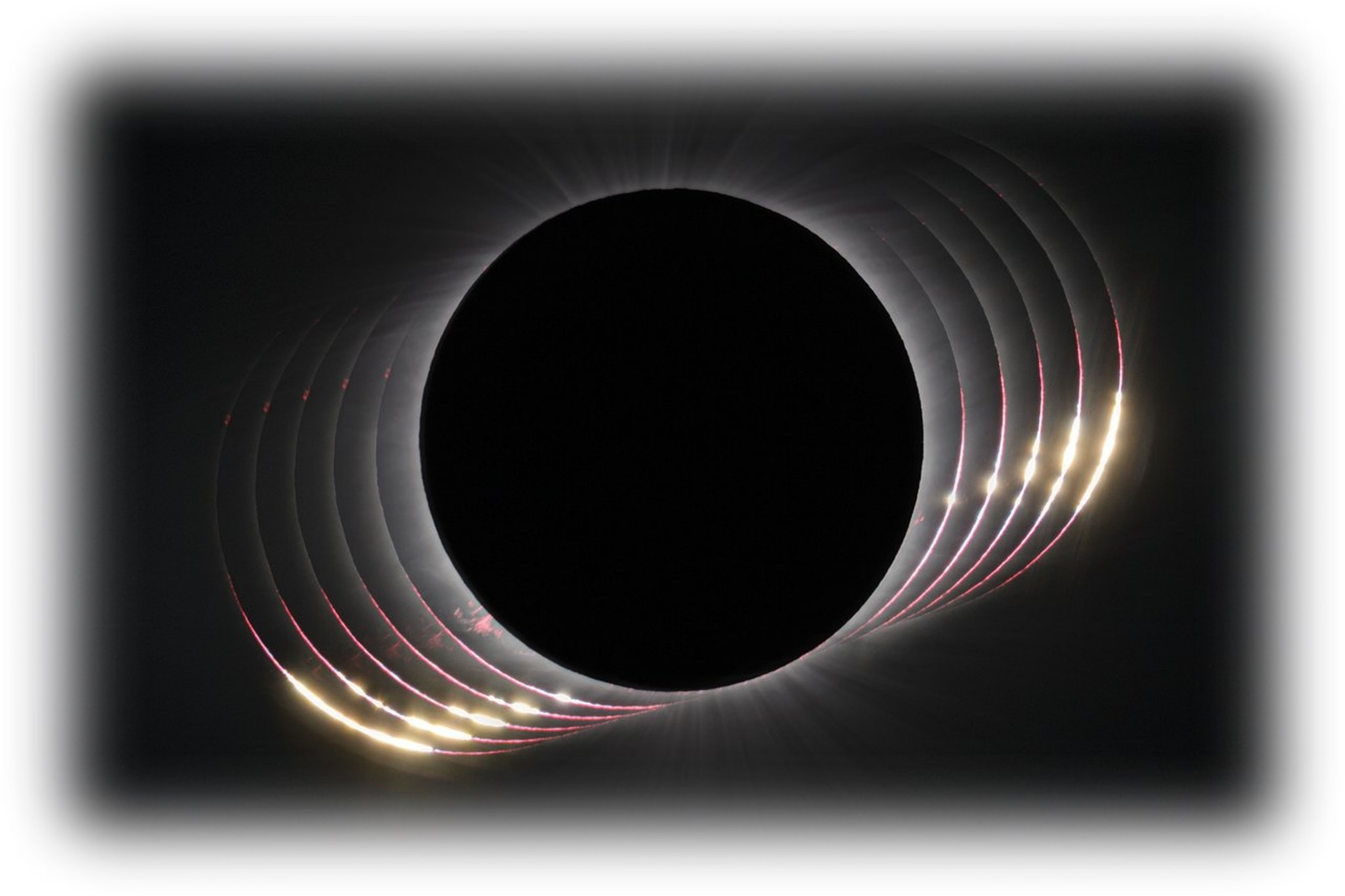
A dark circle in the center with color slivers of light show the movement of the sun during the eclipse.
Baily’s Beads, tiny slivers of sunlight that pass through the valleys on the surface of the moon, seen during the eclipse of 2 July 2019. Register now for the SunSketcher project to use Baily’s Beads to measure the Sun.
Credit P. Horalék/ESO

What shape Is the Sun? Hint: it’s not perfectly round! Knowing precisely how the Sun’s shape deviates from a sphere can teach us about its interior and test theories of gravity. You can help measure the Sun’s shape by joining the SunSketcher project!

During the total solar eclipse on April 8, 2024, we need help from volunteers from along the eclipse’s path of totality – the region from Texas to Maine where the Moon will completely block the Sun’s light – to help create a movie of the eclipse. Using the free SunSketcher smartphone app, you’ll capture views of the eclipse and trace tiny slivers of sunlight that pass through the valleys on the surface of the Moon. The science team will combine your images with precision maps of the Moon collected by NASA’s Lunar Reconnaissance Orbiter to measure the Sun’s size and shape precisely.

Are you planning to watch the April 8 total eclipse? Check out the SunSketcher website for information about eclipses and the SunSketcher project. Make your travel plans now. Register as a SunSketcher to receive regular updates on the progress of this exciting citizen science experiment!

Share

Details

Last Updated
Feb 20, 2024

Powered by WPeMatico

Get The Details…

NASA Sets Coverage of First US Uncrewed Commercial Moon Landing

NASA Sets Coverage of First US Uncrewed Commercial Moon Landing

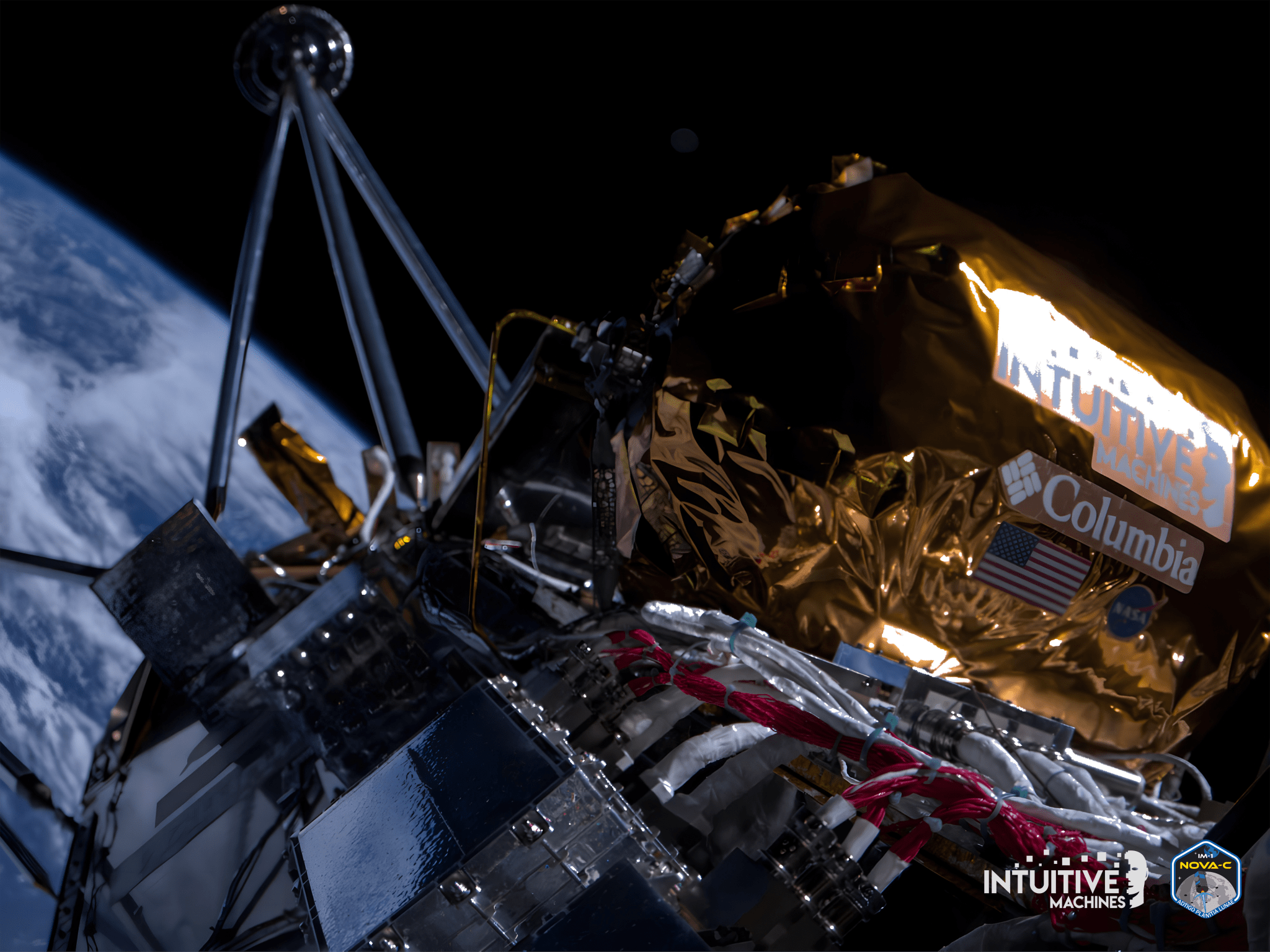
Intuitive Machines is targeting Thursday, Feb. 22, for the landing of their Odysseus lunar lander on the surface of the Moon as part of NASA’s CLPS initiative and Artemis campaign.
Intuitive Machines

As part of NASA’s CLPS (Commercial Lunar Payload Services) initiative and Artemis campaign, Intuitive Machines is targeting no earlier than 5:49 p.m. EST Thursday, Feb. 22, to land their Odysseus lunar lander near Malapert A in the South Pole region of the Moon.

Live landing coverage will air on NASA+, NASA Television, the NASA app, and the agency’s website. NASA TV can be streamed on a variety of platforms, including social media. Coverage will include live streaming and blog updates beginning 4:15 p.m., as the landing milestones occur. Upon successful landing, Intuitive Machines and NASA will host a news conference to discuss the mission and science opportunities that lie ahead as the company begins lunar surface operations.

In May 2019, the agency awarded a task order for scientific payload delivery to Intuitive Machines. Odysseus launched at 1:05 a.m., Feb. 15, on a SpaceX Falcon 9 rocket from Launch Complex 39A at NASA’s Kennedy Space Center in Florida.

NASA is working with several U.S. companies to deliver science and technology to the lunar surface through the agency’s CLPS initiative. This pool of companies may bid on task orders for end-to-end delivery services, which includes payload integration and operations, launching from Earth, and landing on the surface of the Moon. NASA’s CLPS contracts are indefinite-delivery/indefinite-quantity contracts with a cumulative maximum contract value of $2.6 billion through 2028. 

Through the Artemis campaign, commercial robotic deliveries will perform science experiments, test technologies, and demonstrate capabilities to help NASA explore the Moon in advance of Artemis Generation astronaut missions to the lunar surface, and ultimately crewed missions to Mars.

Watch, engage on social media 

Let people know you’re following the mission on X, Facebook, and Instagram by using the hashtag #Artemis. You can also stay connected by following and tagging these accounts: 

X: @NASA, @NASA_Johnson, @NASAArtemis, @NASAMoon 

Facebook: NASA, NASAJohnsonSpaceCenter, NASAArtemis 

Instagram: @NASA, @NASAJohnson, @NASAArtemis 

For more information about the agency’s Commercial Lunar Payload Services initiative, see: 

https://www.nasa.gov/clps

-end- 

Karen Fox / Alise Fisher 
Headquarters, Washington 
202-358-1600  
karen.c.fox@nasa.gov / alise.m.fisher@nasa.gov  

Nilufar Ramji / Laura Sorto
Johnson Space Center, Houston 
281-483-5111 
nilufar.ramji@nasa.gov / laura.g.sorto@nasa.gov

Powered by WPeMatico

Get The Details…
Tiernan P. Doyle