Hubble Views a Galaxy Under Pressure

Hubble Views a Galaxy Under Pressure

2 min read

Hubble Views a Galaxy Under Pressure

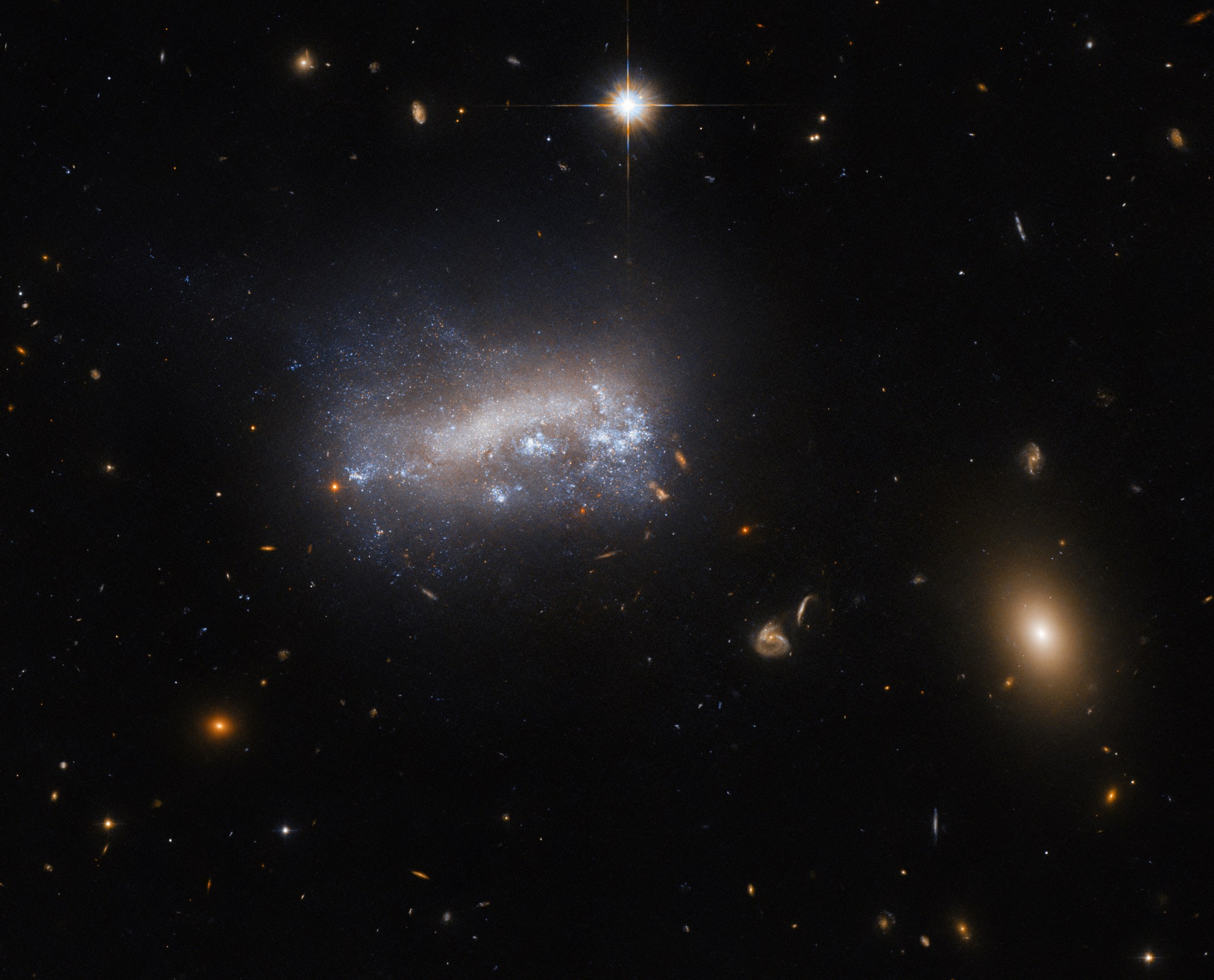
A distorted dwarf galaxy, obscured by dust and by bright outbursts caused by star formation, floats roughly in the center. Tendrils of gas stretch up from the plane of the galaxy. A few distant galaxies are visible in the background around it, many as little spirals, and also including a prominent elliptical galaxy. A bright star hangs above the galaxy in the foreground, marked by cross-shaped diffraction spikes.
This NASA/ESA Hubble Space Telescope image shows dwarf galaxy, LEDA 42160.
ESA/Hubble & NASA, M. Sun

This NASA/ESA Hubble Space Telescope image shows LEDA 42160, a galaxy about 52 million light-years from Earth in the constellation Virgo. The dwarf galaxy is one of many forcing its way through the comparatively dense gas in the massive Virgo cluster of galaxies. The pressure exerted by this intergalactic gas, known as ram pressure, has dramatic effects on star formation in LEDA 42160.

The gas and dust that permeates space exerts pressure on a galaxy as it moves. This resistance, called ram pressure, can strip a galaxy of its star-forming gas and dust, reducing or even stopping the creation of new stars. However, ram pressure can also compress gas in the galaxy, which can boost star formation.

The Hubble data used to create this image of LEDA 42160 is part of a project that studied dwarf galaxies undergoing ram pressure stripping that are part of large galaxy clusters, like the Virgo cluster. Studies show that ram pressure stripping can initially cause new stars to form in larger galaxies. The researchers wanted to see if the same holds true for smaller galaxies, like LEDA 42160. The bright patches on LEDA 42160’s lower-right flank may be star-forming regions spurred on by ram pressure stripping. Hubble’s observations of LEDA 42160 will help astronomers determine the processes that created the features we see in this small galaxy.

Media Contact:

Claire Andreoli
NASA’s Goddard Space Flight CenterGreenbelt, MD
claire.andreoli@nasa.gov

Share

Details

Last Updated
Mar 15, 2024
Editor
Andrea Gianopoulos
Location
Goddard Space Flight Center

Powered by WPeMatico

Get The Details…

Station Reboost, Health Investigations, and Spacesuit Work Top Schedule on Thursday

Station Reboost, Health Investigations, and Spacesuit Work Top Schedule on Thursday

Expedition 70 Flight Engineers and NASA astronauts Loral O'Hara and Michael Barratt post for a portrait together aboard the International Space Station.
Expedition 70 Flight Engineers and NASA astronauts Loral O’Hara and Michael Barratt post for a portrait together aboard the International Space Station.

Cargo operations, health investigations, and spacesuit preparations topped Thursday’s schedule aboard the International Space Station as the Expedition 70 septet gears up for another crew arrival.

The morning kicked off with NASA Flight Engineer Michael Barratt assisting Flight Engineer Jeanette Epps, also from NASA, with a blood sample collection for the Immunity Assay investigation. Afterward, Epps processed the blood samples to monitor how spaceflight impacts stressors on cellular immune function.

Barratt was then joined by NASA Flight Engineer Loral O’Hara to swap cargo in and out of the Cygnus space freighter. In the afternoon, O’Hara switched gears to complete some spacesuit work that began earlier this week. She installed battery packs, and checked the audio system, power and data cables, thermal covers, and helmets. O’Hara then powered up the spacesuits to assess if all components were working properly.

NASA Flight Engineer Matthew Dominick set up equipment for two different health investigations throughout the day. He first set up the Cerebral Autoregulation investigation, which measures blood flow in the brain before, during, and after spaceflight to provide insights into how the brain regulates its blood supply in the microgravity environment. He then moved on to prepping ultrasound equipment for eye exams before completing some crew orientation activities.

Once the ultrasound equipment was set up, Commander Oleg Kononenko and Flight Engineer Nikolai Chub of Roscosmos took turns conducting eye exams on one another. Flight Engineer Alexander Grebenkin, also from Roscosmos, spent his day running a distillation cycle on the water processor, familiarizing himself with computer systems, and replacing condensate lines in the ventilation system.

Three crew members—NASA astronaut Tracy Dyson, cosmonaut Oleg Novitsky, and Flight Engineer Marina Vasilevskaya of Belarus—are preparing to launch aboard the Soyuz MS-25 spacecraft near the end of March.

The space station is orbiting slightly higher after the ISS Progress 87 thrusters fired for 18 minutes and 17 seconds Thursday morning. The orbital reboost sets up the correct phasing for the upcoming Soyuz arrival.


Learn more about station activities by following the space station blog, @space_station and @ISS_Research on X, as well as the ISS Facebook and ISS Instagram accounts.

Get weekly updates from NASA Johnson Space Center at: https://roundupreads.jsc.nasa.gov/

Get the latest from NASA delivered every week. Subscribe here: www.nasa.gov/subscribe

Powered by WPeMatico

Get The Details…

Abby Graf

NASA Artemis Mission Progresses with SpaceX Starship Test Flight

NASA Artemis Mission Progresses with SpaceX Starship Test Flight

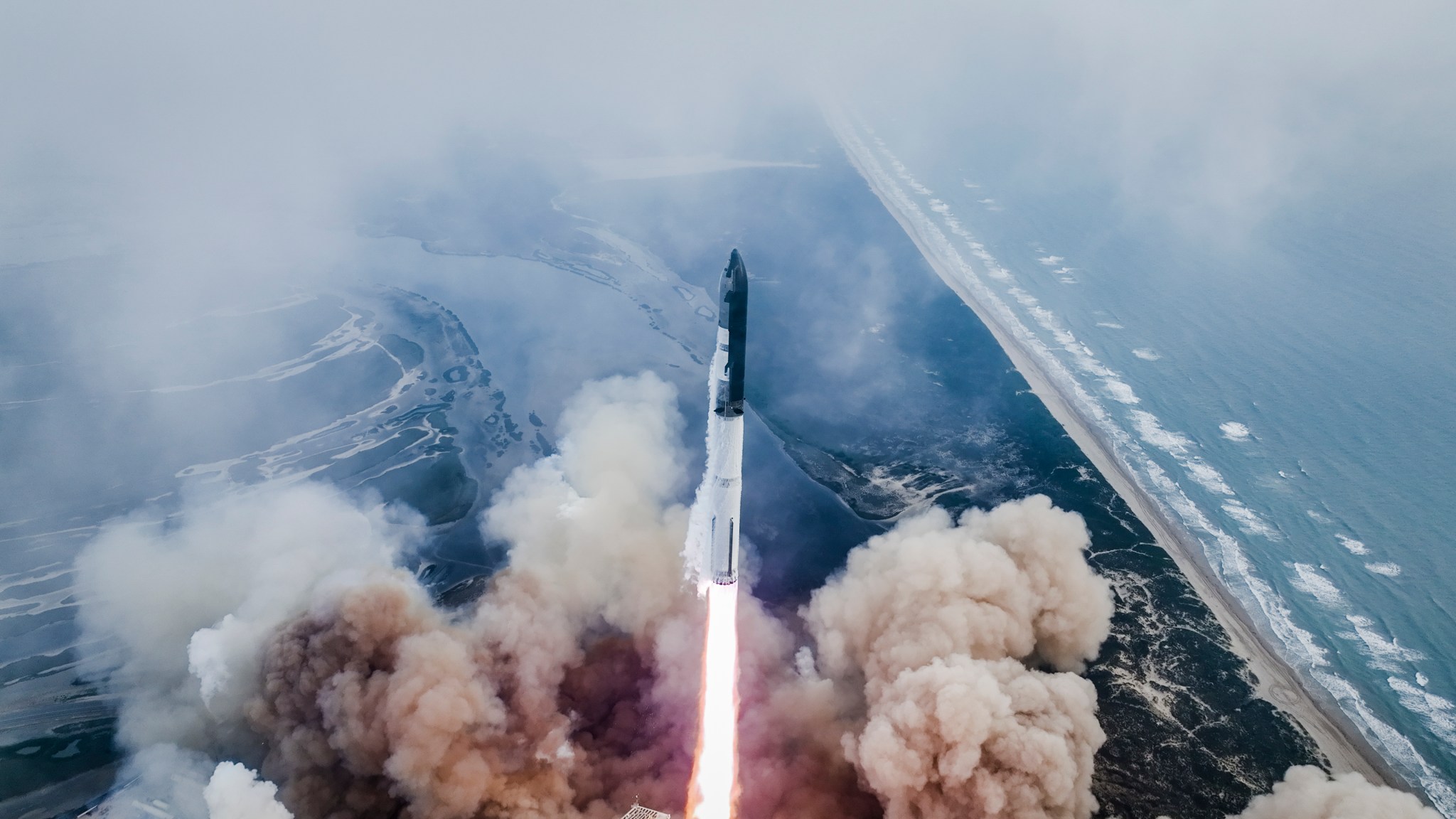
SpaceX launched the third integrated flight test of its Super Heavy booster and Starship upper stage from the company’s Starbase orbital launch pad at 8:25 a.m. CT on March 14. This flight test is an important milestone toward providing NASA with a Starship HLS for its Artemis missions.
SpaceX

As part of NASA’s Artemis campaign to return humans to the Moon for the benefit of all, the agency is working with SpaceX to develop the company’s Starship human landing system (HLS), which will land astronauts near the Moon’s South Pole during the Artemis III and Artemis IV missions. On March 14, SpaceX launched the third integrated flight test of its Super Heavy booster and Starship upper stage, an important milestone toward providing NASA with a Starship HLS for its Artemis missions.

A complement of 33 Raptor engines, fueled by super-cooled liquid methane and liquid oxygen, powered the Super Heavy booster with Starship stacked on top, from the company’s Starbase orbital launch pad at 8:25 a.m. CDT. Starship, using six Raptor engines, separated from the Super Heavy booster employing a hot-staging technique to fire the engines before separation at approximately three minutes into the flight, in accordance with the flight plan. This was the third flight test of the integrated Super Heavy-Starship system.

“With each flight test, SpaceX attempts increasingly ambitious objectives for Starship to learn as much as possible for future mission systems development. The ability to test key systems and processes in flight scenarios like these integrated tests allows both NASA and SpaceX to gather crucial data needed for the continued development of Starship HLS,” said Lisa Watson-Morgan, HLS Program Manager at NASA’s Marshall Space Flight Center in Huntsville, Alabama.

This test accomplished several important firsts that will contribute to the development of Starship for Artemis lunar landing missions. The spacecraft reached its expected orbit and Starship completed the full-duration ascent burn.

One objective closely tied to future Artemis operations is the transfer of thousands of pounds of cryogenic propellant between internal tanks during the spacecraft’s coast phase as part of NASA’s Space Technology Missions Directorate 2020 Tipping Point awards. The propellant transfer demonstration operations were completed, and the NASA-SpaceX team is currently reviewing the flight data that was received. This Tipping Point technology demonstration is one of more than 20 development activities NASA is undertaking to solve the challenges of using cryogenic fluids during future missions.

As a key step toward understanding how super-cooled propellant sloshes within the tanks when the engines shut down, and how that movement affects Starship’s stability while in orbit, engineers will study flight test data to assess the performance of thrusters that control Starship’s orientation in space. They are also interested to learn more about how the fluid’s movement within the tanks can be settled to maximize propellant transfer efficiency and ensure Raptor engines receive needed propellant conditions to support restart in orbit.

“Storing and transferring cryogenic propellant in orbit has never been attempted on this scale before,” said Jeremy Kenny, project manager, NASA’s Cryogenic Fluid Management Portfolio at Marshall. “But this is a game-changing technology that must be developed and matured for science and exploration missions at the Moon, Mars, and those that will venture even deeper into our solar system.”

Under NASA’s Artemis campaign, the agency will land the first woman, first person of color, and its first international partner astronaut on the lunar surface and prepare for human expeditions to Mars. Commercial human landing systems are critical to deep space exploration, along with the Space Launch System rocket, Orion spacecraft, advanced spacesuits and rovers, exploration ground systems, and the Gateway space station.

Learn more about NASA’s Human Landing System Program:

https://www.nasa.gov/humans-in-space/human-landing-system/

News Media Contact

Jenalane (Rowe) Strawn
Marshall Space Flight Center
Huntsville, Ala.
256-544-0034

Powered by WPeMatico

Get The Details…
Lee Mohon

La NASA invita a los medios a conocer a astronautas de la estación espacial

La NASA invita a los medios a conocer a astronautas de la estación espacial

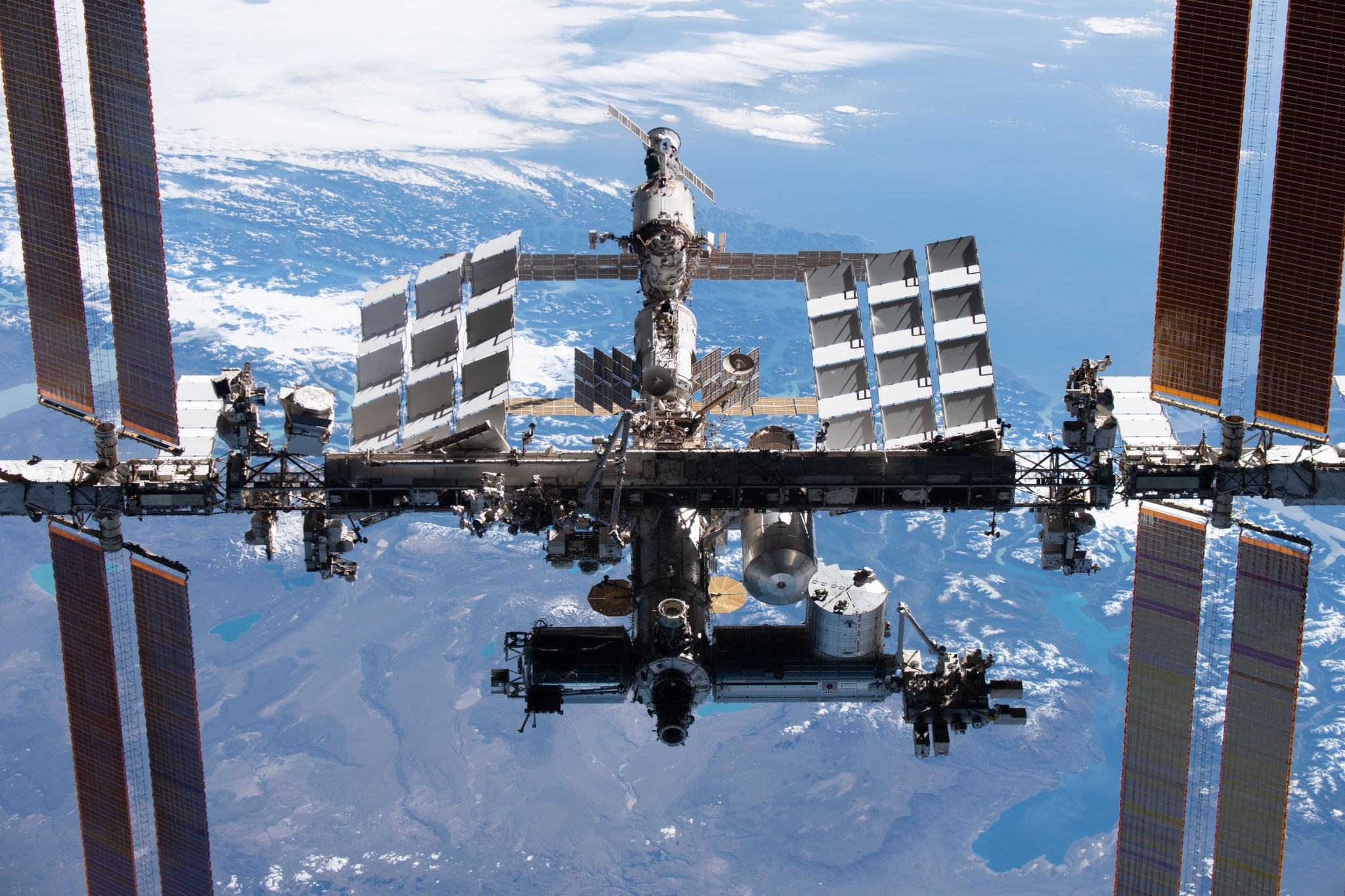
(8 de noviembre de 2021) — La Estación Espacial Internacional, fotografiada desde la nave Crew Dragon Endeavour de SpaceX durante un vuelo alrededor del laboratorio orbital que tuvo lugar tras el desacoplamiento de Dragon del puerto orientado al espacio del módulo Harmony de la estación.
Crédito: NASA

Read this release in English here.

La NASA ofrecerá una rueda de prensa con cuatro astronautas a las 9:30 a.m. EDT (hora del este de EE.UU.) del martes 19 de marzo en la sede de la agencia en Washington. La tripulación, entre la que se encuentra el astronauta de la NASA de origen salvadoreño Frank Rubio, hablará de su reciente misión a bordo de la Estación Espacial Internacional, donde llevaron a cabo una amplia gama de experimentos científicos en beneficio de la vida en la Tierra y de la exploración con seres humanos del espacio.

Rubio, así como sus compañeros astronautas de la NASA Stephen Bowen y Woody Hoburg, y el astronauta de los EAU (Emiratos Árabes Unidos) Sultan Alneyadi, formaron parte de la Expedición 69 de la estación espacial y participarán en la conferencia de prensa.

Durante su primera misión espacial, Rubio completó aproximadamente un viaje de más de 157 millones de millas y 5.936 órbitas a la Tierra, lo que equivale a 328 viajes de ida y vuelta a la Luna. La misión extendida de Rubio brindó a los investigadores la oportunidad de observar los efectos de los vuelos espaciales de larga duración en el ser humano, ya que la agencia planea volver a la Luna a través de la campaña Artemis y prepararse para explorar Marte. Rubio regresó a la Tierra en septiembre de 2023 a bordo de la nave espacial Soyuz de Roscosmos tras pasar 371 días en el espacio, un récord para Estados Unidos.

Como parte de la misión SpaceX Crew-6 de la NASA, Bowen, Hoburg y Alneyadi regresaron a la Tierra en septiembre de 2023 a bordo de una nave espacial Dragon tras pasar 186 días a bordo del laboratorio en microgravedad. Como parte de la misión SpaceX Crew-6 de la NASA, Bowen, Hoburg y Alneyadi regresaron a la Tierra en septiembre de 2023 a bordo de una nave espacial Dragon tras pasar 186 días a bordo del laboratorio en microgravedad. Durante su misión, Bowen y Hoburg llevaron a cabo dos caminatas espaciales, y Alneyadi se convirtió en el primer astronauta de los EAU en realizar una caminata espacial. Con 10 caminatas espaciales realizadas durante sus varias misiones, Bowen está empatado con otros cuatro astronautas por el récord de mayor número de caminatas completadas por un astronauta estadounidense. Ocupa el tercer puesto en la lista de mayor número de horas acumuladas en caminatas espaciales.

Además de sus investigaciones, los miembros de la tripulación también realizaron demostraciones tecnológicas y actividades de mantenimiento de la estación espacial. Bowen, Hoburg y Alneyadi recorrieron 78.875.292 millas durante su misión y completaron 2.976 órbitas alrededor de la Tierra. La misión Crew-6 fue el primer vuelo espacial para Hoburg, Alneyadi y Fedyaev. Bowen ha pasado en total 227 días en el espacio, acumulados en cuatro misiones.

Los medios de comunicación interesados en participar deben confirmar su asistencia antes de las 5 pm EDT del lunes 18 de marzo a Joshua Finch (joshua.a.finch@nasa.gov) y María José Viñas (maria-jose.vinasgarcia@nasa.gov). La política de acreditación de medios de comunicación de la NASA está disponible en línea.

El encuentro con los medios de comunicación tendrá lugar en el Auditorio Webb de la sede central de la NASA, en el edificio Mary W. Jackson, 300 E. Street SW, en Washington.

Aprende más sobre la Estación Espacial Internacional:

https://www.nasa.gov/international-space-station/ (inglés)
https://go.nasa.gov/3wUF46G (español)

-fin-

Joshua Finch
Sede, Washington
202-358-1100
joshua.a.finch@nasa.gov

María José Viñas
Sede, Washington
240-458-0248
maria-jose.vinasgarcia@nasa.gov

Powered by WPeMatico

Get The Details…
Tiernan P. Doyle

NASA Invites Media to Meet Space Station Astronauts at Headquarters

NASA Invites Media to Meet Space Station Astronauts at Headquarters

(Nov. 8, 2021) — The International Space Station is pictured from the SpaceX Crew Dragon Endeavour during a fly around of the orbiting lab that took place following its undocking from the Harmony module’s space-facing port.
Credits: NASA

Lee esta nota de prensa en español aquí.

NASA will host a media availability with four astronauts at 9:30 a.m. EDT Tuesday, March 19, at the agency’s headquarters in Washington. The crew, including record-breaking NASA astronaut Frank Rubio, will discuss their recent mission aboard the International Space Station where they conducted a broad range of science experiments to benefit life on Earth and human space exploration.

Rubio, as well as fellow NASA astronauts Stephen Bowen and Woody Hoburg, and UAE (United Arab Emirates) astronaut Sultan Alneyadi, served as part of space station Expedition 69 and will participate in the media opportunity.

During his first spaceflight mission, Rubio completed approximately 5,936 orbits and a journey of more than 157 million miles, roughly the equivalent of 328 trips to the Moon and back. Rubio’s extended mission provided researchers the opportunity to observe the effects of long-duration spaceflight on humans as the agency plans to return to the Moon through the Artemis campaign and prepare for exploration of Mars. He returned to Earth in September 2023 aboard the Roscosmos Soyuz spacecraft after spending an American record-breaking 371 days in space.

As part of NASA’s SpaceX Crew-6 mission, Bowen, Hoburg, and Alneyadi returned to Earth in September 2023 aboard a Dragon spacecraft after spending 186 days aboard the microgravity laboratory. During the mission, Bowen and Hoburg completed two spacewalks, and Alneyadi became the first UAE astronaut to conduct a spacewalk. With 10 spacewalks throughout his missions, Bowen ties the record for most excursions by a U.S. astronaut, also held by four others. He ranks third on the all-time list for cumulative hours of spacewalking.

In addition to their research, crew members also conducted technology demonstrations, and space station maintenance activities. Bowen, Hoburg, and Alneyadi traveled 78,875,292 miles during their mission and completed 2,976 orbits around Earth. The Crew-6 mission was the first spaceflight for Hoburg, Alneyadi, and Fedyaev. Bowen has logged 227 days in space over four flights.

Media interested in participating must RSVP by 5 p.m., Monday, March 18, to Joshua Finch at joshua.a.finch@nasa.gov. NASA’s media accreditation policy is online.

The media opportunity will take place in the Webb Auditorium at NASA Headquarters in the Mary W. Jackson building, 300 E. Street SW in Washington.

Learn more about the International Space Station:

https://www.nasa.gov/international-space-station/

-end-

Joshua Finch
Headquarters, Washington
202-358-1100
joshua.a.finch@nasa.gov

Powered by WPeMatico

Get The Details…
Tiernan P. Doyle