Ultrasound Scans Continue to Understand Space Effects on Humans

Ultrasound Scans Continue to Understand Space Effects on Humans
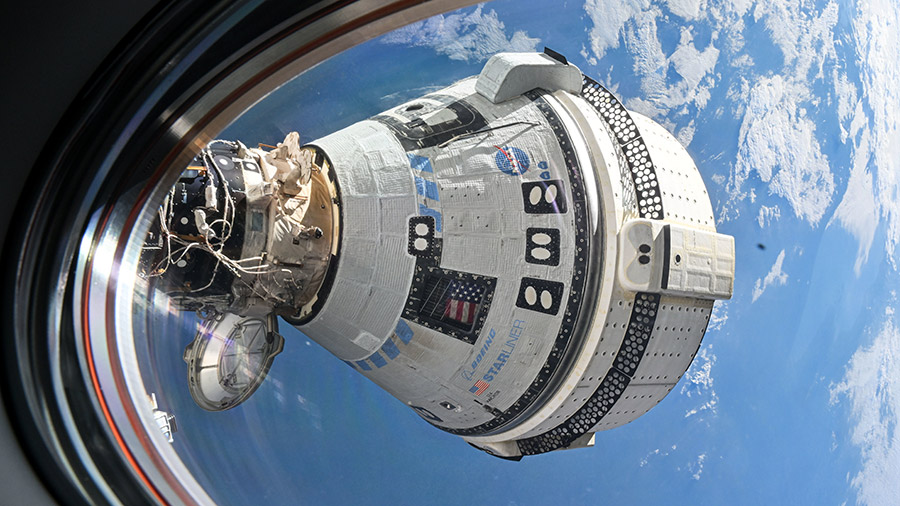
Boeing's Starliner spacecraft is pictured from a window on the SpaceX Dragon Endeavour spacecraft docked to the Harmony module's forward port.
Boeing’s Starliner spacecraft is pictured from a window on the SpaceX Dragon Endeavour spacecraft docked to the Harmony module’s forward port.

Space biology was back on the schedule Thursday as the crewmates aboard the International Space Station resumed exploring how living in weightlessness affects the human  body. The orbital residents also worked on Starliner spacecraft configurations, serviced spacesuit components, and continued lab inspections.

Expedition 71 Flight Engineers Jeanette Epps and Matthew Dominick, both from NASA, kicked off their day collecting blood and saliva samples, processing them for upcoming analysis, and stowing the biological specimens in a science freezer. The duo then joined NASA astronaut Mike Barratt in the afternoon for vein scans with the commercial ButterlyIQ Ultrasound device before and after workout sessions on the advanced resistive exercise device. Results may inform researchers what happens to the body when exercising in microgravity and demonstrate the effectiveness of the FDA-approved portable scanner for space operations.

Barratt began his day with NASA Flight Engineer Tracy C. Dyson in the Columbus laboratory module and explored how living in space affects blood pressure. Dyson scanned Barratt’s veins with the Ultrasound 2 device and collected data from a monitor measuring his heart rate. The study is just one of 14 investigations that are part of the CIPHER human research experiment and explores the cardiovascular health risks of living and working on a long-term space mission. Dyson then spent her afternoon uninstalling and stowing spacesuit batteries and metal oxide containers in the Quest airlock.

NASA astronauts Butch Wilmore and Suni Williams, Commander and Pilot for Boeing’s Crew Flight Test, entered their Starliner crew ship for checkouts on Thursday. The duo examined the spacecraft’s communications systems, set up computer tablets, and charged camera batteries inside the vehicle docked to the Harmony module’s forward port.

Commercial Crew Program manager Steve Stich of NASA and Mike Nappi of Boeing provided a status update of the Starliner spacecraft on NASA TV today. Watch the televised news conference on YouTube.

Station Commander Oleg Kononenko and Flight Engineer Nikolai Chub partnered together throughout Thursday continuing to inspect the vestibule in the aft end of the Zvezda service module where the Progress 87 is docked. While Kononenko spent most of his shift checking out Zvezda, Chub had time for swapping out an electronics unit on an exercise cycle then tested video communications and command gear in the Progress 88 resupply ship docked to the Poisk module.

Mission managers will discuss the upcoming SpaceX Crew-9 mission to the orbital outpost during a mission overview live on NASA TV at 11 a.m. EDT on Friday. Then at 1 p.m., the Crew-9 members Commander Zena Cardman, Pilot Nick Hague, and Mission Specialists Stephanie Wilson and Aleksander Gorbunov will introduce themselves and discuss more details of their space station mission.


Learn more about station activities by following the space station blog, @space_station and @ISS_Research on X, as well as the ISS Facebook and ISS Instagram accounts.

Get weekly video highlights at: https://roundupreads.jsc.nasa.gov/videoupdate/

Get the latest from NASA delivered every week. Subscribe here: www.nasa.gov/subscribe

Powered by WPeMatico

Get The Details…

Mark Garcia

NASA’s Orion Spacecraft Gets Lift on Earth

NASA’s Orion Spacecraft Gets Lift on Earth

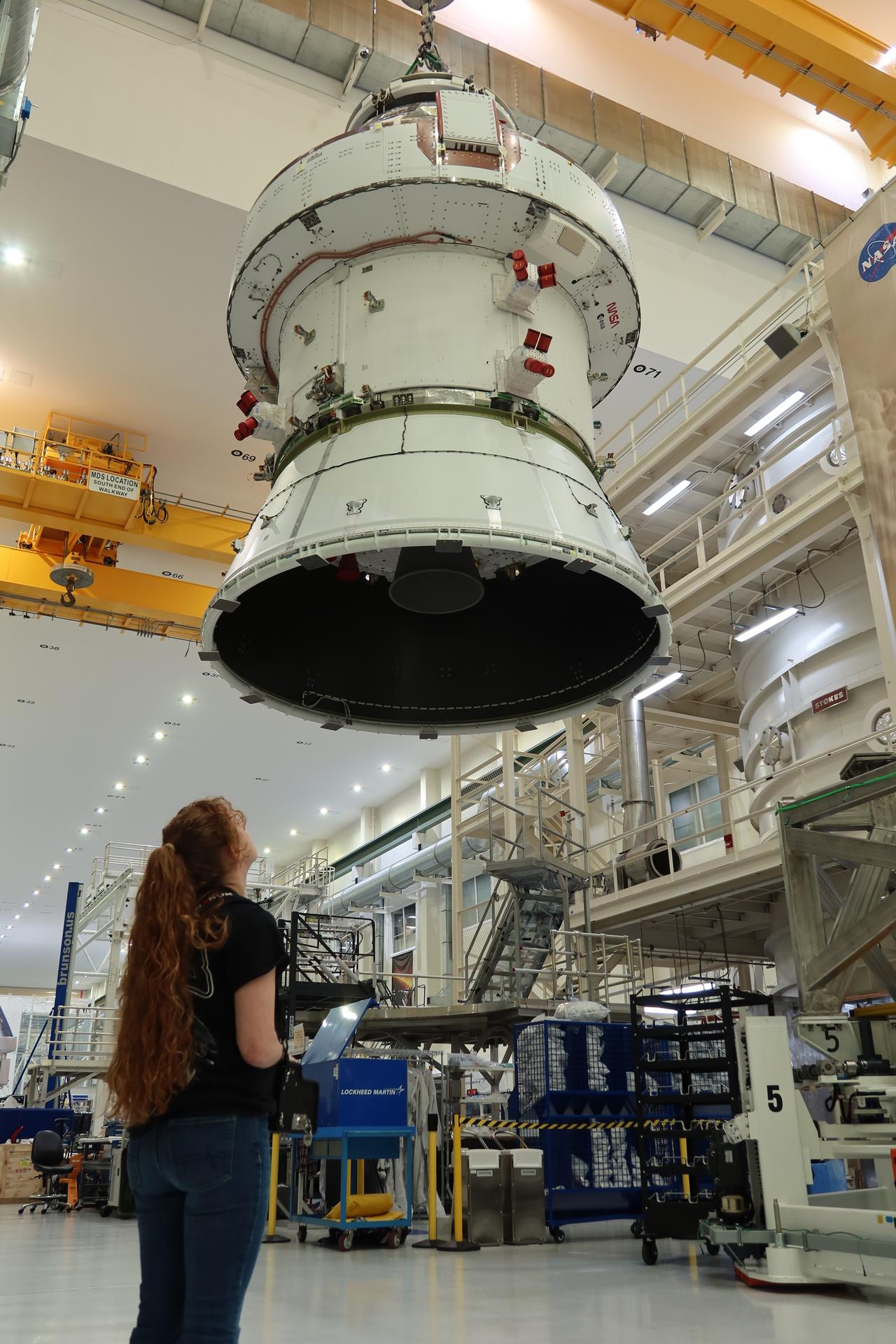
Crane operator Rebekah Tolatovicz, a shift mechanical technician lead for Artic Slope Regional Corporation at NASA’s Kennedy Space Center in Florida, operates a 30-ton crane to lift the agency’s Artemis II Orion spacecraft out of the recently renovated altitude chamber to the Final Assembly and Systems Testing, or FAST, cell inside NASA Kennedy’s Neil A. Armstrong Operations and Checkout Building on April 27.

During her most recent lift July 10, Tolatovicz helped transfer Orion back to the FAST cell following vacuum chamber qualification testing in the altitude chamber earlier this month. This lift is one of around 250 annual lifts performed at NASA Kennedy by seven operator/directors and 14 crane operators on the ASRC Orion team.

“At the time of the spacecraft lift, I focus solely on what’s going on in the moment of the operation,” explains Tolatovicz. “Listening for the commands from the lift director, making sure everyone is safe, verifying the vehicle is clear, and ensuring the crane is moving correctly.”

All Orion crane operators are certified after classroom and on-the-job training focusing on areas such as rigging, weight and center of gravity, mastering crane controls, crane securing, assessing safety issues, and emergency procedures. Once certified, they progress through a series of the different lifts required for Orion spacecraft operations, from simple moves to the complex full spacecraft lift.

“It’s not until after the move is complete and the vehicle is secured that I have a moment to think about how awesome it is to be a part of history on the Orion Program and do what I get to do every day with a team of the most amazing people,” Tolatovicz said.

Photo credit: NASA/Amanda Stevenson

Powered by WPeMatico

Get The Details…
Jason Costa

NASA Selects Marshall Logistics Support Services II Contractor

NASA Selects Marshall Logistics Support Services II Contractor

Image of the NASA logo
Credit: NASA

NASA has awarded the MSFC Logistics Support Services II (MLSS II) contract to Akima Global Logistics, LLC to provide logistics support services at the agency’s Marshall Space Flight Center in Huntsville, Alabama.

The performance-based indefinite-delivery/indefinite-quantity contract has a maximum potential value of $96.3 million. The contract begins on Sunday, Sept. 1 with a one-year base period, followed by one-year option periods that may be exercised at NASA’s discretion.

Under the competitive 8(a) contract, the company will be responsible for providing logistics services supporting NASA Marshall’s institutional operational framework. The logistics support services provided through contractor support cover the areas of management, disposal operations, equipment, mail, transportation, life cycle logistics, supply chains, and other specialty services.

For information about NASA and agency programs, visit: 

https://www.nasa.gov

-end-

Tiernan Doyle
Headquarters, Washington
202-358-1600
tiernan.doyle@nasa.gov

Share

Details

Last Updated

Jul 25, 2024

Powered by WPeMatico

Get The Details…
Tiernan P. Doyle

Meet NASA Interns Shaping Future of Open Science

Meet NASA Interns Shaping Future of Open Science

3 min read

Meet NASA Interns Shaping Future of Open Science

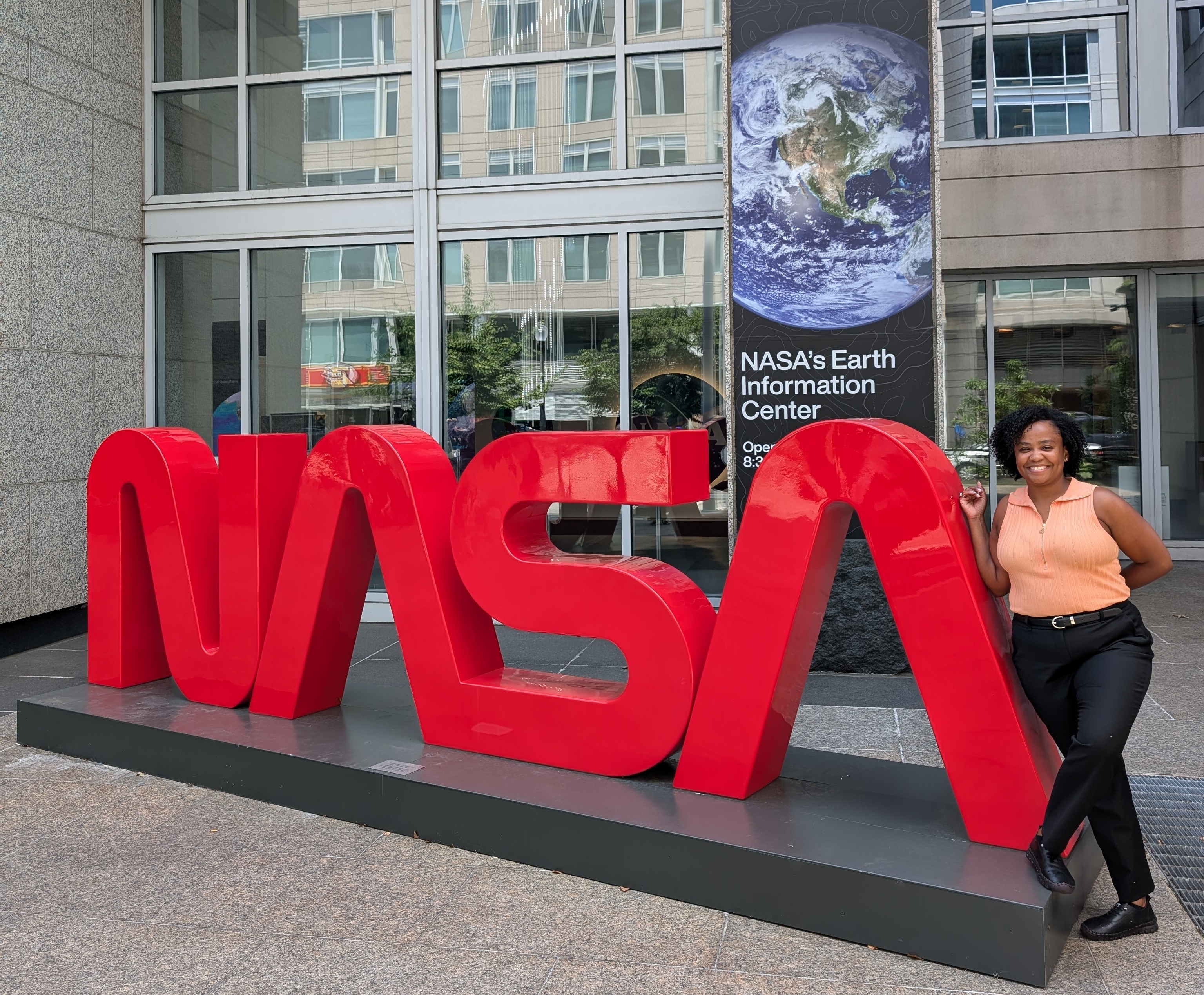
NASA intern Lena Young leans against a red NASA sign in front of NASA's Earth Information Center.
Intern Lena Young, whose work revolves around DEIA and open science, stands next to a NASA sign at NASA’s Earth Information Center in Washington, D.C.
Photo courtesy of Lena Young

Students at NASA’s Office of the Chief Science Data Officer (OCSDO) are working to promote open science during the summer 2024 internship session. Their projects fall across a variety of areas, including user experience, policy, and DEIA (Diversity, Equity, Inclusion, and Accessibility). 

Lena Young: Increasing DEIA Engagement

Lena Young, a doctoral candidate in the Creative Leadership for Innovation and Change program at the University of the Virgin Islands in St. Thomas, envisions equitable space societies 100 – 300 years in the future as part of her dissertation. Her NASA internship project involves researching ways to make science more accessible for different groups and interacting with NASA leadership to assess how well they are engaging historically underserved or excluded communities.

Young also worked with her mentors to find overlap between her internship project and her PhD work as a futurist. “In 30 years, once NASA has achieved their goals, what would open science look like?” Young said. “I want to see what different futures I can create for open science and DEIA engagement.” 

Becca Michelson: Advancing Policy

Becca Michelson has a passion for increasing the availability of scientific information. A soon-to-be-graduate in physics and astronomy from Smith College in Northampton, Massachusetts, she was drawn to an internship role in researching the current state of open science policy for the OCSDO. By understanding the challenges and opportunities in this area, she’s helping NASA better support researchers in making their science accessible to all.

“Open science makes this a more inclusive field, where if I’m an early career scientist, I can build on the science that other people who are experts in the field have done,” Michelson said. In the future, she hopes to implement open science principles into her own research in astronomy, drawing from the best practices she has learned at NASA.

Salma Elsayed-Ali: Bridging Science, User Experience

Salma Elsayed-Ali is on a mission to bridge the gap between science and usability. She recently completed her PhD in Information Science with a focus on Human-Computer Interaction from the University of Maryland, College Park. Her NASA internship project involves conducting UI/UX (User Interface/User Experience) research on some of the OCSDO’s scientific products, most notably the Open Science 101 online course.

Elsayed-Ali became interested in open science during the height of the COVID-19 pandemic, when she conducted UI/UX research on open data sites that provided the public with real-time information about the spread of the virus. This experience sparked her interest in helping users reap the benefits of open science as part of an internship with NASA. 

In improving the OCSDO’s open science interfaces, Elsayed-Ali has acted as the product lead on a UI/UX research project for the first time. “I was drawn to this project as it was an opportunity to advocate for both end users and the advancement of open science,” Elsayed-Ali said. “I have really enjoyed brainstorming creative, practical solutions that enhance the user experience and simultaneously save the product team time and resources.”

By helping open science at NASA to thrive, these interns are ushering in a future of greater access to data and scientific research. Learn more about NASA internships at the NASA Internship Programs page.

Learn to navigate the principles and practices of open science with the Open Science 101 online course.

By Lauren Leese 
Web Content Strategist for the Office of the Chief Science Data Officer 

Share

Details

Last Updated
Jul 25, 2024

Related Terms

Powered by WPeMatico

Get The Details…

Tech Today: Space Age Swimsuit Reduces Drag, Breaks Records

Tech Today: Space Age Swimsuit Reduces Drag, Breaks Records

2 min read

Preparations for Next Moonwalk Simulations Underway (and Underwater)

The LZR Racer reduces skin friction drag by covering more skin than traditional swimsuits. Multiple pieces of the water-resistant and extremely lightweight LZR Pulse fabric connect at ultrasonically welded seams and incorporate extremely low-profile zippers to keep viscous drag to a minimum.
Credit: SpeedoUSA

A supersonic airplane and a competitive swimmer have much more in common than people might realize; both have to contend with the slowing influence of drag. NASA’s Aeronautics Research Mission Directorate focuses primarily on improving flight efficiency and fluid dynamics, especially the forces of pressure and drag, which are the same for bodies moving through air as for bodies moving through water. Shortly after the 2004 Olympics, Los Angeles-based SpeedoUSA, also known as Speedo, asked NASA’s Langley Research Center to help design a swimsuit with reduced surface drag. The manufacturer sought a partnership with NASA because of the agency’s expertise in fluid dynamics.

In competitive swimming, where every hundredth of a second counts, achieving the best possible drag reduction is crucially important. Researchers at NASA began flat plate testing of fabrics, using a small wind tunnel developed for earlier research on low-speed viscous drag reduction and collaborated over the next few years with Speedo to design the LZR Racer swimsuit.

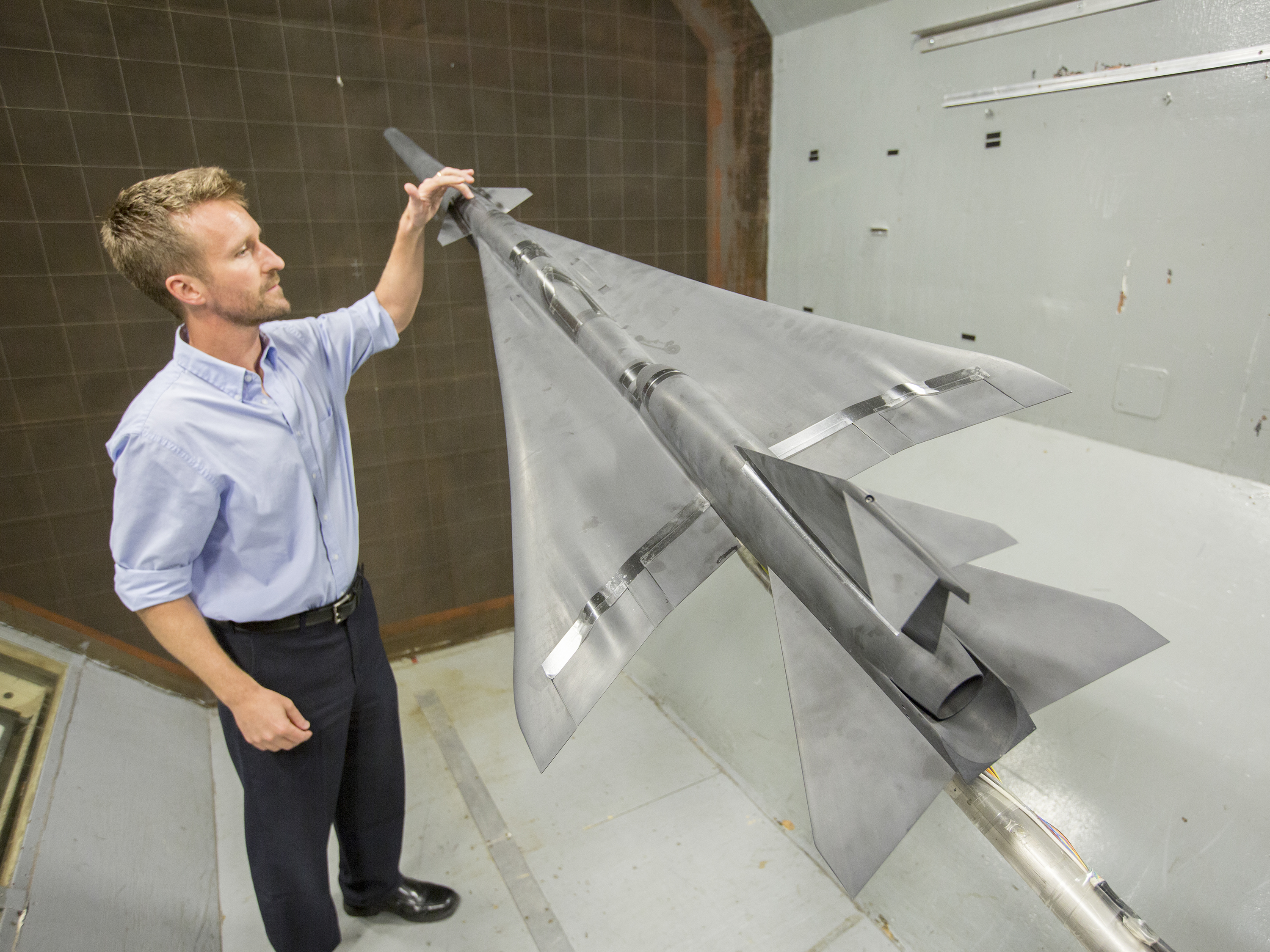
Researcher Corey Diebler inspects an eight percent scale model of the X-59 in NASA Langley's 12-Foot Low Speed Tunnel
Researcher Corey Diebler inspects a model of the supersonic X-59 after a test in Langley Research Center’s 12 foot wind tunnel. Wind tunnel testing at Langley enabled Speedo’s LZR Racer to achieve its excellent underwater performance.
NASA/David C. Bowman.

NASA and Speedo performed tests on traditionally sewn seams, ultrasonically welded seams, and the fabric alone, which gave Speedo a baseline for reducing drag caused by seams and helped identify problem areas. NASA wind tunnel results helped Speedo create a bonding system that eliminates seams and reduces drag. The results also showed that a low-profile zipper ultrasonically bonded into the fabric inside the suit generated eight percent less drag in wind tunnel tests than a standard zipper. Low-profile seams and zippers were a crucial component in the LZR Racer, because the suit consists of multiple connecting fabric pieces—instead of just a few sewn pieces such as found in traditional suits—that provide extra compression for maximum efficiency.

In March 2008, the LZR Racer made its mark on the world of competitive swimming. Athletes donning this innovative swimsuit shattered 13 world records, a testament to the power of collaboration between NASA and Speedo. While the original LZR Racer is no longer used in competition because of the advantage it gave wearers, its legacy lives on in today’s swimsuits approved by World Aquatics, the governing body for international competitive swimming. 

Powered by WPeMatico

Get The Details…
Andrew Wagner