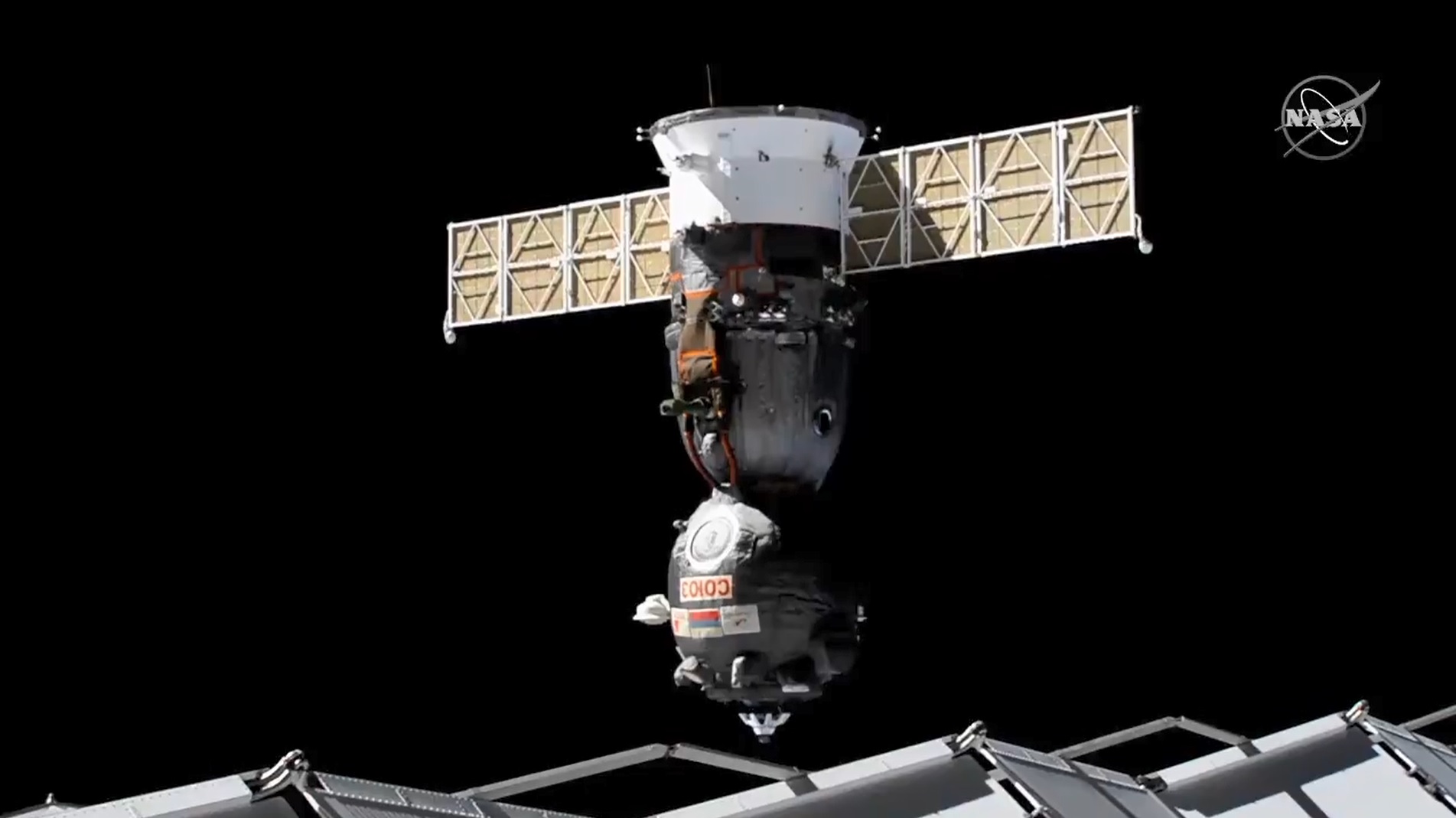
The Soyuz MS-17 spacecraft moments after undocking from the station on April 16th, 2021. Credit: NASA TV
The Soyuz spacecraft undocked from the International Space Station at 9:34 p.m. EDT, carrying three people back to Earth. NASA Television will air live coverage beginning at 11:30 p.m. for the deorbit burn and the spacecraft’s parachute-assisted landing at 12:56 a.m. (10:56 a.m. Kazakhstan time) Saturday, April 17.
Rubins, Ryzhikov, and Kud-Sverchkov’s mission began Oct. 14, 2020, when their spacecraft launched from the Baikonur Cosmodrome in Kazakhstan. Their spacecraft docked to the Earth-facing port of the Rassvet module after a two-orbit, three-hour flight.
Expedition 65 officially began at the time of undocking with NASA astronaut Shannon Walker serving as station commander. Walker will lead the crew until the departure of SpaceX’s Crew Dragon Resilience on Wednesday, April 28, when command of the station will be handed over to JAXA astronaut Akihiko Hoshide.
NASA TV Broadcasts Expedition 64 Crew Departing Station
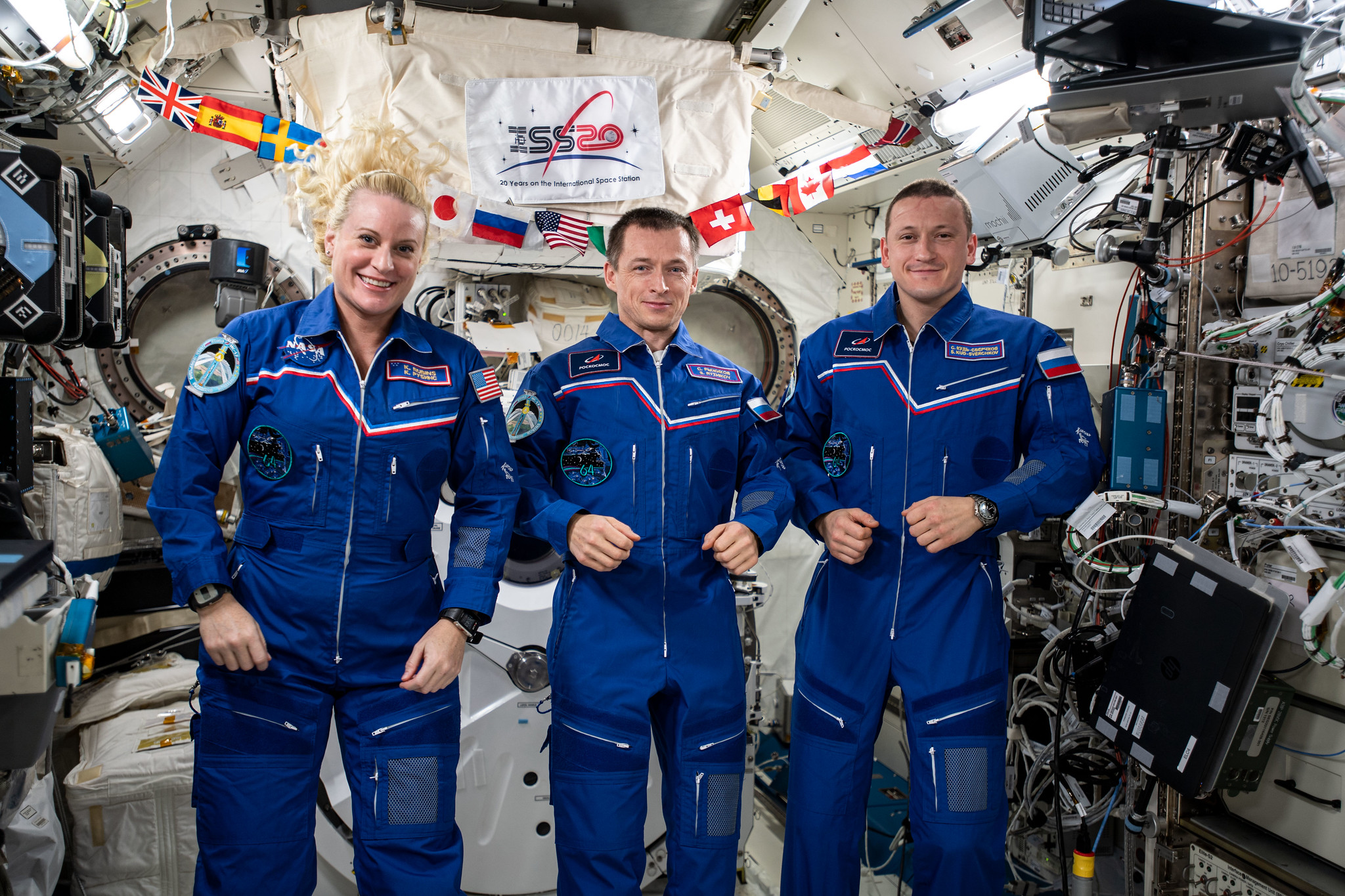
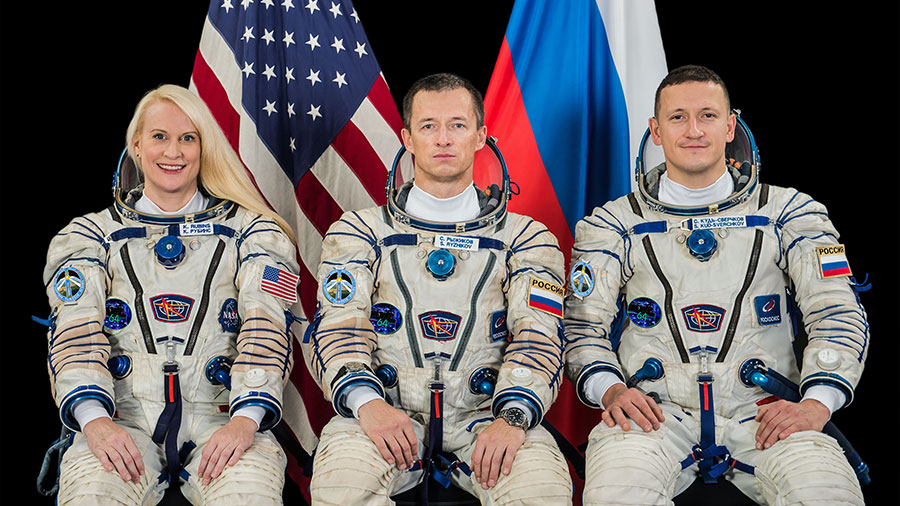
The three-member Expedition 64 crew from JAXA (Japan Aerospace Exploration Agency). From left are, Kate Rubins of NASA,Sergey Ryzhikov of Roscosmos and Sergey Kud-Sverchkov of Roscosmos.
NASA is providing live coverage on NASA TV and its website of the undocking and departure from the International Space Station of the Soyuz spacecraft that will return NASA astronaut Kate Rubins and cosmonauts Sergey Ryzhikov and Sergey Kud-Sverchkov of the Russian space agency Roscosmos to Earth.
The three crew members are concluding a 185-day mission spanning 2,960 orbits of Earth and 78.4 million miles. Rubins is completing her second flight, with 300 cumulative days in space. Ryzhikov is completing his second spaceflight, with 358 cumulative days. This was Kud-Sverchkov’s first spaceflight.
During their mission, Rubins and her crewmates welcomed NASA’s SpaceX Crew-1 astronauts aboard the first long-duration commercial crew spaceflight. Rubins completed two spacewalks alongside NASA astronaut Victor Glover and Japanese Aerospace Exploration Agency (JAXA) astronaut Soichi Noguchi, bringing her career total to four spacewalks. She returns to Earth with a total of 300 days across her two flights, the fourth most days in space by a U.S. female astronaut.
Crew Says Farewell, Enters Soyuz and Prepares to Undock
The hatch closing between the Soyuz MS-17 and station in preparation for the undocking of Expedition 64 crew. Credit: NASA TV
At 6:24 p.m. EDT, the hatch closed between the Soyuz spacecraft and the International Space Station in preparation for undocking. NASA astronaut Kate Rubins and cosmonauts Sergey Ryzhikov and Sergey Kud-Sverchkov of Roscosmos are scheduled to undock their Soyuz MS-17 spacecraft at 9:34 p.m.
NASA Television will air live coverage of the undocking beginning at 9:15 p.m., with coverage of the Soyuz deorbit burn and landing beginning at 11:30 p.m. Their landing in Kazakhstan is targeted for approximately 12:56 a.m. (10:56 a.m. Kazakhstan time) Saturday, April 17.
At the time of undocking, Expedition 65 will formally begin aboard the station, with new station commander Shannon Walker of NASA, NASA astronauts Victor Glover, Michael Hopkins, and Mark Vande Hei, Japan Aerospace Exploration Agency (JAXA) astronaut Soichi Noguchi, and cosmonauts Oleg Novitskiy and Pyotr Dubrov.
NASA TV Begins Live Coverage of Station Crew Departure
Expedition 64 crew members (from left) NASA astronaut Kate Rubins and Roscosmos cosmonauts Sergey Ryzhikov and Sergey Kud-Sverchkov pose for a crew portrait.
NASA is providing live coverage on NASA TV and its website as NASA astronaut Kate Rubins and cosmonauts Sergey Ryzhikov and Sergey Kud-Sverchkov of Roscosmos prepare to conclude their mission aboard the International Space Station and return to Earth.
The trio will and close the hatch to their Soyuz MS-17 spacecraft at 6:10 p.m. EDT to begin the journey back to Earth. They will undock from the space-facing port of the station’s Poisk module at 9:34 p.m., heading for a parachute-assisted landing at 12:56 a.m. (10:56 a.m. Kazakhstan time) Saturday, April 17, on the steppe of Kazakhstan, southeast of the remote town of Dzhezkazgan.
Coverage of the farewells and hatch closure will be followed by undocking coverage at 9:15 p.m., with coverage of the Soyuz deorbit burn and landing beginning at 11:30 p.m.
Expedition 64 Leaving Station as New SpaceX Crew Preps for Launch
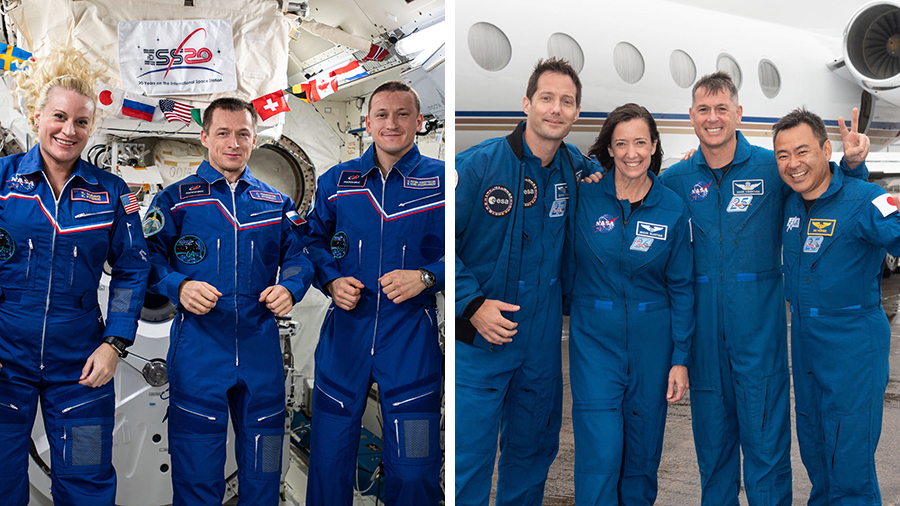
(From left) The Expedition 64 crew is returning to Earth today as the SpaceX Crew-2 astronauts prepare for an April 22 launch to the station from Florida.
Three Expedition 64 crew members are preparing to return to Earth today completing a 185-day research mission on the International Space Station. Meanwhile, four new SpaceX Crew-2 astronauts have arrived at the Kennedy Space Center preparing for a launch next week to the orbiting lab.
NASA astronaut Kate Rubins along with Roscosmos cosmonauts Sergey Ryzhikov and Sergey Kud-Sverchkov will say goodbye to their station crewmates today. They will enter the Soyuz MS-17 crew ship and close the hatch for the final time at 6:10 p.m. EDT. The trio will then undock from the Poisk module at 9:34 p.m. and parachute to Earth about three-and-a-half hours later inside the Soyuz crew ship. NASA TV will broadcast all the homecoming activities live beginning at 5:45 p.m. today.
Four Commercial Crew astronauts left Houston today and arrived in Florida to prepare for an April 22 liftoff from the Kennedy Space Center to the space station. The quartet will take a near 24-hour ride inside the SpaceX Crew Dragon Endeavour before docking to the Harmony module’s forward-facing international docking adapter.
Endeavour will be commanded by Shane Kimbrough and piloted by Megan McArthur, both NASA astronauts. They will be accompanied by Mission Specialists Akihiko Hoshide of the Japan Aerospace Exploration Agency (JAXA) and Thomas Pesquet from the European Space Agency. All four astronauts have previously flown on space shuttles or Soyuz vehicles.
They will be greeted by station Commander and Houston native Shannon Walker of NASA and her SpaceX Crew-1 crewmates Michael Hopkins and Victor Glover of NASA and Soichi Noguchi of JAXA. The foursome, having been aboard the station since November, will then turn its attention to an April 28 return to Earth aboard the Crew Dragon Resilience.
Staying behind at the station with the Crew-2 astronauts will be NASA astronaut Mark Vande Hei and Roscosmos cosmonauts Oleg Novitskiy and Pyotr Dubrov. They arrived on April 9 docking their Soyuz MS-18 spacecraft to the Rassvet module less than three-and-a-half hours after launching from Kazakhstan.