Starliner Stands Down, Station Crew Works Physics and Nauka Transfers

Starliner Stands Down, Station Crew Works Physics and Nauka Transfers

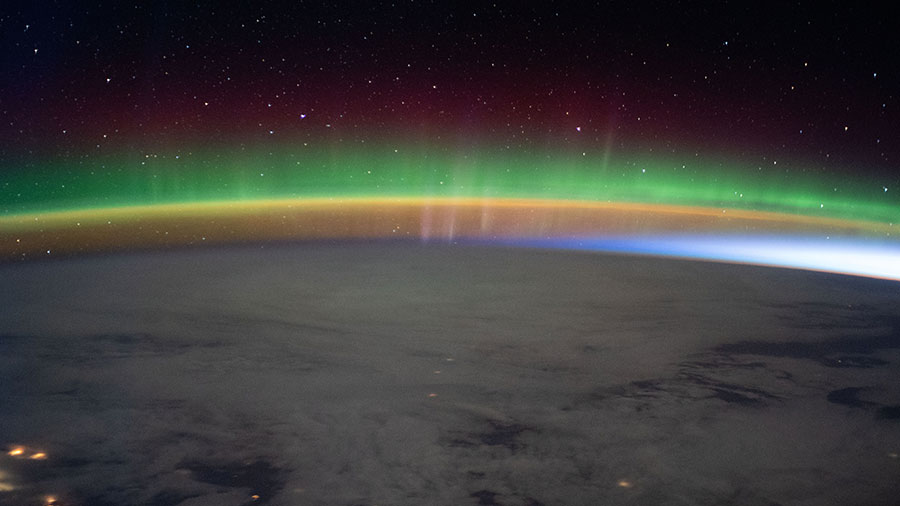
The aurora australis seemingly crowns the Earth's horizon as the station orbited above the southern Indian Ocean in between Asia and Antarctica.
The aurora australis seemingly crowns the Earth’s horizon as the station orbited above the southern Indian Ocean in between Asia and Antarctica.

Boeing’s CST-100 Starliner crew ship will roll back to its Vehicle Integration Facility so mission teams can examine the cause of unexpected valve position indications on the spacecraft’s propulsion system. Starliner’s launch targeted for today was halted as a result.

NASA and Boeing are analyzing indications that not all of Starliner’s valves were in the proper configuration needed for launch. The commercial crew partners will take the time necessary to ensure Starliner is ready to launch on Orbital Flight Test-2 to the International Space Station.

Meanwhile, the Expedition 65 crew explored space physics and transferred cargo from a new Russian science module on Wednesday.

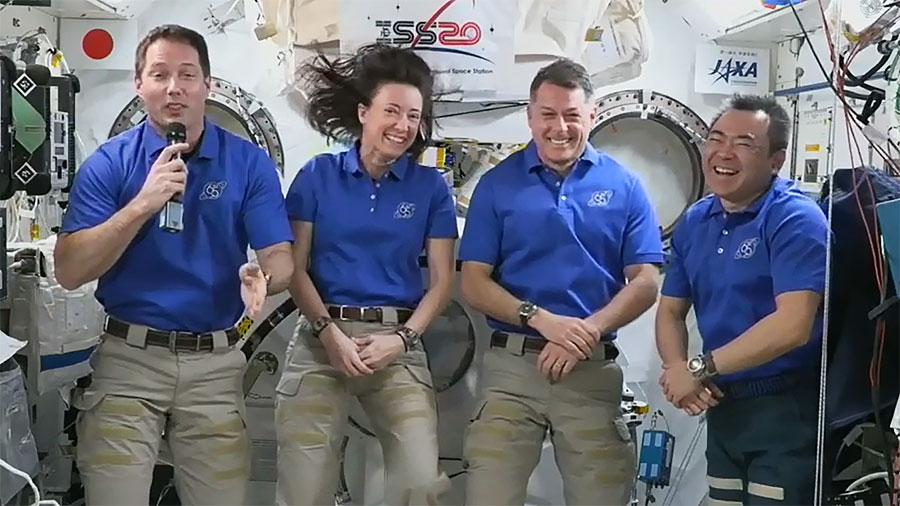
Station Flight Engineers Megan McArthur, Mark Vande Hei and Thomas Pesquet took turns today researching ways to harness nanoparticles for the InSpace-4 space-manufacturing study. The space physics investigation takes place inside the Microgravity Science Glovebox and  seeks to develop advanced materials in microgravity to improve and strengthen spacecraft and Earthbound systems.

NASA Flight Engineer Shane Kimbrough worked in the U.S. Quest airlock on Wednesday removing particles from a smoke detector. Commander Akihiko Hoshide of the Japan Aerospace Exploration Agency replaced lights in the Kibo laboratory module then moved on to orbital plumbing tasks inside the Tranquility module’s waste and hygiene compartment.

Over in the Russian segment of the orbiting lab, cosmonauts Oleg Novitskiy and Pyotr Dubrov partnered up to unpack cargo delivered inside the new “Nauka” Multipurpose Laboratory Module. The duo then took turns exploring spacecraft and robotic piloting techniques for future planetary missions.

Continued analysis following last week’s event with unplanned thruster firings on Nauka has shown the space station remains in good shape with systems performing normally. Post-event reconstructions showed that the station experienced a total attitude change of approximately 540 degrees. Most importantly, the maximum rate and acceleration of the attitude change did not approach safety limits for station systems and normal operations resumed once attitude control was regained.

Get The Details…

Mark Garcia

Powered by WPeMatico

Station Gears up for U.S. Crew and Cargo Spaceships

Station Gears up for U.S. Crew and Cargo Spaceships

Boeing’s CST-100 Starliner spacecraft atop the United Launch Alliance Atlas V rocket rolls out to the launch pad on Monday at Cape Canaveral Space Force Station in Florida.

Boeing’s CST-100 Starliner spacecraft is targeted for launch on Tuesday at 1:20 p.m. EDT atop the Atlas V rocket from United Launch Alliance at Cape Canaveral Space Force Station in Florida. Meteorologists predict a 60% chance of favorable weather at the launch pad on Florida’s Atlantic coast.

For an on-time launch, Starliner would reach the International Space Station one day later and dock to the Harmony module’s forward-port at 1:37 p.m. All events will be broadcast live on NASA TV.

All is well aboard the orbiting lab today as all seven Expedition 65 crew members focus on physics research, spacesuit maintenance and station upkeep. The orbital residents are also gearing up for the next U.S. cargo mission to resupply the station.

Flight Engineers Megan McArthur joined Thomas Pesquet for several runs of the InSpace-4 nanoparticle study throughout Monday. The duo from NASA and ESA (European Space Agency) took turns working inside the Microgravity Science Glovebox for the space-manufacturing investigation. InSpace-4 seeks to develop advanced materials in microgravity to improve and strengthen spacecraft and Earthbound systems.

Both astronauts also trained on a computer for the rendezvous and capture of Northrop Grumman’s Cygnus space freighter planned for Aug. 12 at 6:10 a.m. NASA TV will cover Cygnus’ station arrival including its launch scheduled on Aug. 10 at 5:56 p.m.

Pesquet moved on and assisted Commander Akihiko Hoshide inside the Quest airlock and serviced a pair U.S. spacesuits ahead of an upcoming spacewalk for more roll-out solar array work. NASA Flight Engineers Shane Kimbrough and Mark Vande Hei worked on a variety of science, communications hardware and life support throughout Monday.

Cosmonauts Oleg Novitskiy and Pyotr Dubrov have been unpacking and configuring new hardware delivered aboard Nauka after it docked to the Zvezda service module’s Earth-facing port last week. Novitskiy also activated a long-running Russian Earth observation experiment while Dubrov photographed the condition of Zvezda’s treadmill and downlinked the files.

Get The Details…

Mark Garcia

Powered by WPeMatico

Progress 77 and Pirs Undocked from Station

Progress 77 and Pirs Undocked from Station

Russia's ISS Progress 77 (77P) cargo craft is pictured docked to the Pirs docking compartment on the station's Russian segment.
Russia’s ISS Progress 77 (77P) cargo craft is pictured docked to the Pirs docking compartment on the station’s Russian segment.

The unpiloted Russian Progress 77 cargo spacecraft undocked from the International Space Station while attached to the Pirs docking compartment at 6:55 a.m. EDT.

The spacecraft will reenter Earth’s atmosphere and harmlessly burn up over the south Pacific. The mission launched and docked to the space station in February delivering more than a ton of cargo to the Expedition 65 crew. Deorbit and re-entry will not be covered on NASA TV.

With the port on the Earth-facing side of the Russian segment station vacated by the departure of Pirs and Progress, Russia’s Multipurpose Laboratory Module (MLM) is scheduled to dock at the station Thursday, July 29. Named Nauka, after the Russian word for “science,” MLM launched on July 21 and will serve as a new science facility, docking port, and spacewalk airlock for future operations.

Get The Details…

Norah Moran

Powered by WPeMatico

Crewmembers Finish Science Experiments

Crewmembers Finish Science Experiments

Expedition 65 Flight Engineer Thomas Pesquet of the European Space Agency is pictured inside the Columbus laboratory module setting up hardware for the GRIP experiment.

The Expedition 65 crew capped off this week’s research activities aboard the International Space Station by making headway with various science experiments related to human health and materials performance.

Russian flight controllers continued systems testing Friday on the new Nauka Multipurpose Laboratory Module as it heads toward the International Space Station for a scheduled docking next week.

ESA (European Space Agency) astronaut Thomas Pesquet finished the third part of three GRIP tasks. For the experiment, Pesquet performed a set of movements in the supine position. The GRIP experiment studies the long-duration spaceflight effects on the abilities of human subjects to regulate grip force and upper-limbs trajectories when manipulating objects during different kinds of movements.

Commander Akihiko Hoshide, a Japan Aerospace Exploration Agency astronaut, reconfigured the Cell Biology Experiment Facility – Left (CBEF-L), which is used to conduct space plant research. CBEF-L is an upgraded version of an original facility aboard the space station and provides new capabilities and resources, such as a full high-definition video interface, ethernet, 24 power supply, and a larger-diameter centrifugal test environment.

Hoshide, Pesquet, and NASA Flight Engineers Mark Vande Hei, Shane Kimbrough, and Megan McArthur also took turns undergoing eye exams using a remote ultrasound device. Some astronauts have reported experiencing vision changes during and after spaceflight, and the exams provide insight into how spaceflight affects the eye health of crews throughout the mission.

Kimbrough and McArthur continued conducting runs for the Investigating the Structure of Paramagnetic Aggregates from Colloidal Ellipsoids, or InSPACE-4. For the investigation, the pair took turns distributing particles within the sample vial and activated research equipment. InSpace-4 studies the assembly of tiny structures from colloids using magnetic fields and could shed light on how to harness nanoparticles to fabricate and manufacture new materials.

Additionally, McArthur had a chance to complete a Robotic On-Board Trainer for Research (ROBoT-r) session as part of the Behavioral Core Measures experiment. The purpose of the study is to reliably assess the risk of adverse cognitive or behavioral conditions during extended spaceflight missions. Sessions are completed monthly, starting within two weeks of an astronaut’s arrival on station.

Get The Details…

Deepthi Cauligi

Powered by WPeMatico

Crewmembers Focus on Science and Prepare for Upcoming Dockings and Undockings

Crewmembers Focus on Science and Prepare for Upcoming Dockings and Undockings

Fresh vegetables float around NASA astronaut and Expedition 65 Flight Engineer Megan McArthur.
Fresh vegetables float around NASA astronaut and Expedition 65 Flight Engineer Megan McArthur. She and other astronauts are participating in a study to evaluate the effects of menu fatigue on crew.

A delay in the undocking events scheduled for tomorrow gave the crew of Expedition 65 aboard the International Space Station extra time to focus on training, science, and maintenance today.

Russia’s Multipurpose Laboratory Module (MLM) launched on July 21, and to provide more time for Russian flight controllers to check out MLM’s status, the undocking of the Russian Progress 77 and Pirs docking compartment has been postponed until Saturday, July 24. The space station crew has been notified. Progress 77 undocking with the Pirs docking compartment is now scheduled for 8:28 am EDT. Live coverage on NASA TV, the agency’s website, and the NASA app will begin at 8 am.

On Thursday, June 29,MLM is scheduled to dock at the station. Named Nauka, after the Russian word for “science,” MLM will serve as a new science facility, docking port, and spacewalk airlock for future operations.

Once Pirs and Progress 77 are decoupled from the station on Saturday, they will undergo a de-orbit maneuver that will send it towards Earth’s to disintegrate in Earth’s atmosphere. In preparation, Russian Cosmonauts Pyotr Dubrov and Oleg Novitskiy performed a series of maintenance tasks today.

The crew also prepared for another upcoming event: the scheduled arrival of Boeing’s CST-100 Starliner at the space station on July 31 as part of  NASA’s Boeing Orbital Flight Test-2 (OFT-2) mission. NASA Flight Engineers Mark Vande Hei and Shane Kimbrough along with station Commander Akihiko Hoshide, a Japan Aerospace Exploration Agency astronaut, received training on procedures relating to the approach, docking, and undocking of Starliner.

A full suite of science interspersed these maintenance and training tasks. The crew continued its focus on eye health, remotely guided by scientists on Earth. NASA astronaut Megan McArthur along with Hoshide and Vande Hei set up hardware and helped each other administer drops that dilate their eyes so that onboard equipment can capture 3-D images of their eyes’ internal structures. They also performed vision tests. The low gravity on the space station can change eye shape in some astronauts, so monitoring eye health is important to ensuring crew health.

Astronauts also continued work on science experiments that could provide insight into how to harness nanoparticles to fabricate and manufacture new materials. McArthur, Vande Hei, and Kimbrough all ran tests for the Investigating the Structure of Paramagnetic Aggregates from Colloidal Ellipsoids, or InSPACE-4, study. Magnetic fields used in the experiment, when combined with the station’s low gravity, allow particles to be observed in a suspended state, which is ideal for monitoring their interactions with light and heat.

In addition, Kimbrough, Vande Hei, and McArthur completed surveys about their recent meals that will allow scientists to study menu fatigue. In space, menu fatigue can have serious consequences. Lost appetites could result in astronauts not eating enough food, which may lead to body mass loss, nutritional deficiencies, and other health issues, particularly on long-duration missions.

Meanwhile, ESA (European Space Agency) astronaut Thomas Pesquet focused his attention testing how the KEyence Research Microscope Testbed (KERMIT) would work in different locations on the station. KERMIT is designed to streamline imaging and analysis through a single platform with easy operation by the station crew as well as by remote operatiors on the ground. With real-time guidance from researchers on Earth, Pesquet moved KERMIT along with other equipment that can characterize vibrational disturbances caused by the microscope when in use. He then tested whether KERMIT’s functionality could be retained in this new location.

Get The Details…

Mohi Kumar

Powered by WPeMatico