NASA TV Broadcasting Fifth Spacewalk of the Year Today
Roscosmos cosmonaut Oleg Artemyev waves to the camera during a spacewalk on April 18, 2022, to configure the European robotic arm.
NASA Television coverage is underway as two Russian cosmonauts prepare to venture outside the International Space Station to continue activating the new European robotic arm – a 37-foot-long manipulator system mounted to the recently arrived Nauka module.
Expedition 67 Flight Engineers Oleg Artemyev and Denis Matveev of Roscosmos will conduct the second in a series spacewalk that will be staged out of the Poisk module airlock. During the spacewalk, the duo will monitor the first commanded movements of the robotic arm from its grapple fixtures after removing thermal blankets and launch locks. The arm’s end effectors will translate one at a time to a new base points. The crew also will install more handrails on Nauka.
Coverage of the spacewalk is on NASA Television, the NASA app, and agency’s website.
Artemyev will wear a Russian Orlan spacesuit with red stripes. Matveev will wear a spacesuit with blue stripes. This will be the fifth spacewalk in Artemyev’s career, and the second for Matveev. It will be the fifth spacewalk at the station in 2022 and the 250th spacewalk for space station assembly, maintenance, and upgrades.
During the first spacewalk on April 18, the cosmonauts installed and connected a control panel for the robotic arm. They also removed protective covers from the arm and installed handrails on Nauka. The arm will be used to move spacewalkers and payloads around the Russian segment of the station.
Crew-4 NASA astronauts Mission Commander Kjell Lindgren, Pilot Bob Hines, and Mission Specialist Jessica Watkins, and Mission Specialist Samantha Cristoforetti of ESA (European Space Agency) were greeted by Crew-3 as they arrived to the International Space Station.
NASA astronauts Mission Commander Kjell Lindgren, Pilot Bob Hines, and Mission Specialist Jessica Watkins, and Mission Specialist Samantha Cristoforetti of ESA (European Space Agency) now are aboard the International Space Station following Crew Dragon’s hatch opening about 9:15 p.m. EDT, Wednesday, April 27.
Crew-4 joins Expedition 67 crew of Raja Chari, Thomas Marshburn, and Kayla Barron, all of NASA, Matthias Maurer of ESA, and cosmonauts Oleg Artemyev, Sergey Korsakov, and Denis Matveev of Roscosmos.
NASA TV coverage will conclude shortly after hatch opening and return for live coverage of the welcoming ceremony at 2:40 a.m. Thursday, April 28.
Crew-4 astronauts launched to International Space Station at 3:52 a.m. Wednesday, April 27, from Launch Complex 39A at NASA’s Kennedy Space Center in Florida. The international crew of four will spend several months on the orbital complex on a science expedition mission.
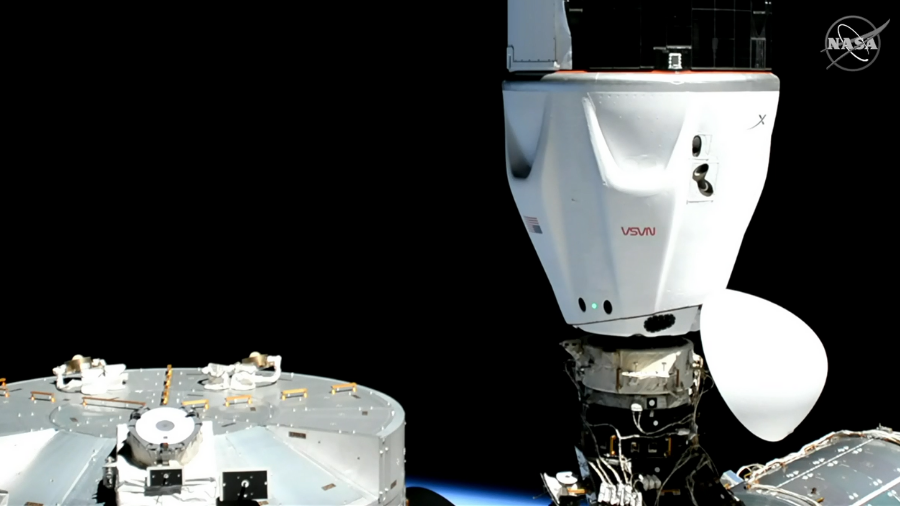
The SpaceX Dragon Freedom capsule is seen after docking to the International Space Station while the station was orbiting 261 statute miles above the Pacific Ocean.
NASA astronauts Kjell Lindgren, Bob Hines, and Jessica Watkins, and ESA (European Space Agency) astronaut Samantha Cristoforetti arrived at the International Space Station Wednesday, April 27, as the SpaceX Dragon Freedom docked to the complex at 7:37 p.m. EDT while the spacecraft were flying about 261 miles above the Pacific Ocean.
Following Crew Dragon’s link up to the Harmony module, the astronauts aboard Dragon and the space station will begin conducting standard leak checks and pressurization between the spacecraft in preparation for hatch opening.
Lindgren, Hines, Watkins, and Cristoforetti will join the Expedition 67 crew of Raja Chari, Thomas Marshburn, and Kayla Barron, all of NASA, Matthias Maurer of ESA, and cosmonauts Oleg Artemyev, Sergey Korsakov, and Denis Matveev of Roscosmos. For a short time, the number of crew on the space station will increase to 11 people until NASA’s SpaceX Crew-3 departs in early May.
NASA Television, the NASA app, and the agency’s website are providing ongoing live coverage through hatch opening. NASA also will cover the ceremony to welcome the crew aboard the orbital outpost about 2:40 a.m. Thursday, April 28.
Crew-4: NASA TV Coverage Continues, Dragon Ahead of Schedule for Docking
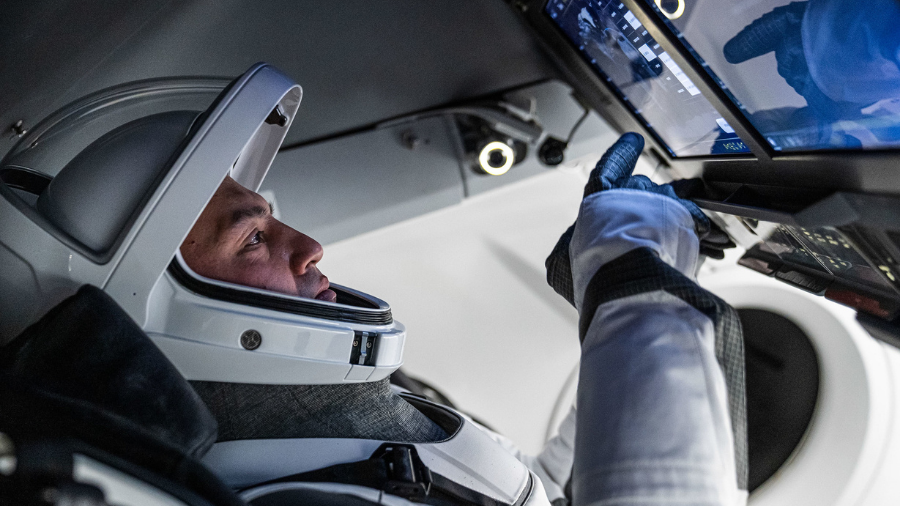
NASA astronaut and SpaceX Crew-4 Commander Kjell Lindgren, representing NASA’s Commercial Crew Program, is pictured during a training session inside a mockup of the Crew Dragon vehicle at SpaceX Headquarters in Hawthorne, California on Feb. 15, 2022.
NASA Television, the NASA app, and the agency’s website are providing live continuous coverage of NASA’s SpaceX Crew-4 mission carrying NASA astronauts Kjell Lindgren, Bob Hines, and Jessica Watkins, and ESA (European Space Agency) astronaut Samantha Cristoforetti on their way to the International Space Station.The Crew Dragon spacecraft, named Freedom, is about 45 minutes ahead of the planned mission timeline. Docking to the space-facing port of the station’s Harmony module now is expected about 7:40 p.m. EDT Wednesday, April 27.
Crew-4 astronauts launched to International Space Station at 3:52 a.m. Wednesday, April 27, from Launch Complex 39A at NASA’s Kennedy Space Center in Florida.
SpaceX Crew-4 Launches to Join Station Crew Tonight
The SpaceX Crew-4 astronauts liftoff from Kennedy Space Center in Florida aboard the Dragon Freedom crew ship atop the Falcon 9 rocket. CRedit: NASA/Joel Kowsky
NASA’s SpaceX Crew-4 astronauts are in orbit following their launch to the International Space Station at 3:52 a.m. EDT Wednesday, April 27, from Launch Complex 39A at NASA’s Kennedy Space Center in Florida. The international crew of astronauts will serve as the fourth commercial crew rotation mission aboard the space station.
A SpaceX Falcon 9 rocket propelled the Dragon spacecraft into orbit carrying Mission Commander Kjell Lindgren, Pilot Bob Hines, and Mission Specialist Jessica Watkins, all NASA astronauts, and Mission Specialist Samantha Cristoforetti of ESA (European Space Agency). The crew will conduct a science expedition in microgravity aboard the space station.
“Liftoff! The past few days at Kennedy Space Center have been inspiring and busy with the return of the Axiom crew and now the successful launch of Crew-4 astronauts to the International Space Station,” said NASA Administrator Bill Nelson. “Aboard station, Kjell, Bob, Jessica, and Samantha will carry out research investigations that will help NASA prepare for longer duration stays on the Moon – and eventually Mars. These missions wouldn’t be possible without the dedicated NASA and SpaceX teams here on Earth. Godspeed, Crew-4!”
This Crew-4 mission is the first launch for Hines and Watkins, and the second flight to the station for Lindgren and Cristoforetti. It launched in a new Dragon spacecraft, named Freedom by the crew, and a Falcon 9 booster flying its fourth mission into space. This is the fifth SpaceX flight with NASA astronauts – including the Demo-2 test flight in 2020 to the space station – as part of the agency’s Commercial Crew Program.
During Dragon’s flight, SpaceX will monitor a series of automatic spacecraft maneuvers from its mission control center in Hawthorne, California, and NASA teams will monitor space station operations throughout the flight from the Mission Control Center at the agency’s Johnson Space Center in Houston.
Dragon will dock autonomously to the space-facing port of the station’s Harmony module around 8:15 p.m. Wednesday, April 27. NASA Television, the NASA app, and the agency’s website are providing ongoing live coverage through docking, and hatch opening. NASA also will cover the ceremony to welcome the crew aboard the orbital outpost about 2:40 a.m. on Thursday, April 28.
“NASA, SpaceX and our international partners have worked tirelessly to ensure that the International Space Station continues conducting important research in microgravity, and working on a whole host of activities that benefit humanity and opens up access to more people in space,” said Kathryn Lueders, associate administrator for NASA’s Space Operations Mission Directorate in Washington. “Crew-4’s launch, less than two days after the return of the first all-private mission to station, exemplifies the spirit and success of the Commercial Crew Program to help maximize use of low-Earth orbit for years to come, testing the technologies we need for the Artemis program and beyond.”
Lindgren, Hines, Watkins, and Cristoforetti will join the space station’s Expedition 67 crew of Raja Chari, Thomas Marshburn, and Kayla Barron, all NASA astronauts, Matthias Maurer of ESA, and cosmonauts Oleg Artemyev, Sergey Korsakov, and Denis Matveev of Roscosmos. For a short time, the number of crew aboard the space station will increase to 11 people until Crew-3 astronauts Chari, Marshburn, Barron, and Maurer return to Earth a few days later.
Crew-4 is the third commercial crew mission to fly an ESA astronaut.
“It gives me great pleasure to see the successful launch of Samantha Cristoforetti and her Crew-4 colleagues. Samantha will take over from Matthias Maurer and continue to represent Europe and support European experiments aboard the space station throughout her mission,” says ESA Director General Josef Aschbacher.
ESA Director of Human and Robotic Exploration David Parker adds, “Samantha has been an excellent role model – even more so as on the space station she will take on the role of USOS lead, responsible for operations within the U.S. Orbital Segment of the International Space Station, comprising of American, European, Japanese and Canadian modules and components.”
The Crew-4 astronauts will spend several months aboard the space station conducting new scientific research in areas such as materials science, health technologies, and plant science to prepare for human exploration beyond low-Earth orbit and to benefit life on Earth.
The Crew-4 mission continues NASA’s efforts to maintain American leadership in human spaceflight. Regular, long-duration commercial crew rotation missions enable NASA to continue the important research and technology investigations taking place aboard the station. Such research benefits people on Earth and lays the groundwork for future exploration of the Moon and Mars, starting with the agency’s Artemis missions, which includes landing the first woman and person of color on the lunar surface.
Lindgren is commander of the Dragon spacecraft and the Crew-4 mission. He is responsible for all phases of flight, from launch to re-entry, and will serve as an Expedition 67 flight engineer. This will be Lindgren’s second spaceflight since becoming an astronaut in 2009. In 2015, he spent 141 days aboard the orbital laboratory as a flight engineer for expeditions 44 and 45. Board certified in emergency medicine, he previously worked at NASA Johnson as a flight surgeon supporting space station training and operations and served as a deputy crew surgeon for space shuttle flight STS-130 and Expedition 24. Lindgren was born in Taipei, Taiwan, and spent most of his childhood in England before graduating from the U.S. Air Force Academy.
Hines is the pilot of the Dragon spacecraft and second in command for the mission. He is responsible for spacecraft systems and performance. Aboard the station, he will serve as an Expedition 67 flight engineer. This will be his first flight since his selection as an astronaut in 2017. Hines has served more than 22 years in the U.S. Air Force as a test pilot, fighter pilot, and instructor pilot. Before his selection in 2017, he was a research pilot at Johnson.
Watkins is a mission specialist for Crew-4 and will work closely with the commander and pilot to monitor the spacecraft during the dynamic launch and re-entry phases of flight. Once aboard the station, she will seve as a flight engineer for Expedition 67. Watkins grew up in Lafayette, Colorado, and studied geology at Stanford University, Palo Alto, California, and the University of California, Los Angeles. As a geologist, she studied the surface of Mars and was a science team collaborator at NASA’s Jet Propulsion Laboratory in Pasadena, California, working on the Mars Science Laboratory rover Curiosity. She also was selected as a NASA astronaut in 2017, and this will be her first trip to space.
Cristoforetti will also serve as a mission specialist, working to monitor the Dragon spacecraft during the dynamic launch and re-entry phases of flight. She will serve as a flight engineer for Expedition 67. This will be her second trip to space following five months in 2015 as a flight engineer for Expeditions 42 and 43. Born in Milan, Italy, she was a fighter pilot in the Italian Air Force prior to being selected as an ESA astronaut in 2009. In 2019, she served as commander for NASA’s 23rd Extreme Environment Mission Operations mission on a 10-day stay in Aquarius, the world’s only undersea research station.