Russian Cargo Craft Blasts off to Resupply Station
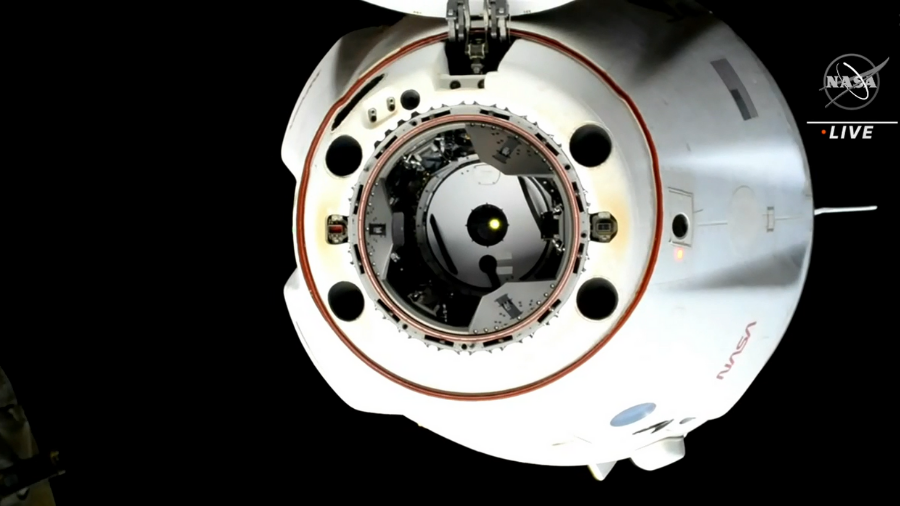
Russia’s Progress 80 resupply ship blasted off on Feb. 14 at 11:25 p.m. EST from the Baikonur Cosmodrome in Kazakhstan. Credit: NASA TV.
The uncrewed Russian Progress 80 is safely in orbit headed for the International Space Station following launch at 11:25 p.m. EST (9:25 a.m. on Feb. 15 Baikonur time) from the Baikonur Cosmodrome in Kazakhstan.
The resupply ship reached preliminary orbit and deployed its solar arrays and navigational antennas as planned on its way to meet up with the orbiting laboratory and its Expedition 66 crew members.
After making 34 orbits of Earth on its journey, Progress will dock to the station’s Poisk module on the space-facing side of the Russian segment at 2:06 a.m. Thursday, Feb. 17. Live coverage on NASA TV of rendezvous and docking will begin at 1:30 a.m.
Progress will deliver almost three tons of food, fuel and supplies to the International Space Station. The Russian space agency Roscosmos will determine a departure date for Progress 80.
Russian Cargo Craft Launching to Station Live on NASA TV
Russia’s Progress 80 space freighter is seen prior to launch in Baikonur. It will deliver almost three tons of food, fuel, and supplies to the Expedition 66 crew. Credit: Roscosmos.
The uncrewed Russian Progress 80 is scheduled to lift off on a Soyuz rocket at 11:25 p.m. EST (9:25 a.m. on Feb. 15 Baikonur time) from the Baikonur Cosmodrome in Kazakhstan to begin a 34-orbit journey to the microgravity laboratory.
Crew Gets Ready for Pair of Cargo Missions Launching this Week
The Nauka multipurpose laboratory module and the Prichal docking module are pictured as the space station orbited above Australia.
A Russian cargo craft is at its launch pad counting down to a lift off tonight to resupply the International Space Station. Meanwhile, the seven-member Expedition 66 crew stayed focused on a variety of research activities while getting ready for another cargo mission due to arrive early next week.
Russia’s ISS Progress 80 resupply ship stands at its launch pad at the Baikonur Cosmodrome in Kazakhstan loaded with nearly three tons of food, fuel, and supplies. The 80th cargo mission from Roscosmos is due to launch tonight at 11:25 p.m. EST and automatically dock to the Poisk module on Thursday at 2:06 a.m. live on NASA TV and the agency’s website and the NASA app.
A U.S. cargo mission is also on tap to launch on Saturday at 12:40 p.m. from Wallops Flight Facility in Virginia. The Northrop Grumman Cygnus space freighter will arrive at a point about 10 meters from the space station when the Canadarm2 robotic arm, commanded by NASA Flight Engineer Raja Chari, will capture the vehicle at 4:35 a.m. next Monday. Robotics controllers on the ground will take over shortly afterward and remotely install Cygnus to the Unity module a couple of hours later. Chari and his back up NASA Flight Engineer Kayla Barron are training today on a computer for the upcoming robotics activities.
While two rockets are getting ready to blast off to the orbiting lab this week, the space lab residents stayed busy today with space science and station maintenance activities.
The Expedition 66 crew is getting ready for a pair of cargo missions launching from Kazakhstan and the United States next week. The Progress and Cygnus resupply ships will be delivering several tons of food, fuel, and supplies to replenish the seven astronauts and cosmonauts aboard the International Space Station.
Russia’s ISS Progress 80 cargo craft will roll out this weekend at Kazakhstan’s Baikonur Cosmodrome and begin counting down to its lift off on Feb. 14 at 11:25 p.m. EST. The Progress 80 will orbit the Earth for just over two days before automatically docking to the Poisk module on Feb. 17 at 2:06 a.m. with nearly three tons of cargo.
Cosmonauts Anton Shkaplerov and Pyotr Dubrov trained today on a computer for the Progress 80’s arrival. The duo from Roscosmos will be at the controls of the tele-operated robotic unit, or TORU, in the Zvezda service module monitoring the cargo craft’s approach and rendezvous. In the unlikely event the Progress 80 is unable to dock on its own, the cosmonauts will be able to use the TORU and manually guide the vehicle to a docking on Poisk.
The next cargo craft to visit the station will be Northrop Grumman’s Cygnus space freighter after it launches from Virginia on Feb. 19 at 12:40 p.m. The Cygnus will arrive at the station on Feb. 21 where it will be captured with the Canadarm2 robotic arm at 4:35 a.m. and installed to the Unity module a few hours later.
NASA astronauts Raja Chari and Kayla Barron joined each other Friday and reviewed robotics procedures necessary to capture Cygnus after it reaches a distance of about 10 meters from the station. Chari will be in the cupola commanding the Canadarm2 to reach out and grapple Cygnus while Barron backs him up and monitors vehicle systems. Ground controllers will take over afterward and remotely guide the robotic arm with Cygnus in its grip and install the U.S. cargo craft to Unity’s Earth-facing port where it will stay for three months.
Human Research Exploring How Astronauts Adapt to Long-Term Spaceflight
Astronaut Kayla Barron works on a space agriculture experiment that explores how to grow fresh food in space.
A host of human research activities dominated Thursday’s research schedule aboard the International Space Station. The Expedition 66 crew members explored how living in microgravity affects sense of orientation, visual function, and the spine.
At the beginning of the day, NASA Flight Engineers Raja Chari and Kayla Barron gathered again in the Columbus laboratory module for the GRIP study. The duo took turns strapping themselves in a specialized seat for the second time this week gripping a control device in response to dynamic events to explore how microgravity affects an astronaut’s sense of motion and orientation. They will have one more session on Friday for the experiment that may inform the design of future spacecraft interfaces.
Chari later spent the afternoon on a series of spinal exams with Flight Engineer Matthias Maurer of ESA (European Space Agency). The astronauts swapped roles as crew medical officer marking their lower, or lumbar spinal section. Then with remote guidance from doctors on the ground, the duo took turns scanning each other’s lumbar spinal section with the Ultrasound 2 device for insights into how the skeletal system adapts to weightlessness.
Matthias first started the day with NASA Flight Engineer Thomas Marshburn conducting biology research inside the Kibo laboratory module. The duo performed operations using the Life Science Glovebox investigating how spaceflight affects visual function by examining changes in the vascular system of the retina and tissue remodeling.