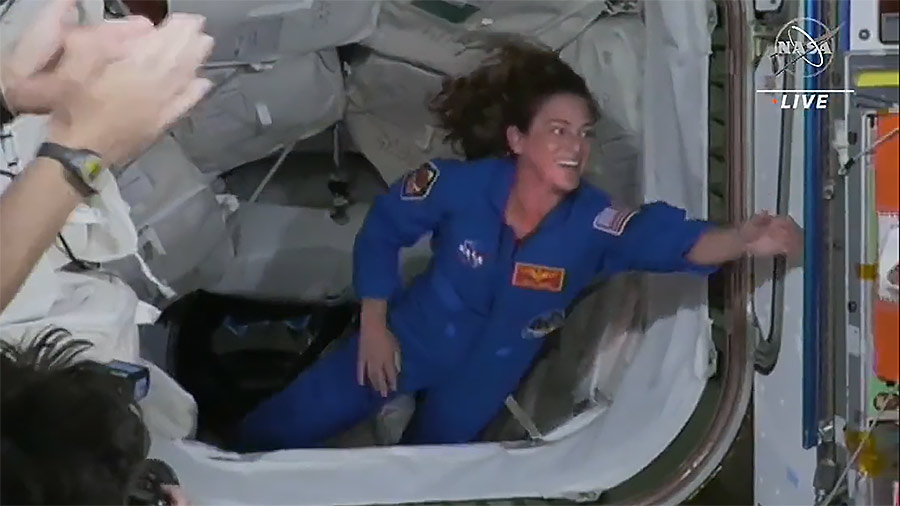
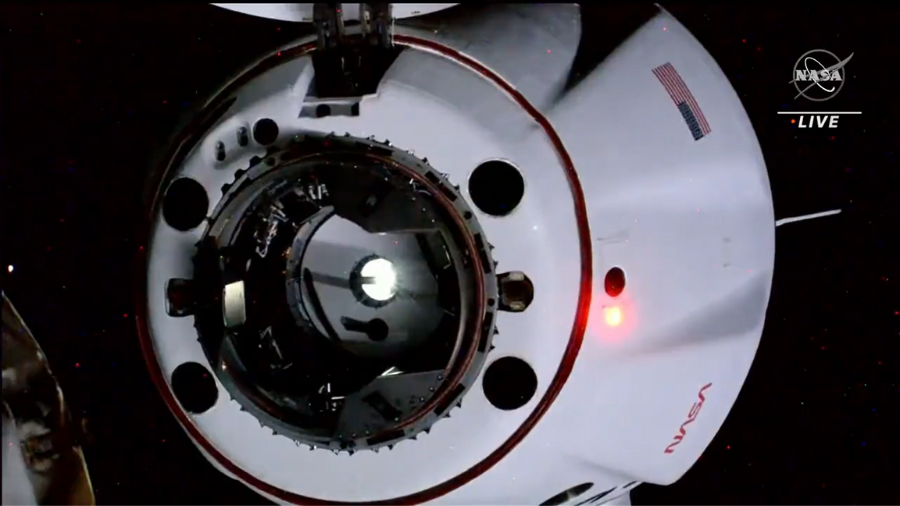
NASA astronaut Nicole Mann enters the space station less than two hours after docking the Dragon Endurance crew ship to the Harmony module’s forward port.
NASA astronauts Nicole Mann and Josh Cassada, JAXA (Japan Aerospace Exploration Agency) astronaut Koichi Wakata, and Roscosmos cosmonaut Anna Kikina aboard the SpaceX Dragon Endurance have arrived at the International Space Station.
Following Dragon hatch opening at 6:49 p.m. EDT, Crew-5 joined the Expedition 68 crew of NASA astronauts Bob Hines, Kjell Lindgren, Frank Rubio, and Jessica Watkins, Samantha Cristoforetti of ESA (European Space Agency), and Roscosmos cosmonauts Sergey Prokopyev and Dmitri Petelin.
NASA TV will end coverage at hatch opening and return for live coverage of the welcoming ceremony at 8:15 p.m.
NASA astronauts Nicole Mann and Josh Cassada, JAXA (Japan Aerospace Exploration Agency) astronaut Koichi Wakata, and Roscosmos cosmonaut Anna Kikina arrived at the International Space Station Thursday Oct. 6, as the SpaceX Dragon Endurance docked to the complex at 5:01 p.m. EDT while the spacecraft were flying 258 miles above the west coast of Africa. Credit: NASA TV
NASA astronauts Nicole Mann and Josh Cassada, JAXA (Japan Aerospace Exploration Agency) astronaut Koichi Wakata, and Roscosmos cosmonaut Anna Kikina arrived at the International Space Station Thursday Oct. 6, as the SpaceX Dragon Endurance docked to the complex at 5:01 p.m. EDT while the spacecraft were flying 258 miles above the west coast of Africa.
Following Dragon’s link up to the Harmony module, the crew aboard Dragon Endurance and the space station will begin conducting standard leak checks and pressurization between the spacecraft in preparation for hatch opening scheduled for 6:42 p.m.
Mann, Cassada, Wakata, and Kikina will join the Expedition 68 crew of NASA astronauts Bob Hines, Kjell Lindgren, Frank Rubio, and Jessica Watkins, Samantha Cristoforetti of ESA (European Space Agency), and Roscosmos cosmonauts Sergey Prokopyev and Dmitri Petelin. For a short time, the number of crew on the space station will increase to 11 people until Crew-4 departs.
NASA Television and the agency’s website are continuing to provide live continuous coverage of the agency’s SpaceX Crew-5 mission.
Station Awaits Arrival of SpaceX Crew-5 Members Today
The SpaceX Endurance crew ship atop the Falcon 9 rocket blasts off from Kennedy Space Center in Florida carrying four Crew-5 members to the space station. Credit: NASA/Joel Kowsky
Three astronauts and one cosmonaut are headed to the International Space Station aboard the SpaceX Dragon Endurance crew ship today. The seven-member Expedition 68 crew worked half-a-day today before sleep-shifting Thursday afternoon to prepare for the rendezvous and docking of the SpaceX Crew-5 mission.
Crew-5 Commander Nicole Mann and Pilot Josh Cassada, both NASA astronauts, with Mission Specialists Koichi Wakata of the Japan Aerospace Exploration Agency (JAXA) and Anna Kikina of Roscosmos, are due to dock to the Harmony module’s forward port at 4:57 p.m. EDT today. About two hours later, the commercial crew quartet will open the vehicle’s hatch and enter the orbiting lab. Finally, all 11 station crew members will gather for welcoming remarks at 8:05 p.m. NASA TV is providing live coverage of the rendezvous, docking, and crew greeting activities on the agency’s app and website.
In the meantime, NASA Flight Engineers Bob Hines and Jessica Watkins spent the morning collecting their blood samples, spinning the samples in a centrifuge, and stowing them in a science freezer for later analysis. Afterward, the pair joined ESA (European Space Agency) Commander Samantha Cristoforetti and NASA Flight Engineer Kjell Lindgren and tested wearing a specialized garment that can manage blood pressure in microgravity. The orthostatic intolerance garment may help astronauts quickly adapt to the return to Earth’s gravity. The foursome is due to board the SpaceX Dragon Freedom crew ship and parachute to a landing off the coast of Florida about a week after the Crew-5 mission arrives.
Astronaut Frank Rubio of NASA, just over two weeks into his first spaceflight, spent his morning on human research collecting and stowing his saliva and urine samples for later analysis, taking a hearing test, then completing a periodic health exam. First time cosmonaut Dmitri Petelin replaced electronics and ventilation components in the Nauka multipurpose laboratory module. Cosmonaut Sergey Prokopyev, on his second station mission, serviced an oxygen generator as part of standard life support maintenance.
Crew Explores Space Effects on Humans, Foams Before SpaceX Crew Launch
NASA astronaut Jessica Watkins observes the behavior of a free-flying water bubble inside the International Space Station’s Kibo laboratory module.
The seven-member Expedition 68 crew continued its science activities on Tuesday exploring how microgravity affects biology and physics. Back on Earth, three astronauts and one cosmonaut are less than a day away from launching to the International Space Station.
NASA Flight Engineers Frank Rubio and Bob Hines targeted their biology studies on what is happening inside the human body during spaceflight. Rubio explored how enhancing space nutrition affects the human immune and microbiome systems for the Food Physiology experiment. Hines collected his blood and urine samples and stowed them in a science freezer for later analysis. A host of space biology investigations require the samples to understand how human physiology adapts to weightlessness.
A portion of Tuesday’s space research looked at fluid physics as station Commander Samantha Cristoforetti studied how foams behave differently in space than on Earth. The ESA (European Space Agency) astronaut swapped foam samples inside the Fluid Science Laboratory for the Soft Matter Dynamics experiment. The study may provide insights helping researchers improve materials production for Earthbound industries such as firefighting, petroleum, medicine, and food products.
Maintenance is also key on the orbital lab to ensure the space station’s many systems continuously operate in tip-top shape while orbiting an average of 260 miles above the Earth. NASA Flight Engineer Kjell Lindgren cleaned vents and fans inside the Unity module to remove impediments to the airflow. NASA astronaut Jessica Watkins worked on water transfer operations then cleaned and inspected station module hatches.
Cosmonaut Sergey Prokopyev, who is on his second spaceflight, spent Tuesday on orbital plumbing and ventilation work before configuring Earth observation hardware. First-time space flyer Dmitri Petelin of Roscosmos also spent his day on orbital plumbing duties and life support maintenance as he and Prokopyev continue to familiarize themselves with life on orbit.
Back on Earth, the SpaceX Crew-5 mission is counting down to its launch from Kennedy Space Center in Florida at noon EDT on Wednesday. Commander Nicole Mann will board the SpaceX Crew Dragon Endurance, atop the Falcon 9 rocket, with Pilot Josh Cassada and Mission Specialists Koichi Wakata and Anna Kikina then take a 29-hour ride after liftoff to the forward port on the station’s Harmony module. The commercial crew quartet will open the vehicle’s hatch and join the Expedition 68 crew shortly afterward. NASA TV will have continuous coverage of the launch, docking, and crew greeting, beginning Wednesday at 8:30 a.m. EDT on the agency’s app and website.
SpaceX Crew Nears Launch as Station Research Under Way
The SpaceX Dragon Endurance crew ship atop the Falcon 9 rocket stands at the launch at the Kennedy Space Center in Florida. Credit: NASA/Joel Kowsky
The next crew to the launch to the International Space Station is at the Kennedy Space Center counting down to liftoff this week. Back onboard the orbiting lab, the seven-member Expedition 68 crew is busy conducting advanced space research to improve life for humans on and off the Earth.
Four SpaceX Crew-5 crew members arrived in Florida on Saturday ahead of their launch aboard the Dragon Endurance at noon EDT on Wednesday. NASA astronauts Nicole Mann and Josh Cassada will command and pilot Endurance respectively. They will ride along with Mission Specialists Koichi Wakata of the Japan Aerospace Exploration Agency (JAXA) and Anna Kikina of Roscosmos. The commercial crew quartet will dock to the forward port of the Harmony module 29 hours after launch to begin their station mission.
After the Dragon Endurance docks to the orbiting lab, another four station crew members will turn their attention to ending their mission and returning to Earth just over a week later. NASA astronauts Kjell Lindgren, Bob Hines, and Jessica Watkins, with ESA (European Space Agency) astronaut Samantha Cristoforetti, who have been living on the station since April 27, will help their Crew-5 replacements adjust to life on the station. The homebound astronauts will then undock inside the SpaceX Dragon Freedom crew ship and parachute to a splashdown off the coast of Florida.
In the meantime, Lindgren and Hines began Monday focusing on how living in space is affecting their muscles. The duo used an Ultrasound device and the Myotones device to scan and measure the biochemical properties of their leg, neck, and back muscles. Watkins nourished vegetables and took photos of the plants growing for the XROOTS space agriculture study taking place in the Columbus laboratory module. NASA Flight Engineer Frank Rubio swapped glass fiber samples in the Microgravity Science Glovebox for the Intelligent Glass Optics space manufacturing investigation. Station Commander Cristoforetti serviced samples inside the Electrostatic Levitation Furnace that supports high-temperature thermophysical research in space.
The station’s two cosmonauts, two-time station visitor Sergey Prokopyev and first-time space flyer Dmitri Petelin, had their hands full on Monday keeping up with lab maintenance while continuing their station familiarization activities. Prokopyev inspected windows inside the Zvezda service module then set up Earth observation gear. Petelin worked on orbital plumbing duties before inventorying and restocking station docking hardware.