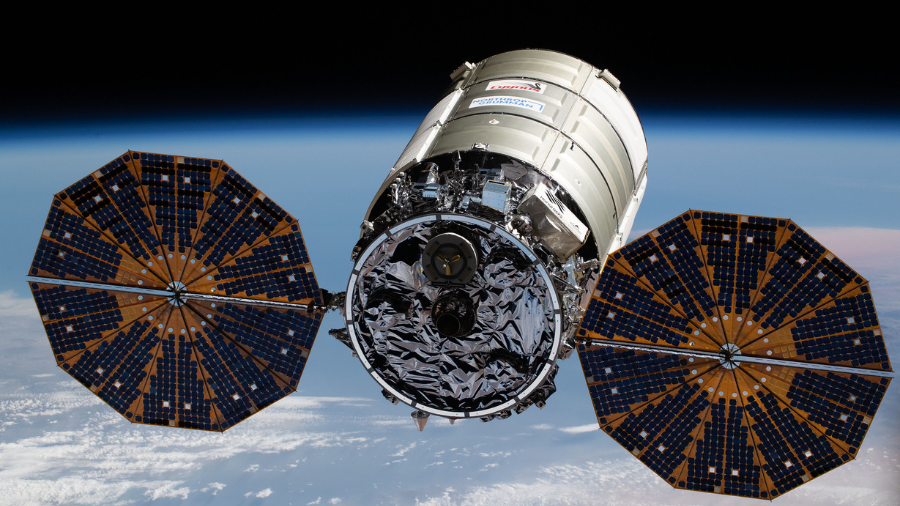
Northrop Grumman’s Cygnus space freighter, with its prominent cymbal-shaped UltraFlex solar arrays, is pictured approaching the International Space Station on Feb. 21, 2022.
NASA television is underway for the capture of Northrop Grumman’s Cygnus spacecraft which launched Monday at 5:32 a.m. EST on an Antares rocket from NASA’s Wallops Flight Facility, Virginia. At about 5:05 a.m., NASA astronaut Nicole Mann will capture Cygnus using the Canadarm2 robotic arm, and NASA astronaut Josh Cassada will be acting as a backup. After capture, the spacecraft will be installed on the Unity module’s Earth-facing port.
This is Northrop Grumman’s 18th commercial resupply mission to the International Space Station for NASA. The Cygnus spacecraft is carrying a supply of 8,200 pounds of scientific investigations and cargo to the orbiting laboratory.
The spacecraft is named the S.S. Sally Ride in honor of the late NASA astronaut, physicist, and first American woman to fly in space.
NASA Television, the NASA app, and agency’s website will provide live coverage of the spacecraft’s installation beginning at 7:15 a.m.
The Northrop Grumman Cygnus cargo spacecraft has successfully deployed one of its two solar arrays and completed four rendezvous burns on its way to the International Space Station. To remain focused on the spacecraft’s arrival at the station, Northrop Grumman and NASA made the determination not to deploy the second solar array after initial attempts to deploy it were unsuccessful. The Cygnus team is gathering information on why the second array did not deploy as planned. Cygnus has sufficient power to rendezvous with the space station Wednesday, Nov. 9. Northrop Grumman is working closely with NASA to monitor and assess the spacecraft ahead of tomorrow’s planned arrival, capture, and installation at the space station. Mission teams also are planning additional inspections of the cargo spacecraft during approach and after capture.
NASA TV coverage of rendezvous and capture will begin at 3:30 a.m. EST followed by installation coverage at 7:15 a.m. At about 5:05 a.m., Expedition 68 NASA astronaut Nicole Mann will capture Cygnus with the station’s robotic arm, with NASA astronaut Josh Cassada acting as backup. After Cygnus capture, ground commands will be sent from mission control at NASA’s Johnson Space Center in Houston for the station’s arm to rotate and install it on the station’s Unity module Earth-facing port.
After launching earlier today, Nov. 7, Northrop Grumman’s Cygnus cargo spacecraft has successfully deployed one of its two solar arrays. Northrop Grumman is gathering data on the second array deployment and is working closely with NASA.
Northrop Grumman has reported to NASA that Cygnus has sufficient power to rendezvous with the International Space Station on Wednesday, Nov. 9, to complete its primary mission, and NASA is assessing this and the configuration required for capture and berthing.
Station Crew Gears Up for Cargo Mission and Spacewalks
Astronaut Koichi Wakata works on spacesuits, also known as Extra-vehicular Mobility Units (EMUs), located in the space station’s Quest airlock.
New science experiments to benefit humans on and off the Earth are packed inside a rocket and ready to blast off this weekend from Virginia to the International Space Station. The Expedition 68 crew is preparing for the arrival of the precious space cargo while also gearing up for a series of spacewalks set to begin this month.
Northrop Grumman’s Antares rocket stands at NASA’s Wallops Flight Facility’s launch pad in Virginia. Attached to the top of the U.S. rocket is the company’s Cygnus space freighter loaded with about four tons of research gear, crew supplies, station hardware. Antares will lift off at 5:50 a.m. EST on Sunday sending Cygnus on a two-day delivery trip to the orbiting lab. NASA TV, on the agency’s website and app, will begin live launch coverage at 5:30 a.m.
Flight Engineers Nicole Mann and Josh Cassada spent Friday reviewing procedures and practicing techniques on a computer to capture Cygnus with the Canadarm2 robotic arm when it arrives next week. Cygnus will perform automated approach and rendezvous maneuvers until it reaches a point about 30 feet (10 meters) from the station early Tuesday. Mann will then command the Canadarm2 to extend toward Cygnus and capture it at 5:50 a.m. on Tuesday while Cassada backs her up monitoring the vehicle’s data. Controllers on the ground will then relieve the duo and remotely guide the Canadarm2 with Cygnus in its grips to the Unity module where it will be installed for 11 weeks of cargo activities.
Spacewalks are also on the schedule this month for two astronauts and two cosmonauts. Cassada and NASA Flight Engineer Frank Rubio are preparing for a Nov. 15 spacewalk to ready the orbiting lab for its third and fourth rollout solar arrays. Mission controllers on Monday will talk on NASA TV about that spacewalk and two more excursions to finish the solar array installation work before the end of the year. Rubio and astronaut Koichi Wakata of the Japan Aerospace Exploration Agency (JAXA) cleaned spacesuit cooling loops, checked the functionality of suit components, and organized the Quest airlock where the two spacewalkers will exit the station. Mann and Cassada were also on hand on Friday assisting with the spacesuit work.
Commander Sergey Prokopyev and Flight Engineer Dmitri Petelin have also been preparing for a different set of spacewalks to install a radiator and airlock on the Nauka science module. The cosmonauts have been getting their Orlan spacesuits ready, gathering spacewalk tools, and cleaning the Poisk module’s airlock ahead of the planned spacewalks. Prokopyev is the veteran of two previous spacewalks from 2018 while Petelin is preparing for his first.
Cosmonaut Anna Kikina started Friday downloading biomedical data to scientists on Earth for analysis. Afterward, she spent the rest of the day servicing the Zvezda service module’s oxygen generator and cleaning vents inside Nauka.
Crewmates Train for Emergency and Await Cygnus Cargo Mission
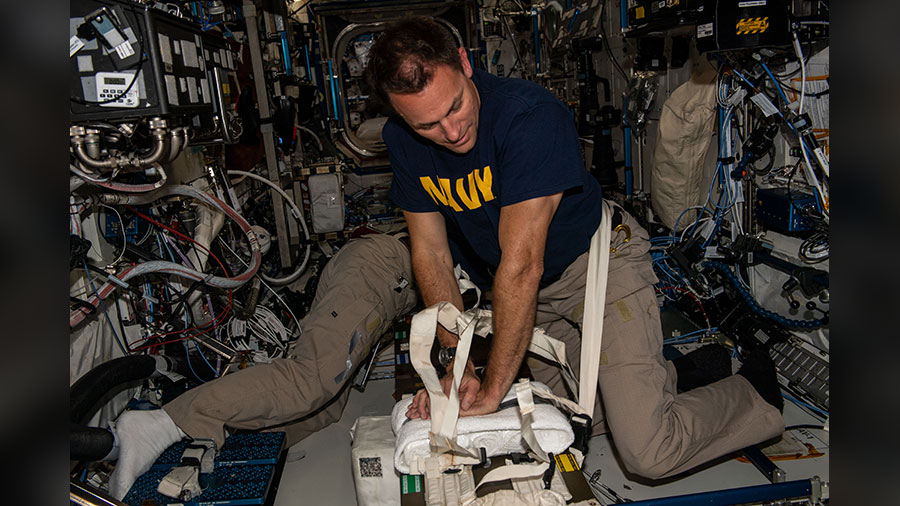
NASA astronaut Josh Cassada practices cardiopulmonary resuscitation (CPR) during a medical emergency drill aboard the space station.
The seven Expedition 68 crew members started Thursday training for an emergency aboard the International Space Station. Afterward, the orbiting septet split up and prepared for next week’s arrival of a U.S. cargo craft, worked on spacesuits, and organized spacewalking tools.
The station’s four astronauts and three cosmonauts began Thursday morning practicing emergency procedures in collaboration with mission controllers on the ground. The commander and six flight engineers from NASA, the Japan Aerospace Exploration Agency (JAXA), and Roscosmos reviewed actions they would take in the unlikely event of several contingency scenarios including a depressurization, an ammonia leak, or a fire. They also coordinated communication protocols with each other and ground controllers from around the world.
In the afternoon, two NASA Flight Engineers, Nicole Mann and Josh Cassada, paired up using a computer to run through a variety of maneuvers necessary to capture Northrop Grumman’s Cygnus space freighter when it arrives next week. Cygnus, packed with 8,200 pounds of cargo, is at the launch pad at NASA’s Wallops Flight Facility in Virginia counting down to its lift off atop the Antares rocket on Sunday at 5:50 a.m. EST. It will rendezvous with the station on Tuesday, where Mann be in the cupola to command the Canadarm2 robotic arm to reach out and capture Cygnus at 5:50 a.m. Cassada will back up Mann as he monitors the spacecraft’s automated approach.
Two astronauts and two cosmonauts have been focusing this week on upcoming spacewalking activities. Cassada and fellow Flight Engineer Frank Rubio spent the better part of Thursday swapping spacesuit components and organizing the Quest airlock for future spacewalks. Commander Sergey Prokopyev and Flight Engineer Dmitri Petelin checked parts on their Orlan spacesuits in the Poisk airlock, gathered spacewalking tools, and photographed their work for review by spacewalk specialists on the ground.
Flight Engineers Koichi Wakata of JAXA and Anna Kikina of Roscosmos focused their attention on lab maintenance activities after Thursday morning’s emergency scenario training. Wakata first checked components on the Microgravity Science Glovebox then turned off the Veggie space botany facility after the completion of experiment activities in both research devices. Kikina cleaned hardware inside the Nauka multipurpose laboratory module then measured her blood pressure and serviced urine samples for analysis.