Aging Process, CubeSat Preps, and Space Physics Fill Station Research Schedule

Aging Process, CubeSat Preps, and Space Physics Fill Station Research Schedule

Astronaut Jessica Watkins sets up cell samples for viewing in a microscope for an immune system aging study.

Human research, nanosatellites, and space physics topped the research operations aboard the International Space Station on Wednesday. The Expedition 67 crew also continued packing a U.S. cargo craft while servicing Russian spacesuits.

NASA Flight Engineer Jessica Watkins peered at tissue stem cells through a microscope in the U.S. Destiny laboratory module today to understand how the human immune system ages in space. Observations may provide insights into the biological aging process and tissue regeneration possibly informing new ways to keeps astronauts healthy in space and treat medical conditions on Earth. Watkins then spent the afternoon readying cargo packed inside the SpaceX Dragon resupply ship for return to Earth in mid-August.

A small satellite deployer loaded with CubeSats has been installed on an external science platform and placed inside the Kibo laboratory module’s airlock by NASA astronaut Kjell Lindgren today. The deployer will soon be moved into the vacuum of space where the CubeSats will be released into low-Earth orbit for a variety of research programs. Lindgren later set up an AstroBee robotic free-flyer to rehearse pre-programmed maneuvers for the upcoming student-based Kibo Robotic Programming Challenge 3.

Flight Engineer Samantha Cristoforetti of ESA (European Space Agency) explored the dynamics of foams, droplets, and granular materials with implications for future planetary travel and industries on Earth. She swapped the samples inside the Fluid Science Laboratory’s Soft Matter Dynamics experiment container.

NASA Flight Engineer Bob Hines started his day transferring U.S. spacewalking gear into the orbiting lab’s Russian segment. During the afternoon, he serviced hardware supporting the Ring Sheared Drop fluid physics study that could lead to a better understanding of Alzheimer’s disease and the development of advanced materials.

Roscosmos cosmonauts Oleg Artemyev and Denis Matveev took the U.S. spacewalk components, including tools and video cameras, Hines delivered today and installed them on a pair of Russian Orlan spacesuits. The duo will conduct a spacewalk on Aug. 17 to continue outfitting the European robotic arm. Flight Engineer Sergey Korsakov focused on network cable connections inside the Nauka and Zvezda modules.

Get The Details…

Mark Garcia

Powered by WPeMatico

Multilateral Coordination Board Joint Statement

Multilateral Coordination Board Joint Statement

This mosaic depicts the space station pictured from the SpaceX Crew Dragon Endeavour on Nov. 8, 2021.

The International Space Station Multilateral Coordination Board met Friday, July 29, to discuss the status of the combined work aboard the microgravity laboratory. Partner representatives from NASA, the Canadian Space Agency, the European Space Agency,  the Ministry of Education, Culture, Sports, Science and Technology of Japan / the Japan Aerospace Exploration Agency, and Roscosmos discussed a variety of topics including space station utilization, operations, and research, and transition planning and partnership in low-Earth orbit in the post-space station era. The board, tasked with  coordinating the management of the space station, also discussed extension of space station operations beyond 2024. Each partner confirmed it will continue to work through respective government processes on station extension and utilization beyond 2024.


Learn more about station activities by following the space station blog@space_station and @ISS_Research on Twitter, as well as the ISS Facebook and ISS Instagram accounts.

Get weekly video highlights at: http://jscfeatures.jsc.nasa.gov/videoupdate/

Get the latest from NASA delivered every week. Subscribe here: www.nasa.gov/subscribe

Get The Details…

Mark Garcia

Powered by WPeMatico

Biology, Botany Research on Station Promoting Healthy Humans

Biology, Botany Research on Station Promoting Healthy Humans

Astronaut Kjell Lindgren processes samples to explore the immunological aging of cells in microgravity possibly informing therapies on Earth and in space.
Astronaut Kjell Lindgren processes samples to explore the immunological aging of cells in microgravity possibly informing immun system therapies on Earth and in space.

Understanding how microgravity affects humans and plants is key to supporting not only astronauts on long-term space missions but also improving life on Earth. The Expedition 67 crew explored those very subjects today while also working on U.S. cargo activities and checking Russian spacewalking gear aboard the International Space Station.

NASA Flight Engineers Kjell Lindgren and Bob Hines worked a pair of different experiments on Tuesday with benefits for humans living on and off the Earth. Lindgren processed samples and explored how the immune system ages in microgravity to learn how to keep astronauts healthy on long term missions and treat immunity conditions on Earth. The two-time station visitor conducted the unique research operations using the Life Science Glovebox located in the Kibo laboratory module.

Hines replaced life support components inside the Plant Habitat, a space botany research device helping NASA and its international partners learn how to sustain crews on future missions to the Moon, Mars, and beyond. He worked in the Harmony module swapping carbon dioxide bottles and filters inside the Plant Habitat ensuring ongoing commercial and fundamental plant experiments in weightlessness.

Astronauts Jessica Watkins of NASA and Samantha Cristoforetti of ESA (European Space Agency) partnered together swapping cargo inside the SpaceX Dragon space freighter expected to depart the station in mid-August. Watkins also processed samples for an investigation exploring how space affects the skin healing process. Cristoforetti, on her second spaceflight, tested a specialized vest that wirelessly transmits health data then participated in a cognitive assessment aboard the orbiting lab.

Cosmonauts Oleg Artemyev and Denis Matveev continued maintenance on a pair of Russian Orlan spacesuits on Tuesday. The duo conducted leak checks and valve tests before testing the suit’s communications systems. Roscosmos Flight Engineer Sergey Korsakov photographed microbe samples growing inside the station’s Russian segment. Korsakov also continued ventilation maintenance inside the Nauka and Zvezda modules.


Learn more about station activities by following the space station blog@space_station and @ISS_Research on Twitter, as well as the ISS Facebook and ISS Instagram accounts.

Get weekly video highlights at: http://jscfeatures.jsc.nasa.gov/videoupdate/

Get the latest from NASA delivered every week. Subscribe here: www.nasa.gov/subscribe

Get The Details…

Mark Garcia

Powered by WPeMatico

Critical Research Under Way Benefiting Humans on and off Earth

Critical Research Under Way Benefiting Humans on and off Earth

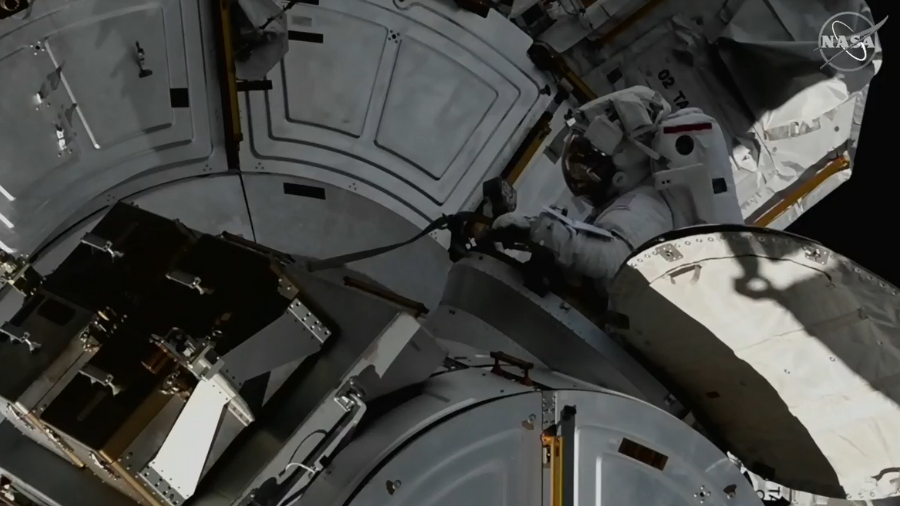
Spacewalker Samantha Cristoforetti works outside the space station to outfit the European robotic arm on July 21, 2022.

The seven Expedition 67 residents kicked off a busy week of critical research benefitting humans living on and off the Earth. The orbital residents also continued supporting the International Space Station’s vast array of flight, research, and life support systems.

Astronauts Bob Hines of NASA and Samantha Cristoforetti of ESA (European Space Agency) took turns on Monday cleaning hardware and supporting samples for a biology study that is exploring skin healing in space. Observations may provide insights improving wound healing therapies for astronauts and Earthlings. Hines then spent the afternoon installing seed cartridges and root modules for the XROOTS space agriculture investigation to begin a 30-day growth period of radishes and mizuna greens. The research uses hydroponics and aeroponics techniques to learn how to produce crops on a larger scale on future missions to the Moon, Mars, and beyond.

NASA Flight Engineer Kjell Lindgren opened up the Kibo laboratory module’s airlock and retrieved an external science platform and installed a small satellite deployer on the research gear. The deployer will be placed outside Kibo in the vacuum of space before deploying a set of CubeSats into low-Earth orbit for a variety of research and education programs.

NASA astronaut Jessica Watkins started her morning with cable connections inside the Combustion Integrated Rack (CIR), a refrigerator-sized research rack. The CIR is located in the U.S. Destiny laboratory module and enables safe investigations into the behavior of fuels, flames, and soot, in weightlessness. Watkins then assisted Lindgren in the afternoon as he installed a barrier on the Quest airlock’s vent relief and isolation valve to prevent inadvertent contact with the life support device.

Two cosmonauts, station Commander Oleg Artemyev and Flight Engineer Denis Matveev, spent Monday servicing a pair of Russian Orlan spacesuits. The duo inspected the suits’ communications and life support systems. Roscosmos Flight Engineer Sergey Korsakov began his day exploring future spacecraft piloting and robotic control techniques then moved on to inspections in the Nauka multipurpose laboratory module and ventilation maintenance the Zvezda service module.


Learn more about station activities by following the space station blog@space_station and @ISS_Research on Twitter, as well as the ISS Facebook and ISS Instagram accounts.

Get weekly video highlights at: http://jscfeatures.jsc.nasa.gov/videoupdate/

Get the latest from NASA delivered every week. Subscribe here: 

Get The Details…

Mark Garcia

Powered by WPeMatico

Crew Finishes Week Scrubbing Spacesuits, Adjusting Hardware, and Transferring Cargo

Crew Finishes Week Scrubbing Spacesuits, Adjusting Hardware, and Transferring Cargo

The sun's rays begin to illuminate the Earth's atmosphere as the International Space Station flew into an orbital sunrise 261 miles above Texas on July 16, 2022.
The sun’s rays begin to illuminate the Earth’s atmosphere as the International Space Station flew into an orbital sunrise 261 miles above Texas on July 16, 2022.

The Expedition 67 crew wrapped up its week aboard International Space Station by scrubbing spacesuits, adjusting hardware, and transferring cargo.

NASA Flight Engineer Bob Hines spent portions of the day performing cooling loop scrubs for spacesuits, called Extravehicular Mobility Units (EMUs), which enable astronauts to work outside the station. He then reconfigured the EMU loop scrub hardware for iodination. Loop scrubs and iodinates are required to remove contaminants from the EMU transport loop.

NASA Flight Engineer Kjell Lindgren and ESA (European Space Agency) Flight Engineer Samantha Cristoforetti worked together to remove and store sample carriers for a suite of experiments that test how space affects various materials and components. If these materials can withstand the harsh environment outside the station, they could help improve equipment for future space exploration.

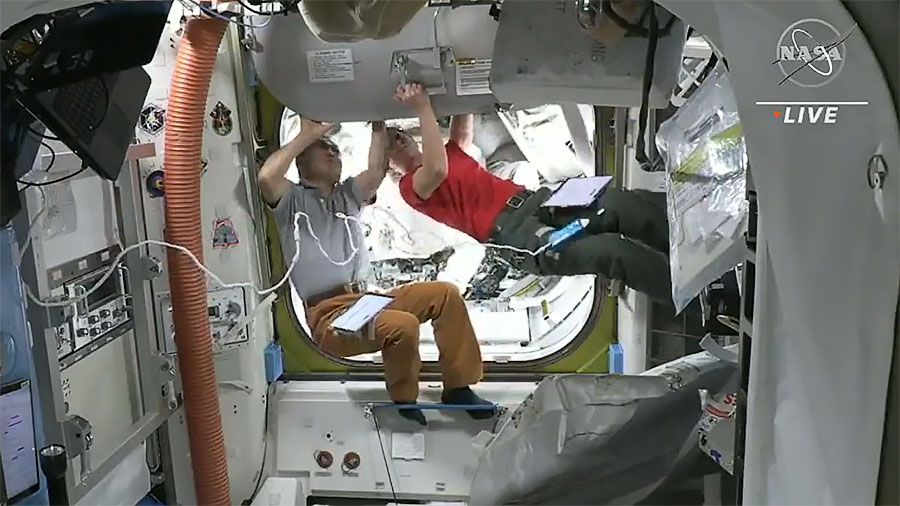
Lindgren and NASA Flight Engineer Jessica Watkins also continued working on cargo operations. The duo took turns packing cargo into Cargo Dragon to prepare for the SpaceX CRS-25 undock on August 18.

The Russian segment of the station largely concentrated on carrying out maintenance tasks. Commander Oleg Artemyev of Roscosmos joined Cosmonaut Denis Matveev to route cables and prepare spacesuits. Meanwhile, cosmonaut Sergey Korsakov conducted a health check on video equipment and closed the day performing maintenance work on a ventilation subsystem.


Learn more about station activities by following the space station blog, @space_station and @ISS_Research on Twitter, as well as the ISS Facebook and ISS Instagram accounts.

Get weekly video highlights at: http://jscfeatures.jsc.nasa.gov/videoupdate/

Get the latest from NASA delivered every week. Subscribe here: www.nasa.gov/subscribe

Get The Details…

Heidi Lavelle

Powered by WPeMatico