Biotech and Digestion Studies Top Thursday’s Research Schedule

Biotech and Digestion Studies Top Thursday’s Research Schedule

NASA astronaut Jeanette Epps poses for a portrait inside the seven-window cupola while orbiting 259 miles above Greece.

Biotechnology and human research were the main science topics on Thursday as the Expedition 71 crew explored ways to improve health on Earth and in space. The seven International Space Station residents also completed advanced plumbing work and staged emergency equipment in preparation for an upcoming mission.

NASA Flight Engineer Jeanette Epps set up research hardware in the Harmony module and explored how microgravity affects surface tension. She observed the microgravity behavior of fluid samples and filmed the experiment activities to help researchers develop therapies for respiratory conditions and reduce contamination in tubes. Results may benefit both the health care and food industries.

NASA Flight Engineer Tracy C. Dyson wrapped up two days of orbital plumbing work with assistance from NASA astronaut Matthew Dominick. The pair replaced a catalytic reactor in the Tranquility module’s restroom, also called the Waste and Hygiene Compartment.  The reactor introduces oxygen in the water recovery system and oxidizes its wastewater ahead of recycling.

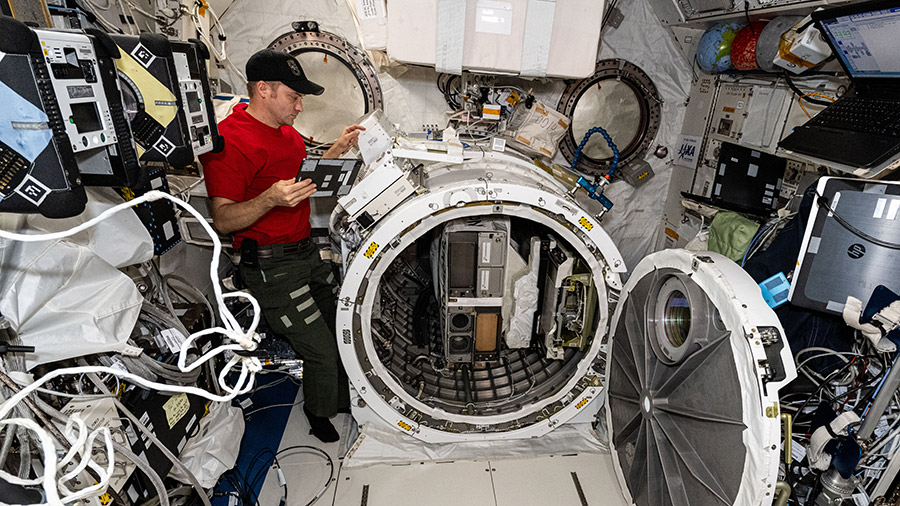
Dominick then joined NASA Flight Engineer Mike Barratt at the end of the day and cleaned up Tranquility returning the module to its normal configuration. Barratt began his day cleaning electronics vents in the Kibo laboratory module. Barratt then collected emergency hardware and staged the gear in preparation for the arrival of NASA astronauts Butch Wilmore and Suni Williams on Boeing’s Crew Flight Test, which is now targeted for launch on Saturday, June 1.

Cosmonauts Oleg Kononenko and Nikolai Chub once again scanned their stomachs with an ultrasound device after breakfast Thursday morning. The duo is continuing its research helping doctors understand how the human digestion system adapts to long-term weightlessness. Kononenko then tested communication systems and cleaned surfaces in the Zvezda service module. Chub spent the rest of his day inventorying spacewalk tools.

Flight Engineer Alexander Grebenkin had a pair of photography sessions pointing his camera out a window and capturing Earth landmarks and wildfires. Grebenkin also spent time servicing life support gear and video hardware in the Roscosmos segment of the orbiting lab.

Mission managers from NASA, Boeing, and ULA (United Launch Alliance) work toward 12:25 p.m. EDT on Saturday, June 1, for the launch of the agency’s Crew Flight Test to the space station. For more information visit https://go.nasa.gov/4ayy9y.


Learn more about station activities by following the space station blog, @space_station and @ISS_Research on X, as well as the ISS Facebook and ISS Instagram accounts.

Get weekly video highlights at: https://roundupreads.jsc.nasa.gov/videoupdate/

Get the latest from NASA delivered every week. Subscribe here: www.nasa.gov/subscribe

Powered by WPeMatico

Get The Details…

Mark Garcia

NASA, Mission Partners Assessing Launch Opportunities for Crew Flight Test

NASA, Mission Partners Assessing Launch Opportunities for Crew Flight Test

A United Launch Alliance Atlas V rocket with Boeing’s CST-100 Starliner spacecraft aboard is seen on the launch pad at Space Launch Complex 41 ahead of the NASA’s Boeing Crew Flight Test.
A United Launch Alliance Atlas V rocket with Boeing’s CST-100 Starliner spacecraft aboard is seen on the launch pad at Space Launch Complex 41 ahead of the NASA’s Boeing Crew Flight Test, Sunday, May 5, 2024 at Cape Canaveral Space Force Station in Florida. Photo credit: NASA/Joel Kowsky

Mission managers from NASA, Boeing, and ULA (United Launch Alliance) continue to evaluate a path forward toward launching the agency’s Boeing Crew Flight Test to the International Space Station. The teams are now working toward a launch opportunity at 12:25 p.m. ET on Saturday, June 1, with additional opportunities on Sunday, June 2, Wednesday, June 5, and Thursday, June 6.

Work continues to assess Starliner performance and redundancy following the discovery of a small helium leak in the spacecraft’s service module. As part of this work, and unrelated to the current leak which remains stable, teams are in the process of completing a follow-on propulsion system assessment to understand potential helium system impacts on some Starliner return scenarios. NASA also will conduct a Delta-Agency Flight Test Readiness Review to discuss the work that was performed since the last CFT launch attempt on May 6, and to evaluate issue closure and flight rationale ahead of the next attempt, as part of NASA’s process for assessing readiness. The date of the upcoming Flight Test Readiness Review is under consideration and will be announced once selected.

“There has been a great deal of exceptional analysis and testing over the last two weeks by the joint NASA, Boeing, and ULA teams to replace the Centaur Self Regulating Valve and troubleshoot the Starliner Service Module helium manifold leak,” said Steve Stich, manager, NASA Commercial Crew Program. “It has been important that we take our time to understand all the complexities of each issue including the redundant capabilities of the Starliner propulsion system and any implications to our Interim Human Rating Certification. We will launch Butch and Suni on this test mission after the entire community has reviewed the teams’ progress and flight rationale at the upcoming Delta Agency Flight Test Readiness Review.”

NASA, Boeing, and ULA officials will provide insight into the next targeted launch opportunity and updates regarding ongoing work during a media teleconference at 11 a.m. EDT Friday, May 24. NASA expects to issue a media advisory Thursday, May 23, with additional details for the call and how to participate.

Meanwhile, NASA astronauts Butch Wilmore and Suni Williams continue practicing in Starliner simulators to prepare for flight. The crew remains quarantined and will fly back to NASA’s Kennedy Space Center in Florida closer to the new launch date.

Powered by WPeMatico

Get The Details…

Danielle Sempsrott

Medicine, DNA Research on Station Benefits Health on Earth and Space

Medicine, DNA Research on Station Benefits Health on Earth and Space

Astronaut Tracy C. Dyson works on the Gaucho Lung investigation studying ways to improve the delivery of respiratory system drugs.

The Expedition 71 crew continued its pharmaceutical research, sequenced DNA, and studied the digestion system on Wednesday. The International Space Station residents also kept up their science hardware and life support maintenance throughout the day.

NASA Flight Engineer Tracy C. Dyson worked in the Harmony module on Wednesday morning studying how microgravity affects surface tension for the Gaucho Lung investigation. Doctors hypothesize results may improve respiratory system medicines and reduce contamination in tubes benefitting both the health care and food industries.

NASA Flight Engineer Jeanette Epps spent her afternoon in the Harmony module sequencing DNA collected from microbe samples swabbed from station surfaces. The Genes in Space Molecular Operations and Sequencing (GISMOS) study seeks to identify bacteria inhabiting station systems without sending samples down to Earth for analysis. Insights may help researchers improve bacterial monitoring and fight antimicrobial resistance maintaining human health on Earth and in space.

Epps earlier helped NASA Flight Engineer Mike Barratt who had been gathering tools to work on the water recovery system located in the Tranquility module. The duo removed the treadmill rack and the water recovery system readying the workspace for the advanced plumbing job that will take place on Thursday.

NASA Flight Engineer Matthew Dominick started his day in Tranquility replacing components in the orbital outpost’s restroom, also known as the Waste and Hygiene Compartment. In the afternoon, Dominick worked in the Columbus laboratory module assembling and installing a device that can measure mass in microgravity. The Space Linear Acceleration Mass Measurement Device (SLAMMD) applies a known force to a crew member then calculates mass using a form of Newton’s Second Law of Motion, force equals mass times acceleration.

During the morning in the station’s Roscosmos segment, cosmonauts Oleg Kononenko and Nikolai Chub scanned their stomachs with an ultrasound device after breakfast. The two were collecting data to help doctors understand how the digestive system adapts to weightlessness. Kononenko went on and downloaded data collected from radiation detectors while Chub packed the Progress 86 cargo craft with items and trash for a disposal.

Roscosmos Flight Engineer Alexander Grebenkin wrapped up operations with the European robotic arm after two days of robotics training and activities. He then spent the rest of the day on cleaning and electronics and communications maintenance.


Learn more about station activities by following the space station blog, @space_station and @ISS_Research on X, as well as the ISS Facebook and ISS Instagram accounts.

Get weekly video highlights at: https://roundupreads.jsc.nasa.gov/videoupdate/

Get the latest from NASA delivered every week. Subscribe here: www.nasa.gov/subscribe

Powered by WPeMatico

Get The Details…

Mark Garcia

Exercise, Science Gear, and Robotics Top Station Research Schedule

Exercise, Science Gear, and Robotics Top Station Research Schedule

Astronaut Matthew Dominick works in the Kibo laboratory module removing CubeSat hardware from Kibo's airlock.
Astronaut Matthew Dominick works in the Kibo laboratory module removing CubeSat hardware from Kibo’s airlock.

Human research, combustion, and robotics were the scientific priorities aboard the International Space Station on Tuesday. The seven-member Expedition 71 crew also continued ongoing cargo operations and hardware maintenance.

Exercising daily in weightlessness counteracts space-caused bone and muscle loss preserving crew health during long-term missions. Researchers frequently monitor a crew members exercise sessions to learn how microgravity affects a variety of physiological parameters. On Tuesday morning, NASA Flight Engineers Matthew Dominick and Mike Barratt attached sensors to their chests and strapped on breathing gear then took turns pedaling on an exercise cycle. Doctors will use the data from the periodic fitness test that measures oxygen uptake and heart activity and evaluate the astronauts’ aerobic capacity.

After the exercise session, Dominick powered down the workout gear and partially stowed the biomedical hardware. The pair then joined each other and tested the installation of a helmet on a spacesuit. Barratt also worked on cargo operations inside the Cygnus space freighter berthed to the Unity module since Feb. 1.

NASA Flight Engineer Tracy C. Dyson split her day between combustion hardware and a robotics demonstration. She spent her morning in the Kibo laboratory module swapping samples and replacing hardware inside the Solid Combustion Experiment Module. The research device is located in Kibo’s Multi-Purpose Small Payload Rack and enables flame and fuel research to promote fire safety on spacecraft. Next, she tested the operations of the Astrobee free-flying robotic assistant for a competition that uses student-written algorithms to control and maneuver the devices.

NASA astronaut Jeanette Epps began her day setting up Actiwatches that monitor crew sleep-wake cycles. Then she spent the afternoon stowing sample collection hardware and servicing a pair of Kubik incubators that can house small organisms for space biology investigations.

In the Roscosmos segment of orbital outpost, Commander Oleg Kononenko and Flight Engineer Nikolai Chub tested communications with the Progress 86 resupply ship then conducted seat fit checks in the Soyuz MS-25 crew ship. Kononenko then tested a 3D printer and configured cameras while Chub spent the rest of his day on life support maintenance. Flight Engineer Alexander Grebenkin was back on robotics duty operating the European robotic arm and scanning the Rassvet module’s docking port.


Learn more about station activities by following the space station blog, @space_station and @ISS_Research on X, as well as the ISS Facebook and ISS Instagram accounts.

Get weekly video highlights at: https://roundupreads.jsc.nasa.gov/videoupdate/

Get the latest from NASA delivered every week. Subscribe here: www.nasa.gov/subscribe

Powered by WPeMatico

Get The Details…

Mark Garcia

Crew Starts Week with Space Biology, Robotics, and Medical Skills

Crew Starts Week with Space Biology, Robotics, and Medical Skills

An atmosphreric glow blankets Earth's horizon and a web of city lights interconnect across India in this photograph from the space station.
An atmosphreric glow blankets Earth’s horizon and a web of city lights interconnect across India in this photograph from the space station.

The week kicked off with a multitude of space biology activities as the Expedition 71 crew studied microgravity’s effect on humans and serviced research hardware. Robotics and lab maintenance rounded out Monday’s schedule aboard the International Space Station.

NASA Flight Engineer Jeanette Epps worked throughout Monday on biomedical activities processing her blood, saliva, and urine samples for analysis. After her blood draws, she spun the samples inside a centrifuge then stowed them in a science freezer. The biological specimens are then compared to astronaut samples collected both pre-flight and post-flight to understand how the human body adapts to long-term weightlessness.

In the afternoon, NASA astronaut Mike Barratt operated the Ultrasound 2 device and scanned the neck, shoulder, and leg veins of NASA Flight Engineer Tracy C. Dyson. Doctors on the ground remotely provided guidance and monitored the vein scans. The ultrasound converts the echo scans into a video signal that is downlinked to Earth and viewed as part of periodic crew health exams.

Earlier, Barratt measured the airflow in the Harmony module crew quarters then reorganized combustion research components to enable a space fire safety experiment. Dyson investigated ways to improve the delivery of respiratory system drugs potentially offering benefits to both the health care and food industries.

NASA Flight Engineer Matthew Dominick spent his day servicing science gear throughout the orbital lab. He started the day checking out and configuring hardware supporting the Rodent Research-28 investigation that is exploring a gene therapy to maintain eye health in microgravity. In the afternoon, he opened up the Life Science Glovebox and audited its systems and components to ensure ongoing advanced biology research operations.

Roscosmos Mission Specialist Alexander Grebenkin powered up the European robotic arm attached to the Nauka science module and practiced maneuvering it in basic operator mode. Cosmonaut Nikolai Chub brushed up on his medical skills familiarizing himself with emergency hardware and procedures onboard the station. Station Commander Oleg Kononenko inspected components inside the Zarya module, photographed the condition of windows in the Nauka and Zvezda modules, then worked on an oxygen generator.

NASA, Boeing, and ULA (United Launch Alliance) teams now are targeting a launch no earlier than 3:09 p.m. EDT Saturday, May 25, for the agency’s Crew Flight Test carrying NASA astronauts Butch Wilmore and Suni Williams to the International Space Station.


Learn more about station activities by following the space station blog, @space_station and @ISS_Research on X, as well as the ISS Facebook and ISS Instagram accounts.

Get weekly video highlights at: https://roundupreads.jsc.nasa.gov/videoupdate/

Get the latest from NASA delivered every week. Subscribe here: www.nasa.gov/subscribe

Powered by WPeMatico

Get The Details…

Mark Garcia