Spacewalk Preps, Science Hardware Work Top Wednesday’s Schedule

Spacewalk Preps, Science Hardware Work Top Wednesday’s Schedule
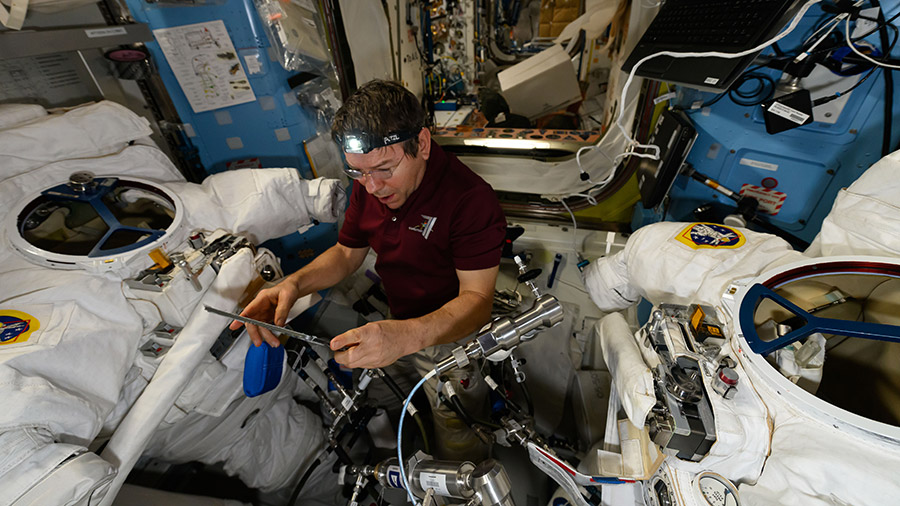
Astronaut Mike Barratt reads maintenance procedures on a computer tablet as he works on a pair of spacesuits inside the Quest airlock.

Spacewalk preparations and science hardware maintenance topped the Expedition 71 crew’s schedule on Wednesday. Human research and 3D printing rounded out the itinerary aboard the International Space Station.

Three spacewalks are planned for the month of June when a pair of astronauts not yet named will exit the orbital outpost to replace and repair hardware and search for microbes on the orbital outpost. NASA Flight Engineers Tracy C. Dyson, Matthew Dominick, Mike Barratt, and Jeanette Epps spent a few hours on Wednesday reviewing standard spacewalk procedures such as suiting up, exiting and entering the Quest airlock, safety, and communications. Afterward, Dyson went on and configured Quest and readied a spacesuit for spacewalk operations. NASA will announce details of the upcoming spacewalks soon in a media advisory and a televised news conference.

Science hardware is constantly running aboard the space station and regularly needs monitoring and maintenance to ensure effective microgravity research. Dominick, Barratt, and Epps split their time throughout the day in the Destiny and Kibo laboratories servicing physics and botany gear.

Dominick began the science work by first swapping samples inside the Materials Science Laboratory, a research furnace that exposes materials such as metals, alloys, polymers, and more to high temperatures for physics research. Epps replaced a carbon dioxide bottle and checked for pressure leaks  on the Advanced Plant Habitat that has grown a variety of crops for several years including lettuce and tomatoes for research and consumption. Next, Barratt installed experiment samples and replaced hardware inside the Combustion Integrated Rack to support an experiment exploring fire safety in space.

Roscosmos Flight Engineer Nikolai Chub finished a 24-hour heart and blood pressure monitoring session for a space cardiac investigation. Chub then wore a sensor-packed cap and studied futuristic spacecraft and robotic piloting techniques on a computer that may inform future planetary missions.

Commander Oleg Kononenko began his 24-hour cardio-monitoring session attaching sensors to himself measuring his heart rate and blood pressure. The veteran cosmonaut and five-time station visitor then activated a 3D printer and tested the on-demand manufacturing of tools in weightlessness.

Flight Engineer Alexander Grebenkin spent his day on life support duties starting with filling up Roscosmos’ Elektron oxygen generator with water. Next, the first-time space flyer spent the afternoon in the Nauka science module replacing orbital plumbing components.


Learn more about station activities by following the space station blog, @space_station and @ISS_Research on X, as well as the ISS Facebook and ISS Instagram accounts.

Get weekly video highlights at: https://roundupreads.jsc.nasa.gov/videoupdate/

Get the latest from NASA delivered every week. Subscribe here: www.nasa.gov/subscribe

Powered by WPeMatico

Get The Details…

Mark Garcia

Cargo Ship Departs, Two Rockets Near Launch During Busy Day on Station

Cargo Ship Departs, Two Rockets Near Launch During Busy Day on Station

May 28, 2024: International Space Station Configuration. Four spaceships are parked at the space station including the SpaceX Dragon Endeavour spacecraft, Northrop Grumman’s Cygnus space freighter, the Soyuz MS-25 crew ship, and the Progress 87 resupply ship.

A cargo ship departed the International Space Station on Tuesday leaving four spacecraft parked at the orbital lab. Meanwhile, as the Expedition 71 crew keeps up its advanced microgravity research two more spaceships are counting down to their missions to the orbital outpost in less than a week.

A trash-loaded Progress 86 cargo craft undocked from the space station’s Poisk module at 4:39 a.m. EDT on Tuesday. The Roscosmos resupply ship ended its six-month stay in space a few hours later when it reentered the Earth’s atmosphere for a safe, but fiery demise above the Pacific Ocean.

Meanwhile, two rockets are gearing up to launch more cargo and a new crew to the orbiting outpost by the end of the week. First, more than three tons of food, fuel, and supplies are scheduled to lift off aboard the Progress 88 spacecraft at 5:43 a.m. on Thursday from the Baikonur Cosmodrome in Kazakhstan. The resupply ship from Roscosmos will then orbit Earth for two days before its automated docking to Poisk at 7:47 a.m. on Saturday.

Cosmonauts Oleg Kononenko and Nikolai Chub trained on Tuesday for the arrival of the Progress 88. The duo practiced for the unlikely possibility of remotely controlling the spacecraft with the space station’s telerobotically operated rendezvous unit, or TORU. The device, located in the Zvezda service module, can send commands to control approaching Roscosmos’ spaceships and be used by cosmonauts to manually guide the vehicles to a docking if necessary.

Meanwhile, NASA astronauts Butch Wilmore and Suni Williams are preparing to depart Houston for Kennedy Space Center in Florida ahead of Boeing’s Crew Flight Test launch to the International Space Station. The experienced space duo is targeted to launch aboard Boeing’s Starliner spacecraft atop an Atlas V rocket from United Launch Alliance at 12:25 p.m. on Saturday. They will take a daylong trip around the planet before docking to the Harmony module’s forward port at 1:50 p.m. on Sunday.

NASA TV will broadcast both missions live on the NASA+ streaming service via the web or the NASA app. Launch and docking coverage also will air live on NASA Television, YouTube, and on the agency’s website. Learn how to stream NASA TV through a variety of platforms including social media.

Back in space, NASA Flight Engineer Tracy C. Dyson spent her day inspecting a treadmill and finalizing spacesuit work. She took turns with fellow NASA astronaut Jeanette Epps checking and cleaning components on the Tranquility module’s treadmill and photographing the condition of the exercise device for analysis. Next, Dyson joined NASA Flight Engineer Matthew Dominick in the Quest airlock and finished cleaning cooling loops inside a pair of spacesuits. Those suits are being readied for a trio of maintenance and science spacewalks planned for June.

NASA astronaut Mike Barratt spent most of his day supporting life science helping doctors understand how weightlessness affects biology. He started his day in the Kibo laboratory module configuring components on biology habitat hardware then installing the advanced gear on an artificial gravity generating incubator. Afterward, he participated in a vision test using a standard eye chart along with Dominick and Epps.

In the Roscosmos segment of the station, Kononenko and Chub worked on a pair of different experiments before their Progress 88 training session. Kononenko explored futuristic piloting techniques on a computer as Chub attached sensors to himself monitoring his heart activity and blood pressure. Flight Engineer Alexander Grebenkin started his day collecting station air samples for analysis before spending the rest of his shift on life support maintenance tasks.


Learn more about station activities by following the space station blog, @space_station and @ISS_Research on X, as well as the ISS Facebook and ISS Instagram accounts.

Get weekly video highlights at: https://roundupreads.jsc.nasa.gov/videoupdate/

Get the latest from NASA delivered every week. Subscribe here: www.nasa.gov/subscribe

Powered by WPeMatico

Get The Details…

Mark Garcia

NASA, Mission Partners Answer Questions Behind Starliner Scrub

NASA, Mission Partners Answer Questions Behind Starliner Scrub

A United Launch Alliance Atlas V rocket with Boeing’s Starliner spacecraft at launch pad at Space Launch Complex-41 on Saturday, May 4, 2024 at Cape Canaveral Space Force Station in Florida. NASA/Joel Kowsky

Managers from NASA, Boeing, and ULA (United Launch Alliance) hosted a media teleconference to discuss ongoing work ahead of sending NASA astronauts Butch Wilmore and Suni Williams to the International Space Station as part of the agency’s Boeing Crew Flight Test. 

The media event provided an update on a valve ULA replaced on the Centaur upper stage of the Atlas V rocket, as well as a small helium leak in the spacecraft’s service module, and a propulsion system assessment to understand potential helium system impacts on some Starliner return scenarios. 

Listen to a replay of the media teleconference on the agency’s YouTube channel. 

Wilmore and Williams are the first to launch aboard Boeing’s Starliner on an Atlas V rocket. The astronauts will spend about a week at the orbiting laboratory before the crew capsule makes a parachute and airbag-assisted landing in the southwestern United States. 

The crew remains in quarantine in preparation for the launch. NASA, Boeing, and ULA also will participate in a Delta-Agency Flight Test Readiness Review on Wednesday, May 29, to evaluate the work performed since the last launch attempt on May 6. 

Liftoff is scheduled for 12:25 p.m. Saturday, June 1, from Space Launch Complex-41 at Cape Canaveral Space Force Station in Florida. After successful completion of the flight test, NASA will begin the final process of certifying Starliner and its systems for crewed rotation missions to the space station. 

Learn more about NASA’s Boeing Crew Flight Test by following the mission blog, the commercial crew blog, @commercial_crew on X, and commercial crew on Facebook. 

Powered by WPeMatico

Get The Details…

Elyna Niles-Carnes

Crew Wraps Week with Biotech Study, Spacesuits, and Orbital Plumbing

Crew Wraps Week with Biotech Study, Spacesuits, and Orbital Plumbing

The city lights of Bangkok, Thailand, and its suburbs contrast with the green lights of the fishing boats on the Gulf of Thailand and the Andaman Sea.

More biotechnology operations were underway aboard the International Space Station on Friday potentially benefitting the health care and food industries. The Expedition 71 crew members also worked on spacesuits as a U.S. cargo craft fired its engines raising the orbital outpost’s altitude.

Research on the space station takes advantage of weightlessness to discover new phenomena impossible to observe in Earth’s gravity. NASA Flight Engineer Tracy C. Dyson continued exploring how microgravity affects surface tension to improve the delivery of therapies in human airways to treat respiratory conditions. She observed and filmed the microgravity behavior of fluid samples for the Gaucho Lung biotechnology study. Results may also reveal solutions to prevent contamination of tubes with intermittent flows of liquids.

Dyson then joined fellow NASA astronauts Mike Barratt and Matthew Dominick in the Quest airlock as they serviced a pair of spacesuits. The trio also outfitted the suits with lights and cameras ahead of a series of spacewalks planned in June for hardware maintenance and science work.

Earlier, Barratt partnered with NASA Flight Engineer Jeanette Epps reconfiguring the Tranquility module and its systems to normal status after a couple of days of advanced plumbing work. Epps ended her day inside the Kibo laboratory module uploading software to the Astrobee robotic free flyers. The software work is for the Clingers demonstration studying docking and close approach maneuvers possibly impacting future satellite and spacecraft repairs, space manufacturing, and on-orbit refueling.

Northrop Grumman’s Cygnus resupply ship is on track to fire its engines twice today while attached to the Unity module’s Earth-facing port. The orbital maneuvers are programmed to boost the space station’s altitude and ready the orbital lab for upcoming crew and cargo missions.

Roscosmos cosmonaut and space station Commander Oleg Kononenko activated a 3D printer testing its ability to manufacture tools and more on demand in space. Flight Engineer Nikolai Chub packed the Progress 86 space freighter with trash and obsolete gear for disposal then updated the station’s inventory system. Flight Engineer Alexander Grebenkin wiped down and treated surfaces inside the Nauka science module for microbes and fungi.

Mission managers from NASA, Boeing, and ULA (United Launch Alliance) work toward 12:25 p.m. EDT on Saturday, June 1, for the launch of the agency’s Crew Flight Test to the space station. For more information visit https://go.nasa.gov/4ayy9y.


Learn more about station activities by following the space station blog, @space_station and @ISS_Research on X, as well as the ISS Facebook and ISS Instagram accounts.

Get weekly updates from NASA Johnson Space Center at: https://roundupreads.jsc.nasa.gov/

Get the latest from NASA delivered every week. Subscribe here: www.nasa.gov/subscribe

Powered by WPeMatico

Get The Details…

Abby Graf

NASA, Mission Partners Hold Teleconference Ahead of Starliner Launch

NASA, Mission Partners Hold Teleconference Ahead of Starliner Launch

A United Launch Alliance Atlas V rocket with Boeing’s Starliner spacecraft aboard is seen on the launch pad at Space Launch Complex 41 ON Sunday, May 5, 2024 at Cape Canaveral Space Force Station in Florida. Photo Credit: NASA/Joel Kowsky

NASA, Boeing, and ULA (United Launch Alliance) will discuss updates regarding ongoing work for the agency’s Boeing Crew Flight Test, which will send NASA astronauts Butch Wilmore and Suni Williams to the International Space Station on Boeing’s Starliner spacecraft. 

At 11 a.m. EDT, NASA will host a media teleconference with the following participants: 

  • Jim Free, NASA associate administrator 
  • Ken Bowersox, associate administrator, NASA’s Space Operations Mission Directorate
  • Steve Stich, manager, NASA’s Commercial Crew Program 
  • Dana Weigel, manager, NASA’s International Space Station Program 
  • Mark Nappi, vice president and program manager, Boeing Commercial Crew Program 
  • Gary Wentz, vice president, Government and Commercial Programs, ULA 

Audio of the teleconference will stream live on the agency’s website.  

NASA’s Boeing Crew Flight Test scrubbed on Monday, May 6, when ULA discovered a faulty pressure regulation valve on the liquid oxygen tank of the Atlas V rocket’s Centaur upper stage. Tests have been conducted and the valve has been replaced. 

Work continues to assess Starliner performance and redundancy following the discovery of a small helium leak in the spacecraft’s service module. As part of this work, and unrelated to the current leak which remains stable, teams are in the process of completing a follow-on propulsion system assessment to understand potential helium system impacts on some Starliner return scenarios. 

Liftoff is scheduled for no earlier than 12:25 p.m. Saturday, June 1, from Space Launch Complex-41 at Cape Canaveral Space Force Station in Florida. 

Wilmore and Williams remain in preflight quarantine at NASA’s Johnson Space Center in Houston. While there, they have participated in various exercises using Starliner simulators to prepare for flight. The duo will be the first to launch aboard Boeing’s Starliner on an Atlas V rocket, spending about a week at the orbiting laboratory before making a parachute and airbag-assisted landing in the southwestern United States. 

After successful completion of the mission, NASA will begin the final process of certifying Starliner and its systems for crewed rotation missions to the space station. 

Learn more about NASA’s Boeing Crew Flight Test by following the mission blog, the commercial crew blog, @commercial_crew on X, and commercial crew on Facebook. 

Powered by WPeMatico

Get The Details…

Elyna Niles-Carnes