Crew Works Space Biology, Preps for Next Spacewalk

Crew Works Space Biology, Preps for Next Spacewalk

Astronaut Jessica Watkins enjoys a personal size pizza during dinner time aboard the space station.

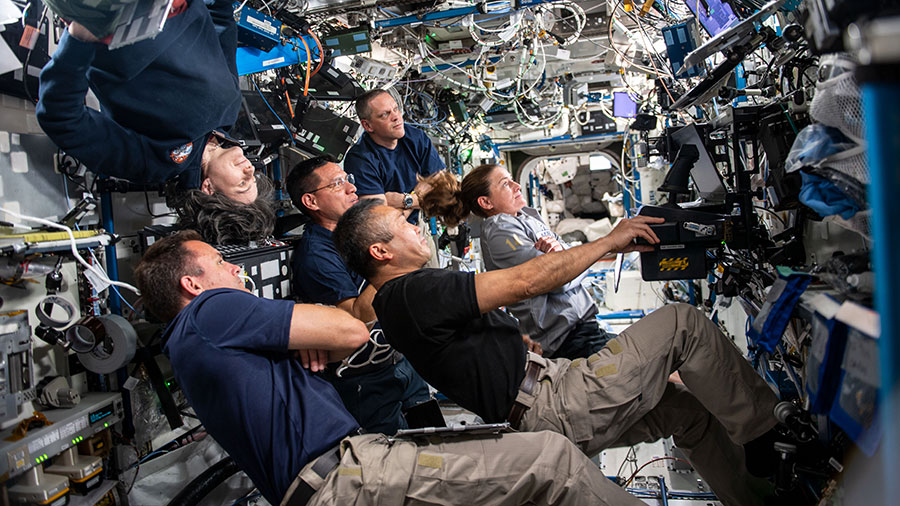
The Expedition 67 crew continued exploring how humans and plants adapt in microgravity while testing robotic free-flyers on Wednesday. The orbital residents are also preparing for another spacewalk at the International Space Station to continue outfitting a new robotic arm.

NASA Flight Engineers Jessica Watkins and Bob Hines partnered together during the morning studying how living in space affects dexterous manipulation. The duo took turns during an hourlong session performing gripping and motion tasks while seated in a specialized chair inside the Columbus laboratory module. Observations may provide scientists a deeper understanding of the human nervous system and help engineers design intelligent spacecraft interfaces.

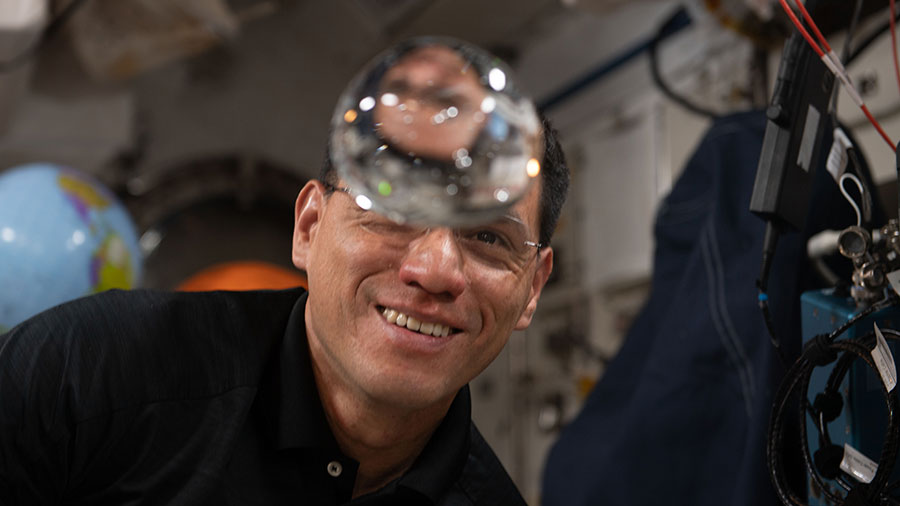
Afterward, Watkins checked on mizuna greens and radishes growing for the XROOTS space botany study demonstrating soilless agricultural methods, such as hydroponic and aeroponic techniques. Hines later activated a pair of toaster-sized Astrobee robotic free-flyers and watched while they navigated autonomously using smartphone technology inside the Kibo laboratory module.

NASA Flight Engineer Kjell Lindgren opened up the Cell Biology Experiment Facility and serviced components inside the biology research device equipped with an artificial gravity generating incubator. Lindgren then spent the afternoon documenting the amount of food stowed aboard the orbiting lab as part of a regularly scheduled audit.

The next spacewalk is expected to take place on July 21 beginning at 10 a.m. EDT with Commander Oleg Artemyev of Roscosmos and Samantha Cristoforetti of ESA (European Space Agency). The pair spent Wednesday morning studying their spacewalk tasks, maneuvers, and safety procedures. Five-time spacewalker Artemyev will lead Cristoforetti on her first spacewalk to continue configuring the European robotic arm for operations during the planned seven-hour excursion.

Flight Engineer Denis Matveev assisted Artemyev with the spacewalk preparations during the afternoon collecting and inspecting tools planned for the upcoming excursion. Flight Engineer Sergey Korsakov spent his day working on assorted electronics gear and checking ventilation systems in the Nauka multipurpose laboratory module.


Learn more about station activities by following the space station blog@space_station and @ISS_Research on Twitter, as well as the ISS Facebook and ISS Instagram accounts.

Get weekly video highlights at: http://jscfeatures.jsc.nasa.gov/videoupdate/

Get the latest from NASA delivered every week. Subscribe here: www.nasa.gov/subscribe

Get The Details…

Mark Garcia

Powered by WPeMatico

Crew Explores Artificial Intelligence, Human Nervous System on Tuesday

Crew Explores Artificial Intelligence, Human Nervous System on Tuesday

This long-duration photograph from the space station shows the Milky Way above the Earth's horizon with an aurora near the bottom right.
This long-duration photograph from the space station shows the Milky Way above the Earth’s horizon with an aurora near the bottom right.

Space physics and human research dominated the science agenda aboard the International Space Station on Tuesday. The Expedition 67 crew also reconfigured a U.S. airlock and tested a new 3-D printer.

The lack of gravity in space affects a wide variety of physics unlocking new phenomena that researchers study to improve life for humans on and off the Earth. One such study uses artificial intelligence to adapt complex glass manufacturing processes in microgravity possibly benefitting numerous Earth- and space-based industries. NASA Flight Engineer Kjell Lindgren set up hardware for the Intelligent Glass Optics experiment for operations inside the Microgravity Science Glovebox on Tuesday afternoon. Observations from the investigation may advance professions such as communications, aerospace, medicine, and astronomy.

Lindgren also joined his fellow flight engineers Jessica Watkins of NASA and Samantha Cristoforetti of ESA (European Space Agency) reconfiguring the NanoRacks Bishop airlock on Tuesday. The trio of astronauts worked throughout the day reinstalling hardware and stowing cargo inside Bishop following its trash disposal and robotic maneuvers over the weekend. Ground controllers commanded the Canadarm2 robotic arm to detach the airlock from the Tranquility module to jettison a trash container on Saturday. The Canadarm2 then moved Bishop back to Tranquility where it was reattached shortly afterward.

Watkins started her day partnering with NASA Flight Engineer Bob Hines for an investigation that explores how weightlessness affects dexterous manipulation. The duo took turns seated in a unique apparatus inside the Columbus laboratory module to help scientists understand how astronauts grip and manipulate objects in space. Insights may inform the design of intelligent spacecraft interfaces and provide a deeper understanding of the human nervous system.

The two flight engineers from Roscosmos, Denis Matveev and Sergey Korsakov, collected microbe samples from modules in the station’s Russian segment for analysis on Tuesday. Matveev also documented his meals and drinks for a study exploring space-caused bone loss. Station Commander Oleg Artemyev installed and tested a new 3-D printer inside the Nauka multipurpose laboratory module.


Learn more about station activities by following the space station blog@space_station and @ISS_Research on Twitter, as well as the ISS Facebook and ISS Instagram accounts.

Get weekly video highlights at: http://jscfeatures.jsc.nasa.gov/videoupdate/

Get the latest from NASA delivered every week. Subscribe here: www.nasa.gov/subscribe

Get The Details…

Mark Garcia

Powered by WPeMatico

Crew Works Multitude of Research Before Fourth of July Weekend

Crew Works Multitude of Research Before Fourth of July Weekend

Astronaut Samantha Cristoforetti replaces centrifuge components inside the Columbus laboratory module's BioLab.
Astronaut Samantha Cristoforetti replaces centrifuge components inside the Columbus laboratory module’s BioLab.

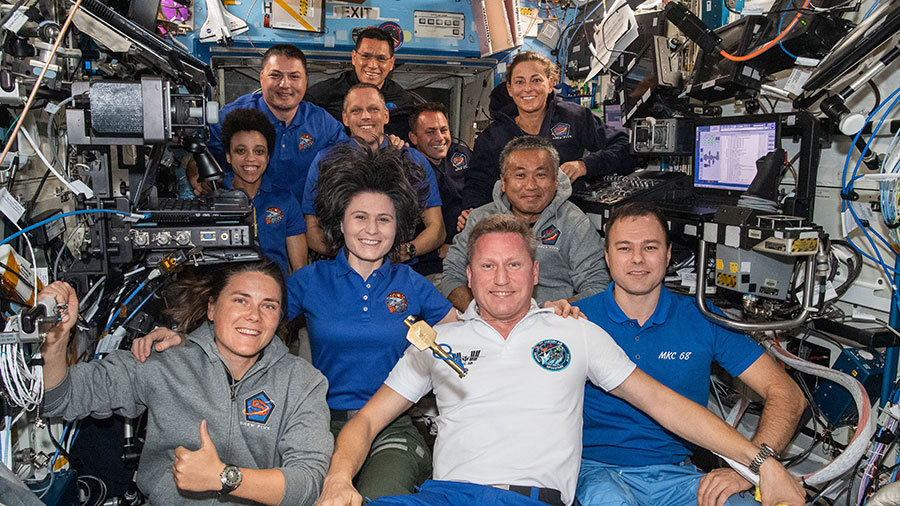
The seven Expedition 67 crew members are going into the weekend with a host of microgravity research and housekeeping activities. The four astronauts and three cosmonauts will also relax on Monday observing the Fourth of July U.S. holiday aboard the International Space Station.

NASA astronauts Kjell Lindgren and Bob Hines participated in a robotics test on Friday. The duo practiced simulated robotics maneuvers on a computer for the Behavioral Core Measures space psychology study. The investigation may provide insights into behavioral health and performance issues crews may face separated from family and friends while on missions farther away from Earth.

NASA Flight Engineer Jessica Watkins set up acoustic monitors in the Kibo laboratory module, the Tranquility module, and the Zvezda service module on Friday. Mission controllers want to ensure station noise levels remain acceptable.

ESA (European Space Agency) astronaut Samantha Cristoforetti started Friday checking samples for the Soft Matter Dynamics fluid physics study potentially impacting the food, cosmetic, and pharmaceutical industries among others. Cristoforetti also serviced combustion research hardware and installed new software to maintain operations and support ongoing science inside an EXPRESS rack.

In the Russian segment of the orbiting lab, Commander Oleg Artemyev had a hearing test then moved on and set up hardware to measure activity in the Earth’s upper atmosphere. Flight Engineer Denis Matveev studied ways future crew members might pilot spacecraft and robots on planetary missions. Flight Engineer Sergey Korsakov collected his blood and saliva samples for an experiment investigating how the immune system adapts to long-term spaceflight.

All seven space station crew members will spend Saturday on housekeeping activities such as disinfecting surfaces, vacuuming dust, and clearing vents for better airflow. Also on Saturday, the NanoRacks Bishop airlock will open up to the vacuum of space for the first time and jettison a trash container toward Earth’s atmosphere for a fiery, but safe disposal. The crew will then relax on Sunday and Monday enjoying a long Fourth of July weekend.

Get The Details…

Mark Garcia

Powered by WPeMatico

Thursday’s Research Explores Botany, Artificial Intelligence, and Immune System

Thursday’s Research Explores Botany, Artificial Intelligence, and Immune System

Expedition 67 crew members are pictured enjoying pizza during dinner time aboard the space station in May of 2022.

The Expedition 67 crew members tended to plants and explored artificial intelligence aboard the International Space Station today. The four astronauts and three cosmonauts also split their day configuring a U.S. airlock and investigating how microgravity affects the human body.

NASA Flight Engineer Bob Hines worked in the Columbus laboratory module on Thursday afternoon processing radish seeds germinating for the XROOTS space botany study. The investigation uses soilless techniques, such as hydroponics and aeroponics, to nourish and grow plants for producing crops on a larger scale for future space missions.

Hines also joined NASA Flight Engineers Kjell Lindgren and Jessica Watkins configuring the NanoRacks Bishop airlock for its first trash disposal task this weekend. The trio prepared the airlock for its depressurization and closed its hatch in the Tranquility module after packing a trash container in Bishop on Wednesday. The container will be jettisoned outside Bishop towards Earth’s atmosphere for a fiery, but safe disposal on Saturday.

Today, ESA (European Space Agency) astronaut Samantha Cristoforetti set up the Microgravity Science Glovebox and serviced components for the Intelligent Glass Optics space physics study. The advanced experiment uses artificial intelligence to adapt Earth-bound manufacturing techniques for the space environment. Results may improve Earth- and space-based technologies such as communications, aerospace, and medicine.

The orbiting lab’s three cosmonauts participated in a series of human research experiments today. Commander Oleg Artemyev attached sensors to himself to collect data about his cardiac activity while working in weightlessness. Flight Engineers Denis Matveev and Sergey Korsakov collected their blood and saliva samples for analysis to understand how the stresses of spaceflight, including radiation exposure and changes in sleep patterns, affect the human immune system.

Get The Details…

Mark Garcia

Powered by WPeMatico

Crew Works Autonomous Medicine, Garbage Packing on Wednesday

Crew Works Autonomous Medicine, Garbage Packing on Wednesday

Astronaut Bob Hines monitors an Astrobee robotic free-flyer using smartphone technology to autonomously navigate and maneuver inside the station.

Wednesday’s schedule on the International Space Station encompassed practicing complicated medical procedures in microgravity to preparing to take out the trash 260 miles above the Earth. The Expedition 67 crew members also continued investigating a wide variety of space phenomena to improve life for humans on Earth and in space.

Future astronauts will need to work independently of mission controllers as they travel beyond low-Earth orbit to the Moon, Mars, and beyond.  As a result, NASA Flight Engineers Kjell Lindgren and Bob Hines trained to diagnose and treat acute medical conditions without ground support today. Hines practiced ultrasound exams on Lindgren’s bladder and kidneys for the Autonomous Medical Officer Support demonstration, or AMOS. The study aims to help crews become more self-reliant and reduce mission risks as communication delays increase the farther a spacecraft ventures from Earth.

The orbiting lab’s four astronauts are also preparing to take out the trash this weekend requiring procedures more complicated than packing garbage on Earth. Astronauts Jessica Watkins of NASA and Samantha Cristoforetti of ESA (European Space Agency) finished loading trash containers in the NanoRacks Bishop airlock today. They were assisted by Lindgren and Hines as they closed the hatch to Bishop and depressurized the airlock. The trash container will be jettisoned towards Earth’s atmosphere for a fiery, but safe disposal on Saturday.

Station Commander Oleg Artemyev of Roscosmos studied ways future crew members might pilot spacecraft or control robots on planetary missions for a long-running Russian investigation. Flight Engineer Denis Matveev continued configuring nanosatellites for a future deployment and worked inside the ISS Progress 80 resupply ship on cargo operations. Cosmonaut Sergey Korsakov spent his day on electronics and computer maintenance before studying international crew dynamics and collecting radiation readings.

Get The Details…

Mark Garcia

Powered by WPeMatico