Space Freighter with Three Tons of Cargo Docks to Station
The ISS Progress 82 cargo craft approaches the space station nearing the Poisk module for a docking two days after launching from the Baikonur Cosmodrome in Kazakhstan. Credit: NASA TV
An uncrewed Roscosmos Progress 82 spacecraft arrived at the International Space Station’s space-facing side of the Poisk module at 10:49 p.m. EDT today. Progress delivered almost three tons of food, fuel and supplies to the International Space Station for the Expedition 68 crew.
Progress Cargo Craft Approaching Station Live on NASA TV
The trash-filled ISS Progress 80 cargo craft undocks the space station on Oct. 23, 2022, making way for the arrival of the ISS Progress 82 resupply ship.
NASA Television, the agency’s website and the NASA app now are providing live coverage of the docking of a Roscosmos cargo spacecraft to the International Space Station. The uncrewed Progress 82 launched on a Soyuz rocket at 8:20 p.m. EDT (5:20 a.m. Baikonur time), Tuesday, Oct. 25, from the Baikonur Cosmodrome in Kazakhstan.
Space Delivery Arriving Tonight as Crew Scans Eyes and Veins
The trash-filled ISS Progress 80 cargo craft departs the space station on Oct. 23, 2022, to make way for the arrival of the ISS Progress 82 resupply ship.
A Roscosmos space freighter is due to arrive at the International Space Station tonight and replenish the Expedition 68 crew. While they wait for the space delivery, the orbital residents stayed busy throughout Thursday working on more eye and vein scans, a plant habitat, and a spacesuit.
At 10:49 p.m. EDT tonight, two cosmonauts will be on duty when the ISS Progress 82 resupply ship docks to the orbiting lab’s Poisk module. Commander Sergey Prokopyev and Flight Engineer Dmitri Petelin will be inside the Zvezda service module monitoring the Progress 82’s rendezvous and docking. A few hours after the vehicle arrives and the pressure equalizes with the station, the duo will open the hatches and begin offloading about three tons of food, fuel, and supplies.
Prokopyev and Petelin called down to mission controllers during Thursday morning to discuss and prepare for the automated approach of the Progress cargo ship. The duo will be at the controls of the telerobotically operated rendezvous unit, or TORU, inside Zvezda ready to take manual control of the approaching spacecraft on Thursday night if necessary. The two cosmonauts along with Flight Engineer Anna Kikina are sleep-shifting today to get ready for the cargo mission’s nighttime arrival.
Advanced microgravity science is continuing at full pace aboard the space station as the astronauts researched how their bodies adapt to microgravity. Scientists on the ground use the observations to help crews stay healthy and fit during long-term space missions, as well as adapt quicker when returning to Earth’s gravity environment.
Eye and vein scans were back on the orbital research schedule on Thursday morning as NASA Flight Engineer Frank Rubio powered on the Ultrasound 2 scanner for the ongoing biomedical research. He took charge as crew medical officer and first scanned the eyes of NASA Flight Engineer Nicole Mann during the 15-minute session. Next, Rubio spent an hour imaging Mann’s neck, shoulder, and leg veins, with the ultrasound device to help doctors understand how the human body adapts to living and working in space.
NASA Flight Engineer Josh Cassada serviced the Plant Habitat located in a science rack installed inside the Kibo laboratory module. He replaced carbon dioxide bottles and checked connections on the automated space botany research facility. Packed with sensors and components that control temperature, relative humidity, carbon dioxide levels and light intensity, the Plant Habitat enables plant growth experiments for up four-and-a-half months at a time.
Astronaut Koichi Wakata of the Japan Aerospace Exploration Agency (JAXA) spent his day inside the Quest airlock working on spacesuit maintenance with assistance from Rubio. The duo cleaned the spacesuit’s cooling loops and reconfigured the suit’s components in anticipation of upcoming spacewalks.
Crew Awaits Space Cargo and Works Eye and Heart Health
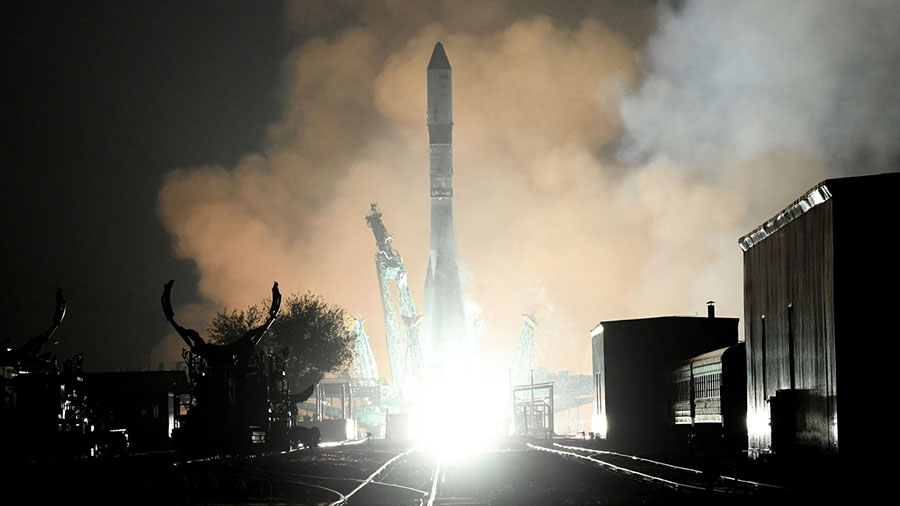
The ISS Progress 82 cargo craft blasts off from the Baikonur Cosmodrome in Kazkakhstan beginning a two-day trip to the space station. Credit: RSC/Energia
A Roscosmos resupply ship is in orbit today chasing the International Space Station for a Thursday night docking. Meanwhile, the seven Expedition 68 crew members scanned their veins, studied plasma physics, reviewed U.S. cargo mission procedures, and practiced controlling a new robotic arm on Wednesday.
Three tons of food, fuel, and supplies are packed inside the ISS Progress 82 cargo craft and orbiting Earth headed for the station’s Poisk module where it will dock at 10:49 p.m. EDT on Thursday. The Progress 82 blasted off from a chilly, cloud-covered Baikonur Cosmodrome in Kazakhstan at 8:20 p.m. on Tuesday. Commander Sergey Prokopyev and Flight Engineer Dmitri Petelin will be on duty in the Zvezda service module monitoring the Progress during its automated approach and docking and will be on standby to take manual control if required. They will open the hatches and begin offloading the new cargo a few hours later.
The orbiting lab’s four astronauts kept up a busy schedule of human research on Wednesday studying how space affects their bodies. Flight Engineer Koichi Wakata of the Japan Aerospace Exploration Agency (JAXA) powered on the Ultrasound 2 device in the morning for a series of vein scans. The veteran astronaut then took turns with NASA Flight Engineers Frank Rubio and Josh Cassada using the Ultrasound 2 to obtain imagery of their neck, shoulder, and leg veins.
Cassada also joined NASA Flight Engineer Nicole Mann and used the same ultrasound device to image their eye’s cornea, lens, and optic nerve. Cassada would later join Rubio in the afternoon for more eye scans using biomedical imaging gear, similar to that found in an eye doctor’s office on Earth, to view their retinas. The optic exams help doctors understand how weightlessness affects eye pressure, shape, anatomy, and vision.
Cassada, Mann, and Wakata started the day with health checks checking temperature, blood pressure, pulse, and respiratory rate. Cassada and Mann then spent about two hours reviewing operations to robotically capture the U.S. Cygnus space freighter planned to arrive in early November.
Prokopyev was back on space physics research studying how plasma crystals form in space that could advance fundamental knowledge, improve spacecraft designs, and benefit industries on Earth. Petelin attached sensors to himself for an experiment observing how microgravity affects the blood circulation system. Finally, cosmonaut Anna Kikina trained to operate the European robotic arm, the station’s third and newest manipulator, for future external payload activities.
Progress 82 Cargo Craft Safely in Orbit Following Launch
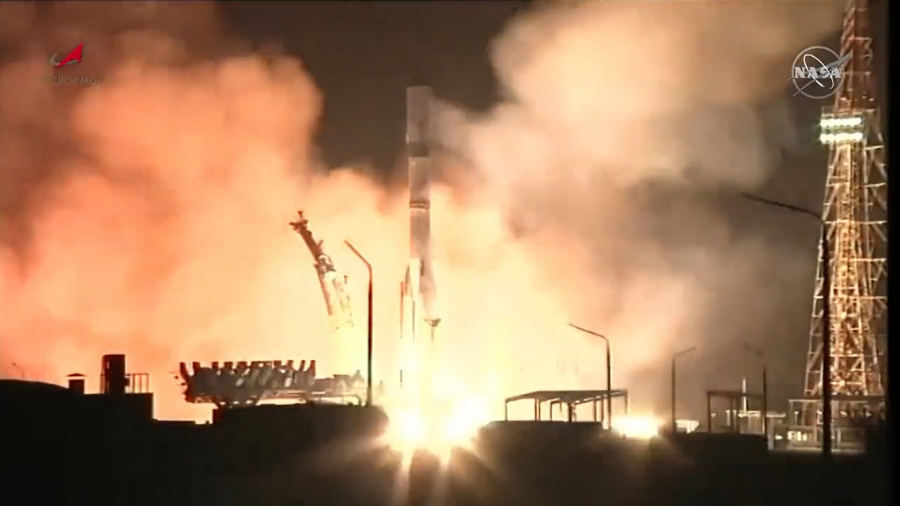
The Progress 82 cargo craft lifted off at 8:20 p.m. EDT on a Soyuz rocket from the Baikonur Cosmodrome in Kazakhstan. Credit: Roscosmos/NASA TV.
The uncrewed Roscosmos Progress 82 is safely in orbit headed for the International Space Station following launch at 8:20 p.m. EDT (5:20 a.m. Baikonur time) Tuesday, Oct. 25, on a Soyuz rocket from the Baikonur Cosmodrome in Kazakhstan.
The resupply ship reached preliminary orbit and deployed its solar arrays and navigational antennas as planned on its way to meet up with the orbiting laboratory and its Expedition 68 crew members.
Progress will dock to the space-facing side of the Poisk module two days from now, on Thursday, Oct. 27, at 10:49 p.m. EDT Live coverage on NASA TV of rendezvous and docking will begin at 10:15 p.m. EDT.
Progress will deliver almost three tons of food, fuel and supplies to the International Space Station.