Central Nervous System, Space Physics Studies Benefit Astronauts and Earthlings

Central Nervous System, Space Physics Studies Benefit Astronauts and Earthlings

Astronaut Samantha Cristoforetti collects microbe samples from around the space station's Veggie space botany facility for analysis.
Astronaut Samantha Cristoforetti collects microbe samples from around the space station’s Veggie space botany facility for analysis.

The Expedition 67 crew members kept up their studies today exploring how the human body adapts to weightlessness and ways that space physics can benefit humans on Earth. Europe’s robotic arm is also being tested for its performance on the International Space Station’s Russian segment.

NASA astronauts Bob Hines and Jessica Watkins partnered together again on Wednesday morning continuing to study how the central nervous system adapts to weightlessness. The duo took turns inside the Columbus laboratory module wearing virtual reality goggles while in a free-flying position for the GRASP experiment sponsored by ESA (European Space Agency). The investigation explores how sight and sound affects the eye-hand/reach-to-grasp coordination without the traditional up and down reference humans are familiar with in Earth’s gravity.

Fluids physics research on the station has a variety of applications that could inform innovations in the pharmaceutical and commercial industries. ESA Flight Engineer Samantha Cristoforetti continued observing emulsion samples in the KERMIT microscope. Results from the Foam and Emulsions study could expand space research opportunities and improve the development of consumer and industrial products. Watkins spent an hour on the Ring Sheared Drop experiment that uses surface tension to contain fluids and observe the formation of destructive protein clusters responsible for neurodegenerative diseases such as Alzheimer’s. Observations may contribute to advanced therapies improving health for both astronauts and Earthlings.

Cristoforetti also joined NASA Flight Engineer Kjell Lindgren in the afternoon for eye checks using a medical imaging device to measure intraocular pressure, or fluid pressure in the eye. Lindgren would work throughout Wednesday checking components on an incubator, collecting and analyzing water samples, then working on orbital plumbing tasks.

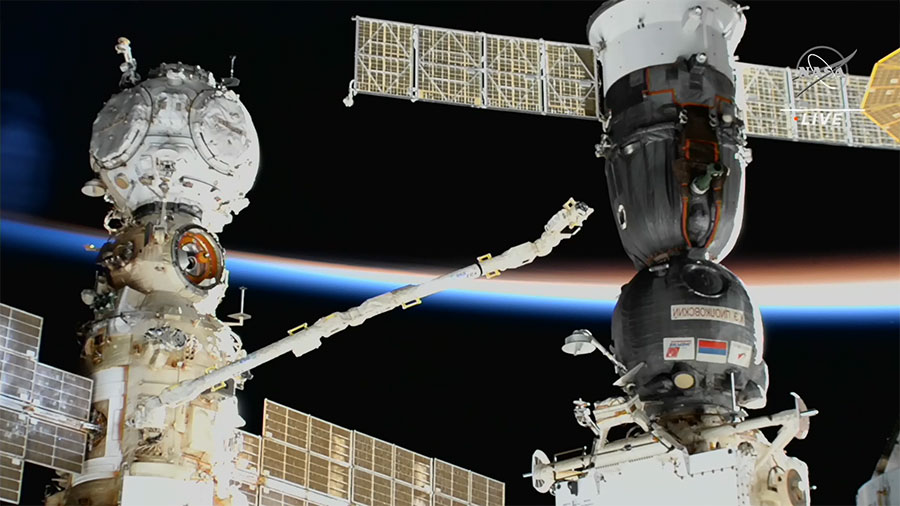
The European robotic arm (ERA) continued going through check outs and verifications before it begins payload operations on the orbiting lab’s Russian segment. Roscosmos Flight Engineer Sergey Korsakov worked throughout Wednesday monitoring the ERA’s telemetry and observing its performance while being maneuvered on the Nauka multipurpose laboratory module.

Station Commander Oleg Artemyev and Flight Engineer Denis Matveev partnered together again for an exercise study to improve workouts in microgravity. The duo later wrapped up the day preparing for their upcoming return to Earth with Korsakov in the Soyuz MS-21 crew ship planned for the end of September.


Learn more about station activities by following the space station blog@space_station and @ISS_Research on Twitter, as well as the ISS Facebook and ISS Instagram accounts.

Get weekly video highlights at: http://jscfeatures.jsc.nasa.gov/videoupdate/

Get the latest from NASA delivered every week. Subscribe here: www.nasa.gov/subscribe

Get The Details…

Mark Garcia

Powered by WPeMatico

Crew Studies Space Physics, Cognition, and Exercise and Checks Robotic Arm

Crew Studies Space Physics, Cognition, and Exercise and Checks Robotic Arm

Hurricane Danielle is pictured from the space station as it orbited above the northern Atlantic Ocean.

The Expedition 67 crew was on duty Tuesday focusing its science activities on space physics and human research. Robotics was also a big part of the day as the European robotic arm continued its verification process on the International Space Station.

Fluid physics is an important part of the research program on the station as scientists and engineers learn how to develop advanced products and applications for Earth and space. NASA Flight Engineer Kjell Lindgren set up hardware on Tuesday inside the Microgravity Science Glovebox to observe how liquids are held together by surface tension. The experiment is studying the formation of destructive protein clusters that may be responsible for neurodegenerative diseases such as Alzheimer’s. Astronaut Samantha Cristoforetti of ESA (European Space Agency) peered at foams and emulsions using the KERMIT microscope to understand why they are more stable in weightlessness. Results from both experiments may provide Earth-bound solutions, that are unobtainable in gravity, for the pharmaceutical, chemical, and consumer products industries.

NASA Flight Engineers Bob Hines and Jessica Watkins were back in the Columbus laboratory module on Tuesday exploring how an astronaut’s central nervous system is affected by microgravity. The duo took turns wearing virtual reality goggles while seated in a specialized chair and responding to pre-programmed stimuli. The video-taped observations may help researchers understand how astronauts adapt to the microgravity environment of spaceflight.

Exercise is critical during space missions as muscles and bones become weaker without the pressure of Earth’s gravity. Astronauts work out for two hours every day using the advanced resistive exercise device, a cycle, and a treadmill, to maintain their cardiovascular and musculoskeletal systems during long-term space missions. The space workouts also ensure crews are in good health and condition to handle the return to Earth’s gravity after living and working in microgravity for months at a time.

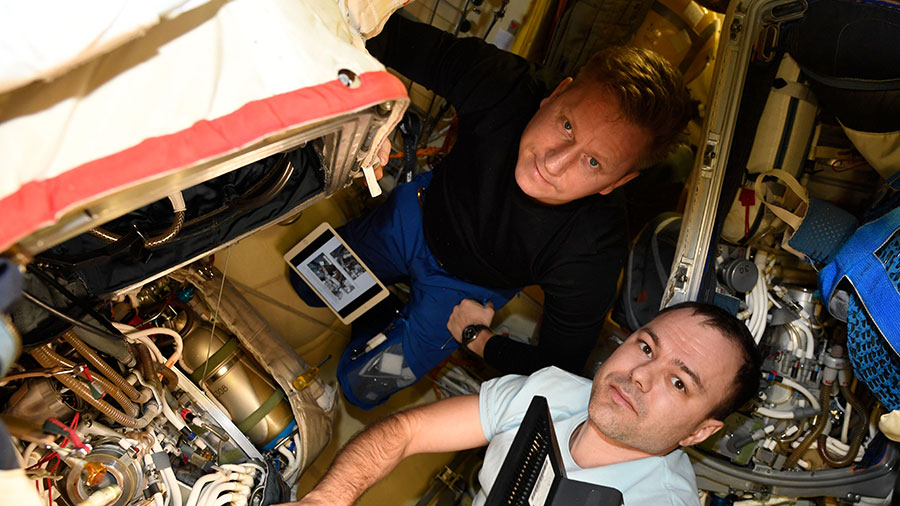
Today, Commander Oleg Artemyev ran on a treadmill while attached to sensors and breathing gear to learn how to exercise more effectively in space. Roscosmos Flight Engineer Denis Matveev assisted the commander with the exercise study before collecting microbe samples from the inside of the Zarya module for analysis.

The orbiting lab’s third and newest robotic arm, the European robotic arm (ERA), continues to be checked out while attached to the Russian segment’s Nauka multipurpose laboratory module. Flight Engineer Sergey Korsakov powered on the ERA and spent all day Tuesday verifying its performance, monitoring its telemetry, and observing its motion while still attached to Nauka.


Learn more about station activities by following the space station blog@space_station and @ISS_Research on Twitter, as well as the ISS Facebook and ISS Instagram accounts.

Get weekly video highlights at: http://jscfeatures.jsc.nasa.gov/videoupdate/

Get the latest from NASA delivered every week. Subscribe here: www.nasa.gov/subscribe

Get The Details…

Mark Garcia

Powered by WPeMatico

Crew Splits Up for Day Off and Departure Preps

Crew Splits Up for Day Off and Departure Preps

NASA astronaut Kjell Lindgren prepares to enjoy a taco during dinner time aboard the space station.

Four of the seven Expedition 67 crew members took the day off on Monday following a busy week of science and maintenance aboard the International Space Station.

Last week saw Flight Engineers Kjell Lindgren, Bob Hines, Jessica Watkins, and Samantha Cristoforetti focus on upgrading life support systems. The quartet moved the Life Support Rack from the Harmony module to the Tranquility module to demonstrate its capacity to remove carbon dioxide and recover oxygen for the crew. The Oxygen Generation System rack was moved from Tranquility to the U.S. Destiny laboratory module to test its ability to detect hydrogen and protect its systems.

Hines and Watkins would spend Thursday and Friday exploring how cognition and perception is affected when living in space long-term. Scientists are using the data to help astronauts adapt to the differing gravity environments of the Moon, Mars, and beyond. Lindgren wrapped up last week testing the station’s new U.S. toilet system while Cristoforetti tended to vegetables growing using non-soil methods such as hydroponics and aeroponics.

The orbiting lab’s three cosmonauts are preparing for their return to Earth at the end of September completing a six-month mission. Commander Oleg Artemyev was joined by Flight Engineers Denis Matveev and Sergey Korsakov for an early morning conference with support personnel who would retrieve the crew after parachuting to Earth inside the Soyuz MS-21 crew ship. Artemyev and Matveev then tested the Lower Body Negative Pressure (LBNP) suit to adapt for the return to Earth’s gravity. The LBNP suit counteracts microgravity’s tendency to pull fluids toward a crew member’s upper body.

During midday, Korsakov joined his cosmonaut crewmates for the LBNP activities to help prepare their bodies for the gravity adjustment when they return to Earth. Korsakov spent the rest of Monday on computer maintenance in the Nauka multipurpose laboratory module as well orbital plumbing duties in the station’s Russian segment.


Learn more about station activities by following the space station blog@space_station and @ISS_Research on Twitter, as well as the ISS Facebook and ISS Instagram accounts.

Get weekly video highlights at: http://jscfeatures.jsc.nasa.gov/videoupdate/

Get the latest from NASA delivered every week. Subscribe here: www.nasa.gov/subscribe

Get The Details…

Mark Garcia

Powered by WPeMatico

Human Research, Space Botany Wrap Up Crew Workweek

Human Research, Space Botany Wrap Up Crew Workweek

Astronauts (from left) Bob Hines, Jessica Watkins, and Kjell Lindgren talked to U.S. Vice President Kamala Harris on Friday when she visited the Mission Control Center at NASA's Johnson Space Center.
Astronauts (from left) Bob Hines, Jessica Watkins, and Kjell Lindgren talked to U.S. Vice President Kamala Harris on Friday when she visited the Mission Control Center at NASA’s Johnson Space Center.

The Expedition 67 crew wrapped up its workweek today with a host of advanced space science work while also beginning preparations for next month’s crew departure activities on the International Space Station.

Friday’s research topics looked at human cognition and perception, space botany, and Earth observations. The microgravity investigations take place inside and outside the orbital lab helping scientists and engineers develop solutions benefitting the Earth and space economies.

NASA Flight Engineers Bob Hines and Jessica Watkins were back in the Columbus laboratory module on Friday morning exploring how cognition and perception is affected when living in space long-term. The duo took turns lying horizontally inside Columbus while gripping and maneuvering a specialized device in response to pre-programmed stimuli. Observations may provide insights helping astronauts adapt to the differing gravitational environments of deep space travel, planets, moons, and asteroids.

Astronaut Samantha Cristoforetti from ESA (European Space Agency) nourished and checked on vegetables growing for the non-soil XROOTS space agricultural study. The experiment explores hydroponic and aeroponic methods as a way to grow larger scale crops during missions beyond low-Earth. NASA Flight Engineer Kjell Lindgren removed a small satellite deployer from inside the Kibo laboratory module’s airlock in the morning after it completed its latest CubeSat deployment mission.

Lindgren and Hines also joined each other on Friday afternoon and practiced on a computer the procedures they would use to return to Earth inside the Crew Dragon Freedom spaceship. Freedom Commander Lindgren and Pilot Hines, along with Dragon Mission Specialists Watkins and Cristoforetti, are targeting undocking from the space station next month and ending their mission which began on April 27.

Lindgren, Hines and Watkins received a call from Vice President Kamala Harris on Friday morning when she visited the Mission Control Center at NASA’s Johnson Space Center (JSC). The Vice President is in Houston with NASA Administrator Bill Nelson for a meeting of the National Space Council and a tour of JSC’s facilities.

Roscosmos Commander Oleg Artemyev and Flight Engineer Sergey Korsakov partnered together in the afternoon for an Earth observation study in the station’s Russian segment. The duo filmed their activities for educational purposes as they photographed landmark’s on the ground using powerful cameras and ultrasonic techniques. Artemyev had earlier checked seat components inside the Soyuz MS-21 crew ship while Korsakov trained to operate the European robotic arm. Flight Engineer Denis Matveev spent his day on Russian life support maintenance and payload operations.


Learn more about station activities by following the space station blog@space_station and @ISS_Research on Twitter, as well as the ISS Facebook and ISS Instagram accounts.

Get weekly video highlights at: http://jscfeatures.jsc.nasa.gov/videoupdate/

Get the latest from NASA delivered every week. Subscribe here: www.nasa.gov/subscribe

Get The Details…

Mark Garcia

Powered by WPeMatico

Crew Studies Adapting to Microgravity, Scans Retinas

Crew Studies Adapting to Microgravity, Scans Retinas

The sun's glint beams across the English Channel and the North Sea in between England and the northern European coast as the station as it orbited 263 miles above. Credit: Thomas Pesquet/ESA
The sun’s glint beams across the English Channel and the North Sea in between England and the northern European coast as the station orbited 263 miles above. Credit: Thomas Pesquet/ESA

More human research, including how astronauts move around in microgravity as well as the effect of weightlessness on vision, packed the science program aboard the International Space Station on Thursday. The seven-member Expedition 67 crew also continued its ongoing focus on life support, orbital plumbing, and electronics systems maintenance.

The lack of an up and down reference while living in microgravity affects how astronauts manipulate and grip objects. Researchers want to get a closer understanding of that behavior to keep astronauts safe in the differing gravitational environments of deep space travel, planets, moons, and asteroids. NASA Flight Engineers Bob Hines and Jessica Watkins took turns seated inside the Columbus laboratory module on Thursday for the long-running GRIP experiment. The duo gripped and maneuvered a specialized device in response to pre-programmed stimuli so scientists can gain insights into a crew member’s cognition and perception during spaceflight.

Hines would go on to orbital plumbing duties filling water containers in the Unity module. Watkins wrapped up her day installing radio frequency identification (RFID) readers inside Unity. The installation work is part of the RFID Smart Sensing study that seeks to improve inventory accuracy and item location on the station.

ESA (European Space Agency) Flight Engineer Samantha Cristoforetti checked radiation detection hardware and collected microbe samples from the area around the Veggie space botany facility for analysis. NASA Flight Engineer Kjell Lindgren stowed biology research hardware and then tested the station’s new toilet system located in the Tranquility module.

Eye checks were back on the schedule on Thursday for Commander Oleg Artemyev and Flight Engineer Sergey Korsakov. The duo took turns scanning each other’s retinas using medical imaging hardware with real-time support from doctors on the ground. The eye exams help researchers understand how weightlessness affects vision and the shape of the eye. Flight Engineer Denis Matveev spent his day servicing Russian life support gear and stowing hardware for disposal inside the ISS Progress 80 resupply ship docked to the Poisk module.


Learn more about station activities by following the space station blog@space_station and @ISS_Research on Twitter, as well as the ISS Facebook and ISS Instagram accounts.

Get weekly video highlights at: http://jscfeatures.jsc.nasa.gov/videoupdate/

Get the latest from NASA delivered every week. Subscribe here: www.nasa.gov/subscribe

Get The Details…

Mark Garcia

Powered by WPeMatico