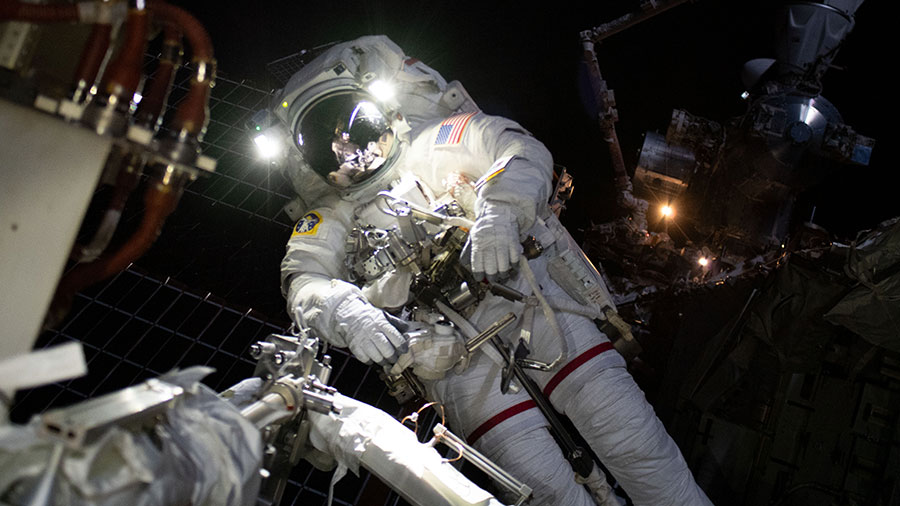
Astronaut Josh Cassada is pictured during a spacewalk on Nov. 15, 2022, to ready the space station for future rollout solar array installation work.
While flight control teams were preparing for today’s U.S. spacewalk, updated tracking data on a fragment of Russian Fregat-SB upper stage debris showed a close approach to station. Based on this new data, flight control teams directed the crew to stop spacewalk preparations as the ground team stepped into procedures to perform a Pre-Determined Debris Avoidance Maneuver (PDAM.)
The maneuver will use the Roscosmos Progress 81 thrusters to provide the complex an extra measure of distance away from the predicted track of the debris. Thruster firing is targeted to occur at 8:42 a.m. EST. The crew is not in any immediate danger.
Without the maneuver, it is predicted that the fragment could pass within less than a quarter mile from the station.
NASA managers will assess the next possible opportunity to perform the day’s planned spacewalk to install a new set of roll-out solar arrays to augment the station’s power capabilities.
Rubio and Cassada spent Tuesday gathering their tools and preparing the Quest airlock for the 12th spacewalk of 2022. The pair were joined for the spacewalk preparations by Flight Engineers Nicole Mann of NASA, Koichi Wakata of the Japan Aerospace Exploration Agency (JAXA), and Commander Sergey Prokopyev from Roscosmos. The quintet gathered together and reviewed Wednesday’s spacewalk procedures, tools, and components then called down to specialists on the ground for a readiness conference.
Mann and Wakata also took turns studying on a computer the Canadarm2 robotic arm maneuvers necessary to support the NASA spacewalkers when they install the roll-out solar array on the P4. The two flight engineers will be at the robotics workstation commanding Canadarm2 and assisting the spacewalking duo during the fine-tuned installation job.
The pair also had time on Tuesday for microgravity research work. Mann watered dwarf tomatoes growing inside the Veggie facility for the Veg-05 space agriculture study. Wakata checked cable connections on the Cell Biology Experiment Facility, a specialized incubator with an artificial gravity generator housing research samples for a bone healing study.
Before Prokopyev assisted the spacewalking team today, he worked on electronics maintenance and orbital plumbing tasks. Roscosmos Flight Engineer Dmitri Petelin assisted Prokopyev with the electronics work before studying advanced Earth photography techniques and exploring ways to pilot spacecraft and robots on future planetary missions. Flight Engineer Anna Kikina also worked on electronic component installations before checking radiation detection hardware and finally researching how international crews and mission controllers from around the world can improve communications.
Week Begins with Bone Research, Cargo Operations Ahead of Spacewalk
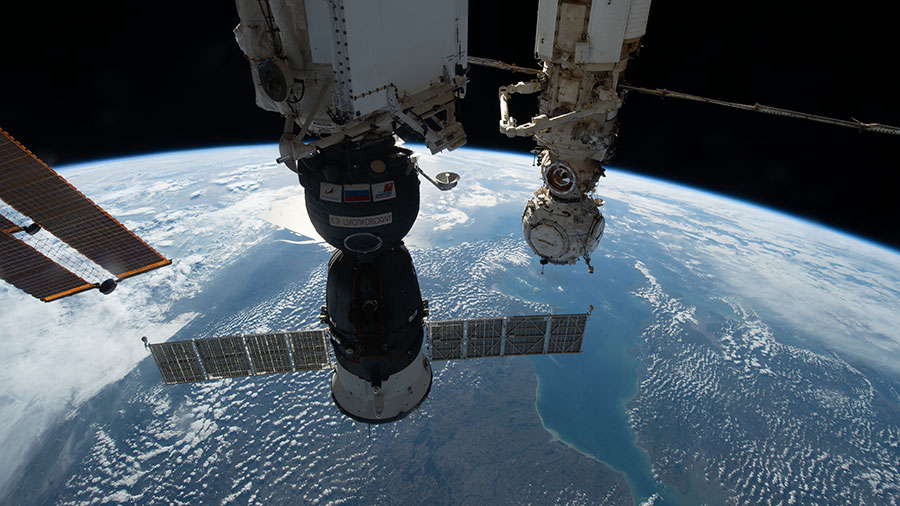
The Soyuz MS-22 crew ship is pictured docked to the Rassvet module. In the background, the Prichal docking module is attached to the Nauka multipurpose laboratory module.
Life science and cargo operations kicked off the week for the Expedition 68 crew aboard the International Space Station. Two astronauts are also planning to exit the orbiting lab on Wednesday for a seven-hour spacewalk.
NASA Flight Engineers Josh Cassada and Nicole Mann took turns with Japan Aerospace Exploration Agency (JAXA) Flight Engineer Koichi Wakata on Monday servicing research samples for an experiment exploring how bones heal in space. The investigation may provide insights into debilitating bone conditions helping advance bone healing therapies for patients on and off the Earth.
All three astronauts also partnered with NASA Flight Engineer Frank Rubio and worked throughout Monday inside the Northrop Grumman Cygnus space freighter attached to the Earth-facing port of the Unity module. The quartet rotated in and out of the vehicle unpacking cargo including crew supplies, new science experiments, and station hardware, as well as stowing trash and old gear inside the space freighter for disposal.
Rubio then spent the afternoon installing multi-layer insulation inside the Harmony module’s space-facing international docking adapter to which the SpaceX Dragon resupply ship is docked. Wakata started his day preparing samples for an experiment run inside the Materials Science Laboratory, a space physics research device sponsored by ESA (European Space Agency). Mann photographed a student-designed study that is exploring new methods to degrade plastic waste in space.
Cassada and Rubio are planning to go on their third spacewalk together at 7:45 a.m. EST on Wednesday. The pair will install another roll-out solar array, also known as an International Space Station Roll-Out Solar Array (iROSA), on the space station’s truss structure. This time the duo will maneuver to the opposite side of the truss structure and install the station’s fourth iROSA on the Port-4 truss structure. The pair will spend about seven hours on the installation job live on NASA TV on the agency’s app and its website.
NASA and Roscosmos continue to evaluate an external cooling loop leak from the Soyuz MS-22 spacecraft docked to the Rassvet module of the International Space Station. Temperatures and humidity within the Soyuz spacecraft remain within acceptable limits. Roscosmos has identified the source of the leak as the external cooling loop of the Soyuz.
As part of the ongoing evaluation and investigation, a robotic inspection of the suspected leak area was completed Dec. 18, using cameras on the Canadarm2 robotic arm. A small hole was observed, and the surface of the radiator around the hole showed discoloration. Roscosmos is evaluating the imagery to determine if this hole could have resulted from micrometeoroid debris or if it is one of the pre-manufactured radiator vent holes.
Space station operations and research continue while station managers and international partners collect and analyze data, and work to develop a forward course of action for the Soyuz and its crew.
With help from the cosmonauts aboard the station, Roscosmos conducted tests on additional Soyuz systems on Dec. 16, including a short demonstration of the spacecraft’s propulsion system. So far, testing has shown no additional issues.
The leak was first detected around 7:45 p.m. EST Dec. 14, when pressure sensors in the cooling loop showed low readings. Data analysis indicates the majority of the cooling fluid had leaked out by 1:30 p.m. Dec. 15.
At the time of the leak, Prokopyev and Petelin were preparing to conduct a spacewalk. The spacewalk was postponed, so the cosmonauts did not exit the space station or become exposed to the leaking coolant.
Back inside station, Prokopyev and Petelin configured the Poisk module and its airlock to its normal status. Prokopyev later collected obsolete hardware for disposal aboard Cygnus and also tested a 3D printer. Petelin inspected cable connections and inventoried spare parts aboard the station. Flight Engineer Anna Kikina spent the morning exploring futuristic spacecraft and robotic piloting techniques then worked in the afternoon servicing an oxygen generator.
Controllers Evaluating Soyuz After Successful Thruster Test
The Soyuz MS-22 crew ship is pictured docked to the Rassvet module. In the background, the Prichal docking module is attached to the Nauka multipurpose laboratory module.
NASA and Roscosmos continue to evaluate an external leak that occurred Dec. 14, from the Roscosmos Soyuz MS-22 spacecraft docked to the Rassvet module of the International Space Station. Roscosmos has identified the source of the leak as the external cooling loop of the Soyuz.
As part of the ongoing evaluation and investigation, Roscosmos flight controllers conducted a successful test of the Soyuz MS-22 thrusters at 3:08 a.m. EST Friday, Dec. 16. The systems that were tested were nominal, and Roscosmos assessments of additional Soyuz systems continue. Temperatures and humidity within the Soyuz spacecraft, which remains docked to the Rassvet module, are within acceptable limits.
NASA is supporting the ongoing investigation with the use of the Canadarm2 robotic arm to provide additional viewing of the Soyuz exterior on Sunday, Dec. 18. To accommodate this change in plans, NASA has determined a new target date for the upcoming U.S. spacewalk to install an International Space Station Roll-Out Solar Array (iROSA), which was originally scheduled for Monday, Dec. 19. The spacewalk will take place Wednesday, Dec. 21.
The leak was first detected around 7:45 p.m. EST Dec. 14, when data pressure sensors in the cooling loop showed low readings. At that time, Roscosmos cosmonauts Sergey Prokopyev and Dmitri Petelin were preparing to conduct a spacewalk. The spacewalk was cancelled, so the cosmonauts did not exit the space station or become exposed to the leaking coolant. From data analysis and cameras aboard the space station, the majority of fluid had leaked out by yesterday, Dec. 15, around 1:30 p.m. EST.
More updates will be provided as data becomes available.
On station the Expedition 68 crew members set up a variety of advanced research gear to capture high definition video of Earth and house biology samples for observation.
Flight Engineers Josh Cassada and Frank Rubio reviewed spacewalk robotics activities with Flight Engineers Nicole Mann of NASA and Koichi Wakata of the Japan Aerospace Exploration Agency (JAXA).
Cassada and Wakata also had time on Friday morning configuring hardware supporting advanced space science experiments. Cassada assembled the SphereCam-1, a digital ultra-high resolution video camera, inside the U.S. Destiny laboratory module. He pointed the camera outside Destiny’s science window, or Window Observation Research Facility, and filmed Earth demonstrating its ability to capture the highest resolution, groundbreaking 12K views from a spacecraft. Wakata activated the Cell Biology Experiment Facility (CBEF) inside the Kibo laboratory module that will house scientific samples for future space biology research. The CBEF is an incubator that supports a variety of life science observing cells, plants, and small mammals.
Prokopyev and Petelin cleaned their Orlan spacesuits and stowed their spacewalking tools following the postponement of Wednesday night’s spacewalk.
Flight Engineer Anna Kikina also worked on post-spacewalk activities returning the station’s Russian segment to normal and checking radiation sensors worn on the Orlan suits. Kikina wrapped up her day treating surfaces inside the Zarya module with an anti-fungal agent to maintain cleanliness and health aboard the station.
NASA Provides Update on International Space Station Operations
The Soyuz MS-22 crew ship is pictured docked to the Rassvet module. In the background, the Prichal docking module is attached to the Nauka multipurpose laboratory module.
On Wednesday, Dec. 14, an external leak was detected from the Roscosmos Soyuz MS-22 spacecraft docked to the Rassvet module on the International Space Station. The external radiator cooling loop of the Soyuz is the suspected leak source.
The Roscosmos Mission Control team in Moscow postponed Wednesday evening’s planned spacewalk with two cosmonauts to evaluate the situation and data from the Soyuz spacecraft. None of the crew members aboard the space station was in danger, and all conducted normal operations throughout the day.
Roscosmos is closely monitoring Soyuz spacecraft temperatures, which remain within acceptable limits. NASA and Roscosmos continue to coordinate external imagery and inspection plans to aid in evaluating the external leak location. Plans for an additional inspection of the Soyuz exterior using the station’s Canadarm2 robotic arm are underway.
The leak was first detected around 7:45 p.m. EST Dec. 14 when data from multiple pressure sensors in the cooling loop showed low readings. At that time, cosmonauts Sergey Prokopyev and Dmitri Petelin were preparing to conduct a spacewalk. The cosmonauts did not exit the space station, and no crew members were exposed to the leaking coolant.
The Soyuz MS-22 spacecraft carried NASA astronaut Frank Rubio and Roscosmos cosmonauts Sergey Prokopyev and Dmitri Petelin into space after launching from the Baikonur Cosmodrome in Kazakhstan on Sept. 21.
The crew aboard station completed normal operations Thursday, including participating in science investigations and research, as well as configuring tools ahead of a planned U.S. spacewalk on Monday, Dec. 19. Specialists are working through robotic plans ahead of Monday’s spacewalk to best optimize for upcoming station operations and the Soyuz inspection.
A Roscosmos spacewalk scheduled for Dec. 21 is indefinitely postponed as the team continues its investigation of the Soyuz spacecraft.
More updates will be provided as data becomes available.