Science and Operational Prep Work Top Wednesday’s Schedule

Science and Operational Prep Work Top Wednesday’s Schedule

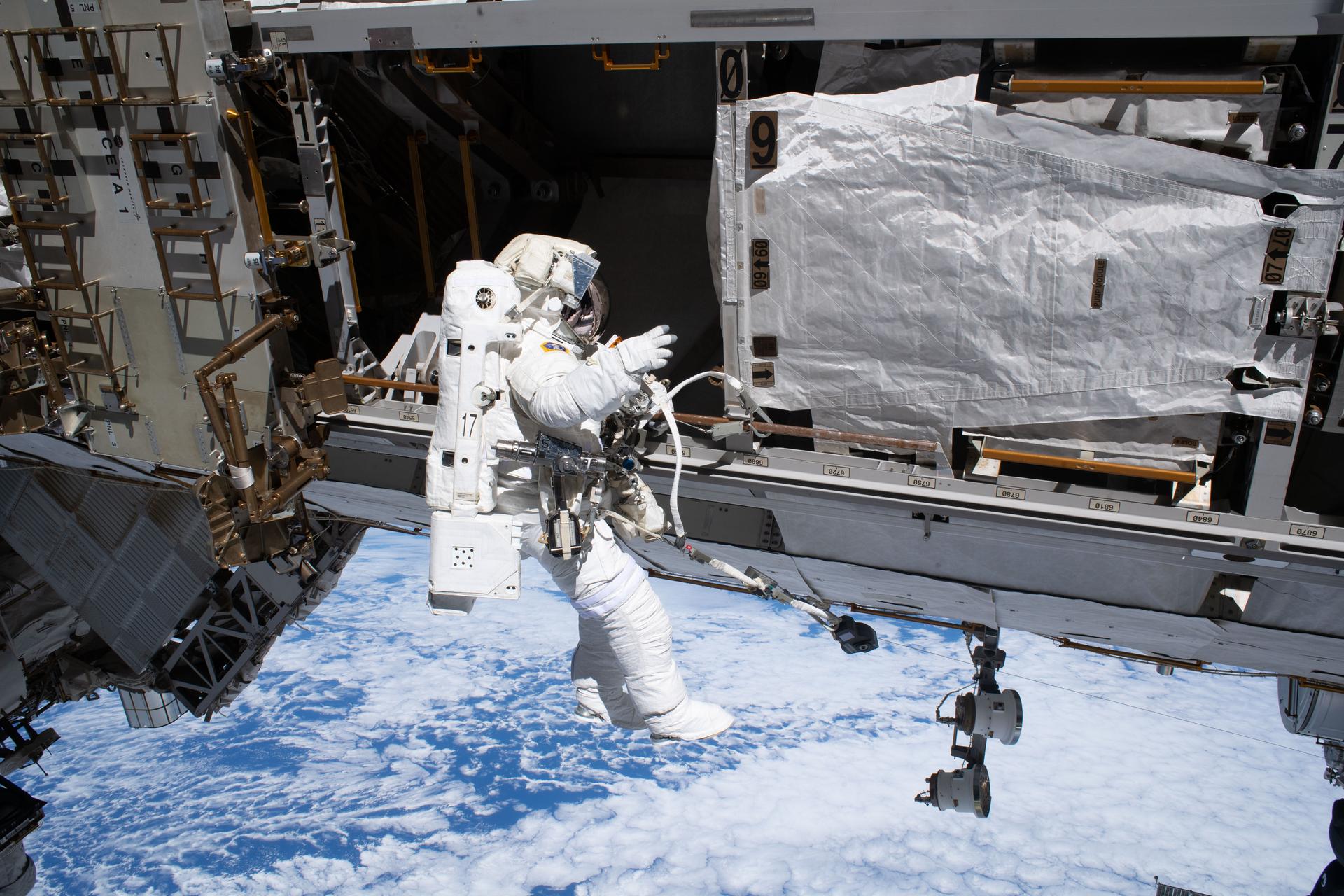
NASA astronauts Jessica Meir and Chris Williams are pictured outside the International Space Station during a seven-hour, two-minute spacewalk on March 18, 2026. Credit: NASA/Jack Hathaway
NASA astronauts Jessica Meir and Chris Williams are pictured outside the International Space Station during a seven-hour, two-minute spacewalk on March 18, 2026.
NASA/Jack Hathaway

Science preparation and procedure reviews topped the schedule aboard the International Space Station on Wednesday. The seven Expedition 74 crew members conducted a variety of tasks to ready for upcoming experiments and to conduct cargo operations.

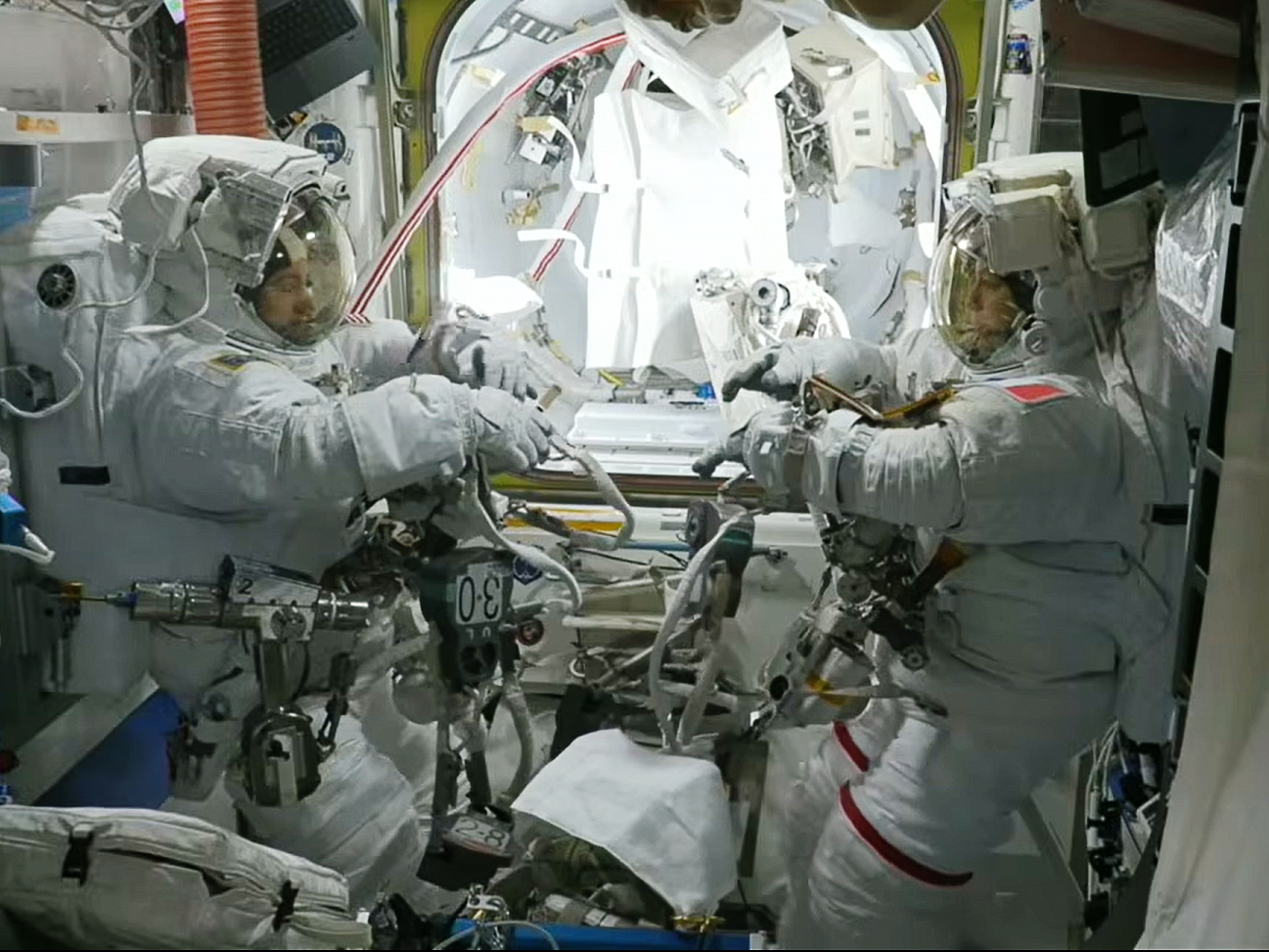
NASA astronauts Jack Hathaway and Jessica Meir worked separately throughout the day to consolidate food and complete post-spacewalk work following the March 18 spacewalk to install a modification kit on the 2A power channel of the space station ahead of future solar array upgrades. This work included the inspection of the suit glove heaters, data recorders, cameras, and helmet lights.

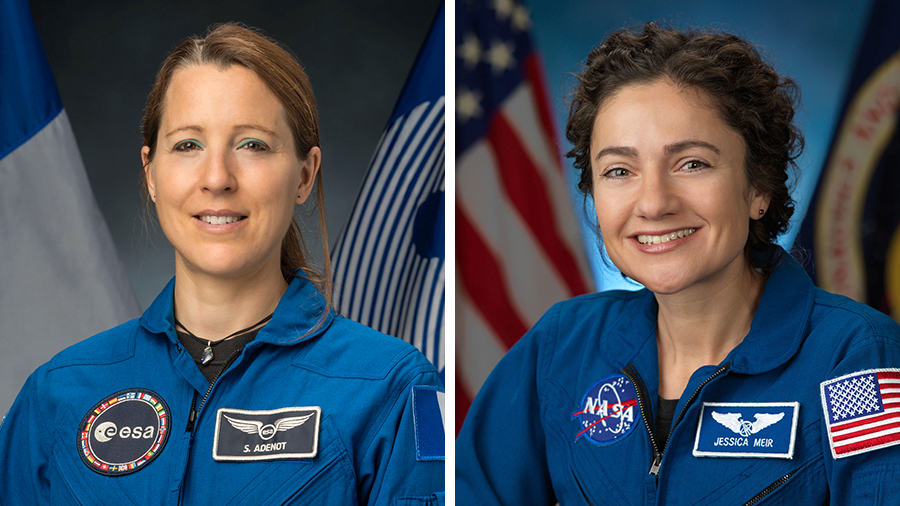
To prepare for upcoming experiment operations, European Space Agency (ESA) astronaut Sophie Adenot spent the morning cleaning and inserting samples into the Soft Matter Dynamics experiment containers, which explore the dynamics of droplets and their size evolution in emulsions. After donning the RelaxPro actigraphy device earlier this week, Adenot transferred the data to ground teams for analysis. She then familiarized herself with spacesuit systems before loading software onto payload hard drives.

In the Kibo module, NASA astronaut Chris Williams spent a large portion of the day installing new data management system racks, which are used to house and manage data for various science experiments. Later in the day, he worked on food consolidation then inspected medical hardware.

Following yesterday’s arrival of the Progress 94 cargo spacecraft,  space station commander Sergey Kud-Sverchkov and flight engineer Sergei Mikaev reviewed cargo transfer and stowage plans as they gear up to unload the nearly three tons of food, fuel, and supplies delivered by the spacecraft.

Later on, Kud-Sverchkov and flight engineer Andrey Fedyaev photographed landmarks across Earth for documentation. Fedyaev also spent time throughout the day conducting some orbital plumbing and reconfiguring station cameras.

Learn more about station activities by following the space station blog@space_station on X, as well as the ISS Facebook and ISS Instagram accounts.

Get the latest from NASA delivered every week. Subscribe here.

Powered by WPeMatico

Get The Details…

Abby Graf

Cargo Headed to Station, Week Begins with Science Prep and Maintenance

Cargo Headed to Station, Week Begins with Science Prep and Maintenance

ESA (European Space Agency) astronaut and Expedition 74 Flight Engineer Sophie Adenot is pictured inside the International Space Station's Harmony module during cargo stowage activities.
iss074e0333993 (Feb. 26, 2026) — ESA (European Space Agency) astronaut and Expedition 74 Flight Engineer Sophie Adenot is pictured inside the International Space Station’s Harmony module during cargo stowage activities.
ESA/Sophie Adenot

A cargo spacecraft is in orbit catching up to the International Space Station for a docking tomorrow to deliver food and supplies to the Expedition 74 crew. Aboard the orbital lab, the seven residents kicked off the week with science operations prep, routine maintenance, and getting systems ready for a future spacewalk.

In the morning, three NASA astronauts—Jessica Meir, Chris Williams, and Jack Hathaway—split up various duties. Meir conducted routine orbital plumbing and replaced a gas trap plug. Meanwhile, Williams relocated connection cables, set up and inserted canisters in the Cell Biology Experiment Facility, and consolidated food packages. Hathaway set his sights to spacesuit work, stowing batteries and performing a cooling loop scrub on the suits.

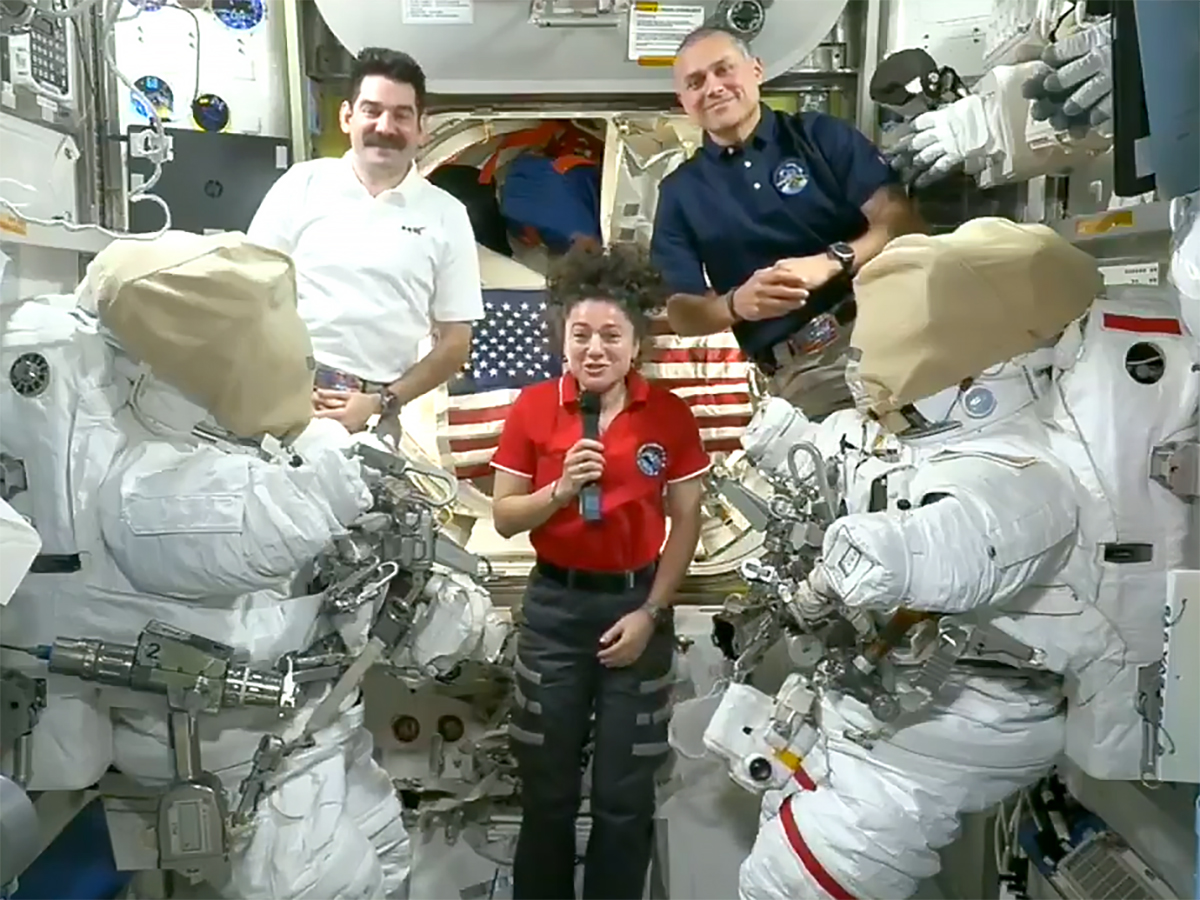
Meir and Williams then teamed up to review procedures and checklist items for an upcoming spacewalk. The duo was later joined by Hathaway and European Space Agency (ESA) astronaut Sophie Adenot to assemble the roll-out solar array mod kit struts, which will be installed to the exterior of the orbital lab during the upcoming spacewalk.

Before teaming up with her crewmates, Adenot completed a questionnaire, donned an actigraphy device, and collected biological samples for the RelaxPro experiment. The study tests relaxation training protocols in flight, which could contribute to the development of measures to reduce stress and behavioral risks for astronauts on future space missions. Adenot then moved into the Kibo module, where she retrieved and swapped in new cartridges to the Electrostatic Levitation Furnace.

In the Roscosmos segment, two cosmonauts are monitoring and gearing up for the arrival of the Progress 94 cargo spacecraft tomorrow. Progress, loaded with nearly three tons of food, fuel, and supplies, launched from the Baikonur Cosmodrome in Kazakhstan at 7:59 a.m. EDT March 22. The cargo spacecraft is set to dock to the space-facing port of the station’s Poisk module tomorrow, March 24, at 9:34 a.m. NASA’s live rendezvous and docking coverage will begin at 8:45 a.m. on NASA+Amazon Prime, and the agency’s YouTube channel. 

Commander Sergey Kud-Sverchkov and flight engineer Sergei Mikaev teamed up to configure and complete training on TORU, the Telerobotically Operated Rendezvous System, which is a control panel located in the Zvezda Service Module. One of the two antennas used for an automated rendezvous and docking did not deploy after separation. Progress will arrive 200 meters from the space station autonomously, then transition to manual piloting for its final approach. Kud-Sverchkov will manually pilot the spacecraft through TORU for rendezvous and docking at the space station’s Poisk module.

Mikaev then moved on to audit stowage, equipment, and hardware throughout the Roscosmos segment. Meanwhile, flight engineer Andrey Fedyaev charged camera batteries, conducted orbital plumbing, then backed up and sent exercise data to ground teams for analysis.

Learn more about station activities by following the space station blog@space_station on X, as well as the ISS Facebook and ISS Instagram accounts.

Get the latest from NASA delivered every week. Subscribe here.

Powered by WPeMatico

Get The Details…

Abby Graf

Progress Cargo Craft Launches to Resupply Station Crew

Progress Cargo Craft Launches to Resupply Station Crew

The Progress 94 cargo spacecraft launches to the International Space Station on March 22, 2026.
NASA

The unpiloted Roscosmos Progress 94 spacecraft is safely in orbit and headed to the International Space Station following its launch at 7:59 a.m. EDT (4:59 p.m. Baikonur time) on a Soyuz rocket from the Baikonur Cosmodrome in Kazakhstan. 

Following launch, one of the Progress spacecraft’s two KURS automated rendezvous antennas did not deploy as planned. All other systems are operating as designed, and Progress will continue toward its planned docking at 9:34 a.m. Tuesday, March 24, to the space-facing port of the station’s Poisk module. Roscosmos will continue troubleshooting the antenna issue. If the antenna cannot be deployed, Roscosmos cosmonaut Sergey Kud-Sverchkov will manually pilot the spacecraft for rendezvous and docking using the TORU (Telerobotically Operated Rendezvous System), which is a control panel located in the Zvezda Service Module that can be used as a backup to the KURS automated system. 

NASA’s live rendezvous and docking coverage will begin at 8:45 a.m. on NASA+, Amazon Prime, and the agency’s YouTube channel. Learn how to watch NASA content through a variety of online platforms, including social media.  

The spacecraft is delivering about three tons of food, fuel, and supplies to the orbiting laboratory.  

Learn more about station activities by following the space station blog, @space_station on X, as well as the ISS Facebook and ISS Instagram accounts.

Get the latest from NASA delivered every week. Subscribe here.

Powered by WPeMatico

Get The Details…

Mark A. Garcia

Progress Counts Down to Launch to Resupply Expedition 74

Progress Counts Down to Launch to Resupply Expedition 74

The Roscosmos Progress 88 spacecraft carrying about three tons of cargo lifts off from the Baikonur Cosmodrome in Kazakhstan on May 30. Credit: NASA TV
The Roscosmos Progress 88 spacecraft carrying about three tons of cargo lifts off from the Baikonur Cosmodrome in Kazakhstan on May 30,2024.
NASA TV

NASA’s live coverage is underway on NASA+, Amazon Prime, and the agency’s YouTube channel. Learn how to watch NASA content through a variety of online platforms, including social media. 

The unpiloted Progress 94 spacecraft is scheduled to launch at 7:59 a.m. EDT (4:59 p.m. Baikonur time) on a Soyuz rocket from the Baikonur Cosmodrome in Kazakhstan. The Roscosmos spacecraft will carry about three tons of food, fuel, and supplies for the Expedition 74 crew aboard the International Space Station. 

After a two-day trip to the space station, the spacecraft will dock autonomously to the Poisk module’s space-facing port at about 9:34 a.m. Tuesday, March 24. NASA’s live rendezvous and docking coverage will begin at 8:45 a.m. on NASA+, Amazon Prime, and the agency’s YouTube channel.

Learn more about station activities by following the space station blog, @space_station on X, as well as the ISS Facebook and ISS Instagram accounts.

Get the latest from NASA delivered every week. Subscribe here.

Powered by WPeMatico

Get The Details…

Mark A. Garcia

Week Wraps with Health Research and Spacewalk Closeout Procedures

Week Wraps with Health Research and Spacewalk Closeout Procedures

Expedition 74 Flight Engineers Jessica Meir and Chris Williams, both NASA astronauts, collect frozen research samples from inside the International Space Station's Destiny laboratory module. The samples were stowed inside science freezers aboard a SpaceX Dragon spacecraft for retrieval and analysis on Earth.
Expedition 74 Flight Engineers Jessica Meir and Chris Williams, both NASA astronauts, collect frozen research samples from inside the International Space Station’s Destiny laboratory module. The samples were stowed inside science freezers aboard a SpaceX Dragon spacecraft for retrieval and analysis on Earth.
ESA/Sophie Adenot

Health research and final spacewalk closeouts wrapped up the week for the Expedition 74 crew members aboard the International Space Station as they gear up to receive a cargo delivery next week.

Understanding how the human body reacts to space is key to ensure crews thrive on future longer-duration missions. Residents aboard the orbital complex often collect biological samples for ground teams to analyze, helping pinpoint microgravity-induced changes in the human body. To facilitate this work, NASA astronauts Jack Hathaway and Jessica Meir collected and analyzed blood samples in the morning for the Venous Flow experiment, which examines how spaceflight affects blood flow. Afterward, Hathaway guided an ultrasound scan on Meir to examine her cardiovascular system.

Later on, the duo was joined by NASA astronaut Chris Williams and European Space Agency (ESA) astronaut Sophie Adenot to review procedures for a future spacewalk and meet with ground teams once more for another debrief following the conclusion of Wednesday’s seven-hour, two-minute spacewalk.

Williams worked in some time to power on the station’s free-flying robots, Astrobee, for future operations before moving onto spacesuit work, charging the batteries and configuring them for stowage. Adenot removed the impact shields on the suits and completed an array of other tasks throughout the day, including hatch seal inspections and computer battery swaps.

In the Roscosmos segment, flight engineer Andrey Fedyaev enjoyed a day off. His colleagues, Commander Sergey Kud-Sverchkov and flight engineer Sergei Mikaev conducted maintenance and swapped batteries on a few testing instruments that monitor materials for cracks and corrosion. Afterward, Mikaev moved into the Zvezda Service Module to conduct inspections with the instruments and then completed a round of computer software updates. Kud-Sverchkov moved throughout the orbital complex during the day to photograph and video his crewmates working to document life aboard the space station.

On Sunday, March 22, the unpiloted Progress 94 cargo spacecraft, loaded with nearly three tons of food, fuel, and supplies, will lift off from the Baikonur Cosmodrome in Kazakhstan at 7:59 a.m. EDT. After a two-day trip, Progress will dock to the Poisk module’s space-facing port around 9:34 a.m. Tuesday, March 24. NASA will provide live coverage of both launch and docking NASA+Amazon Prime, and the agency’s YouTube channel.

Learn more about station activities by following the space station blog@space_station on X, as well as the ISS Facebook and ISS Instagram accounts.

Get the latest from NASA delivered every week. Subscribe here.

Powered by WPeMatico

Get The Details…

Abby Graf