NASA TV Coverage Begins for Power System Mods Spacewalk

NASA TV Coverage Begins for Power System Mods Spacewalk
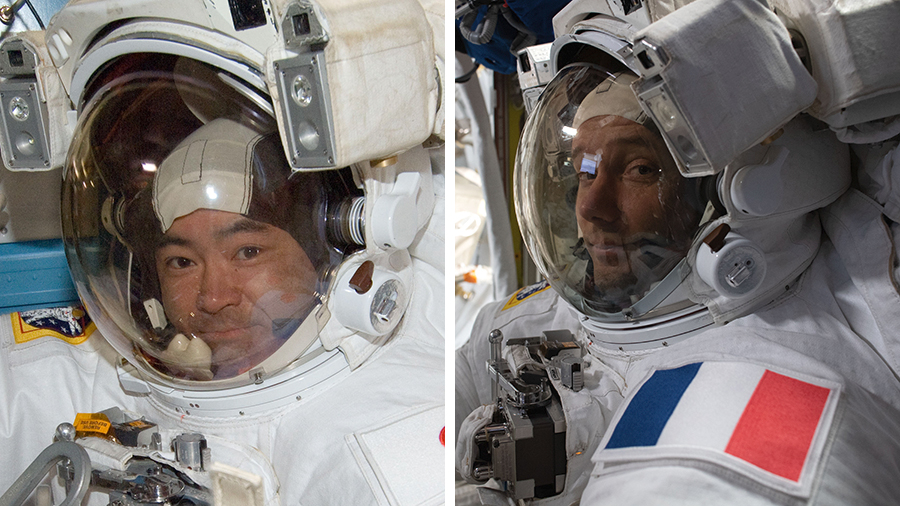
Astronauts (from left) Akihiko Hoshide and Thomas Pesquet are pictured in their U.S. spacesuits preparing for earlier spacewalks.

NASA Television coverage of today’s spacewalk with astronauts Akihiko Hoshide of the Japan Aerospace Exploration Agency (JAXA) and Thomas Pesquet of ESA (European Space Agency) is now underway and is also available on the NASA app and the agency’s website.

The crew members of Expedition 65 are preparing to go outside the International Space Station for a spacewalk scheduled to begin at approximately 8:30 a.m. EDT and last about six and a half hours. They are ahead of schedule.

The crew is in their spacesuits in the airlock in preparation to exit the space station and begin today’s activities that will focus on attaching a support bracket in preparation for future installation of the orbiting laboratory’s third new solar array. NASA astronauts Megan McArthur and Mark Vande Hei are assisting Hoshide and Pesquet in preparations before they exit the station.

Hoshide and Pesquet will work on the port side of the station’s backbone truss structure closest to the station’s pressurized living space, a position known as P4. They will work together to build a bracket structure and attach the bracket and support struts to the mast canister, the base, of one of the P4 solar arrays. The modification kit will prepare the site for future installation and deployment of the third of six new International Space Station Roll-Out Solar Arrays (iROSAs).

The crew also will replace a device that measures the electrical charging potential of the arrays and associated surfaces in its vicinity, called a floating point measurement unit, on a separate truss section.

Leading the mission control team today is Flight Director Adi Boulos with support from Sandy Moore as the lead spacewalk officer and NASA astronaut Jessica Watkins acting as the capsule communicator, or CAPCOM, to the crew.

Learn more about station activities by following @space_station and @ISS_Research on Twitter as well as the ISS Facebook and ISS Instagram accounts.

Get The Details…

Mark Garcia

Powered by WPeMatico

Station Busy with Sunday Spacewalk Preps and Biology, Botany Research

Station Busy with Sunday Spacewalk Preps and Biology, Botany Research

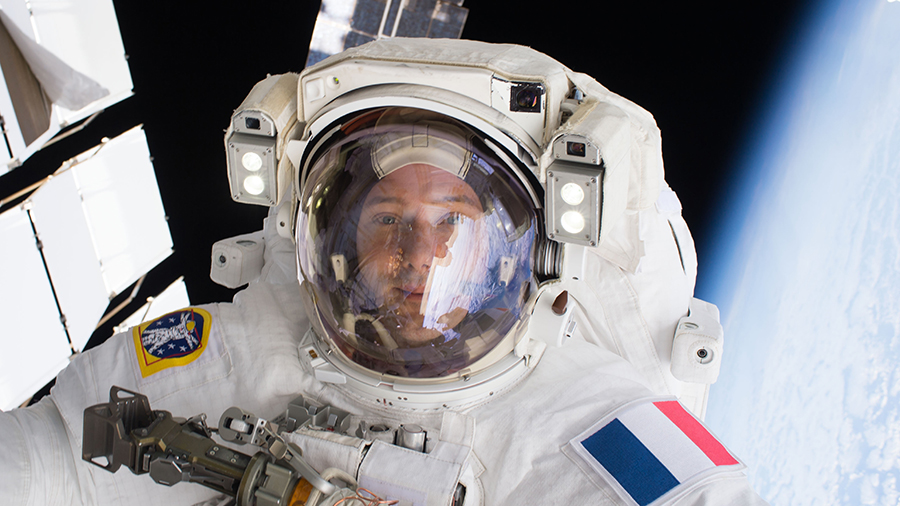
ESA (European Space Agency) astronaut Thomas Pesquet is pictured during a spacewalk in January 2017 when he was an Expedition 50 flight engineer.

Two Expedition 65 astronauts are getting ready for a Sunday spacewalk to modify the International Space Station’s power system. Meanwhile, the orbiting lab is hosting a variety of biology and botany research today as two cosmonauts clean up following Thursday’s spacewalk.

International astronauts Akihiko Hoshide of the Japan Aerospace Exploration Agency (JAXA) and Thomas Pesquet of ESA (European Space Agency) are preparing for a six-and-a-half hour spacewalk on Sunday. They will set their U.S. spacesuits to battery power at 8:30 a.m. EDT, exit the station’s U.S. Quest airlock, then translate to the Port-4 (P4) truss structure to install a modification kit. This will ready the P4 for a new Roll-Out Solar Array set to be delivered on a SpaceX Cargo Dragon mission next year. NASA TV will begin its live spacewalk coverage at 7 a.m. on the NASA app and the agency’s website.

Hoshide and Pesquet still had plenty of time for microgravity research today as they gear up for Sunday’s excursion. The JAXA astronaut, who is on his third space mission, serviced mouse embryo samples in the Kibo laboratory module to learn how the space environment affects key phases of reproduction. ESA Flight Engineer Pesquet set up the Columbus laboratory module and explored how the human central nervous system adapts to weightlessness.

NASA Flight Engineers Shane Kimbrough and Megan McArthur worked on two different space botany experiments today helping mission planners and doctors learn to sustain crews on longer space missions farther away from Earth. Kimbrough harvested plants growing on petri plates for the APEX-08 genetic expression study. McArthur cleaned up debris in the Kibo lab’s Plant Habitat that is growing Hatch Green chiles for the Plant Habitat-04 space crop experiment.

NASA Flight Engineer Mark Vande Hei replaced components inside the Combustion Integrated Rack then relocated a detection device that studies the radiation spectrum onboard the station. Vande Hei also partnered with Hoshide and Pesquet assisting the duo with their spacewalk preparations.

Cosmonauts Oleg Novitskiy and Pyotr Dubrov slept in Friday morning following their seven-hour and 25-minute spacewalk on Thursday to connect data and communication cables to Russia’s Nauka multipurpose laboratory module. The duo from Roscosmos then began disconnecting components on their Orlan spacesuits and stowing spacewalk gear in the orbiting lab’s Russian segment.

Get The Details…

Mark Garcia

Powered by WPeMatico

Cosmonauts Wrap Up Second Spacewalk to Set Up Science Module

Cosmonauts Wrap Up Second Spacewalk to Set Up Science Module

Russian spacewalkers (from left) Oleg Novitskiy and Pyotr Dubrov work over 250 miles above the Earth to configure the Nauka multipurpose laboratory for science operations. Credit: NASA TV

Russian cosmonauts Oleg Novitskiy and Pyotr Dubrov of Roscosmos concluded their spacewalk at 6:16 p.m. EDT after 7 hours and 25 minutes. It was the second of up to 11 spacewalks to prepare the new Nauka multipurpose laboratory module for operations in space.

Novitskiy and Dubrov finished connecting television, rendezvous system and ethernet cables to the recently arrived Nauka module. They also installed handrails, jettisoned a cable reel, and installed a biology experiment on the Poisk module.

This was the 11th spacewalk this year and the 243rd overall in support of space station assembly, maintenance and upgrades. Spacewalkers have now spent a total of 63 days and 23 hours working outside the station.

It is the third spacewalk for both cosmonauts, both of whom have now spent a total of 22 hours and 38 minutes spacewalking.

In November 2020, the International Space Station surpassed its 20-year milestone of continuous human presence, providing opportunities for unique research and technological demonstrations that help prepare for long-duration missions to the Moon and Mars and also improve life on Earth. In that time, 244 people from 19 countries have visited the orbiting laboratory that has hosted nearly 3,000 research investigations from researchers in 108 countries and areas.

Learn more about station activities by following @space_station and @ISS_Research on Twitter as well as the ISS Facebook and ISS Instagram accounts.

Get The Details…

Mark Garcia

Powered by WPeMatico

Cosmonauts Start Spacewalk to Work on Science Module

Cosmonauts Start Spacewalk to Work on Science Module

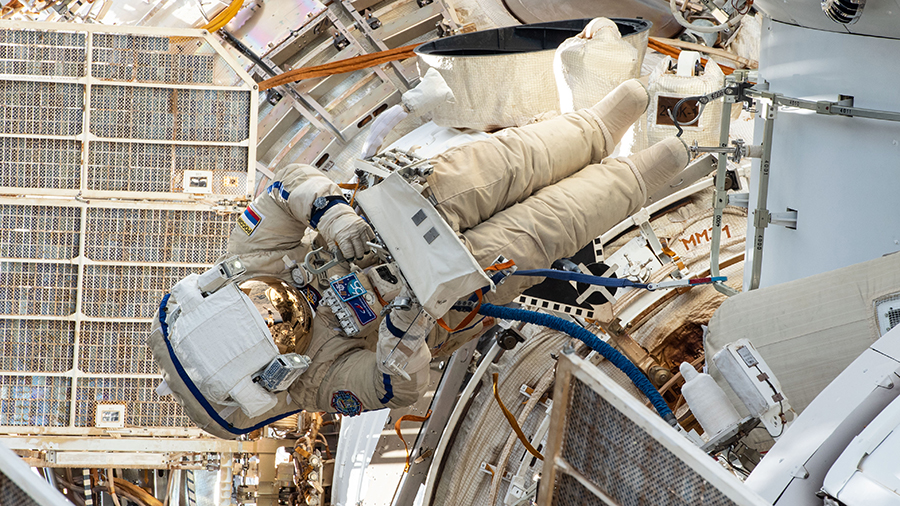
Russian spacewalker Pyotr Dubrov is pictured on Sept. 3 outfitting the Nauka multipurpose laboratory module with ethernet cables, power cables and handrails.

Expedition 65 Flight Engineers Oleg Novitskiy and Pyotr Dubrov of the Russian space agency Roscosmos began a spacewalk to prepare the new Nauka multipurpose laboratory module for operations in space when they opened the hatch of the Poisk docking compartment airlock of the International Space Station at 10:51 a.m. EDT.

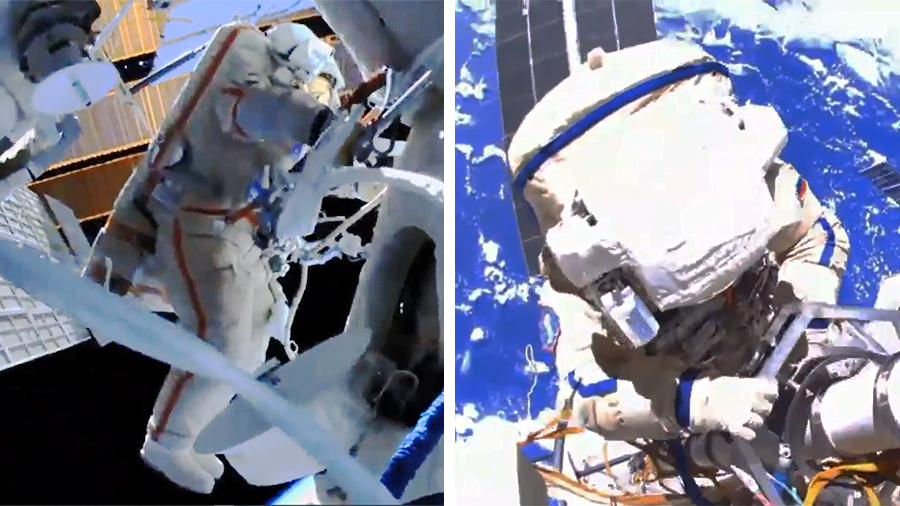
Novitskiy, designated extravehicular crew member 1 (EV1), is wearing a Russian Orlan spacesuit with red stripes, and Dubrov is wearing a spacesuit with blue stripes as extravehicular crew member 2 (EV2).

Coverage of the spacewalk continues on NASA Television, the NASA app, and the agency’s website. Views from a camera on Novitskiy’s helmet are designated with the number 22, and Dubrov’s is labeled with the number 20.

The duo’s primary tasks for today’s spacewalk are to continue connecting an ethernet cable and television and rendezvous system cables to the new module, install handrails to enable spacewalkers to maneuver more easily, and to install a biology experiment on the Poisk module.

Learn more about station activities by following @space_station and @ISS_Research on Twitter as well as the ISS Facebook and ISS Instagram accounts.

Get The Details…

Mark Garcia

Powered by WPeMatico

NASA TV Begins Coverage of Russian Spacewalk to Outfit Science Module

NASA TV Begins Coverage of Russian Spacewalk to Outfit Science Module

Russia's Nauka multipurpose laboratory module is pictured as the station orbited into a sunset above the southern Indian Ocean.
Russia’s Nauka multipurpose laboratory module is pictured as the station orbited into a sunset above the southern Indian Ocean.

NASA Television coverage of today’s spacewalk with cosmonauts Oleg Novitskiy and Pyotr Dubrov of the Russian space agency Roscosmos is now underway and is also available on the NASA app and the agency’s website.

The crew members of Expedition 65 are preparing to exit the International Space Station‘s Poisk module on the space-facing side of the station’s Russian segment for a spacewalk expected to begin at approximately 11:00 a.m. EDT that will last about six and a half hours.

It will be the second of up to 11 spacewalks to prepare the new Nauka multipurpose laboratory module for operations in space. Watch a video animation preview of today’s spacewalk and planned activities at: https://www.youtube.com/watch?v=hfacX6864b4

During the spacewalk, the cosmonauts will perform tasks including installing handrails on Nauka and connecting power, ethernet, and data cables between the recently arrived module and the Zvezda service module. The pair is also scheduled to complete several tasks deferred from their Sept. 3 spacewalk.

Nauka launched on a Russian Proton-M rocket July 21 from the Baikonur Cosmodrome in Kazakhstan and docked autonomously to the Earth-facing Zvezda port July 29.

This will be the third spacewalk for both Novitskiy and Dubrov; the 243rd spacewalk in support of space station assembly, maintenance and upgrades; and the 11th and spacewalk at the station in 2021.

Learn more about station activities by following @space_station and @ISS_Research on Twitter as well as the ISS Facebook and ISS Instagram accounts.

Get The Details…

Mark Garcia

Powered by WPeMatico